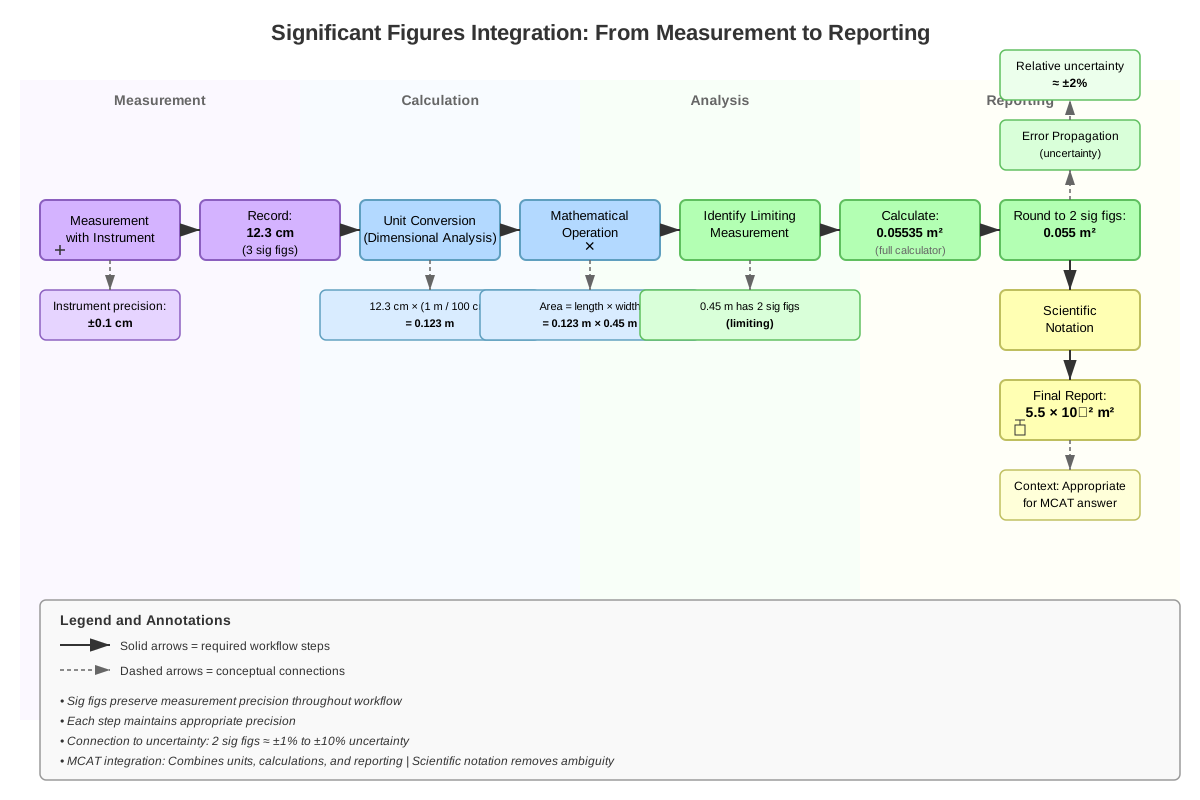
Overview
Significant figures represent one of the most fundamental yet frequently overlooked aspects of quantitative reasoning in Physics and the broader sciences tested on the MCAT. At its core, the concept of significant figures addresses the precision and reliability of measurements and calculations—a critical consideration when interpreting experimental data, solving physics problems, or evaluating research findings in biological and chemical contexts. Understanding significant figures ensures that numerical answers reflect the true precision of the measurements from which they derive, preventing the false impression of accuracy that exceeds what the data actually support.
For MCAT test-takers, mastery of significant figures MCAT conventions is essential not only for the Chemical and Physical Foundations of Biological Systems section but also for data interpretation across all science sections. The exam frequently presents experimental scenarios, graphs, and calculations where recognizing the appropriate number of significant figures distinguishes between answer choices. Moreover, the MCAT calculator (when provided) does not automatically round to appropriate significant figures, making this a skill that must be internalized and applied consciously during the exam.
Within the broader framework of Math and Units in Physics, significant figures connect directly to measurement uncertainty, dimensional analysis, and scientific notation—all tools that enable precise communication of quantitative information. This topic serves as a bridge between pure mathematical manipulation and the physical reality that measurements always carry inherent limitations. A solid grasp of significant figures enhances problem-solving efficiency, reduces calculation errors, and demonstrates the scientific literacy that medical schools seek in applicants.
Learning Objectives
- [ ] Define significant figures using accurate Physics terminology
- [ ] Explain why significant figures matters for the MCAT
- [ ] Apply significant figures to exam-style questions
- [ ] Identify common mistakes related to significant figures
- [ ] Connect significant figures to related Physics concepts
- [ ] Determine the number of significant figures in any given measurement or calculated value
- [ ] Execute mathematical operations (addition, subtraction, multiplication, division) while maintaining proper significant figure conventions
- [ ] Distinguish between exact numbers and measured values in the context of significant figures
Prerequisites
- Basic arithmetic operations: Understanding addition, subtraction, multiplication, and division is essential since significant figure rules differ based on the operation performed
- Scientific notation: Familiarity with expressing numbers in the form a × 10^n helps clarify which digits are significant and simplifies calculations with very large or small values
- Measurement concepts: Recognition that all measurements have inherent uncertainty and that instruments have limited precision provides the conceptual foundation for why significant figures matter
- Rounding rules: Knowledge of standard rounding conventions (round up when the next digit is ≥5, round down when <5) enables proper application of significant figure rules
Why This Topic Matters
In clinical and research settings, the precision of measurements directly impacts patient care and scientific conclusions. When a blood glucose reading reports 120 mg/dL versus 120.0 mg/dL, the additional significant figure communicates greater measurement precision, which might influence treatment decisions. Similarly, when researchers report drug concentrations or reaction rates, appropriate use of significant figures prevents overstatement of experimental precision and maintains scientific integrity.
On the MCAT, significant figures appear with medium frequency across multiple contexts. Approximately 5-10% of quantitative problems explicitly test significant figure knowledge, either by requiring proper rounding in calculations or by including answer choices that differ only in their number of significant figures. More importantly, nearly every calculation-based question implicitly involves significant figures, as the exam expects answers that reflect appropriate precision. Questions commonly appear in:
- Standalone physics calculations involving kinematics, forces, energy, or circuits
- Passage-based questions requiring interpretation of experimental data tables
- Chemistry problems involving stoichiometry, gas laws, or solution concentrations
- Data analysis questions across all science sections where students must evaluate the precision of reported measurements
The MCAT particularly favors questions where multiple answer choices are numerically close, making proper significant figure application the deciding factor. Additionally, passages frequently present data with varying levels of precision, testing whether students recognize that final answers cannot be more precise than the least precise measurement used in calculations.
Core Concepts
Definition and Identification of Significant Figures
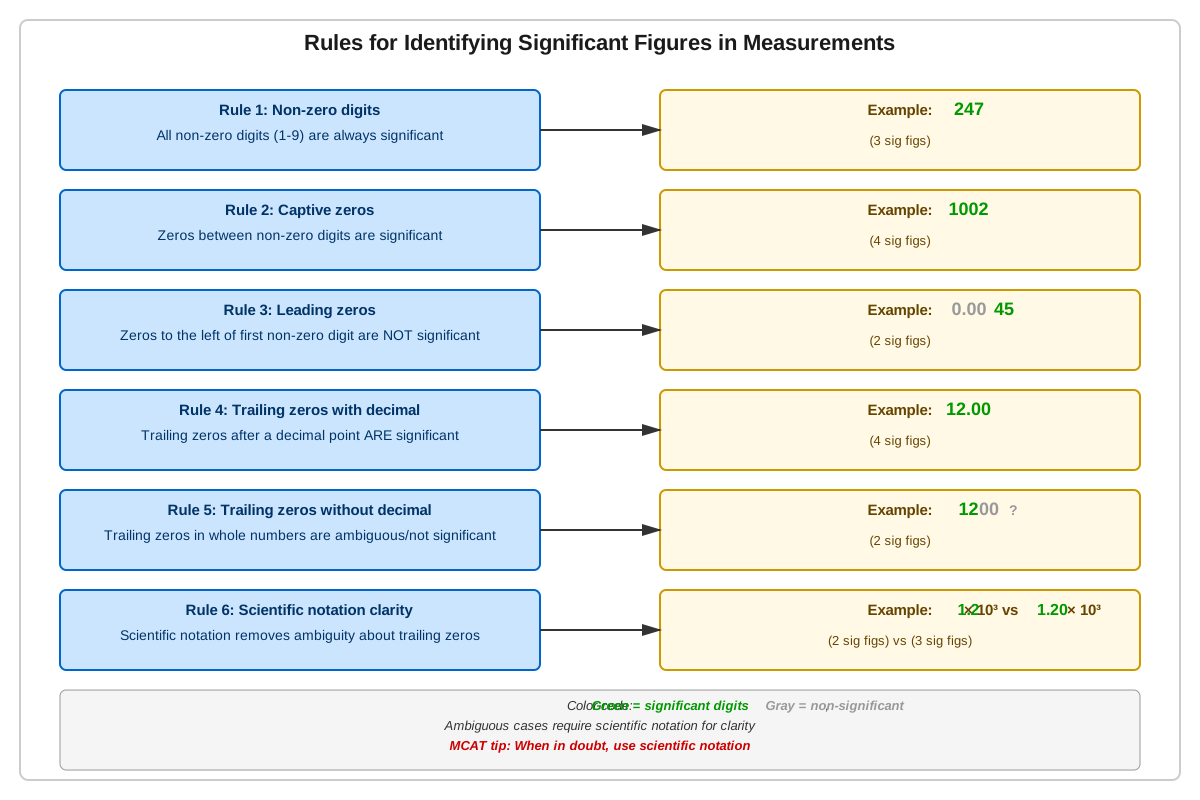
Significant figures (also called significant digits) are all the digits in a measured or calculated value that carry meaningful information about its precision. They include all certain digits plus one estimated or uncertain digit. Understanding which digits count as significant requires applying specific rules:
Rules for Counting Significant Figures:
- All non-zero digits are always significant: The number 1234 has four significant figures
- Zeros between non-zero digits are always significant: The number 1002 has four significant figures
- Leading zeros (zeros to the left of the first non-zero digit) are never significant: The number 0.0025 has two significant figures (the 2 and 5)
- Trailing zeros in a number containing a decimal point are significant: The number 2.500 has four significant figures
- Trailing zeros in a whole number without a decimal point are ambiguous: The number 1500 could have two, three, or four significant figures depending on measurement precision (scientific notation clarifies this: 1.5 × 10³ has two, 1.50 × 10³ has three, 1.500 × 10³ has four)
Exact Numbers vs. Measured Values
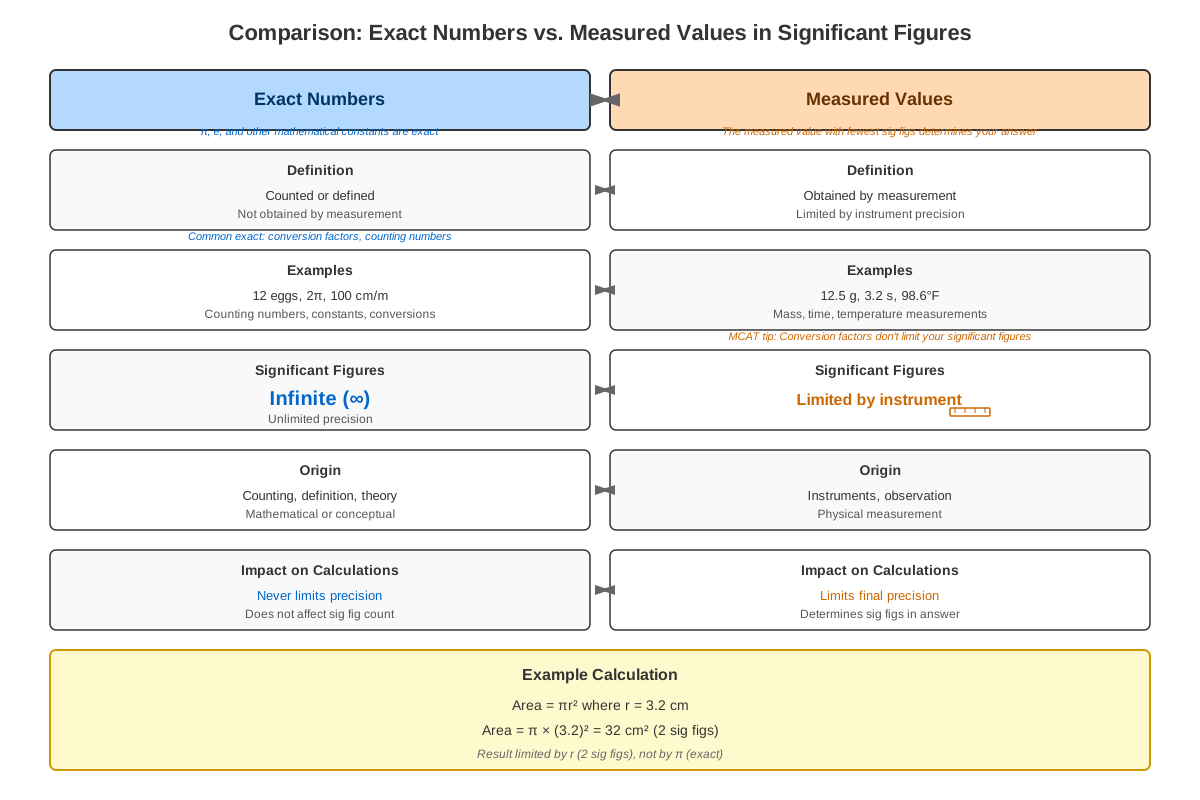
A critical distinction exists between exact numbers and measured values. Exact numbers have infinite significant figures and do not limit the precision of calculations. Examples include:
- Defined quantities: 60 minutes in 1 hour, 100 cm in 1 meter
- Counted items: 23 students in a classroom, 4 limbs on a human
- Mathematical constants: π (when used symbolically), e
- Conversion factors defined by convention: 2.54 cm per inch (exactly)
Measured values, conversely, always have limited precision determined by the measuring instrument. A ruler marked in millimeters cannot measure to 0.01 mm precision, so measurements from it are limited accordingly.
Significant Figures in Mathematical Operations
Different mathematical operations follow different rules for determining significant figures in the result:
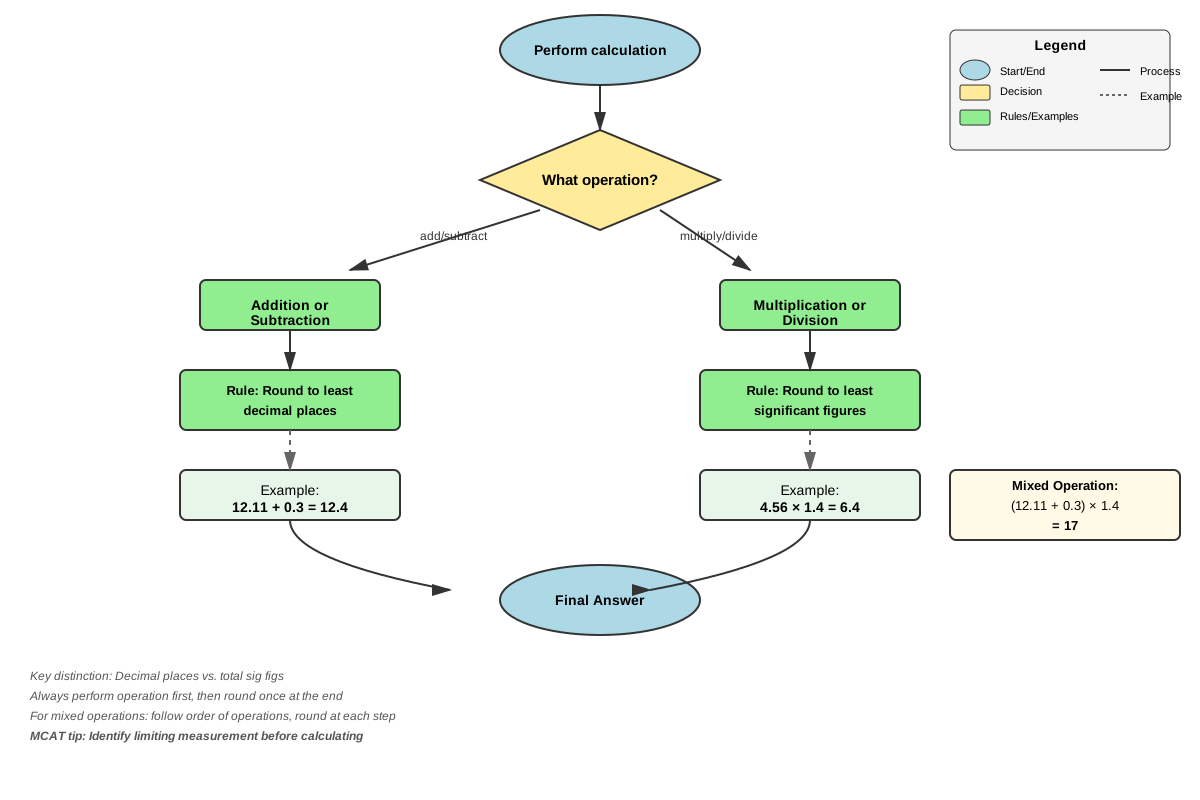
Multiplication and Division
Rule: The result should have the same number of significant figures as the measurement with the fewest significant figures used in the calculation.
Example:
4.56 m × 1.4 s = 6.384 m·s → 6.4 m·s (rounded to 2 sig figs)The measurement 1.4 s has only two significant figures, so the product must also have two significant figures, even though 4.56 m has three.
Addition and Subtraction
Rule: The result should have the same number of decimal places as the measurement with the fewest decimal places used in the calculation.
Example:
12.11 g + 18.0 g + 1.013 g = 31.123 g → 31.1 g (rounded to 1 decimal place)The measurement 18.0 g has only one decimal place, so the sum must also have one decimal place.
Rounding Rules
When rounding to the appropriate number of significant figures:
- If the digit following the last significant figure is less than 5, round down (keep the last significant figure unchanged)
- If the digit following the last significant figure is greater than 5, round up (increase the last significant figure by 1)
- If the digit following the last significant figure is exactly 5 followed by zeros or nothing, round to the nearest even number (banker's rounding)—though for MCAT purposes, rounding up is typically acceptable
Important: Round only the final answer, not intermediate steps. Rounding intermediate values introduces cumulative error that can significantly affect the final result.
Significant Figures in Scientific Notation
Scientific notation provides an unambiguous way to express significant figures. A number written as a × 10^n has significant figures equal to the number of digits in the coefficient a.
| Standard Notation | Scientific Notation | Significant Figures |
|---|---|---|
| 1500 (ambiguous) | 1.5 × 10³ | 2 |
| 1500 (ambiguous) | 1.50 × 10³ | 3 |
| 1500 (ambiguous) | 1.500 × 10³ | 4 |
| 0.00340 | 3.40 × 10⁻³ | 3 |
Logarithms and Significant Figures
For logarithmic functions (common in pH calculations, decibel scales, and thermodynamics):
Rule: The number of significant figures in the mantissa (the decimal part) of a logarithm equals the number of significant figures in the original number.
Example: If pH = -log[H⁺] and [H⁺] = 1.5 × 10⁻³ M (2 sig figs), then pH = 2.82 (2 decimal places in the mantissa, since the "2" before the decimal is determined by the exponent and doesn't count as a significant figure).
Significant Figures in Multi-Step Calculations
For complex calculations involving multiple operations:
- Carry extra digits through intermediate steps (typically 1-2 extra)
- Apply the appropriate rule at each operation
- Round only the final answer to the correct number of significant figures based on the limiting measurement
This approach minimizes rounding error accumulation while ensuring the final answer reflects appropriate precision.
Concept Relationships
The concept of significant figures sits at the intersection of several fundamental scientific principles. Measurement uncertainty provides the conceptual foundation: every measurement has inherent limitations based on instrument precision, and significant figures quantify this limitation numerically. This connects directly to error analysis and experimental design, where understanding measurement precision helps determine whether observed differences are meaningful or within measurement error.
Scientific notation serves as both a prerequisite and a complementary tool—it clarifies ambiguous significant figures in whole numbers and simplifies calculations with very large or small values common in physics and chemistry. When working with dimensional analysis, significant figures ensure that unit conversions maintain appropriate precision throughout the calculation chain.
The relationship flows as follows:
Measurement precision → determines → Number of significant figures → constrains → Calculation precision → influences → Answer choice selection → affects → MCAT score
Additionally, significant figures connect to graphing and data interpretation: when reading values from graphs, the precision of the extracted data depends on the scale divisions, which determines how many significant figures are justified. This links to experimental passages where students must evaluate whether conclusions are supported by the precision of the reported data.
In physics specifically, significant figures interact with unit conversions (ensuring conversion factors don't artificially increase precision), vector calculations (maintaining precision through component analysis), and equation manipulation (recognizing when constants are exact versus measured values).
Quick check — test yourself on Significant figures so far.
Try Flashcards →High-Yield Facts
⭐ All non-zero digits are always significant, regardless of their position in the number
⭐ For multiplication and division, the result has the same number of significant figures as the factor with the fewest significant figures
⭐ For addition and subtraction, the result has the same number of decimal places as the term with the fewest decimal places
⭐ Leading zeros are never significant; they only indicate the position of the decimal point
⭐ Trailing zeros after a decimal point are always significant and indicate measurement precision
- Exact numbers (counted items, defined conversions) have infinite significant figures and never limit calculation precision
- Scientific notation eliminates ambiguity about trailing zeros in whole numbers
- When rounding, carry extra digits through intermediate steps and round only the final answer
- The mantissa of a logarithm should have as many decimal places as the original number has significant figures
- On the MCAT, answer choices differing only in significant figures often indicate that proper rounding is being tested
Common Misconceptions
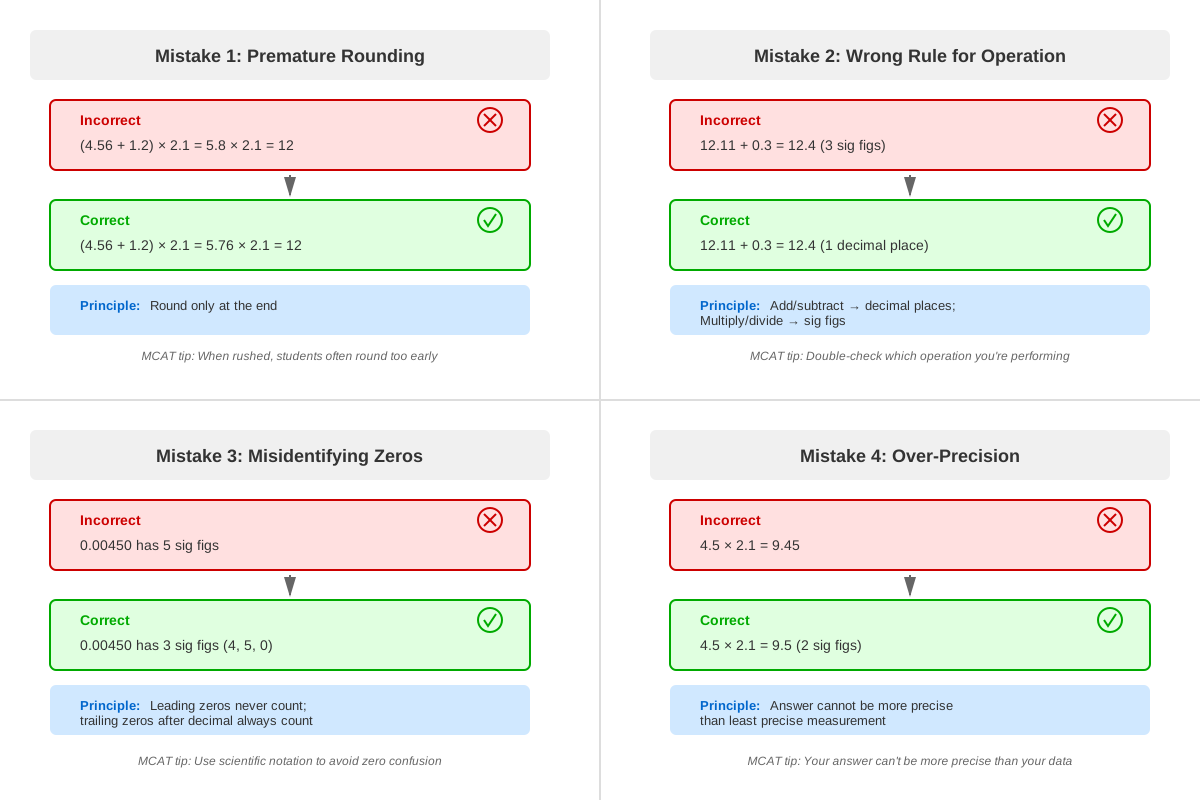
Misconception: All zeros are significant
Correction: Only zeros that fall between non-zero digits, or trailing zeros after a decimal point, are significant. Leading zeros (like the zeros in 0.0045) merely locate the decimal point and are not significant. The number 0.0045 has only two significant figures (4 and 5).
Misconception: When multiplying or dividing, count decimal places like in addition/subtraction
Correction: Multiplication and division follow a different rule than addition and subtraction. For multiplication/division, count total significant figures (not decimal places). For example, 2.0 × 3.00 = 6.0 (2 sig figs, not 1 decimal place).
Misconception: Rounding should be done at every step of a multi-step calculation
Correction: Rounding intermediate values introduces cumulative error. Instead, carry 1-2 extra digits through intermediate steps and round only the final answer to the appropriate number of significant figures based on the original measurements.
Misconception: The number 100 always has three significant figures
Correction: Without additional context, 100 is ambiguous—it could have one, two, or three significant figures depending on measurement precision. Writing 1.00 × 10² (three sig figs) or 1.0 × 10² (two sig figs) eliminates ambiguity. On the MCAT, context usually clarifies the intended precision.
Misconception: More significant figures always means a better or more accurate answer
Correction: Reporting more significant figures than justified by the measurements creates a false impression of precision. An answer of 3.14159 m calculated from measurements precise to only 0.1 m is misleading; the appropriate answer is 3.1 m. Accuracy refers to closeness to the true value, while precision (reflected by significant figures) refers to reproducibility and measurement resolution.
Misconception: Conversion factors always limit significant figures
Correction: Defined conversion factors (like 100 cm = 1 m or 1000 g = 1 kg) are exact and have infinite significant figures. They never limit calculation precision. Only measured conversion factors or those with limited precision affect significant figures.
Worked Examples
Example 1: Multi-Step Calculation with Mixed Operations
Problem: A student measures the dimensions of a rectangular metal plate as length = 12.45 cm, width = 8.1 cm, and thickness = 0.25 cm. The density of the metal is given as 7.87 g/cm³. Calculate the mass of the plate.
Solution:
Step 1: Calculate the volume using V = length × width × thickness
V = 12.45 cm × 8.1 cm × 0.25 cmIdentify significant figures in each measurement:
- 12.45 cm: 4 significant figures
- 8.1 cm: 2 significant figures (limiting factor)
- 0.25 cm: 2 significant figures
For multiplication, the result should have 2 significant figures (the fewest among the factors).
V = 100.8375 cm³ (calculator result)
V = 1.0 × 10² cm³ (rounded to 2 sig figs, using scientific notation for clarity)
Step 2: Calculate mass using m = ρV
m = 7.87 g/cm³ × 100.8375 cm³ (using unrounded intermediate value)Significant figures:
- 7.87 g/cm³: 3 significant figures
- Volume: limited to 2 significant figures from Step 1
The result should have 2 significant figures.
m = 793.59 g (calculator result)
m = 7.9 × 10² g or 790 g (rounded to 2 sig figs)
Key Takeaway: Even though density has 3 significant figures, the limiting factor is the volume calculation, which was constrained by the 2-significant-figure measurements of width and thickness. This demonstrates how precision limitations propagate through multi-step calculations.
Example 2: Addition with Different Decimal Precision
Problem: A chemistry experiment requires combining three solutions. The masses measured are 15.43 g, 2.1 g, and 0.078 g. What is the total mass?
Solution:
Step 1: Identify the decimal places in each measurement:
- 15.43 g: 2 decimal places
- 2.1 g: 1 decimal place (limiting factor)
- 0.078 g: 3 decimal places
Step 2: Add the values:
15.43 g
 2.1  g
 0.078 g
-------
17.608 g (calculator result)
Step 3: Round to the limiting decimal place (1 decimal place):
Total mass = 17.6 gAnalysis: Notice that 2.1 g has only 1 decimal place, making it the limiting measurement. Even though 0.078 g has 3 decimal places, it doesn't increase the precision of the sum. The final answer must reflect the precision of the least precise measurement in terms of decimal places.
MCAT Application: On the exam, answer choices might include:
- A) 17.608 g (incorrect—too many decimal places)
- B) 17.61 g (incorrect—still too precise)
- C) 17.6 g (correct)
- D) 18 g (incorrect—rounded too aggressively)
Recognizing that option C properly applies significant figure rules for addition would lead to the correct answer.
Exam Strategy
When approaching significant figures MCAT questions, employ a systematic strategy to maximize accuracy and efficiency:
Step 1: Identify the operation type (multiplication/division vs. addition/subtraction) as this determines which rule applies. Many students lose points by applying the wrong rule.
Step 2: Locate the limiting measurement before calculating. For multiplication/division, find the factor with fewest significant figures. For addition/subtraction, find the term with fewest decimal places. This preview helps you anticipate the final answer's precision.
Step 3: Perform calculations without premature rounding. Use all digits your calculator provides through intermediate steps, then round only the final answer. This prevents cumulative rounding error.
Trigger words and phrases to watch for:
- "Measured to the nearest..." indicates precision level
- "Approximately" or "about" suggests limited precision
- "Exactly" indicates infinite significant figures (exact number)
- Data tables with varying decimal places test whether you recognize the limiting measurement
Process-of-elimination tips:
- Eliminate answers with obviously wrong magnitude (wrong power of 10)
- Eliminate answers with too many significant figures (more than any measurement used)
- Eliminate answers with too few significant figures (unless rounding is extreme)
- When two answers differ only in the last significant figure, double-check your rounding
Time allocation: Don't spend more than 10-15 seconds on significant figure determination. If a calculation is complex, estimate the answer first to narrow choices, then calculate precisely only if needed to distinguish between remaining options.
Exam Tip: The MCAT calculator doesn't automatically round to significant figures. You must mentally track precision throughout calculations. Practice this skill until it becomes automatic.
Common question formats:
- Direct calculation requiring proper rounding
- Data interpretation where you must recognize measurement precision
- Answer choices differing only in significant figures
- Experimental design questions asking about measurement precision
Memory Techniques
Mnemonic for counting significant figures: "ATLANTIC"
- All non-zero digits are significant
- Trailing zeros after decimal are significant
- Leading zeros are never significant
- Any zeros between non-zero digits are significant
- Numbers that are exact have infinite sig figs
- Trailing zeros without decimal are ambiguous
- Intermediate calculations keep extra digits
- Count carefully before calculating
Visualization for multiplication/division vs. addition/subtraction:
Picture multiplication/division as horizontal operations (factors side-by-side) → count total significant figures across
Picture addition/subtraction as vertical operations (numbers stacked) → align decimal places vertically
Acronym for operation rules: "MDS-ADD"
- Multiplication: count sig figs
- Division: count sig figs
- Subtraction: count decimal places
- ADDition: count decimal places
Memory hook for exact numbers: "DICE" numbers have infinite sig figs
- Defined quantities (60 min = 1 hr)
- Integers from counting (23 students)
- Conversion factors (2.54 cm = 1 inch exactly)
- Exact mathematical constants (when symbolic)
Summary
Significant figures represent the precision of measurements and calculations, ensuring that numerical answers don't imply greater accuracy than the data support. The fundamental principle is that results cannot be more precise than the least precise measurement used to obtain them. For multiplication and division, the result contains the same number of significant figures as the factor with the fewest significant figures. For addition and subtraction, the result has the same number of decimal places as the term with the fewest decimal places. All non-zero digits are significant, zeros between non-zero digits are significant, trailing zeros after a decimal point are significant, but leading zeros are never significant. Exact numbers from definitions or counting have infinite significant figures and don't limit precision. On the MCAT, proper application of significant figures often distinguishes between answer choices, particularly in calculation-heavy problems and data interpretation questions. Mastery requires recognizing which rule applies to each operation, identifying the limiting measurement before calculating, and rounding only the final answer to maintain precision through intermediate steps.
Key Takeaways
- Significant figures quantify measurement precision and prevent overstating the accuracy of calculated results
- Multiplication/division: match the fewest significant figures among all factors
- Addition/subtraction: match the fewest decimal places among all terms
- Leading zeros never count as significant; trailing zeros after a decimal point always count
- Exact numbers (defined conversions, counted items) have infinite significant figures and never limit calculations
- Round only final answers, not intermediate steps, to minimize cumulative error
- MCAT answer choices often differ only in significant figures, making proper rounding essential for correct responses
Related Topics
Scientific Notation and Order of Magnitude: Mastering significant figures naturally leads to deeper work with scientific notation, which provides the clearest way to express significant figures unambiguously and simplifies calculations with extreme values common in physics and chemistry.
Measurement Uncertainty and Error Analysis: Understanding significant figures provides the foundation for more advanced treatment of experimental error, including random vs. systematic error, standard deviation, and confidence intervals—concepts that appear in research-focused MCAT passages.
Dimensional Analysis: Proper tracking of significant figures through unit conversions ensures that dimensional analysis maintains appropriate precision, a critical skill for multi-step physics and chemistry calculations.
Graphing and Data Interpretation: Reading values from graphs and determining the precision of extracted data requires applying significant figure principles to visual information, a common task in passage-based questions.
Logarithmic Scales: pH, pKa, decibels, and other logarithmic quantities require special significant figure treatment, building on the foundational rules covered here.
Practice CTA
Now that you've mastered the core concepts of significant figures, it's time to cement your understanding through active practice. Work through the practice questions to apply these rules in MCAT-style contexts, and use the flashcards to reinforce quick recognition of significant figure patterns. Remember, the difference between a good MCAT score and a great one often comes down to mastering these fundamental skills that others overlook. Every calculation you perform correctly, with proper attention to significant figures, builds the precision and confidence you'll need on test day. You've got this!
Sign up free to keep reading
Create a free AnvayaPrep account to finish this MCAT guide on Significant figures — plus flashcards and practice questions.