Overview
Graph interpretation is a fundamental skill that bridges mathematical reasoning and scientific analysis across all sections of the MCAT. In the context of Physics, graph interpretation involves extracting quantitative and qualitative information from visual representations of relationships between variables—whether analyzing position-time graphs in kinematics, pressure-volume curves in thermodynamics, or force-displacement diagrams in mechanics. This skill extends beyond simple data reading; it requires understanding slopes, areas under curves, intercepts, and the physical meaning of mathematical relationships displayed graphically.
For the MCAT, graph interpretation represents a high-yield skill that appears in approximately 15-20% of Physics questions and frequently in passages across Biological Sciences and Chemical Sciences sections. The exam writers favor graphs because they efficiently test multiple competencies simultaneously: mathematical reasoning, conceptual understanding, data analysis, and the ability to connect abstract representations to physical phenomena. Students who master graph interpretation Physics concepts gain a significant advantage, as these questions often separate high scorers from average performers.
Within the broader framework of Math and Units, graph interpretation serves as the visual language through which physical laws and relationships are communicated. Understanding how to decode graphs connects directly to calculus concepts (derivatives as slopes, integrals as areas), dimensional analysis, and the mathematical modeling of physical systems. This topic forms the foundation for analyzing experimental data, understanding kinematic equations, thermodynamic processes, electrical circuits, and virtually every quantitative relationship tested on the MCAT.
Learning Objectives
- [ ] Define graph interpretation using accurate Physics terminology
- [ ] Explain why graph interpretation matters for the MCAT
- [ ] Apply graph interpretation to exam-style questions
- [ ] Identify common mistakes related to graph interpretation
- [ ] Connect graph interpretation to related Physics concepts
- [ ] Calculate physical quantities from slopes and areas under curves with appropriate units
- [ ] Distinguish between linear, quadratic, inverse, and exponential relationships from graphical representations
- [ ] Predict how changes in one variable affect another based on graphical trends
- [ ] Convert between different graphical representations of the same physical situation
Prerequisites
- Algebra fundamentals: Understanding variables, equations, and solving for unknowns is essential for manipulating relationships shown in graphs
- Basic calculus concepts: Recognizing that slopes represent rates of change and areas represent accumulated quantities underlies most graph interpretation
- Unit analysis: Determining the units of slopes and areas requires facility with dimensional analysis
- Coordinate systems: Familiarity with Cartesian coordinates (x-y axes) provides the framework for all graphical representations
- Scientific notation: Graphs often display data across multiple orders of magnitude, requiring comfort with powers of ten
Why This Topic Matters
Graph interpretation MCAT questions appear with remarkable frequency because they efficiently assess multiple competencies. In clinical practice, physicians regularly interpret electrocardiograms, dose-response curves, population health statistics, and diagnostic imaging data—all requiring the same analytical skills tested through graph interpretation. Research articles, which medical students must critically evaluate, present findings primarily through graphical representations of experimental data.
On the MCAT specifically, graph interpretation appears in 15-20% of Physics questions, 10-15% of Chemistry questions, and 8-12% of Biological Sciences questions. The exam presents graphs in several formats: standalone discrete questions asking about a single graph, passage-based questions where graphs supplement experimental descriptions, and questions requiring students to select the correct graph from multiple options. High-difficulty passages often combine multiple graphs or ask students to predict how one graph would change based on modifications to experimental conditions.
The MCAT particularly favors questions that require students to: (1) calculate slopes or areas and recognize their physical meaning, (2) identify the mathematical relationship between variables (linear, quadratic, inverse, exponential), (3) extrapolate beyond the data shown, (4) recognize when graphs represent the same information in different forms (e.g., position vs. time and velocity vs. time), and (5) identify experimental errors or anomalies in graphical data. Students who can rapidly extract information from graphs save valuable time and often find "shortcut" solutions that bypass lengthy calculations.
Core Concepts
Fundamental Components of Graphs
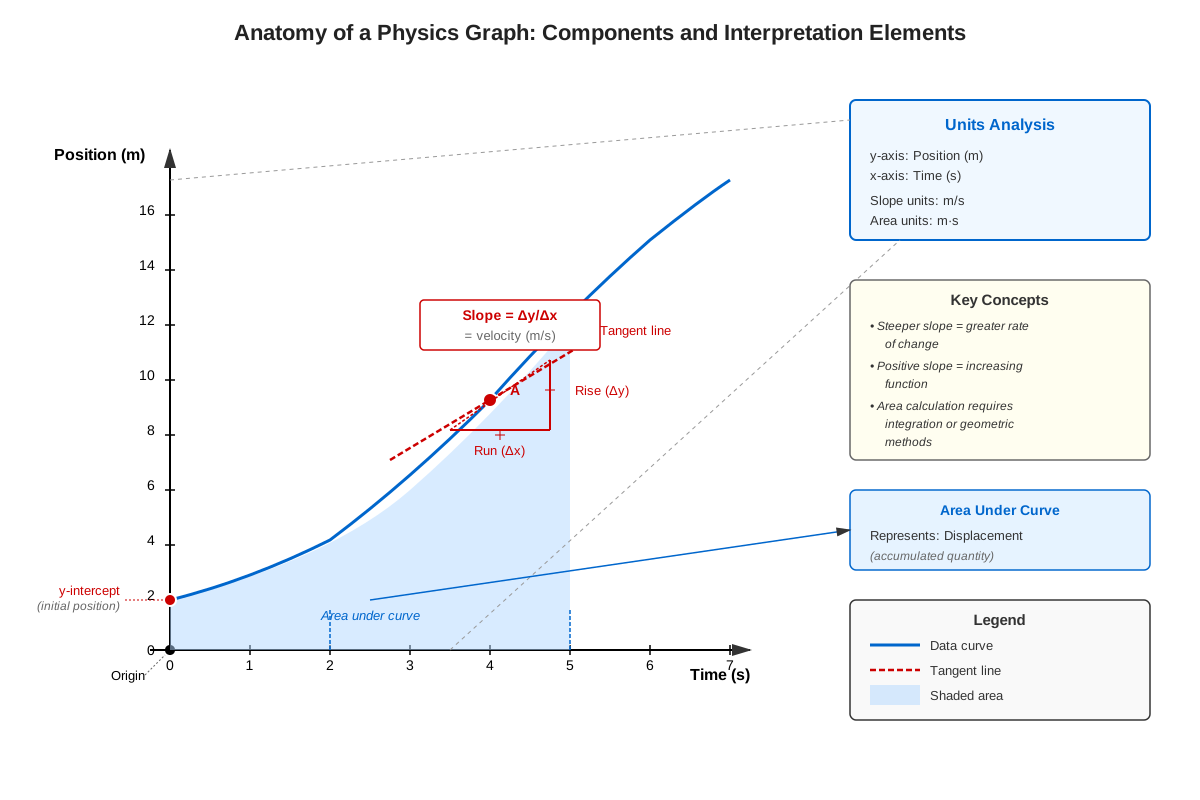
Every graph consists of essential elements that must be identified before interpretation begins. The independent variable (typically plotted on the x-axis) represents the quantity being systematically varied or controlled, while the dependent variable (y-axis) shows the measured response. Axis labels must include both the quantity name and units—a graph showing "velocity" without specifying m/s or km/h cannot be properly interpreted. The scale of each axis determines the numerical relationship between physical distance on the graph and actual values; non-linear scales (logarithmic) appear occasionally on the MCAT and dramatically change interpretation.
The origin (0,0 point) may or may not appear on the displayed graph, and its presence or absence affects interpretation of intercepts. Data points may be shown as discrete markers (scatter plots) or as continuous curves, with the distinction indicating whether the relationship is measured at specific intervals or represents a continuous function. Error bars, when present, indicate measurement uncertainty and are particularly important in experimental passages.
Slope Analysis
The slope of a line or curve represents the rate of change of the dependent variable with respect to the independent variable. For a straight line, slope is calculated as:
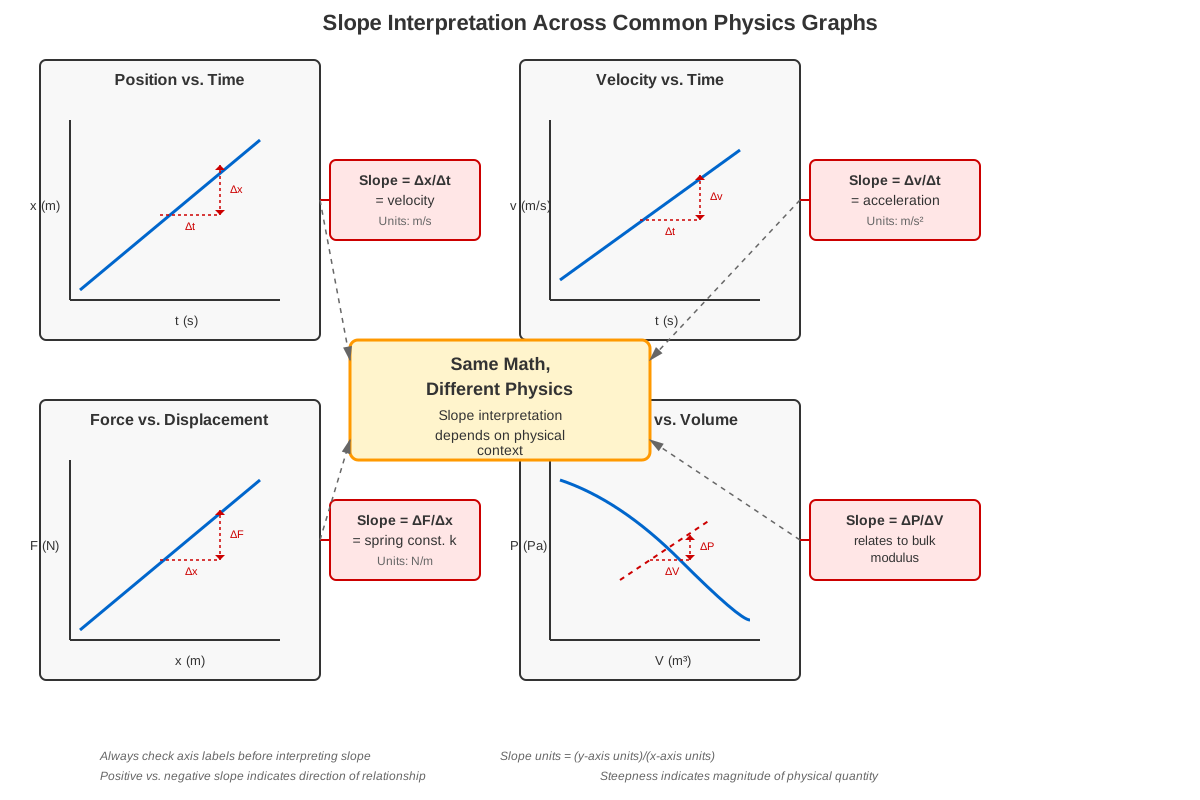
slope = Δy/Δx = (y₂ - y₁)/(x₂ - x₁)The units of the slope are critically important and equal the units of the y-axis divided by the units of the x-axis. For example, on a position-time graph (position in meters, time in seconds), the slope has units of m/s and represents velocity. On a velocity-time graph, the slope has units of m/s² and represents acceleration.
Positive slopes indicate that as the independent variable increases, the dependent variable increases. Negative slopes show an inverse relationship where increasing the independent variable decreases the dependent variable. A zero slope (horizontal line) indicates the dependent variable remains constant regardless of changes in the independent variable. An undefined slope (vertical line) suggests an instantaneous change or discontinuity.
For curved lines, the slope varies continuously. The instantaneous slope at any point equals the slope of the tangent line at that point. Increasing slopes (concave up curves) indicate acceleration in the positive direction, while decreasing slopes (concave down curves) indicate acceleration in the negative direction or deceleration.
Area Under Curves
The area under a curve represents the accumulated product of the y-axis quantity and the x-axis quantity over the specified interval. This concept derives from integral calculus but can be understood geometrically. For simple shapes (rectangles, triangles, trapezoids), standard geometric formulas apply. For irregular curves, the area can be approximated by dividing the region into smaller geometric shapes.
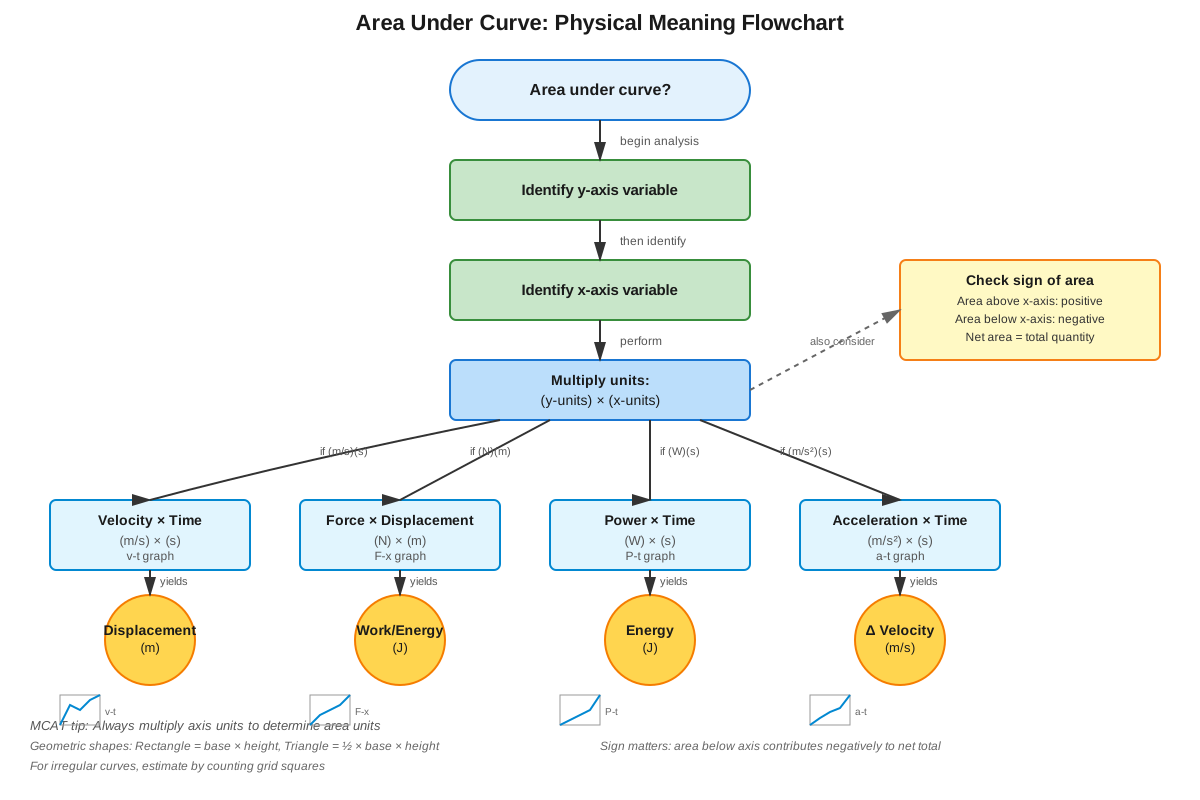
The units of the area equal the product of the y-axis units and x-axis units. On a velocity-time graph (velocity in m/s, time in s), the area has units of (m/s)(s) = m, representing displacement. On a force-displacement graph (force in N, displacement in m), the area has units of N·m = J (joules), representing work done.
Area above the x-axis contributes positively to the total, while area below the x-axis contributes negatively. For example, on a velocity-time graph, area above represents displacement in the positive direction, while area below represents displacement in the negative direction. The net area (algebraic sum) gives the total accumulated quantity.
Intercepts and Their Physical Meaning
The y-intercept represents the value of the dependent variable when the independent variable equals zero. This often has important physical significance: on a position-time graph, the y-intercept represents initial position; on a velocity-time graph, it represents initial velocity. The y-intercept of a linear relationship in the form y = mx + b is the constant b.
The x-intercept represents the value of the independent variable when the dependent variable equals zero. This might represent the time when an object returns to its starting position, the temperature at which a substance undergoes a phase transition, or the concentration at which a reaction rate becomes zero.
Some graphs may have multiple intercepts of either type, indicating the dependent variable crosses zero multiple times (oscillatory motion) or the independent variable can have multiple values that produce zero output (polynomial relationships).
Common Mathematical Relationships
| Relationship Type | Equation Form | Graph Shape | Slope Behavior | MCAT Examples |
|---|---|---|---|---|
| Linear | y = mx + b | Straight line | Constant | Uniform motion, Ohm's law |
| Quadratic | y = ax² + bx + c | Parabola | Linearly changing | Projectile motion, kinetic energy vs. velocity |
| Inverse | y = k/x | Hyperbola | Increasingly negative | Boyle's law (P vs. V), gravitational force vs. distance² |
| Exponential growth | y = ae^(bx) | J-curve | Exponentially increasing | Radioactive decay (reverse), population growth |
| Exponential decay | y = ae^(-bx) | Decay curve | Exponentially decreasing | Capacitor discharge, radioactive decay |
| Square root | y = a√x | Half-parabola | Decreasing positive | Period vs. length (pendulum) |
| Logarithmic | y = a ln(x) | Log curve | Decreasing positive | pH relationships, sound intensity |
Linearization Techniques
Non-linear relationships can often be linearized by plotting transformed variables. This technique is valuable because linear relationships are easier to analyze and allow determination of constants through slope and intercept. For an inverse relationship (y = k/x), plotting y versus 1/x produces a straight line with slope k. For an exponential relationship (y = ae^(bx)), plotting ln(y) versus x produces a straight line with slope b and y-intercept ln(a).
For a power law relationship (y = ax^n), plotting log(y) versus log(x) produces a straight line with slope n and y-intercept log(a). The MCAT occasionally presents linearized data and asks students to determine the original relationship or calculate constants from the transformed graph.
Comparing Multiple Graphs
MCAT passages frequently present multiple graphs showing different aspects of the same phenomenon or comparing different experimental conditions. Students must identify which graphs represent the same data in different forms (position vs. time and velocity vs. time for the same motion), which show different trials or conditions, and how changes in one graph predict changes in another.
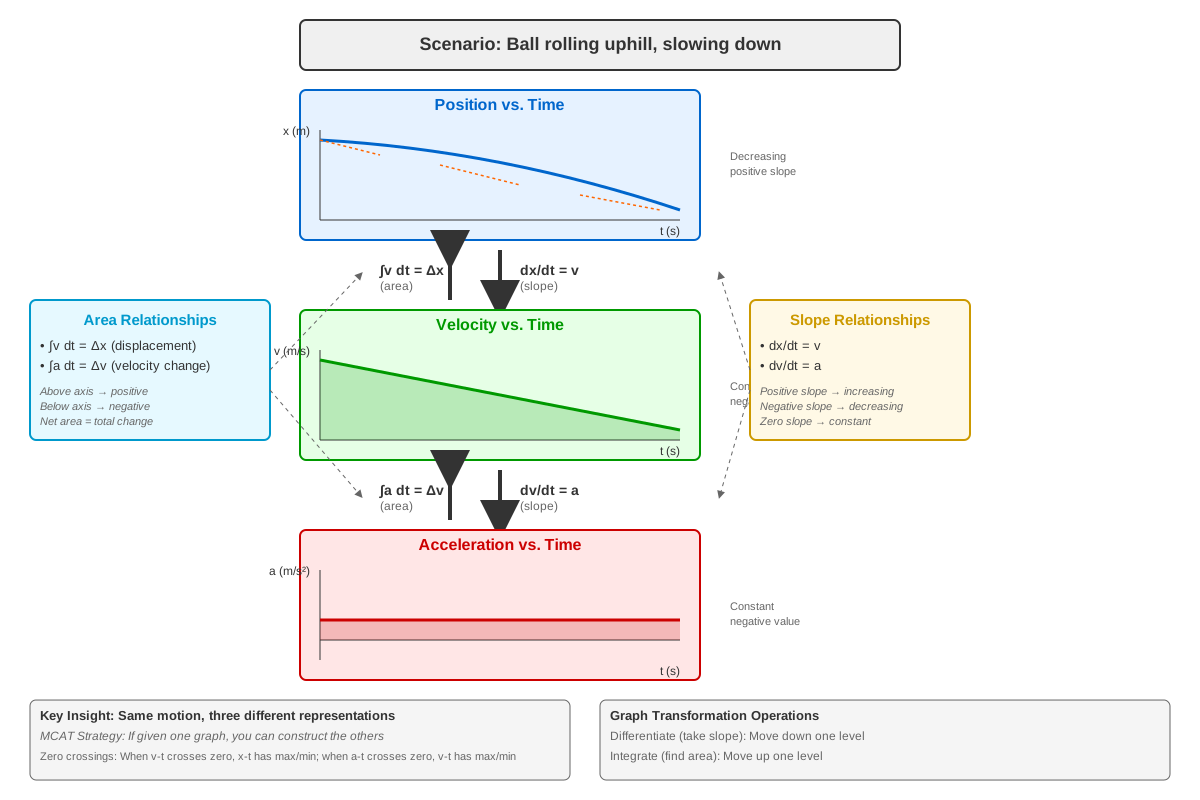
Derivative relationships connect related graphs: the velocity-time graph is the derivative of the position-time graph (velocity is the slope of position vs. time), and the acceleration-time graph is the derivative of the velocity-time graph. Conversely, integral relationships work in reverse: the area under an acceleration-time graph gives the change in velocity, and the area under a velocity-time graph gives displacement.
Concept Relationships
Graph interpretation skills form a hierarchical structure where basic concepts enable more sophisticated analysis. Axis identification and unit analysis → slope calculation → recognition of physical meaning of slope represents the foundational pathway. Similarly, geometric shape recognition → area calculation → understanding physical meaning of area builds the second major skill branch.
These two branches converge in kinematic analysis, where position-time graphs (slopes give velocity, curvature indicates acceleration) connect to velocity-time graphs (slopes give acceleration, areas give displacement) and acceleration-time graphs (areas give velocity change). This represents the most common application of graph interpretation in MCAT Physics.
Graph interpretation connects backward to prerequisite topics: algebra provides the tools for calculating slopes and solving for unknowns, calculus concepts explain why slopes represent derivatives and areas represent integrals, and unit analysis ensures dimensional consistency in all calculations. Forward connections extend to virtually every Physics topic: kinematics (motion graphs), dynamics (force diagrams), energy (work as area under force-displacement curves), thermodynamics (PV diagrams), electricity (IV curves, RC circuit decay), and waves (amplitude-time representations).
The relationship map: Basic graph literacy → Quantitative analysis (slopes, areas) → Physical interpretation → Prediction and extrapolation → Integration with experimental design represents the progression from novice to expert graph interpretation.
High-Yield Facts
⭐ The slope of a position-time graph equals velocity; the slope of a velocity-time graph equals acceleration
⭐ The area under a velocity-time graph equals displacement; the area under an acceleration-time graph equals change in velocity
⭐ The area under a force-displacement graph equals work done by or against the force
⭐ On a PV diagram (pressure-volume), the area enclosed by a cyclic process equals the net work done per cycle
⭐ The slope of a linear best-fit line through the origin indicates a directly proportional relationship (y ∝ x)
- A horizontal line on a velocity-time graph indicates constant velocity (zero acceleration)
- A horizontal line on a position-time graph indicates the object is stationary
- The steeper the slope on a position-time graph, the greater the speed
- Curves that are concave up indicate increasing slope; curves that are concave down indicate decreasing slope
- The y-intercept of a velocity-time graph represents initial velocity at t = 0
- Negative area under a curve (below the x-axis) must be subtracted when calculating net accumulated quantity
- An inverse relationship (y = k/x) appears as a hyperbola that approaches but never touches the axes
- Exponential decay curves approach but never reach zero (asymptotic behavior)
- The slope of ln(y) vs. x for exponential data y = ae^(bx) equals the exponent constant b
- Plotting 1/y versus 1/x linearizes the relationship y = (ax)/(b + x), common in enzyme kinetics
Quick check — test yourself on Graph interpretation so far.
Try Flashcards →Common Misconceptions
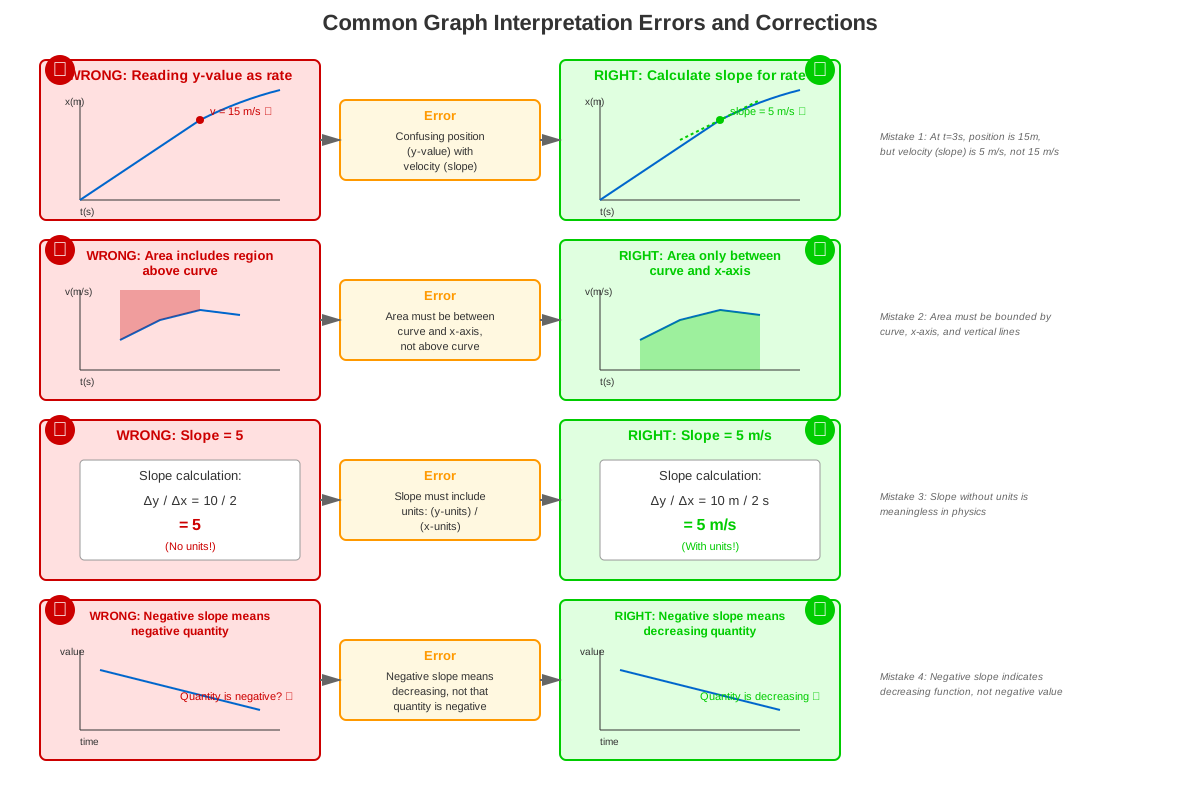
Misconception: The steepness of a line on any graph always indicates "faster" or "more intense" → Correction: Steepness (slope magnitude) must be interpreted in context of what the axes represent. A steep position-time graph indicates high velocity, but a steep velocity-time graph indicates high acceleration, not high velocity. Always identify what physical quantity the slope represents before interpreting its magnitude.
Misconception: The area under any curve represents the total amount of the y-axis quantity → Correction: Area represents the product of y-axis and x-axis quantities, not simply the y-axis quantity alone. The area under a velocity-time curve is displacement (velocity × time), not total velocity. Always multiply the units to determine what the area represents physically.
Misconception: A curve that looks exponential is always exponential growth or decay → Correction: Many functions produce similar-looking curves. A quadratic function (y = x²) can appear similar to exponential growth over limited ranges. Inverse relationships (y = 1/x) can resemble exponential decay. Check whether equal intervals on the x-axis produce equal ratios (exponential) or equal differences (polynomial) in y-values.
Misconception: The highest point on a graph always represents the maximum value of the dependent variable → Correction: This is only true if the entire relevant domain is shown. Graphs may display only a portion of the full relationship, and the maximum might occur outside the displayed range. Additionally, local maxima may exist that are not the global maximum.
Misconception: Negative slope always means the dependent variable is negative → Correction: Negative slope means the dependent variable is decreasing as the independent variable increases, but the dependent variable itself may still be positive. An object moving in the positive direction but slowing down has positive velocity (above the x-axis) but negative acceleration (negative slope on the v-t graph).
Misconception: The point where two lines intersect on a graph means the two quantities are equal → Correction: The intersection means the y-values are equal at that particular x-value, but this must be interpreted in context. On a graph showing position vs. time for two objects, intersection means they are at the same position at that time, not that they have the same velocity.
Misconception: A straight line always indicates a simple, direct relationship → Correction: A straight line on a transformed plot (log-log, semi-log, reciprocal axes) may represent a complex non-linear relationship in the original variables. Always check whether axes show the actual variables or transformed versions.
Worked Examples
Example 1: Kinematic Graph Analysis
Problem: A car's motion is represented by the velocity-time graph shown below (described): The graph shows velocity (m/s) on the y-axis and time (s) on the x-axis. From t = 0 to t = 4 s, the velocity increases linearly from 0 to 20 m/s. From t = 4 s to t = 8 s, the velocity remains constant at 20 m/s. From t = 8 s to t = 12 s, the velocity decreases linearly from 20 m/s to 0 m/s. Calculate: (a) the acceleration during each phase, (b) the total displacement, and (c) describe what the position-time graph would look like.
Solution:
(a) Acceleration during each phase
Acceleration equals the slope of the velocity-time graph.
Phase 1 (0-4 s):
a₁ = Δv/Δt = (20 m/s - 0 m/s)/(4 s - 0 s) = 5 m/s²Phase 2 (4-8 s):
The velocity is constant (horizontal line), so slope = 0
a₂ = 0 m/s²Phase 3 (8-12 s):
a₃ = Δv/Δt = (0 m/s - 20 m/s)/(12 s - 8 s) = -5 m/s²The negative sign indicates deceleration (acceleration opposite to the direction of motion).
(b) Total displacement
Displacement equals the area under the velocity-time curve.
Phase 1: Triangle with base = 4 s, height = 20 m/s
Area₁ = (1/2)(4 s)(20 m/s) = 40 mPhase 2: Rectangle with base = 4 s, height = 20 m/s
Area₂ = (4 s)(20 m/s) = 80 mPhase 3: Triangle with base = 4 s, height = 20 m/s
Area₃ = (1/2)(4 s)(20 m/s) = 40 mTotal displacement = 40 m + 80 m + 40 m = 160 m
(c) Position-time graph description
The position-time graph would show:
- Phase 1: Upward-curving parabola (concave up) starting at the origin, indicating increasing velocity (positive acceleration). The slope starts at zero and increases to 20 m/s at t = 4 s.
- Phase 2: Straight line with constant positive slope of 20 m/s, indicating constant velocity. The position increases linearly from 40 m to 120 m.
- Phase 3: Downward-curving parabola (concave down) indicating decreasing velocity (negative acceleration). The slope decreases from 20 m/s to 0 m/s. The curve ends at position 160 m at t = 12 s with zero slope (object at rest).
Connection to learning objectives: This problem demonstrates applying graph interpretation to calculate physical quantities (slopes as acceleration, areas as displacement) and connecting different graphical representations of the same motion.
Example 2: Thermodynamic PV Diagram
Problem: A gas undergoes a cyclic process shown on a PV diagram (described): Starting at point A (V = 2 L, P = 3 atm), the gas expands isobarically (constant pressure) to point B (V = 6 L, P = 3 atm). From B, the gas undergoes isochoric cooling (constant volume) to point C (V = 6 L, P = 1 atm). From C, the gas returns to A along a straight line. Calculate: (a) the work done during each process, (b) the net work done per cycle, and (c) identify during which process(es) work is done by the gas versus on the gas.
Solution:
(a) Work done during each process
Work in a PV diagram equals the area under the curve (for expansion/compression along the x-axis).
Process A→B (isobaric expansion):
Work = P × ΔV (area of rectangle)
Converting units: 1 atm = 101,325 Pa; 1 L = 0.001 m³
W_{AB} = (3 atm)(101,325 Pa/atm)(6 L - 2 L)(0.001 m³/L)
W_{AB} = (303,975 Pa)(0.004 m³) = 1,216 J
Alternatively, using L·atm: W = (3 atm)(4 L) = 12 L·atm × 101.325 J/(L·atm) ≈ 1,216 J
Process B→C (isochoric cooling):
No volume change (ΔV = 0), so no work is done.
W_{BC} = 0 JProcess C→A (linear compression):
This is a trapezoid under the line from C to A. Alternatively, calculate as the area of the triangle plus rectangle, or use the average pressure method.
The line from C (6 L, 1 atm) to A (2 L, 3 atm) has:
W_{CA} = (1/2)(P_C + P_A)(V_A - V_C)
W_{CA} = (1/2)(1 atm + 3 atm)(2 L - 6 L)
W_{CA} = (2 atm)(-4 L) = -8 L·atm ≈ -810 J
The negative sign indicates work done on the gas (compression).
(b) Net work done per cycle
The net work equals the area enclosed by the cycle (going counterclockwise means net negative work; clockwise means net positive work).
This cycle goes clockwise (expansion at high pressure, compression at low pressure), so net work is positive.
W_{net} = W_{AB} + W_{BC} + W_{CA}
W_{net} = 1,216 J + 0 J + (-810 J) = 406 J
Alternatively, calculate the enclosed area directly: The cycle encloses a triangle with vertices at A (2, 3), B (6, 3), and C (6, 1).
Area = (1/2) × base × height = (1/2)(4 L)(2 atm) = 4 L·atm ≈ 405 J(c) Work by vs. on the gas
- A→B: Work done by the gas (expansion, W > 0): 1,216 J
- B→C: No work (isochoric process)
- C→A: Work done on the gas (compression, W < 0): 810 J
- Net: Work done by the gas per cycle: 406 J
Connection to learning objectives: This demonstrates interpreting areas on specialized graphs (PV diagrams), understanding sign conventions, and connecting graphical analysis to physical processes (expansion vs. compression).
Exam Strategy
When approaching graph interpretation MCAT questions, follow a systematic process to maximize accuracy and efficiency:
Step 1: Identify and label (5-10 seconds)
- Read axis labels carefully, noting both quantities and units
- Identify the independent variable (x-axis) and dependent variable (y-axis)
- Note the scale and whether it's linear or logarithmic
- Check for multiple curves or data sets on the same graph
Step 2: Determine what's being asked (5 seconds)
- Slope calculation? → Focus on rise over run and units
- Area calculation? → Identify geometric shapes and units
- Trend identification? → Look at overall shape and direction
- Comparison? → Identify differences between curves or regions
- Extrapolation? → Extend the existing pattern
Step 3: Eliminate obviously wrong answers (10-15 seconds)
- Check units: If the question asks for velocity and an answer has units of acceleration, eliminate it
- Check magnitude: If the graph shows values between 0-10 and an answer suggests 1000, eliminate it
- Check sign: If the slope is clearly negative, eliminate positive answers
- Check trends: If the graph shows exponential growth, eliminate answers suggesting linear relationships
Exam Tip: The MCAT often includes one answer choice with correct magnitude but wrong units, and another with correct units but wrong magnitude. Always verify both.
Trigger words and phrases to watch for:
- "Rate of change" → calculate slope
- "Total" or "accumulated" → calculate area
- "Initially" or "at t = 0" → look at y-intercept
- "Directly proportional" → linear relationship through origin
- "Inversely proportional" → hyperbolic relationship
- "Exponentially" → check if equal x-intervals produce equal y-ratios
- "Maximum" or "minimum" → look for peaks/troughs or endpoints
- "Instantaneous" → slope of tangent line at a specific point
Time allocation advice:
- Simple slope or area calculation: 30-45 seconds
- Complex multi-step graph analysis: 60-90 seconds
- Passage-based graph questions: 45-60 seconds (leverage passage information)
- Graph selection questions (choosing correct graph): 45-60 seconds
Process-of-elimination specific to graphs:
- If asked to identify the correct graph, eliminate those with wrong units on axes first
- For slope questions, eliminate answers that would require slopes steeper or shallower than physically possible
- For area questions, eliminate answers that exceed the maximum possible area (entire rectangle bounded by max x and max y values)
- For relationship identification, test extreme values: if x → 0 or x → ∞, does the answer choice behave correctly?
Memory Techniques
SLOPE mnemonic for remembering what slopes represent in common graphs:
- Speed from position-time
- Load (force) rate from momentum-time
- Output rate from cumulative production
- Power from energy-time
- Electric field from potential-distance
AREA mnemonic for remembering what areas represent:
- Acceleration × time = velocity change
- Rate × time = total amount
- Energy from force-distance (work)
- Amount from concentration-volume
Visualization strategy for kinematic graphs:
Imagine riding in the vehicle/object being graphed:
- Position-time: Where you are relative to start
- Velocity-time: How fast the scenery passes (speedometer reading)
- Acceleration-time: How hard you're pressed into the seat (or thrown forward)
The "Derivative Chain" for connected graphs:
Position → (slope) → Velocity → (slope) → Acceleration
Acceleration → (area) → Velocity change → (area) → Displacement
Unit analysis acronym "DUSA" (Divide Units for Slope, Accumulate):
- Divide y-units by x-units for slope
- Units of area = y-units × x-units
- Slope shows rate
- Area shows total
Relationship recognition: "LIQES"
- Linear: constant slope, straight line
- Inverse: hyperbola, product is constant
- Quadratic: parabola, symmetric curve
- Exponential: J-curve or decay, constant ratio
- Square root: half-parabola, diminishing slope
Summary
Graph interpretation represents a critical skill for MCAT success, requiring students to extract quantitative information from visual representations and connect mathematical relationships to physical phenomena. Mastery involves understanding that slopes represent rates of change (derivatives) with units of y-axis/x-axis, while areas under curves represent accumulated products (integrals) with units of y-axis × x-axis. The most high-yield applications appear in kinematics, where position-time graphs (slopes give velocity), velocity-time graphs (slopes give acceleration, areas give displacement), and acceleration-time graphs (areas give velocity change) form an interconnected system. Beyond kinematics, graph interpretation applies to thermodynamic PV diagrams (areas represent work), electrical circuits (IV curves show resistance), and experimental data analysis across all sciences. Success requires systematic analysis: identify axes and units, determine what physical quantity slopes and areas represent, recognize mathematical relationships (linear, quadratic, inverse, exponential), and connect graphical features to physical meaning. Students must avoid common pitfalls such as confusing slope magnitude with the dependent variable's value, forgetting to account for units when calculating slopes and areas, and misidentifying mathematical relationships based on limited data ranges.
Key Takeaways
- The slope of any graph equals Δy/Δx with units of (y-axis units)/(x-axis units), representing the rate of change of the dependent variable
- The area under a curve equals the accumulated product of y-axis and x-axis quantities, with units of (y-axis units) × (x-axis units)
- On kinematic graphs: position-time slopes give velocity, velocity-time slopes give acceleration, velocity-time areas give displacement, and acceleration-time areas give velocity change
- Linear relationships through the origin indicate direct proportionality; hyperbolic curves indicate inverse relationships; J-curves or decay curves suggest exponential relationships
- Always verify both the magnitude AND units of calculated quantities from graphs—MCAT answer choices frequently include correct magnitude with wrong units or vice versa
- Multiple graphs showing related quantities (position, velocity, acceleration) must be analyzed together, recognizing that one is the derivative or integral of another
- Negative slopes indicate decreasing dependent variables; negative areas (below x-axis) must be subtracted when calculating net accumulated quantities
Related Topics
Kinematics equations and motion analysis: Graph interpretation provides the visual foundation for understanding the mathematical relationships between position, velocity, and acceleration. Mastering graphs enables intuitive understanding of when to apply specific kinematic equations.
Calculus concepts in Physics: The derivative and integral relationships underlying slope and area calculations connect directly to more advanced applications of calculus in Physics, including instantaneous rates and accumulation functions.
Experimental design and data analysis: Graph interpretation skills extend to analyzing experimental results, identifying trends, determining error, and drawing conclusions from data—critical for passage-based questions across all MCAT sections.
Thermodynamic processes and PV diagrams: The specialized application of graph interpretation to pressure-volume diagrams requires understanding how area represents work and how different paths between states represent different processes.
Electrical circuits and characteristic curves: IV curves (current-voltage relationships) for resistors, capacitors, and other circuit elements represent another specialized application of graph interpretation in Physics.
Practice CTA
Now that you've mastered the core concepts of graph interpretation, it's time to solidify your understanding through active practice. Work through the practice questions and flashcards associated with this topic, focusing on applying the systematic approach outlined in the Exam Strategy section. Pay particular attention to questions requiring you to calculate slopes and areas, as these represent the highest-yield applications on the MCAT. Remember that graph interpretation is a skill that improves dramatically with deliberate practice—each problem you solve strengthens your pattern recognition and speeds your analysis. Challenge yourself to identify what physical quantity a slope or area represents before calculating its numerical value, and always verify that your answer makes physical sense in context. You've built a strong foundation; now transform that knowledge into test-day confidence through consistent practice!
Sign up free to keep reading
Create a free AnvayaPrep account to finish this MCAT guide on Graph interpretation — plus flashcards and practice questions.