Overview
PV diagrams (pressure-volume diagrams) represent one of the most powerful visual tools in thermodynamics, allowing students to analyze thermodynamic processes and calculate work done by or on a gas system. These graphs plot pressure on the vertical axis against volume on the horizontal axis, with each point representing a unique thermodynamic state of a gas. Understanding how to read, interpret, and manipulate PV diagrams is essential for mastering the Thermodynamics and Gases unit in Physics, as these diagrams encode information about work, heat transfer, and internal energy changes in a single visual representation.
For the MCAT, PV diagrams appear regularly in passages involving heat engines, refrigerators, and gas processes. The exam tests not only the ability to calculate work from the area under curves but also the conceptual understanding of how different thermodynamic processes (isothermal, adiabatic, isobaric, and isochoric) appear as distinct paths on these diagrams. Questions may ask students to compare the efficiency of different cycles, determine whether heat flows into or out of a system, or predict how changes in one variable affect others according to the ideal gas law.
PV diagrams Physics concepts connect directly to the first law of thermodynamics, the ideal gas law, and the kinetic molecular theory of gases. They serve as the bridge between abstract thermodynamic equations and concrete physical processes, making them indispensable for both conceptual questions and quantitative calculations. Mastery of PV diagrams enables students to tackle complex multi-step thermodynamic problems by breaking them into manageable segments, each represented by a distinct path on the diagram.
Learning Objectives
- [ ] Define PV diagrams using accurate Physics terminology
- [ ] Explain why PV diagrams matter for the MCAT
- [ ] Apply PV diagrams to exam-style questions
- [ ] Identify common mistakes related to PV diagrams
- [ ] Connect PV diagrams to related Physics concepts
- [ ] Calculate work done during thermodynamic processes from PV diagram areas
- [ ] Distinguish between different thermodynamic processes based on their PV diagram representations
- [ ] Analyze cyclic processes and determine net work and heat transfer for complete cycles
Prerequisites
- Ideal Gas Law (PV = nRT): Essential for understanding how pressure, volume, and temperature relate at each point on a PV diagram and how changes in one variable affect others
- First Law of Thermodynamics (ΔU = Q - W): Required to connect work calculated from PV diagrams to heat transfer and internal energy changes
- Work and Energy Concepts: Necessary to understand that work equals force times distance and how this translates to pressure-volume work
- Basic Calculus Concepts: Helpful for understanding that work equals the integral (area under the curve) on a PV diagram
- Temperature and Kinetic Theory: Needed to interpret how molecular motion relates to pressure and volume changes
Why This Topic Matters
PV diagrams MCAT questions appear in approximately 15-20% of thermodynamics passages on the Chemical and Physical Foundations section. These diagrams provide a visual framework for understanding heat engines, which have direct applications to biological systems (muscle contraction involves cyclic processes) and medical devices (ventilators, heart-lung machines). The ability to quickly extract information from PV diagrams distinguishes high-scoring students from those who struggle with thermodynamics.
In clinical contexts, understanding pressure-volume relationships is crucial for respiratory physiology. The lungs operate through cyclic pressure-volume changes, and pulmonary function tests generate PV loops that physicians use to diagnose restrictive and obstructive lung diseases. Cardiac function is also assessed using pressure-volume loops that show the work performed by the heart during each cardiac cycle.
On the MCAT, PV diagrams typically appear in passages describing heat engines (Carnot cycles, Otto cycles), refrigeration systems, or experimental setups involving pistons and cylinders. Questions may present a diagram and ask students to: (1) calculate work done during one or more processes, (2) determine the sign and magnitude of heat transfer, (3) identify which process represents isothermal expansion or adiabatic compression, (4) compare the efficiency of different cycles, or (5) predict how changing one parameter affects the entire cycle. Discrete questions may also test whether students can sketch the correct PV diagram for a described process or identify errors in a given diagram.
Core Concepts
Structure and Components of PV Diagrams
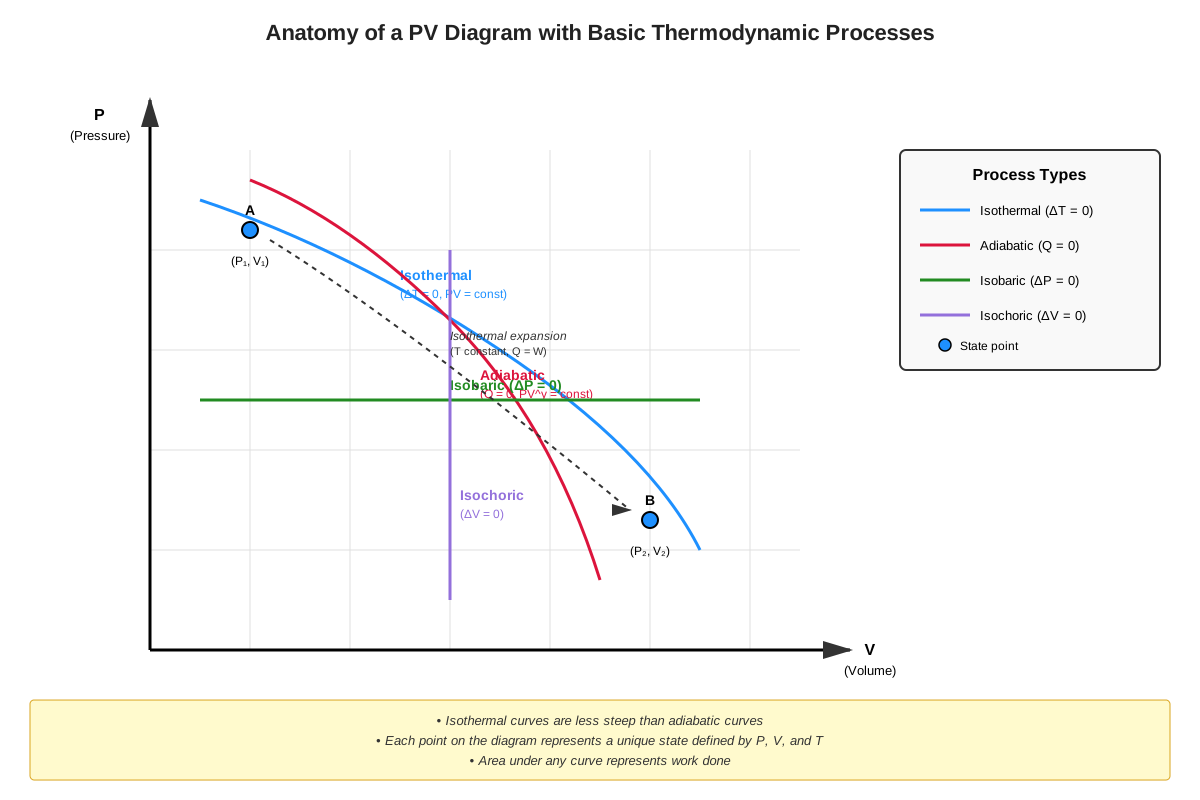
A PV diagram consists of a two-dimensional coordinate system where the horizontal axis represents volume (V) and the vertical axis represents pressure (P). Each point on the diagram represents a unique equilibrium state of the gas, characterized by specific values of pressure, volume, and (implicitly) temperature through the ideal gas law. The state variables (P, V, T, n) are related by PV = nRT, meaning that if you know any two variables (and the amount of gas), you can determine the third.
Paths or curves connecting different states represent thermodynamic processes—the specific ways the system transitions from one equilibrium state to another. The shape of these paths encodes critical information about how the process occurs. Unlike state variables, which depend only on the current condition of the system, the path taken between states determines path-dependent quantities like work and heat transfer.
Work Calculation from PV Diagrams
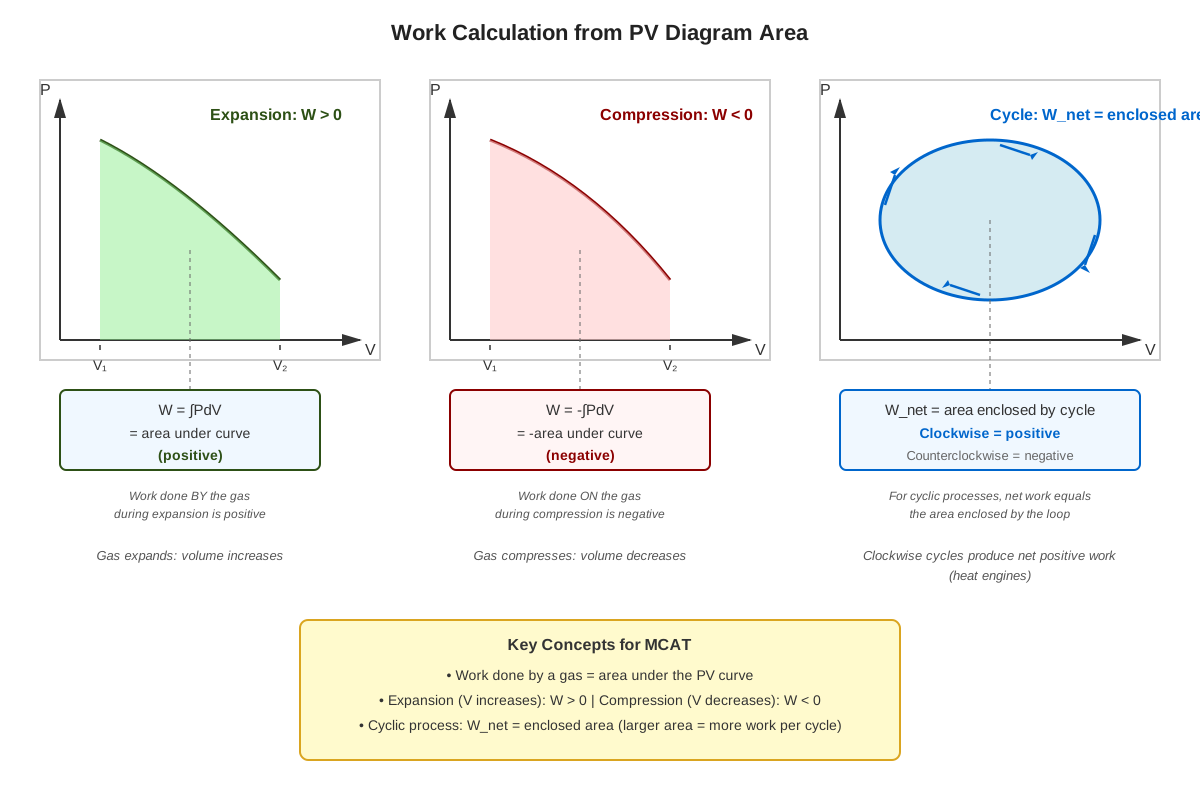
The most fundamental application of PV diagrams is calculating work done by or on a gas. The work done by a gas during expansion or compression is given by:
W = ∫ P dVGeometrically, this integral represents the area under the curve on a PV diagram. When a gas expands (volume increases, moving right on the diagram), the gas does positive work on its surroundings. When a gas is compressed (volume decreases, moving left), work is done on the gas, and W is negative.
For simple processes with constant pressure (isobaric processes), the work calculation simplifies to:
W = P ΔV = P(V_f - V_i)This appears as a rectangular area under a horizontal line on the PV diagram. For more complex paths, the area must be calculated by breaking the process into segments or using geometric formulas for the shapes created.
Exam Tip: Always remember that work equals the area under the curve, not the area to the left of the curve. The horizontal extent (ΔV) matters, but you must multiply by the pressure at each point along the path.
Four Fundamental Thermodynamic Processes
| Process Type | Constant Variable | PV Diagram Appearance | Work Done | First Law Simplification |
|---|---|---|---|---|
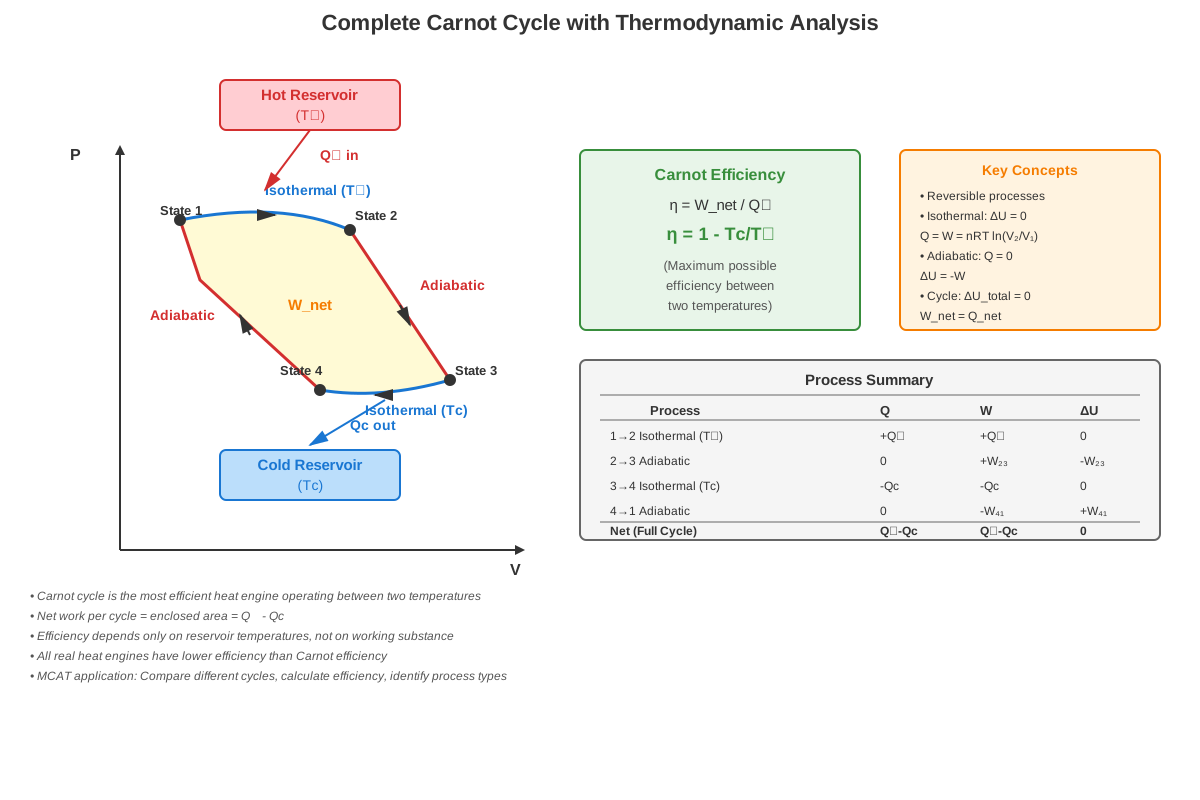
| Isothermal | Temperature (T) | Hyperbolic curve (PV = constant) | W = nRT ln(V_f/V_i) | Q = W (ΔU = 0) |
| Adiabatic | Heat transfer (Q = 0) | Steeper hyperbolic curve | W = -ΔU | ΔU = -W |
| Isobaric | Pressure (P) | Horizontal line | W = P ΔV | Q = ΔU + P ΔV |
| Isochoric | Volume (V) | Vertical line | W = 0 | Q = ΔU |
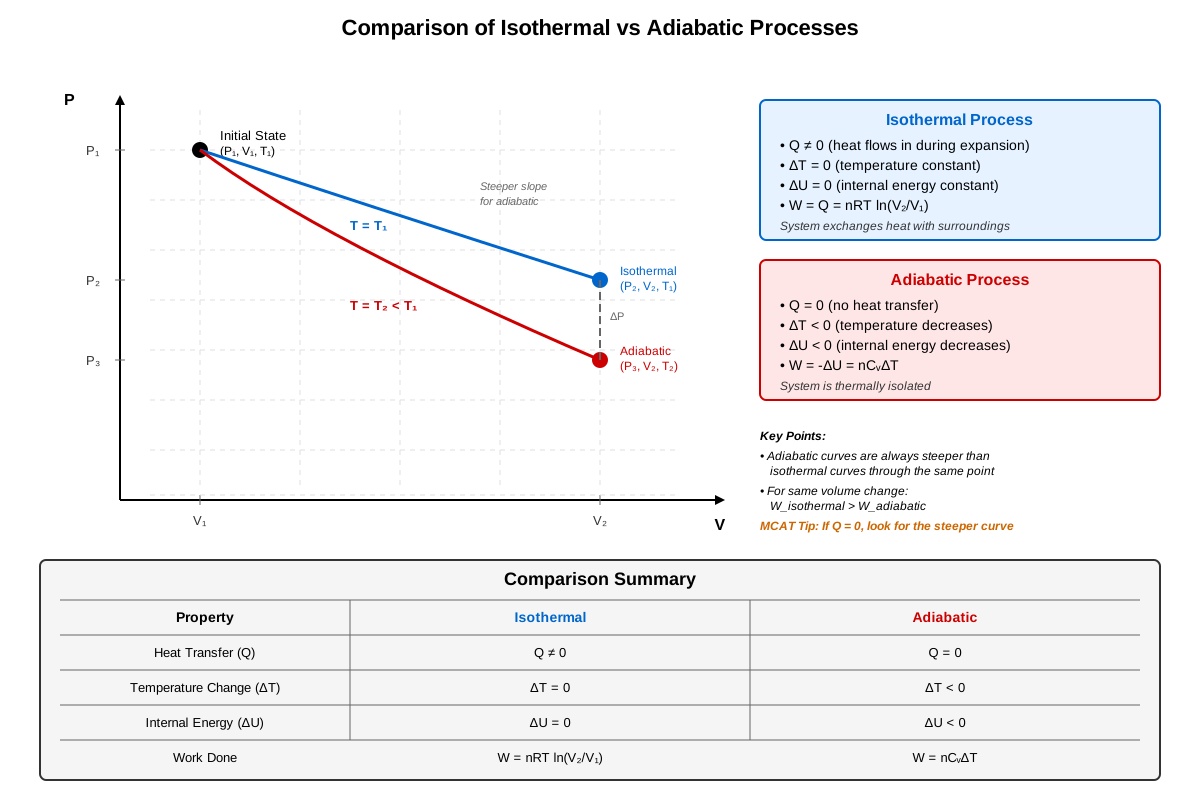
Isothermal processes occur at constant temperature, requiring thermal contact with a heat reservoir. On a PV diagram, these appear as hyperbolas following PV = constant (from the ideal gas law with T and n constant). During isothermal expansion, the gas does work on its surroundings, and heat must flow into the system to maintain constant temperature. The internal energy of an ideal gas depends only on temperature, so ΔU = 0 for isothermal processes, meaning all heat absorbed equals work done (Q = W).
Adiabatic processes occur without heat transfer (Q = 0), typically because the system is thermally insulated or the process happens too quickly for heat exchange. These processes follow PV^γ = constant, where γ (gamma) is the heat capacity ratio (C_p/C_v). Adiabatic curves are steeper than isothermal curves on PV diagrams. During adiabatic expansion, the gas does work, but since no heat enters, the internal energy decreases and temperature drops. For adiabatic processes, all work comes from or goes into internal energy: W = -ΔU.
Isobaric processes maintain constant pressure, appearing as horizontal lines on PV diagrams. These occur when a gas is heated or cooled while allowed to expand or contract freely (like a piston with constant external pressure). Work is simply W = P ΔV, represented by the rectangular area under the horizontal line. Heat transfer in isobaric processes must account for both the change in internal energy and the work done: Q = ΔU + P ΔV.
Isochoric processes occur at constant volume, appearing as vertical lines on PV diagrams. Since volume doesn't change (ΔV = 0), no work is done (W = 0). All heat transfer goes directly into changing the internal energy: Q = ΔU. These processes occur in rigid containers where the gas cannot expand or contract.
Cyclic Processes and Heat Engines
A cyclic process returns the system to its initial state, forming a closed loop on a PV diagram. Since internal energy is a state function, ΔU = 0 for any complete cycle. From the first law (ΔU = Q - W), this means Q_net = W_net for the entire cycle. The net work done per cycle equals the area enclosed by the loop.
The direction of the cycle determines whether the system functions as a heat engine or a refrigerator. Clockwise cycles (expanding at high pressure, compressing at low pressure) represent heat engines that convert heat into work. The enclosed area represents useful work output. Counterclockwise cycles represent refrigerators or heat pumps that require work input to transfer heat from cold to hot reservoirs.
The efficiency of a heat engine is defined as:
η = W_net / Q_in = (Q_in - Q_out) / Q_in = 1 - (Q_out / Q_in)On a PV diagram, Q_in represents heat absorbed during expansion processes, while Q_out represents heat rejected during compression. The Carnot cycle—consisting of two isothermal and two adiabatic processes—represents the maximum possible efficiency for any heat engine operating between two temperature reservoirs.
Sign Conventions and the First Law
Understanding sign conventions is crucial for correctly applying the first law of thermodynamics (ΔU = Q - W) with PV diagrams:
- Work (W): Positive when the gas expands (does work on surroundings), negative when compressed (work done on gas)
- Heat (Q): Positive when heat flows into the system, negative when heat flows out
- Internal Energy Change (ΔU): Positive when temperature increases, negative when temperature decreases
For expansion processes (moving right on PV diagram), W > 0. For compression processes (moving left), W < 0. The area under the curve always gives the magnitude; the direction of the process determines the sign.
Concept Relationships
The core concepts within PV diagrams form an interconnected framework. PV diagrams serve as the visual representation that connects the ideal gas law (which determines the relationship between P, V, and T at each point) to the first law of thermodynamics (which governs energy conservation during processes). Each thermodynamic process type (isothermal, adiabatic, isobaric, isochoric) represents a specific constraint that determines the path shape on the diagram.
The relationship flows as follows: Ideal Gas Law → defines state points on PV diagram → Process constraints → determine path shape between states → Area under path → calculates work done → First Law → relates work to heat and internal energy changes → Cyclic processes → combine multiple paths to create heat engines or refrigerators.
Connections to prerequisite topics include: Work-energy concepts provide the foundation for understanding that area under a curve represents work. Calculus explains why integration gives area and thus work. Temperature and kinetic theory explain why internal energy changes with temperature, making ΔU = 0 for isothermal processes.
Connections to related topics: PV diagrams enable analysis of heat engines and efficiency, which extends to the second law of thermodynamics and entropy. Understanding phase transitions requires modified PV diagrams that show liquid-gas coexistence regions. Real gas behavior appears as deviations from ideal gas curves on PV diagrams at high pressure or low temperature.
Quick check — test yourself on PV diagrams so far.
Try Flashcards →High-Yield Facts
⭐ Work done by a gas equals the area under the curve on a PV diagram; expansion gives positive work, compression gives negative work
⭐ For cyclic processes, ΔU = 0, so Q_net = W_net, and net work equals the enclosed area
⭐ Isothermal processes appear as hyperbolas (PV = constant) and satisfy Q = W since ΔU = 0
⭐ Adiabatic processes (Q = 0) are steeper than isothermal processes and satisfy W = -ΔU
⭐ Clockwise cycles represent heat engines (convert heat to work); counterclockwise cycles represent refrigerators (require work to move heat)
- Isobaric processes appear as horizontal lines with work W = P ΔV
- Isochoric processes appear as vertical lines with zero work (W = 0)
- The slope of an adiabatic curve is steeper than an isothermal curve passing through the same point
- For an ideal gas, internal energy depends only on temperature, so isothermal processes have ΔU = 0
- Heat engine efficiency η = 1 - (Q_out/Q_in) = W_net/Q_in, always less than 1 for real engines
- The Carnot cycle (two isotherms and two adiabats) has maximum efficiency η = 1 - (T_cold/T_hot)
- During adiabatic expansion, temperature decreases because internal energy converts to work
- During isothermal expansion, heat must flow in to maintain constant temperature while doing work
- The area enclosed by a cycle represents net work per cycle, not total work for all processes
- Pressure and volume are inversely related for isothermal processes (Boyle's Law)
Common Misconceptions
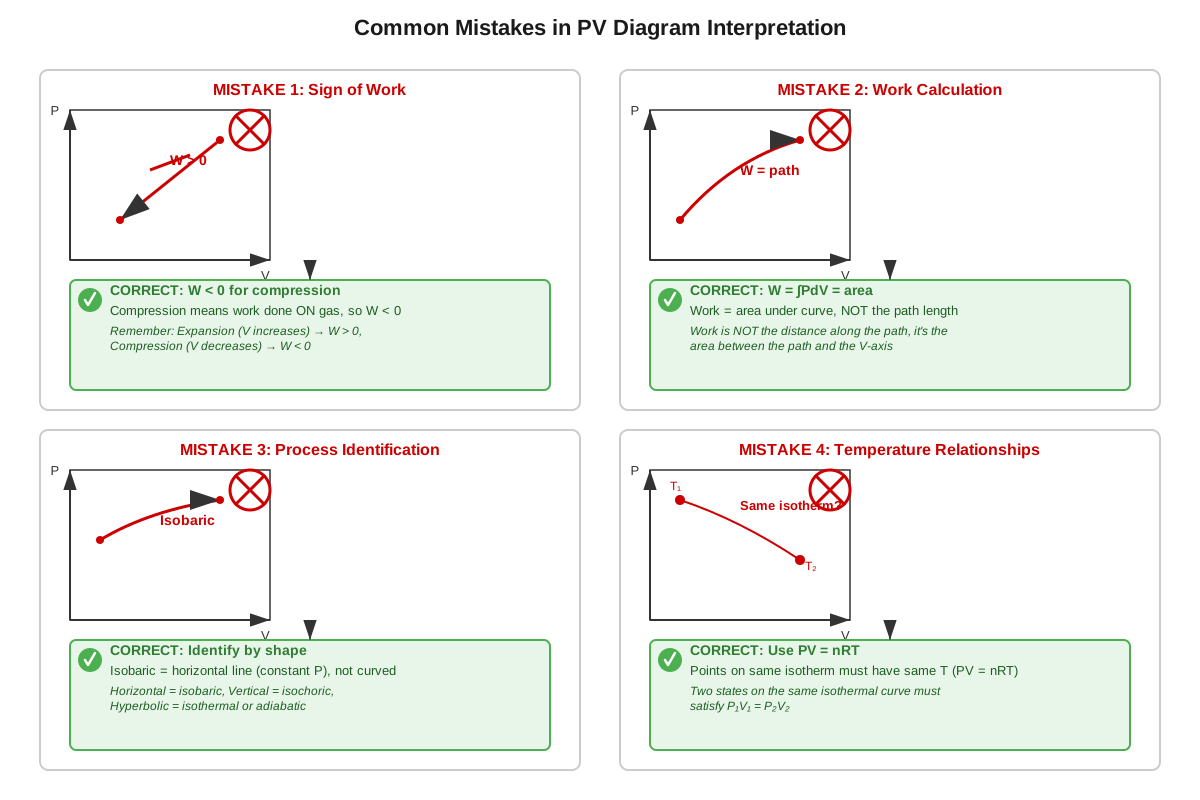
Misconception: The area to the left of a curve on a PV diagram represents work done.
Correction: Work equals the area under the curve (between the curve and the horizontal axis), not to the left. The horizontal extent matters, but you must integrate P with respect to V.
Misconception: All curves that slope downward on PV diagrams represent the same type of process.
Correction: Both isothermal and adiabatic processes show pressure decreasing as volume increases, but adiabatic curves are steeper. The specific relationship (PV = constant vs. PV^γ = constant) determines the curve shape and physical meaning.
Misconception: If a gas returns to its initial state, no work was done.
Correction: For cyclic processes, the net work equals the enclosed area and is generally non-zero. Individual processes within the cycle involve work; only the net change in internal energy is zero (ΔU = 0).
Misconception: Isothermal processes involve no energy transfer because temperature is constant.
Correction: Isothermal processes involve both work and heat transfer that exactly balance (Q = W) to keep temperature constant. Energy is transferred, but internal energy doesn't change because ΔU depends only on temperature for ideal gases.
Misconception: The steepness of a curve on a PV diagram directly indicates how fast the process occurs.
Correction: PV diagrams show equilibrium states and paths, not time evolution. A steep curve doesn't mean a fast process; it indicates the mathematical relationship between P and V. Adiabatic processes are often fast (preventing heat transfer), but the diagram itself is time-independent.
Misconception: Work is always positive when volume increases.
Correction: Work done by the gas is positive during expansion, but this represents energy leaving the system. From the system's perspective in some sign conventions, this might be considered negative. Always clarify whether discussing work done by or on the gas, and use consistent sign conventions with the first law.
Misconception: All points on a PV diagram represent equilibrium states.
Correction: Only points on the diagram represent equilibrium states. The paths between points represent quasi-static processes where the system passes through a continuous series of equilibrium states. Real rapid processes may not follow these idealized paths.
Worked Examples
Example 1: Calculating Work for a Multi-Step Process
Problem: An ideal gas undergoes a three-step process: (A) isobaric expansion from (2 L, 3 atm) to (5 L, 3 atm), (B) isochoric cooling to (5 L, 1 atm), and (C) isothermal compression back to 2 L. Calculate the total work done by the gas and determine whether the cycle operates as a heat engine or refrigerator.
Solution:
Step A (Isobaric Expansion):
- Process occurs at constant P = 3 atm
- Work = P ΔV = 3 atm × (5 L - 2 L) = 9 L·atm
- Converting to SI: 9 L·atm × 101.3 J/(L·atm) ≈ 912 J
- Work is positive (expansion)
Step B (Isochoric Cooling):
- Volume constant at V = 5 L
- Work = 0 (no volume change)
- This is a vertical line on the PV diagram
Step C (Isothermal Compression):
- Must return to initial point (2 L, 3 atm)
- For isothermal process: W = nRT ln(V_f/V_i)
- From ideal gas law at point (5 L, 1 atm): nRT = PV = 5 L·atm
- Work = 5 L·atm × ln(2/5) = 5 × (-0.916) = -4.58 L·atm ≈ -464 J
- Work is negative (compression)
Total Work:
- W_total = 912 J + 0 J + (-464 J) = 448 J
- Net work is positive
Cycle Direction:
- Plotting the points: (2,3) → (5,3) → (5,1) → (2,3)
- The path moves right (expansion) at high pressure, then down, then left (compression) at low pressure
- This creates a clockwise cycle
- Conclusion: This operates as a heat engine, converting heat into 448 J of work per cycle
Connection to Learning Objectives: This example demonstrates applying PV diagrams to calculate work (area under curves), identifying process types, and analyzing cyclic processes—all key MCAT skills.
Example 2: Comparing Isothermal and Adiabatic Processes
Problem: An ideal monatomic gas (γ = 5/3) starts at state (V₀, P₀) and expands to volume 2V₀ via two different paths: Path 1 is isothermal, Path 2 is adiabatic. Compare the final pressures, work done, and heat transferred for each path.
Solution:
Path 1 (Isothermal Expansion):
- For isothermal process: P₁V₁ = P₂V₂
- P₀V₀ = P_final(2V₀)
- P_final = P₀/2
- Work: W = nRT ln(V_f/V_i) = nRT ln(2) = P₀V₀ ln(2) ≈ 0.693 P₀V₀
- Since ΔU = 0 for isothermal: Q = W ≈ 0.693 P₀V₀
- Heat flows into the system
Path 2 (Adiabatic Expansion):
- For adiabatic process: P₁V₁^γ = P₂V₂^γ
- P₀V₀^(5/3) = P_final(2V₀)^(5/3)
- P_final = P₀/(2^(5/3)) = P₀/3.17 ≈ 0.315 P₀
- Work: W = (P₀V₀ - P_final·2V₀)/(γ-1) = (P₀V₀ - 0.63P₀V₀)/(2/3) ≈ 0.555 P₀V₀
- Since Q = 0 for adiabatic: ΔU = -W ≈ -0.555 P₀V₀
- No heat transfer; internal energy decreases
Comparison Table:
| Property | Isothermal | Adiabatic |
|---|---|---|
| Final Pressure | 0.5 P₀ | 0.315 P₀ |
| Work Done | 0.693 P₀V₀ | 0.555 P₀V₀ |
| Heat Transfer | 0.693 P₀V₀ (in) | 0 |
| ΔU | 0 | -0.555 P₀V₀ |
Key Insights:
- Adiabatic expansion results in lower final pressure (steeper curve on PV diagram)
- Isothermal expansion does more work because heat flows in to maintain temperature
- Adiabatic expansion cools the gas (ΔU < 0), while isothermal maintains temperature
- On a PV diagram, the adiabatic curve would lie below the isothermal curve
Connection to Learning Objectives: This example illustrates distinguishing between process types, connecting PV diagrams to thermodynamic calculations, and identifying common conceptual differences tested on the MCAT.
Exam Strategy
When approaching PV diagrams MCAT questions, begin by identifying what type of question is being asked: work calculation, process identification, or cycle analysis. For work calculations, immediately identify whether you need the area under a single curve or the enclosed area of a cycle. Sketch the diagram if not provided, labeling all known values.
Trigger words to watch for include:
- "Constant temperature" → isothermal process (hyperbola, Q = W)
- "Thermally insulated" or "no heat transfer" → adiabatic process (steeper curve, Q = 0)
- "Constant pressure" → isobaric process (horizontal line, W = PΔV)
- "Rigid container" → isochoric process (vertical line, W = 0)
- "Returns to initial state" → cyclic process (ΔU = 0, Q_net = W_net)
- "Heat engine" → clockwise cycle, converts heat to work
- "Refrigerator" → counterclockwise cycle, requires work input
For process-of-elimination strategies, remember that:
- If work is zero, the process must be isochoric (eliminate any answer suggesting volume change)
- If ΔU = 0, the process must be isothermal (eliminate answers with temperature change)
- If Q = 0, the process must be adiabatic (eliminate answers involving heat reservoirs)
- Clockwise cycles always do net positive work (eliminate negative work answers for heat engines)
- Efficiency must be less than 1 for real engines (eliminate η ≥ 1)
Time allocation: Spend 30-45 seconds analyzing the diagram and identifying process types, then 60-90 seconds on calculations. If a calculation becomes complex, check whether the question asks for a qualitative comparison rather than exact numbers—many MCAT questions test conceptual understanding rather than computational skill.
For multi-part cycles, break the problem into segments: calculate work for each process separately, then sum for total work. Remember that state functions (U, T for ideal gas) depend only on initial and final states, while path functions (Q, W) require analyzing each segment.
Memory Techniques
Mnemonic for Process Types - "I Am In Iceland":
- Isothermal: Invariant Temperature
- Adiabatic: Absolutely no heat (Q = 0)
- Isobaric: Invariant Pressure
- Isochoric: Invariant Volume (also called isovolumetric)
Visualization Strategy for Curve Steepness:
Picture an adiabatic process as a "steep mountain" that the gas must climb without any external heat energy—it gets colder (loses internal energy) as it expands. An isothermal process is a "gentle hill" where heat continuously flows in to maintain temperature, allowing more gradual pressure decrease.
Acronym for Cycle Direction - "CHEER":
- Clockwise = Heat Engine Extracts Real work
- Counterclockwise = Refrigerator (requires work input)
Memory Aid for Work Sign:
"Expansion = Exhausting = Positive work done BY gas (energy leaves)"
"Compression = Cramming = Negative work done BY gas (energy enters)"
Visualization for First Law:
Picture ΔU as a "bank account," Q as "deposits," and W as "withdrawals." The first law (ΔU = Q - W) says your account balance change equals deposits minus withdrawals. Heat coming in is a deposit, work done by the gas is a withdrawal.
Summary
PV diagrams provide a powerful visual framework for analyzing thermodynamic processes and cycles, essential for MCAT success in thermodynamics questions. These graphs plot pressure versus volume, with each point representing an equilibrium state and paths representing processes. The fundamental principle is that work equals the area under the curve, positive for expansion and negative for compression. Four key process types appear as distinct shapes: isothermal (hyperbola, constant T, Q = W), adiabatic (steeper hyperbola, Q = 0, W = -ΔU), isobaric (horizontal line, constant P, W = PΔV), and isochoric (vertical line, constant V, W = 0). Cyclic processes form closed loops where net work equals enclosed area and ΔU = 0, making Q_net = W_net. Clockwise cycles represent heat engines that convert heat to work, while counterclockwise cycles represent refrigerators requiring work input. Mastery requires connecting visual diagram features to quantitative calculations using the ideal gas law and first law of thermodynamics, while maintaining correct sign conventions throughout.
Key Takeaways
- Work done by a gas equals the area under the PV curve; expansion yields positive work, compression yields negative work
- Four fundamental processes have distinct PV diagram appearances: isothermal (hyperbola), adiabatic (steeper hyperbola), isobaric (horizontal), and isochoric (vertical)
- For cyclic processes, ΔU = 0 and net work equals the enclosed area, with clockwise cycles representing heat engines
- Isothermal processes maintain constant temperature (Q = W, ΔU = 0), while adiabatic processes have no heat transfer (Q = 0, W = -ΔU)
- Adiabatic curves are always steeper than isothermal curves on PV diagrams due to the PV^γ relationship
- The first law of thermodynamics (ΔU = Q - W) connects work calculated from PV diagrams to heat transfer and internal energy changes
- Correct sign conventions are critical: positive work means the gas does work on surroundings (expansion), positive heat means energy flows into the system
Related Topics
Heat Engines and Carnot Cycle: Building on PV diagram analysis, this topic explores the theoretical maximum efficiency of heat engines and introduces entropy concepts. Mastering PV diagrams enables understanding of why no real engine can achieve 100% efficiency.
Entropy and the Second Law of Thermodynamics: PV diagrams provide the foundation for calculating entropy changes during reversible processes, connecting microscopic disorder to macroscopic thermodynamic quantities.
Real Gas Behavior and Van der Waals Equation: Understanding ideal gas PV diagrams prepares students to recognize deviations in real gases, particularly at high pressures and low temperatures where intermolecular forces become significant.
Phase Transitions and Phase Diagrams: PV diagrams extend to show liquid-gas coexistence regions, with horizontal lines representing isothermal phase changes at constant pressure.
Respiratory Physiology: Clinical applications include pulmonary pressure-volume loops used to diagnose lung diseases, directly applying PV diagram concepts to medical practice.
Practice CTA
Now that you've mastered the core concepts of PV diagrams, it's time to solidify your understanding through active practice. Work through the practice questions to test your ability to calculate work, identify process types, and analyze cycles under exam conditions. Use the flashcards to reinforce high-yield facts and process characteristics until you can instantly recognize each process type on a diagram. Remember: PV diagrams appear frequently on the MCAT, and students who can quickly extract information from these visual representations gain a significant advantage. Your investment in mastering this topic will pay dividends across multiple thermodynamics questions on test day!
Sign up free to keep reading
Create a free AnvayaPrep account to finish this MCAT guide on PV diagrams — plus flashcards and practice questions.