Overview
Scalars represent one of the two fundamental categories of physical quantities in Physics, distinguished by their complete description using only magnitude (size or amount) without any directional component. Understanding scalars is essential for success on the MCAT because they form the foundation for quantitative reasoning across all physics problems, from kinematics to thermodynamics. While vectors (the complementary category) require both magnitude and direction, scalars simplify calculations and conceptual understanding in many physical scenarios, making them a high-yield topic for efficient problem-solving on test day.
The distinction between scalar and vector quantities permeates every section of MCAT Physics, and misidentifying a quantity's nature leads to systematic errors in problem-solving. Scalars Physics concepts appear in approximately 15-20% of physics questions on the MCAT, either directly testing the definition or indirectly requiring proper mathematical manipulation of scalar quantities. Students who master scalar identification and manipulation gain significant advantages in time management and accuracy, particularly in passage-based questions where multiple physical quantities interact.
Within the broader context of Math and Units, scalars serve as the simpler building blocks that students must understand before tackling more complex vector operations. The MCAT frequently tests whether students can correctly identify scalar quantities, perform appropriate mathematical operations with them, and distinguish situations where directional information matters from those where it does not. This foundational knowledge connects directly to kinematics, energy, thermodynamics, and even biological applications like metabolic rate calculations and drug concentration measurements.
Learning Objectives
- [ ] Define Scalars using accurate Physics terminology
- [ ] Explain why Scalars matters for the MCAT
- [ ] Apply Scalars to exam-style questions
- [ ] Identify common mistakes related to Scalars
- [ ] Connect Scalars to related Physics concepts
- [ ] Distinguish between scalar and vector quantities in complex physical scenarios
- [ ] Perform mathematical operations with scalar quantities correctly
- [ ] Recognize scalar quantities across different physics domains (mechanics, thermodynamics, electricity)
Prerequisites
- Basic algebra and arithmetic operations: Essential for manipulating scalar quantities through addition, subtraction, multiplication, and division
- Understanding of physical quantities and units: Necessary to recognize that scalars possess magnitude measured in specific units (meters, seconds, kilograms, etc.)
- Familiarity with the SI unit system: Required to work with standardized measurements and perform unit conversions with scalar quantities
- Concept of magnitude: Fundamental to understanding that scalars represent "how much" without "which way"
Why This Topic Matters
Clinical and Real-World Significance
Scalar quantities dominate medical and biological measurements that physicians and researchers use daily. Temperature, mass, blood pressure (when reported as a single value), drug dosages, metabolic rates, and time intervals are all scalar quantities. A physician prescribing medication considers the scalar quantity of drug mass (milligrams) without directional concerns. Body temperature measurements, critical for diagnosing infections or metabolic disorders, represent pure scalar values. Understanding scalars enables proper interpretation of laboratory values, vital signs, and pharmacokinetic parameters—all essential for clinical reasoning tested on the MCAT.
MCAT Exam Statistics
Scalar-related questions appear in approximately 3-5 discrete questions per MCAT administration, with an additional 10-15 passage-based questions requiring scalar identification or manipulation. The Chemical and Physical Foundations of Biological Systems section most frequently tests scalars, though they also appear in Biological and Biochemical Foundations questions involving rates, concentrations, and energetics. Questions typically present as:
- Direct identification tasks ("Which of the following is a scalar quantity?")
- Calculation problems requiring scalar arithmetic
- Passage-based scenarios mixing scalar and vector quantities
- Conceptual questions about energy, work, or thermodynamic properties
Common Exam Appearances
MCAT passages frequently embed scalar quantities within complex scenarios: a biochemistry passage might discuss reaction rates (scalar) and molecular velocities (vector); a physiology passage could present cardiac output (scalar) alongside blood flow direction (vector); physics passages often mix kinetic energy (scalar) with momentum (vector). The exam tests whether students can extract relevant scalar information, perform appropriate calculations, and avoid incorrectly applying vector mathematics to scalar quantities.
Core Concepts
Definition of Scalars
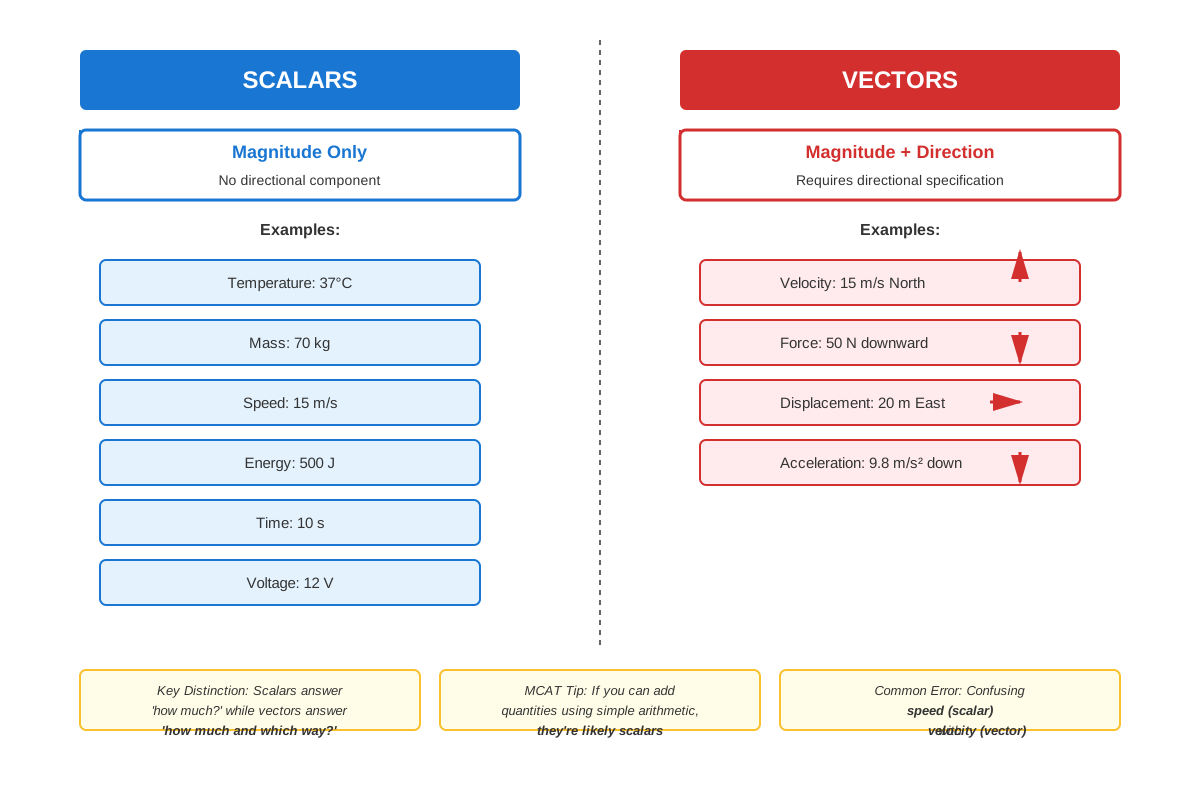
A scalar is a physical quantity completely described by a single numerical value (magnitude) and appropriate units, with no directional component required for its complete specification. Scalars obey the ordinary rules of arithmetic—they can be added, subtracted, multiplied, and divided using standard algebraic operations without concern for orientation in space. Examples include mass (5 kg), temperature (37°C), time (10 seconds), speed (15 m/s), energy (100 joules), and volume (2 liters).
The defining characteristic separating scalars from vectors is this absence of directional information. When stating that an object has a mass of 70 kg, no additional directional specification is needed or meaningful—mass exists as a property of the object regardless of orientation. Similarly, when reporting that a reaction releases 50 kJ of energy, the energy value itself carries no inherent direction, though energy transfer might have a directional component in specific contexts.
Mathematical Properties of Scalars
Scalar quantities follow commutative, associative, and distributive properties of standard arithmetic:
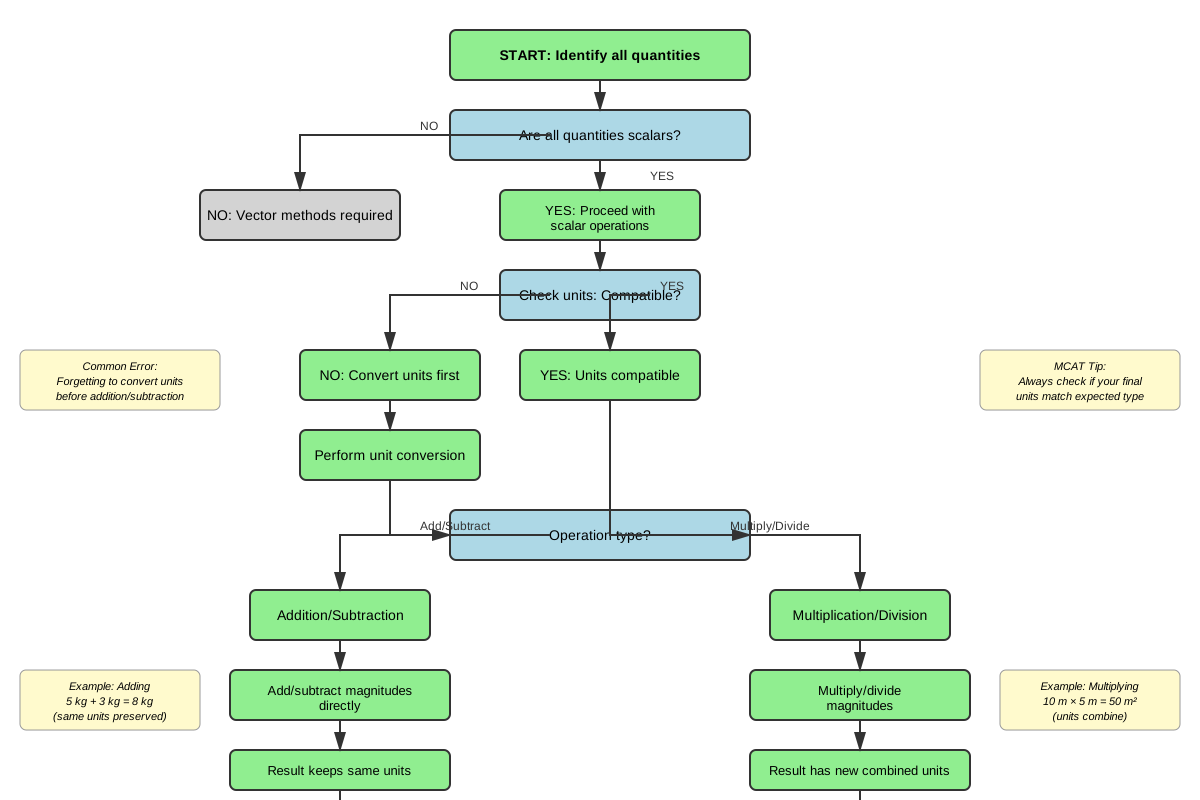
Addition and Subtraction: Scalars of the same type (same units) combine through simple arithmetic addition or subtraction. Adding 5 kg + 3 kg = 8 kg requires no consideration of direction. Temperature differences (scalar) calculate as simple subtraction: 37°C - 25°C = 12°C.
Multiplication and Division: Scalars multiply and divide freely, producing new scalar quantities. Multiplying mass (scalar) by speed (scalar) yields momentum magnitude (though momentum itself is a vector, its magnitude is scalar). Dividing distance (scalar) by time (scalar) produces speed (scalar).
Scalar Multiplication with Vectors: When a scalar multiplies a vector, the result is a vector with magnitude scaled by the scalar value but direction unchanged. This operation appears frequently in physics equations like F = ma, where mass (scalar) multiplies acceleration (vector) to produce force (vector).
Common Scalar Quantities in MCAT Physics
| Scalar Quantity | Symbol | SI Unit | MCAT Context |
|---|---|---|---|
| Mass | m | kilogram (kg) | Mechanics, dynamics, energy |
| Time | t | second (s) | All physics domains |
| Temperature | T | Kelvin (K) | Thermodynamics, kinetics |
| Energy | E | joule (J) | Mechanics, thermodynamics |
| Work | W | joule (J) | Mechanics, energy transfer |
| Power | P | watt (W) | Energy rate, circuits |
| Speed | v (magnitude) | meter/second (m/s) | Kinematics |
| Distance | d | meter (m) | Kinematics, geometry |
| Volume | V | cubic meter (m³) | Fluids, thermodynamics |
| Density | ρ | kg/m³ | Fluids, materials |
| Pressure | P | pascal (Pa) | Fluids, thermodynamics |
| Electric Potential | V | volt (V) | Circuits, electrostatics |
| Resistance | R | ohm (Ω) | Circuits |
| Charge | q | coulomb (C) | Electrostatics |
Scalars in Different Physics Domains
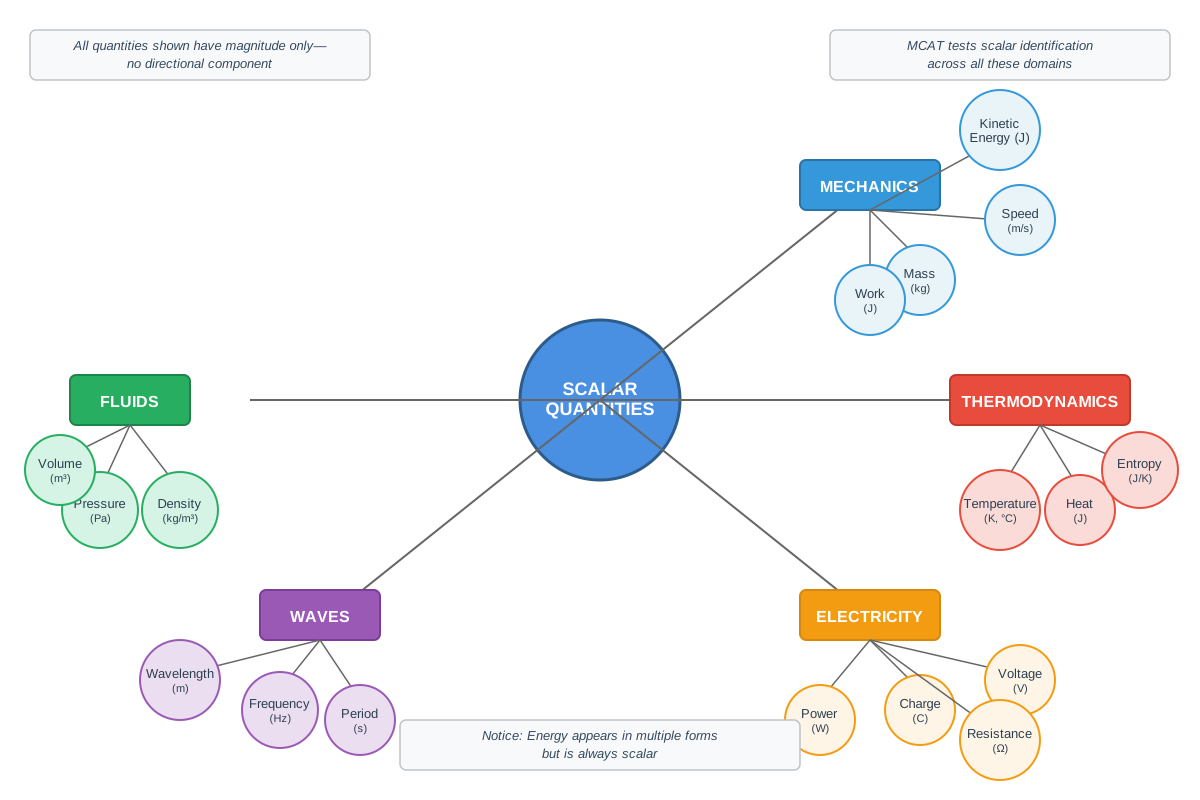
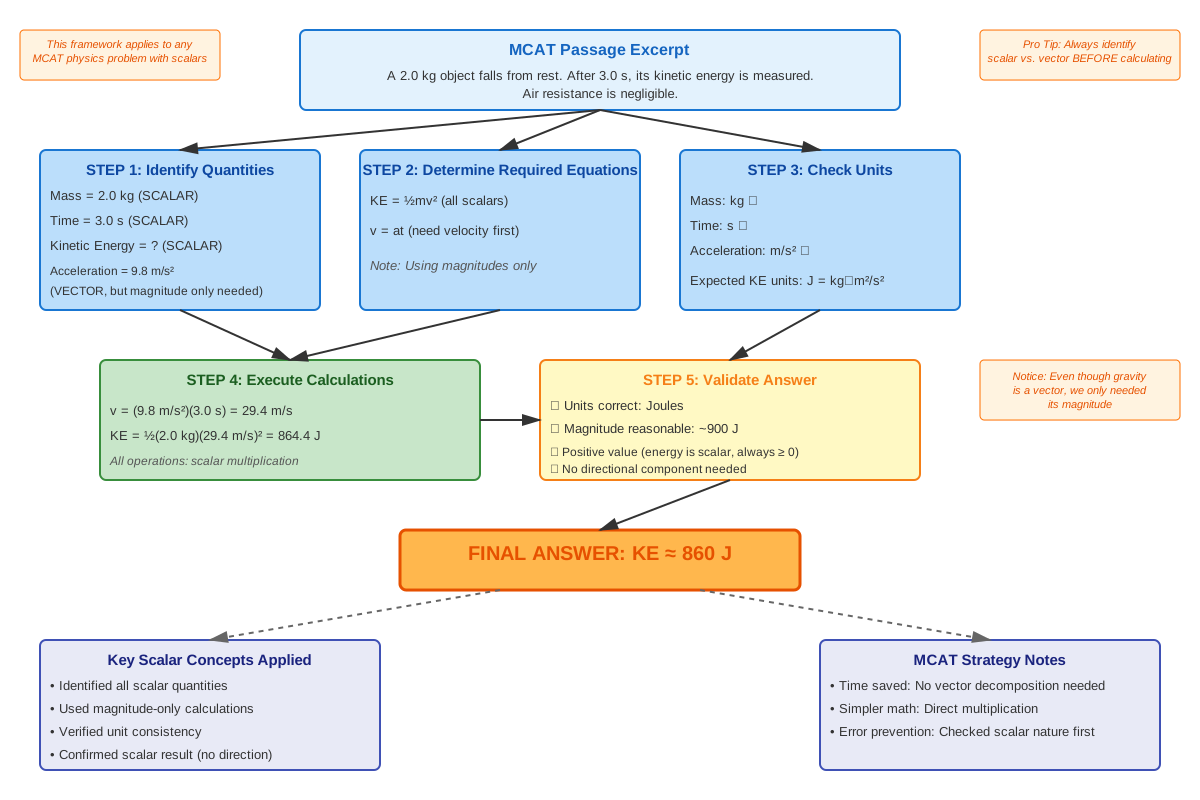
Mechanics: Distance (not displacement), speed (not velocity), mass, time, kinetic energy, potential energy, and work represent key scalar quantities. When calculating kinetic energy (KE = ½mv²), both mass and the squared velocity term are scalars, producing a scalar result. Work, despite involving force (vector) and displacement (vector), calculates as their dot product, yielding a scalar result.
Thermodynamics: Temperature, heat, internal energy, entropy, and specific heat capacity are all scalars. The first law of thermodynamics (ΔU = Q - W) involves only scalar quantities, simplifying calculations significantly. Pressure, though it acts in directions, is defined as a scalar quantity representing force per unit area magnitude.
Electricity and Magnetism: Electric potential, voltage, resistance, capacitance, and electric charge are scalars. Current, despite flowing in a direction, is conventionally treated as a scalar in circuit analysis. Electric potential energy and the work done moving charges through potential differences involve scalar calculations.
Waves and Optics: Frequency, period, wavelength, intensity, and energy are scalar quantities. While wave propagation has direction, these fundamental wave properties require only magnitude for complete description.
Distinguishing Scalars from Vectors
The critical distinction lies in whether directional information is necessary for complete description:
Scalar Example: "The car traveled 50 kilometers" describes distance (scalar) completely—no direction needed.
Vector Example: "The car's displacement was 50 kilometers north" requires direction for complete specification—this is displacement (vector).
Scalar Example: "The object has 100 joules of kinetic energy" completely describes the energy state without directional information.
Vector Example: "The object has momentum of 50 kg⋅m/s eastward" requires direction—momentum is a vector.
Some quantities have both scalar and vector forms: speed (scalar) versus velocity (vector), distance (scalar) versus displacement (vector). The MCAT frequently tests this distinction, requiring students to recognize which form appears in a given context.
Concept Relationships
Scalars form the foundational layer of quantitative physics reasoning, connecting to virtually every other physics concept. The relationship hierarchy flows as follows:
Math and Units → Scalars → Vector Quantities: Understanding scalars precedes vector comprehension because vectors build upon scalar concepts by adding directional components. The magnitude of any vector is itself a scalar quantity.
Scalars → Energy Concepts: All forms of energy (kinetic, potential, thermal, electrical) are scalar quantities. This scalar nature simplifies energy conservation calculations, as energy transfers require only magnitude tracking without directional bookkeeping.
Scalars → Thermodynamics: Temperature, heat, internal energy, and entropy are scalars, making thermodynamic calculations more straightforward than mechanical problems involving vectors. The scalar nature of thermodynamic quantities reflects their statistical, aggregate nature.
Scalars → Work and Power: Work, calculated as the dot product of force and displacement vectors, yields a scalar result. Power, the rate of energy transfer, is also scalar. This connection demonstrates how vector operations can produce scalar results.
Scalars ↔ Vectors (Dot Product): The dot product operation converts two vectors into a scalar, representing the projection of one vector onto another. This mathematical relationship appears in work calculations (W = F⋅d) and power calculations (P = F⋅v).
Scalars × Vectors (Scalar Multiplication): Multiplying a scalar by a vector produces a vector with scaled magnitude but unchanged direction. This operation appears in Newton's second law (F = ma) where mass (scalar) scales acceleration (vector).
High-Yield Facts
⭐ Scalars are completely described by magnitude and units alone, requiring no directional information
⭐ Energy in all forms (kinetic, potential, thermal, electrical) is always a scalar quantity
⭐ Speed is the scalar magnitude of velocity; distance is the scalar magnitude of displacement
⭐ Work and power are scalar quantities despite being calculated from vector quantities
⭐ Temperature, pressure, mass, time, and charge are fundamental scalar quantities appearing frequently on the MCAT
- Scalar addition and subtraction follow ordinary arithmetic rules without vector component considerations
- The dot product of two vectors always produces a scalar result
- Resistance, voltage, and current in circuits are treated as scalar quantities in MCAT problems
- Density, volume, and concentration are scalar quantities essential for fluid and solution problems
- Kinetic energy (½mv²) is scalar because squaring velocity eliminates directional information
- Scalar quantities can be positive, negative, or zero, but the sign indicates magnitude relationship, not direction
- Electric potential and electric potential energy are scalars, while electric field is a vector
- The magnitude (absolute value) of any vector quantity is itself a scalar
Quick check — test yourself on Scalars so far.
Try Flashcards →Common Misconceptions
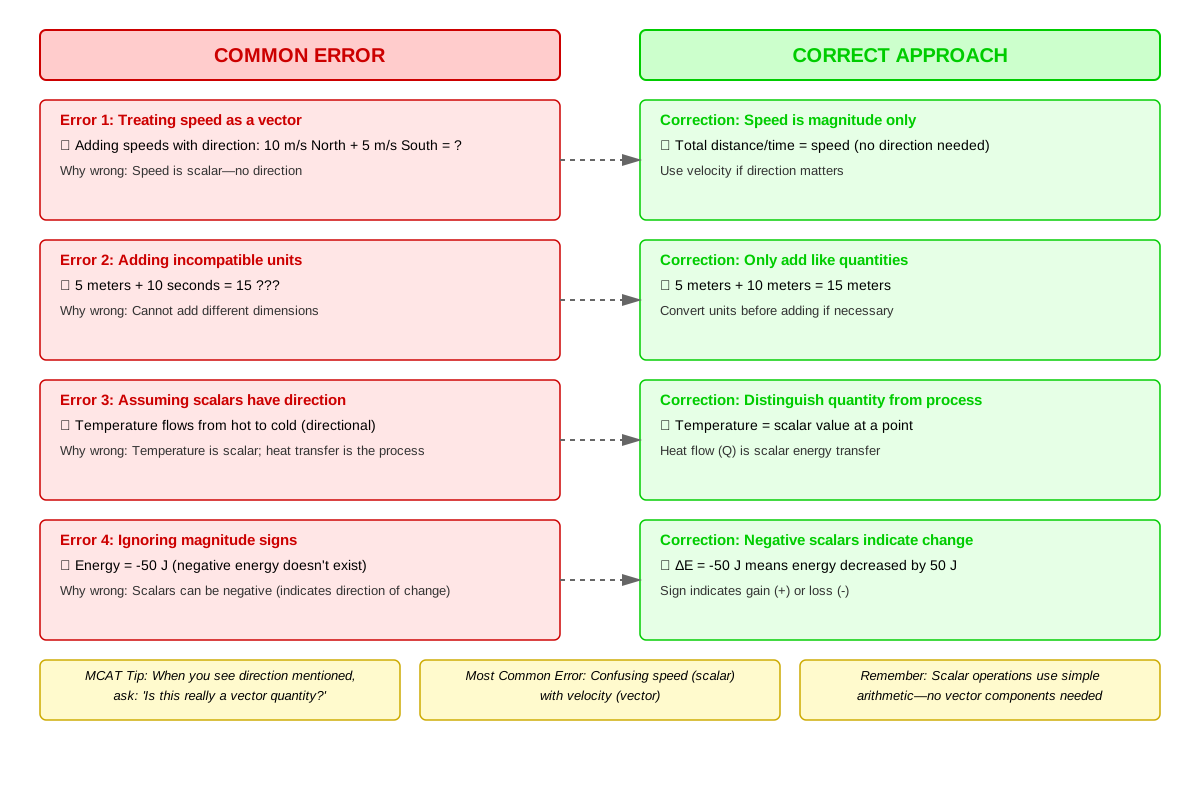
Misconception: Pressure is a vector because it acts in a direction perpendicular to surfaces.
Correction: Pressure is defined as a scalar quantity representing force magnitude per unit area. While pressure forces act directionally, pressure itself is specified by magnitude alone. The MCAT treats pressure as scalar in all thermodynamic and fluid mechanics contexts.
Misconception: Current must be a vector because it flows in a specific direction through circuits.
Correction: Despite having directional flow, electric current is conventionally defined and treated as a scalar quantity in circuit analysis. The MCAT uses scalar current values in all circuit problems, with direction indicated by circuit diagrams rather than vector notation.
Misconception: Work is a vector because it involves force (vector) and displacement (vector).
Correction: Work is the scalar dot product of force and displacement vectors (W = F⋅d⋅cosθ). The dot product operation converts two vectors into a scalar result. Work can be positive, negative, or zero, but these signs indicate energy transfer direction (into or out of a system), not spatial direction.
Misconception: All quantities with positive or negative values are vectors.
Correction: Scalars can be positive, negative, or zero. The sign indicates magnitude relationships or energy transfer direction, not spatial direction. Temperature changes (ΔT) can be negative (cooling), but temperature remains scalar. Work can be negative (energy leaving a system), but work is scalar.
Misconception: Speed and velocity are interchangeable terms for the same vector quantity.
Correction: Speed is the scalar magnitude of velocity (vector). Speed = |velocity| and contains no directional information. An object moving in a circle at constant speed has changing velocity (because direction changes) but constant speed. The MCAT frequently tests this distinction.
Misconception: Distance and displacement mean the same thing and are both scalars.
Correction: Distance is scalar (total path length traveled), while displacement is vector (straight-line change in position with direction). An object traveling in a complete circle has zero displacement but non-zero distance. This distinction appears frequently in kinematics problems.
Misconception: Multiplying two scalars always produces a scalar result.
Correction: While this is true, the reverse is not—multiplying a scalar by a vector produces a vector, and the dot product of two vectors produces a scalar. Understanding these operations prevents errors in multi-step calculations.
Worked Examples
Example 1: Identifying Scalar and Vector Quantities in a Passage
Problem: A passage describes an experiment where a 2.0 kg block slides down a frictionless incline, starting from rest. After 3.0 seconds, the block has traveled 15 meters along the incline and is moving at 10 m/s. The block's displacement from its starting position is 12 meters horizontally and 9 meters vertically downward. The kinetic energy at this moment is 100 J. Identify all scalar quantities mentioned and explain why each is scalar.
Solution:
Step 1: Systematically identify each quantity and classify it.
Scalar quantities identified:
- Mass (2.0 kg): Scalar because mass is an intrinsic property requiring only magnitude, no direction
- Time (3.0 seconds): Scalar because time intervals have magnitude only; time doesn't point in a direction
- Distance along incline (15 meters): Scalar because this represents path length traveled, not directional change in position
- Speed (10 m/s): Scalar because this is the magnitude of velocity without directional specification
- Kinetic energy (100 J): Scalar because all forms of energy are scalar quantities
- Horizontal distance component (12 meters): While this seems directional, it's presented as a magnitude of one displacement component, making it scalar in this context
- Vertical distance component (9 meters): Same reasoning as horizontal component
Step 2: Identify non-scalar (vector) quantities for contrast:
- Displacement: Vector because it specifies change in position with direction (12 m horizontal, 9 m vertical)
- Velocity: Vector because it includes both speed magnitude and direction of motion
Step 3: Connect to MCAT strategy:
When passages mix scalar and vector quantities, the MCAT tests whether students can extract appropriate values for calculations. Energy calculations require only scalar inputs (mass, speed), while momentum calculations would require vector velocity. Recognizing that kinetic energy uses speed (scalar) rather than velocity (vector) prevents errors.
Example 2: Calculating with Scalar Quantities
Problem: A chemical reaction releases 250 kJ of heat energy over 5.0 minutes. The reaction vessel has a mass of 2.0 kg and a specific heat capacity of 0.50 kJ/(kg⋅°C). If all released heat is absorbed by the vessel, calculate: (a) the power output of the reaction, (b) the temperature change of the vessel, and (c) explain why all quantities involved are scalars.
Solution:
Part (a): Power calculation
Step 1: Identify given scalar quantities:
- Heat energy released: Q = 250 kJ = 250,000 J
- Time interval: t = 5.0 minutes = 300 s
Step 2: Apply power definition (scalar equation):
P = Q/t = 250,000 J / 300 s = 833 WStep 3: Verify scalar nature:
Power is scalar (energy per unit time), calculated from two scalars (energy and time), producing a scalar result.
Part (b): Temperature change calculation
Step 1: Identify additional scalar quantities:
- Mass: m = 2.0 kg
- Specific heat capacity: c = 0.50 kJ/(kg⋅°C) = 500 J/(kg⋅°C)
- Heat absorbed: Q = 250 kJ = 250,000 J
Step 2: Apply heat transfer equation (all scalars):
Q = mcΔT
ΔT = Q/(mc) = 250,000 J / (2.0 kg × 500 J/(kg⋅°C))
ΔT = 250,000 / 1,000 = 250°C
Step 3: Interpret result:
The temperature increases by 250°C, a scalar change requiring no directional specification.
Part (c): Explanation of scalar nature
All quantities in this problem are scalars:
- Heat (Q): Energy transfer, scalar quantity
- Time (t): Duration, scalar quantity
- Power (P): Rate of energy transfer, scalar quantity
- Mass (m): Intrinsic property, scalar quantity
- Specific heat capacity (c): Material property, scalar quantity
- Temperature change (ΔT): Thermal state change, scalar quantity
MCAT Connection: Thermodynamics problems on the MCAT involve exclusively scalar quantities, simplifying calculations compared to mechanics problems with vectors. Recognizing this allows confident application of algebraic operations without vector component concerns. The scalar nature of energy makes energy conservation a powerful problem-solving tool—energy can be tracked through transformations using simple arithmetic.
Exam Strategy
Approaching Scalar Questions on the MCAT
Step 1: Identify the Question Type
- Direct identification: "Which of the following is a scalar quantity?"
- Calculation: "Calculate the kinetic energy..." (energy is scalar)
- Conceptual: "Why does temperature have no direction?"
Step 2: Apply the Magnitude-Only Test
Ask: "Is this quantity completely described by magnitude and units alone?" If yes, it's scalar. If directional information is needed for complete description, it's a vector.
Step 3: Watch for Scalar-Vector Pairs
The MCAT frequently tests distinctions between related scalar-vector pairs:
- Speed (scalar) vs. Velocity (vector)
- Distance (scalar) vs. Displacement (vector)
- Energy (scalar) vs. Momentum (vector)
Trigger Words and Phrases
Scalar indicators:
- "magnitude of..."
- "total energy..."
- "temperature change..."
- "time elapsed..."
- "mass of..."
- "speed of..." (without directional words)
- "work done..." (work is scalar despite involving vectors)
- "power output..."
Vector indicators (for contrast):
- "displacement toward..."
- "velocity in the direction of..."
- "force acting northward..."
- "acceleration downward..."
Process of Elimination Tips
When identifying scalar quantities from a list:
- Eliminate obvious vectors first: Any quantity explicitly stating direction (force northward, velocity eastward) is vector
- Eliminate vector-only quantities: Acceleration, force, momentum, displacement, velocity are always vectors
- Recognize energy forms: All energy types (kinetic, potential, thermal, electrical) are scalar
- Check for magnitude-only description: If the quantity makes sense without direction, it's likely scalar
Time Allocation Advice
Scalar identification questions should take 30-45 seconds maximum—they test definition recognition, not complex reasoning. If spending more time, the question likely involves additional concepts beyond simple scalar identification. Calculation problems involving only scalars (thermodynamics, energy) typically solve faster than vector problems (forces, momentum) because they require only algebraic manipulation without component decomposition.
Exam Tip: When a passage mixes scalar and vector quantities, create a quick mental or scratch-paper list separating them. This prevents accidentally applying vector mathematics to scalars or vice versa, a common source of calculation errors.
Memory Techniques
Mnemonic for Common Scalar Quantities
"TEMP DEWS" - Temperature, Energy, Mass, Pressure, Distance, Electric charge, Work, Speed
This mnemonic covers the most frequently tested scalar quantities on the MCAT, providing quick recall during time-pressured exam conditions.
Visualization Strategy: The "No Arrow" Rule
Visualize scalar quantities as numbers without arrows. When mentally representing a physics scenario, scalars appear as plain numbers with units, while vectors require arrows showing direction. If adding an arrow seems meaningless or impossible, the quantity is scalar. Temperature can't point anywhere; energy doesn't have direction; mass exists regardless of orientation.
The "Complete Description" Test
Create a mental checklist: "To completely describe this quantity, do I need to specify direction?"
- Mass: 5 kg → Complete? YES → Scalar
- Velocity: 10 m/s → Complete? NO (which direction?) → Vector
- Energy: 50 J → Complete? YES → Scalar
- Force: 20 N → Complete? NO (which direction?) → Vector
Acronym for Scalar-Vector Pairs
"SV-DV-SD" - Speed/Velocity, Distance/Displacement, Speed/Direction
This reminds students of the three most commonly confused scalar-vector pairs on the MCAT. The first term in each pair is scalar (magnitude only), the second is vector (magnitude + direction).
Summary
Scalars represent physical quantities completely described by magnitude and appropriate units, requiring no directional specification. This fundamental distinction from vectors simplifies calculations across all physics domains tested on the MCAT. Common scalar quantities include mass, time, temperature, energy (all forms), work, power, speed, distance, pressure, electric charge, and resistance. Scalars obey ordinary arithmetic rules, allowing straightforward addition, subtraction, multiplication, and division without vector component considerations. The MCAT frequently tests scalar identification, particularly distinguishing scalars from related vector quantities (speed vs. velocity, distance vs. displacement). Understanding that energy is always scalar provides a powerful problem-solving advantage, as energy conservation calculations involve only algebraic manipulation. Recognizing scalar quantities enables efficient problem-solving, prevents vector mathematics errors, and forms the foundation for understanding more complex vector operations. Mastery of scalars is essential for success across mechanics, thermodynamics, electricity, and interdisciplinary passages combining multiple physics concepts.
Key Takeaways
- Scalars are completely described by magnitude and units alone, with no directional component required
- All forms of energy (kinetic, potential, thermal, electrical) are scalar quantities, simplifying energy conservation problems
- Speed, distance, and work are scalars; velocity, displacement, and force are vectors—the MCAT frequently tests these distinctions
- Scalar arithmetic follows ordinary algebraic rules without vector component decomposition
- Temperature, pressure, mass, time, charge, resistance, and voltage are fundamental scalars appearing across MCAT physics domains
- The dot product of two vectors produces a scalar result (e.g., work = force · displacement)
- Recognizing scalar quantities enables faster problem-solving and prevents vector mathematics errors on exam day
Related Topics
Vector Quantities: Understanding vectors builds directly on scalar mastery, adding directional components to magnitude. Vectors include displacement, velocity, acceleration, force, and momentum—all requiring both magnitude and direction for complete description.
Kinematics: Motion analysis requires distinguishing scalar quantities (distance, speed, time) from vector quantities (displacement, velocity, acceleration). Mastering scalars enables proper kinematic equation application.
Energy and Work: These scalar quantities connect to force and displacement vectors through the dot product operation. Understanding scalar energy simplifies conservation law applications.
Thermodynamics: This domain involves almost exclusively scalar quantities (temperature, heat, internal energy, entropy), making scalar mastery essential for thermodynamic problem-solving.
Electricity and Circuits: Scalar quantities dominate circuit analysis (voltage, current, resistance, charge), while electric and magnetic fields introduce vector concepts.
Practice CTA
Now that you've mastered the fundamentals of scalars, reinforce your understanding by attempting the practice questions and flashcards for this topic. These resources provide targeted practice identifying scalar quantities, distinguishing them from vectors, and applying scalar concepts to MCAT-style problems. Consistent practice with scalar identification will build the automaticity needed for efficient problem-solving on test day. Remember: recognizing whether a quantity is scalar or vector is often the first critical step in solving physics problems correctly. Your investment in mastering this foundational concept will pay dividends across every physics domain on the MCAT!
Sign up free to keep reading
Create a free AnvayaPrep account to finish this MCAT guide on Scalars — plus flashcards and practice questions.