Overview
Work is a foundational concept in Physics that bridges kinematics and energy, making it one of the most frequently tested topics in the Mechanics section of the MCAT. In physics, work represents the transfer of energy that occurs when a force acts on an object to cause displacement. Unlike the everyday usage of the word "work," the physics definition is precise and quantitative: work is done only when a force causes an object to move in the direction of that force. This concept serves as the critical link between forces (which students learn about in dynamics) and energy (which governs thermodynamics and many biological processes).
Understanding Work Physics is essential for MCAT success because it appears not only in standalone physics questions but also in integrated passages involving biological systems, muscle contraction, cardiovascular function, and metabolic processes. The MCAT frequently tests whether students can distinguish between situations where work is and isn't being done, calculate work in various scenarios, and apply the work-energy theorem to solve complex problems. Questions may involve inclined planes, pulley systems, friction, or even molecular-level processes where forces cause displacement at the cellular level.
The Work MCAT content connects directly to kinetic energy, potential energy, power, conservation of energy, and thermodynamics. Mastering work provides the conceptual foundation for understanding how energy transforms from one form to another—a principle that underlies everything from ATP synthesis in mitochondria to the biomechanics of human movement. This topic typically appears in 3-5 questions per MCAT exam, either as direct calculations or as part of passage-based reasoning about energy transformations in biological or physical systems.
Learning Objectives
- [ ] Define Work using accurate Physics terminology
- [ ] Explain why Work matters for the MCAT
- [ ] Apply Work to exam-style questions
- [ ] Identify common mistakes related to Work
- [ ] Connect Work to related Physics concepts
- [ ] Calculate work done by constant and variable forces in multiple dimensions
- [ ] Distinguish between positive, negative, and zero work scenarios
- [ ] Apply the work-energy theorem to solve problems involving multiple forces
Prerequisites
- Vector operations and components: Work calculations require decomposing forces into components parallel and perpendicular to displacement
- Newton's Laws of Motion: Understanding forces is essential since work is defined in terms of force and displacement
- Kinematics equations: Connecting work to changes in velocity requires knowledge of motion equations
- Basic trigonometry: Calculating work when force and displacement are at angles requires cosine functions
- Units and dimensional analysis: Converting between joules, newton-meters, and other energy units is frequently tested
Why This Topic Matters
Clinical and Real-World Significance
Work is fundamental to understanding how biological systems function at every scale. At the molecular level, motor proteins do work to transport vesicles along microtubules, and ion pumps do work against concentration gradients to maintain cellular homeostasis. At the organ level, the heart does work to pump blood throughout the circulatory system, and skeletal muscles do work to move limbs and maintain posture. Physical therapists calculate work done during rehabilitation exercises, and biomedical engineers design prosthetics that minimize the work required for locomotion. Understanding work is also essential for analyzing metabolic efficiency—how effectively organisms convert chemical energy from ATP into mechanical work.
Exam Statistics and Question Types
Work appears on the MCAT with high frequency, typically in 3-5 discrete questions or passage-based items per exam. Approximately 60% of work-related questions involve direct calculation using the work formula, while 40% require conceptual understanding of when work is or isn't done. Common question formats include:
- Calculating work done by multiple forces acting on an object
- Determining net work and applying the work-energy theorem
- Analyzing work in biological contexts (muscle contraction, heart pumping)
- Identifying scenarios where forces do no work (centripetal force, normal force on horizontal surfaces)
- Comparing work done in different scenarios or by different forces
Common Passage Contexts
Work frequently appears in MCAT passages involving:
- Biomechanics of human movement (walking, running, jumping)
- Cardiovascular physiology (cardiac work, blood pressure)
- Molecular motors and cellular transport mechanisms
- Simple machines (pulleys, inclined planes, levers)
- Energy metabolism and efficiency of biological processes
- Sports medicine and exercise physiology
Core Concepts
Definition of Work
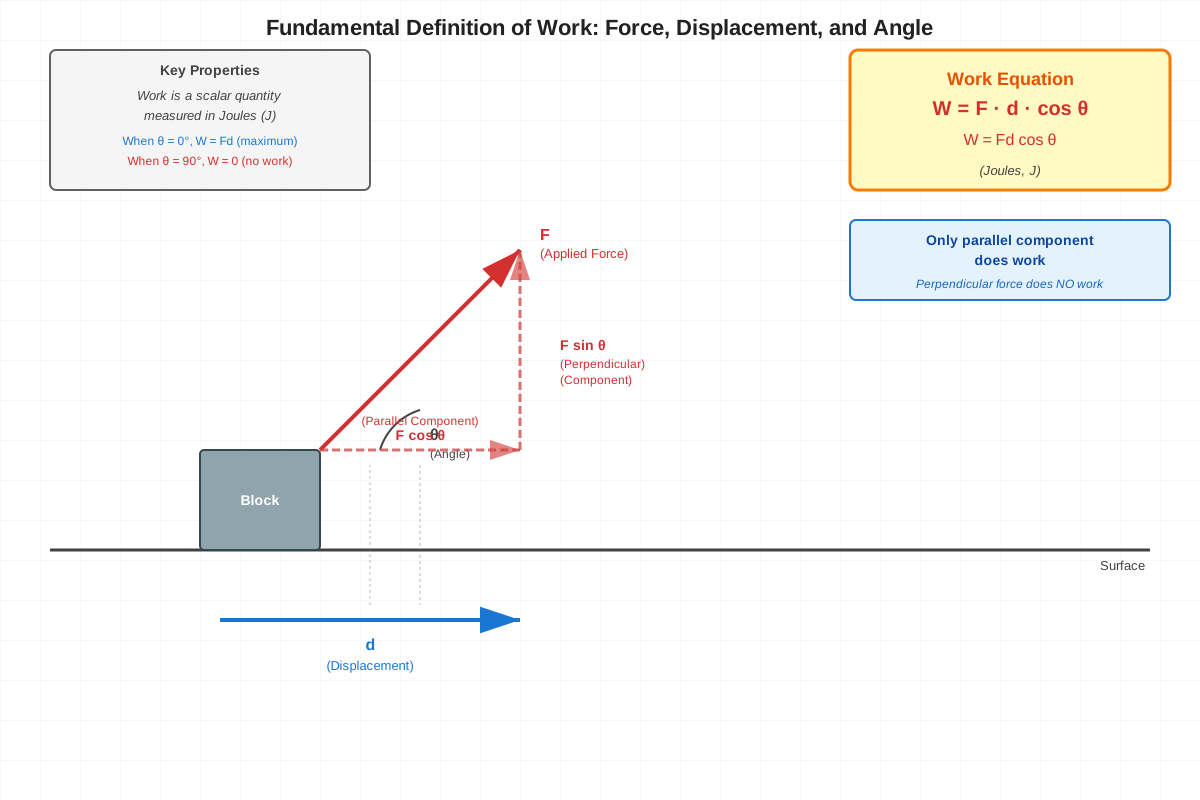
Work is defined as the product of the component of force in the direction of displacement and the magnitude of that displacement. Mathematically, for a constant force:
W = F · d · cos(θ)Where:
- W = work (measured in joules, J)
- F = magnitude of the applied force (newtons, N)
- d = magnitude of displacement (meters, m)
- θ = angle between the force vector and displacement vector
Alternatively, using vector notation: W = F⃗ · d⃗ (the dot product of force and displacement vectors)
The SI unit of work is the joule (J), which equals one newton-meter (N·m). One joule represents the work done when a force of one newton causes a displacement of one meter in the direction of the force.
Key Characteristics of Work
Work is a scalar quantity, not a vector, despite being calculated from two vectors. The dot product operation yields a single number that can be positive, negative, or zero. Work represents energy transfer—when positive work is done on an object, energy is transferred to it; when negative work is done, energy is removed from it.
Positive, Negative, and Zero Work
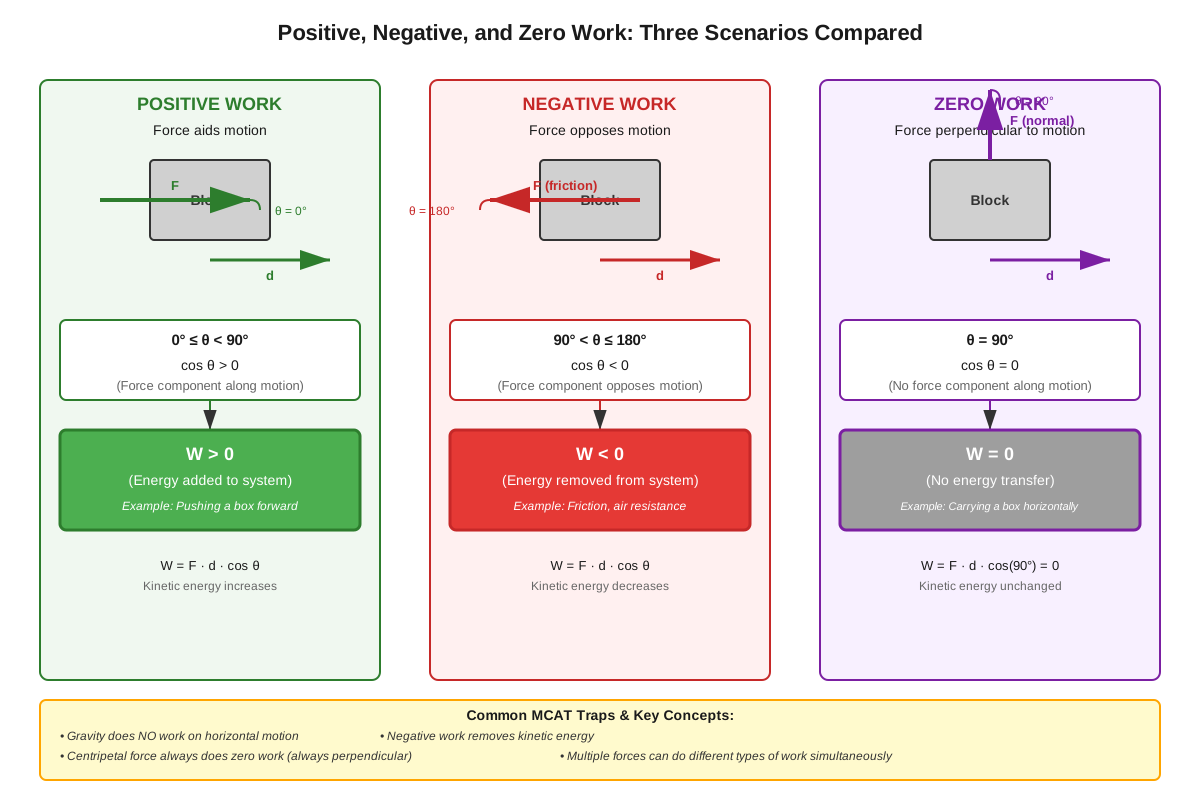
The sign and magnitude of work depend critically on the angle between force and displacement:
| Angle Range | cos(θ) Value | Type of Work | Energy Transfer | Example |
|---|---|---|---|---|
| 0° | +1 | Maximum positive | Energy added to object | Pushing a box forward |
| 0° < θ < 90° | Positive | Positive | Energy added to object | Pulling a sled at an angle |
| 90° | 0 | Zero work | No energy transfer | Carrying a book horizontally |
| 90° < θ < 180° | Negative | Negative | Energy removed from object | Friction opposing motion |
| 180° | -1 | Maximum negative | Maximum energy removed | Catching a ball |
Positive work occurs when the force has a component in the direction of motion (0° ≤ θ < 90°). The object gains kinetic energy. Examples include a car's engine accelerating the vehicle forward, or lifting an object upward against gravity.
Negative work occurs when the force has a component opposite to the direction of motion (90° < θ ≤ 180°). The object loses kinetic energy. Examples include friction slowing a sliding object, air resistance slowing a projectile, or gravity acting on an object thrown upward.
Zero work occurs when the force is perpendicular to displacement (θ = 90°). Despite a force being applied, no energy is transferred. Examples include:
- Centripetal force in uniform circular motion (force points toward center, displacement is tangential)
- Normal force when an object slides horizontally across a surface
- Carrying an object horizontally at constant velocity (vertical force, horizontal displacement)
Work Done by Multiple Forces
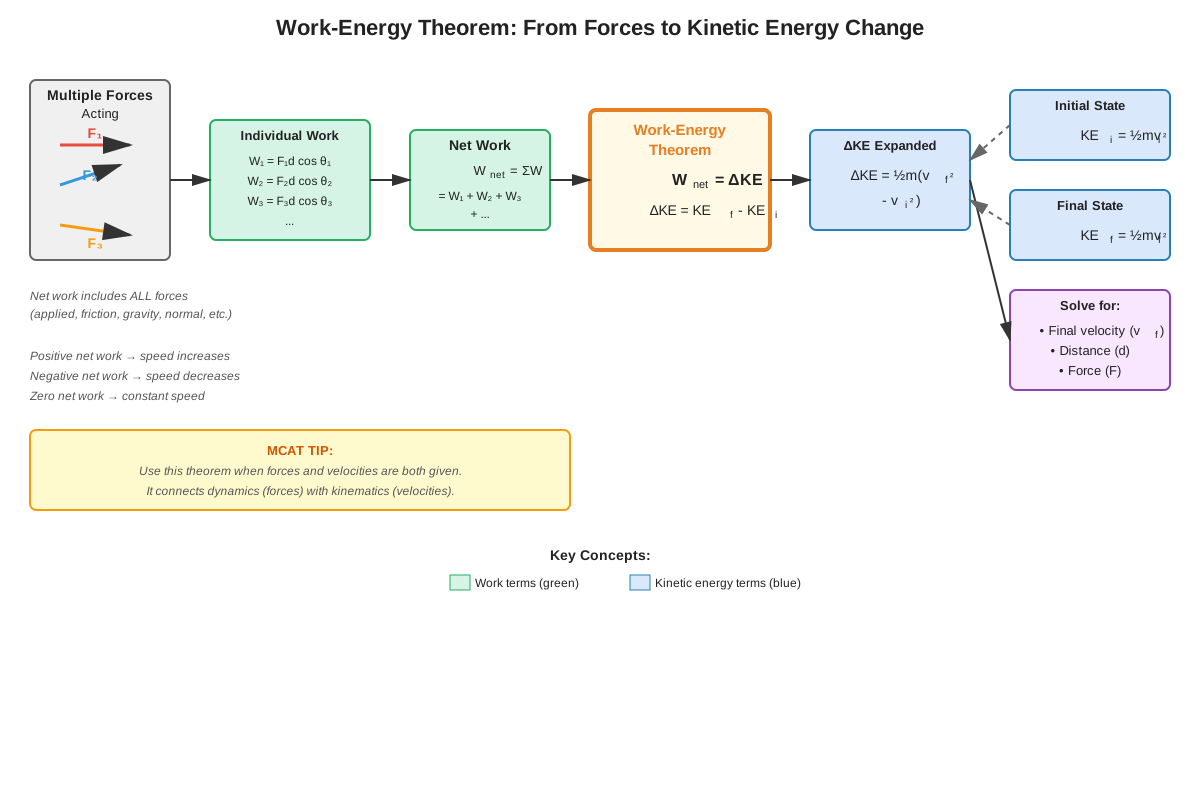
When multiple forces act on an object, each force can do work independently. The net work (total work) equals the sum of work done by each individual force:
W_net = W₁ + W₂ + W₃ + ... = ΣWAlternatively, net work can be calculated by finding the net force first, then calculating work:
W_net = F_net · d · cos(θ)Both methods yield identical results, but one may be more efficient depending on the problem structure.
The Work-Energy Theorem
The work-energy theorem is one of the most powerful tools in mechanics, stating that the net work done on an object equals its change in kinetic energy:
W_net = ΔKE = KE_final - KE_initial = ½mv² - ½mv₀²This theorem provides a direct connection between forces (through work) and motion (through kinetic energy). It's particularly useful when:
- Multiple forces act on an object
- The path is complex or curved
- Acceleration is not constant
- You need to find final velocity without knowing time or acceleration
The work-energy theorem applies to the net work only—the sum of work done by all forces. Individual forces may do positive or negative work, but only the net work determines the change in kinetic energy.
Work Done by Gravity
Gravity does work whenever an object moves vertically. For an object moving vertically through a height h:
W_gravity = mgh · cos(θ)Where θ is the angle between the gravitational force (downward) and displacement:
- Object falling down: θ = 0°, W = +mgh (positive work)
- Object rising up: θ = 180°, W = -mgh (negative work)
- Object moving horizontally: θ = 90°, W = 0 (zero work)
The work done by gravity depends only on the vertical displacement, not the path taken. This path-independence makes gravity a conservative force, a concept that connects to potential energy.
Work Done Against Gravity
When lifting an object at constant velocity, an applied force must equal the gravitational force in magnitude but opposite in direction. The work done by the applied force is:
W_applied = +mghThis positive work increases the object's gravitational potential energy. The work done by gravity is -mgh, so the net work is zero, consistent with no change in kinetic energy (constant velocity).
Work Done by Friction
Friction always opposes motion, so it always does negative work:
W_friction = -f_k · d = -μ_k · N · dWhere:
- f_k = kinetic friction force
- μ_k = coefficient of kinetic friction
- N = normal force
- d = distance traveled
The negative work done by friction converts kinetic energy into thermal energy, which is why sliding objects slow down and surfaces heat up.
Work Done by Springs
For a spring obeying Hooke's Law (F = -kx), the work done to compress or stretch the spring from its equilibrium position is:
W_spring = ½kx²Where:
- k = spring constant (N/m)
- x = displacement from equilibrium (m)
This work is stored as elastic potential energy in the spring. The spring force is variable (increases with displacement), so the work calculation requires integration or using the average force (½kx).
Variable Forces and Integration
When force varies with position, work must be calculated using integration:
W = ∫F(x)dxGraphically, work equals the area under a force vs. position curve. For the MCAT, students should recognize that:
- Constant force: area of rectangle = F × d
- Linearly varying force: area of triangle or trapezoid
- Spring force: area of triangle = ½(kx)(x) = ½kx²
Concept Relationships
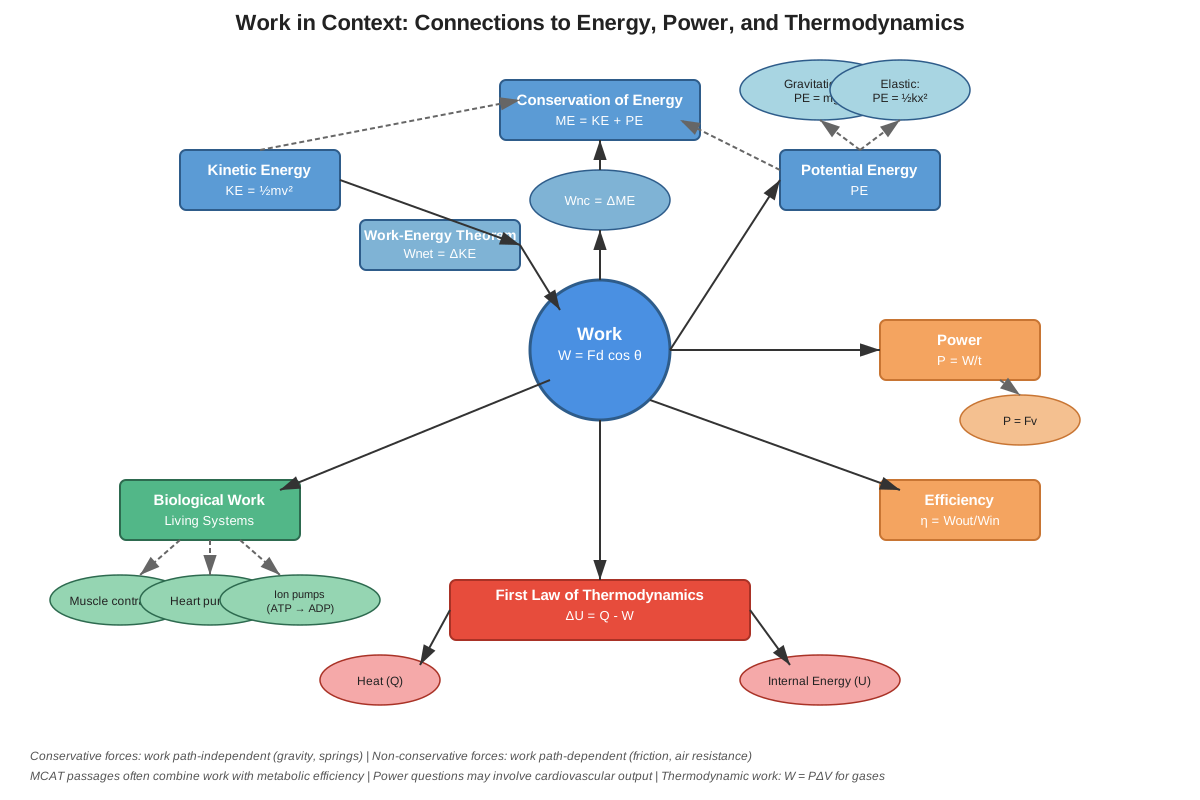
Work serves as the central connecting concept between forces and energy in mechanics. The relationship flow follows this pattern:
Forces (Newton's Laws) → Work (energy transfer) → Kinetic Energy (motion) → Total Mechanical Energy (conservation)
Within the topic of work itself, the concepts connect as follows:
Basic Definition (W = Fd cos θ) → Sign of Work (positive/negative/zero) → Multiple Forces (net work) → Work-Energy Theorem (ΔKE) → Specific Applications (gravity, friction, springs)
Work connects backward to prerequisite topics:
- Vectors: Work uses dot product and component analysis
- Forces: Work quantifies the effect of forces over distance
- Kinematics: Work-energy theorem connects to velocity changes
Work connects forward to subsequent topics:
- Kinetic Energy: Work changes kinetic energy (work-energy theorem)
- Potential Energy: Work against conservative forces stores potential energy
- Conservation of Energy: Net work by non-conservative forces equals change in mechanical energy
- Power: Power is the rate of doing work (P = W/t)
- Thermodynamics: Work is one way to transfer energy (first law: ΔU = Q - W)
The work-energy theorem specifically bridges dynamics (force-based analysis) and energy methods (energy-based analysis), allowing students to solve problems using whichever approach is more efficient.
High-Yield Facts
⭐ Work is only done when force causes displacement in the direction of the force; perpendicular forces do no work
⭐ The work-energy theorem states that net work equals change in kinetic energy: W_net = ΔKE
⭐ Work is a scalar quantity measured in joules (J), where 1 J = 1 N·m
⭐ Negative work removes energy from an object; positive work adds energy to an object
⭐ Work done by gravity depends only on vertical displacement: W = ±mgh
- Work done by centripetal force in uniform circular motion is always zero because force is perpendicular to velocity
- When carrying an object horizontally at constant velocity, the upward force does no work because displacement is perpendicular
- Friction always does negative work because it always opposes the direction of motion
- Work done to stretch or compress a spring is W = ½kx², where x is displacement from equilibrium
- Net work can be calculated either by summing individual works or by using net force: both methods give identical results
- Work is path-independent for conservative forces (gravity, springs) but path-dependent for non-conservative forces (friction)
- The area under a force vs. position graph equals the work done by that force
- When multiple forces act, only forces with components parallel to displacement do work
- Work has the same units as energy because work represents energy transfer
- At constant velocity, net work is zero because kinetic energy doesn't change
Quick check — test yourself on Work so far.
Try Flashcards →Common Misconceptions
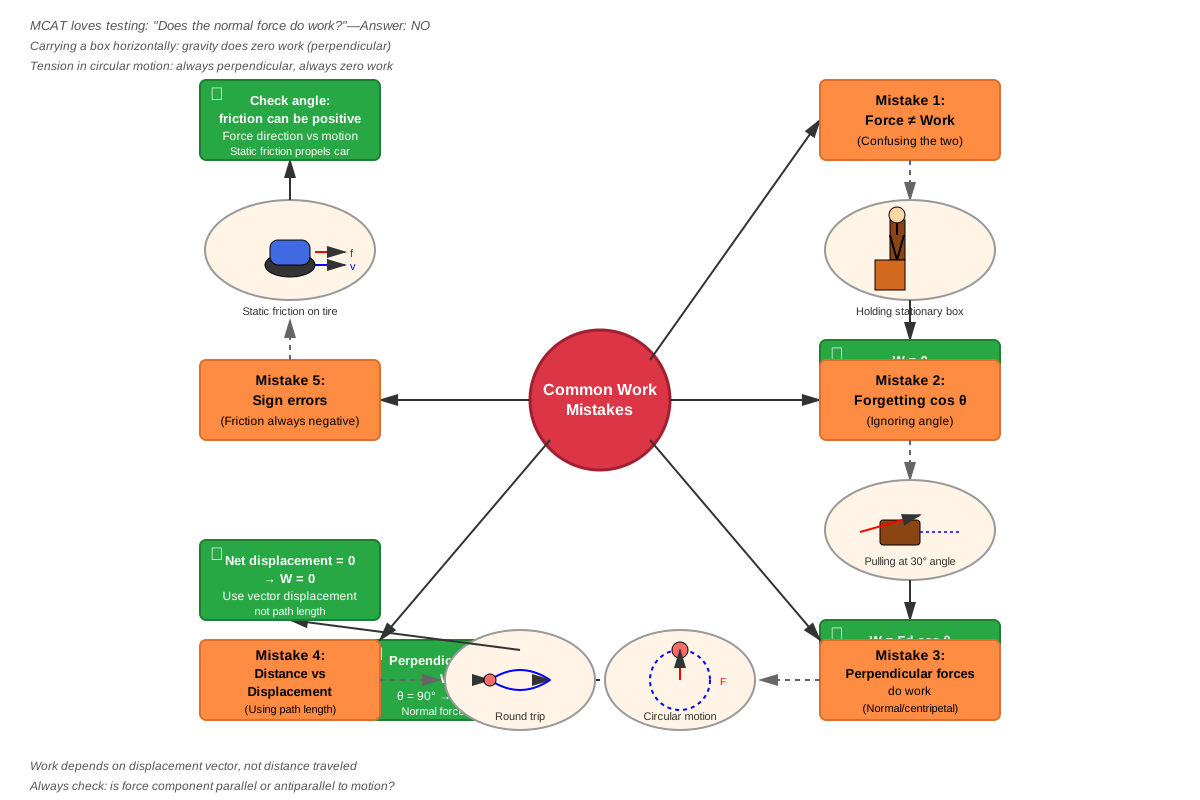
Misconception: Work is done whenever a force is applied to an object.
Correction: Work requires both force AND displacement in the direction of the force. Pushing against a stationary wall does no work (no displacement). Holding a heavy object stationary does no work (no displacement). Carrying an object horizontally does no work by the upward force (perpendicular to displacement).
Misconception: Greater force always means more work is done.
Correction: Work depends on both force and displacement. A small force acting over a large distance can do more work than a large force acting over a small distance. Additionally, if the force is perpendicular to displacement, no work is done regardless of force magnitude.
Misconception: Negative work means no work is done.
Correction: Negative work is still work—it represents energy being removed from the object. Friction doing -50 J of work means 50 J of kinetic energy is converted to thermal energy. The negative sign indicates the direction of energy transfer, not the absence of work.
Misconception: The normal force always does zero work.
Correction: The normal force does zero work only when displacement is parallel to the surface (perpendicular to the normal force). In an elevator accelerating upward, the normal force does positive work on a passenger because both force and displacement are upward. The key is the angle between force and displacement, not the type of force.
Misconception: Work and energy are different things measured in different units.
Correction: Work and energy are measured in the same units (joules) because work is a mechanism of energy transfer. When work is done on a system, energy enters or leaves that system. Work is not a form of energy itself but rather the process by which energy is transferred via forces.
Misconception: In the work formula W = Fd cos θ, θ can be any angle you choose.
Correction: The angle θ must be specifically the angle between the force vector and the displacement vector. This is determined by the physical situation, not by choice. Incorrectly identifying this angle is a common source of calculation errors.
Misconception: The work-energy theorem only applies when a single force acts on an object.
Correction: The work-energy theorem relates NET work (sum of all forces) to change in kinetic energy. It applies regardless of how many forces act on the object. You must either calculate work for each force and sum them, or find the net force first and calculate work from that.
Worked Examples
Example 1: Work by Multiple Forces on an Incline
Problem: A 5.0 kg block is pulled 3.0 m up a frictionless incline that makes a 30° angle with the horizontal. The block is pulled by a rope parallel to the incline with a tension of 35 N. Calculate: (a) work done by tension, (b) work done by gravity, (c) work done by the normal force, (d) net work, and (e) the block's final speed if it started from rest.
Solution:
(a) Work done by tension:
The tension force is parallel to displacement (both along the incline), so θ = 0°.
W_tension = F · d · cos(0°) = 35 N × 3.0 m × 1 = +105 J(b) Work done by gravity:
Gravity acts downward (mg), displacement is along the incline. The vertical height change is:
h = d · sin(30°) = 3.0 m × 0.5 = 1.5 mGravity opposes upward motion, so work is negative:
W_gravity = -mgh = -(5.0 kg)(10 m/s²)(1.5 m) = -75 JAlternatively, using the angle between force and displacement:
The angle between downward gravity and upward-along-incline displacement is 120°.
W_gravity = mg · d · cos(120°) = 50 N × 3.0 m × (-0.5) = -75 J(c) Work done by normal force:
The normal force is perpendicular to the incline surface, and displacement is along the incline, so θ = 90°.
W_normal = N · d · cos(90°) = N × 3.0 m × 0 = 0 J(d) Net work:
W_net = W_tension + W_gravity + W_normal = 105 J + (-75 J) + 0 J = +30 J(e) Final speed using work-energy theorem:
W_net = ΔKE = ½mv² - ½mv₀²
30 J = ½(5.0 kg)v² - 0
v² = 12 m²/s²
v = 3.46 m/s ≈ 3.5 m/s
Key Insights: This problem demonstrates that each force must be analyzed independently. The normal force does no work despite being a large force because it's perpendicular to motion. The net work is positive, so the block gains kinetic energy. The work-energy theorem provides final velocity without needing to know acceleration or time.
Example 2: Work and Friction in a Biological Context
Problem: A 70 kg person walks 100 m horizontally at constant velocity. While walking, the person's center of mass rises and falls by 3.0 cm with each step, and the person takes 50 steps to cover the 100 m. The coefficient of kinetic friction between shoes and ground is 0.80. Calculate: (a) work done by friction, (b) work done by the person's muscles against gravity, (c) total work the person's muscles must do, and (d) explain why the person gets tired despite moving at constant velocity.
Solution:
(a) Work done by friction:
At constant velocity, the forward force from the ground (static friction) does no net work in the horizontal direction. However, we need to consider the normal force and horizontal displacement. Since the person moves at constant velocity horizontally, the net horizontal work is zero. The friction force that matters is the one opposing the foot's backward push, but this is internal to the person-ground system. For the person's center of mass moving horizontally at constant velocity:
W_friction_horizontal = 0 J (constant velocity means no net work)(b) Work done against gravity:
The person's center of mass rises 3.0 cm = 0.030 m with each step, then falls 0.030 m. Over 50 steps:
- Total upward displacement: 50 × 0.030 m = 1.5 m
- Total downward displacement: 50 × 0.030 m = 1.5 m
Work done by muscles lifting the body:
W_up = mgh = (70 kg)(10 m/s²)(1.5 m) = +1050 JDuring the downward phase, gravity does positive work (+1050 J), but muscles must do negative work (eccentric contraction) to control the descent and prevent falling:
W_down = -1050 J (approximately, assuming controlled descent)Total work against gravity per cycle: The net displacement is zero, but muscles do work in both directions.
W_gravity_total ≈ 1050 J + 1050 J = 2100 J(c) Total muscular work:
In addition to lifting the center of mass, muscles must overcome internal friction in joints, tendons, and tissues. The total work includes:
- Work to raise center of mass: 1050 J
- Work to control descent: 1050 J
- Work against internal resistance (estimated at ~30% of gravitational work): ~630 J
W_total ≈ 2100 J + 630 J ≈ 2700 J(d) Why fatigue occurs at constant velocity:
Even though the person's kinetic energy doesn't change (constant velocity means ΔKE = 0 and W_net = 0), the muscles continuously do positive and negative work to raise and lower the center of mass with each step. This work converts chemical energy (ATP) into mechanical work and heat. Negative work (eccentric contractions during descent) still requires ATP and causes muscle damage and fatigue. Additionally, maintaining posture and overcoming internal friction requires continuous energy expenditure. The zero net work refers only to the person's overall kinetic energy, not to the internal work done by muscles.
Key Insights: This problem illustrates that zero net work doesn't mean no energy expenditure. Internal biological work, cyclic motion, and negative work all require metabolic energy. This concept frequently appears in MCAT passages about locomotion, exercise physiology, and metabolic efficiency.
Exam Strategy
Approaching Work Questions
- Identify all forces acting on the object first. Draw a free-body diagram if the situation is complex.
- Determine displacement magnitude and direction. Work depends on displacement, not distance traveled.
- Find angles between each force vector and the displacement vector. This is the most common source of errors.
- Calculate work for each force individually using W = Fd cos θ, paying careful attention to signs.
- Sum to find net work if the question asks for total work or if you need to apply the work-energy theorem.
- Apply work-energy theorem if the question involves velocity changes: W_net = ΔKE.
Trigger Words and Phrases
- "At constant velocity" → Net work is zero; kinetic energy doesn't change
- "Frictionless" → Friction does no work; only consider other forces
- "Horizontal surface" → Gravity and normal force do no work (perpendicular to displacement)
- "Lifted vertically" → Work against gravity = mgh
- "Comes to rest" → Final kinetic energy is zero; W_net = -½mv₀²
- "Starting from rest" → Initial kinetic energy is zero; W_net = ½mv²
- "Pulled at an angle" → Must use cos θ; only the parallel component does work
- "Circular path" → Centripetal force does no work (perpendicular to velocity)
Process of Elimination Tips
- Eliminate answers with wrong units: Work must be in joules (J) or equivalent energy units
- Check signs: If an object speeds up, net work must be positive; if it slows down, net work must be negative
- Verify zero work scenarios: If force is perpendicular to displacement, work must be zero
- Use limiting cases: If angle is 0°, work should equal Fd; if angle is 90°, work should be zero
- Energy conservation check: Total energy should be conserved unless non-conservative forces do work
Time Allocation
- Simple calculation (one force, given angle): 30-45 seconds
- Multiple forces (need to find net work): 60-90 seconds
- Work-energy theorem application: 60-90 seconds
- Passage-based with multiple parts: 2-3 minutes for the full set
Exam Tip: If a question asks for work done by a specific force, calculate only that force's work. If it asks for net work or involves velocity changes, you must consider all forces. Read carefully to distinguish between these scenarios.
Memory Techniques
Mnemonic for When Work is Zero
"PEN" - Perpendicular forces, Equal and opposite (constant velocity), No displacement
- Perpendicular: Force at 90° to displacement does no work
- Equal and opposite: At constant velocity, positive and negative work cancel (net = 0)
- No displacement: No movement means no work, regardless of force
Visualization for Work Sign
Imagine pushing a shopping cart:
- Positive work: Pushing forward (force and motion same direction) - cart speeds up
- Negative work: Pushing backward while cart rolls forward (force opposes motion) - cart slows down
- Zero work: Pushing down on the handle while cart rolls forward (force perpendicular) - speed unchanged
Acronym for Work-Energy Theorem
"NEW KE" - Net External Work = Kinetic Energy change
This reminds you that:
- Only NET work matters for kinetic energy changes
- EXTERNAL forces do work (internal forces cancel in systems)
- WORK equals the change in KE
Memory Aid for Common Zero-Work Scenarios
"CAN'T" do work:
- Centripetal force (perpendicular to velocity)
- At constant velocity (net work is zero)
- Normal force on horizontal surface (perpendicular to motion)
- Tension in uniform circular motion (perpendicular to velocity)
Summary
Work is the transfer of energy that occurs when a force causes displacement in the direction of that force, quantified by W = Fd cos θ. This fundamental concept connects forces to energy changes and appears frequently on the MCAT in both physics and biological contexts. Work is a scalar measured in joules, and its sign indicates the direction of energy transfer: positive work adds energy to an object, negative work removes energy, and zero work occurs when force is perpendicular to displacement. The work-energy theorem, stating that net work equals change in kinetic energy, provides a powerful alternative to force-based analysis for solving mechanics problems. Common applications include calculating work done by gravity (±mgh), friction (-μNd), and springs (½kx²), as well as analyzing scenarios where multiple forces act simultaneously. Understanding when work is zero—such as for centripetal force, normal force on horizontal surfaces, or when carrying objects horizontally—is crucial for avoiding common misconceptions. Mastery of work enables students to analyze energy transformations in biological systems, from molecular motors to cardiovascular function, making it essential for MCAT success.
Key Takeaways
- Work is defined as W = Fd cos θ, where θ is the angle between force and displacement vectors; it represents energy transfer via forces
- The sign of work indicates energy flow: positive work adds energy, negative work removes energy, and perpendicular forces do zero work
- The work-energy theorem (W_net = ΔKE) connects net work to changes in kinetic energy, providing an efficient problem-solving method
- Each force acting on an object can do work independently; net work is the sum of all individual works
- Common zero-work scenarios include centripetal force, normal force on horizontal surfaces, and any force perpendicular to displacement
- Work done by gravity depends only on vertical displacement (±mgh), while friction always does negative work (-fd)
- At constant velocity, net work is zero because kinetic energy doesn't change, even though individual forces may do work
Related Topics
Kinetic Energy: Work directly changes an object's kinetic energy through the work-energy theorem. Understanding work is prerequisite to analyzing how energy of motion changes in mechanical systems.
Potential Energy: Work done against conservative forces (gravity, springs) is stored as potential energy. The relationship between work and potential energy explains energy storage in biological and physical systems.
Conservation of Energy: Work by non-conservative forces equals the change in total mechanical energy. This extends work concepts to comprehensive energy analysis.
Power: Power is the rate of doing work (P = W/t), connecting work to time. This is essential for understanding metabolic rate, cardiac output, and muscle performance.
Impulse and Momentum: While work relates force to energy changes, impulse relates force to momentum changes. Comparing these parallel concepts deepens understanding of force effects.
Simple Machines: Levers, pulleys, and inclined planes redistribute work and force. Analyzing these systems requires applying work principles to mechanical advantage.
Practice CTA
Now that you've mastered the conceptual foundation of work, it's time to solidify your understanding through active practice. Work through the accompanying practice questions, focusing on identifying force-displacement angles and applying the work-energy theorem. Create flashcards for the high-yield facts, especially the zero-work scenarios that frequently appear on the MCAT. Challenge yourself with problems involving multiple forces and biological contexts—these mirror the integrated reasoning the MCAT demands. Remember, understanding work unlocks the entire energy unit in physics, making your investment in this topic highly efficient for exam preparation. You've built the foundation; now apply it with confidence!
Sign up free to keep reading
Create a free AnvayaPrep account to finish this MCAT guide on Work — plus flashcards and practice questions.