Overview
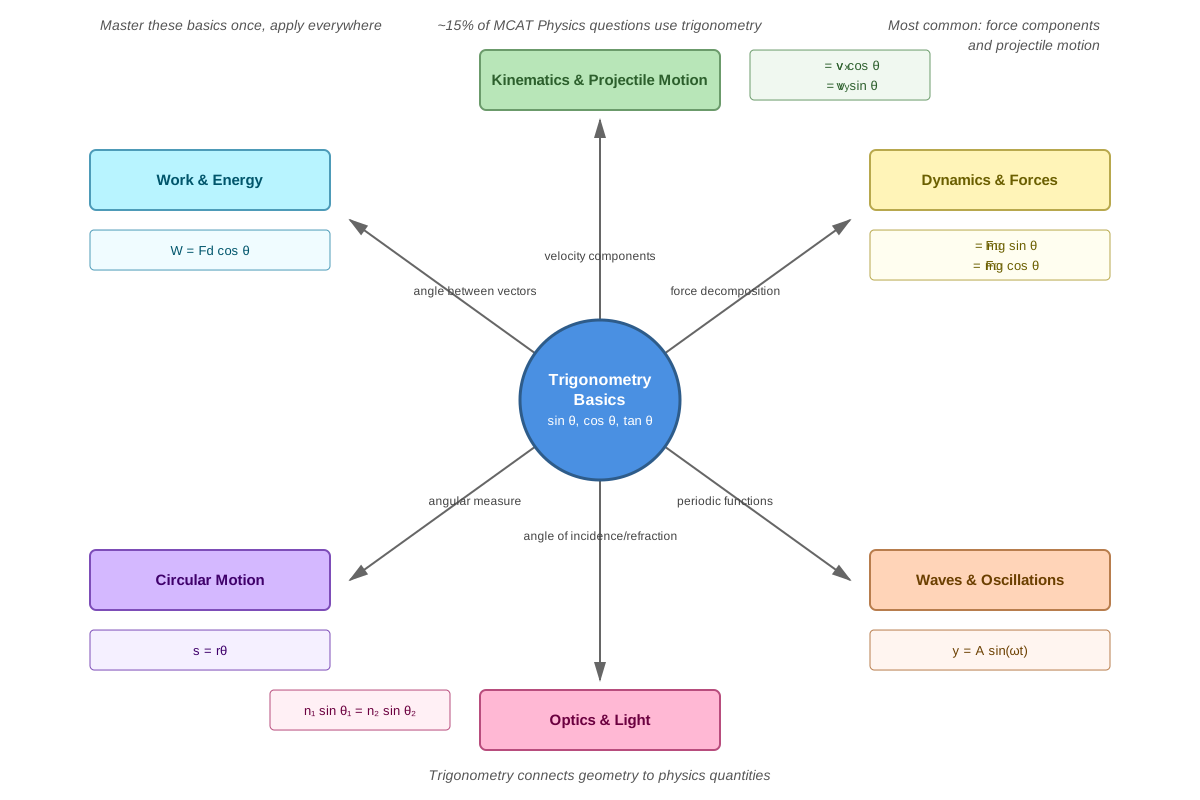
Trigonometry basics form an essential mathematical foundation for success on the MCAT, particularly within the Physics section where vector analysis, wave phenomena, and force decomposition appear frequently. While the MCAT does not test advanced trigonometric identities or complex proofs, a solid understanding of fundamental trigonometric ratios, the unit circle, and basic angle relationships enables students to solve problems involving projectile motion, inclined planes, pendulums, wave interference, and electromagnetic field components. These mathematical tools bridge the gap between abstract physics principles and quantitative problem-solving, allowing test-takers to translate conceptual understanding into numerical answers.
The importance of trigonometry basics Physics extends beyond isolated calculation questions. MCAT passages often present experimental setups involving angles—such as light refraction through prisms, forces on inclined surfaces, or oscillating systems—where recognizing the appropriate trigonometric relationship becomes the key to unlocking the correct answer. Students who can quickly identify when to apply sine, cosine, or tangent functions, and who understand the geometric meaning behind these ratios, gain significant time advantages and accuracy improvements on test day.
Within the broader context of Math and Units, trigonometry serves as a critical tool for vector decomposition and coordinate system transformations. This topic connects directly to kinematics, dynamics, optics, and waves—all high-yield areas for the MCAT. Understanding how trigonometric functions relate angles to side ratios in right triangles, and how these relationships extend to circular motion and periodic phenomena, provides the mathematical literacy necessary to navigate approximately 15-20% of physics questions and select biochemistry problems involving molecular geometry.
Learning Objectives
- [ ] Define Trigonometry basics using accurate Physics terminology
- [ ] Explain why Trigonometry basics matters for the MCAT
- [ ] Apply Trigonometry basics to exam-style questions
- [ ] Identify common mistakes related to Trigonometry basics
- [ ] Connect Trigonometry basics to related Physics concepts
- [ ] Calculate sine, cosine, and tangent values for standard angles (0°, 30°, 45°, 60°, 90°) without a calculator
- [ ] Decompose vectors into perpendicular components using trigonometric functions
- [ ] Recognize and apply the Pythagorean theorem in conjunction with trigonometric ratios
Prerequisites
- Basic algebra: Manipulation of equations and solving for unknown variables is necessary to isolate trigonometric terms and solve for angles or side lengths
- Right triangle geometry: Understanding the properties of right triangles, including the relationship between angles and sides, forms the foundation for all trigonometric ratios
- Unit conversions: Converting between degrees and radians, and understanding angular measurements, ensures proper application of trigonometric functions
- Basic calculator skills: While the MCAT provides a basic calculator, knowing when and how to use it for trigonometric calculations saves valuable time
Why This Topic Matters
Trigonometry basics MCAT questions appear with moderate frequency across multiple physics contexts, making this topic a reliable source of points for well-prepared students. Approximately 10-15% of physics questions involve some trigonometric calculation or conceptual understanding, whether explicitly (calculating force components on an incline) or implicitly (understanding phase relationships in waves). The MCAT specifically tests students' ability to apply trigonometry in practical scenarios rather than testing pure mathematical theory, meaning every trigonometric concept learned translates directly to problem-solving capability.
In clinical and research contexts, trigonometry underlies numerous medical technologies and physiological measurements. Medical imaging techniques like CT scans use trigonometric reconstruction algorithms, ultrasound wave propagation involves angular relationships, and biomechanical analysis of joint forces requires vector decomposition using sine and cosine functions. Understanding these mathematical foundations helps future physicians appreciate the quantitative basis of diagnostic tools and treatment planning.
On the MCAT, trigonometry most commonly appears in discrete questions about forces on inclined planes, projectile motion problems, and optics questions involving angles of incidence and refraction. Passage-based questions may embed trigonometric relationships within experimental designs, such as determining the horizontal and vertical components of velocity in a ballistics experiment or calculating the work done by a force applied at an angle. Recognition of these patterns—identifying when a problem requires trigonometric analysis—becomes as important as executing the calculations themselves.
Core Concepts
The Right Triangle Foundation
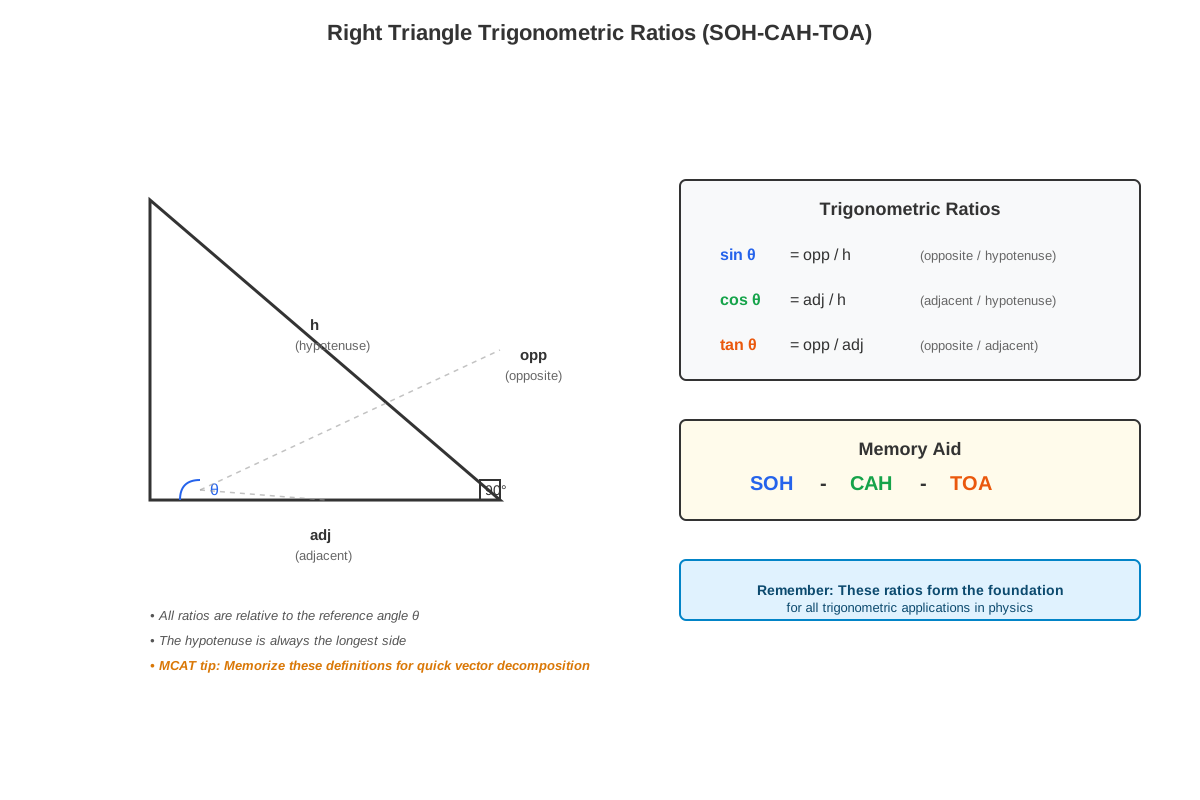
Trigonometry basics begin with the right triangle, a three-sided polygon containing one 90-degree angle. The three sides are designated as the hypotenuse (the longest side, opposite the right angle), the opposite side (across from the angle of interest), and the adjacent side (next to the angle of interest, but not the hypotenuse). These relative positions change depending on which acute angle serves as the reference point, making it crucial to identify the angle of interest before applying trigonometric ratios.
The three primary trigonometric functions—sine (sin), cosine (cos), and tangent (tan)—define relationships between angles and side ratios:
sin(θ) = opposite/hypotenuse
cos(θ) = adjacent/hypotenuse
tan(θ) = opposite/adjacent
These ratios remain constant for any given angle regardless of the triangle's size, which is why trigonometric functions are so powerful for solving problems involving similar triangles or scaling relationships. The mnemonic SOH-CAH-TOA (Sine = Opposite/Hypotenuse, Cosine = Adjacent/Hypotenuse, Tangent = Opposite/Adjacent) provides a reliable memory aid for these fundamental definitions.
Standard Angle Values
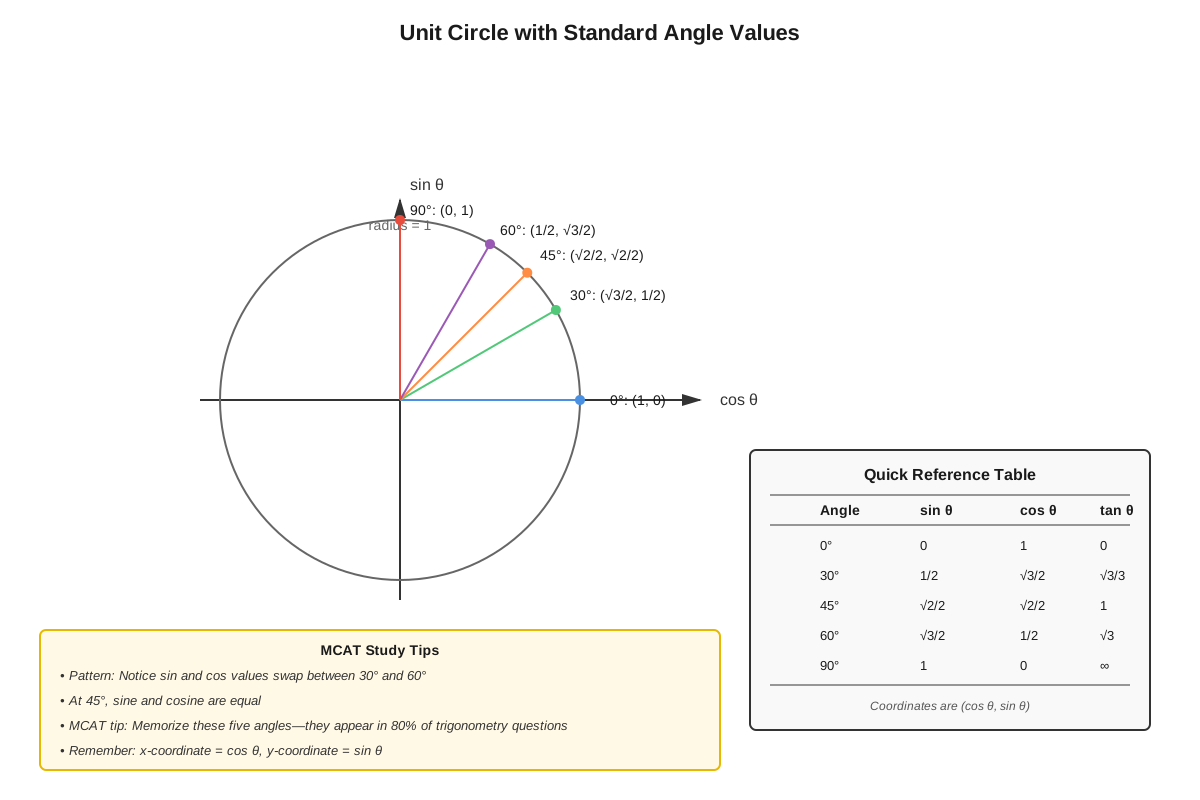
For the MCAT, memorizing trigonometric values for standard angles eliminates the need for time-consuming calculator use and enables rapid estimation. The most important angles and their values are:
| Angle | sin(θ) | cos(θ) | tan(θ) |
|---|---|---|---|
| 0° | 0 | 1 | 0 |
| 30° | 1/2 | √3/2 | 1/√3 |
| 45° | √2/2 | √2/2 | 1 |
| 60° | √3/2 | 1/2 | √3 |
| 90° | 1 | 0 | undefined |
These values derive from the geometry of special right triangles: the 30-60-90 triangle (with side ratios 1:√3:2) and the 45-45-90 triangle (with side ratios 1:1:√2). Understanding these special triangles allows students to reconstruct trigonometric values if memory fails during the exam.
For practical MCAT purposes, approximating √2 ≈ 1.4 and √3 ≈ 1.7 provides sufficient accuracy for most calculations. Additionally, recognizing that sin(30°) = cos(60°) and sin(60°) = cos(30°) illustrates the complementary angle relationship: sin(θ) = cos(90° - θ).
Vector Decomposition
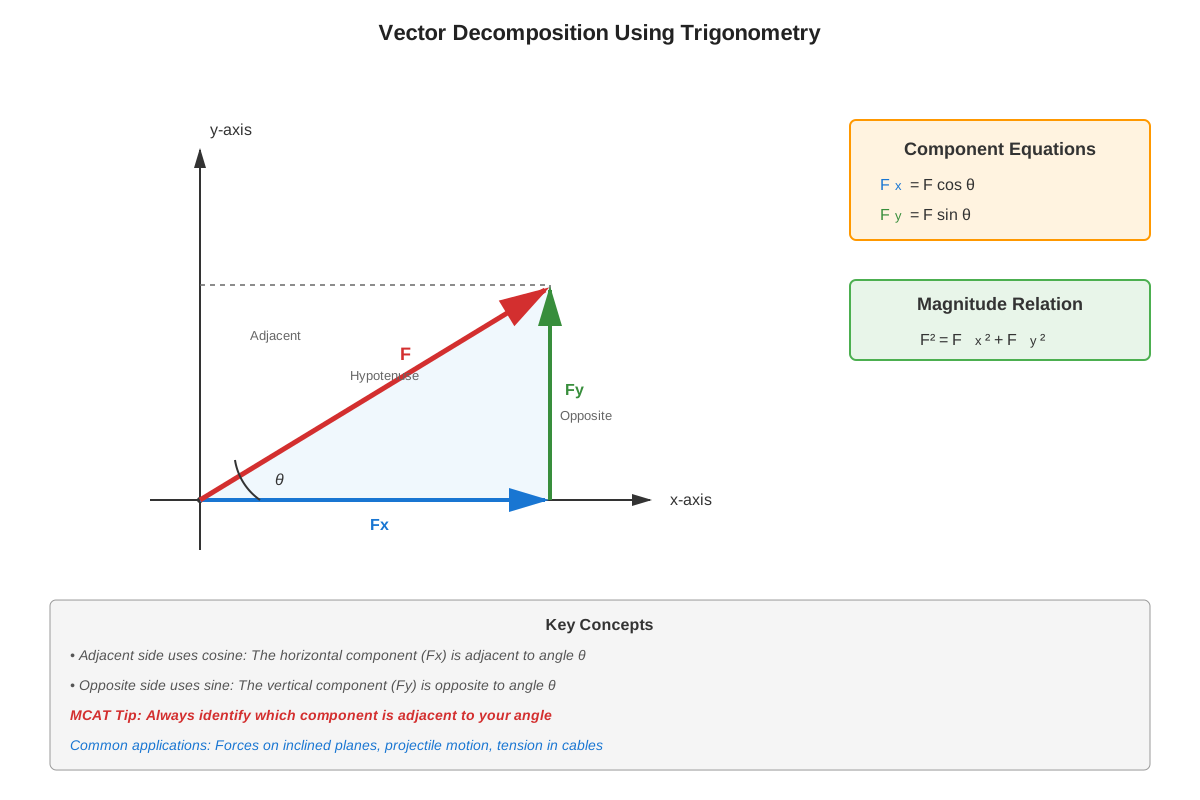
One of the most high-yield applications of trigonometry basics Physics involves breaking vectors into perpendicular components. Any vector at an angle θ from the horizontal can be decomposed into:
- Horizontal component: Vₓ = V cos(θ)
- Vertical component: Vᵧ = V sin(θ)
This decomposition proves essential for analyzing projectile motion, where initial velocity at an angle must be separated into horizontal and vertical components that behave independently. Similarly, forces acting at angles (such as tension in a rope pulling at an angle or the normal force on an inclined plane) require component analysis to apply Newton's laws correctly.
The reverse process—combining perpendicular components into a resultant vector—uses the Pythagorean theorem:
V = √(Vₓ² + Vᵧ²)The angle of the resultant vector relative to the horizontal is found using:
θ = tan⁻¹(Vᵧ/Vₓ)Inclined Plane Analysis
Inclined planes represent one of the most common MCAT applications of trigonometry. When an object rests on a surface tilted at angle θ from the horizontal, the gravitational force (mg) must be decomposed into components parallel and perpendicular to the surface:
- Parallel component (down the incline): F‖ = mg sin(θ)
- Perpendicular component (into the surface): F⊥ = mg cos(θ)
The perpendicular component equals the normal force (in the absence of other vertical forces), while the parallel component drives the object's acceleration down the incline (opposed by friction if present). A common error involves confusing which component uses sine versus cosine; remembering that steeper inclines (larger θ) produce larger parallel forces helps verify that sin(θ) is correct for the parallel component, since sin(θ) increases with θ.
Trigonometric Relationships and Identities
While the MCAT does not extensively test trigonometric identities, several relationships prove useful for problem-solving:
- Pythagorean identity: sin²(θ) + cos²(θ) = 1
- Reciprocal functions: csc(θ) = 1/sin(θ), sec(θ) = 1/cos(θ), cot(θ) = 1/tan(θ)
- Tangent relationship: tan(θ) = sin(θ)/cos(θ)
The Pythagorean identity allows calculation of one trigonometric function from another, which occasionally appears in MCAT problems where only partial information is provided. The reciprocal functions rarely appear explicitly but may be embedded in physics formulas.
Small Angle Approximations
For angles measured in radians where θ << 1 (typically θ < 0.1 radians or about 6°), the small angle approximations simplify calculations:
- sin(θ) ≈ θ
- cos(θ) ≈ 1
- tan(θ) ≈ θ
These approximations appear in pendulum motion (for small amplitude oscillations), wave optics (for small diffraction angles), and other scenarios where angles remain small. Recognizing when these approximations apply can dramatically simplify MCAT calculations and is particularly relevant for passage-based questions involving experimental conditions with small angular deviations.
Concept Relationships
The core trigonometric ratios (sine, cosine, tangent) serve as the foundation from which all other concepts in this topic derive. These ratios → enable vector decomposition → which facilitates analysis of forces on inclined planes and projectile motion. The standard angle values → provide quick reference points → that eliminate calculator dependence and enable rapid estimation during timed exams.
Vector decomposition connects directly to prerequisite knowledge of right triangle geometry, as each component analysis creates a right triangle where the vector is the hypotenuse. This relationship → extends to kinematics → where velocity and acceleration vectors must be analyzed in perpendicular directions. Similarly, force analysis → requires trigonometric decomposition → to apply Newton's second law in multiple dimensions.
The Pythagorean identity links back to the Pythagorean theorem from geometry, demonstrating how trigonometric functions maintain internal consistency. This mathematical relationship → ensures that component vectors → when recombined → reproduce the original vector magnitude. Understanding this circular relationship prevents errors in multi-step problems where decomposition and recombination both occur.
Small angle approximations → connect to more advanced physics topics → including simple harmonic motion, wave behavior, and optics. These approximations → simplify differential equations → that describe oscillatory systems, making them particularly relevant for MCAT passages involving pendulums or springs. The approximations also → relate to experimental design → where researchers intentionally maintain small angles to linearize otherwise complex relationships.
High-Yield Facts
⭐ sin(30°) = 1/2, cos(30°) = √3/2, sin(60°) = √3/2, cos(60°) = 1/2 — these are the most frequently tested standard angle values on the MCAT
⭐ For vector decomposition: horizontal component = V cos(θ), vertical component = V sin(θ) where θ is measured from the horizontal
⭐ On an inclined plane at angle θ: parallel force = mg sin(θ), perpendicular force = mg cos(θ)
⭐ sin²(θ) + cos²(θ) = 1 for all angles, enabling calculation of one function from the other
⭐ sin(45°) = cos(45°) = √2/2 ≈ 0.707, making 45° angles particularly simple for calculations
- tan(θ) = sin(θ)/cos(θ), which equals opposite/adjacent in right triangles
- Complementary angles satisfy: sin(θ) = cos(90° - θ)
- For small angles in radians: sin(θ) ≈ tan(θ) ≈ θ and cos(θ) ≈ 1
- The hypotenuse is always the longest side in a right triangle and always appears in the denominator for sine and cosine
- In a 30-60-90 triangle, sides are in ratio 1:√3:2; in a 45-45-90 triangle, sides are in ratio 1:1:√2
- When a force is applied at angle θ to the direction of motion, only the component F cos(θ) does work
- sin(0°) = 0 and cos(0°) = 1, meaning horizontal vectors have no vertical component
Quick check — test yourself on Trigonometry basics so far.
Try Flashcards →Common Misconceptions
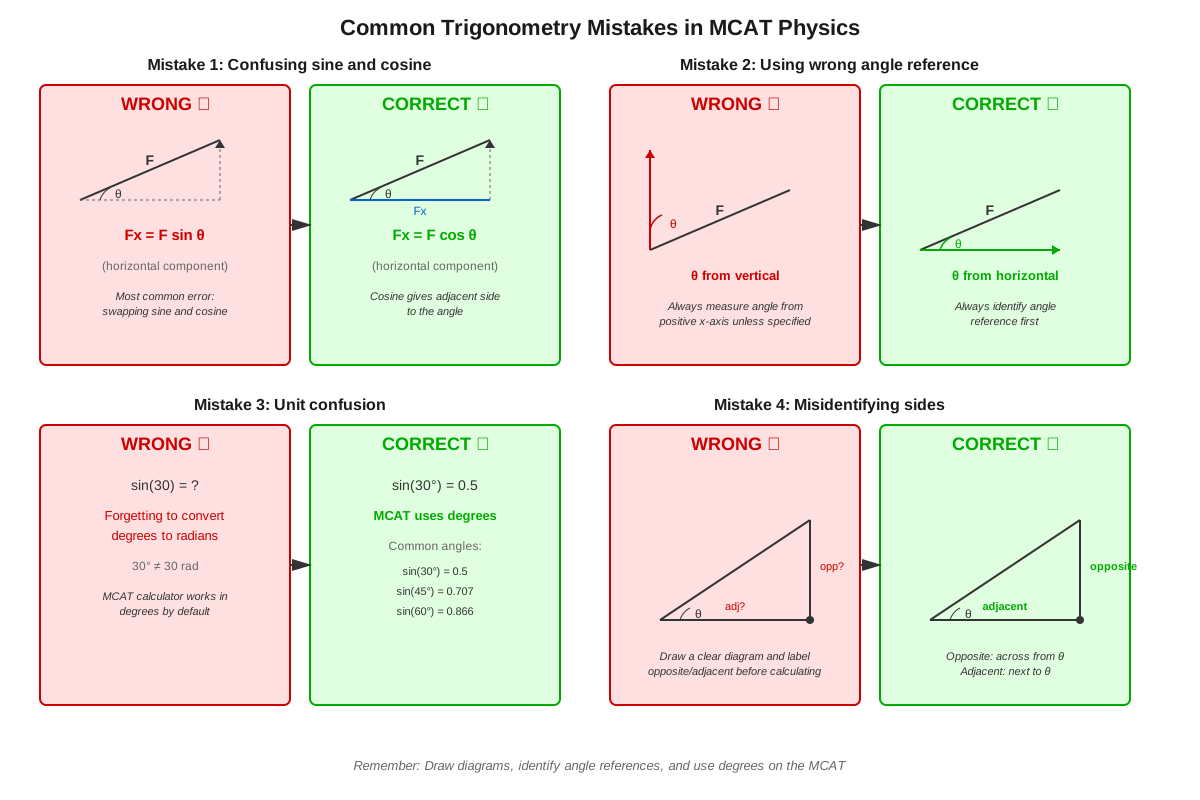
Misconception: Sine always corresponds to the vertical component and cosine to the horizontal component regardless of angle orientation.
Correction: The correct decomposition depends on how the angle is measured. If θ is measured from the horizontal, then cos(θ) gives the horizontal component and sin(θ) gives the vertical component. However, if θ is measured from the vertical, these assignments reverse. Always identify the reference direction before applying trigonometric functions.
Misconception: On an inclined plane, the component of gravity parallel to the surface is mg cos(θ).
Correction: The parallel component is mg sin(θ). This can be verified by considering extreme cases: at θ = 90° (vertical wall), the entire weight acts parallel to the surface, and sin(90°) = 1, giving mg as expected. At θ = 0° (horizontal surface), no component acts parallel to the surface, and sin(0°) = 0, correctly giving zero.
Misconception: Trigonometric functions can be applied with angles in degrees directly into calculators without mode consideration.
Correction: Scientific calculators have both degree and radian modes. The MCAT calculator defaults to degree mode, but students must verify this before calculations. Additionally, some physics formulas (particularly in rotational motion and waves) require angles in radians, necessitating conversion using π radians = 180°.
Misconception: The tangent function equals opposite/hypotenuse.
Correction: Tangent equals opposite/adjacent, not opposite/hypotenuse. This error often occurs when students confuse the SOH-CAH-TOA mnemonic. Tangent can also be calculated as sin(θ)/cos(θ), providing an alternative method when sine and cosine values are known.
Misconception: Larger angles always produce larger sine and cosine values.
Correction: While sine increases from 0° to 90°, cosine decreases over this range. Beyond 90°, both functions oscillate. For MCAT purposes, focusing on the first quadrant (0° to 90°) suffices for most problems, but recognizing that cos(θ) decreases as θ increases prevents errors in problems involving complementary angles.
Misconception: The small angle approximation sin(θ) ≈ θ works for angles in degrees.
Correction: Small angle approximations only work when angles are expressed in radians. Using degrees produces dramatically incorrect results. For example, sin(30°) = 0.5, but 30 ≠ 0.5. Converting to radians: 30° = π/6 ≈ 0.524 radians, and sin(π/6) = 0.5 ≈ π/6, demonstrating the approximation's validity in radians.
Worked Examples
Example 1: Projectile Motion with Angled Launch
Problem: A ball is launched from ground level with an initial velocity of 20 m/s at an angle of 30° above the horizontal. Calculate the horizontal and vertical components of the initial velocity, and determine the maximum height reached (use g = 10 m/s²).
Solution:
Step 1: Identify the given information and what needs to be found.
- Initial velocity magnitude: v₀ = 20 m/s
- Launch angle: θ = 30° from horizontal
- Need: horizontal component (v₀ₓ), vertical component (v₀ᵧ), maximum height (h)
Step 2: Decompose the initial velocity using trigonometric functions.
Since the angle is measured from the horizontal:
- v₀ₓ = v₀ cos(θ) = 20 cos(30°) = 20 × (√3/2) = 20 × 0.866 ≈ 17.3 m/s
- v₀ᵧ = v₀ sin(θ) = 20 sin(30°) = 20 × (1/2) = 10 m/s
Step 3: Calculate maximum height using kinematic equations.
At maximum height, the vertical velocity becomes zero. Using vᵧ² = v₀ᵧ² - 2gh:
- 0 = (10)² - 2(10)h
- 0 = 100 - 20h
- h = 5 m
Answer: The horizontal component is approximately 17.3 m/s, the vertical component is 10 m/s, and the maximum height is 5 m.
Connection to learning objectives: This problem demonstrates the application of trigonometry basics to decompose vectors (a core MCAT skill) and connects to kinematics, showing how trigonometric analysis enables multi-step physics problem-solving.
Example 2: Forces on an Inclined Plane
Problem: A 5 kg block rests on a frictionless inclined plane that makes a 60° angle with the horizontal. Calculate the component of the gravitational force parallel to the incline and the normal force acting on the block (use g = 10 m/s²).
Solution:
Step 1: Draw a free body diagram (mentally or on scratch paper) showing weight (mg) pointing downward, normal force (N) perpendicular to the incline, and identify the angle.
- Mass: m = 5 kg
- Incline angle: θ = 60°
- Weight: W = mg = 5 × 10 = 50 N
Step 2: Decompose the weight into components parallel and perpendicular to the incline.
The key insight is that the angle between the weight vector and the perpendicular to the incline equals the incline angle θ.
- Parallel component: F‖ = mg sin(θ) = 50 sin(60°) = 50 × (√3/2) = 50 × 0.866 ≈ 43.3 N
- Perpendicular component: F⊥ = mg cos(θ) = 50 cos(60°) = 50 × (1/2) = 25 N
Step 3: Determine the normal force.
Since the surface is frictionless and there are no other forces perpendicular to the incline, the normal force equals the perpendicular component of weight:
- N = F⊥ = 25 N
Step 4: Verify the answer makes physical sense.
At 60° (a steep incline), most of the weight should act parallel to the surface, and indeed 43.3 N > 25 N. If the incline were 90° (vertical), all weight would be parallel (sin(90°) = 1), and if horizontal (0°), all weight would be perpendicular (cos(0°) = 1). Our answer fits this pattern.
Answer: The parallel component is approximately 43.3 N, and the normal force is 25 N.
Connection to learning objectives: This example illustrates a classic MCAT scenario where identifying which trigonometric function to use (sine for parallel, cosine for perpendicular) is crucial. It also demonstrates the importance of checking answers against limiting cases to catch common mistakes.
Exam Strategy
When approaching MCAT questions involving trigonometry basics, begin by identifying whether the problem requires vector decomposition, force analysis, or geometric relationships. Look for trigger words such as "angle," "incline," "component," "horizontal," "vertical," "direction," or "tilted"—these signal that trigonometric analysis will likely be necessary. Passage-based questions may describe experimental setups with angular measurements, requiring students to recognize implicit trigonometric relationships even when not explicitly stated.
Time management is critical: memorizing standard angle values (30°, 45°, 60°) eliminates calculator use for most MCAT trigonometry questions, saving 15-30 seconds per calculation. When calculator use is necessary, double-check that the calculator is in degree mode (the MCAT default) unless the problem specifically uses radians. For estimation purposes, remember that sin(θ) and tan(θ) increase with θ from 0° to 90°, while cos(θ) decreases—this allows quick elimination of answer choices that violate these trends.
Process of elimination becomes powerful when combined with limiting case analysis. If a problem involves an inclined plane, mentally test θ = 0° and θ = 90° to see which answer choices produce physically reasonable results. For example, at θ = 0° (horizontal surface), the parallel force component should be zero, immediately eliminating any answer choice that doesn't equal zero when θ = 0°. Similarly, dimensional analysis helps eliminate incorrect answers: trigonometric functions are dimensionless, so if an answer choice has units where none should exist (or lacks units where they're required), it can be eliminated.
For multi-step problems, work systematically: (1) identify the angle and reference direction, (2) determine which components are needed, (3) apply the appropriate trigonometric function, (4) verify the answer makes physical sense. Rushing through step 1 causes most trigonometry errors on the MCAT—taking three seconds to clearly identify "angle from horizontal" versus "angle from vertical" prevents costly mistakes. When uncertain between sine and cosine, sketch a quick right triangle with the angle marked; the visual representation usually clarifies which side is opposite versus adjacent.
Memory Techniques
SOH-CAH-TOA remains the most reliable mnemonic for basic trigonometric ratios:
- Sine = Opposite / Hypotenuse
- Cosine = Adjacent / Hypotenuse
- Tangent = Opposite / Adjacent
For remembering standard angle values, visualize the "hand trick": Hold up your left hand with fingers spread. Starting from the thumb (0°) to pinky (90°), each finger represents 30° increments. The sine value equals √(n/4) where n is the finger number (0-4). For example, the middle finger (60°, n=3) gives sin(60°) = √(3/4) = √3/2. Cosine values are the same sequence in reverse.
The "All Students Take Calculus" mnemonic helps remember which trigonometric functions are positive in each quadrant (though MCAT problems rarely venture beyond the first quadrant):
- All functions positive (Quadrant I: 0°-90°)
- Sine positive (Quadrant II: 90°-180°)
- Tangent positive (Quadrant III: 180°-270°)
- Cosine positive (Quadrant IV: 270°-360°)
For inclined plane problems, remember "Sine Slides": the component that makes objects slide down the surface uses sine. This prevents confusion about which component uses sine versus cosine. Alternatively, visualize that as the angle increases (steeper incline), the sliding force increases, and since sin(θ) increases with θ, sine must be correct for the parallel component.
To remember that small angle approximations require radians, think "Radians are Real"—the approximations reflect real mathematical limits that only work with the "natural" angular unit (radians), not the arbitrary degree system. Additionally, visualize that for small angles, the arc length (which equals θ in radians) approximately equals the opposite side of the triangle, making sin(θ) ≈ θ intuitive.
Summary
Trigonometry basics provide essential mathematical tools for MCAT Physics, enabling vector decomposition, force analysis, and geometric problem-solving across multiple content areas. The three fundamental ratios—sine (opposite/hypotenuse), cosine (adjacent/hypotenuse), and tangent (opposite/adjacent)—form the foundation for analyzing any right triangle scenario. Memorizing standard angle values (particularly 30°, 45°, and 60°) eliminates calculator dependence and accelerates problem-solving during timed exams. The most high-yield MCAT applications involve decomposing vectors into perpendicular components (horizontal = V cos(θ), vertical = V sin(θ)) and analyzing forces on inclined planes (parallel = mg sin(θ), perpendicular = mg cos(θ)). Success requires not just memorizing formulas but understanding the geometric relationships they represent, enabling quick identification of which trigonometric function applies in each context. Students who master these basics gain significant advantages in kinematics, dynamics, optics, and wave problems, making trigonometry one of the highest-return investments of study time within the Math and Units foundation.
Key Takeaways
- SOH-CAH-TOA defines the three primary trigonometric ratios: sin = opposite/hypotenuse, cos = adjacent/hypotenuse, tan = opposite/adjacent
- Memorize standard angle values: sin(30°) = 1/2, sin(45°) = √2/2, sin(60°) = √3/2, and their corresponding cosine values
- Vector decomposition uses cos(θ) for the component along the reference direction and sin(θ) for the perpendicular component when θ is measured from that reference
- On inclined planes, the parallel force component is mg sin(θ) and the perpendicular component is mg cos(θ), where θ is the angle from horizontal
- The Pythagorean identity sin²(θ) + cos²(θ) = 1 enables calculation of one trigonometric function from another
- Small angle approximations (sin(θ) ≈ θ, cos(θ) ≈ 1) only work when angles are expressed in radians
- Always verify trigonometric answers using limiting cases (θ = 0° and θ = 90°) to catch sign errors and function confusion
Related Topics
Vector Addition and Subtraction: Building on trigonometric decomposition, this topic covers how to combine multiple vectors using component methods and geometric approaches, essential for analyzing net forces and resultant velocities.
Kinematics in Two Dimensions: Projectile motion and circular motion both require trigonometric analysis to separate motion into independent perpendicular components, directly applying the decomposition techniques learned here.
Newton's Laws and Force Analysis: Free body diagrams frequently involve forces at angles, requiring trigonometric decomposition to apply F = ma in multiple dimensions, particularly for inclined planes, tension problems, and equilibrium scenarios.
Work and Energy: Calculating work done by forces at angles (W = Fd cos(θ)) requires understanding the cosine function's role in projecting force along the displacement direction.
Optics and Wave Phenomena: Snell's law, diffraction patterns, and interference all involve trigonometric relationships between angles and wave properties, making this mathematical foundation essential for light and sound problems.
Practice CTA
Now that you've mastered the fundamentals of trigonometry for the MCAT, it's time to solidify your understanding through active practice. Attempt the practice questions associated with this topic, focusing on identifying which trigonometric function to apply before performing calculations. Use the flashcards to drill standard angle values until recall becomes automatic—this investment of 5-10 minutes will save valuable seconds on every physics question involving angles. Remember, trigonometry is a tool that unlocks entire categories of MCAT problems; confidence with these basics translates directly into points on test day. You've built the foundation—now strengthen it through deliberate practice!
Sign up free to keep reading
Create a free AnvayaPrep account to finish this MCAT guide on Trigonometry basics — plus flashcards and practice questions.