Overview
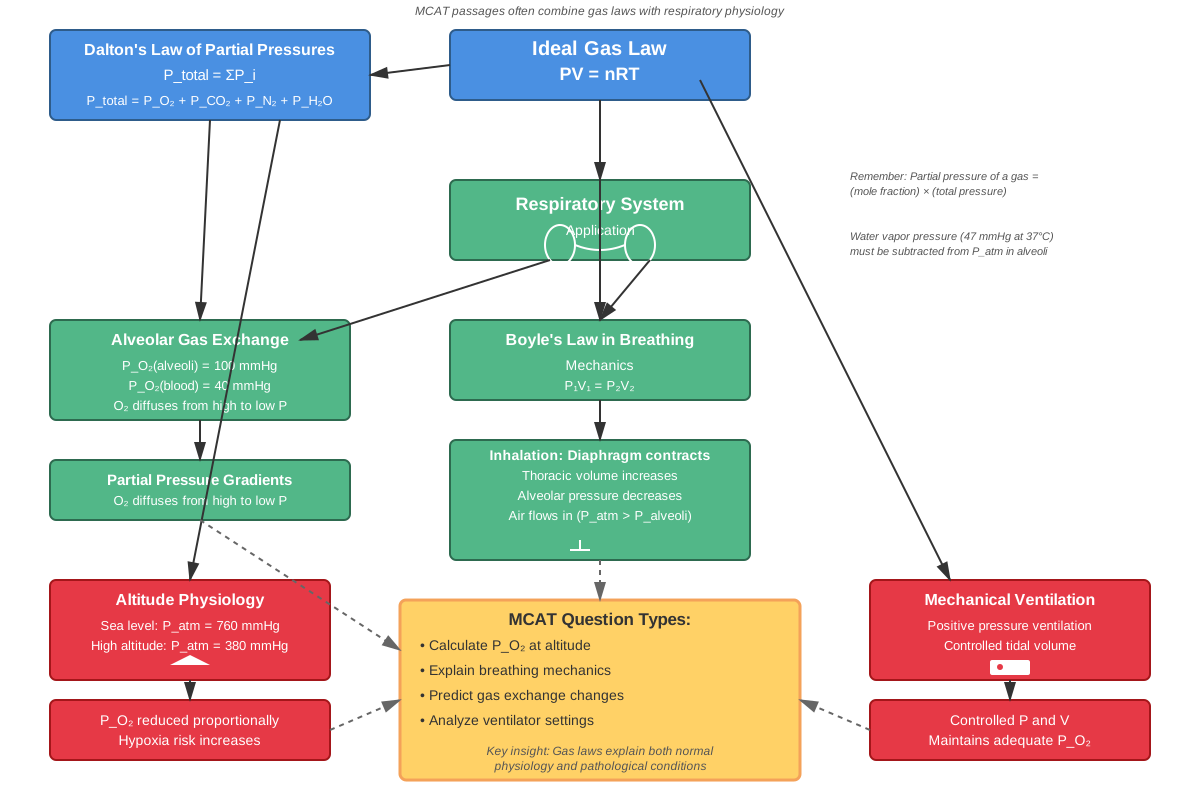
The Ideal gas law is one of the most fundamental and frequently tested equations in Physics on the MCAT, serving as a cornerstone of Thermodynamics and Gases. This mathematical relationship connects four critical state variables—pressure, volume, temperature, and amount of substance—into a single, elegant equation: PV = nRT. Understanding this law is essential not only for solving quantitative problems but also for grasping the behavior of gases in biological systems, from alveolar gas exchange in the lungs to the function of pressurized medical equipment.
The Ideal gas law MCAT questions appear regularly across both the Chemical and Physical Foundations of Biological Systems section and occasionally in passages discussing physiological processes. Students must be comfortable manipulating the equation algebraically, understanding when real gases approximate ideal behavior, and recognizing how changes in one variable affect others when certain conditions are held constant. This topic integrates mathematical reasoning with conceptual understanding, making it a medium-difficulty but high-yield area for exam preparation.
Beyond isolated calculations, the Ideal gas law Physics principles connect to broader concepts including kinetic molecular theory, partial pressures in gas mixtures, thermodynamic processes, and energy transfer. Mastery of this topic provides the foundation for understanding more complex phenomena such as adiabatic processes, respiratory physiology, and the behavior of gases under non-ideal conditions. The ability to quickly recall and apply this relationship under timed exam conditions is a skill that distinguishes high-scoring students.
Learning Objectives
- [ ] Define Ideal gas law using accurate Physics terminology
- [ ] Explain why Ideal gas law matters for the MCAT
- [ ] Apply Ideal gas law to exam-style questions
- [ ] Identify common mistakes related to Ideal gas law
- [ ] Connect Ideal gas law to related Physics concepts
- [ ] Derive and apply special cases of the ideal gas law (Boyle's, Charles's, Gay-Lussac's laws)
- [ ] Calculate changes in gas properties when multiple variables change simultaneously
- [ ] Distinguish between conditions where real gases behave ideally versus non-ideally
Prerequisites
- Basic algebra and equation manipulation: Required to isolate variables and solve for unknowns in the ideal gas equation
- Unit conversions: Essential for converting between temperature scales (Celsius to Kelvin), pressure units (atm, mmHg, Pa, torr), and volume units
- Mole concept: Understanding the mole as a unit of quantity is fundamental since 'n' represents the number of moles in the equation
- Temperature scales: Knowledge that absolute temperature (Kelvin) must be used in gas law calculations
- Pressure concepts: Basic understanding of pressure as force per unit area and common pressure units
Why This Topic Matters
The ideal gas law appears in approximately 2-4 discrete questions per MCAT exam and frequently within passage-based questions involving respiratory physiology, experimental apparatus, or chemical reactions producing gases. Understanding gas behavior is clinically relevant to numerous medical scenarios: calculating oxygen delivery to tissues, understanding decompression sickness in divers, interpreting arterial blood gas measurements, and operating ventilators in critical care settings.
On the MCAT, this topic typically appears in three contexts: (1) straightforward calculation questions requiring direct application of PV = nRT, (2) passage-based questions describing experimental setups with changing gas conditions, and (3) integrated questions connecting gas behavior to biological systems like the respiratory system or cellular metabolism. The Chemical and Physical Foundations section may present scenarios involving gas collection over water, reactions producing gaseous products, or changes in atmospheric conditions.
Real-world applications extend beyond medicine to understanding weather patterns, scuba diving safety, hot air balloon operation, and industrial processes. For medical students, the principles governing alveolar ventilation, anesthetic gas delivery, and hyperbaric oxygen therapy all depend on ideal gas law concepts. The ability to quickly recognize which variables are changing and which remain constant is a critical skill for both exam success and clinical reasoning.
Core Concepts
The Ideal Gas Law Equation
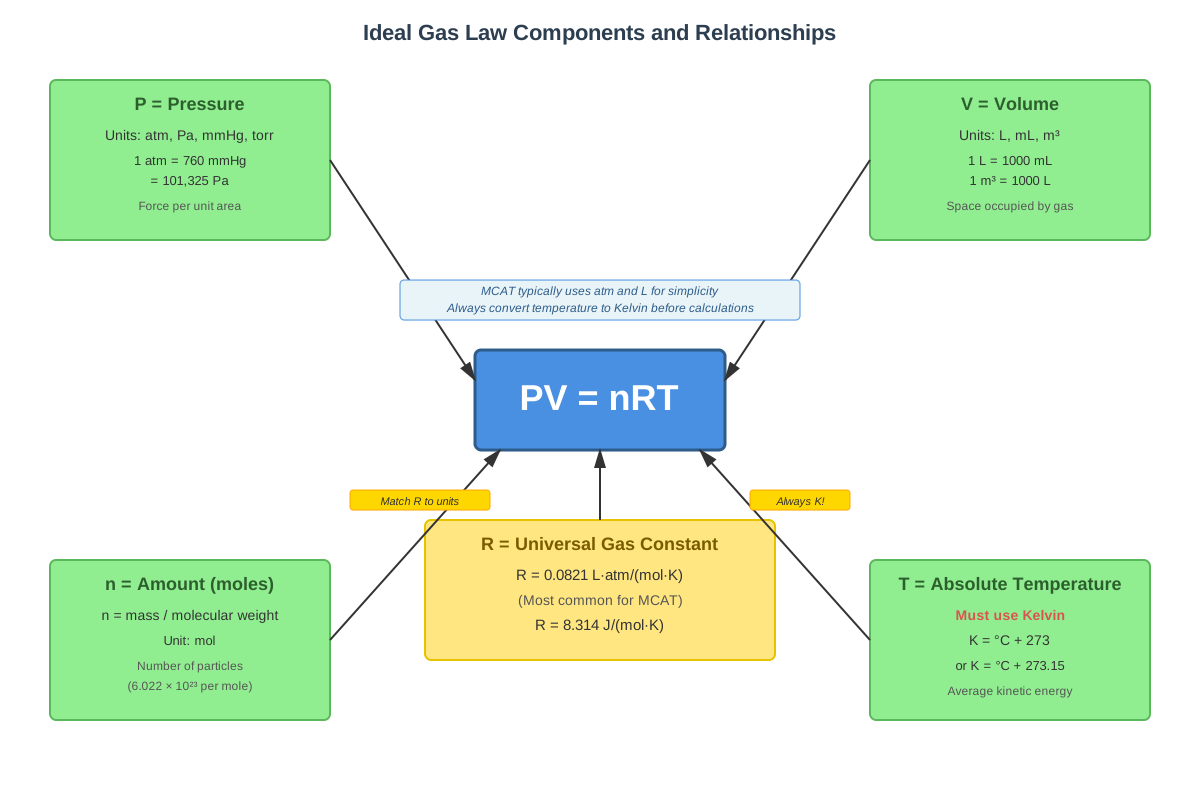
The ideal gas law is expressed mathematically as:
PV = nRTWhere:
- P = pressure (typically in atmospheres, Pa, or mmHg)
- V = volume (typically in liters or m³)
- n = number of moles of gas
- R = universal gas constant
- T = absolute temperature (must be in Kelvin)
The universal gas constant R has different numerical values depending on the units used:
- R = 0.0821 L·atm/(mol·K) — most common for MCAT
- R = 8.314 J/(mol·K) — when working with energy units
- R = 62.4 L·mmHg/(mol·K) — when pressure is in mmHg
Exam Tip: The MCAT will provide the value of R when needed, but memorizing R = 0.0821 L·atm/(mol·K) can save time and reduce errors.
Assumptions of Ideal Gas Behavior
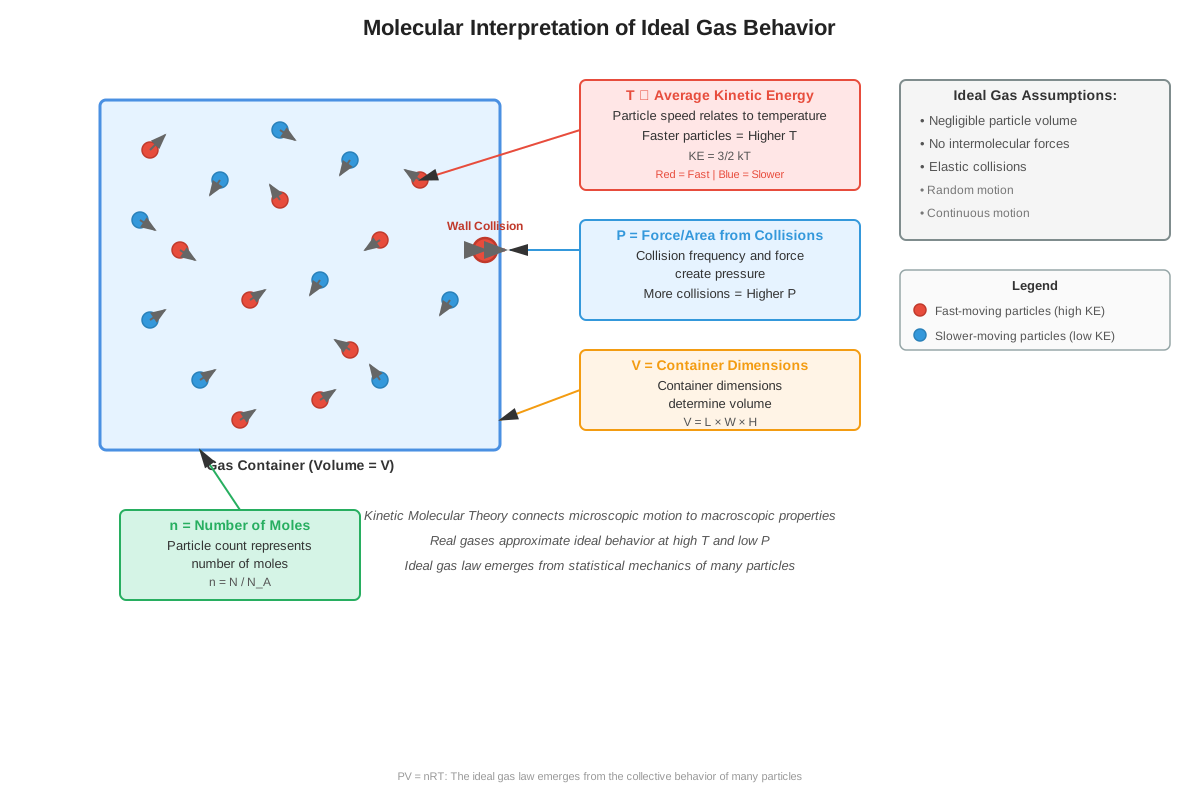
An ideal gas is a theoretical construct that assumes:
- Gas particles have negligible volume compared to the container volume
- No intermolecular forces exist between gas particles
- Collisions between particles and container walls are perfectly elastic
- Particles are in constant, random motion
- Average kinetic energy is directly proportional to absolute temperature
Real gases approximate ideal behavior under conditions of:
- High temperature (particles have sufficient kinetic energy to overcome intermolecular forces)
- Low pressure (particles are far apart, minimizing interactions)
- Low molecular complexity (noble gases and small molecules like H₂, N₂, O₂)
Real gases deviate from ideal behavior at high pressures and low temperatures, where intermolecular forces and particle volume become significant.
Derived Gas Laws
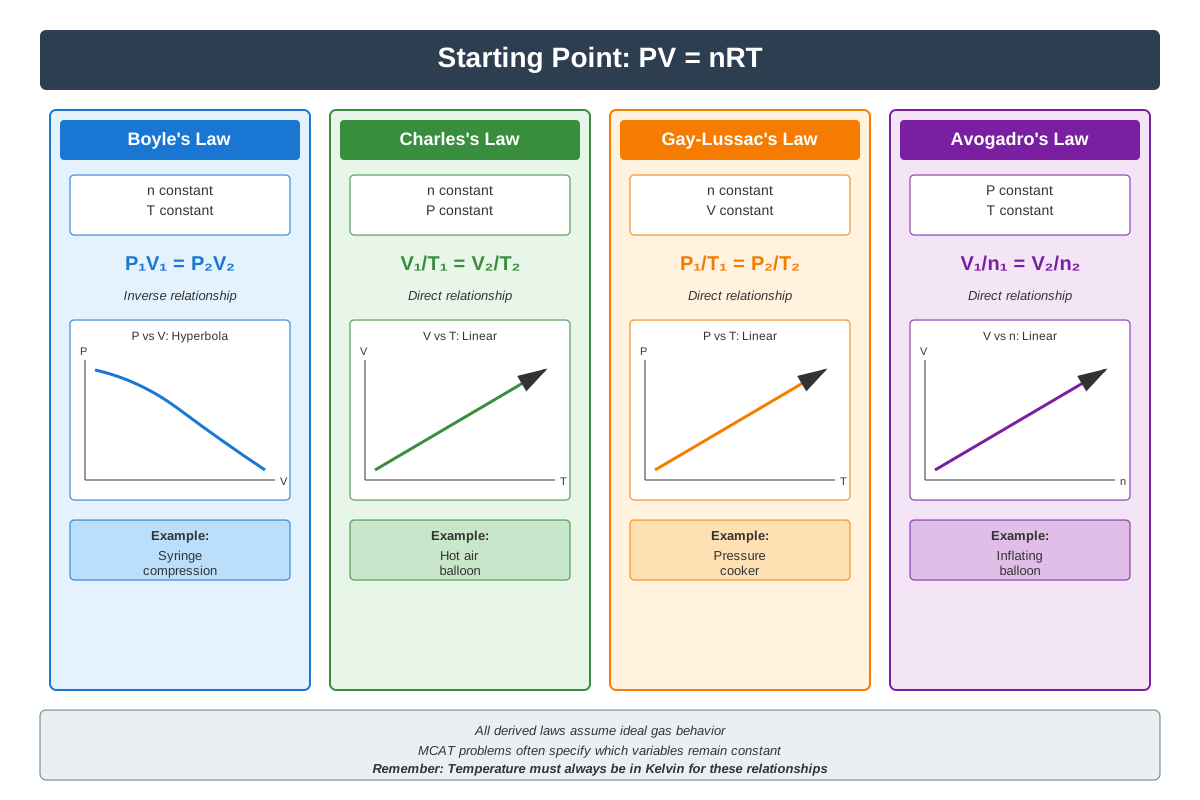
The ideal gas law encompasses several special cases that describe relationships when certain variables are held constant:
| Law | Equation | Constant Variables | Relationship |
|---|---|---|---|
| Boyle's Law | P₁V₁ = P₂V₂ | n, T | Inverse: pressure increases as volume decreases |
| Charles's Law | V₁/T₁ = V₂/T₂ | n, P | Direct: volume increases as temperature increases |
| Gay-Lussac's Law | P₁/T₁ = P₂/T₂ | n, V | Direct: pressure increases as temperature increases |
| Avogadro's Law | V₁/n₁ = V₂/n₂ | P, T | Direct: volume increases as moles increase |
| Combined Gas Law | (P₁V₁)/T₁ = (P₂V₂)/T₂ | n | Combines Boyle's, Charles's, and Gay-Lussac's |
These derived relationships are useful for solving problems where the number of moles remains constant and only two or three variables change.
Standard Temperature and Pressure (STP)
Standard Temperature and Pressure defines reference conditions for gas measurements:
- Temperature: 273.15 K (0°C)
- Pressure: 1 atm (760 mmHg, 101.325 kPa)
At STP, one mole of any ideal gas occupies 22.4 liters. This molar volume is a high-yield fact frequently tested on the MCAT.
Density and Molar Mass Applications
The ideal gas law can be rearranged to relate gas density to molar mass:
d = PM/(RT)Where:
- d = density (g/L)
- M = molar mass (g/mol)
This relationship is derived by substituting n = m/M (where m is mass) into PV = nRT and rearranging to m/V = PM/(RT).
Partial Pressures and Dalton's Law
In gas mixtures, each component exerts a partial pressure proportional to its mole fraction. Dalton's Law of Partial Pressures states:
P_total = P₁ + P₂ + P₃ + ...The partial pressure of gas i is:
P_i = X_i × P_totalWhere X_i is the mole fraction of gas i (n_i/n_total).
This concept is critical for understanding alveolar gas exchange, where oxygen and carbon dioxide partial pressures drive diffusion across respiratory membranes.
Temperature Conversions
Since the ideal gas law requires absolute temperature in Kelvin:
T(K) = T(°C) + 273.15A common MCAT shortcut uses 273 instead of 273.15 for faster mental math. Never use Celsius or Fahrenheit directly in gas law calculations—this is a frequent source of errors.
Concept Relationships
The ideal gas law serves as the central hub connecting multiple gas behavior concepts. Kinetic molecular theory provides the theoretical foundation explaining why PV = nRT works: gas pressure results from particle collisions with container walls, and temperature reflects average kinetic energy. This microscopic view → leads to → macroscopic gas law predictions.
The derived gas laws (Boyle's, Charles's, Gay-Lussac's) are special cases of the ideal gas law where certain variables remain constant. Understanding that these are not separate laws but rather simplified versions of PV = nRT → enables → more flexible problem-solving when multiple variables change simultaneously.
Dalton's Law of Partial Pressures extends the ideal gas law to mixtures, where each gas component behaves independently. This connection → is essential for → understanding respiratory physiology, particularly alveolar gas exchange and oxygen transport in blood.
The relationship between gas density and molar mass through the ideal gas law → connects to → stoichiometry and molecular weight determination. This integration → appears in → MCAT passages describing experimental gas collection and identification.
Thermodynamic processes (isothermal, isobaric, isochoric, adiabatic) represent different pathways on a PV diagram, each governed by constraints on the ideal gas law variables. This relationship → bridges → pure gas behavior to energy transfer and work calculations.
Quick check — test yourself on Ideal gas law so far.
Try Flashcards →High-Yield Facts
⭐ The ideal gas law equation is PV = nRT, where R = 0.0821 L·atm/(mol·K) is the most commonly used value on the MCAT
⭐ Temperature must always be converted to Kelvin (K = °C + 273) before using in gas law calculations
⭐ At STP (273 K, 1 atm), one mole of any ideal gas occupies 22.4 liters
⭐ Real gases behave most ideally at high temperatures and low pressures
⭐ When comparing two states of the same gas sample with constant moles: (P₁V₁)/T₁ = (P₂V₂)/T₂
- Pressure and volume are inversely related when temperature and moles are constant (Boyle's Law)
- Volume and temperature are directly proportional when pressure and moles are constant (Charles's Law)
- Partial pressure of a gas in a mixture equals its mole fraction times total pressure
- Increasing temperature increases both pressure (constant volume) and volume (constant pressure)
- Doubling the number of moles doubles the volume at constant temperature and pressure
- Gas density increases with increasing molar mass and pressure, but decreases with increasing temperature
- The ideal gas law applies to each individual gas in a mixture as well as to the mixture as a whole
- At constant temperature, compressing a gas to half its volume doubles its pressure
- Noble gases (He, Ne, Ar) behave most ideally due to minimal intermolecular forces
- Water vapor pressure must be subtracted when collecting gases over water to find the dry gas pressure
Common Misconceptions
Misconception: Temperature in Celsius can be used directly in the ideal gas law equation.
Correction: Only absolute temperature in Kelvin can be used because the ideal gas law requires a temperature scale with a true zero point. Using Celsius will produce incorrect results. Always convert: K = °C + 273.
Misconception: When volume doubles, pressure doubles.
Correction: When volume doubles at constant temperature and moles, pressure is cut in half (inverse relationship). This is Boyle's Law: P₁V₁ = P₂V₂. Students often confuse direct and inverse proportionalities.
Misconception: R is always 8.314 in gas law problems.
Correction: The value of R depends on the units being used. R = 0.0821 L·atm/(mol·K) is most common for MCAT problems involving pressure in atmospheres and volume in liters. R = 8.314 J/(mol·K) is used when calculating energy or work.
Misconception: All gases behave ideally under all conditions.
Correction: Real gases deviate from ideal behavior at high pressures (where particle volume matters) and low temperatures (where intermolecular forces become significant). Polar molecules and large molecules deviate more than small, nonpolar molecules.
Misconception: STP means room temperature and atmospheric pressure.
Correction: STP specifically means 273 K (0°C) and 1 atm. Room temperature is approximately 298 K (25°C), which is different from STP. Some problems specify "standard conditions" versus "room temperature"—read carefully.
Misconception: Mole fraction and volume fraction are different for ideal gases.
Correction: For ideal gases at the same temperature and pressure, mole fraction equals volume fraction (Avogadro's Law). This is why partial pressure can be calculated from either mole fraction or volume percentage.
Misconception: When a gas expands, its temperature must increase.
Correction: Temperature change depends on the type of process. In isothermal expansion, temperature remains constant while pressure decreases. In adiabatic expansion, temperature actually decreases. Only in certain processes (like constant pressure heating) do expansion and temperature increase occur together.
Worked Examples
Example 1: Basic Ideal Gas Law Calculation
Problem: A sample of oxygen gas occupies 5.0 L at 27°C and 2.0 atm. How many moles of oxygen are present?
Solution:
Step 1: Identify known variables and convert temperature to Kelvin
- P = 2.0 atm
- V = 5.0 L
- T = 27°C + 273 = 300 K
- R = 0.0821 L·atm/(mol·K)
- n = ?
Step 2: Rearrange PV = nRT to solve for n
n = PV/(RT)Step 3: Substitute values and calculate
n = (2.0 atm)(5.0 L) / [(0.0821 L·atm/(mol·K))(300 K)]
n = 10 / 24.63
n ≈ 0.41 molAnswer: Approximately 0.41 moles of oxygen are present.
Connection to Learning Objectives: This example demonstrates direct application of the ideal gas law equation, requiring proper unit usage and temperature conversion—both critical skills for MCAT success.
Example 2: Combined Gas Law Application
Problem: A balloon contains 2.5 L of helium at 20°C and 1.0 atm. The balloon is taken to the top of a mountain where the temperature is -10°C and the pressure is 0.75 atm. Assuming the balloon can expand freely, what is the new volume?
Solution:
Step 1: Identify that moles remain constant, so use the combined gas law
(P₁V₁)/T₁ = (P₂V₂)/T₂Step 2: List known values and convert temperatures to Kelvin
- P₁ = 1.0 atm, V₁ = 2.5 L, T₁ = 20°C + 273 = 293 K
- P₂ = 0.75 atm, V₂ = ?, T₂ = -10°C + 273 = 263 K
Step 3: Rearrange to solve for V₂
V₂ = (P₁V₁T₂)/(P₂T₁)Step 4: Substitute and calculate
V₂ = (1.0 atm)(2.5 L)(263 K) / [(0.75 atm)(293 K)]
V₂ = 657.5 / 219.75
V₂ ≈ 3.0 L
Step 5: Verify the answer makes sense
- Pressure decreased (should increase volume)
- Temperature decreased (should decrease volume)
- Pressure effect dominates, so net volume increase is reasonable
Answer: The new volume is approximately 3.0 L.
Connection to Learning Objectives: This problem requires recognizing when to use the combined gas law instead of the full ideal gas law, understanding how multiple variable changes affect the outcome, and checking whether the answer is physically reasonable.
Exam Strategy
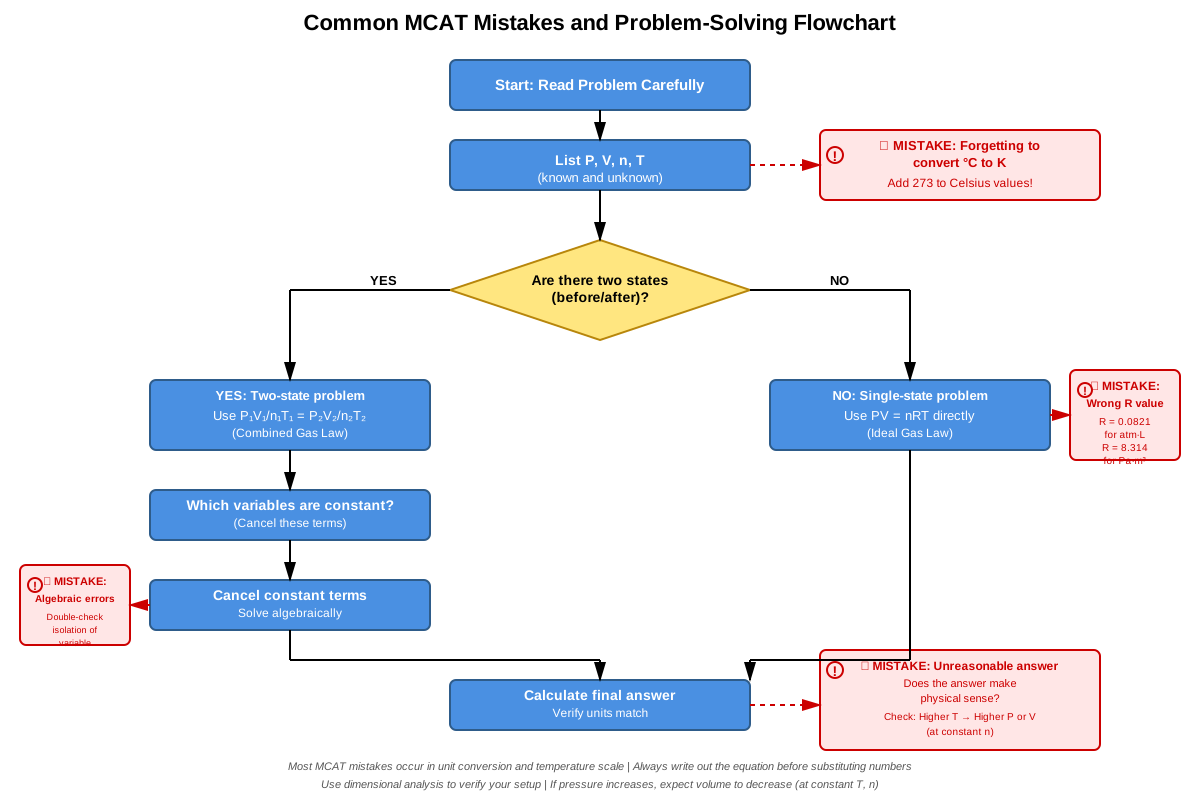
When approaching Ideal gas law MCAT questions, first identify which variables are given, which are unknown, and which remain constant. This classification immediately tells you whether to use the full ideal gas law (PV = nRT) or a simplified version like Boyle's Law or Charles's Law. Questions stating "the amount of gas remains constant" or "in a sealed container" signal that moles (n) is constant, allowing use of the combined gas law.
Trigger words and phrases to watch for:
- "At STP" → immediately know T = 273 K, P = 1 atm, and molar volume = 22.4 L/mol
- "Sealed container" → moles constant, volume likely constant (rigid container)
- "Flexible container" → volume can change, pressure likely constant (atmospheric)
- "Isothermal process" → temperature constant
- "Collected over water" → subtract water vapor pressure from total pressure
Process-of-elimination strategies:
- Eliminate any answer choice that violates basic proportionalities (e.g., if temperature increases at constant volume, pressure must increase)
- Check units—if an answer has impossible units, eliminate it immediately
- Use limiting cases: if temperature approaches zero Kelvin, volume should approach zero (for constant P and n)
- Estimate using round numbers before calculating precisely to eliminate unreasonable answers
Time allocation: Straightforward ideal gas law calculations should take 45-60 seconds. If you find yourself spending more than 90 seconds, you may be overcomplicating the problem. Look for a simpler approach or flag the question and return to it later. Many MCAT gas law questions can be solved using proportional reasoning without full calculation.
Common question formats:
- Direct calculation: given three variables, find the fourth
- Comparison: how does changing one variable affect another?
- Experimental setup: gas collected in a lab setting with multiple conditions
- Physiological application: alveolar gas exchange, breathing mechanics
Memory Techniques
Mnemonic for the ideal gas law: "Please Vote Next Round Tuesday" → PV = nRT
Mnemonic for conditions favoring ideal behavior: "High Temperature, Low Pressure" → Hot and Loose (gases spread out and behave ideally)
Mnemonic for STP values: "Silly Turkeys Peck" at 273 degrees while standing 1 foot tall in 22.4 square feet → STP = 273 K, 1 atm, 22.4 L/mol
Visualization for Boyle's Law: Picture a syringe—pushing the plunger (decreasing volume) increases pressure. The inverse relationship becomes intuitive when you imagine compressing gas particles into a smaller space, causing more frequent wall collisions.
Visualization for Charles's Law: Imagine a balloon on a cold day (shrinks) versus a hot day (expands). Temperature and volume move together when pressure is constant.
Acronym for derived gas laws: "Boyle Charles Gay-Lussac Avogadro" → Big Cats Get Lazy Afternoons (helps remember the sequence and that these are related concepts)
Memory aid for R values: The most common value 0.0821 can be remembered as "oh-eight-twenty-one" like a date (August 21st). Associate the units L·atm/(mol·K) with "Large Atoms Move Kinetically."
Summary
The ideal gas law (PV = nRT) is a fundamental equation in Physics that relates pressure, volume, temperature, and amount of gas through the universal gas constant R. This relationship assumes ideal gas behavior, which real gases approximate at high temperatures and low pressures. The MCAT frequently tests this concept through direct calculations, derived gas laws (Boyle's, Charles's, Gay-Lussac's), and applications to physiological systems like respiration. Critical skills include converting temperature to Kelvin, selecting the appropriate value of R based on units, recognizing when to use simplified versions of the equation, and understanding how changes in one variable affect others. At STP (273 K, 1 atm), one mole of ideal gas occupies 22.4 L—a high-yield fact for rapid problem-solving. Success requires both computational proficiency and conceptual understanding of gas behavior under various conditions.
Key Takeaways
- The ideal gas law PV = nRT connects four state variables; always use Kelvin for temperature and match R to your units
- Real gases behave ideally at high temperature and low pressure; deviations occur when intermolecular forces and particle volume matter
- At STP (273 K, 1 atm), one mole of any ideal gas occupies 22.4 liters
- Derived gas laws (Boyle's, Charles's, Gay-Lussac's) are special cases where certain variables remain constant
- When solving problems, identify which variables are constant to choose the most efficient equation form
- Partial pressures in gas mixtures follow Dalton's Law: each gas behaves independently and contributes proportionally to total pressure
- Common errors include forgetting to convert Celsius to Kelvin and confusing direct versus inverse proportionalities
Related Topics
Kinetic Molecular Theory: Provides the microscopic explanation for why the ideal gas law works, connecting particle motion and energy to macroscopic gas properties. Mastering the ideal gas law creates the foundation for understanding this deeper theoretical framework.
Thermodynamic Processes: Isothermal, adiabatic, isobaric, and isochoric processes represent different constraints on the ideal gas law variables, leading to different relationships between heat, work, and internal energy.
Respiratory Physiology: Alveolar ventilation, oxygen transport, and carbon dioxide removal all depend on partial pressure gradients and gas law principles. Understanding ideal gas behavior is essential for interpreting blood gas measurements and ventilation mechanics.
Real Gases and Van der Waals Equation: Explores corrections to the ideal gas law that account for intermolecular forces and particle volume, explaining when and why real gases deviate from ideal predictions.
Stoichiometry of Gases: Combines mole concepts with gas laws to solve problems involving chemical reactions that produce or consume gases, integrating general chemistry with physics principles.
Practice CTA
Now that you've mastered the core concepts of the ideal gas law, it's time to solidify your understanding through active practice. Attempt the practice questions and work through the flashcards to reinforce these high-yield concepts. Remember, the difference between passive reading and true mastery comes from application—each problem you solve strengthens your ability to recognize patterns and execute efficiently under timed conditions. The ideal gas law appears consistently on the MCAT, making your investment in practice directly translatable to exam points. You've built the foundation; now build the speed and confidence that will serve you on test day!
Sign up free to keep reading
Create a free AnvayaPrep account to finish this MCAT guide on Ideal gas law — plus flashcards and practice questions.