Overview
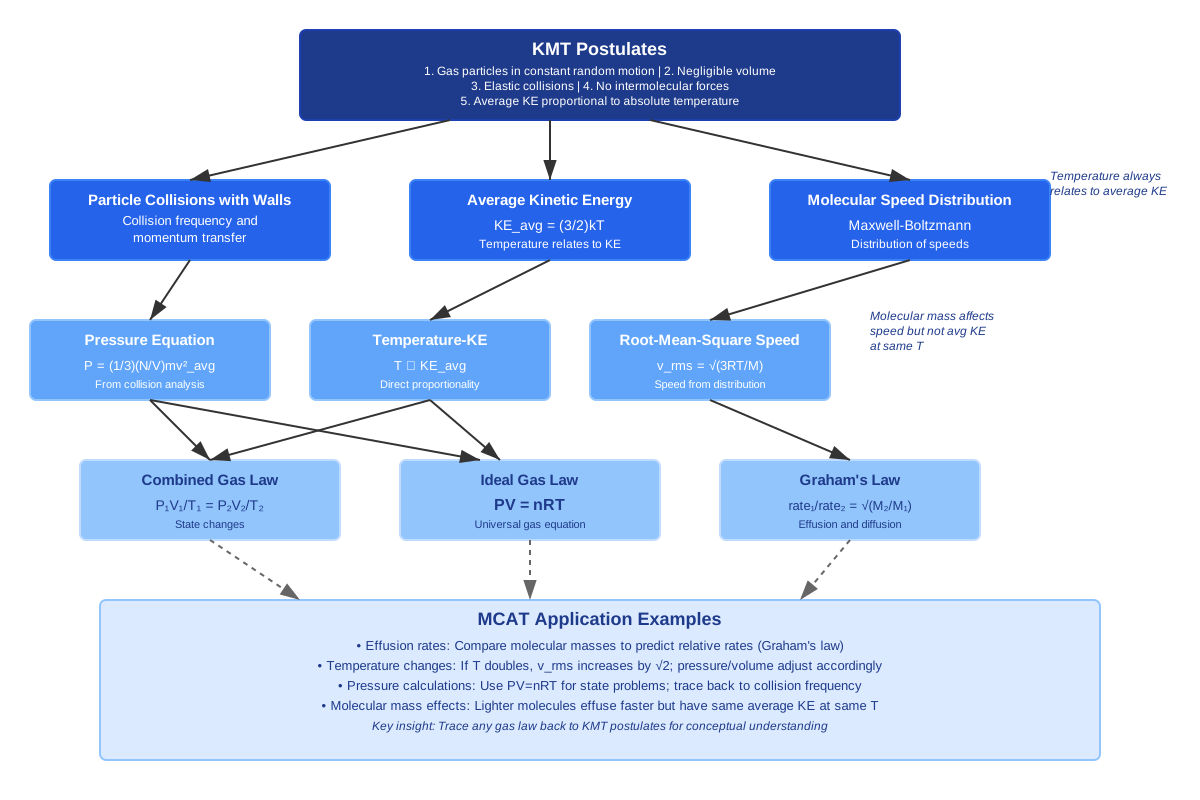
Kinetic molecular theory (KMT) is a foundational model in Physics that explains the macroscopic properties of gases by describing the microscopic behavior of individual gas particles. This theory bridges the gap between observable phenomena—such as pressure, temperature, and volume—and the underlying molecular motion that produces these properties. For the MCAT, kinetic molecular theory serves as the conceptual framework for understanding gas laws, thermodynamic processes, and the behavior of ideal versus real gases. The theory posits that gas particles are in constant, random motion and that the collisions between particles and container walls generate measurable pressure. Temperature, in this model, directly reflects the average kinetic energy of gas molecules, creating a quantitative link between thermal and mechanical properties.
Understanding kinetic molecular theory is essential for the MCAT because it appears across multiple contexts within the Thermodynamics and Gases unit and connects to broader topics in chemistry and biology. Questions may ask students to predict how changes in temperature affect molecular speed, explain deviations from ideal behavior, or apply gas law equations derived from KMT principles. The theory also provides the mechanistic basis for understanding diffusion, effusion, and the distribution of molecular speeds—all testable concepts on the exam.
From a big-picture perspective, kinetic molecular theory represents the application of Newtonian mechanics to large ensembles of particles, demonstrating how statistical approaches can predict bulk properties from individual particle behavior. This topic connects to thermodynamics (particularly the relationship between internal energy and temperature), fluid dynamics (pressure as molecular collisions), and even biochemistry (how gases like oxygen and carbon dioxide behave in physiological systems). Mastery of KMT enables students to approach gas-related problems systematically and to recognize when ideal gas assumptions break down in real-world scenarios.
Learning Objectives
- [ ] Define Kinetic molecular theory using accurate Physics terminology
- [ ] Explain why Kinetic molecular theory matters for the MCAT
- [ ] Apply Kinetic molecular theory to exam-style questions
- [ ] Identify common mistakes related to Kinetic molecular theory
- [ ] Connect Kinetic molecular theory to related Physics concepts
- [ ] Derive the relationship between temperature and average kinetic energy from KMT postulates
- [ ] Predict how molecular mass affects the speed distribution of gas particles
- [ ] Analyze scenarios where real gases deviate from ideal behavior and explain these deviations using KMT principles
Prerequisites
- Basic understanding of atomic and molecular structure: Kinetic molecular theory treats gases as collections of particles, requiring familiarity with atoms and molecules as discrete entities
- Newton's laws of motion: KMT applies classical mechanics to particle collisions, necessitating knowledge of momentum, force, and energy conservation
- Concept of temperature and heat: Understanding temperature as a measure of thermal energy is essential for connecting KMT to thermodynamic properties
- Pressure as force per unit area: KMT explains pressure mechanistically through particle collisions, requiring prior knowledge of pressure definitions
- Basic algebra and proportional reasoning: Manipulating gas law equations and understanding inverse/direct relationships is fundamental to applying KMT
Why This Topic Matters
Kinetic molecular theory provides the mechanistic foundation for understanding respiratory physiology, anesthetic gas behavior, and metabolic gas exchange—all clinically relevant topics that may appear in MCAT passages. In medical practice, understanding how gases behave under different conditions of temperature and pressure is crucial for managing ventilators, interpreting blood gas measurements, and understanding altitude physiology. The principles of KMT also explain why certain drugs are administered as aerosols and how gas solubility affects decompression sickness in divers.
On the MCAT, kinetic molecular theory appears in approximately 2-4 questions per exam, typically within the Chemical and Physical Foundations of Biological Systems section. Questions may be standalone or embedded within passages discussing respiratory mechanics, atmospheric chemistry, or industrial processes. The topic frequently appears in three formats: (1) conceptual questions asking students to predict how changing one variable affects others, (2) calculation problems requiring application of gas laws or kinetic energy equations, and (3) graph interpretation questions showing molecular speed distributions or pressure-volume relationships.
Common passage contexts include experiments measuring gas properties under varying conditions, physiological scenarios involving pulmonary function, and industrial applications like gas separation or compression. The MCAT particularly favors questions that test whether students can distinguish between ideal and real gas behavior, understand the molecular basis of temperature, and apply the root-mean-square speed equation. Recognizing these patterns helps students anticipate question types and allocate study time effectively.
Core Concepts
Postulates of Kinetic Molecular Theory
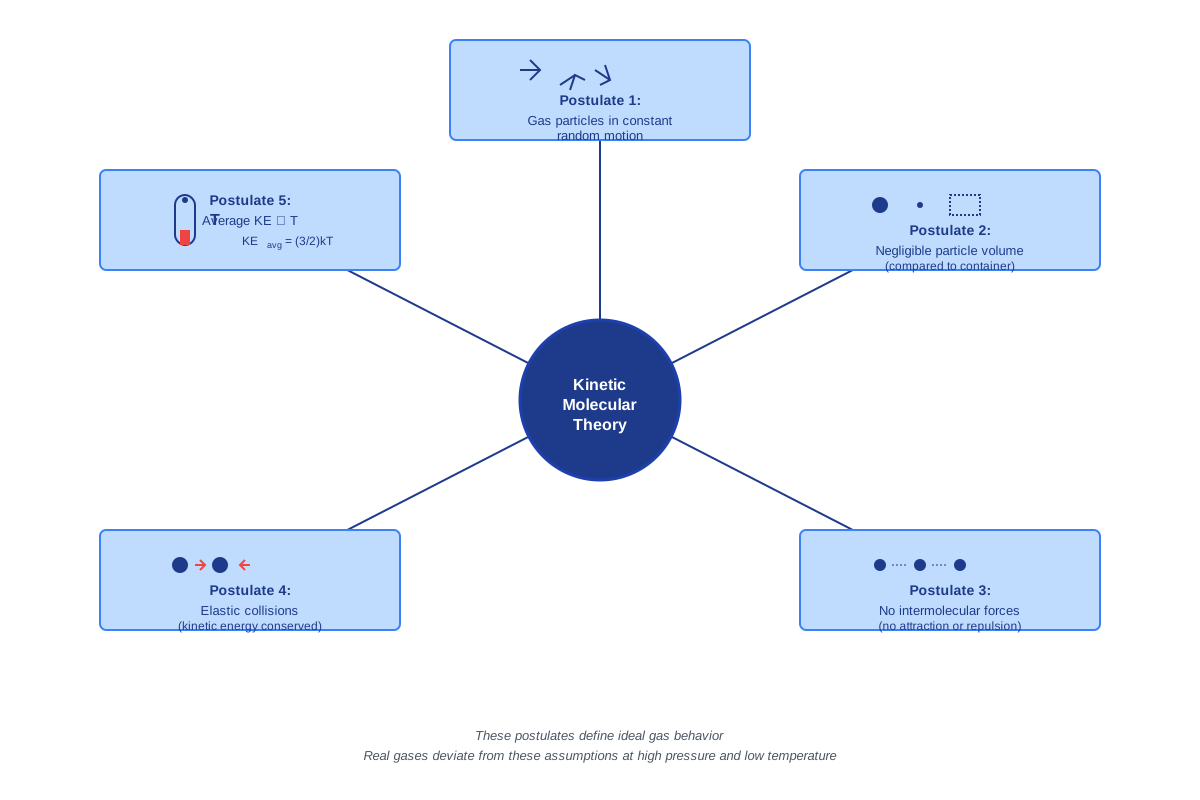
The kinetic molecular theory rests on five fundamental postulates that define ideal gas behavior. First, gases consist of a large number of particles (atoms or molecules) in constant, random motion. These particles are treated as point masses with negligible volume compared to the container volume. Second, gas particles experience perfectly elastic collisions with each other and the container walls, meaning no kinetic energy is lost during collisions—energy is conserved. Third, gas particles exert no intermolecular forces on one another except during the brief moments of collision; they neither attract nor repel each other. Fourth, the average kinetic energy of gas particles is directly proportional to the absolute temperature (in Kelvin) of the gas. Fifth, the pressure exerted by a gas results from collisions between gas particles and the container walls; more frequent or more forceful collisions produce higher pressure.
These postulates create a simplified model that accurately predicts the behavior of many real gases under standard conditions (moderate temperature and low pressure). Understanding each postulate is crucial because MCAT questions often test whether students can identify which assumption breaks down when real gases deviate from ideal behavior.
Temperature and Average Kinetic Energy
One of the most important relationships in kinetic molecular theory is the direct proportionality between absolute temperature and the average kinetic energy of gas particles. Mathematically, this is expressed as:
KE_avg = (3/2)kTwhere KE_avg is the average kinetic energy per particle, k is Boltzmann's constant (1.38 × 10⁻²³ J/K), and T is the absolute temperature in Kelvin. This equation reveals that temperature is not merely a measure of "hotness" but a quantitative indicator of molecular motion. When temperature doubles, the average kinetic energy of gas particles doubles, leading to increased molecular speeds and more forceful collisions with container walls.
For a mole of gas particles, this relationship can be expressed using the gas constant R:
KE_avg = (3/2)RT/N_A = (3/2)kTThis connection between temperature and kinetic energy explains why heating a gas increases its pressure (if volume is constant) or expands its volume (if pressure is constant). The MCAT frequently tests this concept by asking students to predict how temperature changes affect molecular behavior or to calculate kinetic energy changes given temperature variations.
Root-Mean-Square Speed
The root-mean-square (rms) speed represents the effective average speed of gas particles and is derived from the average kinetic energy. The rms speed equation is:
v_rms = √(3RT/M) = √(3kT/m)where R is the gas constant (8.314 J/(mol·K)), T is temperature in Kelvin, M is the molar mass in kg/mol, and m is the mass of a single molecule. This equation reveals several critical relationships:
- Temperature dependence: rms speed is proportional to the square root of temperature (v ∝ √T)
- Mass dependence: rms speed is inversely proportional to the square root of molar mass (v ∝ 1/√M)
- At the same temperature, lighter molecules move faster than heavier molecules
This mass-speed relationship explains phenomena like Graham's law of effusion and why hydrogen gas diffuses more rapidly than oxygen. On the MCAT, students must recognize that doubling the temperature increases rms speed by a factor of √2 (approximately 1.41), not by a factor of 2.
Maxwell-Boltzmann Distribution
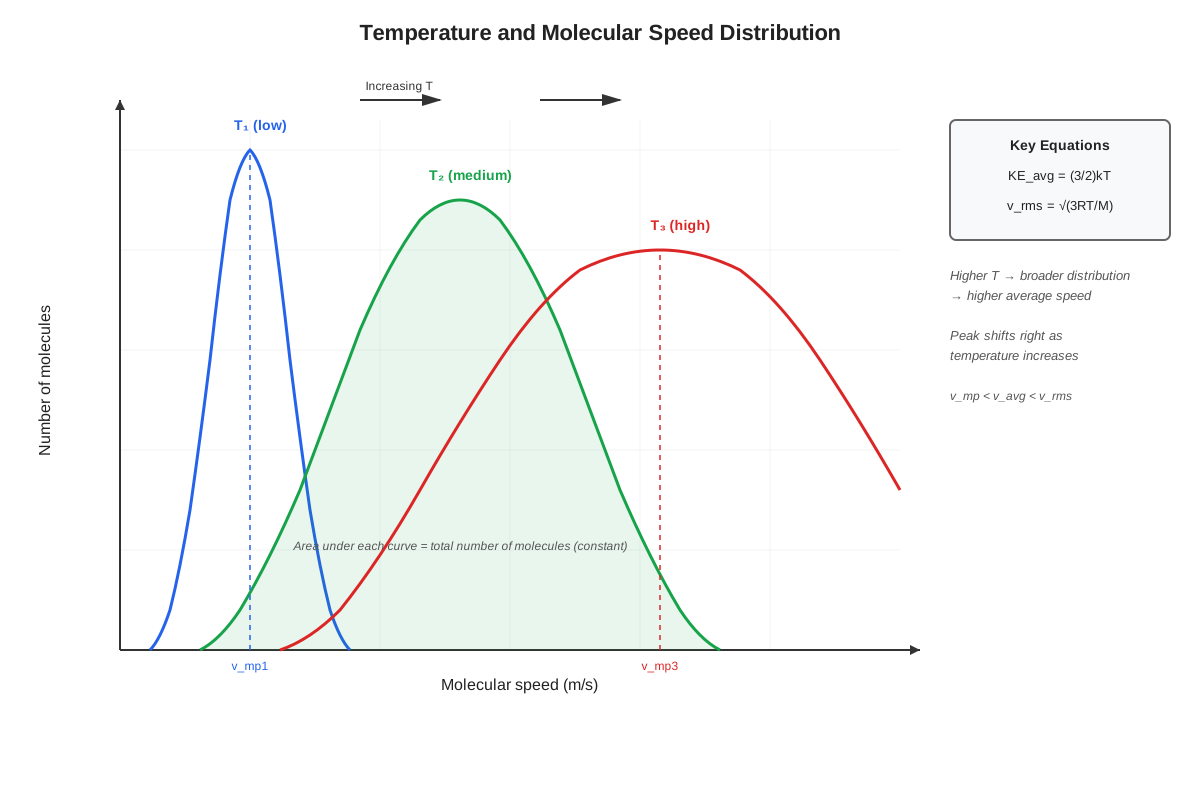
The Maxwell-Boltzmann distribution describes the range of speeds present in a gas sample at a given temperature. Rather than all molecules moving at exactly the rms speed, gas particles exhibit a distribution of speeds: some move slowly, most move at intermediate speeds, and a few move very rapidly. The distribution curve shows:
- A peak at the most probable speed (the speed possessed by the largest number of molecules)
- The average speed (arithmetic mean of all speeds)
- The rms speed (always the highest of the three characteristic speeds)
As temperature increases, the distribution curve flattens and shifts to higher speeds, with the peak moving rightward. This broadening indicates greater variation in molecular speeds at higher temperatures. For the MCAT, students should recognize that the area under the curve remains constant (representing the total number of molecules) and that higher temperatures increase the fraction of molecules with sufficient energy to overcome activation barriers in chemical reactions.
Pressure from a Molecular Perspective
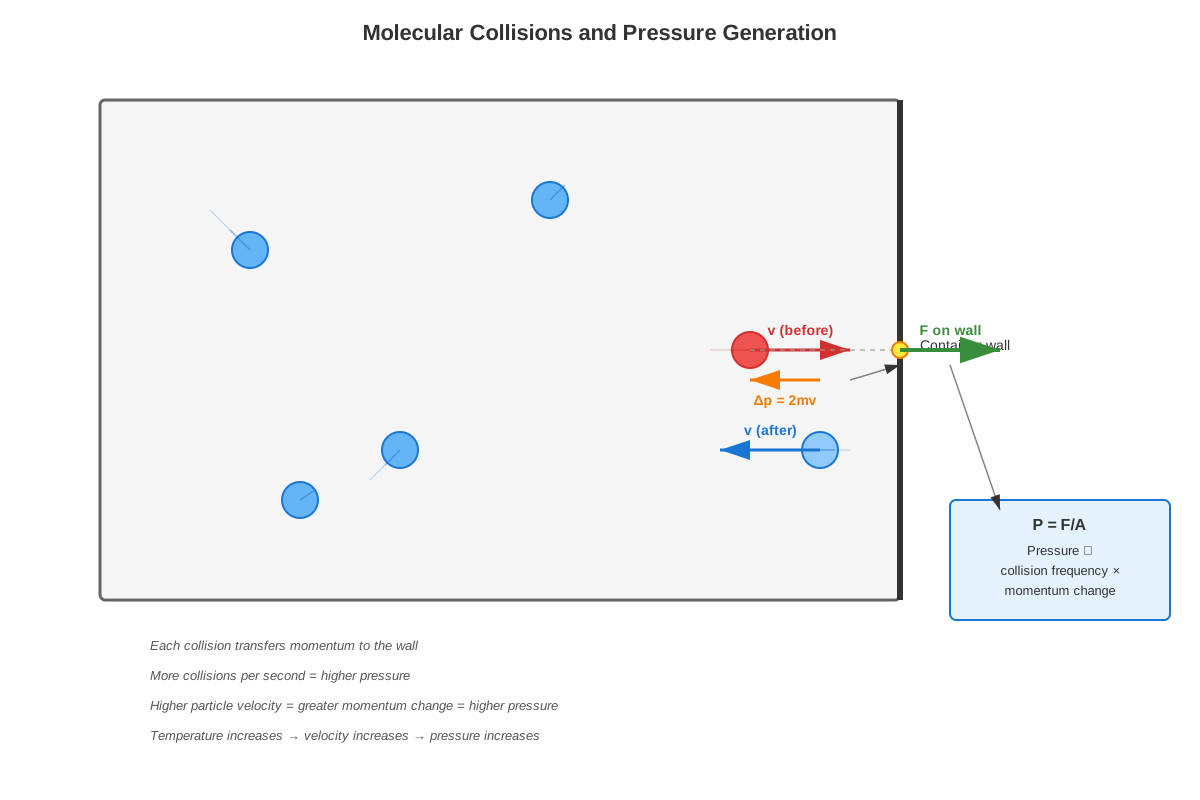
Kinetic molecular theory explains pressure as the cumulative result of countless molecular collisions with container walls. Each collision transfers momentum to the wall, creating a force. Pressure (force per unit area) increases when:
- Particle density increases: More particles per unit volume leads to more frequent collisions
- Temperature increases: Higher kinetic energy produces more forceful collisions
- Container volume decreases: Particles travel shorter distances between wall collisions, increasing collision frequency
This molecular interpretation connects directly to the ideal gas law (PV = nRT), where each variable has a microscopic explanation:
- P (pressure): collision frequency and force
- V (volume): space available for particle motion
- n (moles): number of particles
- T (temperature): average kinetic energy
- R (gas constant): proportionality factor connecting macroscopic and microscopic scales
Ideal vs. Real Gases
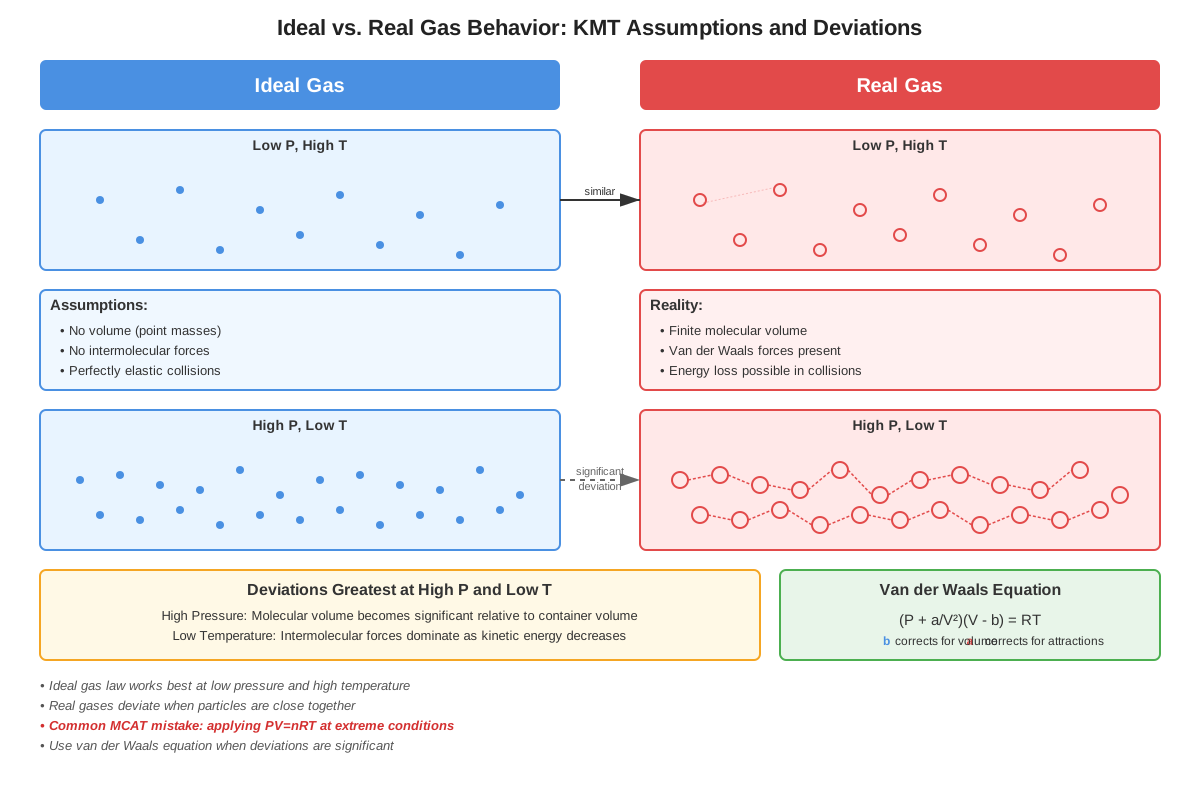
Kinetic molecular theory describes ideal gases perfectly but requires modifications for real gases. Real gases deviate from ideal behavior when:
| Condition | Why Deviation Occurs | KMT Assumption Violated |
|---|---|---|
| High pressure | Particle volume becomes significant relative to container volume | Negligible particle volume |
| Low temperature | Intermolecular forces become significant, particles attract | No intermolecular forces |
| Large molecules | Molecular volume cannot be ignored | Point mass approximation |
| Polar molecules | Dipole-dipole interactions affect motion | No attractive forces |
The van der Waals equation corrects the ideal gas law for these deviations by adding terms that account for molecular volume (b) and intermolecular attractions (a). For the MCAT, students should recognize that gases behave most ideally at high temperature and low pressure, where kinetic energy overwhelms intermolecular forces and particle volume is negligible compared to container volume.
Internal Energy of Ideal Gases
For an ideal gas, the internal energy (U) depends solely on temperature and is given by:
U = (3/2)nRTfor monatomic gases, where n is the number of moles. This equation shows that internal energy is directly proportional to both the number of particles and the absolute temperature. For diatomic and polyatomic gases, additional energy is stored in rotational and vibrational modes, increasing the proportionality constant. This relationship is fundamental to understanding the first law of thermodynamics and predicting how heat transfer affects gas temperature and energy.
Concept Relationships
The postulates of kinetic molecular theory form the foundation from which all other concepts derive. The assumption of constant, random particle motion → leads to → the statistical distribution of molecular speeds described by the Maxwell-Boltzmann distribution. The postulate that average kinetic energy is proportional to temperature → enables → the derivation of the rms speed equation, which quantifies how fast particles move at a given temperature.
The relationship between temperature and kinetic energy → connects to → the ideal gas law, explaining why pressure increases with temperature (more energetic collisions) and why volume increases with temperature at constant pressure (particles push walls outward more forcefully). The assumption of elastic collisions and no intermolecular forces → defines → ideal gas behavior, while violations of these assumptions → explain → real gas deviations captured by the van der Waals equation.
Within the broader Thermodynamics and Gases unit, kinetic molecular theory → provides the microscopic basis for → macroscopic gas laws (Boyle's, Charles's, Gay-Lussac's, and Avogadro's laws). The theory → also explains → diffusion and effusion rates through Graham's law, which derives from the mass dependence of rms speed. Furthermore, KMT → connects to → thermodynamic concepts like internal energy, heat capacity, and entropy by linking molecular motion to thermal properties.
The prerequisite understanding of Newton's laws → enables → the analysis of particle collisions and momentum transfer that produces pressure. The concept of temperature as thermal energy → becomes quantified → through the KE_avg = (3/2)kT relationship. These connections demonstrate how kinetic molecular theory integrates mechanical, thermal, and statistical physics into a unified framework for understanding gas behavior.
Quick check — test yourself on Kinetic molecular theory so far.
Try Flashcards →High-Yield Facts
⭐ Average kinetic energy of gas particles is directly proportional to absolute temperature: KE_avg = (3/2)kT, meaning doubling temperature doubles average kinetic energy
⭐ Root-mean-square speed is inversely proportional to the square root of molar mass: At the same temperature, lighter molecules move faster than heavier molecules (v_rms ∝ 1/√M)
⭐ Pressure results from molecular collisions with container walls: Increasing temperature or decreasing volume increases collision frequency and force, raising pressure
⭐ Ideal gases have no intermolecular forces and negligible particle volume: Real gases deviate from ideal behavior at high pressure and low temperature
⭐ The Maxwell-Boltzmann distribution broadens and shifts right as temperature increases: Higher temperatures produce a wider range of molecular speeds with a higher average
- Gas particles undergo perfectly elastic collisions, conserving total kinetic energy in the system
- The internal energy of an ideal monatomic gas depends only on temperature: U = (3/2)nRT
- At the same temperature, all gases have the same average kinetic energy per particle regardless of molecular mass
- Increasing the number of moles at constant volume and temperature increases pressure proportionally (P ∝ n)
- The most probable speed, average speed, and rms speed are three distinct values, with rms speed always being the highest
- Real gases behave most ideally at high temperature and low pressure, where kinetic energy dominates over intermolecular forces
- Graham's law of effusion (rate ∝ 1/√M) derives directly from the rms speed equation in kinetic molecular theory
Common Misconceptions
Misconception: All gas molecules in a sample move at the same speed at a given temperature.
Correction: Gas molecules exhibit a distribution of speeds described by the Maxwell-Boltzmann distribution. While there is an average (rms) speed, individual molecules move at various speeds ranging from nearly zero to very high values. Temperature determines the average kinetic energy, not a uniform speed for all particles.
Misconception: Increasing temperature increases molecular speed linearly (doubling T doubles speed).
Correction: The rms speed is proportional to the square root of temperature (v_rms ∝ √T), not temperature itself. Doubling the absolute temperature increases rms speed by a factor of √2 ≈ 1.41, not 2. This square root relationship is crucial for MCAT calculations.
Misconception: Heavier molecules have more kinetic energy than lighter molecules at the same temperature.
Correction: At the same temperature, all gas molecules have the same average kinetic energy (KE_avg = 3/2 kT), regardless of mass. However, heavier molecules move more slowly to maintain this equal kinetic energy, since KE = (1/2)mv². This is why hydrogen diffuses faster than oxygen at the same temperature.
Misconception: Pressure is caused by gas particles pushing against each other inside the container.
Correction: Pressure results from gas particles colliding with the container walls, not from inter-particle collisions. According to KMT, ideal gas particles exert no forces on each other except during brief collision moments. The cumulative effect of countless wall collisions creates measurable pressure.
Misconception: Real gases always behave differently from ideal gases.
Correction: Real gases approximate ideal behavior under many common conditions, specifically at high temperature and low pressure. Deviations become significant only when intermolecular forces or particle volume cannot be ignored—typically at low temperatures (where attractions matter) or high pressures (where particle volume becomes significant relative to container volume).
Misconception: The kinetic energy of a gas is the same as its temperature.
Correction: Temperature is proportional to average kinetic energy but is not identical to it. Temperature is measured in Kelvin, while kinetic energy is measured in joules. The relationship KE_avg = (3/2)kT shows that temperature is a measure of average kinetic energy per particle, with the Boltzmann constant k serving as the conversion factor between thermal and mechanical energy scales.
Worked Examples
Example 1: Comparing Molecular Speeds
Question: At 300 K, which gas has the higher root-mean-square speed: helium (He, M = 4 g/mol) or nitrogen (N₂, M = 28 g/mol)? By what factor does the faster gas exceed the slower gas's speed?
Solution:
Step 1: Recognize that rms speed depends on both temperature and molar mass according to v_rms = √(3RT/M).
Step 2: Since both gases are at the same temperature, the ratio of their speeds depends only on molar mass:
v_He / v_N₂ = √(M_N₂ / M_He) = √(28/4) = √7 ≈ 2.65Step 3: Helium molecules move approximately 2.65 times faster than nitrogen molecules at the same temperature.
Reasoning: This problem tests the inverse relationship between molecular mass and speed. Lighter molecules must move faster to maintain the same average kinetic energy as heavier molecules at a given temperature. The square root relationship is critical—helium is 7 times lighter but only 2.65 times faster, not 7 times faster.
Connection to Learning Objectives: This example applies kinetic molecular theory to predict relative molecular speeds and demonstrates the mass-speed relationship that underlies Graham's law of effusion.
Example 2: Temperature and Kinetic Energy Changes
Question: A sample of argon gas initially at 27°C is heated until the average kinetic energy of its molecules doubles. What is the final temperature in Celsius?
Solution:
Step 1: Convert initial temperature to Kelvin: T₁ = 27 + 273 = 300 K
Step 2: Recognize that average kinetic energy is directly proportional to absolute temperature: KE_avg ∝ T
Step 3: If kinetic energy doubles, temperature must double:
T₂ = 2 × T₁ = 2 × 300 K = 600 K
Step 4: Convert back to Celsius: T₂ = 600 - 273 = 327°C
Reasoning: This problem tests understanding of the direct proportionality between temperature and kinetic energy. The key insight is that this relationship only holds for absolute temperature (Kelvin), not Celsius. Doubling the Celsius temperature would not double the kinetic energy. Students must convert to Kelvin, perform the calculation, then convert back if needed.
Common Trap: Some students might incorrectly double the Celsius temperature (27°C × 2 = 54°C), which would be wrong because the relationship KE ∝ T requires absolute temperature. This example reinforces why temperature must always be in Kelvin for kinetic molecular theory calculations.
Connection to Learning Objectives: This worked example demonstrates the quantitative relationship between temperature and kinetic energy, a core principle of KMT, and highlights a common mistake (using Celsius instead of Kelvin).
Exam Strategy
When approaching kinetic molecular theory questions on the MCAT, first identify whether the question asks about ideal or real gas behavior. Trigger phrases like "assuming ideal gas behavior" or "at high temperature and low pressure" indicate that KMT postulates apply directly. Conversely, phrases like "at very low temperature" or "under high pressure" signal that real gas deviations may be relevant.
For calculation problems involving rms speed or kinetic energy, immediately check that temperature is in Kelvin—this is the most common source of errors. If given temperature in Celsius, convert first before applying any equations. When comparing speeds of different gases, remember that the ratio depends only on the square root of the molar mass ratio if temperatures are equal, allowing quick mental calculations without plugging in all constants.
For conceptual questions about molecular motion, visualize the Maxwell-Boltzmann distribution and how it shifts with temperature. Questions asking "what happens when temperature increases" can often be answered by recognizing that the curve shifts right and flattens, indicating higher average speeds and greater speed variation. If asked about pressure changes, think mechanistically: what affects collision frequency (particle density, volume) and collision force (temperature, kinetic energy)?
Process-of-elimination strategies work well for KMT questions. Eliminate answer choices that violate fundamental principles: any choice suggesting that heavier molecules have more kinetic energy at the same temperature is wrong; any choice claiming that all molecules move at the same speed is wrong; any choice stating that pressure comes from inter-particle forces rather than wall collisions is wrong.
Time allocation for KMT questions should be approximately 1-1.5 minutes for straightforward conceptual questions and 2-2.5 minutes for calculation problems. If a calculation seems complex, check whether the question asks for a ratio or comparison rather than an absolute value—these often simplify dramatically because constants cancel out. For passage-based questions, identify which KMT principle the experiment tests (usually temperature-speed relationships or pressure-volume relationships) and use that framework to interpret data.
Memory Techniques
Mnemonic for KMT Postulates - "PLANET":
- Particles in constant motion
- Large number of particles
- Average KE proportional to temperature
- No intermolecular forces (ideal gas)
- Elastic collisions
- Tiny particle volume (negligible)
Visualization for Temperature-Speed Relationship: Picture a thermometer next to a speedometer. As the thermometer rises (temperature increases), the speedometer needle moves right (speed increases), but not linearly—it follows a square root curve. This visual reinforces v_rms ∝ √T.
Acronym for Speed Hierarchy - "MAP": In the Maxwell-Boltzmann distribution, speeds from lowest to highest are Most probable, Average, Peak (rms). Note: "peak" here refers to the peak value (rms), not the peak of the curve (which is the most probable speed). This helps remember that rms speed is always the highest of the three characteristic speeds.
Memory Aid for Real Gas Deviations - "HELP": Real gases deviate from ideal behavior when you need High pressure or Extremely Low temperature, especially with Polar or large molecules. This reminds you of the two main conditions (high P, low T) that cause deviations.
Conceptual Anchor for Pressure: Remember "pressure = particle punches per second." Each collision is a "punch" on the wall. More punches per second (higher collision frequency) or harder punches (higher kinetic energy) means higher pressure. This concrete image helps recall that pressure derives from wall collisions.
Summary
Kinetic molecular theory provides the microscopic foundation for understanding macroscopic gas behavior by treating gases as collections of particles in constant, random motion. The theory's five postulates—negligible particle volume, elastic collisions, no intermolecular forces, kinetic energy proportional to temperature, and pressure from wall collisions—define ideal gas behavior and enable derivation of gas laws. The critical quantitative relationships include the direct proportionality between temperature and average kinetic energy (KE_avg = 3/2 kT) and the inverse relationship between molecular mass and rms speed (v_rms ∝ 1/√M). The Maxwell-Boltzmann distribution describes the range of molecular speeds at a given temperature, with the distribution shifting to higher speeds and broadening as temperature increases. Real gases deviate from ideal behavior when intermolecular forces or particle volume become significant, typically at high pressure or low temperature. For MCAT success, students must recognize these relationships, convert temperatures to Kelvin for calculations, understand the molecular basis of pressure and temperature, and identify when ideal gas assumptions break down. Mastery of kinetic molecular theory enables systematic problem-solving for gas law questions and provides the conceptual framework for understanding thermodynamic processes.
Key Takeaways
- Kinetic molecular theory explains gas properties through particle motion: pressure from wall collisions, temperature as average kinetic energy, and volume as space for particle movement
- Average kinetic energy is directly proportional to absolute temperature (KE_avg = 3/2 kT), making temperature a quantitative measure of molecular motion
- Root-mean-square speed depends on temperature and molar mass (v_rms = √(3RT/M)), with lighter molecules moving faster at the same temperature
- The Maxwell-Boltzmann distribution shows that gas molecules have a range of speeds, with the distribution shifting right and flattening as temperature increases
- Ideal gas assumptions (negligible volume, no intermolecular forces, elastic collisions) break down at high pressure and low temperature, causing real gas deviations
- All gases at the same temperature have the same average kinetic energy per particle, regardless of molecular mass
- Pressure increases with temperature (more energetic collisions), particle density (more frequent collisions), or decreased volume (shorter distance between collisions)
Related Topics
Ideal Gas Law and Gas Law Derivations: Understanding how PV = nRT and related gas laws (Boyle's, Charles's, Gay-Lussac's) derive from kinetic molecular theory principles provides deeper insight into why these mathematical relationships hold and when they break down.
Graham's Law of Effusion and Diffusion: The mass-speed relationship from KMT directly explains why lighter gases effuse and diffuse faster than heavier gases, with rates inversely proportional to the square root of molar mass.
Van der Waals Equation and Real Gas Behavior: Exploring corrections to the ideal gas law for molecular volume and intermolecular forces extends KMT to more realistic scenarios and explains gas liquefaction.
Thermodynamic Processes (Isothermal, Adiabatic, Isobaric, Isochoric): Kinetic molecular theory provides the microscopic explanation for how gases behave during different thermodynamic processes, connecting particle motion to heat transfer and work.
Heat Capacity and Degrees of Freedom: Understanding how molecular structure (monatomic vs. diatomic vs. polyatomic) affects energy storage builds on KMT's treatment of kinetic energy and extends it to rotational and vibrational modes.
Boltzmann Distribution and Statistical Mechanics: The Maxwell-Boltzmann distribution is a specific application of broader statistical principles that describe how energy distributes among particles in thermal equilibrium, foundational for physical chemistry.
Mastering kinetic molecular theory creates a solid foundation for these advanced topics by establishing the particle-level perspective that underlies all gas behavior and thermodynamic phenomena.
Practice CTA
Now that you've thoroughly reviewed kinetic molecular theory, it's time to solidify your understanding through active practice. Attempt the practice questions and flashcards associated with this topic to test your ability to apply KMT principles to MCAT-style problems. Focus especially on questions involving temperature-speed relationships, molecular speed comparisons, and identifying when real gases deviate from ideal behavior. Each practice problem you work through strengthens your pattern recognition and builds the confidence needed to tackle any gas-related question on test day. Remember: understanding the theory is essential, but applying it under timed conditions is what translates knowledge into points. You've got this—make the most of your practice sessions!
Sign up free to keep reading
Create a free AnvayaPrep account to finish this MCAT guide on Kinetic molecular theory — plus flashcards and practice questions.