Overview
The Doppler effect is a fundamental phenomenon in Physics that describes the change in frequency (and wavelength) of a wave as perceived by an observer when there is relative motion between the wave source and the observer. This concept is essential for understanding Waves and Sound behavior and appears regularly on the MCAT in both standalone questions and passage-based contexts. When a sound source moves toward an observer, the perceived frequency increases (higher pitch); when it moves away, the frequency decreases (lower pitch). This principle extends beyond sound to electromagnetic waves, though the MCAT primarily tests the acoustic applications.
Understanding the Doppler effect is crucial for MCAT success because it integrates multiple physics concepts including wave properties, relative motion, and mathematical relationships between frequency, wavelength, and velocity. The MCAT frequently presents this topic in clinical contexts such as Doppler ultrasound for measuring blood flow velocity, echocardiography, and fetal heart rate monitoring. Questions may require students to calculate frequency shifts, predict qualitative changes in pitch, or interpret data from medical imaging techniques that rely on this principle.
The Doppler effect connects to broader physics concepts including wave mechanics, kinematics, and energy. It demonstrates how wave properties are frame-dependent and reinforces the relationship between frequency and wavelength through the wave equation (v = fλ). Mastery of this topic requires both conceptual understanding of relative motion and quantitative problem-solving skills, making it a medium-difficulty but high-yield topic that bridges multiple areas of the MCAT Physics curriculum.
Learning Objectives
- [ ] Define Doppler effect using accurate Physics terminology
- [ ] Explain why Doppler effect matters for the MCAT
- [ ] Apply Doppler effect to exam-style questions
- [ ] Identify common mistakes related to Doppler effect
- [ ] Connect Doppler effect to related Physics concepts
- [ ] Derive and apply the Doppler equation for moving sources and observers
- [ ] Distinguish between scenarios involving source motion versus observer motion
- [ ] Analyze Doppler shift in medical applications including ultrasound and blood flow measurement
- [ ] Calculate both frequency and wavelength changes resulting from relative motion
Prerequisites
- Wave properties (frequency, wavelength, velocity): Essential for understanding how the Doppler effect alters these fundamental wave characteristics and for applying the wave equation v = fλ
- Relative motion and reference frames: Necessary to determine whether the source, observer, or both are moving and to establish the correct directional relationships
- Sound wave propagation: Required to understand that sound travels through a medium at a fixed speed and how this constrains Doppler calculations
- Basic kinematics: Needed to work with velocities and understand vector directions in Doppler scenarios
- Frequency and pitch relationship: Important for qualitative predictions about how perceived sound changes with motion
Why This Topic Matters
The Doppler effect has profound clinical significance in modern medicine, making it a natural fit for MCAT testing. Doppler ultrasound is one of the most widely used diagnostic tools in cardiology, obstetrics, and vascular medicine. Physicians use this technology to measure blood flow velocity, detect arterial stenosis, assess cardiac valve function, and monitor fetal heart rates. Understanding the physical principles behind these medical applications demonstrates the integration of physics knowledge with clinical practice—a key competency the MCAT assesses.
On the MCAT, the Doppler effect appears with moderate frequency, typically 1-3 questions per exam. Questions may be standalone discrete items testing calculation skills or may be embedded in passages describing medical imaging techniques, cardiovascular physiology, or experimental setups. The topic appears most commonly in the Chemical and Physical Foundations of Biological Systems section but can also emerge in passages within the Biological and Biochemical Foundations of Living Systems section when discussing diagnostic techniques.
Common MCAT presentations include: (1) calculating the frequency shift when a sound source or observer moves at a specified velocity, (2) determining whether frequency increases or decreases based on relative motion direction, (3) interpreting Doppler ultrasound data to calculate blood flow velocity, (4) analyzing double Doppler shifts when sound reflects off moving objects (like red blood cells), and (5) comparing Doppler effects for different wave types or velocities. The MCAT favors questions that require both conceptual understanding and mathematical application, often testing whether students can correctly identify which velocity terms belong in the numerator versus denominator of the Doppler equation.
Core Concepts
Fundamental Definition of the Doppler Effect
The Doppler effect (also called Doppler shift) is the change in observed frequency and wavelength of a wave when there is relative motion between the source of the wave and the observer. This phenomenon occurs for all wave types—mechanical waves like sound and electromagnetic waves like light—though the mathematical treatment differs slightly between these categories. For the MCAT, focus primarily on the Doppler effect for sound waves traveling through air or other media.
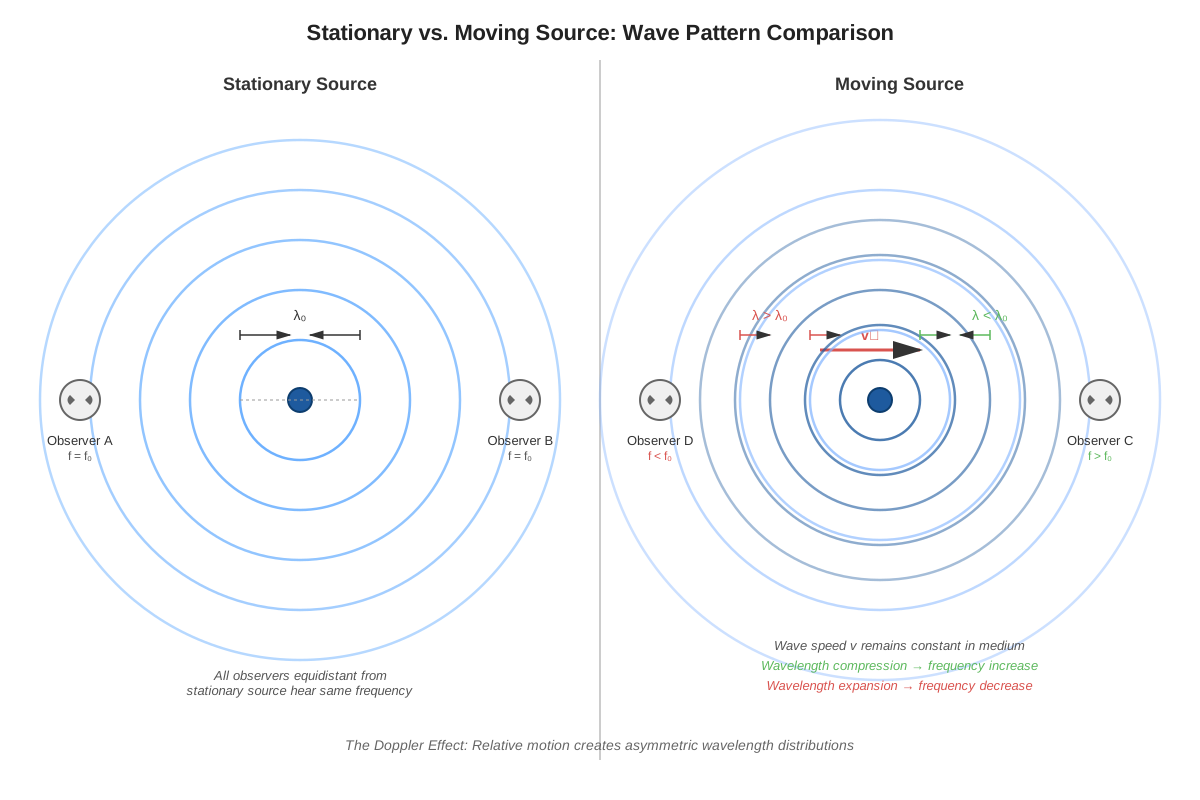
The physical basis of the Doppler effect lies in how relative motion affects the rate at which wave crests reach an observer. When a source moves toward a stationary observer, it emits successive wave crests from positions progressively closer to the observer, effectively "compressing" the wavelength and increasing the frequency. Conversely, when the source moves away, successive crests are emitted from increasingly distant positions, "stretching" the wavelength and decreasing the frequency. The speed of sound in the medium remains constant—only the wavelength and frequency change.
The Doppler Equation for Sound
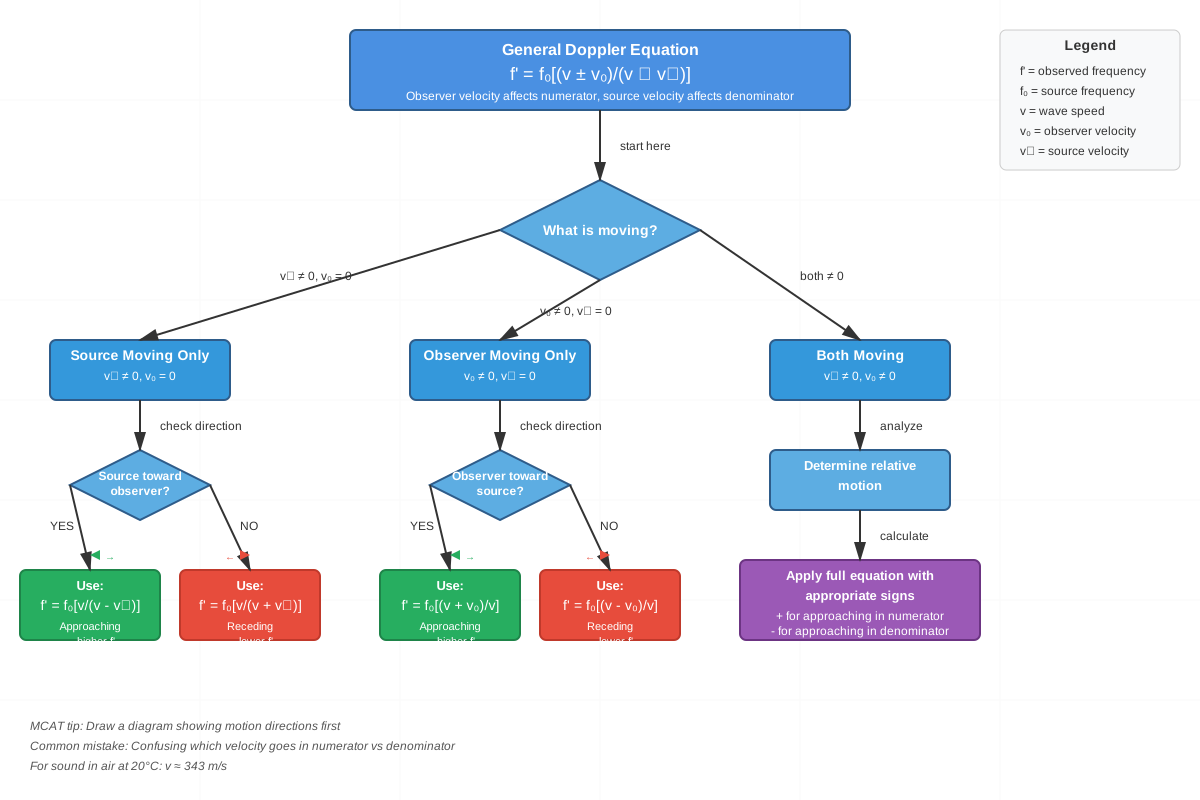
The general Doppler equation for sound waves relates the observed frequency (f') to the source frequency (f₀):
f' = f₀ × [(v ± v_observer) / (v ∓ v_source)]Where:
- f' = observed frequency (what the observer hears)
- f₀ = source frequency (what the source emits)
- v = speed of sound in the medium (approximately 343 m/s in air at 20°C)
- v_observer = speed of the observer
- v_source = speed of the source
The sign convention is critical for correct application:
- Numerator (observer term): Use plus (+) when the observer moves toward the source; use minus (−) when the observer moves away from the source
- Denominator (source term): Use minus (−) when the source moves toward the observer; use plus (+) when the source moves away from the observer
This sign convention can be remembered by thinking about the expected result: motion that brings source and observer closer should increase frequency (f' > f₀), while motion that separates them should decrease frequency (f' < f₀).
Source Motion vs. Observer Motion
Although the Doppler equation accounts for both source and observer motion, these two scenarios produce different effects when the speeds are equal. This asymmetry arises because the source motion affects the wavelength in the medium, while observer motion affects the rate at which the observer encounters wave crests.
When the source moves:
- The wavelength in the medium actually changes
- Ahead of the source: λ' = λ − (v_source/f₀)
- Behind the source: λ' = λ + (v_source/f₀)
- The effect is more pronounced for a given speed
When the observer moves:
- The wavelength in the medium remains unchanged
- The observer encounters wave crests at a different rate
- The relative velocity between observer and waves changes
- The effect is less pronounced for a given speed
For MCAT purposes, always use the complete Doppler equation rather than trying to remember separate formulas for each case. Set the appropriate velocity to zero if only the source or only the observer is moving.
Wavelength Changes in the Doppler Effect
While frequency changes are more commonly discussed, the Doppler effect also alters the observed wavelength. For a moving source, the wavelength in the direction of motion is:
λ' = λ₀ × [(v ∓ v_source) / v]Use minus (−) when the source moves toward the observer (wavelength decreases) and plus (+) when moving away (wavelength increases). The relationship between frequency and wavelength remains governed by the wave equation: v = f'λ', where v is the constant speed of sound in the medium.
Doppler Effect in Medical Ultrasound
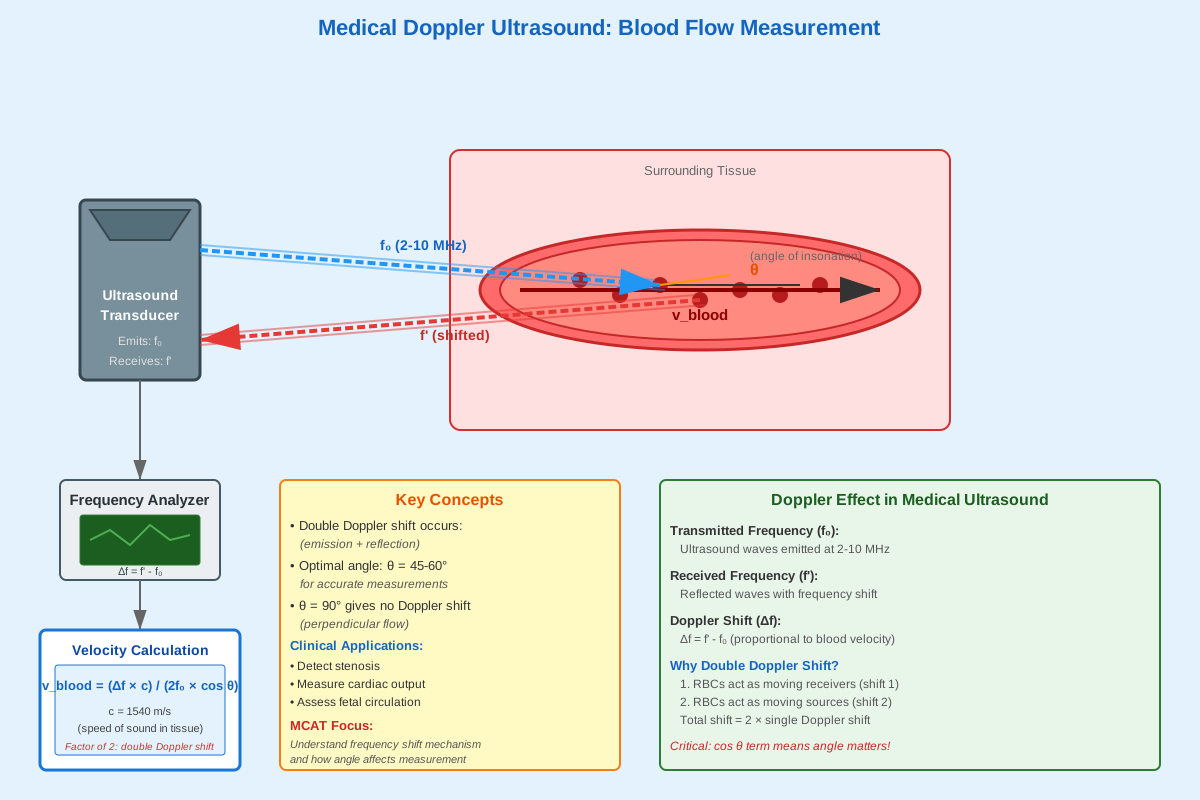
Medical applications of the Doppler effect, particularly Doppler ultrasound, represent high-yield MCAT content. In these applications, an ultrasound transducer emits high-frequency sound waves (typically 2-10 MHz) that reflect off moving structures, most commonly red blood cells in flowing blood.
The Doppler ultrasound scenario involves a double Doppler shift:
- First shift: The moving blood cells act as moving observers receiving the ultrasound from the stationary transducer
- Second shift: The blood cells then act as moving sources re-emitting (reflecting) the ultrasound back to the stationary transducer
The combined frequency shift is:
Δf = 2f₀ × (v_blood × cos θ) / v_soundWhere:
- Δf = frequency shift (f' − f₀)
- f₀ = transmitted ultrasound frequency
- v_blood = velocity of blood flow
- θ = angle between the ultrasound beam and blood flow direction
- v_sound = speed of sound in tissue (approximately 1540 m/s)
The factor of 2 accounts for the double shift, and the cosine term accounts for the angle of insonation. Blood flow velocity can be calculated by rearranging this equation, making Doppler ultrasound a powerful diagnostic tool for assessing cardiovascular function.
Qualitative Predictions and Limiting Cases
For MCAT success, develop strong intuition for qualitative predictions:
| Scenario | Frequency Change | Pitch Change | Wavelength Change |
|---|---|---|---|
| Source approaching observer | Increases (f' > f₀) | Higher pitch | Decreases |
| Source receding from observer | Decreases (f' < f₀) | Lower pitch | Increases |
| Observer approaching source | Increases (f' > f₀) | Higher pitch | Unchanged in medium |
| Observer receding from source | Decreases (f' < f₀) | Lower pitch | Unchanged in medium |
| No relative motion | No change (f' = f₀) | Same pitch | Unchanged |
Limiting cases help verify calculations:
- When v_source or v_observer = 0, the equation simplifies appropriately
- When v_source approaches v (speed of sound), the denominator approaches zero and f' approaches infinity (sonic boom conditions)
- When speeds are much smaller than v, the fractional change in frequency approximately equals the fractional change in relative velocity
Doppler Effect for Electromagnetic Waves
While the MCAT primarily tests acoustic Doppler effects, electromagnetic wave Doppler shifts may appear in astronomy or advanced physics passages. For electromagnetic waves, the relativistic Doppler equation applies:
f' = f₀ × √[(1 − β) / (1 + β)]Where β = v/c (velocity as a fraction of light speed). For speeds much less than c, this reduces to the classical approximation. The key difference is that electromagnetic Doppler shifts depend only on relative velocity (no asymmetry between source and observer motion) because electromagnetic waves don't require a medium.
Concept Relationships
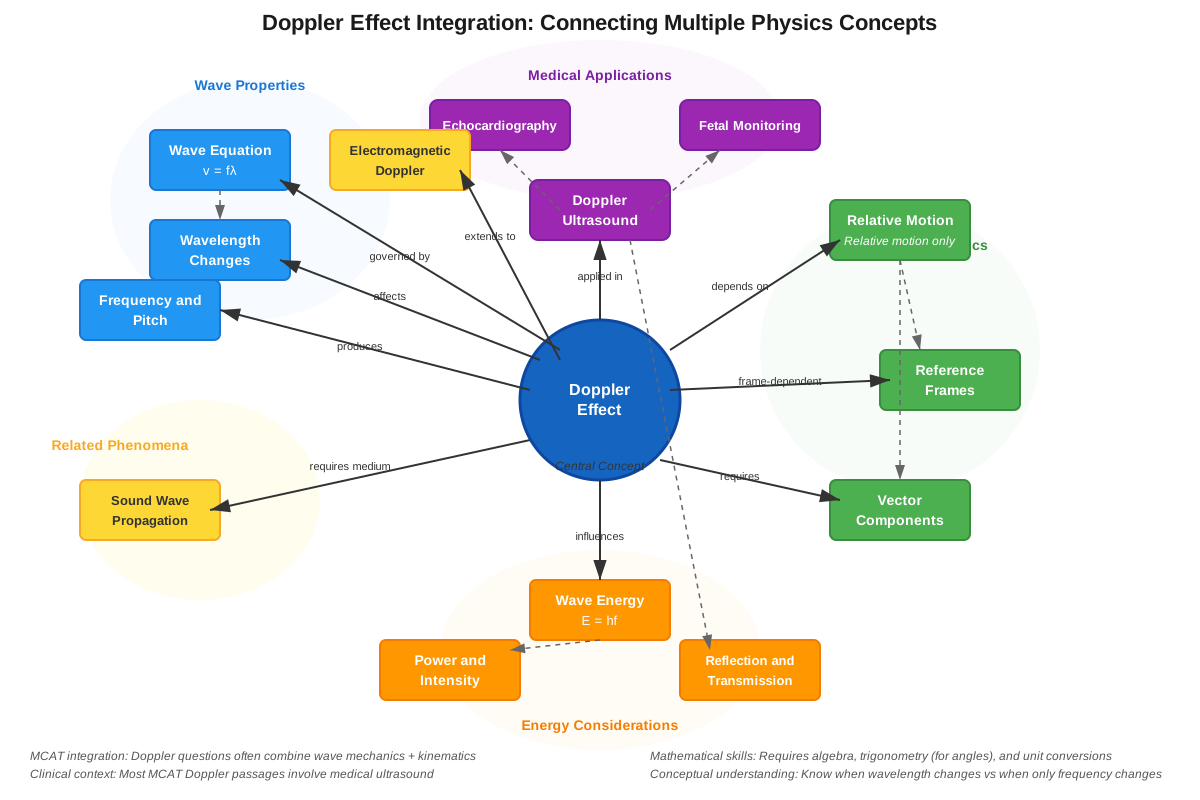
The Doppler effect integrates multiple fundamental physics concepts into a unified framework. At its foundation, the Doppler effect depends on wave properties—specifically the relationships among frequency, wavelength, and wave velocity expressed in the wave equation v = fλ. This equation remains valid during Doppler shifts; as frequency changes, wavelength must change inversely to maintain constant wave speed in the medium.
Relative motion forms the causal basis for the Doppler effect. The phenomenon only occurs when source and observer have non-zero relative velocity along the line connecting them. This connects to kinematics and reference frames, as the observed frequency depends on the velocity components parallel to the wave propagation direction. Perpendicular motion produces no first-order Doppler shift (though relativistic transverse Doppler effects exist for electromagnetic waves).
The relationship map flows as follows:
Wave properties (f, λ, v) → Wave propagation in medium → Relative motion between source and observer → Altered rate of wave crest encounters → Frequency shift (Doppler effect) → Applications in medical imaging and diagnostics
Within the topic itself, source motion and observer motion connect through the unified Doppler equation, though they produce physically distinct effects on wavelength in the medium. Both types of motion contribute additively to the overall frequency shift when both source and observer move simultaneously.
The Doppler effect connects forward to more advanced topics including shock waves and sonic booms (when source velocity exceeds wave velocity), redshift in astronomy (cosmological Doppler shifts indicating universal expansion), and radar technology (electromagnetic Doppler for velocity measurement). In biological contexts, it enables echocardiography, fetal monitoring, and vascular flow assessment—all clinically relevant applications that may appear in MCAT passages.
Understanding the Doppler effect also reinforces the distinction between mechanical waves (requiring a medium, with asymmetric source/observer effects) and electromagnetic waves (no medium required, symmetric relativistic effects). This conceptual distinction helps students recognize when different equations apply.
Quick check — test yourself on Doppler effect so far.
Try Flashcards →High-Yield Facts
⭐ The Doppler equation for sound is f' = f₀ × [(v ± v_observer) / (v ∓ v_source)], where the signs depend on whether motion brings source and observer together (frequency increases) or separates them (frequency decreases).
⭐ When the source moves toward the observer, use minus (−) in the denominator; when the source moves away, use plus (+) in the denominator.
⭐ When the observer moves toward the source, use plus (+) in the numerator; when the observer moves away, use minus (−) in the numerator.
⭐ Doppler ultrasound involves a double Doppler shift because sound reflects off moving blood cells, which act first as moving observers then as moving sources.
⭐ The frequency shift in medical ultrasound is Δf = 2f₀(v_blood cos θ)/v_sound, where the factor of 2 accounts for the double shift and cos θ accounts for the angle between beam and flow.
- The speed of sound in the medium (v) remains constant during Doppler shifts; only frequency and wavelength change.
- Source motion and observer motion produce different magnitudes of frequency shift even when the speeds are equal, because source motion changes the wavelength in the medium while observer motion does not.
- The Doppler effect is maximized when motion is directly along the line connecting source and observer (θ = 0° or 180°) and is zero for purely perpendicular motion.
- As source velocity approaches the speed of sound, the observed frequency approaches infinity in the forward direction (leading to shock wave formation at supersonic speeds).
- For electromagnetic waves, the Doppler shift depends only on relative velocity and requires relativistic treatment at high speeds, unlike sound waves which show source/observer asymmetry.
- Blood flow velocity can be calculated from Doppler ultrasound frequency shifts, making it a non-invasive diagnostic tool for cardiovascular assessment.
- The Doppler effect applies to all periodic waves including water waves, seismic waves, and light waves, though the mathematical treatment varies.
Common Misconceptions
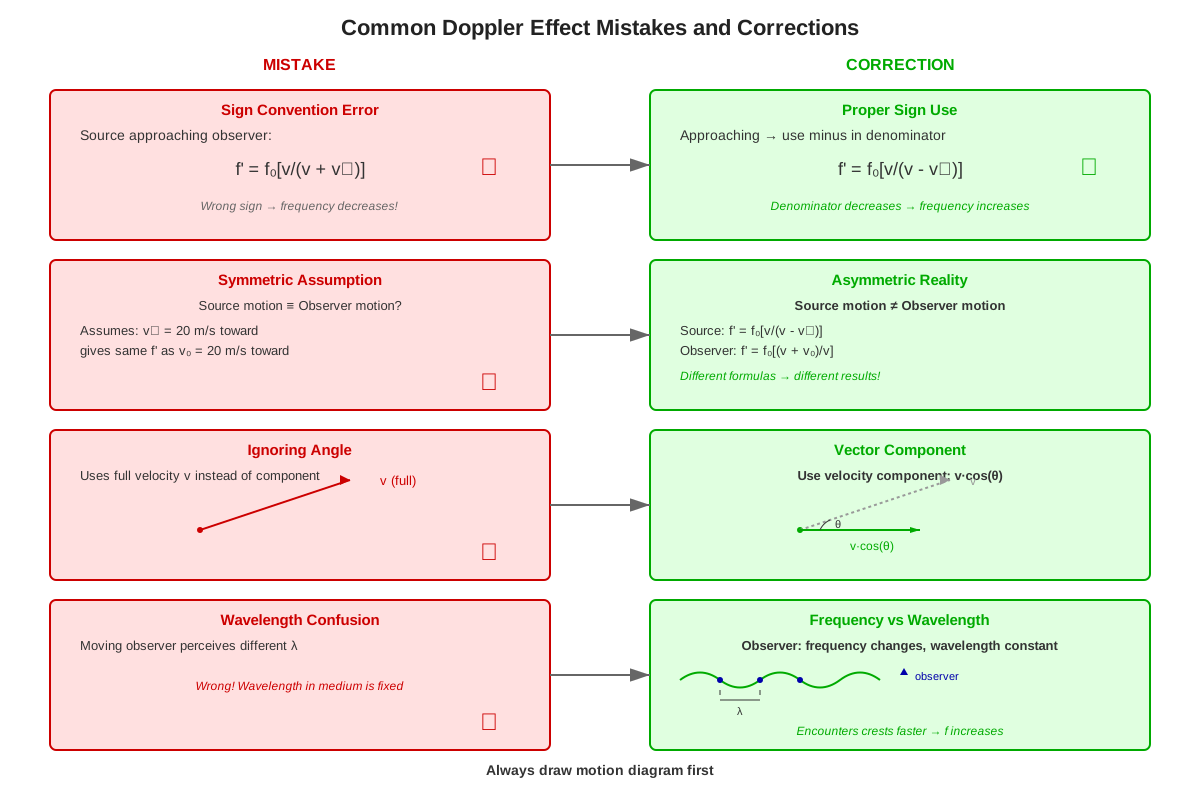
Misconception: The speed of sound changes during the Doppler effect.
Correction: The speed of sound in a given medium remains constant regardless of source or observer motion. Only the frequency and wavelength change, and they change inversely to maintain v = fλ. The Doppler effect is about how motion affects the rate at which wave crests reach an observer, not about changing the wave propagation speed.
Misconception: Source motion and observer motion produce identical frequency shifts when the speeds are equal.
Correction: Equal speeds of source and observer produce different frequency shifts. Source motion changes the wavelength in the medium itself, while observer motion only changes the rate at which the observer encounters existing wave crests. Always use the complete Doppler equation rather than assuming symmetry.
Misconception: The sign convention in the Doppler equation is arbitrary or can be memorized without understanding.
Correction: The signs follow logically from the expected result. Motion that brings source and observer closer should increase frequency, so choose signs that make f' > f₀. Specifically: observer approaching → plus in numerator; source approaching → minus in denominator. Understanding this logic prevents sign errors.
Misconception: Doppler ultrasound measures a single frequency shift.
Correction: Medical Doppler ultrasound involves a double Doppler shift. The moving blood cells first receive shifted ultrasound (acting as moving observers), then reflect it back with a second shift (acting as moving sources). This is why the frequency shift equation includes a factor of 2.
Misconception: The Doppler effect only occurs when the source is moving.
Correction: The Doppler effect occurs whenever there is relative motion between source and observer, regardless of which one moves or whether both move. Observer motion alone produces a Doppler shift, though of different magnitude than equivalent source motion.
Misconception: Perpendicular motion produces no Doppler shift because there's still relative motion.
Correction: While there is relative motion, the Doppler effect depends specifically on the component of velocity along the line connecting source and observer. Purely perpendicular motion produces no change in the distance between source and observer at the instant they are closest, resulting in no first-order Doppler shift (though relativistic transverse effects exist for light).
Misconception: Higher frequency sources always produce larger Doppler shifts.
Correction: The absolute frequency shift (Δf) is proportional to the source frequency, but the fractional frequency shift (Δf/f₀) depends only on the velocities and is independent of the source frequency. A 1000 Hz source and a 10,000 Hz source moving at the same speed will have different absolute shifts but the same percentage shift.
Worked Examples
Example 1: Ambulance Siren Approaching and Receding
Problem: An ambulance siren emits sound at a frequency of 1200 Hz. The ambulance travels at 30 m/s toward a stationary observer. The speed of sound in air is 340 m/s. (a) What frequency does the observer hear as the ambulance approaches? (b) What frequency does the observer hear after the ambulance passes and is moving away?
Solution:
(a) Ambulance approaching:
Given:
- f₀ = 1200 Hz (source frequency)
- v_source = 30 m/s (toward observer)
- v_observer = 0 m/s (stationary)
- v = 340 m/s (speed of sound)
Since the observer is stationary, the numerator is simply v. Since the source is moving toward the observer, we use minus (−) in the denominator:
f' = f₀ × [v / (v − v_source)]
f' = 1200 Hz × [340 m/s / (340 m/s − 30 m/s)]
f' = 1200 Hz × [340 / 310]
f' = 1200 Hz × 1.097
f' ≈ 1316 Hz
The observer hears a higher frequency (higher pitch) of approximately 1316 Hz as the ambulance approaches.
(b) Ambulance receding:
Now the source moves away from the observer, so we use plus (+) in the denominator:
f' = f₀ × [v / (v + v_source)]
f' = 1200 Hz × [340 m/s / (340 m/s + 30 m/s)]
f' = 1200 Hz × [340 / 370]
f' = 1200 Hz × 0.919
f' ≈ 1103 Hz
The observer hears a lower frequency (lower pitch) of approximately 1103 Hz as the ambulance recedes.
Key insights: Notice that the frequency shift is asymmetric—the increase when approaching (116 Hz) is larger than the decrease when receding (97 Hz). This occurs because the denominator changes differently in each case. This problem demonstrates the practical application of the Doppler effect and reinforces the sign convention.
Example 2: Doppler Ultrasound Blood Flow Measurement
Problem: A cardiologist uses Doppler ultrasound to measure blood flow velocity in a patient's carotid artery. The ultrasound transducer emits waves at 5.0 MHz and receives reflected waves at 5.0065 MHz. The ultrasound beam makes a 60° angle with the direction of blood flow. The speed of sound in tissue is 1540 m/s. Calculate the blood flow velocity.
Solution:
Given:
- f₀ = 5.0 MHz = 5.0 × 10⁶ Hz (transmitted frequency)
- f' = 5.0065 MHz = 5.0065 × 10⁶ Hz (received frequency)
- θ = 60° (angle between beam and flow)
- v_sound = 1540 m/s (speed of sound in tissue)
- v_blood = ? (what we're solving for)
First, calculate the frequency shift:
Δf = f' − f₀ = 5.0065 × 10⁶ Hz − 5.0 × 10⁶ Hz = 6500 HzFor Doppler ultrasound with reflection, use the double-shift equation:
Δf = 2f₀ × (v_blood × cos θ) / v_soundRearranging to solve for v_blood:
v_blood = (Δf × v_sound) / (2f₀ × cos θ)Substituting values:
v_blood = (6500 Hz × 1540 m/s) / (2 × 5.0 × 10⁶ Hz × cos 60°)
v_blood = (10,010,000) / (2 × 5.0 × 10⁶ × 0.5)
v_blood = (10,010,000) / (5.0 × 10⁶)
v_blood ≈ 2.0 m/s
The blood flow velocity is approximately 2.0 m/s (or 200 cm/s).
Key insights: This problem demonstrates the clinical application of the Doppler effect and requires understanding of the double-shift phenomenon. The angle correction (cos θ) is crucial—if the angle were 0° (beam parallel to flow), the velocity would be 1.0 m/s. The angle reduces the effective velocity component along the beam direction. This type of calculation is high-yield for MCAT passages involving medical imaging technology.
Exam Strategy
When approaching Doppler effect questions on the MCAT, first identify whether the question requires qualitative reasoning or quantitative calculation. Many MCAT questions test conceptual understanding rather than complex math, so determine whether you can eliminate wrong answers based on whether frequency should increase or decrease before attempting detailed calculations.
Trigger words and phrases to watch for:
- "Approaching" or "moving toward" → frequency increases
- "Receding" or "moving away" → frequency decreases
- "Pitch" → directly related to frequency
- "Ultrasound," "echocardiography," or "blood flow" → likely involves double Doppler shift
- "Stationary observer" or "stationary source" → simplifies equation by setting one velocity to zero
- "Relative velocity" → consider both source and observer motion
Step-by-step approach for calculation problems:
- Identify what's moving: Determine whether the source, observer, or both are in motion
- Establish direction: Determine whether motion brings them together (frequency increases) or separates them (frequency decreases)
- Choose signs carefully: Apply the sign convention systematically (observer approaching = + numerator; source approaching = − denominator)
- Check reasonableness: Verify that f' > f₀ when approaching and f' < f₀ when receding
- Watch for special cases: Medical ultrasound requires the double-shift equation with the factor of 2
Process-of-elimination strategies:
- Eliminate any answer choice that shows frequency decreasing when source and observer approach each other (or vice versa)
- For medical ultrasound problems, eliminate answers that don't account for the double shift
- If the problem states "small velocities compared to sound speed," the frequency shift should be a small percentage of the original frequency
- Eliminate answers where the calculated velocity exceeds the speed of sound (unless the problem explicitly involves supersonic conditions)
Time allocation: Doppler effect questions typically require 60-90 seconds. Spend 15-20 seconds reading and identifying the scenario, 30-45 seconds on calculations (if needed), and 10-15 seconds checking your answer's reasonableness. If a question requires extensive calculation and you're running short on time, use qualitative reasoning to eliminate obviously wrong answers and make an educated guess.
Exam Tip: If you forget the exact sign convention, remember this principle: whatever configuration brings source and observer closer together should increase frequency. Work backward from this principle to determine the correct signs.
Memory Techniques
Sign Convention Mnemonic - "TAPS":
- Toward in Top (numerator): Observer moving toward source → + in numerator
- Away in Answer (numerator): Observer moving away from source → − in numerator
- Pursuing Puts minus (denominator): Source pursuing (toward) observer → − in denominator
- Separating Sums (denominator): Source separating (away) from observer → + in denominator
Frequency Change Visualization:
Picture a source emitting concentric circles (wave crests). When the source moves, imagine the circles bunching up ahead of the source (shorter wavelength, higher frequency) and spreading out behind (longer wavelength, lower frequency). This visual reinforces why approaching sources produce higher pitch.
Medical Ultrasound Acronym - "DOUBLE":
- Doppler ultrasound
- Observer first (blood cells receive)
- Ultrasound reflects
- Blood cells become source
- Leads to factor of 2
- Equation includes angle
Qualitative Prediction Shortcut:
Use your hand: fingers together = approaching = frequency increases (fingers are "compressed"). Fingers spread = receding = frequency decreases (fingers are "stretched").
Equation Structure Memory:
Think "Observer On Top, Source on Bottom" (OOTS-B) to remember that observer velocity goes in the numerator and source velocity goes in the denominator of the Doppler equation.
Summary
The Doppler effect describes the change in observed wave frequency resulting from relative motion between a wave source and observer. For sound waves, the observed frequency f' relates to the source frequency f₀ through the equation f' = f₀ × [(v ± v_observer) / (v ∓ v_source)], where careful attention to sign convention is essential: motion bringing source and observer together increases frequency, while motion separating them decreases frequency. The phenomenon arises because relative motion changes either the wavelength in the medium (source motion) or the rate at which an observer encounters wave crests (observer motion), though the wave speed in the medium remains constant. Medical applications, particularly Doppler ultrasound for measuring blood flow velocity, represent high-yield MCAT content and involve a double Doppler shift as sound reflects off moving blood cells. Success on MCAT questions requires both qualitative understanding to predict frequency changes and quantitative skills to apply the Doppler equation correctly, with particular attention to sign conventions and special cases like angled ultrasound beams.
Key Takeaways
- The Doppler effect causes frequency to increase when source and observer approach each other and decrease when they separate, while the wave speed in the medium remains constant
- The complete Doppler equation f' = f₀ × [(v ± v_observer) / (v ∓ v_source)] accounts for both source and observer motion with specific sign conventions based on direction
- Source motion and observer motion produce different effects: source motion changes wavelength in the medium, while observer motion changes the encounter rate with existing wave crests
- Medical Doppler ultrasound involves a double frequency shift (factor of 2) because sound reflects off moving blood cells that act first as observers then as sources
- The angle between the ultrasound beam and blood flow direction affects the measured frequency shift through a cosine factor, making proper probe positioning clinically important
- Qualitative reasoning about whether frequency increases or decreases can often eliminate wrong answers faster than detailed calculations
- The Doppler effect connects wave properties, relative motion, and medical diagnostics, making it a high-yield integrative topic for the MCAT
Related Topics
Shock Waves and Sonic Booms: When a source moves faster than the wave speed (supersonic motion), wave crests pile up to form a shock wave. Understanding the Doppler effect provides the foundation for analyzing these extreme cases where the denominator in the Doppler equation approaches zero.
Ultrasound Imaging Physics: Beyond Doppler applications, ultrasound imaging relies on wave reflection, transmission, and the acoustic impedance of tissues. Mastering the Doppler effect enables deeper understanding of how ultrasound technology provides both structural and functional information.
Electromagnetic Doppler Shifts and Redshift: The Doppler effect for light waves requires relativistic treatment and explains astronomical phenomena like cosmological redshift. This extends Doppler principles to electromagnetic waves and connects physics to astronomy.
Wave Interference and Beats: When two frequencies are present simultaneously (such as the original and Doppler-shifted frequencies), they can interfere to produce beat frequencies. This connects the Doppler effect to wave superposition principles.
Cardiovascular Physiology and Hemodynamics: Understanding how Doppler ultrasound measures blood flow velocity connects to broader topics in cardiovascular function, including cardiac output, vascular resistance, and flow patterns in health and disease.
Practice CTA
Now that you've mastered the core concepts of the Doppler effect, it's time to reinforce your understanding through active practice. Work through the practice questions to test your ability to apply the Doppler equation, predict qualitative frequency changes, and analyze medical applications. Use the flashcards to drill the sign conventions and key equations until they become automatic. Remember, the Doppler effect appears regularly on the MCAT in both straightforward calculations and complex passage-based scenarios—your investment in practice now will pay dividends on test day. Focus especially on problems involving medical ultrasound and scenarios requiring careful attention to sign conventions, as these represent the highest-yield applications. You've got this!
Sign up free to keep reading
Create a free AnvayaPrep account to finish this MCAT guide on Doppler effect — plus flashcards and practice questions.