Overview
Biases represent systematic patterns of deviation from rationality in judgment and decision-making. In the context of Psychology and Cognition and Consciousness, biases are mental shortcuts or heuristics that can lead to predictable errors in thinking, perception, and memory. These cognitive phenomena emerge from the brain's attempt to process vast amounts of information efficiently, but they often result in flawed conclusions that deviate from logical or statistical reasoning.
Understanding biases is crucial for the MCAT because they appear frequently in the Psychological, Social, and Biological Foundations of Behavior section. Questions may present experimental scenarios, clinical vignettes, or research studies where recognizing specific biases becomes essential to selecting the correct answer. The MCAT tests not only the ability to define various biases but also to apply them to novel situations, distinguish between similar biases, and understand their implications for human behavior and decision-making.
Biases Psychology connects to broader themes within cognition, including problem-solving, decision-making, memory formation and retrieval, social perception, and attribution theory. Mastering this topic provides a foundation for understanding how humans process information imperfectly, which has implications for medical practice, research interpretation, patient communication, and healthcare disparities. The Biases MCAT content integrates with topics such as heuristics, schemas, social cognition, and the influence of emotion on reasoning—all high-yield areas for exam success.
Learning Objectives
- [ ] Define Biases using accurate Psychology terminology
- [ ] Explain why Biases matters for the MCAT
- [ ] Apply Biases to exam-style questions
- [ ] Identify common mistakes related to Biases
- [ ] Connect Biases to related Psychology concepts
- [ ] Distinguish between different types of cognitive biases and their specific mechanisms
- [ ] Analyze how biases influence medical decision-making and patient-provider interactions
- [ ] Evaluate experimental scenarios to identify which bias is most likely operating
Prerequisites
- Heuristics and problem-solving strategies: Biases often result from the misapplication of mental shortcuts (heuristics) that usually serve us well but can lead to systematic errors.
- Memory processes (encoding, storage, retrieval): Many biases affect how information is remembered or recalled, making understanding of memory systems essential.
- Attribution theory: Several biases relate to how we explain behavior and assign causality to ourselves versus others.
- Social cognition fundamentals: Biases operate within social contexts and affect how we perceive, interpret, and interact with others.
- Basic statistical reasoning: Understanding biases requires recognizing when intuitive judgments deviate from statistical probability.
Why This Topic Matters
Clinical and Real-World Significance
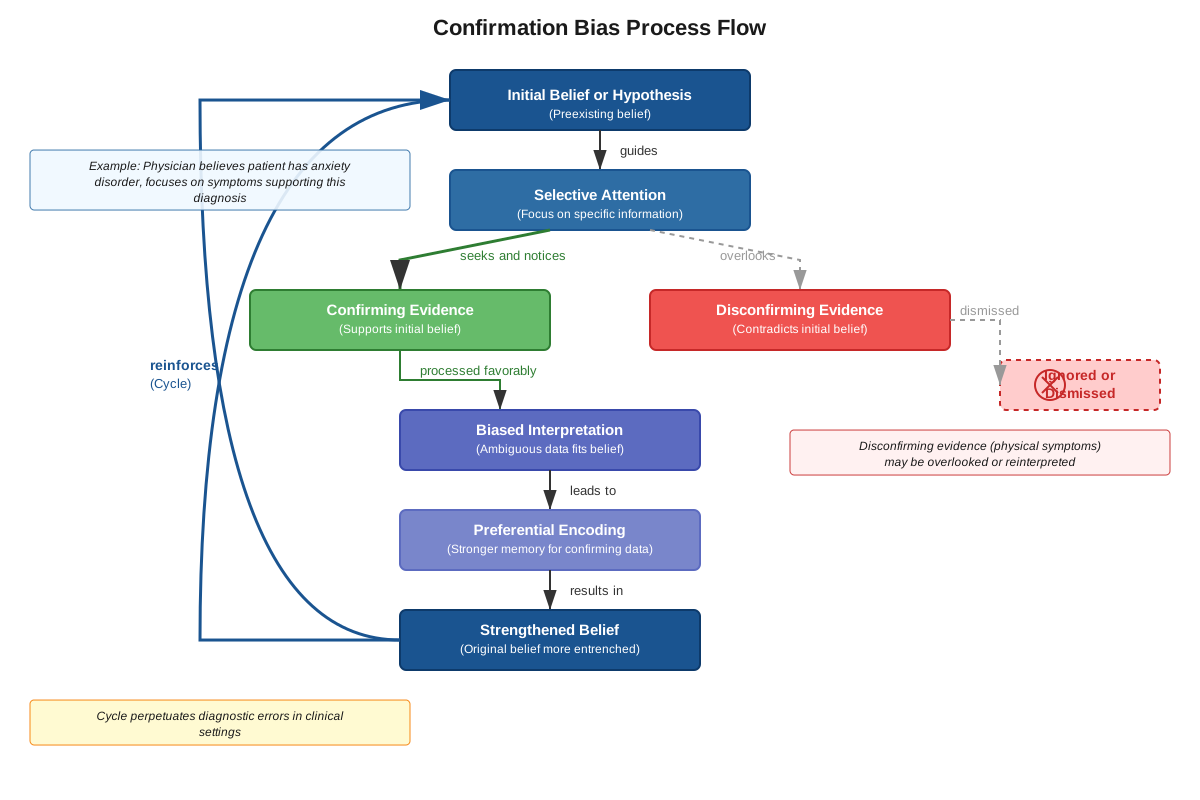
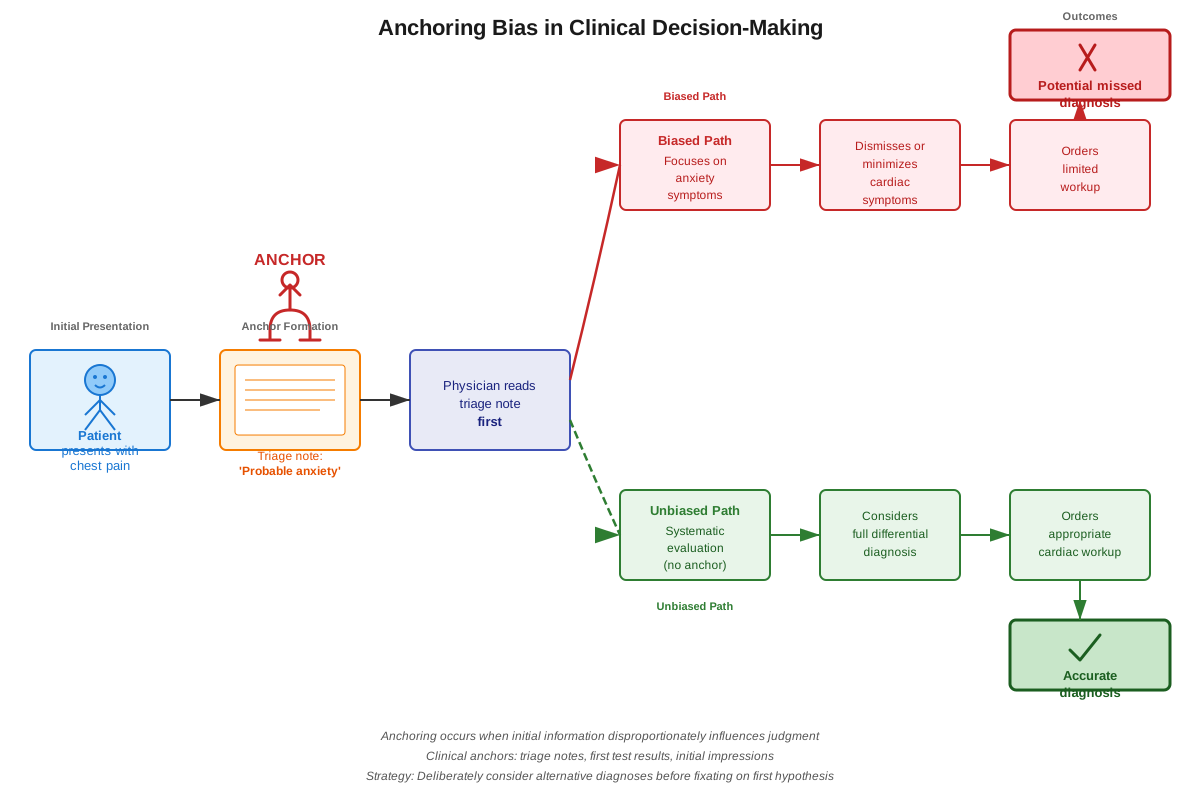
Biases profoundly impact medical practice and healthcare delivery. Physicians may exhibit confirmation bias when they seek information that supports their initial diagnosis while ignoring contradictory evidence. Anchoring bias can cause clinicians to fixate on initial test results or presenting symptoms, potentially missing alternative diagnoses. Understanding these cognitive pitfalls helps future physicians develop metacognitive awareness and implement systematic approaches to reduce diagnostic errors. Additionally, biases contribute to healthcare disparities, as implicit biases can unconsciously influence treatment decisions and patient interactions.
Exam Statistics and Question Types
Biases appear in approximately 10-15% of Psychology/Sociology section questions on the MCAT. Questions typically present in three formats: (1) definition-based items requiring identification of a specific bias from a description, (2) application questions where students must recognize which bias explains behavior in a vignette, and (3) research-based passages where understanding biases is necessary to evaluate study design, interpret results, or identify methodological limitations. The MCAT particularly favors questions that require distinguishing between similar biases (e.g., availability vs. representativeness heuristic) or recognizing how multiple biases might operate simultaneously.
Common Exam Appearances
Biases frequently appear in passages about medical decision-making, research methodology, social psychology experiments, and memory studies. Expect to see clinical vignettes where a physician's reasoning demonstrates a specific bias, research scenarios where participant responses reflect cognitive distortions, or social situations where attribution errors occur. The exam often embeds bias questions within larger passages about judgment and decision-making, requiring integration with other cognitive concepts.
Core Concepts
Definition and Mechanisms of Cognitive Biases
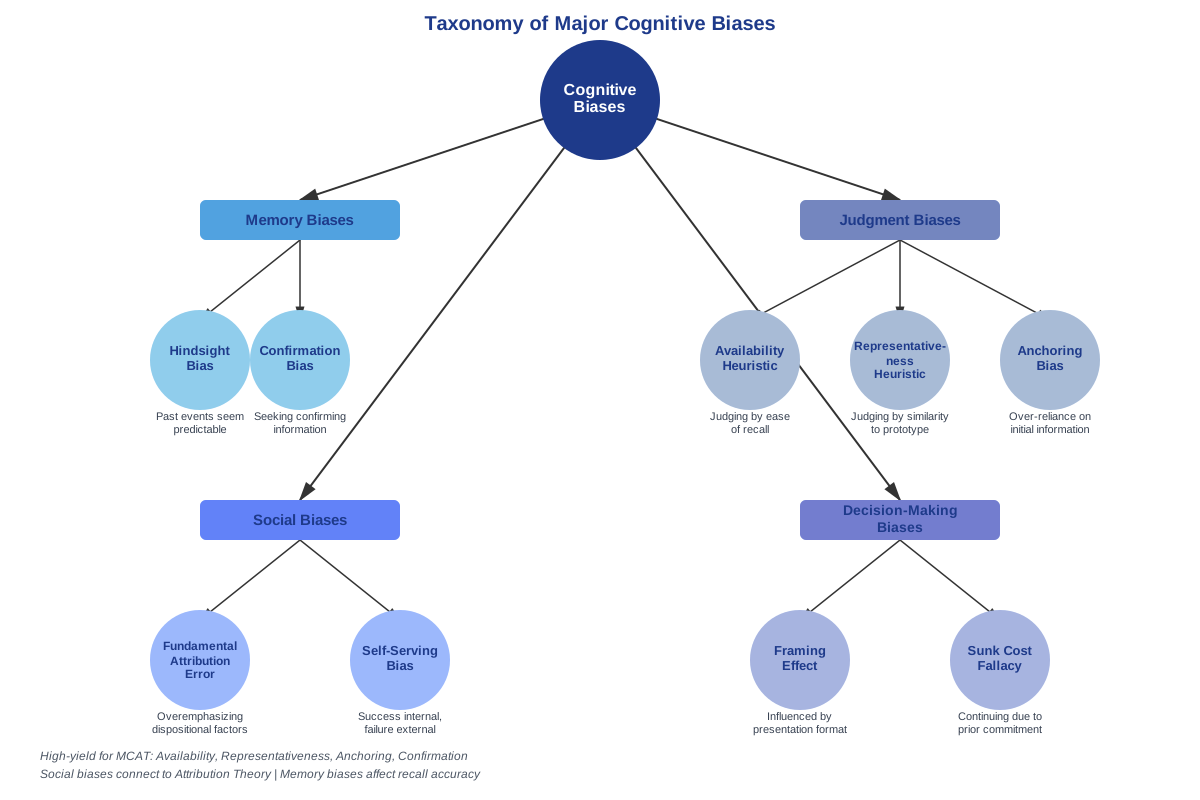
Cognitive biases are systematic patterns of deviation from norm or rationality in judgment, whereby inferences about other people and situations may be drawn in an illogical fashion. Unlike random errors, biases are predictable and consistent, arising from the brain's reliance on heuristics—mental shortcuts that simplify complex information processing. While heuristics enable rapid decision-making with limited cognitive resources, they can produce systematic errors when applied inappropriately.
The mechanism underlying most biases involves dual-process theory: System 1 (fast, automatic, intuitive) and System 2 (slow, deliberate, analytical) thinking. Biases typically emerge from over-reliance on System 1 processing without adequate System 2 verification. The brain prioritizes efficiency over accuracy, leading to predictable patterns of error that persist even when individuals are aware of them.
Major Categories of Cognitive Biases
Memory-Related Biases
Hindsight bias (also called the "knew-it-all-along effect") occurs when people perceive past events as having been more predictable than they actually were. After learning an outcome, individuals believe they "knew it all along," which distorts memory of their original predictions. This bias affects how medical students evaluate clinical cases retrospectively and can impair learning from mistakes.
Confirmation bias represents the tendency to search for, interpret, favor, and recall information that confirms pre-existing beliefs while giving disproportionately less consideration to alternative possibilities. In medical contexts, this manifests when clinicians selectively gather evidence supporting their initial diagnostic hypothesis while dismissing contradictory findings. This bias operates at multiple stages: information search (seeking confirming evidence), interpretation (viewing ambiguous evidence as supportive), and recall (remembering confirming instances more readily).
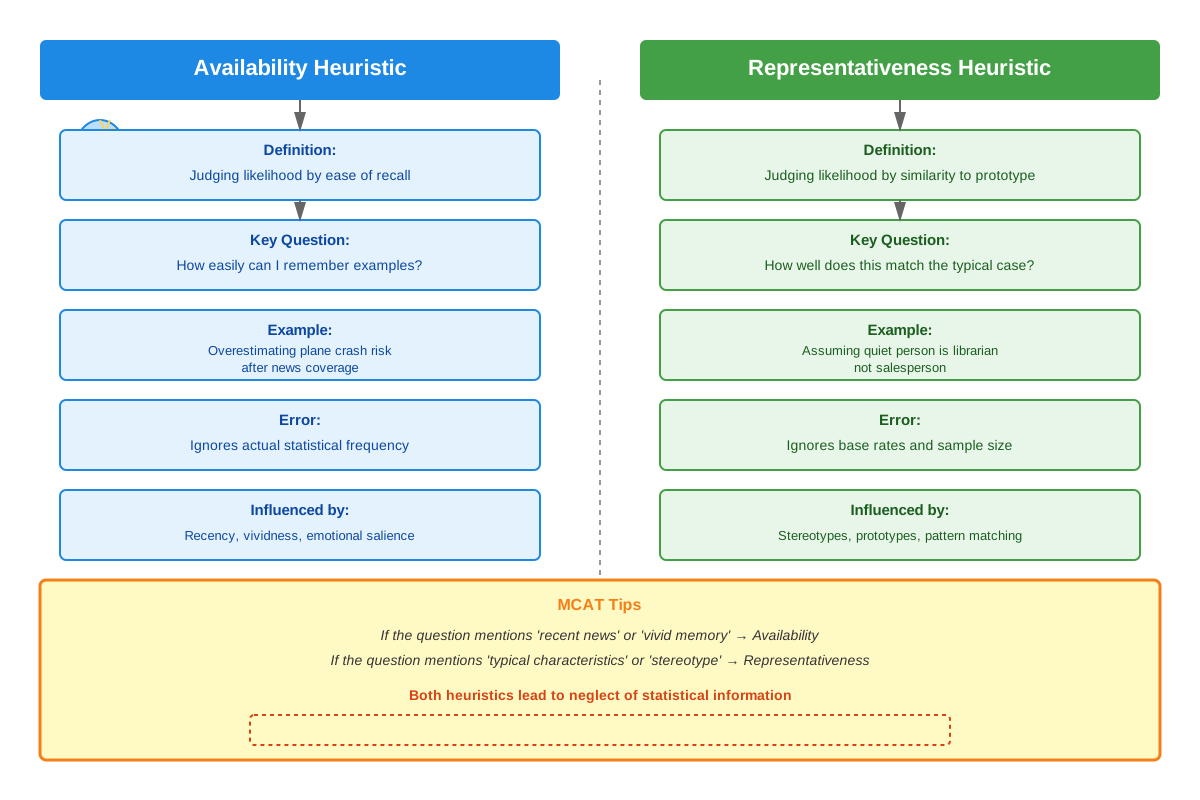
Availability heuristic involves estimating the likelihood of events based on how easily examples come to mind rather than on actual probability. Recent, vivid, or emotionally charged events are more "available" in memory, leading to overestimation of their frequency. A physician who recently treated a rare disease might overdiagnose it in subsequent patients because the condition is cognitively available.
Misinformation effect occurs when exposure to misleading information after an event distorts memory of the original event. This bias has profound implications for eyewitness testimony and demonstrates memory's reconstructive (rather than reproductive) nature.
Decision-Making and Judgment Biases
Anchoring bias describes the tendency to rely too heavily on the first piece of information encountered (the "anchor") when making decisions. Subsequent judgments are insufficiently adjusted away from this initial value. In clinical settings, initial vital signs, preliminary diagnoses, or first impressions can serve as anchors that inappropriately influence later reasoning.
Framing effect demonstrates that people react differently to the same choice depending on how it is presented (framed). Describing a surgery as having a "90% survival rate" versus a "10% mortality rate" produces different patient decisions despite identical information. This bias reveals that human decision-making is not purely rational but influenced by presentation context.
Representativeness heuristic involves judging the probability of an event by how similar it is to a prototype or stereotype rather than using base rate information (actual statistical prevalence). This leads to neglect of base rates and can cause diagnostic errors when clinicians focus on how well symptoms match a disease prototype while ignoring that disease's actual prevalence.
Gambler's fallacy is the mistaken belief that past random events affect the probability of future random events. After observing a streak of one outcome, people incorrectly believe the alternative outcome is "due" to occur, failing to recognize that independent events have no memory.
Attribution and Social Biases
Fundamental attribution error (also called correspondence bias) refers to the tendency to overemphasize dispositional (personality-based) explanations for others' behavior while underestimating situational factors. When someone cuts us off in traffic, we attribute it to their rude personality rather than considering they might be rushing to an emergency. Conversely, when explaining our own behavior, we tend to emphasize situational factors.
Self-serving bias involves attributing successes to internal factors (ability, effort) while attributing failures to external factors (bad luck, task difficulty). This bias protects self-esteem but can impair accurate self-assessment and learning from mistakes.
Actor-observer bias describes the tendency to attribute our own actions to situational factors while attributing others' actions to their dispositions. This asymmetry stems from differences in available information and perceptual focus—we're aware of situational pressures on ourselves but observe others' behavior without full context.
Just-world hypothesis is the cognitive bias that people get what they deserve—good things happen to good people and bad things to bad people. This belief helps maintain a sense of control and predictability but can lead to victim-blaming and failure to recognize systemic injustices.
Comparison Table of Common Biases
| Bias | Definition | Example | MCAT Context |
|---|---|---|---|
| Confirmation Bias | Seeking/interpreting information that confirms existing beliefs | Doctor orders only tests supporting initial diagnosis | Research methodology, clinical reasoning |
| Availability Heuristic | Judging probability by ease of recall | Overestimating plane crash risk after news coverage | Risk perception, memory |
| Anchoring | Over-relying on first information encountered | Initial blood pressure reading influences interpretation of later values | Clinical decision-making |
| Representativeness Heuristic | Judging probability by similarity to prototype | Diagnosing based on symptom match while ignoring base rates | Statistical reasoning, diagnosis |
| Hindsight Bias | Viewing past events as predictable | "I knew that treatment wouldn't work" (after outcome known) | Memory, learning from experience |
| Fundamental Attribution Error | Overattributing others' behavior to disposition | Assuming patient non-compliance reflects laziness vs. barriers | Social psychology, patient care |
| Framing Effect | Different responses to equivalent information based on presentation | Surgery acceptance varies with survival vs. mortality framing | Decision-making, patient communication |
Mechanisms of Bias Formation and Persistence
Biases persist despite awareness due to several factors. Cognitive economy demands that the brain conserve resources, making heuristics adaptive despite occasional errors. Emotional influences strengthen biases, as emotionally charged information receives preferential processing and memory consolidation. Social reinforcement occurs when shared biases within groups create echo chambers that validate distorted thinking. Metacognitive limitations mean that people often lack insight into their own cognitive processes, making biases difficult to detect in real-time.
The illusion of validity causes people to maintain confidence in judgments even when those judgments are demonstrably biased. This overconfidence prevents the metacognitive monitoring necessary to catch and correct errors. Additionally, motivated reasoning occurs when emotional stakes in an outcome lead to biased information processing that supports desired conclusions.
Concept Relationships
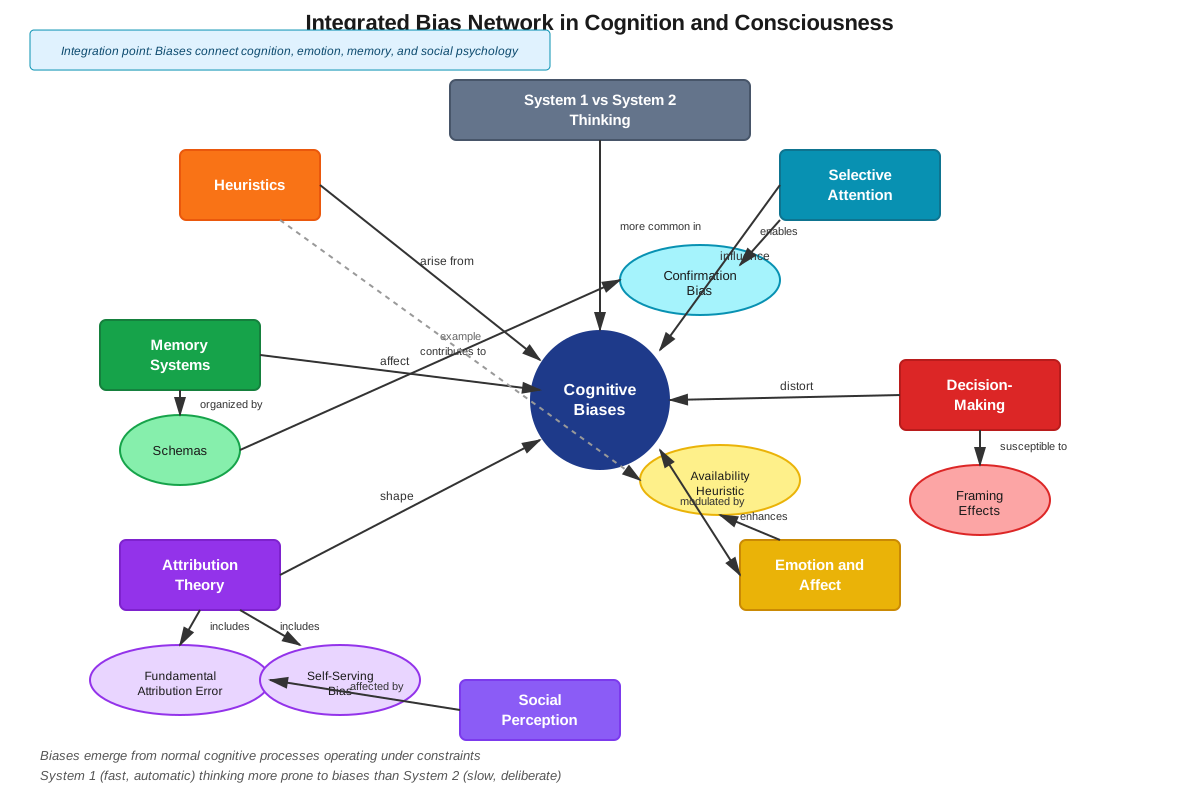
Biases emerge from the interaction between heuristics (mental shortcuts) and cognitive limitations (working memory capacity, attention constraints). When heuristics are applied inappropriately or without adequate deliberative processing, systematic biases result. This relationship flows: Limited Cognitive Resources → Reliance on Heuristics → Systematic Biases.
Within the bias family, memory-related biases (hindsight, availability, misinformation) connect to memory processes including encoding specificity, retrieval cues, and reconstructive memory. Attribution biases (fundamental attribution error, self-serving bias, actor-observer bias) link directly to attribution theory and social cognition, explaining how we make sense of behavior in social contexts.
Decision-making biases (anchoring, framing, representativeness) relate to judgment and decision-making theories, particularly prospect theory and expected utility theory. These biases demonstrate systematic deviations from rational choice models, connecting to behavioral economics concepts increasingly relevant to healthcare policy and patient decision-making.
The relationship map: Schemas and Expectations → Confirmation Bias → Selective Attention and Memory → Reinforced Schemas creates a feedback loop that strengthens biased thinking over time. Similarly, Emotional Arousal → Enhanced Availability → Overestimation of Probability → Anxiety/Fear → Further Emotional Arousal demonstrates how biases can create self-perpetuating cycles.
Biases also connect to consciousness and attention because they often operate automatically (outside conscious awareness) and influence what information receives attentional resources. The relationship between implicit attitudes and biases explains how unconscious associations can produce biased judgments despite conscious egalitarian values.
Quick check — test yourself on Biases so far.
Try Flashcards →High-Yield Facts
⭐ Confirmation bias causes people to seek, interpret, and remember information that confirms pre-existing beliefs while dismissing contradictory evidence—the most commonly tested bias in clinical reasoning scenarios.
⭐ Availability heuristic leads to probability judgments based on ease of recall rather than actual frequency; recent, vivid, or emotional events are overweighted.
⭐ Anchoring bias occurs when initial information disproportionately influences subsequent judgments, even when that anchor is arbitrary or irrelevant.
⭐ Fundamental attribution error involves overattributing others' behavior to dispositional factors while underestimating situational influences; this asymmetry reverses for self-attributions.
⭐ Representativeness heuristic causes people to judge probability by similarity to prototypes while neglecting base rate information (actual prevalence).
- Hindsight bias makes past events seem more predictable after outcomes are known, impairing accurate evaluation of decision quality.
- Framing effects demonstrate that logically equivalent information produces different decisions depending on presentation (gain vs. loss framing).
- Self-serving bias protects self-esteem by attributing successes internally and failures externally, but impairs learning from mistakes.
- Misinformation effect shows that post-event information can alter memory of original events, demonstrating memory's reconstructive nature.
- Actor-observer bias explains why we attribute our behavior to situations but others' behavior to their personalities.
- Just-world hypothesis leads to victim-blaming by assuming people get what they deserve, maintaining belief in a fair and predictable world.
- Gambler's fallacy reflects misunderstanding of independent events, believing past outcomes influence future probabilities in random sequences.
Common Misconceptions
Misconception: Biases are the same as heuristics.
Correction: Heuristics are mental shortcuts or rules of thumb used for efficient decision-making; biases are the systematic errors that can result when heuristics are misapplied. Heuristics are strategies; biases are outcomes.
Misconception: Confirmation bias means only seeking information that confirms beliefs.
Correction: Confirmation bias operates at multiple stages—not just information seeking, but also interpretation (viewing ambiguous evidence as supportive) and memory (better recall of confirming instances). People can encounter disconfirming evidence but interpret or remember it in biased ways.
Misconception: The fundamental attribution error means we always blame people's personalities for their behavior.
Correction: The fundamental attribution error specifically describes overattributing others' behavior to dispositional factors while underestimating situational influences. When explaining our own behavior, we typically do the opposite (actor-observer bias), emphasizing situational factors.
Misconception: Availability heuristic is just about recent events.
Correction: While recency increases availability, so do vividness, emotional intensity, and personal relevance. A dramatic but rare event from years ago might be more "available" than a common but mundane recent event.
Misconception: Being aware of biases eliminates them.
Correction: Biases are remarkably persistent even with awareness because they operate largely through automatic System 1 processing. Awareness helps but requires deliberate System 2 engagement and systematic debiasing strategies to overcome.
Misconception: Anchoring only occurs with numerical values.
Correction: While often demonstrated with numbers, anchoring affects various judgments including diagnostic categories, treatment plans, and qualitative assessments. Any initial information can serve as an anchor.
Misconception: The representativeness heuristic and availability heuristic are interchangeable.
Correction: Representativeness involves judging probability by similarity to a prototype (ignoring base rates), while availability involves judging probability by ease of recall (influenced by recency, vividness, emotion). They're distinct mechanisms producing different error patterns.
Worked Examples
Example 1: Clinical Vignette Analysis
Vignette: Dr. Martinez sees a 45-year-old patient presenting with chest pain. The patient's father died of a heart attack at age 50, and Dr. Martinez immediately orders a full cardiac workup. Despite normal cardiac enzymes and EKG, Dr. Martinez remains convinced the patient has cardiac disease and orders additional cardiac tests. The patient later receives a diagnosis of gastroesophageal reflux disease (GERD) from another physician.
Question: Which cognitive bias best explains Dr. Martinez's clinical reasoning?
Analysis:
Let's systematically evaluate potential biases:
- Anchoring bias: The family history served as an initial anchor (cardiac disease), and Dr. Martinez failed to adjust sufficiently from this anchor despite disconfirming evidence. This is a strong candidate.
- Confirmation bias: Dr. Martinez continued ordering cardiac tests (seeking confirming evidence) while potentially dismissing or underweighting the normal cardiac findings. This also fits well.
- Availability heuristic: Unless Dr. Martinez recently treated cardiac cases or had a particularly memorable cardiac case, this seems less applicable.
- Representativeness heuristic: This would involve judging probability based on similarity to a cardiac disease prototype, but the vignette emphasizes persistence despite negative findings rather than initial pattern matching.
Best Answer: Confirmation bias is the most complete explanation because it accounts for both the selective information gathering (ordering additional cardiac tests) and the dismissal of contradictory evidence (normal initial workup). While anchoring contributed to the initial hypothesis, confirmation bias explains the persistence despite disconfirming data.
Key Reasoning: The critical detail is that Dr. Martinez "remained convinced" and ordered "additional cardiac tests" despite normal results. This persistence in seeking confirming evidence while dismissing contradictory findings is the hallmark of confirmation bias. Anchoring would explain the initial focus but not necessarily the persistence.
Connection to Learning Objectives: This example demonstrates application of bias concepts to clinical scenarios (LO 3) and distinguishes between similar biases (LO 6).
Example 2: Research Methodology Scenario
Vignette: A study examines physician diagnostic accuracy. Researchers present physicians with patient cases and ask them to make diagnoses. After revealing the correct diagnoses, researchers ask physicians to estimate how confident they were in their initial diagnoses. Physicians consistently report having been more confident in correct diagnoses than they actually were at the time of initial assessment.
Question: Which bias explains the physicians' retrospective confidence ratings?
Analysis:
The key temporal element is "after revealing the correct diagnoses" followed by asking about past confidence. This retrospective assessment after knowing outcomes is crucial.
- Hindsight bias: Once physicians knew the correct diagnoses, they believed they had been more confident all along. This "knew-it-all-along" effect perfectly matches the scenario. The outcome knowledge distorted memory of their original confidence levels.
- Confirmation bias: This doesn't fit because the bias involves seeking confirming evidence, not retrospective memory distortion.
- Self-serving bias: While physicians might want to view themselves positively, the specific mechanism here is outcome knowledge distorting memory, not attributing success to internal factors.
- Overconfidence effect: This involves being more confident than accuracy warrants, but the scenario specifically describes retrospective distortion after learning outcomes, not initial overconfidence.
Best Answer: Hindsight bias. The physicians' memory of their original confidence was distorted by knowing the correct answers. Once they learned the outcomes, past events seemed more predictable than they actually were.
Key Reasoning: The temporal sequence is diagnostic—outcome knowledge came first, then retrospective assessment. Hindsight bias specifically involves outcomes making past events seem more predictable or past judgments seem more confident than they actually were.
Teaching Point: Hindsight bias has important implications for medical education and learning from clinical experiences. It can impair accurate evaluation of decision quality because outcomes distort memory of the original decision context.
Connection to Learning Objectives: This demonstrates bias application in research contexts (LO 3), connects to memory processes (LO 5), and illustrates how biases affect medical education and learning.
Exam Strategy
Approaching MCAT Bias Questions
Step 1: Identify the temporal sequence. Many biases have characteristic timing:
- Hindsight bias: Outcome known → retrospective judgment
- Anchoring: Initial information → subsequent judgment
- Confirmation bias: Hypothesis formed → selective information gathering
Step 2: Look for the decision-making mechanism:
- Is someone seeking/interpreting information selectively? → Confirmation bias
- Is someone judging probability by ease of recall? → Availability heuristic
- Is someone judging probability by similarity to prototype? → Representativeness heuristic
- Is initial information disproportionately influential? → Anchoring
Step 3: Consider the social context:
- Explaining others' behavior? → Fundamental attribution error, actor-observer bias
- Explaining own success/failure? → Self-serving bias
- Judging fairness of outcomes? → Just-world hypothesis
Trigger Words and Phrases
Watch for these exam language patterns:
- "Initially," "first impression," "starting point" → Suggests anchoring bias
- "Remained convinced despite," "continued to believe," "sought additional evidence for" → Suggests confirmation bias
- "After learning the outcome," "in retrospect," "looking back" → Suggests hindsight bias
- "Easily recalled," "recent news coverage," "vivid memory" → Suggests availability heuristic
- "Typical," "representative," "matches the pattern" → Suggests representativeness heuristic
- "Attributed to personality," "explained by character" → Suggests fundamental attribution error
- "Due to bad luck," "because of the situation" (for own behavior) → Suggests self-serving bias or actor-observer bias
Process of Elimination Tips
- Eliminate biases that don't match the temporal sequence: If no outcome is known yet, eliminate hindsight bias.
- Distinguish between similar biases:
- Availability vs. Representativeness: Is it about ease of recall OR similarity to prototype?
- Confirmation vs. Anchoring: Is it about seeking confirming evidence OR being stuck on initial information?
- Fundamental attribution error vs. Self-serving bias: Is it about explaining others' behavior OR explaining own success/failure?
- Watch for "most likely" or "best explains": Multiple biases might be present, but one typically provides the most complete explanation for the scenario.
- Consider the outcome: What specific error occurred? Match the error pattern to the bias mechanism.
Time Allocation
Bias questions typically require 60-90 seconds. Spend:
- 20-30 seconds reading and identifying key details (temporal sequence, decision mechanism, social context)
- 20-30 seconds matching to bias definitions
- 20-30 seconds eliminating wrong answers and confirming the best choice
Don't overthink—if a scenario clearly matches a bias definition, trust that match rather than searching for complexity that isn't there.
Memory Techniques
Mnemonic for Major Biases: "CAFHAR"
Confirmation - Seeking confirming evidence
Anchoring - Stuck on initial information
Fundamental attribution error - Overattributing to personality
Hindsight - Knew it all along
Availability - Easy to recall = seems common
Representativeness - Matches prototype = seems probable
Visualization Strategy for Attribution Biases
Picture a theater stage:
- Actor (you) on stage sees the situation (lights, props, director's instructions) → You attribute your behavior to situational factors
- Observer (audience) sees only the actor's performance → They attribute your behavior to your personality
- When the actor becomes the observer (watching someone else), the perspective flips
This captures both fundamental attribution error and actor-observer bias.
Acronym for Memory Biases: "HAMS"
Hindsight - Knew it all along
Availability - Easy recall
Misinformation - Post-event information distorts memory
Source monitoring errors - Forgetting where information came from
Framing Effect Memory Aid
"Frame changes, choice changes" - Same information, different frame (gain vs. loss), different decision. Picture a picture frame around information—changing the frame changes how you see the picture.
Distinguishing Heuristics
Availability: "Available in memory" (ease of recall)
Representativeness: "Resembles prototype" (similarity matching)
Both judge probability incorrectly, but through different mechanisms.
Summary
Biases represent systematic deviations from rational judgment that emerge from the brain's reliance on cognitive shortcuts (heuristics) to process information efficiently. These predictable error patterns affect memory, decision-making, and social perception. Key biases for the MCAT include confirmation bias (seeking confirming evidence), availability heuristic (judging probability by ease of recall), anchoring (over-relying on initial information), representativeness heuristic (judging probability by similarity to prototypes), hindsight bias (viewing past events as predictable), and fundamental attribution error (overattributing others' behavior to personality). Understanding biases requires recognizing their distinct mechanisms, temporal patterns, and contexts. These concepts appear frequently in MCAT Psychology/Sociology questions, particularly in clinical reasoning scenarios, research methodology passages, and social psychology contexts. Mastery involves not just defining biases but applying them to novel situations, distinguishing between similar biases, and recognizing their implications for medical practice and human behavior.
Key Takeaways
- Biases are systematic, predictable deviations from rationality that result from heuristic misapplication, not random errors or lack of intelligence.
- Confirmation bias (seeking confirming evidence) and anchoring bias (over-relying on initial information) are the most commonly tested biases in clinical reasoning scenarios.
- Availability and representativeness heuristics both involve probability misjudgment but through different mechanisms—ease of recall versus similarity to prototypes.
- Attribution biases (fundamental attribution error, self-serving bias, actor-observer bias) explain systematic patterns in how we explain behavior, with different patterns for self versus others.
- Temporal sequence is diagnostic: hindsight bias requires outcome knowledge before retrospective judgment; anchoring requires initial information before subsequent judgment.
- Biases persist despite awareness because they operate through automatic System 1 processing; overcoming them requires deliberate System 2 engagement and systematic debiasing strategies.
- MCAT questions test application and distinction: recognizing which bias operates in a scenario and distinguishing between similar biases are higher-order skills essential for exam success.
Related Topics
Heuristics and Problem-Solving: Understanding the mental shortcuts (availability, representativeness, affect heuristic) that underlie many biases provides deeper insight into cognitive efficiency-accuracy tradeoffs.
Dual-Process Theory: Exploring System 1 (automatic, intuitive) versus System 2 (deliberate, analytical) processing explains why biases occur and persist despite awareness.
Attribution Theory: Expanding beyond attribution biases to comprehensive attribution models (Kelley's covariation model, Weiner's attribution theory) enriches understanding of how we explain behavior.
Social Cognition and Stereotyping: Biases connect to broader social cognitive processes including stereotype formation, prejudice, and discrimination—high-yield MCAT topics.
Memory Processes: Deep understanding of encoding, storage, and retrieval mechanisms explains memory-related biases (hindsight, availability, misinformation effect) and their persistence.
Judgment and Decision-Making: Prospect theory, expected utility theory, and behavioral economics provide theoretical frameworks for understanding decision-making biases and their implications.
Mastering biases creates a foundation for understanding these related topics because biases represent specific applications of broader cognitive principles. The ability to recognize and analyze biases transfers directly to evaluating research methodology, understanding clinical reasoning, and analyzing social behavior—all essential MCAT competencies.
Practice CTA
Now that you've mastered the core concepts of cognitive biases, it's time to test your understanding with practice questions and flashcards. Active retrieval through practice is the most effective way to consolidate this knowledge and develop the pattern recognition skills essential for MCAT success. Challenge yourself to apply these concepts to novel scenarios, distinguish between similar biases, and explain the mechanisms underlying each bias. Remember: understanding biases isn't just about memorizing definitions—it's about recognizing how these systematic errors operate in real clinical, research, and social contexts. Your ability to identify and analyze biases will serve you not only on exam day but throughout your medical career. You've got this!
Sign up free to keep reading
Create a free AnvayaPrep account to finish this MCAT guide on Biases — plus flashcards and practice questions.