Overview
Heuristics are mental shortcuts or "rules of thumb" that simplify decision-making and problem-solving by reducing the cognitive load required to process complex information. In the context of Psychology and Cognition and Consciousness, heuristics represent a fundamental aspect of how the human mind efficiently navigates an overwhelming amount of information in daily life. Rather than engaging in exhaustive analysis of every decision, the brain employs these cognitive strategies to arrive at satisfactory solutions quickly, though not always optimally.
For the MCAT, understanding Heuristics Psychology is essential because these concepts appear frequently in the Psychological, Social, and Biological Foundations of Behavior section. Questions may present experimental scenarios, clinical vignettes, or everyday situations where test-takers must identify which heuristic is being employed, predict decision-making outcomes, or explain why certain cognitive errors occur. The Heuristics MCAT content bridges multiple domains: it connects to judgment and decision-making, cognitive biases, problem-solving strategies, and social cognition.
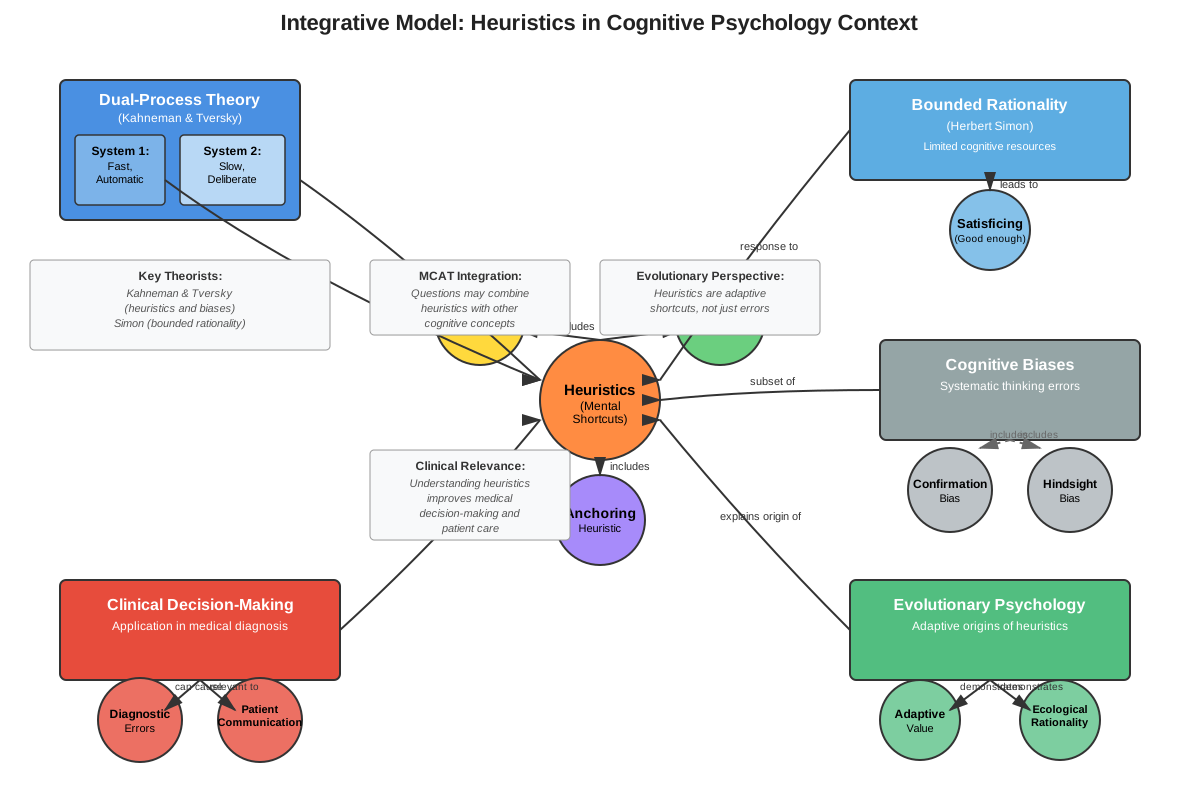
The study of heuristics reveals the dual nature of human cognition—our remarkable ability to function efficiently in complex environments, balanced against our systematic vulnerabilities to predictable errors. This topic integrates seamlessly with broader themes in cognitive psychology, including dual-process theory (System 1 vs. System 2 thinking), bounded rationality, and the adaptive nature of cognitive processes. Mastering heuristics provides insight into both normal cognitive functioning and the systematic deviations from rationality that characterize human judgment.
Learning Objectives
- [ ] Define Heuristics using accurate Psychology terminology
- [ ] Explain why Heuristics matters for the MCAT
- [ ] Apply Heuristics to exam-style questions
- [ ] Identify common mistakes related to Heuristics
- [ ] Connect Heuristics to related Psychology concepts
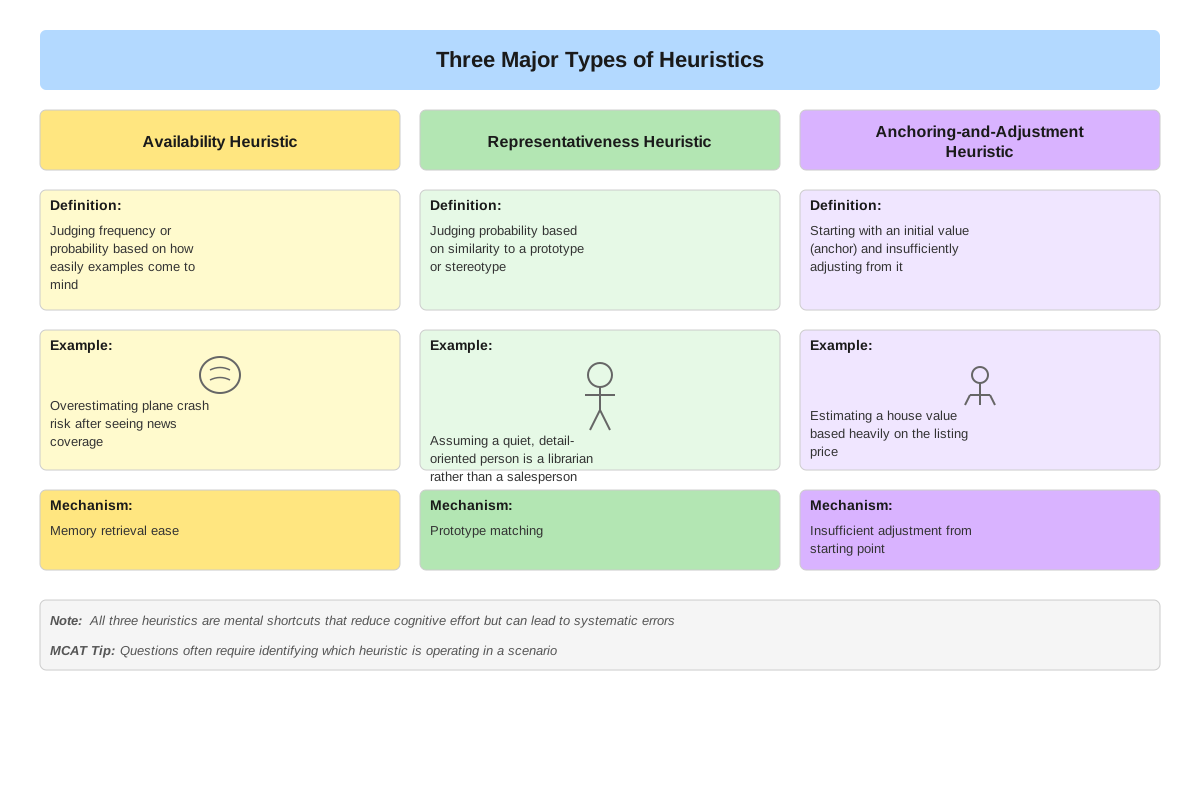
- [ ] Distinguish between the three major types of heuristics (availability, representativeness, and anchoring-and-adjustment)
- [ ] Analyze experimental scenarios to determine which heuristic is operating
- [ ] Evaluate the adaptive advantages and systematic errors associated with heuristic processing
Prerequisites
- Basic cognitive processes: Understanding of attention, memory, and information processing provides the foundation for comprehending why mental shortcuts develop
- Decision-making fundamentals: Familiarity with how individuals make choices under uncertainty helps contextualize when and why heuristics are employed
- Probability concepts: Basic understanding of statistical reasoning and probability allows recognition of when heuristic judgments deviate from normative standards
- Cognitive biases overview: General awareness that systematic errors in thinking exist prepares students to understand heuristics as specific mechanisms producing these biases
Why This Topic Matters
Clinical and Real-World Significance
Heuristics influence countless real-world decisions, from medical diagnosis to financial planning. Physicians may rely on the availability heuristic when diagnosing patients, potentially overestimating the likelihood of diseases they've recently encountered. Patients make healthcare decisions using these mental shortcuts, sometimes leading to suboptimal choices about treatment adherence or risk assessment. Understanding heuristics helps healthcare professionals recognize their own cognitive vulnerabilities and communicate more effectively with patients about medical decisions.
MCAT Exam Statistics
Heuristics appear in approximately 3-5% of Psychology/Sociology section questions, making them a medium-yield topic that nonetheless appears consistently across test administrations. Questions typically take three forms: (1) identification questions asking which heuristic explains a described behavior, (2) application questions requiring prediction of judgments based on heuristic processing, and (3) experimental interpretation questions where students must analyze research findings related to judgment and decision-making.
Common Exam Presentations
MCAT passages frequently embed heuristics within:
- Research studies examining judgment errors in various populations
- Clinical scenarios involving patient or physician decision-making
- Social psychology experiments on persuasion and attitude formation
- Consumer behavior and marketing contexts
- Risk perception and health behavior scenarios
Core Concepts
Definition and Theoretical Foundation
Heuristics are cognitive strategies that simplify complex problems by using readily accessible information to generate quick, generally adequate solutions. Introduced prominently by psychologists Daniel Kahneman and Amos Tversky in the 1970s, heuristics represent a departure from classical economic models assuming perfect rationality. Instead, they reflect bounded rationality—the idea that cognitive limitations, time constraints, and information availability necessitate "good enough" rather than optimal decision-making.
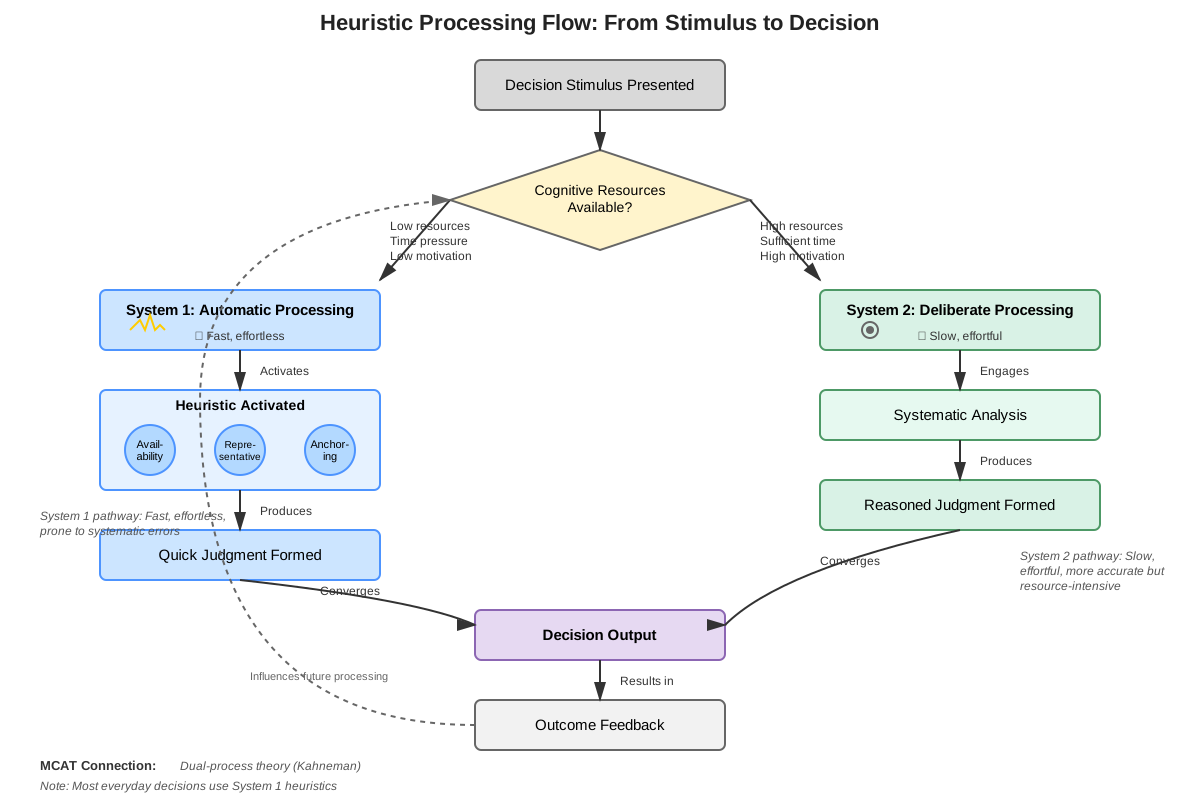
Heuristics operate primarily within System 1 thinking, the fast, automatic, and intuitive mode of cognitive processing. This contrasts with System 2 thinking, which is slower, deliberate, and analytical. While System 2 can override heuristic judgments, it requires cognitive effort that individuals often avoid, particularly under time pressure, cognitive load, or when the stakes seem low.
The Availability Heuristic
The availability heuristic involves estimating the frequency, probability, or likelihood of an event based on how easily examples come to mind. If instances are readily recalled, people judge the event as more common or probable. This mental shortcut leverages memory accessibility as a proxy for actual frequency.
Mechanism: Recent, vivid, emotionally charged, or personally experienced events are more cognitively available, leading to overestimation of their frequency. Conversely, events that are difficult to recall are underestimated.
Examples:
- After seeing news coverage of airplane crashes, individuals overestimate the danger of air travel despite statistical safety
- Physicians who recently treated a rare disease may overdiagnose it in subsequent patients
- People estimate divorce rates as higher if they can easily recall multiple divorced friends
Adaptive value: In ancestral environments, easily recalled dangers (predator attacks, poisonous foods) were often genuinely frequent or important threats, making availability a useful heuristic.
Systematic errors: Media coverage, personal experience, and emotional salience distort availability, creating systematic deviations from actual base rates.
The Representativeness Heuristic
The representativeness heuristic involves judging the probability that an object or event belongs to a category based on how similar it is to a typical member of that category. People assess likelihood by comparing features to prototypes or stereotypes, often neglecting relevant statistical information like base rates.
Mechanism: Individuals evaluate similarity between a specific instance and a category prototype, using this resemblance as the primary basis for probability judgments.
Examples:
- Assuming someone who is shy and enjoys reading is more likely a librarian than a salesperson, despite salespeople vastly outnumbering librarians (base rate neglect)
- Believing a sequence of coin flips H-T-H-T-H-T is more likely than H-H-H-T-T-T because it "looks more random"
- Judging that a detailed, specific scenario is more probable than a simpler, more general version (conjunction fallacy)
The Conjunction Fallacy: A specific manifestation where people judge the probability of A and B together as higher than A alone, violating basic probability rules. The famous "Linda problem" demonstrates this: describing Linda as a philosophy major concerned with social justice leads people to rate "Linda is a bank teller and feminist" as more probable than "Linda is a bank teller," despite the logical impossibility.
Base rate neglect: The representativeness heuristic often causes people to ignore or underweight statistical information about overall frequencies in favor of case-specific similarity information.
The Anchoring-and-Adjustment Heuristic
The anchoring-and-adjustment heuristic occurs when people make estimates by starting from an initial value (the anchor) and adjusting insufficiently from that starting point. The anchor may be arbitrary, suggested by the problem context, or self-generated, yet it powerfully influences final judgments.
Mechanism: Initial values serve as reference points that constrain subsequent adjustments. Adjustments tend to be insufficient, leaving final estimates biased toward the anchor.
Examples:
- When asked if Gandhi died before or after age 140, then asked to estimate his actual age at death, people give higher estimates than if first asked about age 40
- Real estate prices are influenced by listing prices, even when buyers know these are strategic
- Physicians' diagnoses can be anchored by initial impressions or preliminary test results
Characteristics:
- Anchoring occurs even with obviously irrelevant anchors (random numbers, unrelated quantities)
- Experts show anchoring effects, though sometimes reduced compared to novices
- Adjustment is typically insufficient regardless of anchor direction (high or low)
Adaptive considerations: In many natural contexts, initial information provides genuinely useful starting points, making anchoring functional despite its potential for bias.
Comparison of Major Heuristics
| Heuristic | Core Mechanism | Key Question Asked | Primary Error Pattern | Classic Example |
|---|---|---|---|---|
| Availability | Memory accessibility | "How easily can I recall examples?" | Overestimating vivid/recent events | Airplane crash fears |
| Representativeness | Similarity to prototype | "How similar is this to the category?" | Base rate neglect | Linda problem |
| Anchoring-and-adjustment | Starting point bias | "What's a reasonable adjustment from this value?" | Insufficient adjustment | Gandhi age estimation |
Additional Heuristics
Affect heuristic: Judgments guided by emotional responses rather than systematic analysis. Positive feelings toward something lead to underestimating risks and overestimating benefits, while negative feelings produce the opposite pattern.
Recognition heuristic: When choosing between alternatives, selecting the recognized option, assuming recognition correlates with relevant quality. This works when recognition indeed predicts the criterion (e.g., recognizing larger cities) but fails when recognition is unrelated to the judgment dimension.
Take-the-best heuristic: A sequential strategy examining cues in order of validity, making decisions based on the first discriminating cue. This "fast and frugal" approach often performs surprisingly well with minimal information processing.
Ecological Rationality
Modern perspectives emphasize ecological rationality—the idea that heuristics are not simply flawed approximations of optimal reasoning but rather adaptive strategies suited to specific environmental structures. A heuristic that produces errors in laboratory tasks may perform excellently in the natural contexts for which it evolved. This framework shifts focus from cataloging biases to understanding the match between cognitive strategies and environmental demands.
Concept Relationships
Heuristics function as the mechanistic bridge between basic cognitive processes and observable judgment errors. The relationship flows as follows:
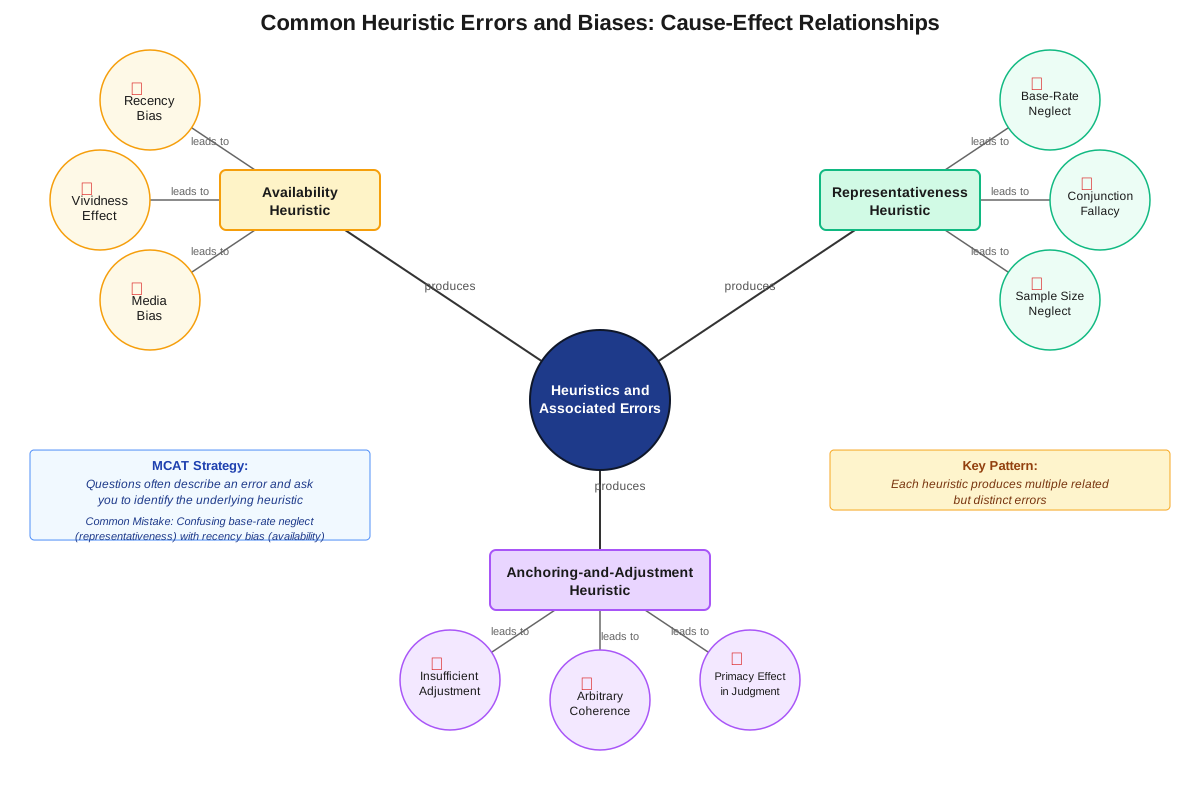
Limited cognitive capacity → necessitates → Heuristic strategies → produces → Efficient but sometimes biased judgments → manifests as → Cognitive biases
Within the topic itself, the three major heuristics represent parallel solutions to the same fundamental problem: how to make judgments under uncertainty with limited cognitive resources. Each exploits a different information source:
- Availability uses memory accessibility
- Representativeness uses similarity/pattern matching
- Anchoring uses initial reference points
These heuristics connect to broader psychological concepts:
To dual-process theory: Heuristics exemplify System 1 processing—fast, automatic, and intuitive. System 2 can monitor and correct heuristic judgments but often fails to do so.
To cognitive biases: Heuristics generate specific biases (availability → recency bias; representativeness → base rate neglect; anchoring → adjustment bias). Understanding the heuristic explains why the bias occurs.
To social cognition: Stereotyping relies heavily on the representativeness heuristic, judging individuals based on group prototypes. The availability heuristic influences attitude formation through media exposure.
To problem-solving: Heuristics contrast with algorithms (systematic, exhaustive procedures guaranteeing solutions). Problem-solving often involves choosing between heuristic and algorithmic approaches based on time, resources, and accuracy requirements.
Quick check — test yourself on Heuristics so far.
Try Flashcards →High-Yield Facts
⭐ Heuristics are mental shortcuts that reduce cognitive effort in judgment and decision-making, producing generally adequate but sometimes systematically biased outcomes.
⭐ The availability heuristic estimates probability based on how easily examples come to mind, leading to overestimation of vivid, recent, or emotionally salient events.
⭐ The representativeness heuristic judges probability by similarity to prototypes, often causing base rate neglect and the conjunction fallacy.
⭐ The anchoring-and-adjustment heuristic produces estimates biased toward initial values due to insufficient adjustment from the anchor.
⭐ Heuristics operate primarily through System 1 (fast, automatic) rather than System 2 (slow, deliberate) processing.
- The conjunction fallacy demonstrates representativeness: people judge specific scenarios (A and B) as more probable than general ones (A alone), violating probability rules.
- Base rate neglect occurs when representativeness causes people to ignore statistical frequency information in favor of case-specific similarity.
- Anchoring effects occur even with arbitrary or obviously irrelevant anchors, demonstrating the automatic nature of this heuristic.
- The affect heuristic shows that emotional responses guide judgments, with positive feelings reducing perceived risk and negative feelings increasing it.
- Ecological rationality emphasizes that heuristics are adaptive strategies suited to specific environments, not simply inferior approximations of optimal reasoning.
- Recognition heuristic performance depends on whether recognition validity matches the judgment criterion in that environment.
- Kahneman and Tversky's research program established heuristics as a major framework for understanding systematic deviations from rational choice models.
Common Misconceptions
Misconception: Heuristics always lead to errors and should be avoided.
Correction: Heuristics are generally adaptive strategies that produce accurate judgments efficiently in most real-world contexts. They become problematic primarily in specific situations where the heuristic's assumptions are violated or when high precision is required.
Misconception: The availability heuristic only involves recent events.
Correction: While recency increases availability, vividness, emotional intensity, personal experience, and ease of imagination also affect how readily examples come to mind. A single dramatic event from years ago may be more available than numerous mundane recent events.
Misconception: Base rate neglect means people completely ignore statistical information.
Correction: People don't ignore base rates entirely; rather, they underweight them relative to case-specific information when using the representativeness heuristic. When base rates are made salient or presented in frequency formats, people use them more appropriately.
Misconception: Anchoring only works when the anchor is relevant to the judgment.
Correction: Anchoring effects occur even with obviously arbitrary anchors (random numbers from a wheel spin, unrelated quantities). The effect is robust across relevant and irrelevant anchors, though magnitude may vary.
Misconception: Experts don't use heuristics; they rely on systematic analysis.
Correction: Experts use heuristics extensively, often more efficiently than novices because their heuristics are better calibrated to domain-relevant patterns. Expert intuition often reflects sophisticated heuristic processing rather than deliberate analysis.
Misconception: The conjunction fallacy only occurs with the Linda problem.
Correction: Conjunction fallacy effects appear across diverse domains whenever detailed scenarios seem more representative than simpler alternatives. Medical diagnosis, legal judgments, and political forecasting all show this pattern.
Misconception: Teaching people about heuristics eliminates their influence.
Correction: Knowledge of heuristics provides limited protection against their effects. Because heuristics operate automatically (System 1), awareness alone doesn't prevent their activation. Debiasing requires specific strategies and deliberate System 2 engagement.
Worked Examples
Example 1: Identifying Heuristics in a Clinical Scenario
Vignette: Dr. Martinez recently treated three patients with Lyme disease in one week, an unusually high number for her practice. The following week, when examining a patient with fatigue and joint pain, she immediately considers Lyme disease as the most likely diagnosis, despite the patient having no history of tick exposure and living in an urban area where Lyme disease is rare.
Question: Which heuristic best explains Dr. Martinez's diagnostic reasoning?
Step 1 - Identify the judgment being made: Dr. Martinez is estimating the probability that her patient has Lyme disease.
Step 2 - Analyze the information being used: She is basing her judgment on her recent experience with three Lyme disease cases, which makes examples of this diagnosis readily accessible in her memory.
Step 3 - Consider each major heuristic:
- Availability: Recent cases make Lyme disease examples easy to recall, potentially inflating her estimate of its probability
- Representativeness: The patient's symptoms (fatigue, joint pain) do match Lyme disease features, but the question emphasizes her recent experience rather than symptom matching
- Anchoring: No initial numerical value or reference point is being adjusted
Step 4 - Evaluate context clues: The vignette specifically mentions "recently treated three patients" and "unusually high number," highlighting the recency and accessibility of these cases. The patient lacks typical risk factors (no tick exposure, urban location), suggesting the diagnosis isn't driven primarily by how representative the case is.
Answer: The availability heuristic best explains this reasoning. Recent experience with Lyme disease makes examples highly accessible, leading Dr. Martinez to overestimate its probability despite low base rates in this patient's demographic and geographic context.
Connection to learning objectives: This example demonstrates application of heuristics to clinical scenarios (common MCAT format) and illustrates how availability can produce diagnostic errors when recent experience doesn't reflect actual base rates.
Example 2: Distinguishing Between Representativeness and Base Rates
Vignette: Researchers present participants with the following information: "In a study population, 995 out of 1,000 people are healthy, and 5 have Disease X. A diagnostic test correctly identifies Disease X 95% of the time (true positive rate) and incorrectly indicates Disease X in healthy people 5% of the time (false positive rate). John tests positive. What is the probability John has Disease X?"
Most participants estimate 90-95%, but the correct answer using Bayes' theorem is approximately 9%.
Question: Explain why participants' estimates are so inaccurate, identifying the relevant heuristic and the information being neglected.
Step 1 - Identify the cognitive process: Participants are judging the probability of disease given a positive test result.
Step 2 - Analyze what information participants use: They focus on the test's accuracy (95% true positive rate), which makes a positive test seem highly representative of actual disease. The test result "looks like" what would happen if someone had the disease.
Step 3 - Identify neglected information: Participants underweight or ignore the base rate (only 5 out of 1,000 people have the disease). This extremely low prevalence means that even with a 5% false positive rate, the absolute number of false positives (approximately 50) far exceeds true positives (approximately 5).
Step 4 - Calculate the correct answer:
- True positives: 5 × 0.95 = 4.75
- False positives: 995 × 0.05 = 49.75
- Probability of disease given positive test: 4.75 / (4.75 + 49.75) ≈ 9%
Step 5 - Connect to heuristic framework: The representativeness heuristic drives the error. A positive test result seems highly representative of having the disease (matching the prototype of "sick person"), leading participants to judge high probability. They commit base rate neglect, failing to adequately incorporate the low disease prevalence into their judgment.
Answer: Participants use the representativeness heuristic, judging probability based on how well the positive test matches their prototype of disease presence. They neglect the crucial base rate information showing disease rarity, leading to dramatic overestimation of disease probability.
Connection to learning objectives: This example illustrates base rate neglect as a consequence of representativeness, demonstrates application to medical contexts (high-yield for MCAT), and shows how heuristics produce systematic, predictable errors rather than random mistakes.
Exam Strategy
Approaching MCAT Heuristics Questions
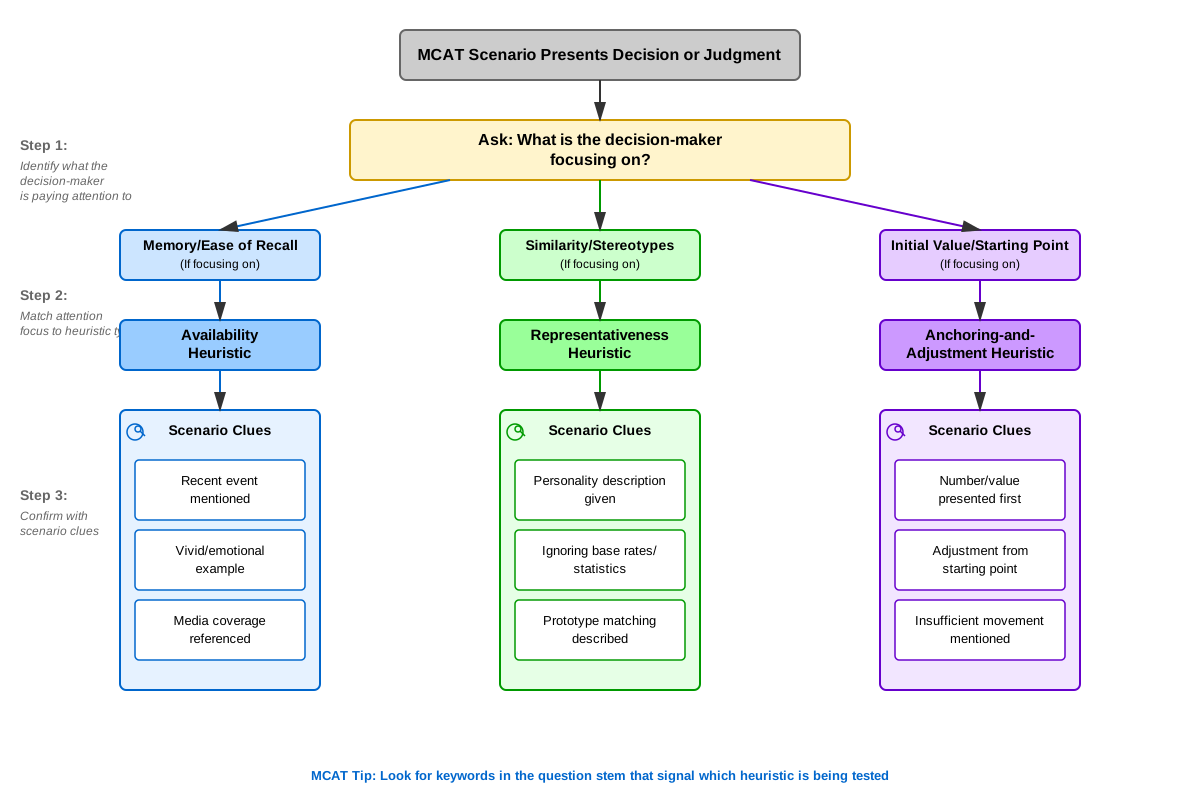
Step 1 - Identify the judgment type: Determine what kind of estimate or decision is being made (probability, frequency, numerical value, category membership).
Step 2 - Look for trigger words:
- Availability: "recent," "vivid," "memorable," "easily recalled," "comes to mind"
- Representativeness: "similar to," "typical," "looks like," "matches," "stereotype," "prototype"
- Anchoring: "starting from," "initial value," "suggested," "reference point," "adjust"
Step 3 - Identify the information source: What is the person using to make their judgment?
- Memory accessibility → availability
- Similarity/pattern matching → representativeness
- Initial value → anchoring
Step 4 - Check for specific error patterns:
- Overestimating vivid events → availability
- Ignoring base rates → representativeness
- Insufficient adjustment → anchoring
Process of Elimination Tips
When choosing between heuristics:
- Eliminate anchoring if no initial numerical value or reference point is mentioned
- Eliminate availability if the scenario emphasizes similarity/matching rather than memory accessibility
- Eliminate representativeness if the focus is on how easily examples come to mind rather than how typical something seems
Exam Tip: If a question describes someone making a judgment after seeing news coverage, experiencing a recent event, or recalling vivid examples, availability is likely correct. If it emphasizes matching to stereotypes, prototypes, or typical cases while ignoring statistics, choose representativeness.
Time Allocation
Heuristics questions typically require 60-90 seconds:
- 20-30 seconds: Read and identify the judgment scenario
- 20-30 seconds: Determine which information source is being used
- 20-30 seconds: Match to the appropriate heuristic and eliminate alternatives
Don't overthink these questions—heuristics themselves are about quick judgments, and MCAT questions usually provide clear indicators of which heuristic is operating.
Common Question Formats
- Direct identification: "Which heuristic best explains this behavior?"
- Prediction: "Based on the availability heuristic, how would this person likely judge...?"
- Experimental interpretation: "The results showing participants overestimated X after Y manipulation demonstrate which concept?"
- Error explanation: "Why did participants make this systematic error?"
Memory Techniques
Mnemonic for Major Heuristics: "AAR"
Availability - Accessibility in memory
Anchoring - Adjustment from initial value
Representativeness - Resemblance to prototype
Visualization Strategy
Availability: Picture a mental filing cabinet where recent, vivid files are at the front, easily grabbed (available), while older, mundane files are buried in back.
Representativeness: Visualize a matching game where you're comparing a card to a prototype card, judging similarity without checking the deck composition (base rates).
Anchoring: Imagine a boat anchor dropped at a starting point; the boat can move but remains tethered, unable to drift far from the anchor.
Acronym for Availability Triggers: "REVIVE"
- Recent events
- Emotional salience
- Vivid imagery
- Intense experiences
- Visibility (media coverage)
- Ease of recall
Representativeness Error Pattern: "BASE"
- Base rates neglected
- Assumes similarity = probability
- Stereotypes drive judgment
- Errors include conjunction fallacy
Summary
Heuristics are cognitive shortcuts that enable efficient judgment and decision-making by reducing complex problems to simpler operations. The three major heuristics—availability, representativeness, and anchoring-and-adjustment—each exploit different information sources to generate quick estimates. The availability heuristic uses memory accessibility as a proxy for frequency or probability, leading to overestimation of vivid, recent, or emotionally salient events. The representativeness heuristic judges probability based on similarity to prototypes, often causing base rate neglect and the conjunction fallacy. The anchoring-and-adjustment heuristic produces estimates biased toward initial values due to insufficient adjustment. While heuristics generally serve adaptive functions and produce accurate judgments efficiently, they create systematic errors in specific contexts where their underlying assumptions are violated. Understanding heuristics is essential for MCAT success because these concepts appear regularly in Psychology/Sociology passages involving judgment, decision-making, clinical reasoning, and social cognition. Mastery requires ability to identify which heuristic operates in described scenarios, predict judgment patterns, and explain systematic errors.
Key Takeaways
- Heuristics are mental shortcuts that simplify complex judgments, operating primarily through fast, automatic System 1 processing
- Availability heuristic: probability judgments based on ease of recall, leading to overestimation of memorable events
- Representativeness heuristic: probability judgments based on similarity to prototypes, causing base rate neglect and conjunction fallacy
- Anchoring-and-adjustment heuristic: estimates biased toward initial values due to insufficient adjustment
- Heuristics are generally adaptive but produce systematic errors in specific contexts, particularly when laboratory or artificial situations violate natural environmental structures
- MCAT questions typically require identifying which heuristic explains a behavior, predicting judgments, or explaining systematic errors in experimental results
- Trigger words (recent, vivid, similar, typical, starting from) provide crucial clues for distinguishing between heuristics
Related Topics
Cognitive Biases: Systematic patterns of deviation from rationality; heuristics provide mechanistic explanations for many biases. Mastering heuristics enables understanding of confirmation bias, hindsight bias, and overconfidence.
Dual-Process Theory: Framework distinguishing System 1 (fast, automatic) from System 2 (slow, deliberate) processing. Heuristics exemplify System 1 operations and explain when System 2 intervention is needed.
Problem-Solving Strategies: Comparison between heuristics (quick, approximate) and algorithms (systematic, guaranteed). Understanding when each approach is appropriate for different problem types.
Social Cognition: Application of heuristics to person perception, stereotype formation, and attitude change. Representativeness particularly relevant to understanding stereotyping and prejudice.
Judgment and Decision-Making: Broader framework encompassing heuristics, prospect theory, framing effects, and risk perception. Heuristics provide foundation for understanding more complex decision phenomena.
Practice CTA
Now that you've mastered the core concepts of heuristics, it's time to solidify your understanding through active practice. Challenge yourself with MCAT-style practice questions that require you to identify heuristics in novel scenarios, predict judgment patterns, and explain systematic errors. Use flashcards to drill the distinguishing features of availability, representativeness, and anchoring until recognition becomes automatic. Remember: understanding heuristics isn't just about memorizing definitions—it's about developing the ability to analyze cognitive processes in real-time during the exam. Your investment in practice now will pay dividends when you encounter these high-yield concepts on test day. You've got this!
Sign up free to keep reading
Create a free AnvayaPrep account to finish this MCAT guide on Heuristics — plus flashcards and practice questions.