Overview
Decision making is a fundamental cognitive process that involves selecting a course of action from multiple alternatives based on available information, personal values, and anticipated outcomes. Within the context of Psychology and the broader domain of Cognition and Consciousness, decision making represents a complex interplay between rational thought processes, emotional influences, heuristics, and biases that shape human behavior. Understanding decision making is essential for MCAT success because it bridges multiple psychological domains—cognitive psychology, behavioral economics, social psychology, and neuroscience—while providing a framework for analyzing human behavior in clinical, research, and everyday contexts.
For the MCAT, decision making appears frequently in both the Psychological, Social, and Biological Foundations of Behavior section and within passage-based questions that require application of psychological principles to real-world scenarios. Questions may present clinical vignettes involving patient treatment choices, research scenarios requiring methodological decisions, or social situations demanding behavioral predictions. The MCAT tests not only factual knowledge of decision-making theories and models but also the ability to identify cognitive biases, distinguish between different decision-making strategies, and predict how various factors influence choices under different conditions.
Decision making Psychology connects intimately with other cognitive processes including problem-solving, judgment, memory retrieval, and attention. It also interfaces with emotional regulation, motivation, and social influence—making it a high-yield topic that can appear across multiple question types. Mastery of decision making enables students to approach MCAT questions with a sophisticated understanding of why people make certain choices, how cognitive shortcuts can lead to systematic errors, and what factors optimize or impair decision quality in various contexts.
Learning Objectives
- [ ] Define Decision making using accurate Psychology terminology
- [ ] Explain why Decision making matters for the MCAT
- [ ] Apply Decision making to exam-style questions
- [ ] Identify common mistakes related to Decision making
- [ ] Connect Decision making to related Psychology concepts
- [ ] Distinguish between normative and descriptive models of decision making
- [ ] Analyze how heuristics and biases systematically influence decision outcomes
- [ ] Evaluate the role of emotion, stress, and cognitive load on decision quality
- [ ] Compare and contrast different decision-making strategies and their appropriate applications
Prerequisites
- Basic cognitive processes: Understanding attention, memory, and perception provides the foundation for how information is processed during decision making
- Problem-solving fundamentals: Decision making extends problem-solving by adding choice evaluation and selection components
- Emotion and motivation: Affective states and motivational drives significantly influence decision preferences and risk tolerance
- Social psychology basics: Understanding social influence, conformity, and group dynamics is essential for comprehending decisions in social contexts
- Basic probability concepts: Rational decision models often involve probability assessment and expected value calculations
Why This Topic Matters
Decision making has profound clinical significance across medical practice. Physicians constantly make diagnostic decisions under uncertainty, weighing treatment options with different risk-benefit profiles, and communicating choices to patients who must make informed decisions about their own care. Understanding decision-making processes helps future physicians recognize their own cognitive biases (such as anchoring on initial diagnoses or availability bias from recent cases), improve shared decision-making with patients, and design interventions that account for how people actually make health-related choices rather than how they theoretically should.
On the MCAT, decision making appears in approximately 3-5% of Psychology/Sociology questions, with particular concentration in passages involving behavioral economics, cognitive psychology experiments, and clinical scenarios. Questions typically present in three formats: (1) discrete questions testing knowledge of specific biases or heuristics, (2) passage-based questions requiring application of decision-making principles to experimental results or clinical vignettes, and (3) research design questions where understanding decision processes helps predict participant behavior or identify confounding variables.
Common MCAT presentations include passages describing experiments on framing effects, scenarios involving medical decision making under uncertainty, social psychology studies examining group decision processes, or behavioral economics research on risk preferences. The exam frequently tests the ability to identify which specific bias or heuristic explains observed behavior, predict how changing decision contexts will alter choices, or recognize when emotional factors override rational analysis. Understanding decision making also enables students to eliminate incorrect answer choices that confuse similar concepts (such as distinguishing availability heuristic from representativeness heuristic) or that misapply decision principles to inappropriate contexts.
Core Concepts
Defining Decision Making
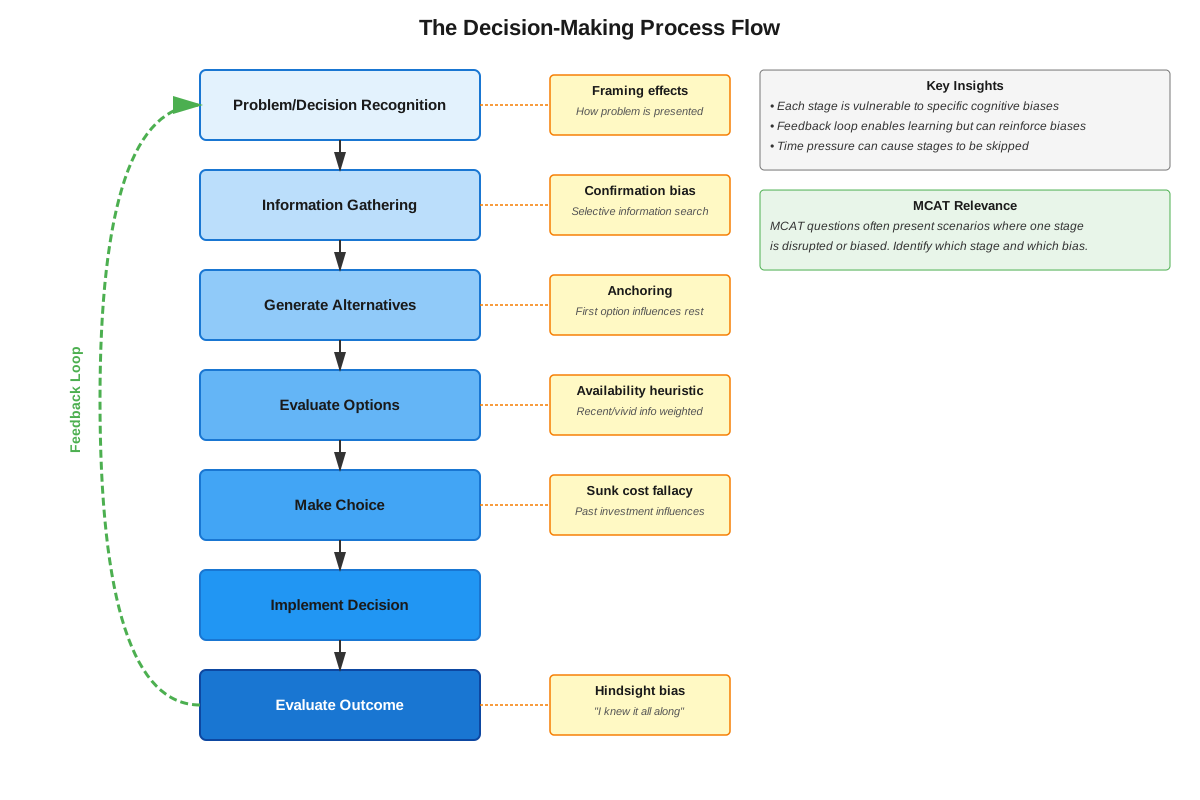
Decision making is the cognitive process of selecting a course of action from two or more alternatives based on evaluation of available information, consideration of potential outcomes, and alignment with goals and values. This process involves multiple stages: problem recognition, information gathering, alternative generation, evaluation of options, choice selection, and post-decision evaluation. Decision making differs from simple problem-solving in that it explicitly involves choice among competing alternatives, each with distinct consequences and associated uncertainties.
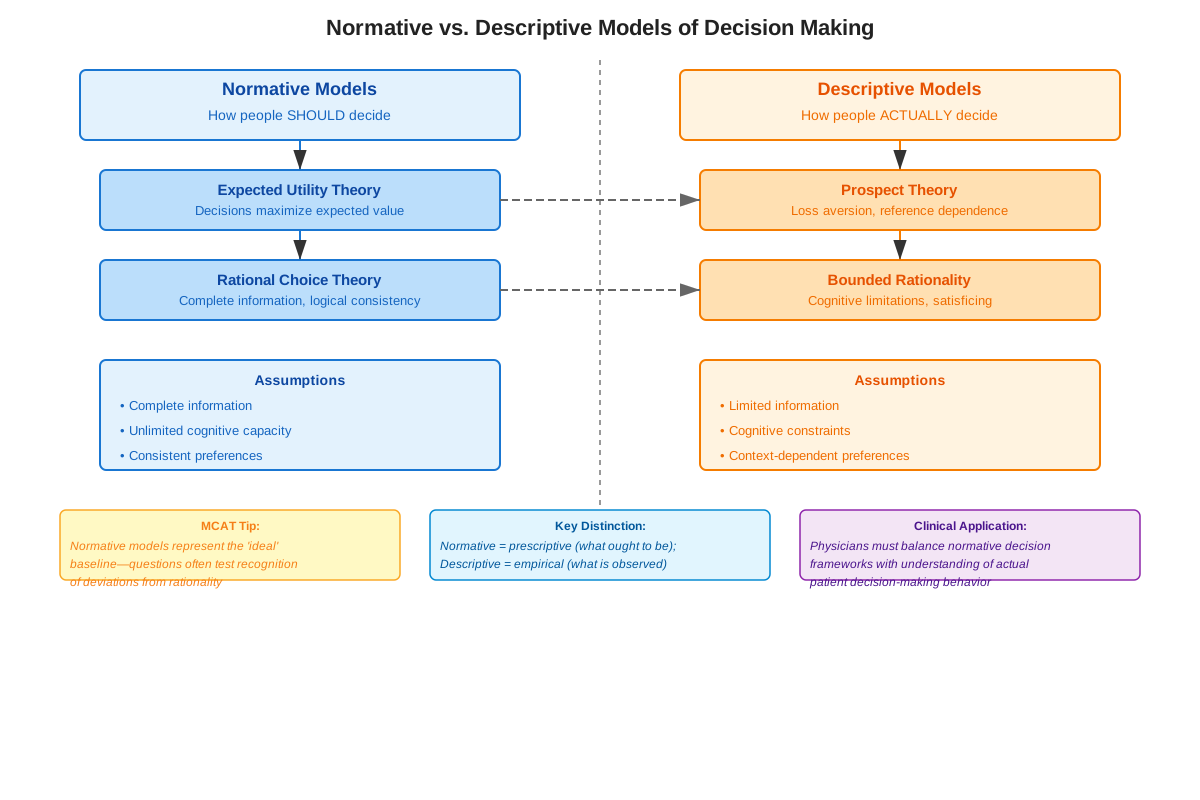
The field distinguishes between normative models (how people should make decisions to maximize utility) and descriptive models (how people actually make decisions in practice). Normative models, rooted in classical economics and logic, assume rational actors who maximize expected utility through systematic evaluation of probabilities and outcomes. Descriptive models, developed through psychological research, acknowledge that human decision makers use mental shortcuts, are influenced by emotions, and systematically deviate from optimal strategies in predictable ways.
Types of Decision-Making Processes
Decision making can be categorized along several dimensions that influence both process and outcome:
Rational Decision Making involves systematic analysis of alternatives using logical evaluation of costs, benefits, probabilities, and expected values. This approach follows a structured sequence: define the problem clearly, identify decision criteria, weight the criteria by importance, generate alternatives, evaluate each alternative against criteria, and select the option with highest expected utility. While normative models assume this approach, research demonstrates that pure rational decision making is rare due to cognitive limitations, time constraints, and emotional influences.
Intuitive Decision Making relies on rapid, automatic processing based on pattern recognition, prior experience, and "gut feelings" without conscious deliberation. Also called System 1 thinking (from dual-process theory), intuitive decisions can be highly effective when the decision maker has extensive domain expertise and the environment provides reliable cues. However, intuition can also lead to systematic errors when applied inappropriately or when influenced by irrelevant factors.
Recognition-Primed Decision Making represents a naturalistic model where experienced decision makers recognize situations as similar to previous encounters and implement solutions that worked previously, with minimal conscious deliberation. This approach is common in high-stakes, time-pressured environments like emergency medicine, where rapid pattern recognition enables quick action.
Heuristics: Mental Shortcuts in Decision Making
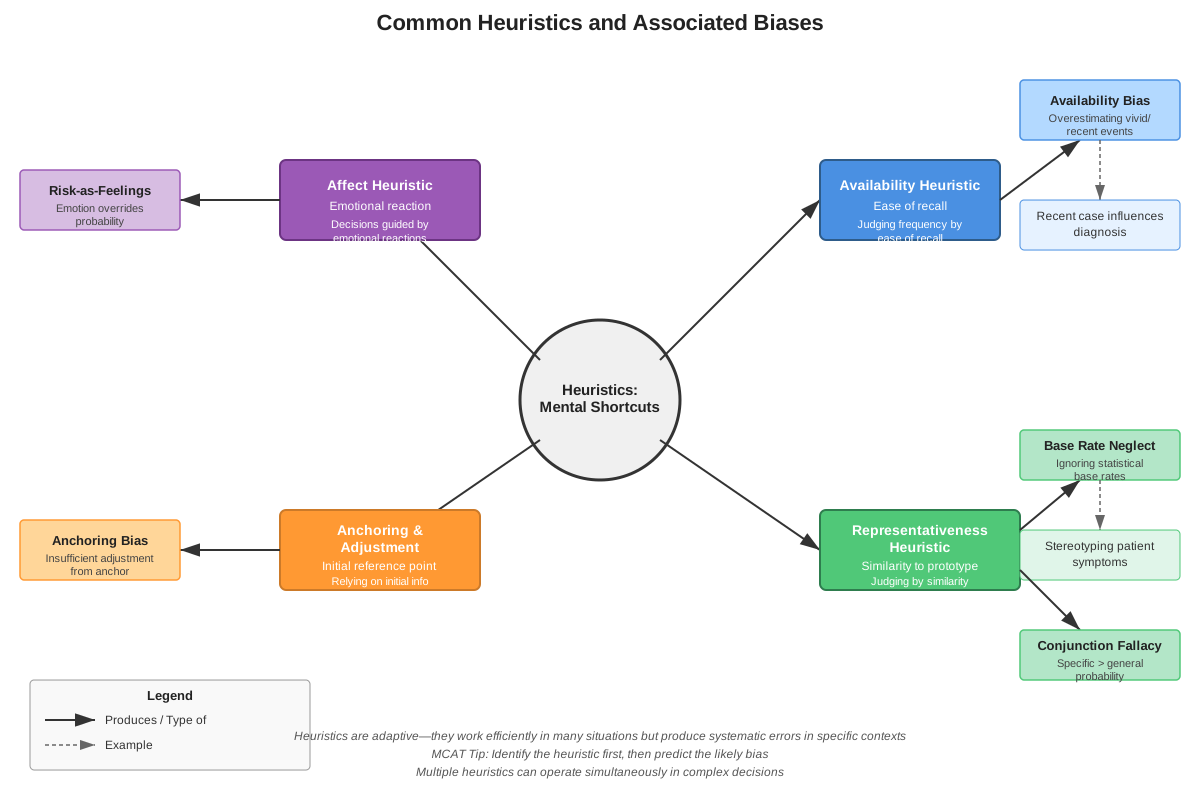
Heuristics are cognitive shortcuts or "rules of thumb" that simplify complex decisions by reducing the information processing required. While heuristics enable faster decisions with limited cognitive resources, they can produce systematic biases—predictable deviations from optimal choices.
Availability Heuristic: Estimating probability or frequency based on how easily examples come to mind. Events that are vivid, recent, or emotionally salient are judged as more probable than they actually are. For example, after seeing news coverage of airplane crashes, people overestimate flight risk because these dramatic events are easily recalled. In medical contexts, physicians may overestimate disease prevalence if they recently treated several cases (availability bias).
Representativeness Heuristic: Judging probability based on similarity to a prototype or stereotype, while ignoring base rates and sample size. When told "Steve is shy and withdrawn, likes order, and has a passion for detail," people judge it more likely he's a librarian than a farmer, despite farmers vastly outnumbering librarians. This heuristic leads to the base rate fallacy—neglecting prior probabilities when making judgments.
Anchoring and Adjustment: Initial information (the "anchor") disproportionately influences subsequent judgments, even when the anchor is arbitrary or irrelevant. People adjust insufficiently from anchors when making estimates. In clinical settings, initial diagnostic impressions can anchor subsequent reasoning, making physicians less likely to revise diagnoses even when contradictory evidence emerges.
Affect Heuristic: Decisions guided by emotional responses rather than systematic analysis. Positive feelings toward an option lead to underestimating risks and overestimating benefits, while negative feelings produce the opposite pattern. This explains why people judge activities they enjoy (like wine drinking) as having high benefits and low risks, while activities they dislike (like nuclear power) are seen as high risk and low benefit.
Cognitive Biases in Decision Making
Cognitive biases are systematic patterns of deviation from rational judgment that arise from heuristics, motivational factors, or information processing limitations.
| Bias | Description | Example |
|---|---|---|
| Confirmation Bias | Seeking, interpreting, and remembering information that confirms pre-existing beliefs | A physician convinced of a diagnosis selectively attends to supporting symptoms while dismissing contradictory findings |
| Framing Effect | Different responses to logically equivalent information depending on presentation | 90% survival rate sounds better than 10% mortality rate, though they're identical |
| Sunk Cost Fallacy | Continuing investment in failing courses of action because of prior resource commitment | Continuing ineffective treatment because of time/money already invested |
| Overconfidence Bias | Excessive confidence in one's own judgments and knowledge | Physicians overestimating diagnostic accuracy, leading to insufficient testing |
| Hindsight Bias | After learning an outcome, believing it was more predictable than it actually was | "I knew that diagnosis all along" after learning the correct answer |
| Status Quo Bias | Preference for current state; resistance to change even when alternatives are superior | Continuing default treatment options rather than adopting evidence-based innovations |
Prospect Theory and Decision Under Risk
Prospect Theory, developed by Kahneman and Tversky, describes how people actually make decisions involving risk and uncertainty, contrasting with expected utility theory's normative predictions. Key principles include:
Reference Dependence: People evaluate outcomes relative to a reference point (usually the status quo) rather than in absolute terms. Gains and losses matter more than final wealth states.
Loss Aversion: Losses loom larger than equivalent gains—the pain of losing $100 exceeds the pleasure of gaining $100. This asymmetry explains risk-averse behavior in gain domains and risk-seeking behavior to avoid losses.
Diminishing Sensitivity: The subjective difference between $0 and $100 feels larger than between $1000 and $1100, creating a value function that is concave for gains and convex for losses.
Probability Weighting: People overweight small probabilities (explaining lottery ticket purchases) and underweight moderate to high probabilities (explaining insurance under-purchasing).
These principles explain the framing effect: presenting options as gains versus losses changes preferences even when objective outcomes are identical. A medical treatment with "90% survival" is preferred over one with "10% mortality," despite logical equivalence.
Factors Influencing Decision Quality
Cognitive Load and Mental Resources: Decision quality deteriorates under high cognitive load, time pressure, or mental fatigue. When working memory is taxed, people rely more heavily on heuristics and are more susceptible to biases. This explains why physicians make more errors at the end of long shifts.
Emotional State: Strong emotions can enhance or impair decisions depending on context. Incidental emotions (unrelated to the decision) can inappropriately influence choices—anxiety increases risk aversion even for unrelated decisions. Integral emotions (directly related to decision outcomes) can provide valuable information but may also lead to impulsive choices when intense.
Group Decision Making: Groups can improve decisions through diverse perspectives and error correction, but also introduce unique biases. Groupthink occurs when desire for harmony overrides critical evaluation, leading to poor decisions. Group polarization describes how group discussion often shifts opinions toward more extreme positions than individuals initially held.
Decision Fatigue: Making many decisions depletes mental resources, leading to decision avoidance, impulsive choices, or default selections. This explains why judges grant parole more frequently early in the day and after breaks.
Dual-Process Theory
Dual-process theory proposes two distinct systems for thinking and decision making:
System 1 operates automatically, quickly, and effortlessly, relying on intuition, heuristics, and associative processing. It handles routine decisions and pattern recognition but is prone to biases and cannot handle complex logical operations.
System 2 involves deliberate, effortful, conscious reasoning that can perform complex calculations and logical analysis. It's slower, requires attention, and has limited capacity, but can override System 1 when engaged.
Effective decision making often requires knowing when to trust intuition (System 1) versus when to engage analytical thinking (System 2). Expertise develops through building accurate System 1 patterns through extensive experience in predictable environments.
Concept Relationships
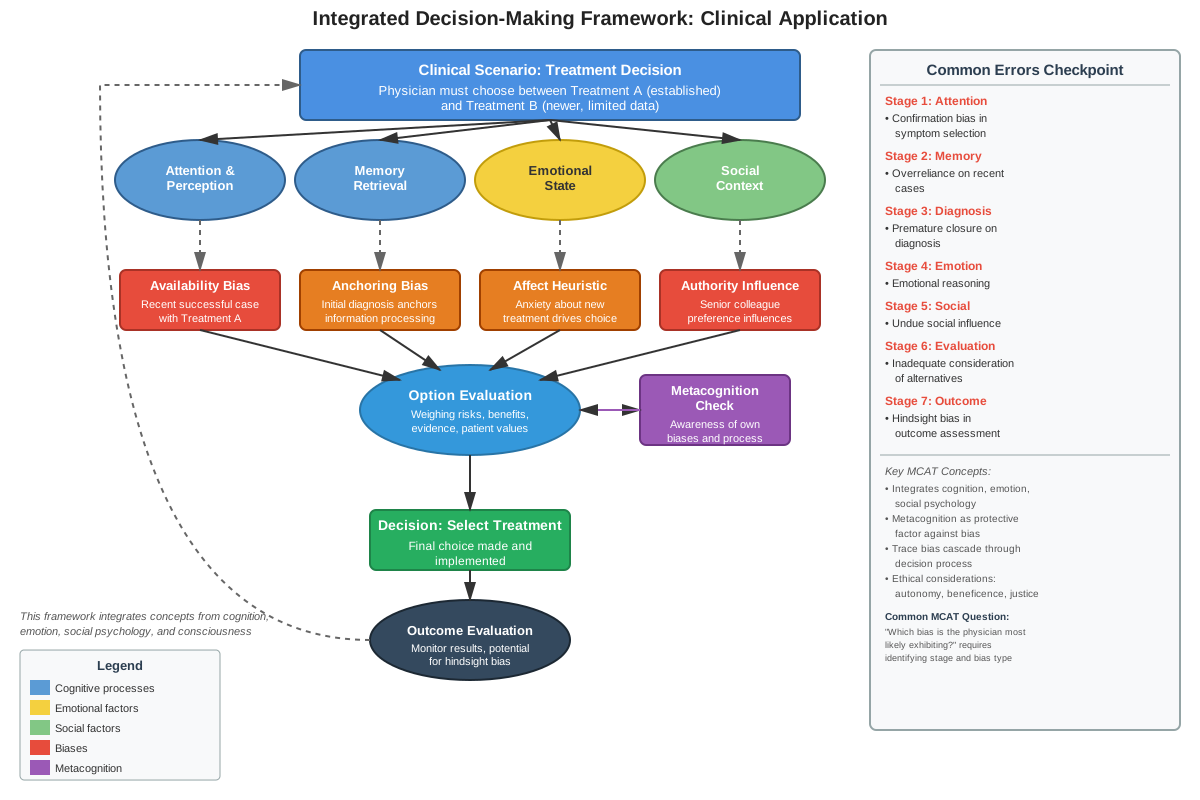
Decision making integrates multiple cognitive processes in a hierarchical framework. Attention determines which information enters decision processes → Perception interprets sensory input about decision alternatives → Memory retrieval provides relevant past experiences and knowledge → Judgment evaluates alternatives → Decision making selects among options → Problem-solving implements the chosen solution.
Within decision making itself, concepts connect sequentially: Heuristics (mental shortcuts) → lead to → Cognitive biases (systematic errors) → which are explained by → Prospect theory (descriptive model of actual behavior) → contrasting with → Rational models (normative ideals). Dual-process theory provides an overarching framework explaining when heuristics (System 1) versus analytical reasoning (System 2) dominate.
Decision making connects to emotion through the affect heuristic and the influence of mood states on risk preferences. It links to social psychology through group decision processes, social influence on individual choices, and conformity pressures. Motivation influences decision making by establishing goals and values that guide option evaluation. Stress and cognitive load impair decision quality by reducing System 2 capacity and increasing reliance on heuristics.
Understanding these relationships enables prediction: high stress → increased cognitive load → greater reliance on System 1 → more susceptibility to biases → lower decision quality. This chain explains why emergency situations, despite requiring optimal decisions, often produce suboptimal choices unless decision makers have extensive training that builds reliable System 1 patterns.
Quick check — test yourself on Decision making so far.
Try Flashcards →High-Yield Facts
⭐ Availability heuristic causes people to judge events as more probable when examples are easily recalled, leading to overestimation of vivid or recent events.
⭐ Loss aversion means losses have approximately twice the psychological impact of equivalent gains, explaining risk-seeking behavior to avoid losses but risk-averse behavior for gains.
⭐ Framing effects demonstrate that logically equivalent information produces different choices depending on whether options are presented as gains or losses.
⭐ Anchoring bias occurs when initial information disproportionately influences subsequent judgments, even when the anchor is arbitrary or irrelevant.
⭐ Confirmation bias leads people to seek, interpret, and remember information that confirms pre-existing beliefs while dismissing contradictory evidence.
- Representativeness heuristic causes people to judge probability based on similarity to prototypes while ignoring base rates and sample size.
- Sunk cost fallacy describes continued investment in failing courses of action due to prior resource commitment, violating rational decision principles.
- System 1 thinking is fast, automatic, and intuitive but prone to biases, while System 2 is slow, deliberate, and analytical but requires cognitive resources.
- Groupthink occurs when group cohesion and desire for harmony override critical evaluation, leading to poor collective decisions.
- Decision fatigue results from making many sequential decisions, depleting mental resources and leading to impulsive choices or decision avoidance.
- Overconfidence bias causes people to overestimate the accuracy of their judgments and knowledge, leading to insufficient information gathering.
- Hindsight bias makes outcomes seem more predictable after they occur than they actually were beforehand ("I knew it all along").
- Affect heuristic guides decisions through emotional responses, with positive feelings leading to risk underestimation and benefit overestimation.
Common Misconceptions
Misconception: Heuristics are always bad and should be avoided in decision making.
Correction: Heuristics are adaptive mental shortcuts that enable efficient decisions with limited information and cognitive resources. They become problematic only when applied inappropriately or when the environment doesn't match the heuristic's assumptions. In familiar domains with reliable cues, heuristics often produce accurate decisions more efficiently than analytical approaches.
Misconception: Rational decision making always produces better outcomes than intuitive decision making.
Correction: Decision quality depends on context. In complex, uncertain environments with time pressure, experienced decision makers' intuition (System 1) often outperforms deliberate analysis. Rational analysis excels when sufficient time exists, the problem is well-defined, and relevant information is available. Expertise develops through building accurate intuitive patterns.
Misconception: The availability heuristic and representativeness heuristic are the same thing.
Correction: Availability heuristic judges probability by ease of recall (how easily examples come to mind), while representativeness heuristic judges probability by similarity to prototypes (how much something resembles a typical case). A physician using availability might overestimate disease frequency after seeing recent cases; using representativeness might diagnose based on symptom similarity while ignoring base rates.
Misconception: Framing effects only occur when people are deliberately manipulated or misled.
Correction: Framing effects are automatic consequences of how the human cognitive system processes information, not results of manipulation or irrationality. Even when people recognize that "90% survival" and "10% mortality" are logically equivalent, the different frames activate different emotional responses and mental representations, genuinely influencing preferences.
Misconception: Groups always make better decisions than individuals because they have more information and perspectives.
Correction: While groups can improve decisions through diverse viewpoints and error correction, they also introduce unique problems like groupthink, group polarization, social loafing, and diffusion of responsibility. Group decision quality depends on group composition, leadership, decision procedures, and whether the environment encourages critical evaluation versus conformity.
Misconception: Cognitive biases can be eliminated through awareness and training.
Correction: While awareness of biases can help in some contexts, most biases persist even when people know about them because they arise from fundamental features of cognitive architecture. Effective debiasing requires environmental restructuring (checklists, decision aids, forcing consideration of alternatives) rather than relying solely on individual awareness.
Misconception: Emotional decision making is always inferior to purely rational analysis.
Correction: Emotions provide valuable information about preferences, values, and potential outcomes. Integral emotions (related to decision consequences) can improve decisions by incorporating important considerations that pure logic might miss. Problems arise primarily with incidental emotions (unrelated to the decision) that inappropriately influence choices, or when emotions are so intense they prevent consideration of relevant information.
Worked Examples
Example 1: Identifying Heuristics and Biases in Clinical Decision Making
Scenario: Dr. Martinez is evaluating a 45-year-old patient presenting with chest pain. Last week, she treated three patients with similar symptoms who all had gastroesophageal reflux disease (GERD). She quickly diagnoses GERD and prescribes antacids without ordering cardiac workup. Later, the patient returns with a myocardial infarction.
Question: Which cognitive biases most likely contributed to Dr. Martinez's initial diagnostic error?
Analysis:
Step 1: Identify the decision-making context
This involves diagnostic decision making under uncertainty, where the physician must evaluate multiple possible causes of chest pain and select appropriate testing and treatment.
Step 2: Examine the information processing
Dr. Martinez's recent experience with three GERD cases made this diagnosis highly accessible in memory. She reached a quick conclusion without systematic evaluation of alternative diagnoses or consideration of cardiac risk factors.
Step 3: Match observed patterns to specific biases
Availability heuristic: The three recent GERD cases made this diagnosis easily recalled and mentally accessible, leading Dr. Martinez to overestimate its probability for the current patient. Recent, vivid experiences disproportionately influenced probability judgment.
Anchoring bias: The initial impression of GERD served as an anchor that prevented adequate consideration of alternative diagnoses. Once anchored on GERD, Dr. Martinez failed to adjust sufficiently toward other possibilities despite chest pain being a symptom of multiple serious conditions.
Confirmation bias: After forming the GERD hypothesis, Dr. Martinez likely focused on symptoms consistent with GERD while dismissing or not seeking information that might suggest cardiac causes.
Step 4: Consider what would improve decision quality
Implementing a systematic diagnostic checklist for chest pain would force consideration of cardiac causes regardless of recent case experiences. Deliberately generating alternative diagnoses before settling on one would counteract anchoring. Seeking disconfirming evidence would address confirmation bias.
Answer: The primary biases are availability heuristic (recent GERD cases increased perceived probability), anchoring bias (initial GERD impression prevented adequate revision), and confirmation bias (selective attention to supporting information). These demonstrate how System 1 thinking, while efficient, can produce systematic errors in diagnostic reasoning.
Example 2: Applying Prospect Theory to Treatment Decisions
Scenario: Researchers present two groups of patients with identical information about a surgical procedure, but with different framing:
- Group A is told: "This surgery has a 90% survival rate."
- Group B is told: "This surgery has a 10% mortality rate."
Group A shows 75% acceptance of the surgery, while Group B shows only 50% acceptance.
Question: Use prospect theory to explain why logically equivalent information produced different acceptance rates.
Analysis:
Step 1: Identify the theoretical framework
This scenario directly tests framing effects, a key prediction of prospect theory. The objective information is identical (90% survive = 10% die), but presentation differs.
Step 2: Apply prospect theory principles
Reference dependence: People evaluate outcomes relative to a reference point. The "survival" frame uses continued life as the reference, presenting the outcome as a gain. The "mortality" frame uses death as the reference, presenting the outcome as a loss.
Loss aversion: Losses loom larger than equivalent gains. The mortality frame activates loss aversion by highlighting the possibility of death (a loss), which has greater psychological impact than the equivalent probability of survival (a gain). Even though the probabilities are identical, the emotional response differs.
Value function shape: Prospect theory's value function is steeper for losses than gains, meaning the psychological impact of a 10% mortality risk exceeds the positive impact of a 90% survival probability, despite mathematical equivalence.
Step 3: Predict the behavioral outcome
The survival frame (gain frame) should produce higher acceptance because it activates the less steep portion of the value function and avoids triggering loss aversion. The mortality frame (loss frame) should produce lower acceptance because it activates loss aversion and the steeper loss portion of the value function.
Step 4: Connect to broader implications
This demonstrates that how medical information is communicated substantially affects patient decisions, even when the objective facts remain constant. Ethical medical communication requires awareness of framing effects while ensuring patients understand actual risks and benefits.
Answer: Prospect theory explains this through loss aversion and reference dependence. The mortality frame activates loss aversion by highlighting death as a potential loss, which has greater psychological impact than the equivalent survival probability presented as a gain. The value function's steeper slope for losses than gains means the 10% mortality risk feels worse than the 90% survival probability feels good, despite logical equivalence. This framing effect demonstrates that decision making depends not just on objective information but on how that information is presented relative to reference points.
Exam Strategy
When approaching MCAT questions on decision making, first identify whether the question asks about normative models (how people should decide) versus descriptive models (how people actually decide). The MCAT typically focuses on descriptive models—actual human behavior including biases and heuristics—rather than optimal rational strategies.
Trigger words that signal decision-making questions include: "heuristic," "bias," "framing," "risk," "choice," "judgment," "probability estimation," "System 1/System 2," "intuitive," "analytical," and "prospect theory." When you see these terms, activate your knowledge of specific biases and their characteristics.
Process-of-elimination strategy: When identifying which bias or heuristic explains observed behavior, systematically eliminate options by asking:
- Does this involve probability/frequency estimation? → Consider availability or representativeness
- Does this involve initial information influencing later judgments? → Consider anchoring
- Does this involve equivalent information presented differently? → Consider framing
- Does this involve seeking confirming evidence? → Consider confirmation bias
- Does this involve continuing failed investments? → Consider sunk cost fallacy
For passage-based questions, pay close attention to experimental manipulations. If researchers change how information is presented while keeping content constant, they're likely testing framing effects. If they manipulate what information is easily recalled, they're testing availability heuristic. If they provide initial numbers before asking for estimates, they're testing anchoring.
Time allocation: Decision-making questions typically require 60-90 seconds. Spend 20-30 seconds identifying the decision context and what's being manipulated, 30-40 seconds matching the pattern to specific concepts, and 10-20 seconds eliminating wrong answers. Don't overthink—the MCAT usually tests straightforward application of well-defined concepts rather than subtle distinctions.
Common trap answers include:
- Confusing similar heuristics (availability vs. representativeness)
- Selecting biases that sound relevant but don't match the specific pattern
- Choosing normative/rational explanations when the question describes actual (biased) behavior
- Confusing System 1 and System 2 characteristics
When questions present clinical scenarios, consider how cognitive load, time pressure, and emotional factors influence which decision system dominates. High-pressure situations with limited time typically activate System 1, making heuristics and biases more likely.
Memory Techniques
FRAMING ANCHOR mnemonic for major decision-making biases:
- Framing effect (presentation changes preferences)
- Representativeness (judging by similarity to prototype)
- Availability (judging by ease of recall)
- Mortality salience (awareness of death influences decisions)
- Incremental commitment (sunk cost fallacy)
- Neglect of base rates (ignoring prior probabilities)
- Groupthink (cohesion overrides critical thinking)
- Anchoring (initial info influences subsequent judgments)
- Normative vs. descriptive (should vs. actually do)
- Confirmation (seeking supporting evidence)
- Hindsight (outcome seems predictable after the fact)
- Overconfidence (excessive certainty in judgments)
- Risk aversion (losses loom larger than gains)
System 1 vs. System 2 visualization: Picture System 1 as a fast sports car (quick, automatic, efficient but can crash if conditions are tricky) and System 2 as a careful engineer (slow, deliberate, accurate but requires fuel/energy and can't work on multiple problems simultaneously).
Prospect Theory value function: Visualize a steep cliff on the loss side (loss aversion—falling hurts more than climbing feels good) and a gentle slope on the gain side (diminishing sensitivity to gains). The reference point is where you're standing now.
Heuristic distinction memory aid:
- Availability = "Can I RECALL examples?" (both have 'A')
- Representativeness = "Does it RESEMBLE the prototype?" (both start with 'RE')
- Anchoring = "Am I STUCK on initial info?" (anchors hold ships in place)
Summary
Decision making is the cognitive process of selecting among alternatives based on evaluation of information, outcomes, and goals. The MCAT emphasizes descriptive models that explain actual human behavior rather than normative models of optimal choice. Key concepts include heuristics (mental shortcuts like availability, representativeness, and anchoring), cognitive biases (systematic deviations from rationality including confirmation bias, framing effects, and sunk cost fallacy), and prospect theory (explaining decisions under risk through loss aversion, reference dependence, and probability weighting). Dual-process theory distinguishes System 1 (fast, automatic, intuitive) from System 2 (slow, deliberate, analytical) thinking. Decision quality is influenced by cognitive load, emotional state, time pressure, and expertise. Understanding these concepts enables prediction of behavior in clinical scenarios, identification of biases in research contexts, and recognition of factors that improve or impair decision making. For MCAT success, focus on distinguishing between similar heuristics, recognizing how context activates different biases, and applying prospect theory principles to explain choices involving risk and uncertainty.
Key Takeaways
- Decision making involves selecting among alternatives through processes that often deviate systematically from rational models due to heuristics and biases
- Heuristics (availability, representativeness, anchoring) are mental shortcuts that enable efficient decisions but can produce predictable errors
- Prospect theory explains decisions under risk through loss aversion (losses hurt more than equivalent gains help), reference dependence, and probability weighting
- Dual-process theory distinguishes System 1 (fast, automatic, intuitive) from System 2 (slow, analytical, effortful) thinking, with decision quality depending on which system dominates
- Framing effects demonstrate that logically equivalent information produces different choices depending on presentation as gains versus losses
- Cognitive biases (confirmation, overconfidence, hindsight, sunk cost) systematically impair judgment in predictable ways
- Decision quality deteriorates under cognitive load, time pressure, emotional arousal, and decision fatigue, making environmental supports (checklists, decision aids) more effective than relying solely on individual awareness
Related Topics
Problem-Solving: Decision making extends problem-solving by adding explicit choice among alternatives; mastering decision making enables better understanding of how people select solution strategies.
Memory and Cognition: Availability heuristic depends on memory retrieval processes; understanding memory accessibility explains why certain information disproportionately influences decisions.
Emotion and Motivation: Affect heuristic and the influence of emotional states on risk preferences connect decision making to emotion; understanding this relationship explains seemingly irrational choices.
Social Psychology: Group decision processes, conformity, and social influence shape choices in social contexts; mastering individual decision making provides foundation for understanding collective decisions.
Behavioral Economics: Applications of decision-making research to economic behavior, health choices, and policy design; understanding psychological principles enables prediction of behavior in economic contexts.
Judgment and Reasoning: Closely related to decision making but focused on evaluation and inference rather than choice; these processes work together in complex cognitive tasks.
Practice CTA
Now that you've mastered the core concepts of decision making, it's time to solidify your understanding through active practice. Attempt the practice questions to apply these principles to MCAT-style scenarios, and use the flashcards to reinforce key definitions and distinctions between similar concepts. Remember: understanding decision-making biases not only helps you answer MCAT questions correctly but also improves your own study decisions and future clinical reasoning. The investment you make in truly mastering this material will pay dividends across multiple sections of the exam and throughout your medical career!
Sign up free to keep reading
Create a free AnvayaPrep account to finish this MCAT guide on Decision making — plus flashcards and practice questions.