Overview
Language development is a fundamental topic within Cognition and Consciousness that examines how humans acquire, process, and utilize linguistic systems throughout the lifespan. This multifaceted process encompasses the acquisition of phonology (sound systems), morphology (word structure), syntax (grammar rules), semantics (meaning), and pragmatics (social use of language). Understanding language development requires integrating knowledge from developmental psychology, cognitive neuroscience, and social psychology, making it a high-yield interdisciplinary topic for the MCAT.
For the MCAT, language development appears frequently in Psychology passages that explore cognitive milestones, brain lateralization, critical periods, and the nature-versus-nurture debate. Questions often present experimental scenarios involving children at different developmental stages or clinical cases involving language disorders. The MCAT tests not only factual recall of developmental milestones but also the ability to apply theoretical frameworks—such as nativist versus learning theories—to novel situations. This topic bridges multiple testable domains: biological bases of behavior (Broca's and Wernicke's areas), social processes (language socialization), and cognitive development (Piaget's stages).
The significance of language development extends beyond isolated facts about when children say their first words. It connects to broader psychological principles including neural plasticity, the role of environmental input in shaping cognition, cultural influences on thought processes (linguistic relativity), and the relationship between language and other cognitive functions like memory and problem-solving. Mastering this topic provides a foundation for understanding communication disorders, educational interventions, and the complex interplay between biological maturation and experiential learning that characterizes human development.
Learning Objectives
- [ ] Define Language development using accurate Psychology terminology
- [ ] Explain why Language development matters for the MCAT
- [ ] Apply Language development to exam-style questions
- [ ] Identify common mistakes related to Language development
- [ ] Connect Language development to related Psychology concepts
- [ ] Compare and contrast major theoretical perspectives on language acquisition (nativist, learning theory, interactionist)
- [ ] Sequence the major milestones of language development from infancy through early childhood
- [ ] Analyze the role of critical periods and brain lateralization in language acquisition
- [ ] Evaluate the relationship between language development and cognitive development
Prerequisites
- Basic developmental psychology: Understanding of general developmental stages provides context for when language milestones occur
- Brain anatomy: Knowledge of cortical regions (frontal, temporal lobes) is essential for understanding language localization
- Learning theories: Familiarity with behaviorism, social learning, and cognitive approaches frames theoretical debates about language acquisition
- Nature versus nurture: This foundational debate underlies all discussions of how language emerges
- Piaget's cognitive development stages: Language development parallels and interacts with broader cognitive milestones
Why This Topic Matters
Language development represents one of the most remarkable achievements of human cognition, and its study illuminates fundamental questions about what makes us uniquely human. Clinically, understanding normal language development is essential for identifying developmental delays, autism spectrum disorders, specific language impairments, and the effects of early deprivation or hearing loss. Speech-language pathologists, pediatricians, educators, and clinical psychologists all rely on knowledge of typical and atypical language trajectories to guide interventions.
On the MCAT, language development appears in approximately 3-5% of Psychology/Sociology section questions, typically integrated into passages about child development, cognitive neuroscience, or educational psychology. Questions may present research studies examining language acquisition in different populations, clinical vignettes describing children with communication difficulties, or theoretical debates about the origins of linguistic competence. The MCAT particularly favors questions that require students to distinguish between receptive and expressive language, identify critical period effects, or apply theoretical frameworks to novel scenarios.
Common MCAT passage formats include: (1) experimental studies comparing language outcomes in children with different environmental exposures, (2) neuroimaging research on brain activation during language tasks, (3) cross-cultural studies examining linguistic relativity, and (4) clinical cases involving aphasia or developmental language disorders. Discrete questions often test knowledge of specific milestones, theoretical perspectives, or the neuroanatomical basis of language. Understanding this topic also enables students to tackle interdisciplinary questions that connect language to social identity, cultural transmission, and cognitive processing.
Core Concepts
Definition and Components of Language Development
Language development refers to the process by which humans acquire the capacity to perceive, produce, and use words to understand and communicate. This complex developmental trajectory involves multiple interrelated components that emerge in a predictable sequence across cultures. The five primary components include:
- Phonology: The sound system of language, including the ability to discriminate and produce phonemes (the smallest units of sound)
- Morphology: Understanding of morphemes (the smallest units of meaning), including root words, prefixes, and suffixes
- Syntax: The grammatical rules governing how words combine into phrases and sentences
- Semantics: The meaning system of language, including vocabulary acquisition and conceptual understanding
- Pragmatics: The social rules governing language use in context, including turn-taking, politeness, and conversational repair
These components develop simultaneously but at different rates, with receptive language (comprehension) consistently preceding expressive language (production) across all domains.
Theoretical Perspectives on Language Acquisition
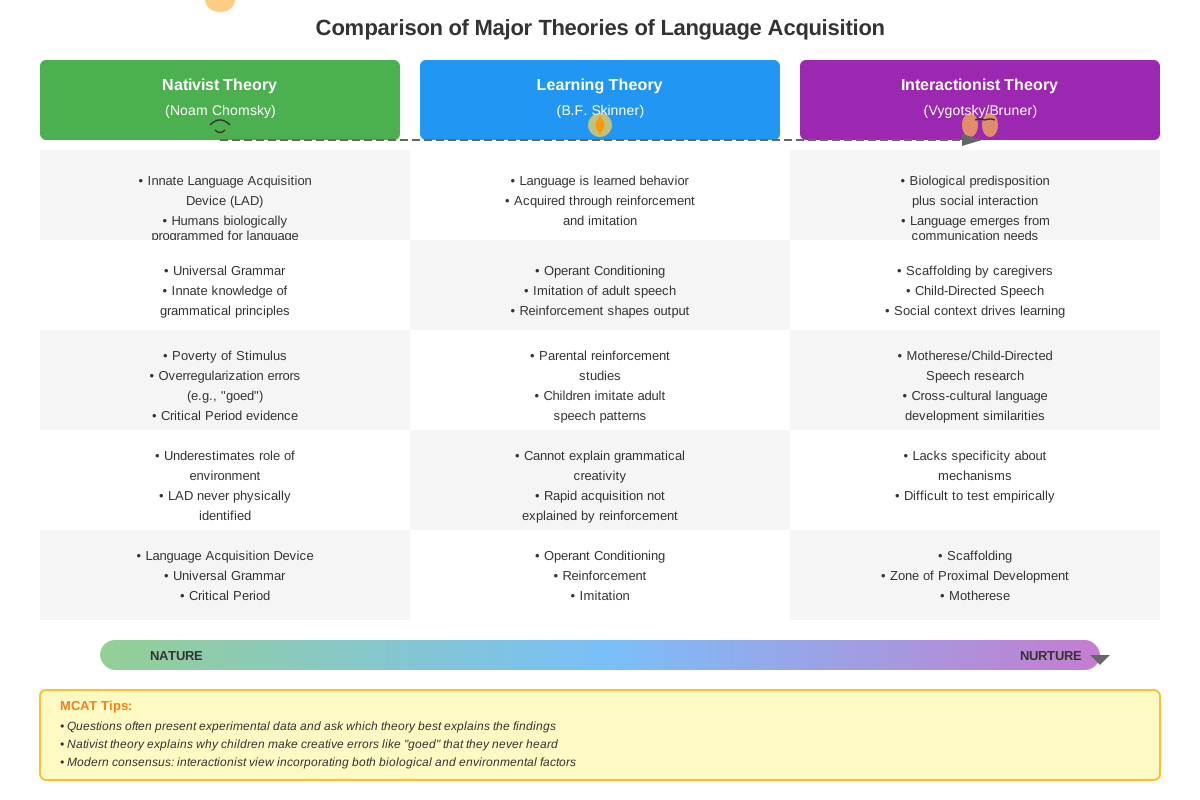
Understanding the major theoretical frameworks is essential for MCAT success, as questions frequently require students to identify which perspective best explains a given phenomenon.
Nativist Theory (Noam Chomsky)
The nativist perspective proposes that humans possess an innate biological capacity for language acquisition. Chomsky argued for a Language Acquisition Device (LAD), a hypothetical brain mechanism containing universal grammar—the fundamental principles common to all human languages. Key evidence supporting nativism includes:
- The poverty of the stimulus argument: Children acquire complex grammatical rules despite limited and often grammatically imperfect input
- Universal grammar: All languages share deep structural similarities
- Critical period: Language acquisition is dramatically easier during a biologically determined window
- Species-specificity: Only humans naturally acquire complex grammatical language
Learning Theory (B.F. Skinner)
The learning theory perspective emphasizes environmental input and reinforcement. Skinner proposed that language acquisition follows the same principles as other learned behaviors:
- Operant conditioning: Children produce sounds randomly; caregivers selectively reinforce language-like vocalizations
- Imitation: Children copy the speech they hear in their environment
- Shaping: Caregivers gradually reinforce closer approximations to correct speech
Limitations of pure learning theory include its inability to explain novel utterances, overgeneralization errors (e.g., "goed" instead of "went"), and the speed of acquisition despite inconsistent reinforcement.
Interactionist/Social-Pragmatic Theory
The interactionist perspective integrates biological predispositions with environmental input, emphasizing the social context of language learning. This view highlights:
- Child-directed speech (motherese/parentese): Caregivers naturally modify their speech patterns (higher pitch, exaggerated intonation, simplified grammar) to facilitate learning
- Joint attention: Shared focus between caregiver and child on objects or events provides context for word learning
- Social motivation: Children are intrinsically motivated to communicate and connect with others
- Scaffolding: Caregivers provide structured support that adjusts to the child's developing abilities
Developmental Milestones and Stages
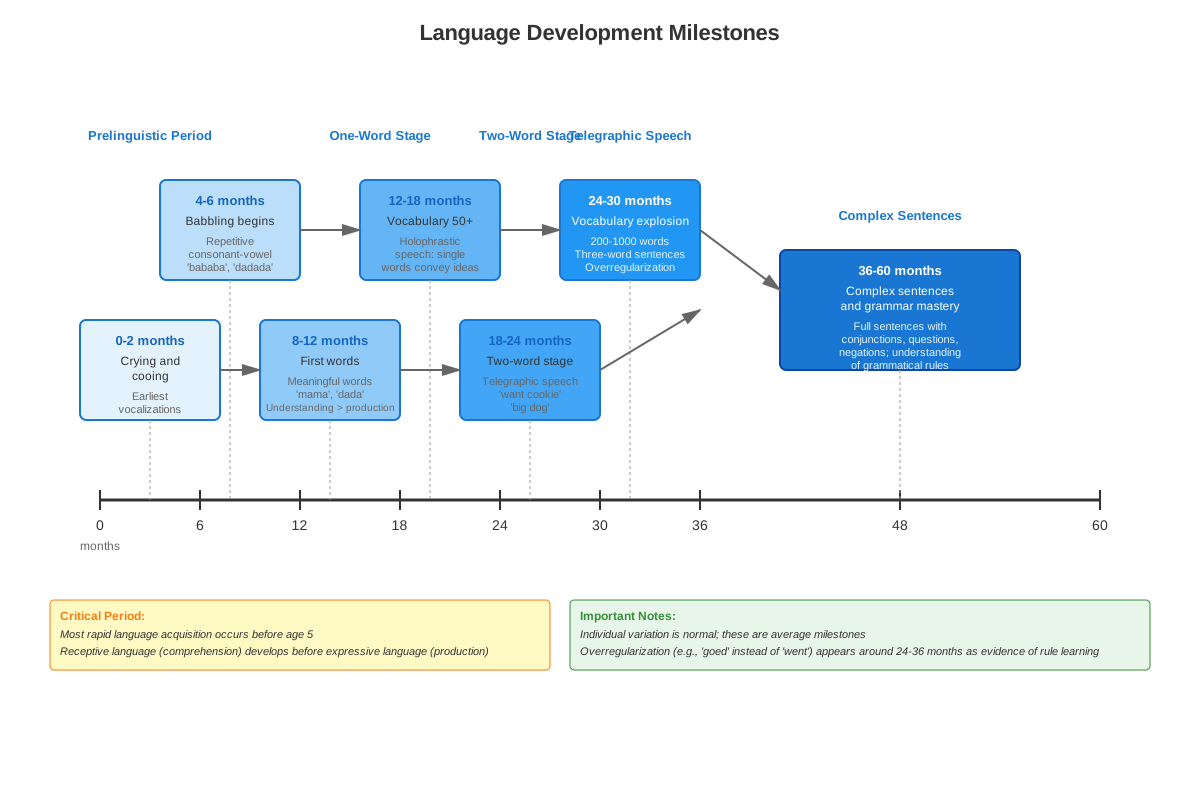
Language development follows a remarkably consistent sequence across cultures, though the exact timing varies among individuals.
| Age Range | Receptive Language | Expressive Language | Key Characteristics |
|---|---|---|---|
| 0-6 months | Responds to voices; discriminates phonemes from all languages | Cooing (vowel-like sounds); crying | Universal phoneme discrimination |
| 6-12 months | Understands simple words ("no," "bye-bye"); responds to name | Babbling (consonant-vowel combinations); canonical babbling (repetitive syllables like "bababa") | Perceptual narrowing: loses ability to discriminate non-native phonemes |
| 12-18 months | Understands 50+ words; follows simple commands | First words (typically around 12 months); holophrastic speech (single words convey complete thoughts) | Vocabulary spurt often begins around 18 months |
| 18-24 months | Understands 200+ words; comprehends two-step commands | Two-word stage: telegraphic speech combining two meaningful words ("more milk," "daddy go") | Rapid vocabulary expansion; 50-word milestone triggers grammar emergence |
| 2-3 years | Understands complex sentences; follows multi-step instructions | 3-4 word sentences; begins using grammatical morphemes (plurals, past tense); overgeneralization errors | Vocabulary reaches 200-1000 words |
| 3-5 years | Comprehends most conversational speech; understands stories | Complex sentences with embedded clauses; asks questions; tells simple narratives | Pragmatic skills develop; some articulation errors persist |
| 5+ years | Adult-like comprehension in most contexts | Grammatically sophisticated speech; continues vocabulary growth throughout life | Metalinguistic awareness emerges |
Critical and Sensitive Periods
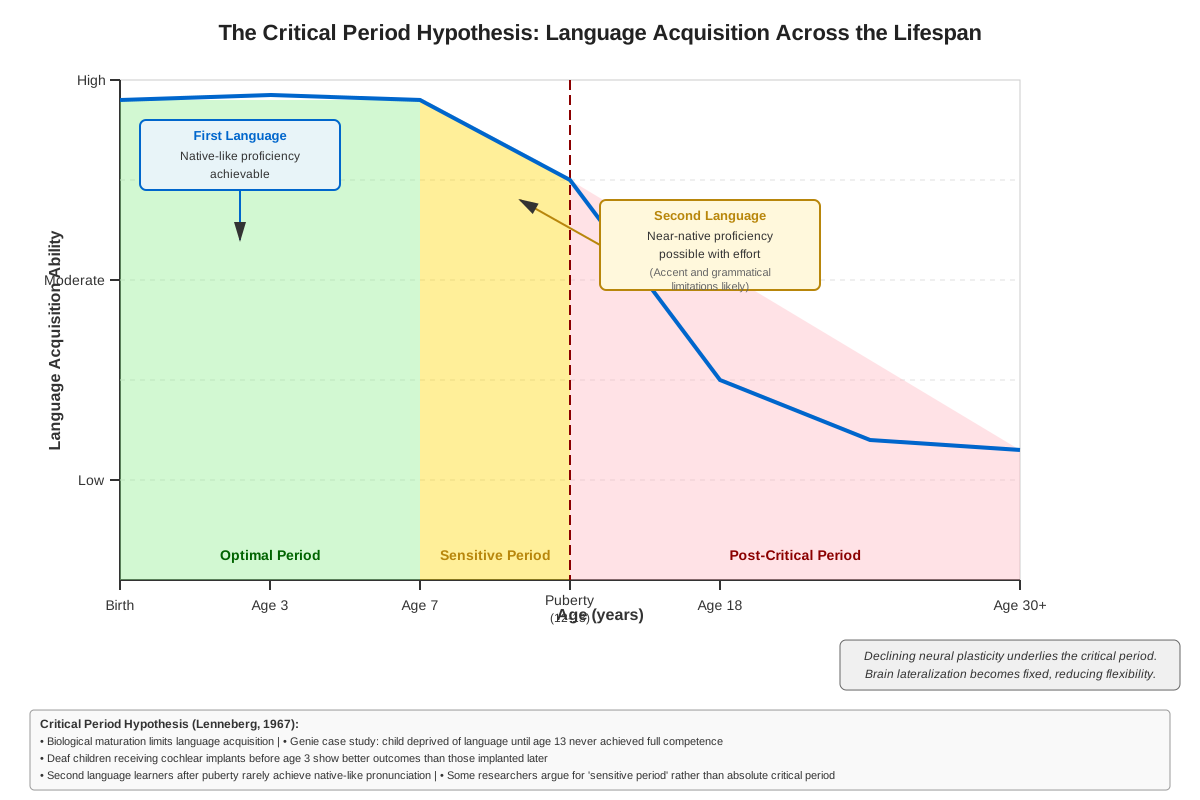
The critical period hypothesis proposes that language acquisition must occur during a biologically determined window for normal development. Evidence includes:
- Genie case study: A girl deprived of language input until age 13 never acquired normal grammar despite intensive intervention
- Second language acquisition: Native-like pronunciation and grammar are nearly impossible to achieve after puberty
- Deaf children and sign language: Early exposure to sign language results in native fluency; delayed exposure leads to persistent deficits
- Neuroplasticity: The brain's capacity for language reorganization decreases with age
The sensitive period is a more flexible concept, suggesting optimal rather than absolute time windows. Research indicates that while basic language can be acquired throughout life, native-like proficiency requires early exposure.
Neurobiological Basis of Language
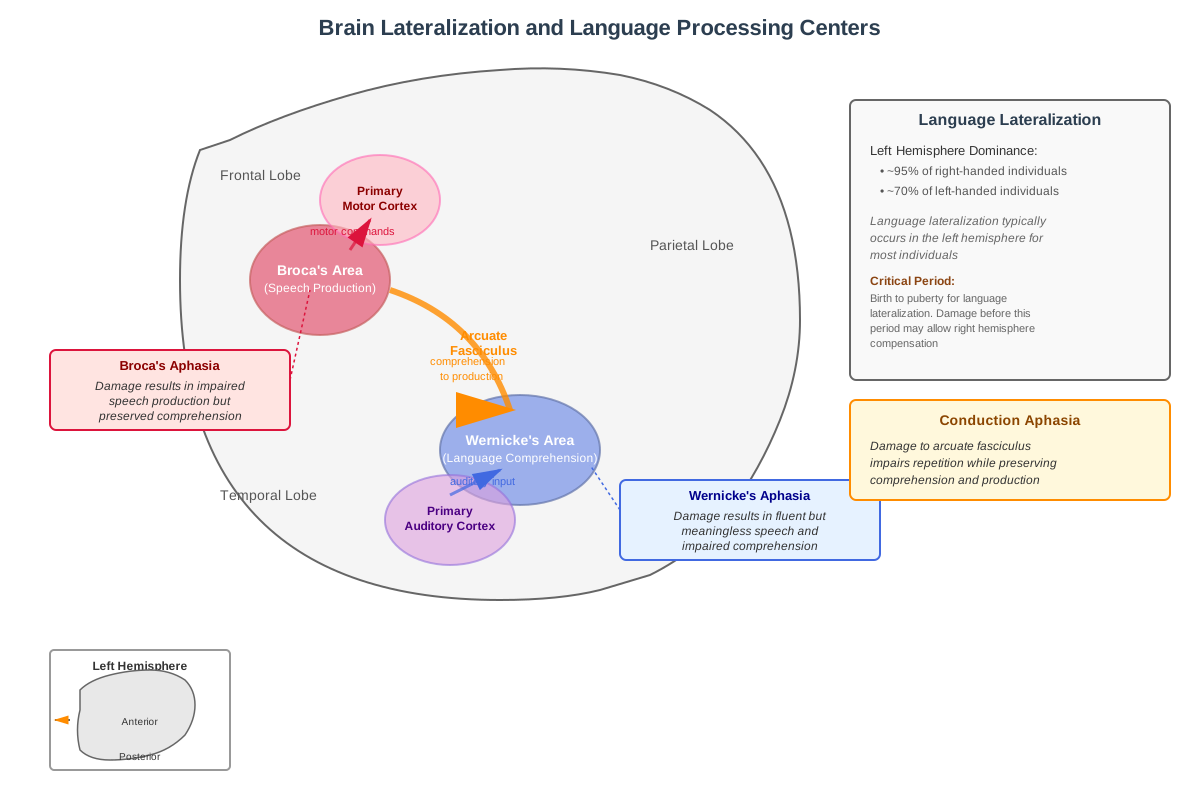
Language processing involves a distributed network of brain regions, with two areas particularly critical:
Broca's area (left inferior frontal gyrus):
- Responsible for speech production and grammatical processing
- Damage causes Broca's aphasia: effortful, telegraphic speech with relatively preserved comprehension
- Also involved in syntax processing and motor planning for speech
Wernicke's area (left posterior superior temporal gyrus):
- Critical for language comprehension and semantic processing
- Damage causes Wernicke's aphasia: fluent but meaningless speech with severely impaired comprehension
- Connects auditory input to meaning
The arcuate fasciculus connects these regions, enabling the integration of comprehension and production. Language is typically lateralized to the left hemisphere in 95% of right-handed individuals and 70% of left-handed individuals.
Linguistic Relativity and Language-Thought Relationships
The Sapir-Whorf hypothesis (linguistic relativity) proposes that language shapes thought and perception. Two versions exist:
- Strong version (linguistic determinism): Language determines thought; concepts cannot exist without words to express them (largely rejected)
- Weak version (linguistic relativity): Language influences thought and makes certain cognitive operations easier or more habitual (supported by research)
Evidence for linguistic relativity includes cross-cultural differences in color perception, spatial reasoning, and time conceptualization based on linguistic categories. However, universal cognitive capacities exist independent of specific languages.
Concept Relationships
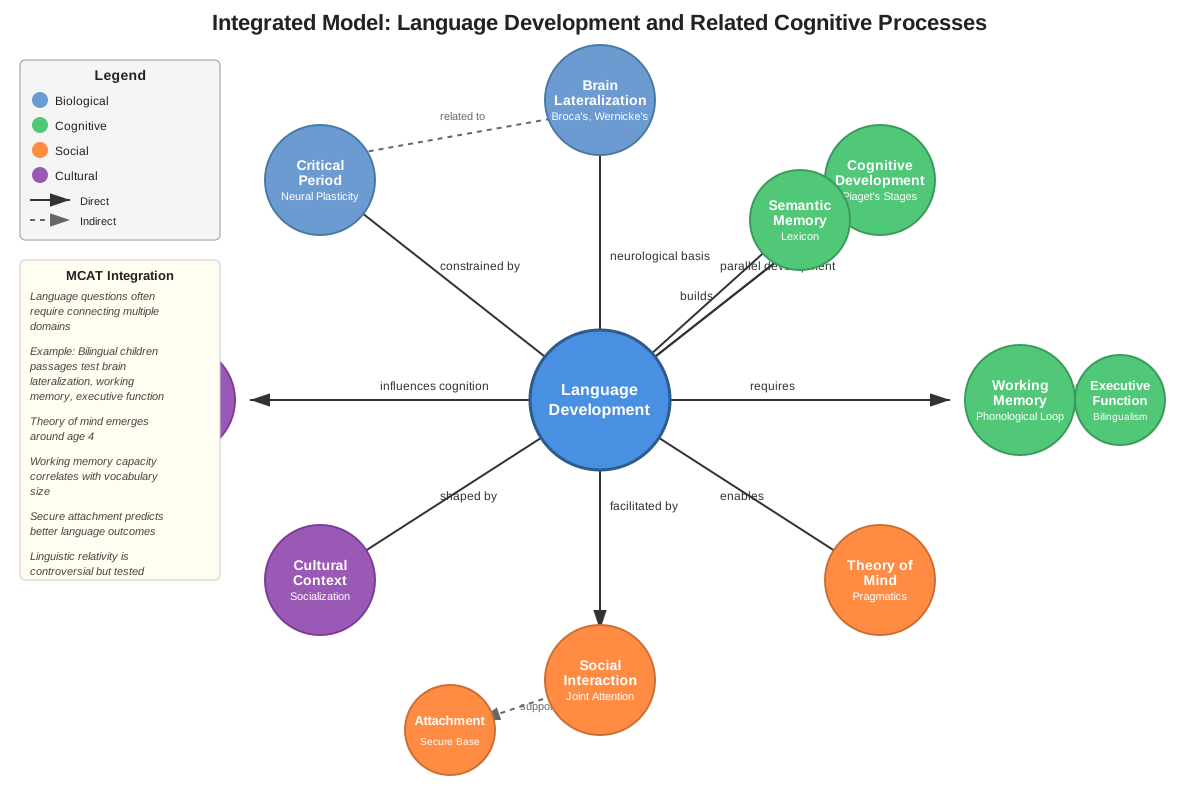
Language development represents a complex interplay of multiple interconnected processes. At the foundational level, biological maturation of neural structures (particularly Broca's and Wernicke's areas) provides the necessary hardware for language processing. This biological readiness interacts with environmental input through the mechanism of social interaction, where caregivers provide both linguistic models and motivation for communication.
The relationship flows as follows: Innate predispositions (LAD/universal grammar) → Perceptual abilities (phoneme discrimination) → Environmental exposure (child-directed speech) → Receptive language development → Expressive language development → Grammatical refinement → Pragmatic competence. Each stage builds upon previous achievements while simultaneously supporting subsequent developments.
Language development connects bidirectionally with cognitive development. Piaget argued that cognitive development precedes and enables language (cognition → language), while Vygotsky proposed that language tools transform cognitive processes (language → cognition). The modern consensus recognizes reciprocal influences: early cognitive abilities like object permanence support word learning, while language acquisition enables more sophisticated categorization and abstract reasoning.
The topic also connects to social development: language enables participation in cultural practices, formation of social identity, and development of theory of mind (understanding others' mental states). Additionally, language development relates to memory systems: procedural memory supports grammar acquisition, while semantic memory stores vocabulary and world knowledge.
Critical period effects link language development to neuroplasticity: the brain's capacity for reorganization is maximal during early development, explaining why early language exposure is crucial. This connects to broader principles of developmental sensitive periods across multiple domains (vision, attachment, motor skills).
Quick check — test yourself on Language development so far.
Try Flashcards →High-Yield Facts
⭐ Receptive language (comprehension) consistently develops before expressive language (production) across all components and stages
⭐ The critical period for language acquisition extends from birth through puberty, with optimal acquisition occurring before age 7
⭐ Broca's area (frontal lobe) controls speech production; damage causes effortful, telegraphic speech with preserved comprehension
⭐ Wernicke's area (temporal lobe) controls language comprehension; damage causes fluent but meaningless speech with impaired comprehension
⭐ Overgeneralization errors (e.g., "goed," "mouses") demonstrate that children actively construct grammatical rules rather than simply imitating
- Babbling begins around 6 months and initially includes phonemes from all languages before perceptual narrowing occurs
- The vocabulary spurt typically occurs around 18 months, with children learning new words at accelerating rates
- Telegraphic speech (two-word combinations like "want cookie") emerges around 18-24 months
- Child-directed speech (motherese) features exaggerated intonation, higher pitch, slower tempo, and simplified grammar
- Holophrastic speech refers to single-word utterances that convey complete thoughts (e.g., "milk" meaning "I want milk")
- The poverty of the stimulus argument supports nativist theory: children acquire complex grammar despite limited input
- Language is lateralized to the left hemisphere in approximately 95% of right-handed individuals
- Genie's case study demonstrates critical period effects: language deprivation until age 13 resulted in permanent grammatical deficits
- Phonological awareness (recognizing sound structures) predicts later reading ability
- Pragmatic language skills (social use of language) continue developing through adolescence
Common Misconceptions
Misconception: Children learn language primarily through imitation and reinforcement.
Correction: While imitation plays a role, children produce novel utterances they've never heard (e.g., "I goed to the store"), demonstrating active rule construction. Overgeneralization errors prove children aren't simply copying adult speech. The nativist and interactionist perspectives better explain the speed and universality of acquisition.
Misconception: Broca's area is only responsible for speech production, and Wernicke's area only for comprehension.
Correction: While these are their primary functions, both areas contribute to multiple language processes. Broca's area is involved in grammatical processing and comprehension of complex syntax. Wernicke's area contributes to word retrieval during production. Language processing involves distributed networks, not isolated modules.
Misconception: The critical period for language ends at a specific age, after which no language learning is possible.
Correction: The critical period represents a gradient of declining plasticity rather than an absolute cutoff. Basic language can be acquired throughout life, but native-like proficiency (especially pronunciation and implicit grammar) becomes increasingly difficult after puberty. The concept of "sensitive periods" more accurately captures this gradual decline.
Misconception: Bilingual language development confuses children and delays language milestones.
Correction: Bilingual children may show slightly different patterns (like code-switching) but reach major milestones within normal ranges. Bilingualism provides cognitive advantages including enhanced executive function and metalinguistic awareness. Any apparent delays typically reflect measurement issues (testing in only one language) rather than true deficits.
Misconception: Language and thought are completely independent processes.
Correction: While strong linguistic determinism is rejected, substantial evidence supports linguistic relativity: language influences (though doesn't determine) thought. Language provides tools for categorization, memory encoding, and abstract reasoning. The relationship is bidirectional, with cognitive development enabling language acquisition and language transforming cognitive processes.
Misconception: All components of language develop at the same rate.
Correction: Different language components follow distinct developmental trajectories. Phonological development largely completes by age 5-7, while pragmatic skills continue developing through adolescence. Vocabulary growth continues throughout life. Syntax develops rapidly between ages 2-5 but continues refining into school years.
Worked Examples
Example 1: Applying Theoretical Perspectives
Question: A researcher observes that children from diverse linguistic backgrounds all begin producing two-word combinations around 18-24 months, despite vastly different amounts and types of parental input. The children make similar grammatical errors (like overgeneralization) regardless of the specific language they're learning. Which theoretical perspective best explains these observations?
Analysis:
Let's systematically evaluate each theoretical framework:
Learning Theory Prediction: If language acquisition depended primarily on imitation and reinforcement, we would expect:
- Significant variation in timing based on amount of input
- Children from high-input environments developing faster
- No systematic errors (children would copy correct forms)
- Language-specific patterns reflecting what children hear
Observation Mismatch: The universal timing and similar error patterns contradict pure learning theory predictions.
Nativist Theory Prediction: If humans possess innate language mechanisms (LAD with universal grammar), we would expect:
- Universal developmental milestones across cultures
- Similar grammatical errors reflecting innate rule-construction
- Acquisition occurring despite variable input quality
- Deep structural similarities across languages
Observation Match: The described phenomena align perfectly with nativist predictions. The universal timing suggests biological maturation drives development. Overgeneralization errors (applying rules too broadly) demonstrate active rule construction rather than imitation. The consistency across diverse linguistic environments supports innate mechanisms.
Interactionist Theory Prediction: This perspective would predict:
- Universal biological foundations with environmental modulation
- Social interaction facilitating but not determining acquisition
- Both universal patterns and some cultural variation
Observation Partial Match: While interactionist theory could explain the observations, the emphasis on universal patterns despite variable input more strongly supports nativism.
Answer: The nativist perspective (Chomsky's theory with LAD and universal grammar) best explains these observations. The universal timing, systematic errors, and consistency across diverse environments suggest innate biological mechanisms drive language acquisition.
MCAT Connection: This question type requires distinguishing theoretical perspectives based on empirical observations—a common MCAT task. Key trigger: "universal patterns despite variable input" → think nativist theory.
Example 2: Clinical Application of Language Development Knowledge
Question: A 3-year-old child produces sentences like "I goed to park" and "She haved two cookies." The child's parents are concerned about these errors and wonder if they should correct them. Based on language development principles, what is the most appropriate interpretation and recommendation?
Analysis:
Step 1: Identify the phenomenon
The child is making overgeneralization errors—applying regular grammatical rules (add "-ed" for past tense) to irregular verbs. This is a normal and actually positive developmental milestone.
Step 2: Understand the developmental significance
Overgeneralization demonstrates:
- The child has extracted grammatical rules from input (not just memorizing individual words)
- Active cognitive processing and rule construction
- Normal language development for a 3-year-old
- The child previously used correct irregular forms through memorization, then "regressed" when discovering rules
Step 3: Developmental trajectory
This is a U-shaped developmental curve:
- Initial correct usage through memorization ("went," "had")
- Overgeneralization when rules are discovered ("goed," "haved")
- Eventually correct usage with understanding of exceptions
Step 4: Appropriate intervention
Research shows that:
- Direct correction is largely ineffective and may reduce communication motivation
- Recasting (repeating the child's utterance with correct grammar) is more effective: Child: "I goed to park" → Parent: "Yes, you went to the park!"
- Errors typically self-correct as the child gains more experience with irregular forms
- Overgeneralization is a sign of healthy language development, not a problem
Answer: These overgeneralization errors are a normal and positive sign of language development, indicating the child is actively constructing grammatical rules. Parents should use recasting (modeling correct forms) rather than direct correction, and understand that these errors will naturally resolve as the child gains more linguistic experience.
MCAT Connection: This question integrates developmental milestones, theoretical understanding (rule construction), and practical application—a common MCAT format. Recognizing overgeneralization as normal development is high-yield knowledge.
Exam Strategy
When approaching MCAT questions on language development, employ these strategic approaches:
1. Identify the developmental stage first: Many questions hinge on knowing what's typical at different ages. If a passage describes a child's language abilities, immediately place them on the developmental timeline (prelinguistic, one-word, two-word, complex grammar stages). This context guides interpretation of subsequent information.
2. Watch for theory-identification triggers:
- "Universal patterns" or "despite limited input" → Nativist theory
- "Reinforcement" or "imitation" → Learning theory
- "Social interaction" or "child-directed speech" → Interactionist theory
- "Novel utterances" or "overgeneralization" → Evidence against pure learning theory
3. Distinguish receptive versus expressive language: Questions often test whether students recognize that comprehension precedes production. If a passage describes what a child "understands" versus "says," this distinction is likely relevant to the answer.
4. Apply the critical period concept carefully: Questions may present scenarios involving:
- Second language learning at different ages
- Language deprivation cases
- Recovery from brain injury at different developmental stages
Remember: earlier = better plasticity, but learning remains possible throughout life
5. Neuroanatomy shortcuts:
- Production problems + preserved comprehension = Broca's area
- Comprehension problems + fluent but meaningless speech = Wernicke's area
- If the question mentions "frontal lobe" → production
- If the question mentions "temporal lobe" → comprehension
6. Process of elimination for theory questions:
- Eliminate learning theory if the scenario involves novel utterances or systematic errors
- Eliminate nativist theory if the scenario emphasizes environmental variation causing different outcomes
- Choose interactionist when both biological and environmental factors are emphasized
7. Time management: Language development questions are typically straightforward if you know the content. Allocate 60-90 seconds for discrete questions, 90-120 seconds for passage-based questions. Don't overthink—the MCAT tests core concepts, not obscure details.
8. Common question formats to anticipate:
- Matching developmental milestones to ages
- Identifying theoretical perspectives from research descriptions
- Interpreting language errors (overgeneralization, telegraphic speech)
- Applying critical period concepts to novel scenarios
- Connecting language areas to aphasia symptoms
Memory Techniques
Mnemonic for Language Components (PMSSP):
Phonology (sounds)
Morphology (meaningful units)
Syntax (grammar rules)
Semantics (meaning)
Pragmatics (social use)
Visualization: "Phone More Syntax Seems Practical" - Imagine calling someone on a phone to discuss grammar rules, which seems like a practical conversation.
Broca vs. Wernicke Memory Aid:
Broca's = Broken speech, Better comprehension (both start with B)
Wernicke's = Wordy but Worthless, Won't understand (all start with W)
Developmental Sequence Mnemonic (CBHTC):
Cooing (0-6 months)
Babbling (6-12 months)
Holophrastic/one-word (12-18 months)
Telegraphic/two-word (18-24 months)
Complex sentences (2+ years)
Visualization: Imagine a baby's development as climbing stairs, with each step representing a new language milestone.
Critical Period Reminder:
"Seven is heaven for language" - Optimal language acquisition occurs before age 7; after this, native-like proficiency becomes increasingly difficult.
Theory Distinction Acronym (NIL):
Nativist = Nature (innate LAD)
Interactionist = Integration (nature + nurture)
Learning = nurture (environment and reinforcement)
Overgeneralization Memory Trick:
"Kids OVER-apply rules they GENERALize" - This error shows rule construction, not imitation. Remember: "goed" and "mouses" are signs of intelligence, not deficits!
Summary
Language development encompasses the acquisition of phonology, morphology, syntax, semantics, and pragmatics through a predictable sequence of milestones from birth through childhood. Three major theoretical perspectives explain this process: nativist theory emphasizes innate biological mechanisms (LAD and universal grammar), learning theory focuses on environmental reinforcement and imitation, and interactionist theory integrates biological predispositions with social-environmental input. Key developmental stages include cooing, babbling, holophrastic speech, telegraphic speech, and complex grammatical sentences, with receptive language consistently preceding expressive language. The critical period hypothesis, supported by cases like Genie and second language acquisition research, demonstrates that early exposure is crucial for native-like proficiency. Neuroanatomically, Broca's area controls speech production while Wernicke's area governs comprehension, with both regions typically lateralized to the left hemisphere. Overgeneralization errors reveal that children actively construct grammatical rules rather than passively imitating. For MCAT success, students must distinguish theoretical perspectives, sequence developmental milestones, connect language areas to aphasia types, and apply critical period concepts to novel scenarios.
Key Takeaways
- Language development follows a universal sequence: cooing → babbling → one-word → two-word → complex grammar, with receptive language always preceding expressive language
- Three theoretical frameworks explain acquisition differently: nativist (innate LAD), learning theory (reinforcement/imitation), and interactionist (biological + environmental integration)
- Critical period effects are strongest before age 7; early language exposure is essential for native-like proficiency, though basic acquisition remains possible throughout life
- Broca's area (frontal) controls production; damage causes effortful, telegraphic speech with preserved comprehension. Wernicke's area (temporal) controls comprehension; damage causes fluent but meaningless speech
- Overgeneralization errors (e.g., "goed") demonstrate active rule construction and are normal developmental milestones, not deficits requiring correction
- Child-directed speech (motherese) with exaggerated prosody and simplified grammar facilitates language learning through social interaction
- Linguistic relativity (weak Sapir-Whorf hypothesis) suggests language influences but doesn't determine thought, affecting perception and categorization across cultures
Related Topics
Cognitive Development (Piaget and Vygotsky): Language development intersects with broader cognitive milestones; Piaget viewed language as reflecting cognitive development, while Vygotsky emphasized language as a tool transforming cognition. Understanding these perspectives enriches comprehension of language-thought relationships.
Brain Lateralization and Hemispheric Specialization: Language lateralization to the left hemisphere exemplifies broader principles of hemispheric specialization. Mastering language localization enables understanding of split-brain research and functional neuroanatomy.
Learning and Memory Systems: Language acquisition involves multiple memory systems—procedural memory for grammar, semantic memory for vocabulary, and episodic memory for language experiences. This connection illuminates how different memory types support complex skill acquisition.
Social Development and Theory of Mind: Language enables children to discuss mental states, facilitating theory of mind development. Understanding this bidirectional relationship connects language development to social cognition.
Developmental Disorders: Knowledge of typical language development provides the foundation for understanding autism spectrum disorder, specific language impairment, and intellectual disabilities—all testable MCAT topics.
Practice CTA
Now that you've mastered the core concepts of language development, it's time to solidify your understanding through active practice. Challenge yourself with MCAT-style practice questions that require you to apply theoretical frameworks to novel scenarios, identify developmental milestones in clinical vignettes, and distinguish between different types of aphasia. Use flashcards to drill high-yield facts like the sequence of language milestones and the functions of Broca's and Wernicke's areas. Remember: understanding language development isn't just about memorizing facts—it's about developing the analytical skills to tackle any question the MCAT throws at you. Your ability to integrate biological, cognitive, and social perspectives on this topic demonstrates the interdisciplinary thinking that defines MCAT success. Keep pushing forward—you're building the foundation for an excellent Psychology/Sociology score!
Sign up free to keep reading
Create a free AnvayaPrep account to finish this MCAT guide on Language development — plus flashcards and practice questions.