Overview
Semantics is the branch of linguistics and cognitive psychology that studies meaning in language—how words, phrases, sentences, and larger units of discourse convey meaning. In the context of Psychology and the MCAT, semantics focuses on how the human mind processes, stores, and retrieves meaning from linguistic information. This topic sits at the intersection of language, memory, and thought, making it essential for understanding how humans communicate complex ideas and how cognitive processes enable comprehension.
For the MCAT, semantics is particularly important within the Cognition and Consciousness framework because it addresses fundamental questions about mental representation and information processing. Understanding semantics helps explain how people extract meaning from written passages (a skill directly tested on every MCAT section), how memory systems organize conceptual knowledge, and how language disorders affect cognitive function. The MCAT frequently tests semantic concepts through passages about language development, cognitive impairments, reading comprehension studies, and neuropsychological case studies.
Semantics connects to broader psychological concepts including memory systems (particularly semantic memory), language acquisition, cognitive development, and neural processing. It provides the foundation for understanding how humans move beyond simple word recognition to grasp abstract concepts, metaphors, context-dependent meanings, and the relationships between ideas—all skills that MCAT test-takers must demonstrate when analyzing complex scientific passages and experimental designs.
Learning Objectives
- [ ] Define Semantics using accurate Psychology terminology
- [ ] Explain why Semantics matters for the MCAT
- [ ] Apply Semantics to exam-style questions
- [ ] Identify common mistakes related to Semantics
- [ ] Connect Semantics to related Psychology concepts
- [ ] Distinguish between semantic memory and other memory systems
- [ ] Analyze how semantic processing differs from syntactic processing
- [ ] Evaluate the role of semantic networks in knowledge organization
- [ ] Apply semantic priming concepts to experimental design questions
Prerequisites
- Basic memory systems: Understanding the distinction between declarative and procedural memory provides the foundation for comprehending where semantic knowledge fits within memory architecture
- Language fundamentals: Familiarity with basic linguistic components (phonemes, morphemes, syntax) enables differentiation between structural and meaning-based language processing
- Cognitive processing models: Knowledge of information processing stages (encoding, storage, retrieval) is necessary to understand how semantic information flows through cognitive systems
- Neural basis of cognition: Basic understanding of brain regions involved in language (Broca's area, Wernicke's area) contextualizes where semantic processing occurs neurologically
Why This Topic Matters
Semantics has profound clinical significance in understanding language disorders, cognitive decline, and developmental disabilities. Patients with semantic dementia progressively lose conceptual knowledge while maintaining other cognitive functions, demonstrating that semantic processing represents a distinct cognitive system. Aphasia subtypes are partially classified by whether semantic processing remains intact—Wernicke's aphasia involves semantic comprehension deficits, while Broca's aphasia typically preserves semantic understanding. These clinical presentations frequently appear in MCAT passages about neuropsychology and cognitive disorders.
On the MCAT, semantics-related content appears in approximately 3-5% of Psychology/Sociology section questions, often integrated into passages about language development, memory research, or cognitive neuroscience. Questions typically present experimental designs studying semantic priming, semantic memory organization, or language comprehension, then ask students to interpret results or identify methodological considerations. The Biological and Biochemical Foundations section may also include semantics when discussing neural correlates of language or brain imaging studies of comprehension.
Common MCAT passage contexts include: developmental studies of vocabulary acquisition in children, neuroimaging research showing brain activation during semantic tasks, case studies of patients with semantic processing deficits, experiments on reading comprehension and context effects, and research on bilingualism and semantic representation across languages. Understanding semantics enables students to quickly grasp passage content about language and cognition while recognizing how semantic concepts apply to experimental interpretations.
Core Concepts
Definition and Scope of Semantics
Semantics refers to the study of meaning in language and how the mind represents, processes, and uses meaningful information. In Semantics Psychology, the focus extends beyond dictionary definitions to encompass how people understand relationships between concepts, extract meaning from context, and organize knowledge in memory. Semantic processing involves accessing stored conceptual knowledge and applying it to comprehend linguistic input, whether spoken, written, or signed.
The scope of semantics includes lexical semantics (word meanings), compositional semantics (how word meanings combine to form phrase and sentence meanings), and pragmatic aspects of meaning (how context influences interpretation). For the MCAT, understanding that semantics deals with "what language means" rather than "how language is structured" (syntax) or "how language sounds" (phonology) is crucial for distinguishing between different aspects of language processing in experimental passages.
Semantic Memory
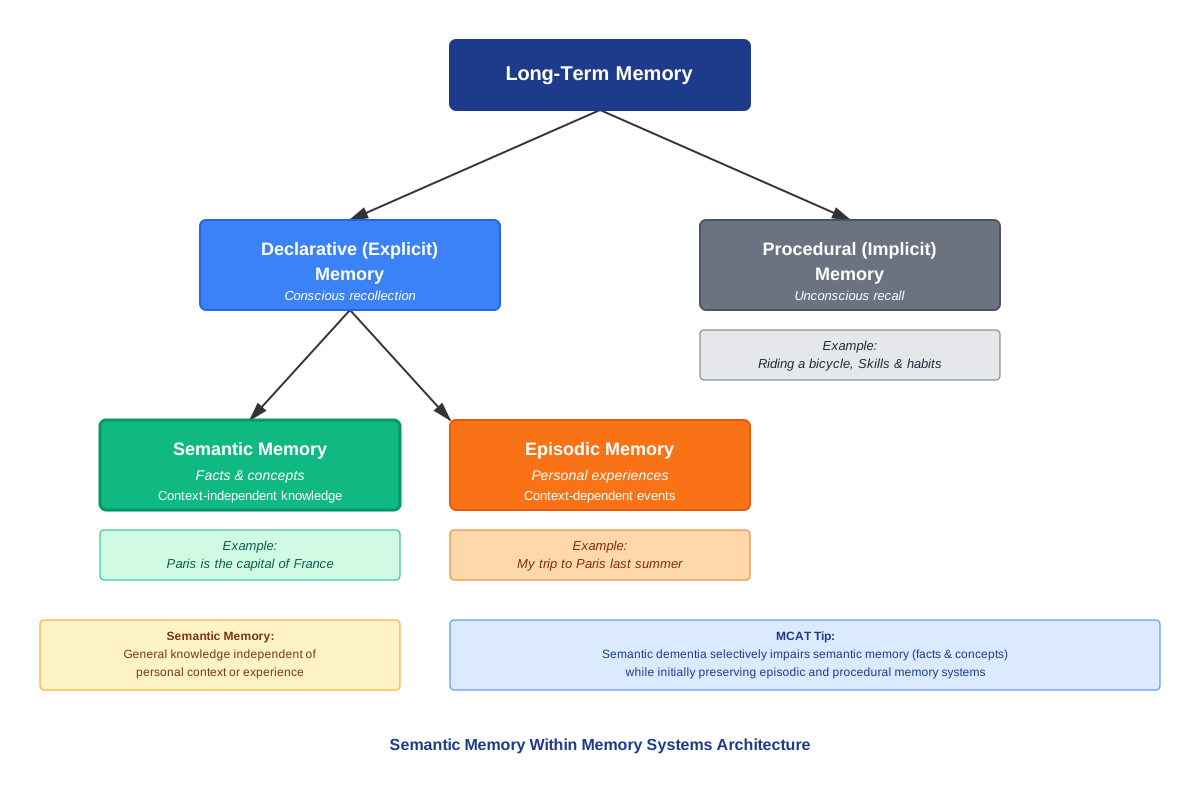
Semantic memory is the long-term memory system that stores general world knowledge, facts, concepts, and the meanings of words independent of personal experience or temporal context. Unlike episodic memory (which stores personally experienced events with temporal and spatial context), semantic memory contains decontextualized information—you know that Paris is the capital of France without remembering when or where you learned this fact.
Semantic memory is organized conceptually rather than chronologically. It includes:
- Factual knowledge (historical dates, scientific principles)
- Conceptual knowledge (what defines a "bird" or "democracy")
- Vocabulary and word meanings
- Relationships between concepts (hierarchical, associative, functional)
Semantic memory typically remains intact longer than episodic memory in aging and early-stage Alzheimer's disease, though it deteriorates specifically in semantic dementia. This dissociation provides evidence that semantic and episodic memory represent distinct systems—a concept frequently tested on the MCAT through clinical vignettes.
Semantic Networks
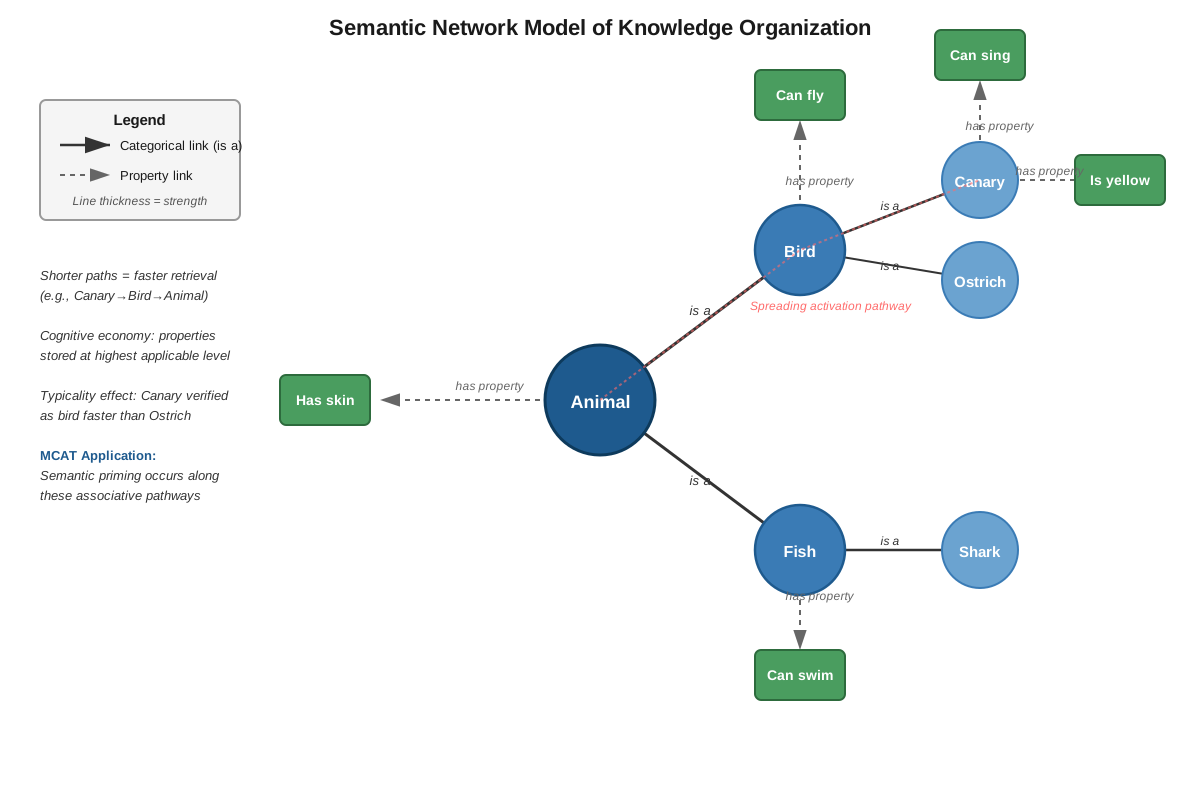
Semantic networks are theoretical models representing how concepts are organized and interconnected in memory. In these models, concepts are represented as nodes, and relationships between concepts are represented as links or edges connecting the nodes. The strength of connections reflects how closely related concepts are, with more strongly associated concepts having shorter or stronger links.
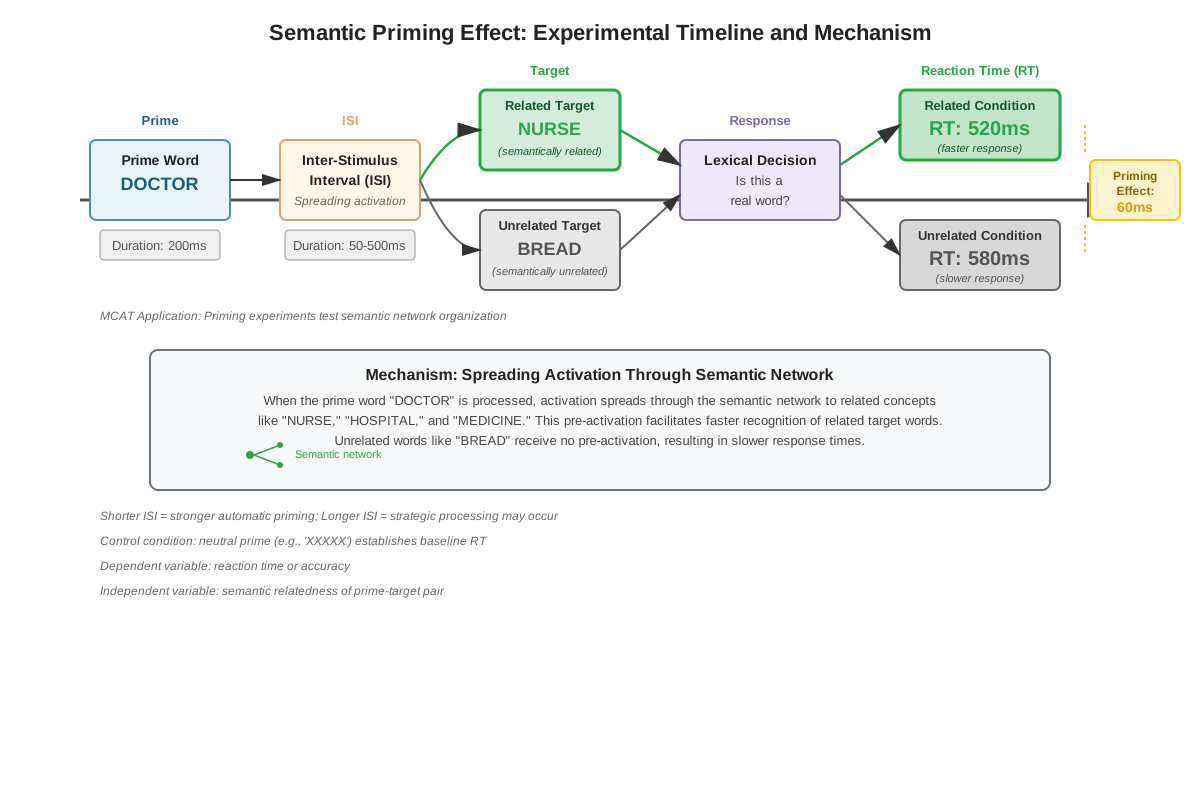
The spreading activation model proposes that when one concept is activated (brought into conscious awareness), activation spreads along the network to related concepts, making them more accessible. This explains semantic priming effects: exposure to one word (e.g., "doctor") facilitates faster recognition or processing of related words (e.g., "nurse") compared to unrelated words (e.g., "butter").
| Network Feature | Description | Example |
|---|---|---|
| Hierarchical organization | Concepts organized from general to specific | Animal → Bird → Robin |
| Associative links | Concepts connected by common co-occurrence | Bread ↔ Butter |
| Functional relationships | Concepts linked by purpose or use | Key → Lock |
| Property inheritance | Specific concepts inherit properties from general categories | Robins have wings (inherited from "bird") |
Semantic Priming
Semantic priming is a phenomenon where exposure to one stimulus (the prime) influences the processing of a subsequent related stimulus (the target). When a semantically related prime precedes a target word, reaction time to recognize or process the target decreases compared to when an unrelated prime is presented. For example, participants recognize the word "nurse" faster after seeing "doctor" than after seeing "table."
Semantic priming demonstrates that semantic information is organized in interconnected networks and that accessing one concept automatically activates related concepts. This effect occurs even when the prime is presented subliminally (below conscious awareness threshold), indicating that semantic processing can occur automatically without conscious attention.
MCAT passages frequently describe semantic priming experiments to test understanding of:
- Experimental design (prime-target pairs, control conditions)
- Dependent variables (reaction time, accuracy)
- Interpretation of results (what faster reaction times indicate about semantic organization)
Semantic Processing vs. Syntactic Processing
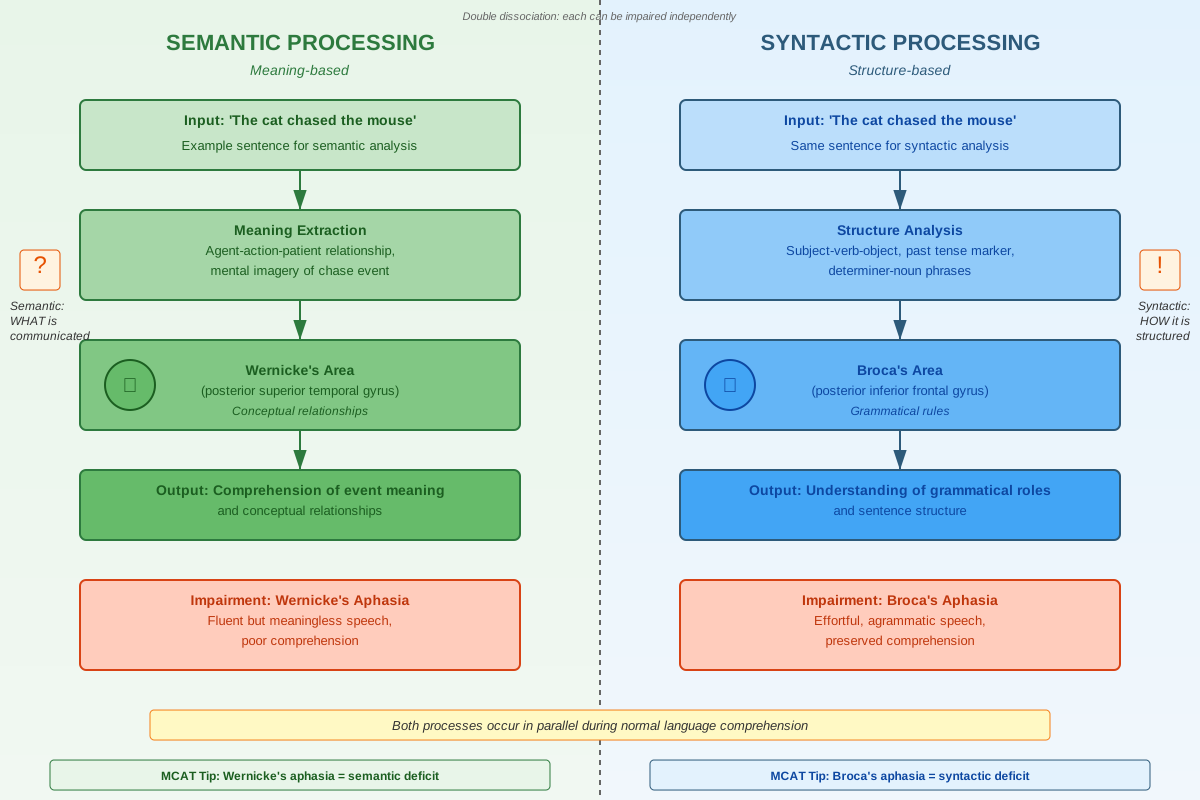
Understanding the distinction between semantic and syntactic processing is essential for Semantics MCAT questions. Syntactic processing involves analyzing the grammatical structure of sentences—word order, grammatical rules, sentence structure—without necessarily accessing meaning. Semantic processing involves extracting meaning from linguistic input by accessing stored conceptual knowledge.
These processes are dissociable: individuals with Broca's aphasia often struggle with syntactic processing (producing grammatically correct sentences) while maintaining relatively intact semantic comprehension. Conversely, Wernicke's aphasia involves fluent, grammatically correct speech that lacks meaningful semantic content. This double dissociation provides neurological evidence that syntax and semantics represent distinct cognitive processes.
Levels of Semantic Processing
The levels of processing framework (Craik & Lockhart) proposes that information processed at deeper, more meaningful levels is better remembered than information processed superficially. Semantic processing represents deep processing, while structural (visual appearance) or phonological (sound-based) processing represents shallow processing.
Experimental evidence shows that when people encode words by thinking about their meaning (semantic processing: "Does this word represent something living?") rather than their appearance (structural processing: "Is this word in capital letters?"), subsequent recall is significantly better. This demonstrates that semantic processing creates more durable memory traces, a concept that appears in MCAT passages about memory encoding strategies and study techniques.
Context Effects in Semantic Processing
Semantic interpretation is highly context-dependent. The same word can have different meanings depending on surrounding words, prior discourse, and situational context. For example, "bank" means something different in "river bank" versus "savings bank." Context effects demonstrate that semantic processing is not simply looking up fixed definitions but involves dynamic integration of multiple information sources.
Context influences semantic processing through:
- Lexical ambiguity resolution: Using context to determine which meaning of an ambiguous word is intended
- Inference generation: Filling in unstated information based on semantic knowledge and context
- Expectation effects: Context creates expectations about likely upcoming words or meanings, facilitating processing when expectations are met
Concept Relationships
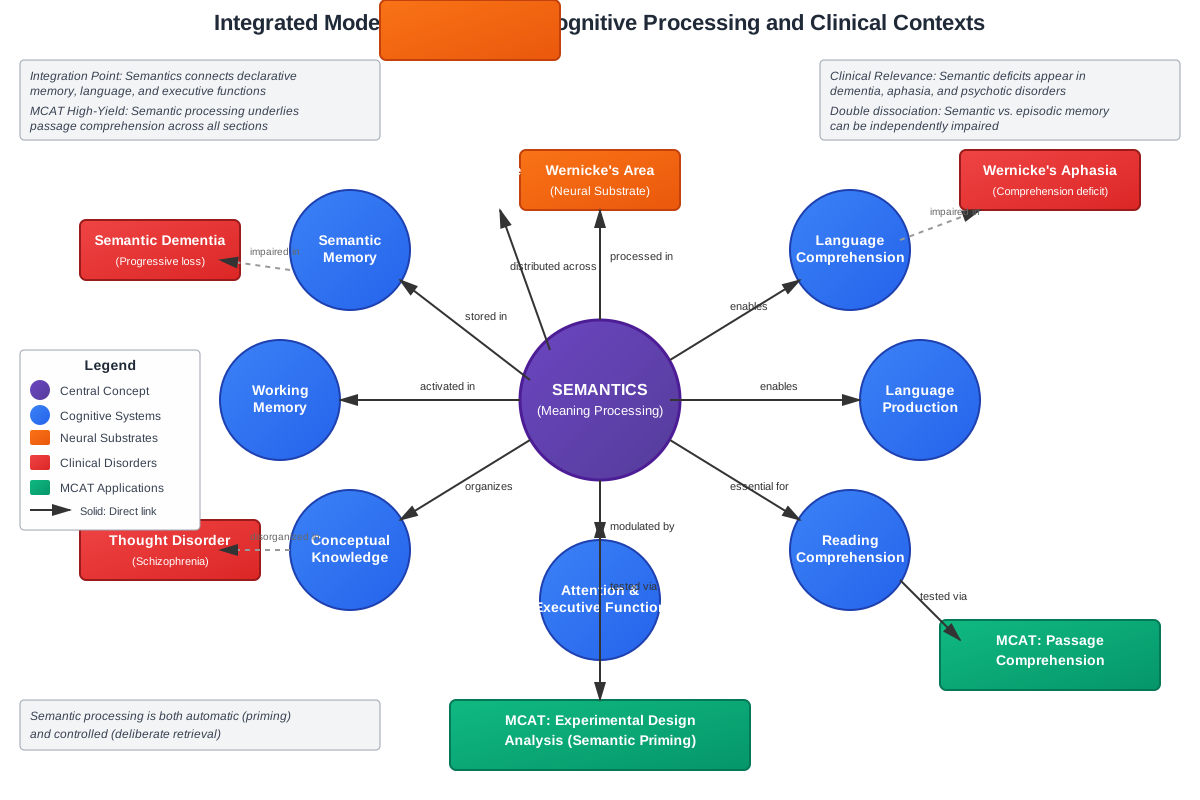
Semantics connects intimately with multiple cognitive systems and processes. Semantic memory serves as the knowledge base that semantic processing accesses, while semantic networks provide the organizational structure for that knowledge. When semantic processing occurs, activation spreads through semantic networks via spreading activation, producing semantic priming effects that facilitate related concept processing.
The relationship flows: Semantic Networks (structure) → Semantic Memory (storage) → Semantic Processing (access and use) → Semantic Priming (observable effect).
Semantics relates to prerequisite knowledge through several pathways. The broader memory systems framework positions semantic memory as one component of declarative (explicit) long-term memory, contrasting with episodic memory (personal experiences) and procedural memory (skills). Language fundamentals provide the raw material (words, sentences) that semantic processing interprets, with syntax providing structure and semantics providing meaning.
Within Cognition and Consciousness, semantics connects to attention (semantic processing requires attentional resources for complex meanings), working memory (holding semantic information during comprehension), and executive functions (resolving semantic ambiguity, making inferences). Semantic processing also relates to schema theory—schemas are semantic knowledge structures that organize information about concepts, events, and situations.
Neurologically, semantic processing involves distributed brain networks including temporal lobe regions (storing conceptual knowledge), inferior frontal regions (retrieving and selecting semantic information), and angular gyrus (integrating semantic information). This connects semantics to neuropsychology topics including aphasia, dementia, and brain imaging studies.
Quick check — test yourself on Semantics so far.
Try Flashcards →High-Yield Facts
⭐ Semantic memory stores general world knowledge and word meanings independent of personal experience or temporal context, distinguishing it from episodic memory.
⭐ Semantic priming occurs when exposure to one concept facilitates processing of related concepts, demonstrating that semantic information is organized in interconnected networks.
⭐ Semantic processing (deep, meaning-based processing) produces better memory retention than structural or phonological (shallow) processing, according to levels of processing theory.
⭐ Semantic networks organize concepts as nodes with connecting links, where activation spreads from one concept to related concepts through spreading activation.
⭐ Semantic and syntactic processing are dissociable, as demonstrated by different aphasia types affecting meaning comprehension versus grammatical structure differently.
- Semantic dementia involves progressive loss of conceptual knowledge while other cognitive functions remain relatively preserved, demonstrating semantic memory as a distinct system.
- Context strongly influences semantic interpretation, enabling resolution of lexical ambiguity and generation of inferences during comprehension.
- Wernicke's aphasia involves impaired semantic comprehension despite fluent speech production, while Broca's aphasia typically preserves semantic understanding despite impaired production.
- Semantic processing can occur automatically and without conscious awareness, as demonstrated by subliminal semantic priming effects.
- Hierarchical organization in semantic networks allows property inheritance, where specific concepts automatically inherit properties from their superordinate categories.
- Semantic memory typically deteriorates more slowly than episodic memory in normal aging and early Alzheimer's disease.
Common Misconceptions
Misconception: Semantics is just about dictionary definitions of words. → Correction: Semantics encompasses how concepts relate to each other, how context influences meaning, how knowledge is organized in memory, and how people extract meaning from complex linguistic input—far beyond simple word definitions.
Misconception: Semantic memory and episodic memory are the same thing because both involve remembering information. → Correction: Semantic memory stores decontextualized general knowledge without temporal or spatial context (knowing Paris is France's capital), while episodic memory stores personally experienced events with specific temporal and spatial context (remembering your trip to Paris last summer).
Misconception: Semantic priming only works when people consciously notice the relationship between prime and target. → Correction: Semantic priming occurs even with subliminal primes presented below conscious awareness threshold, demonstrating that semantic processing can occur automatically without conscious attention or awareness.
Misconception: Semantic processing and syntactic processing always occur together and cannot be separated. → Correction: Neurological evidence from aphasia patients demonstrates double dissociation—semantic processing can be impaired while syntax remains intact (Wernicke's aphasia) or syntax can be impaired while semantics remains relatively preserved (Broca's aphasia), proving these are distinct processes.
Misconception: Semantic networks are fixed structures that don't change once established. → Correction: Semantic networks are dynamic and continuously modified through learning and experience. New concepts are added, connections strengthen with repeated co-activation, and reorganization occurs throughout life as knowledge expands and changes.
Misconception: All semantic processing requires conscious effort and attention. → Correction: While complex semantic processing (like resolving difficult ambiguities or understanding metaphors) requires conscious attention, basic semantic access occurs automatically and rapidly, as demonstrated by automatic semantic priming and the Stroop effect (automatic reading of word meaning interfering with color naming).
Worked Examples
Example 1: Interpreting a Semantic Priming Experiment
Passage Summary: Researchers investigated semantic organization by measuring reaction times to target words preceded by either semantically related or unrelated prime words. Participants saw a prime word for 200ms, then a target word, and pressed a button when they recognized the target as a real word (lexical decision task). Results showed participants responded 50ms faster to targets preceded by related primes (e.g., "doctor"-"nurse") compared to unrelated primes (e.g., "table"-"nurse").
Question: The faster reaction times to targets following related primes best support which conclusion about semantic memory organization?
Step 1 - Identify the phenomenon: The passage describes semantic priming—facilitated processing of targets following related primes.
Step 2 - Recall the theoretical explanation: Semantic priming occurs because concepts are organized in interconnected networks. When a prime concept is activated, activation spreads to related concepts through connecting links, pre-activating them and making them easier to process.
Step 3 - Connect to the results: The 50ms faster reaction time for related prime-target pairs indicates that the prime pre-activated the target concept through spreading activation in the semantic network, reducing the time needed to recognize the target.
Step 4 - Evaluate answer choices (hypothetical):
- A) Semantic memory is organized randomly → Incorrect; random organization wouldn't produce systematic priming effects
- B) Related concepts are stored in interconnected networks → Correct; explains spreading activation from prime to target
- C) Semantic processing requires conscious awareness → Incorrect; priming occurs even with subliminal primes
- D) Syntactic structure determines semantic relationships → Incorrect; confuses syntax with semantics
Answer: B - The systematic facilitation effect demonstrates that related concepts are interconnected in semantic networks, allowing activation to spread from prime to target.
Example 2: Analyzing a Clinical Case of Semantic Impairment
Vignette: A 68-year-old patient exhibits progressive difficulty naming objects and understanding word meanings. When shown a picture of a dog, she cannot name it or describe its characteristics, though she can accurately copy the drawing and describe its visual features. She speaks fluently with correct grammar but her speech lacks specific content words, using vague terms like "thing" and "stuff." Other cognitive functions including episodic memory, visuospatial skills, and executive functions remain intact.
Question: This presentation is most consistent with impairment of which cognitive system?
Step 1 - Identify preserved functions: The patient maintains fluent, grammatically correct speech (syntax intact), can copy drawings (visuospatial processing intact), and has intact episodic memory and executive functions.
Step 2 - Identify impaired functions: The patient cannot access word meanings, cannot name objects, and cannot describe conceptual knowledge about objects (what dogs are, their characteristics). She can describe visual features, indicating perceptual processing is intact.
Step 3 - Map to cognitive systems: The selective impairment of conceptual knowledge and word meanings while other functions remain intact indicates specific semantic memory dysfunction. This pattern is characteristic of semantic dementia.
Step 4 - Rule out alternatives:
- Not episodic memory (personal memories intact)
- Not syntactic processing (grammar preserved)
- Not perceptual processing (can describe visual features)
- Not general cognitive decline (other functions intact)
Step 5 - Connect to semantic concepts: Semantic memory stores decontextualized conceptual knowledge and word meanings. Selective semantic memory impairment produces exactly this pattern—loss of "what things are" while maintaining "how things look," grammatical structure, and other cognitive functions.
Answer: The presentation indicates selective semantic memory impairment, most consistent with semantic dementia, demonstrating that semantic memory represents a distinct cognitive system that can be selectively damaged.
Exam Strategy
When approaching Semantics MCAT questions, first identify whether the question addresses semantic memory (knowledge storage), semantic processing (meaning extraction), semantic organization (network structure), or semantic effects (priming, context). Many questions present experimental designs—focus on identifying the independent variable (often prime type, processing depth, or context condition) and dependent variable (usually reaction time or recall accuracy).
Trigger words indicating semantic content include: "meaning," "conceptual knowledge," "word comprehension," "semantic priming," "related concepts," "general knowledge," "facts," "spreading activation," and "semantic network." Distinguish these from syntactic triggers ("grammar," "sentence structure," "word order") and phonological triggers ("sound," "pronunciation," "phonemes").
For process-of-elimination, eliminate answers that:
- Confuse semantics with syntax or phonology
- Confuse semantic memory with episodic memory (watch for temporal/personal context clues)
- Suggest semantic processing requires conscious awareness (it can be automatic)
- Ignore the role of context in semantic interpretation
- Misapply semantic priming (remember: related primes facilitate, not inhibit, target processing)
Time allocation: Semantic questions typically require 60-90 seconds. Spend 30 seconds understanding the experimental design or clinical presentation, 20 seconds identifying the relevant semantic concept, and 30 seconds evaluating answer choices. If a passage describes a priming experiment, quickly identify what's being primed and what the dependent measure is—this usually leads directly to the correct answer.
Exam Tip: When passages describe patients with language impairments, create a quick mental table of what's preserved versus impaired. Selective semantic impairment with preserved syntax suggests semantic dementia or Wernicke's aphasia; preserved semantics with impaired syntax suggests Broca's aphasia.
Memory Techniques
PRIME mnemonic for semantic priming effects:
- Pre-activation occurs
- Related concepts facilitated
- Interconnected networks demonstrated
- Meaning-based (not structural)
- Even works subliminally
Semantic vs. Episodic memory distinction: "Semantic = School facts (decontextualized knowledge); Episodic = Experienced events (personal, contextualized)"
Levels of Processing (shallow to deep): "S-P-S" = Structural (shallowest) → Phonological → Semantic (deepest, best retention)
Visualization for semantic networks: Picture a spider web where each intersection point is a concept and the silk strands are connections. When you touch one point (activate a concept), vibrations spread along connected strands (spreading activation) to nearby points (related concepts). Stronger connections = thicker strands = faster spreading.
Aphasia types and semantics: "Wernicke's = Words without meaning (semantic impairment, fluent speech); Broca's = Broken speech (syntactic impairment, semantic comprehension preserved)"
Summary
Semantics is the study of meaning in language and how the mind represents, organizes, and processes meaningful information. Semantic memory stores general world knowledge and word meanings independent of personal experience, distinguishing it from episodic memory's contextualized personal events. Semantic information is organized in interconnected networks where concepts are nodes and relationships are links, with activation spreading from one concept to related concepts through spreading activation. This organization produces semantic priming effects where related primes facilitate target processing. Semantic processing represents deep, meaning-based processing that produces superior memory retention compared to shallow structural or phonological processing. Context strongly influences semantic interpretation, enabling ambiguity resolution and inference generation. Semantic and syntactic processing are dissociable cognitive functions, as demonstrated by different aphasia types selectively impairing meaning comprehension versus grammatical structure. For the MCAT, understanding semantic concepts enables interpretation of language research, memory experiments, and neuropsychological case studies.
Key Takeaways
- Semantics studies meaning in language; semantic memory stores decontextualized general knowledge distinct from episodic memory's personal experiences
- Semantic networks organize concepts as interconnected nodes with spreading activation explaining how accessing one concept facilitates related concepts
- Semantic priming demonstrates network organization: related primes reduce reaction time to targets through pre-activation
- Semantic processing (deep, meaning-based) produces better retention than shallow structural or phonological processing
- Semantic and syntactic processing are dissociable: Wernicke's aphasia impairs semantics with preserved syntax; Broca's aphasia shows the opposite pattern
- Context critically influences semantic interpretation, enabling ambiguity resolution and inference generation
- Semantic processing can occur automatically without conscious awareness, as shown by subliminal priming effects
Related Topics
Language Development: Understanding semantics provides foundation for studying how children acquire word meanings, develop conceptual categories, and expand vocabulary—building on semantic network concepts to explain developmental trajectories.
Memory Systems: Semantic memory connects to broader declarative memory systems, contrasting with episodic memory and procedural memory, enabling deeper understanding of memory organization and dissociations in amnesia.
Cognitive Neuroscience of Language: Semantic concepts connect to neural substrates including temporal lobe semantic storage, frontal semantic retrieval, and distributed networks revealed through neuroimaging during semantic tasks.
Schema Theory: Schemas represent organized semantic knowledge structures about concepts, events, and situations, extending semantic network concepts to more complex knowledge organization.
Reading Comprehension: Semantic processing underlies extracting meaning from text, connecting to metacognition and study strategies—directly applicable to MCAT passage analysis skills.
Practice CTA
Now that you've mastered the core concepts of semantics, test your understanding with practice questions and flashcards. Focus on distinguishing semantic from syntactic processing, identifying semantic priming in experimental designs, and analyzing clinical cases of semantic impairment. The more you apply these concepts to MCAT-style questions, the more automatic your recognition of semantic content will become. Remember: semantic processing creates deeper, more durable learning—so think about the meaning and connections as you practice, not just memorizing facts. You've got this!
Sign up free to keep reading
Create a free AnvayaPrep account to finish this MCAT guide on Semantics — plus flashcards and practice questions.