Overview
Erikson stages represent one of the most influential frameworks in developmental psychology, describing eight sequential psychosocial stages that individuals navigate from infancy through late adulthood. Developed by Erik Erikson in the mid-20th century, this theory posits that personality develops through a predetermined sequence of stages, each characterized by a specific psychosocial crisis or conflict that must be resolved for healthy psychological development. Unlike purely biological or cognitive developmental theories, Erikson's model emphasizes the social and cultural context of development, making it particularly relevant for understanding how individuals form identity, build relationships, and find meaning across the lifespan.
For the MCAT, Erikson stages Psychology is a medium-yield topic that appears regularly in the Psychological, Social, and Biological Foundations of Behavior section. Test-makers favor this framework because it integrates seamlessly with questions about identity formation, social development, attachment, and the influence of culture on behavior. Understanding Erikson stages MCAT content enables students to analyze developmental passages, interpret research study designs involving different age groups, and answer discrete questions about age-appropriate behaviors and psychological challenges.
Within the broader context of Development and Personality in Psychology, Erikson's theory bridges multiple domains. It connects to attachment theory (particularly in the first stage), identity development during adolescence, moral reasoning, and the social factors that shape personality across time. Mastering this topic provides a developmental lens through which to view many other psychological phenomena tested on the MCAT, from parenting styles to aging and end-of-life concerns.
Learning Objectives
- [ ] Define Erikson stages using accurate Psychology terminology
- [ ] Explain why Erikson stages matters for the MCAT
- [ ] Apply Erikson stages to exam-style questions
- [ ] Identify common mistakes related to Erikson stages
- [ ] Connect Erikson stages to related Psychology concepts
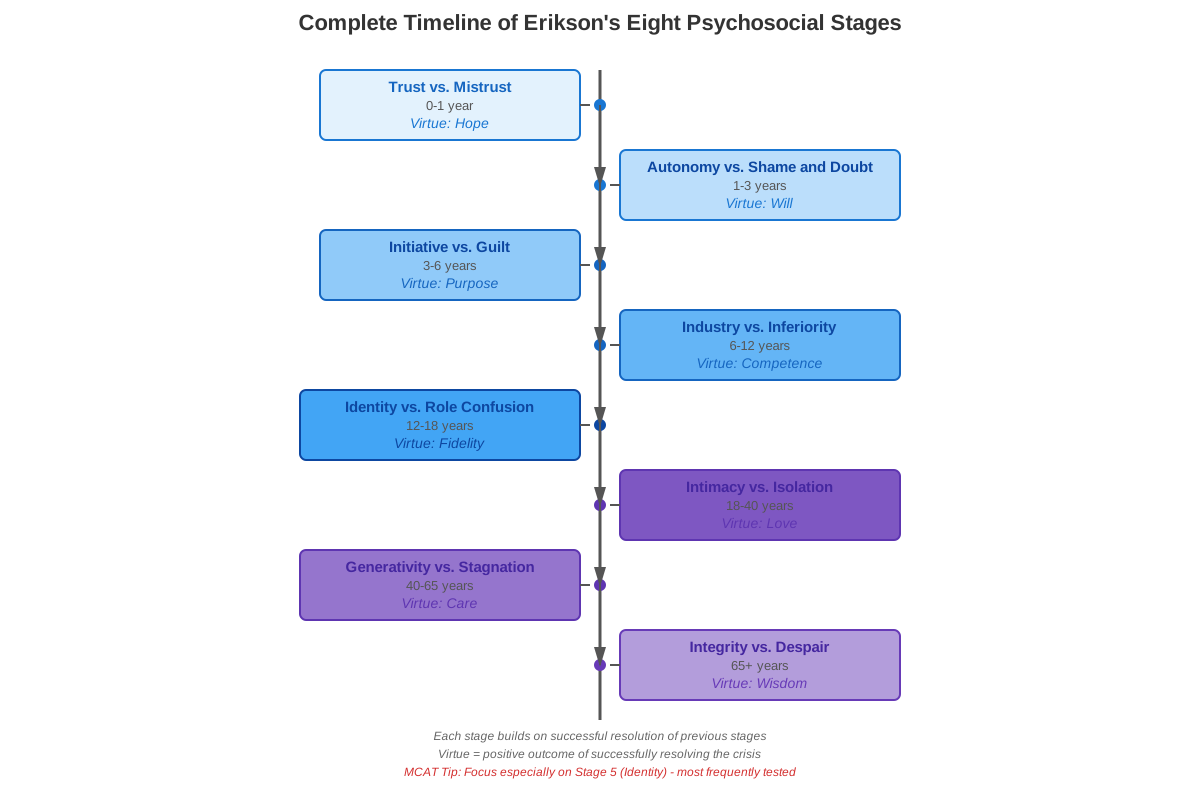
- [ ] Sequence all eight Erikson stages in chronological order with their corresponding age ranges
- [ ] Analyze the consequences of successful versus unsuccessful resolution of each psychosocial crisis
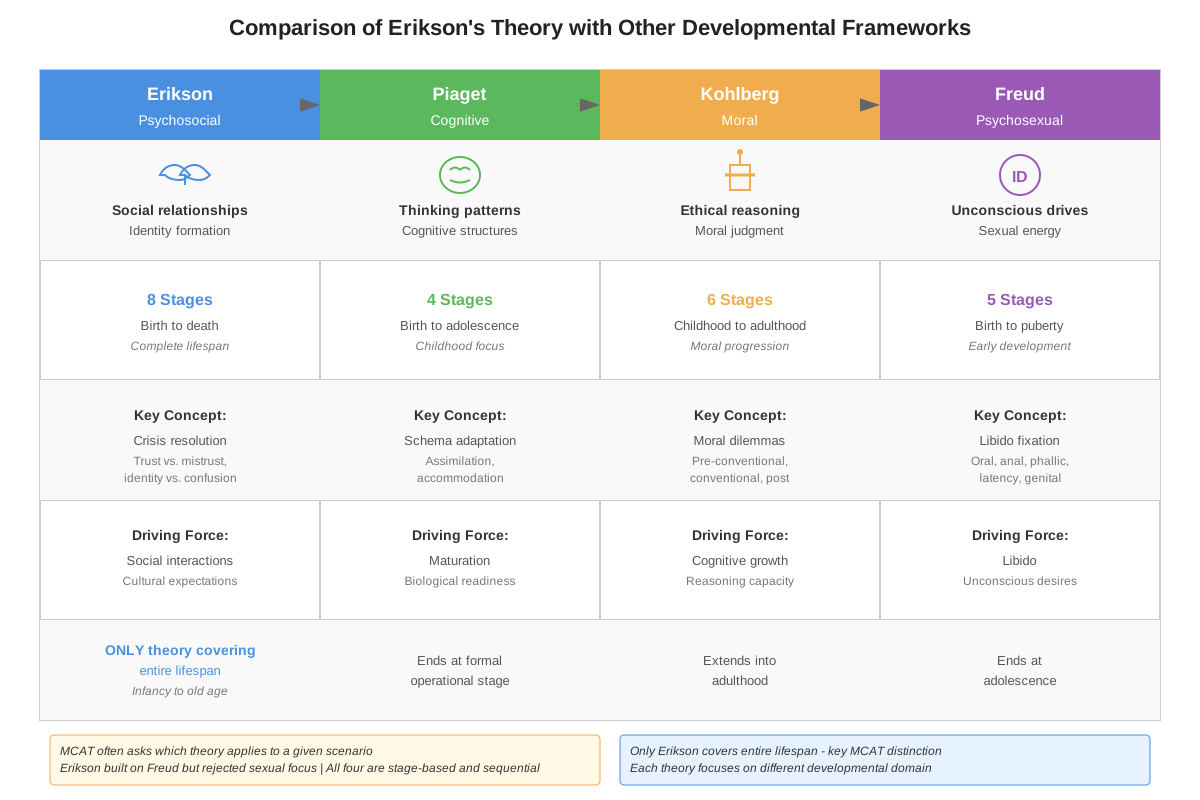
- [ ] Distinguish Erikson's psychosocial theory from other developmental theories (Piaget, Kohlberg, Freud)
Prerequisites
- Basic developmental psychology concepts: Understanding that development occurs in stages provides the foundation for appreciating Erikson's sequential model
- Lifespan perspective: Recognizing that psychological development continues throughout life, not just childhood, is essential for understanding Erikson's comprehensive eight-stage framework
- Social influences on behavior: Familiarity with how culture, family, and society shape individual psychology helps contextualize the "psychosocial" nature of Erikson's crises
- Identity and self-concept: Basic understanding of how individuals develop a sense of self prepares students for Erikson's emphasis on identity formation
Why This Topic Matters
Erikson's psychosocial development theory holds significant real-world relevance for understanding human behavior across the lifespan. Clinicians use this framework to assess whether patients are navigating age-appropriate developmental challenges, to identify potential sources of psychological distress, and to design interventions that support healthy development. For example, adolescents struggling with identity versus role confusion may benefit from different therapeutic approaches than older adults grappling with integrity versus despair. The theory also informs educational practices, parenting approaches, and workplace dynamics by highlighting the unique psychological needs of different age groups.
On the MCAT, Erikson stages appear with moderate frequency, typically in 2-4 questions per exam. Questions may take several forms: discrete questions asking students to identify which stage corresponds to a particular age or crisis; passage-based questions requiring application of Erikson's theory to interpret research findings or case studies; and questions that ask students to compare Erikson's approach with other developmental theories. The Psychological, Social, and Biological Foundations section particularly favors questions that integrate developmental concepts with social psychology, requiring students to understand how developmental stage influences social behavior, identity formation, and interpersonal relationships.
Common exam scenarios include passages describing individuals at different life stages facing characteristic challenges (a toddler asserting independence, a teenager exploring different identities, an elderly person reflecting on life accomplishments), research studies examining age-related differences in psychological outcomes, and questions about the role of social support and cultural context in navigating developmental transitions. Understanding Erikson's framework enables efficient analysis of these complex scenarios.
Core Concepts
The Psychosocial Development Framework
Erikson stages constitute a comprehensive theory of psychosocial development that spans the entire human lifespan. Unlike theories focused solely on cognitive or moral development, Erikson's model emphasizes the interaction between individual psychological needs and social/cultural demands. Each stage presents a psychosocial crisis—a turning point where individuals face competing psychological forces. The term "crisis" does not imply catastrophe but rather a crucial period of increased vulnerability and heightened potential for growth.
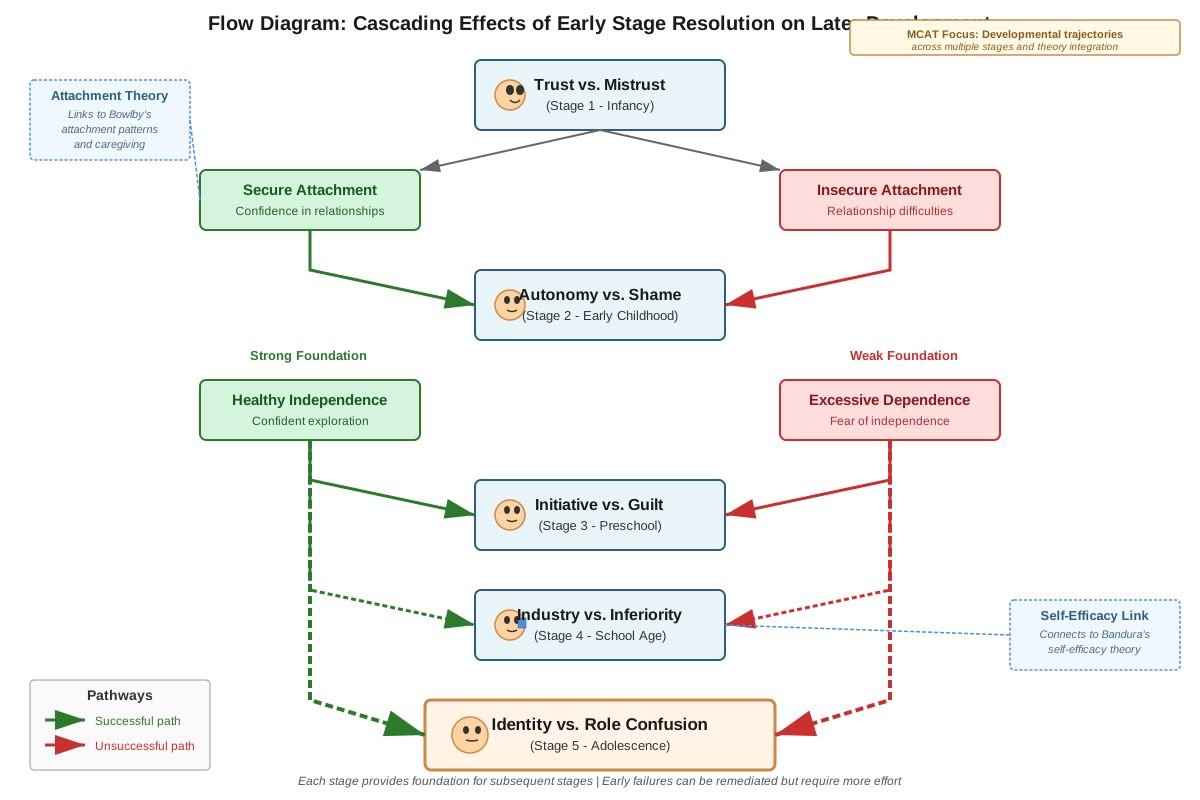
The resolution of each crisis exists on a continuum rather than as a binary outcome. Successful navigation results in the development of a specific virtue or psychological strength, while unsuccessful resolution leads to maladaptation or malignancy. Importantly, Erikson proposed that later stages build upon earlier ones—unresolved conflicts from previous stages can complicate subsequent developmental challenges, though individuals can revisit and rework earlier crises throughout life.
Stage 1: Trust versus Mistrust (Birth to 18 months)
The first stage occurs during infancy, when the primary developmental task involves forming a sense of basic trust in caregivers and the environment. Infants depend entirely on others for survival, and consistent, responsive caregiving teaches them that the world is predictable and reliable. When caregivers meet needs promptly and lovingly, infants develop hope—the virtue associated with this stage—and a foundational belief that they can depend on others.
Conversely, inconsistent, neglectful, or abusive care leads to mistrust, where infants learn that the world is unpredictable and dangerous. This stage connects directly to attachment theory (Bowlby and Ainsworth), as secure attachment typically corresponds with successful trust development. The balance between trust and mistrust established here influences all subsequent relationships and the individual's general outlook on life.
Stage 2: Autonomy versus Shame and Doubt (18 months to 3 years)
During toddlerhood, children develop motor skills and language abilities that enable greater independence. The central conflict involves asserting autonomy—the ability to make choices and control one's own body and actions—while managing the inevitable failures and limitations that come with developing competence. Parents who encourage appropriate independence while providing supportive structure help children develop will—the virtue of self-control and determination.
Overly controlling parents who criticize mistakes or don't allow age-appropriate independence foster shame and doubt. Children may become overly dependent, lack confidence in their abilities, or develop compulsive tendencies. This stage corresponds with toilet training and other self-care milestones, making it a period where parenting style significantly impacts developmental outcomes. The balance achieved here influences later self-esteem and self-efficacy.
Stage 3: Initiative versus Guilt (3 to 6 years)
The preschool years bring expanded social interactions and imaginative play. Children begin planning activities, initiating projects, and asserting power through social interactions. Successfully navigating this stage means developing initiative—the ability to pursue goals and take on leadership roles—and the virtue of purpose. Children learn that their actions can influence outcomes and that they can pursue their interests.
However, when adults are overly critical of children's self-initiated activities or dismiss their ideas, children may develop excessive guilt about their desires and actions. This can lead to inhibition, lack of spontaneity, and difficulty pursuing goals. The stage connects to the development of the superego in Freudian theory and to early moral development, as children begin internalizing rules and standards.
Stage 4: Industry versus Inferiority (6 to 12 years)
During middle childhood and elementary school years, children focus on developing competence in academic, social, and physical skills. This stage emphasizes industry—the dedication to learning and mastering culturally valued skills. Success leads to the virtue of competence and confidence in one's abilities to accomplish tasks and meet challenges.
Children who struggle academically, socially, or athletically without adequate support may develop feelings of inferiority—a sense that they are less capable than peers. Teachers, coaches, and peers become increasingly important during this stage, as children compare their abilities to others and receive feedback from multiple sources. The balance achieved here significantly impacts academic motivation, career aspirations, and willingness to tackle challenging tasks in adulthood.
Stage 5: Identity versus Role Confusion (12 to 18 years)
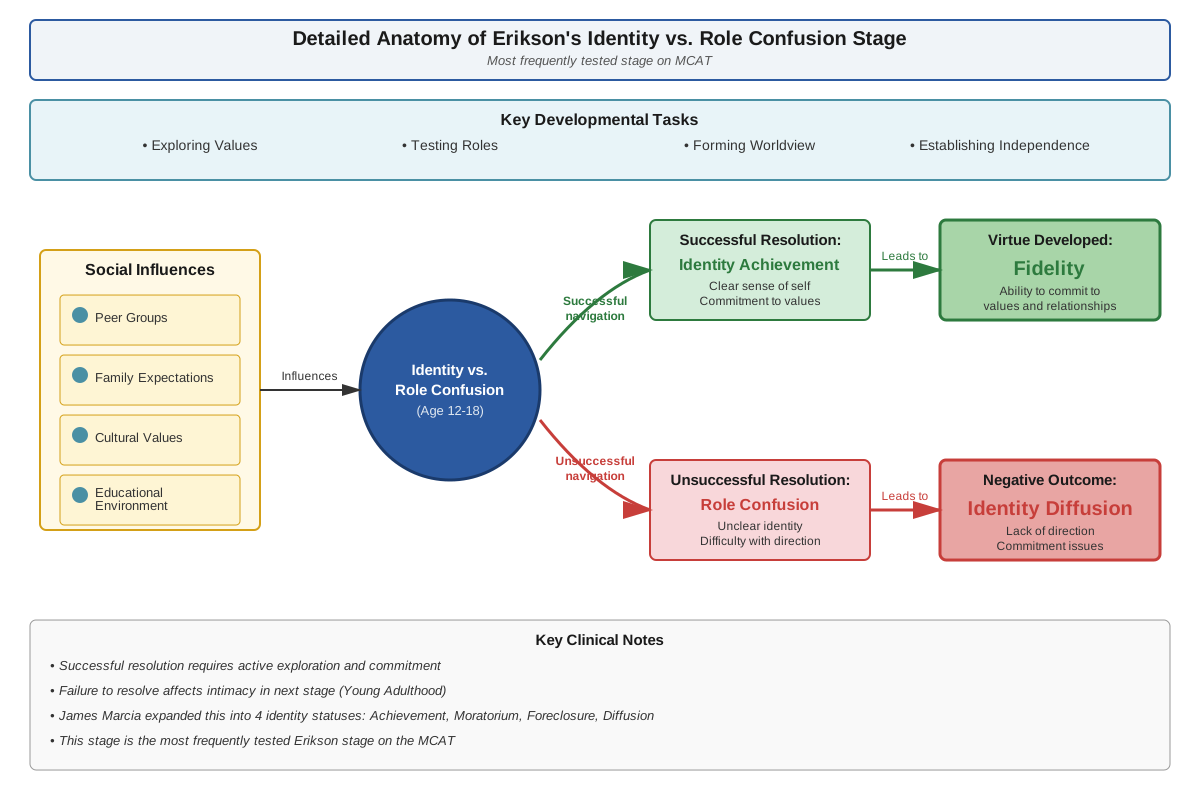
Adolescence represents a pivotal stage where individuals explore different roles, beliefs, values, and goals to form a coherent identity. This stage involves integrating childhood identifications with biological changes, cognitive advances, and social expectations to answer the question "Who am I?" Successfully navigating this crisis results in fidelity—the ability to commit to an identity and maintain loyalty to chosen values and relationships.
Role confusion occurs when adolescents cannot integrate various aspects of self into a coherent identity or when they feel pressured to adopt identities that don't fit their authentic selves. This may manifest as difficulty making decisions, frequent identity shifts, or adopting negative identities. James Marcia later expanded on this stage by identifying four identity statuses: identity achievement (crisis experienced, commitment made), moratorium (actively exploring, no commitment yet), foreclosure (commitment without exploration), and identity diffusion (no exploration or commitment).
Stage 6: Intimacy versus Isolation (Young adulthood, approximately 18-40 years)
Young adulthood focuses on forming deep, committed relationships with others. Intimacy involves the ability to merge one's identity with another's without fear of losing oneself—to be vulnerable, share deeply, and commit to relationships. The virtue developed is love—the ability to give and receive affection in mature relationships.
Individuals who fear losing their identity or who haven't successfully resolved the identity crisis may experience isolation—difficulty forming close relationships, superficial connections, or withdrawal from social intimacy. Erikson emphasized that true intimacy requires a solid sense of identity; without knowing oneself, one cannot genuinely share oneself with another. This stage encompasses romantic relationships, close friendships, and the capacity for emotional vulnerability.
Stage 7: Generativity versus Stagnation (Middle adulthood, approximately 40-65 years)
Middle adulthood centers on generativity—the concern for establishing and guiding the next generation through parenting, mentoring, teaching, or contributing to society. This stage involves looking beyond oneself to make lasting contributions that will outlive the individual. The virtue is care—the commitment to caring for others and for the creations and ideas one generates.
Stagnation occurs when individuals become self-absorbed, focusing only on personal needs without contributing to others or society. This may manifest as boredom, lack of purpose, or excessive concern with personal comfort and wealth. Generativity extends beyond biological parenting to include any activity that nurtures future generations or creates lasting value—artistic creation, community service, professional mentorship, or social activism.
Stage 8: Integrity versus Despair (Late adulthood, 65+ years)
The final stage involves reflecting on one's life and accepting its successes and failures. Ego integrity means viewing one's life as meaningful and worthwhile, accepting the choices made, and facing death without fear. The virtue is wisdom—a detached yet active concern with life in the face of death, and the ability to see one's life in perspective.
Despair arises when individuals view their lives as wasted, full of regrets, and lacking meaning. This may manifest as bitterness, depression, or fear of death. Erikson believed that successfully navigating earlier stages makes integrity more achievable, as individuals can look back on a life where they trusted, loved, created, and contributed. This stage connects to concepts of successful aging and the psychological factors that contribute to well-being in later life.
Summary Table of Erikson's Eight Stages
| Stage | Age Range | Crisis | Virtue | Key Relationships |
|---|---|---|---|---|
| 1 | 0-18 months | Trust vs. Mistrust | Hope | Primary caregivers |
| 2 | 18 months-3 years | Autonomy vs. Shame/Doubt | Will | Parents |
| 3 | 3-6 years | Initiative vs. Guilt | Purpose | Family |
| 4 | 6-12 years | Industry vs. Inferiority | Competence | School, peers |
| 5 | 12-18 years | Identity vs. Role Confusion | Fidelity | Peers, role models |
| 6 | 18-40 years | Intimacy vs. Isolation | Love | Partners, friends |
| 7 | 40-65 years | Generativity vs. Stagnation | Care | Community, next generation |
| 8 | 65+ years | Integrity vs. Despair | Wisdom | Humanity, oneself |
Concept Relationships
The eight Erikson stages form a sequential, hierarchical structure where each stage builds upon previous ones. Trust versus mistrust establishes the foundation for all subsequent relationships and influences whether individuals approach new stages with confidence or anxiety. Autonomy versus shame and doubt builds on trust—children who trust their caregivers feel safer asserting independence. Initiative versus guilt extends autonomy into social and creative domains, requiring the confidence developed in earlier stages.
The identity versus role confusion stage serves as a pivotal transition point, integrating all childhood experiences into a coherent sense of self. This identity then becomes the foundation for intimacy—one cannot truly merge with another without first knowing oneself. Generativity extends intimacy beyond dyadic relationships to broader social contributions, and integrity represents the culmination of all previous stages, as individuals reflect on how they navigated each crisis.
Erikson's theory connects to multiple related psychological concepts. It relates to attachment theory (Stage 1), parenting styles (Stages 1-3), self-efficacy (Stage 4), identity development theories (Stage 5), relationship psychology (Stage 6), and theories of successful aging (Stage 8). The framework also intersects with social psychology through its emphasis on cultural context and social relationships, and with personality psychology through its focus on how consistent patterns of behavior develop across time.
The concept of psychosocial crisis → leads to → resolution on a continuum → produces → virtue or maladaptation → influences → subsequent developmental stages → ultimately determines → overall personality and psychological health. This chain illustrates how Erikson viewed development as cumulative and interconnected rather than as isolated stages.
Quick check — test yourself on Erikson stages so far.
Try Flashcards →High-Yield Facts
⭐ Erikson proposed eight sequential psychosocial stages spanning the entire lifespan from birth to death, each characterized by a specific crisis that must be resolved.
⭐ Each stage's crisis exists on a continuum; successful resolution produces a virtue (psychological strength), while unsuccessful resolution leads to maladaptation.
⭐ Stage 1 (Trust vs. Mistrust, 0-18 months) establishes basic trust through consistent caregiving and directly relates to attachment theory.
⭐ Stage 5 (Identity vs. Role Confusion, 12-18 years) is the pivotal adolescent stage where individuals explore and commit to an identity; James Marcia expanded this into four identity statuses.
⭐ Stage 6 (Intimacy vs. Isolation, young adulthood) requires successful identity formation; individuals cannot achieve true intimacy without first knowing themselves.
- Stage 2 (Autonomy vs. Shame/Doubt, 18 months-3 years) corresponds with toilet training and the development of self-control and independence.
- Stage 3 (Initiative vs. Guilt, 3-6 years) involves children planning activities and taking initiative; excessive criticism leads to guilt about desires and actions.
- Stage 4 (Industry vs. Inferiority, 6-12 years) focuses on developing competence in culturally valued skills; failure without support produces feelings of inferiority.
- Stage 7 (Generativity vs. Stagnation, 40-65 years) involves contributing to the next generation through parenting, mentoring, or creative work; stagnation results from self-absorption.
- Stage 8 (Integrity vs. Despair, 65+ years) requires accepting one's life as meaningful; despair arises from viewing life as wasted or full of regrets.
- Unlike Freud's psychosexual stages that end in adolescence, Erikson's psychosocial stages continue throughout adulthood, emphasizing lifelong development.
- Each stage has key relationships that are most influential: caregivers (Stage 1), parents (Stage 2), family (Stage 3), school/peers (Stage 4), peers/role models (Stage 5), partners (Stage 6), community (Stage 7), and humanity/self (Stage 8).
Common Misconceptions
Misconception: Each crisis must be completely resolved before moving to the next stage. → Correction: Individuals progress through stages based on age and social expectations regardless of resolution; unresolved crises can be revisited throughout life, and resolution exists on a continuum rather than as complete success or failure.
Misconception: Erikson's stages only apply to Western cultures. → Correction: While Erikson developed his theory in a Western context, the stages reflect universal human needs; however, the specific manifestations and timing of crises may vary across cultures, and cultural values influence what constitutes successful resolution.
Misconception: Identity formation is complete by the end of adolescence. → Correction: While Stage 5 focuses on identity formation, identity continues to evolve throughout life; individuals may revisit identity questions during major life transitions, and identity development is an ongoing process rather than a one-time achievement.
Misconception: Erikson's stages are the same as Freud's psychosexual stages. → Correction: While Erikson was influenced by Freud, his theory differs fundamentally: Erikson emphasized psychosocial (not psychosexual) development, extended development across the entire lifespan (not just to adolescence), and focused on ego development and social relationships rather than id impulses and biological drives.
Misconception: Failing to resolve a crisis means permanent psychological damage. → Correction: While unsuccessful resolution creates challenges, Erikson believed in the possibility of growth and change throughout life; individuals can develop compensatory strengths, revisit earlier crises, and achieve better resolution later through relationships, therapy, or life experiences.
Misconception: Generativity only refers to having biological children. → Correction: Generativity encompasses any contribution to the next generation or society—mentoring, teaching, creating art or knowledge, community service, or any activity that leaves a lasting positive impact beyond oneself; many childless individuals successfully achieve generativity.
Worked Examples
Example 1: Identifying Stages from Case Descriptions
Question: A 15-year-old high school student experiments with different friend groups, tries various extracurricular activities, changes his style of dress frequently, and questions the religious beliefs he was raised with. According to Erikson's theory, which psychosocial crisis is this student most likely navigating, and what would indicate successful resolution?
Step 1 - Identify the age and behaviors: The student is 15 years old (adolescence) and is actively exploring different aspects of identity—social groups, activities, appearance, and values.
Step 2 - Match to the appropriate stage: Age 12-18 corresponds to Stage 5: Identity versus Role Confusion. The behaviors described (exploration, experimentation, questioning) are characteristic of identity formation.
Step 3 - Determine the specific crisis: The student is exploring different roles and values to form a coherent sense of self—the central task of identity versus role confusion.
Step 4 - Identify successful resolution: Successful resolution would involve the student eventually committing to an identity after exploration (identity achievement in Marcia's terms), developing fidelity (the virtue of this stage), and having a clear sense of values, goals, and self-concept. The student would be able to answer "Who am I?" with confidence while remaining open to growth.
Step 5 - Consider unsuccessful resolution: Role confusion would manifest as inability to commit to any identity, feeling lost or fragmented, adopting a negative identity, or prematurely committing without exploration (foreclosure).
Answer: The student is navigating Identity versus Role Confusion (Stage 5). Successful resolution would be indicated by eventual commitment to a coherent identity after exploration, development of fidelity, and a stable sense of self that integrates various aspects of identity.
Example 2: Applying Erikson to Research Interpretation
Question: Researchers conduct a study examining life satisfaction in adults aged 70-85. They find that participants who report having made meaningful contributions to their communities and families during middle age show significantly higher life satisfaction and lower rates of depression than those who report having focused primarily on personal leisure and comfort during that period. How does Erikson's theory explain these findings?
Step 1 - Identify the relevant stages: The study examines adults aged 70-85 (Stage 8: Integrity vs. Despair) but asks about their middle age experiences (Stage 7: Generativity vs. Stagnation).
Step 2 - Connect the stages: Erikson's theory proposes that earlier stage resolution influences later stages. Stage 7 (middle adulthood) sets the foundation for Stage 8 (late adulthood).
Step 3 - Analyze Stage 7 outcomes: Participants who made meaningful contributions during middle age successfully achieved generativity—they developed care for others and future generations. Those who focused on personal leisure and comfort may have experienced stagnation—self-absorption without broader contribution.
Step 4 - Connect to Stage 8: In late adulthood (Stage 8), individuals reflect on their lives. Those who achieved generativity can look back on meaningful contributions, facilitating ego integrity—the sense that life was worthwhile. Those who experienced stagnation may feel their lives lacked purpose, leading to despair.
Step 5 - Explain the findings: Higher life satisfaction and lower depression in the generative group reflects successful achievement of ego integrity. They can accept their lives as meaningful because they contributed beyond themselves. The other group's lower satisfaction may reflect despair—regret about a self-focused life without lasting contributions.
Answer: Erikson's theory explains these findings through the connection between Stage 7 (Generativity vs. Stagnation) and Stage 8 (Integrity vs. Despair). Participants who achieved generativity in middle age by contributing to others can more easily achieve ego integrity in late adulthood, viewing their lives as meaningful and worthwhile. This produces higher life satisfaction and lower depression. Those who experienced stagnation through self-focus may struggle with despair, regretting missed opportunities to contribute, resulting in lower life satisfaction.
Exam Strategy
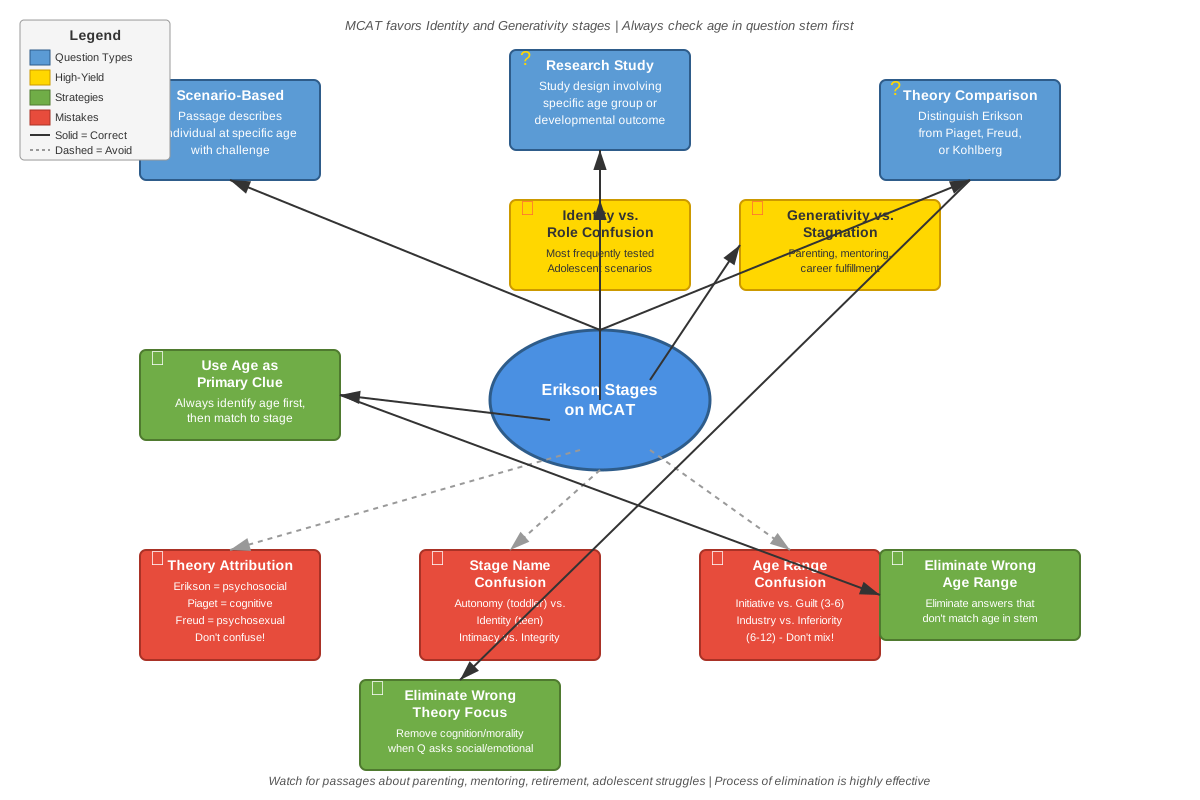
When approaching MCAT questions on Erikson stages, first identify the age or life stage mentioned in the question stem or passage. This immediately narrows down which stage is relevant. Create a mental or written note of the age ranges for each stage, as test-makers often provide subtle age cues.
Trigger words and phrases to watch for include: "infant" or "caregiver consistency" (Stage 1), "toddler" or "independence/toilet training" (Stage 2), "preschooler" or "initiative/imagination" (Stage 3), "school-age" or "competence/achievement" (Stage 4), "adolescent" or "identity/exploration" (Stage 5), "young adult" or "intimacy/commitment" (Stage 6), "middle-aged" or "generativity/mentoring" (Stage 7), and "elderly" or "life review/acceptance" (Stage 8).
For process of elimination, remember that Erikson's stages are sequential and age-specific. If a question describes a 4-year-old, immediately eliminate answer choices referring to identity formation (adolescence) or generativity (middle adulthood). Also eliminate options that confuse Erikson with other theorists—if an answer choice mentions "concrete operations" or "formal operations," that's Piaget, not Erikson; if it mentions "preconventional morality," that's Kohlberg.
Compare and contrast questions frequently appear, asking students to distinguish Erikson from Freud, Piaget, or Kohlberg. Remember: Erikson = psychosocial + lifespan + social relationships; Freud = psychosexual + childhood only + biological drives; Piaget = cognitive development + stages of thinking; Kohlberg = moral reasoning + ethical decision-making.
Time allocation: Discrete questions on Erikson typically require 60-90 seconds—quickly identify the age, match to the stage, and select the answer. Passage-based questions may require 90-120 seconds as you must integrate the stage information with passage content. Don't overthink these questions; they usually test straightforward knowledge of which crisis corresponds to which age.
Exam Tip: If a question asks about the "most important relationship" or "primary influence" at a particular stage, use the key relationships column from the summary table: caregivers (infancy), parents (toddlerhood), family (preschool), school/peers (childhood), peers/role models (adolescence), partners (young adulthood), community (middle age), humanity/self (late adulthood).
Memory Techniques
Mnemonic for the eight stages in order: "The Awesome Instructor Is Inspiring Great Intelligence"
- Trust vs. Mistrust
- Autonomy vs. Shame/Doubt
- Initiative vs. Guilt
- Industry vs. Inferiority
- Identity vs. Role Confusion
- Intimacy vs. Isolation
- Generativity vs. Stagnation
- Integrity vs. Despair
Age range memory aid: Remember the major transition points: 18 months (trust to autonomy), 3 years (autonomy to initiative), 6 years (initiative to industry—school starts), 12 years (industry to identity—puberty), 18 years (identity to intimacy—legal adulthood), 40 years (intimacy to generativity—midlife), 65 years (generativity to integrity—retirement age).
Virtue visualization: Create a mental image of each virtue as a superpower: Hope (infant reaching toward caregiver), Will (toddler saying "no!"), Purpose (child playing pretend), Competence (student receiving an A), Fidelity (teen with a clear sense of self), Love (couple embracing), Care (parent teaching child), Wisdom (elder sharing life lessons).
Crisis resolution spectrum: Visualize each crisis as a balance scale—successful development means the positive side outweighs (but doesn't eliminate) the negative side. Everyone experiences some mistrust, shame, guilt, inferiority, role confusion, isolation, stagnation, and despair; healthy development means the positive predominates.
Summary
Erikson's eight stages of psychosocial development provide a comprehensive framework for understanding personality development across the entire lifespan. Each stage presents a psychosocial crisis arising from the interaction between individual needs and social demands, with resolution existing on a continuum from successful (producing a virtue) to unsuccessful (producing maladaptation). The stages progress sequentially from trust versus mistrust in infancy through integrity versus despair in late adulthood, with each stage building upon previous ones. For the MCAT, students must know the age ranges, crises, and virtues for all eight stages, understand how earlier stages influence later development, and be able to apply the framework to case studies and research scenarios. The theory emphasizes that development continues throughout life, that social and cultural contexts shape psychological growth, and that individuals can revisit and rework earlier crises. Mastering Erikson's stages enables students to analyze developmental questions efficiently and to integrate developmental concepts with other psychological domains tested on the MCAT.
Key Takeaways
- Erikson proposed eight sequential psychosocial stages from birth to death, each with a specific crisis, age range, virtue, and key relationships
- Stage resolution exists on a continuum; successful resolution produces psychological strengths (virtues) while unsuccessful resolution creates challenges for subsequent stages
- The five childhood stages are: Trust vs. Mistrust (0-18 months), Autonomy vs. Shame/Doubt (18 months-3 years), Initiative vs. Guilt (3-6 years), Industry vs. Inferiority (6-12 years), and Identity vs. Role Confusion (12-18 years)
- The three adulthood stages are: Intimacy vs. Isolation (young adulthood), Generativity vs. Stagnation (middle adulthood), and Integrity vs. Despair (late adulthood)
- Identity formation in adolescence (Stage 5) is pivotal and must precede true intimacy in young adulthood (Stage 6)
- Unlike Freud's psychosexual theory, Erikson's psychosocial theory emphasizes social relationships, extends across the lifespan, and focuses on ego development rather than biological drives
- For MCAT questions, identify the age first, match to the appropriate stage, and remember that each stage has specific key relationships that are most influential
Related Topics
Attachment Theory (Bowlry and Ainsworth): Directly relates to Erikson's Stage 1 (Trust vs. Mistrust); understanding attachment styles (secure, anxious, avoidant, disorganized) deepens comprehension of how early relationships shape development and provides a complementary framework for understanding infant-caregiver bonds.
Identity Development (Marcia's Identity Statuses): Expands on Erikson's Stage 5 by identifying four identity statuses (achievement, moratorium, foreclosure, diffusion); mastering this topic enables more nuanced analysis of adolescent identity formation.
Parenting Styles (Baumrind): Connects to Erikson's early stages (1-3) by explaining how different parenting approaches (authoritative, authoritarian, permissive, neglectful) influence trust, autonomy, and initiative development.
Kohlberg's Stages of Moral Development: Provides a complementary developmental framework focused on moral reasoning; understanding both Erikson and Kohlberg enables comparison questions and integrated analysis of adolescent development.
Successful Aging Theories: Relates to Erikson's Stage 8 by examining factors that contribute to well-being in late adulthood; includes activity theory, disengagement theory, and socioemotional selectivity theory.
Self-Efficacy and Self-Concept Development: Connects to multiple Erikson stages, particularly Stage 4 (Industry vs. Inferiority); understanding how beliefs about competence develop enhances comprehension of personality formation.
Practice CTA
Now that you've mastered Erikson's eight stages of psychosocial development, test your knowledge with practice questions and flashcards! Focus on questions that require you to identify stages from age cues, apply the framework to case studies, and distinguish Erikson's theory from other developmental models. The more you practice applying these concepts to MCAT-style scenarios, the more automatic your recognition will become on test day. Remember: understanding the sequential nature of the stages and the connection between early and later development is key to answering complex passage-based questions. You've got this—your investment in mastering developmental psychology will pay dividends across multiple MCAT questions!
Sign up free to keep reading
Create a free AnvayaPrep account to finish this MCAT guide on Erikson stages — plus flashcards and practice questions.