Overview
Instinct theory represents one of the earliest systematic attempts to explain human motivation and behavior through the lens of innate, biologically programmed patterns. Developed primarily in the late 19th and early 20th centuries, this theoretical framework proposed that complex behaviors arise from inherited predispositions rather than learned experiences. William James, William McDougall, and Sigmund Freud were among the prominent psychologists who contributed to instinct theory, each proposing that humans possess a set of instincts that drive behavior in predictable ways. While instinct theory has largely been superseded by more nuanced motivational theories, understanding its historical context and limitations remains essential for comprehending the evolution of psychological thought about motivation.
For the MCAT, instinct theory Psychology serves as a foundational concept within the broader domain of Emotion Motivation and Stress. The exam frequently tests students' ability to distinguish between different motivational theories and apply them to behavioral scenarios. Instinct theory often appears in passages discussing evolutionary psychology, comparative behavior across species, or the nature-versus-nurture debate. Understanding this theory enables students to critically evaluate why certain explanations of behavior are insufficient and how modern theories have addressed these shortcomings.
The significance of instinct theory extends beyond historical interest—it connects directly to contemporary topics in Psychology including evolutionary psychology, behavioral genetics, and the biological bases of behavior. By mastering instinct theory, students develop the analytical framework necessary to evaluate motivational theories systematically, recognize the interplay between biological and environmental factors in behavior, and understand how scientific theories evolve in response to empirical challenges. This conceptual foundation proves invaluable when encountering MCAT questions that require comparing theoretical perspectives or identifying the most appropriate explanation for a given behavioral phenomenon.
Learning Objectives
- [ ] Define Instinct theory using accurate Psychology terminology
- [ ] Explain why Instinct theory matters for the MCAT
- [ ] Apply Instinct theory to exam-style questions
- [ ] Identify common mistakes related to Instinct theory
- [ ] Connect Instinct theory to related Psychology concepts
- [ ] Compare and contrast instinct theory with drive-reduction theory and arousal theory
- [ ] Analyze the historical decline of instinct theory and identify its key limitations
- [ ] Evaluate behavioral scenarios to determine whether instinct theory provides an adequate explanation
Prerequisites
- Basic understanding of motivation: Familiarity with motivation as a psychological construct that energizes and directs behavior is necessary to contextualize instinct theory within motivational psychology
- Nature versus nurture debate: Knowledge of the fundamental tension between inherited and learned influences on behavior helps frame instinct theory's emphasis on biological determinism
- Evolutionary principles: Basic understanding of natural selection and adaptation provides context for why instinct theory proposed innate behavioral patterns
- Scientific method and theory evaluation: Ability to assess theories based on testability, falsifiability, and explanatory power is essential for understanding why instinct theory fell out of favor
Why This Topic Matters
Instinct theory holds significant clinical and real-world relevance despite its historical limitations. The theory's emphasis on biological bases of behavior laid groundwork for modern neuroscience and behavioral genetics. Contemporary research on innate behavioral patterns in infants, attachment behaviors, and fear responses all trace conceptual lineage to early instinct theorists. Understanding instinct theory helps clinicians and researchers distinguish between truly innate responses and learned behaviors, informing treatment approaches for various psychological conditions.
On the MCAT, instinct theory appears with moderate frequency, typically in 1-2 questions per Psychology/Sociology section. Questions most commonly take three forms: (1) identification questions asking students to recognize which theory best explains a described behavior, (2) comparison questions requiring differentiation between instinct theory and other motivational theories, and (3) critical analysis questions asking students to identify limitations or problems with instinct-based explanations. The instinct theory MCAT content often appears embedded within passages discussing evolutionary psychology, animal behavior studies, or historical perspectives on motivation.
Exam passages frequently present scenarios involving reflexive behaviors, species-typical behaviors, or debates about biological versus environmental influences. Students must recognize when instinct theory would be invoked historically versus when modern theories provide better explanations. The ability to critically evaluate instinct theory demonstrates higher-order thinking skills that the MCAT values, particularly the capacity to recognize theoretical limitations and understand scientific progress in psychology.
Core Concepts
Definition and Historical Context
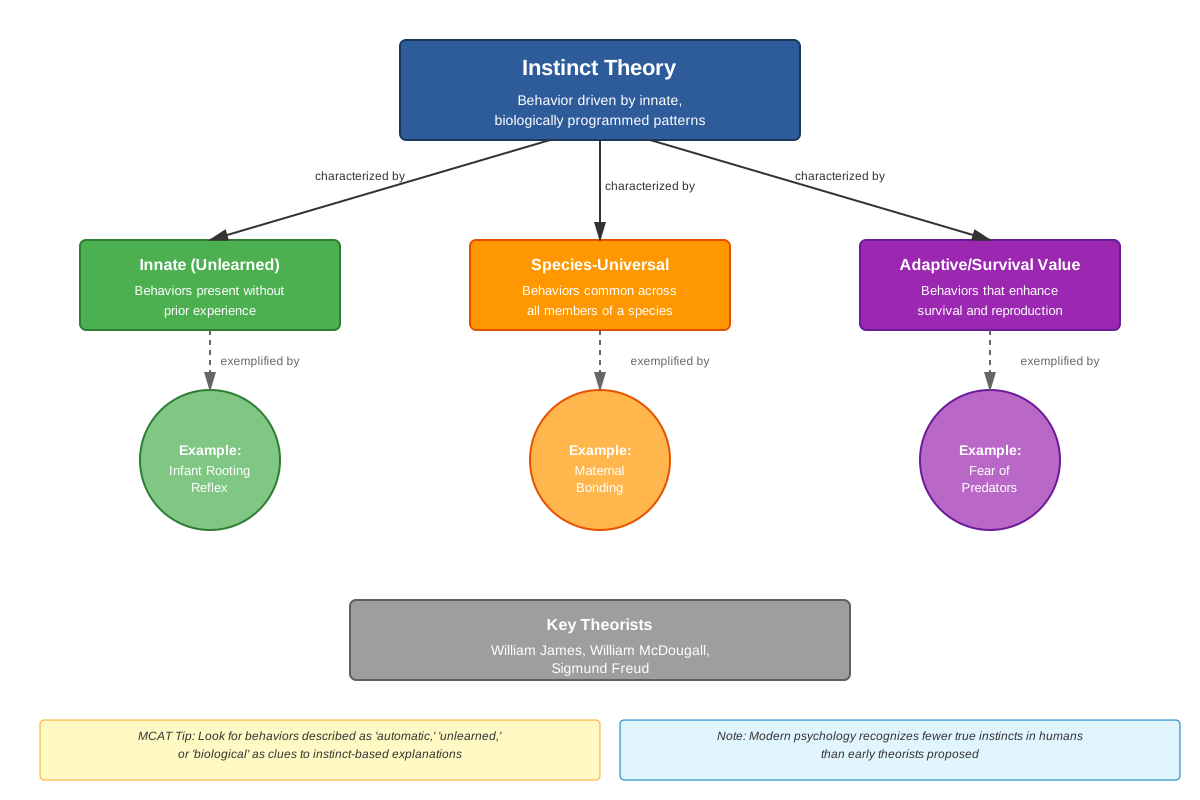
Instinct theory proposes that organisms are born with innate biological tendencies that produce complex, species-typical behaviors in response to environmental stimuli. An instinct is defined as an unlearned, inherited pattern of behavior that is relatively unchangeable and universal within a species. Early instinct theorists believed these innate patterns could explain the full range of human motivation and behavior.
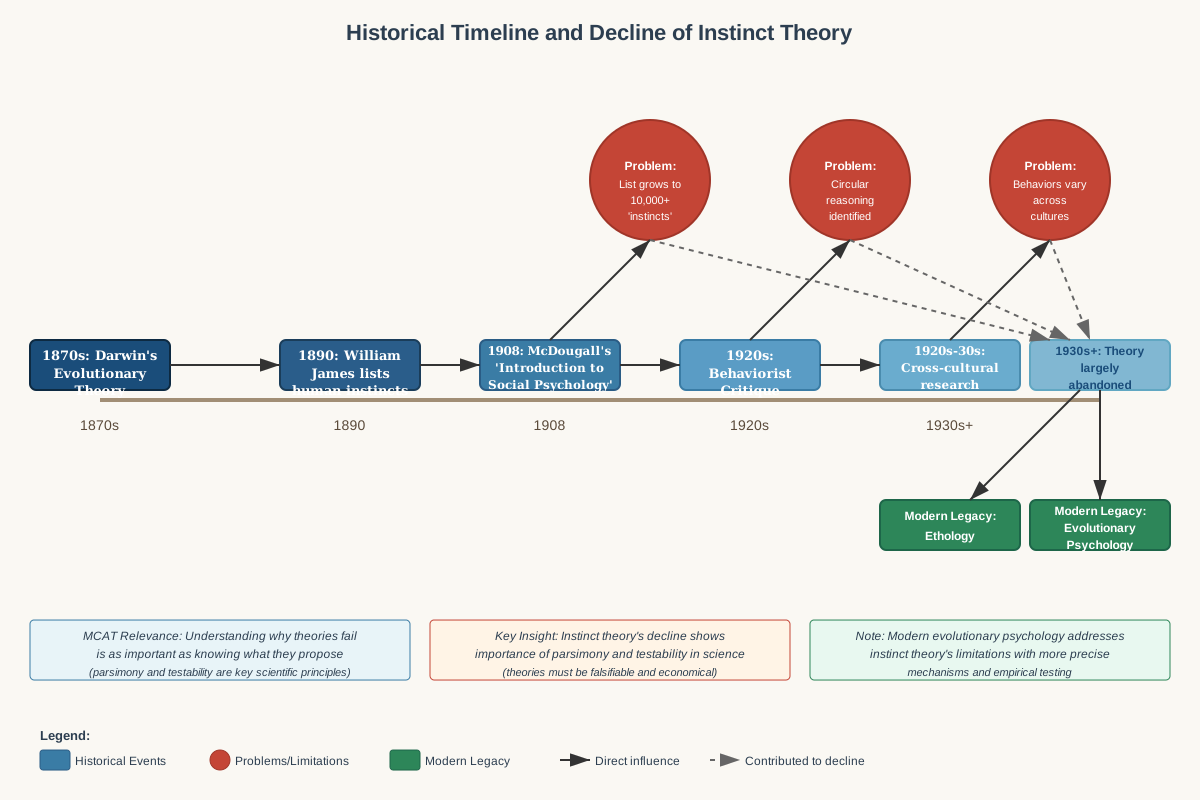
William James (1890) initially proposed a list of approximately 20 human instincts including fear, anger, love, curiosity, and cleanliness. William McDougall (1908) expanded this dramatically, eventually proposing over 18 primary instincts, each associated with a specific emotion and behavioral tendency. Sigmund Freud incorporated instinct theory into psychoanalytic theory, proposing two fundamental instincts: Eros (life instinct, including sexual and survival drives) and Thanatos (death instinct, including aggression and self-destruction).
Core Assumptions of Instinct Theory
The theoretical framework rests on several key assumptions:
- Biological determinism: Behavior is primarily determined by inherited biological programming rather than learning or environmental factors
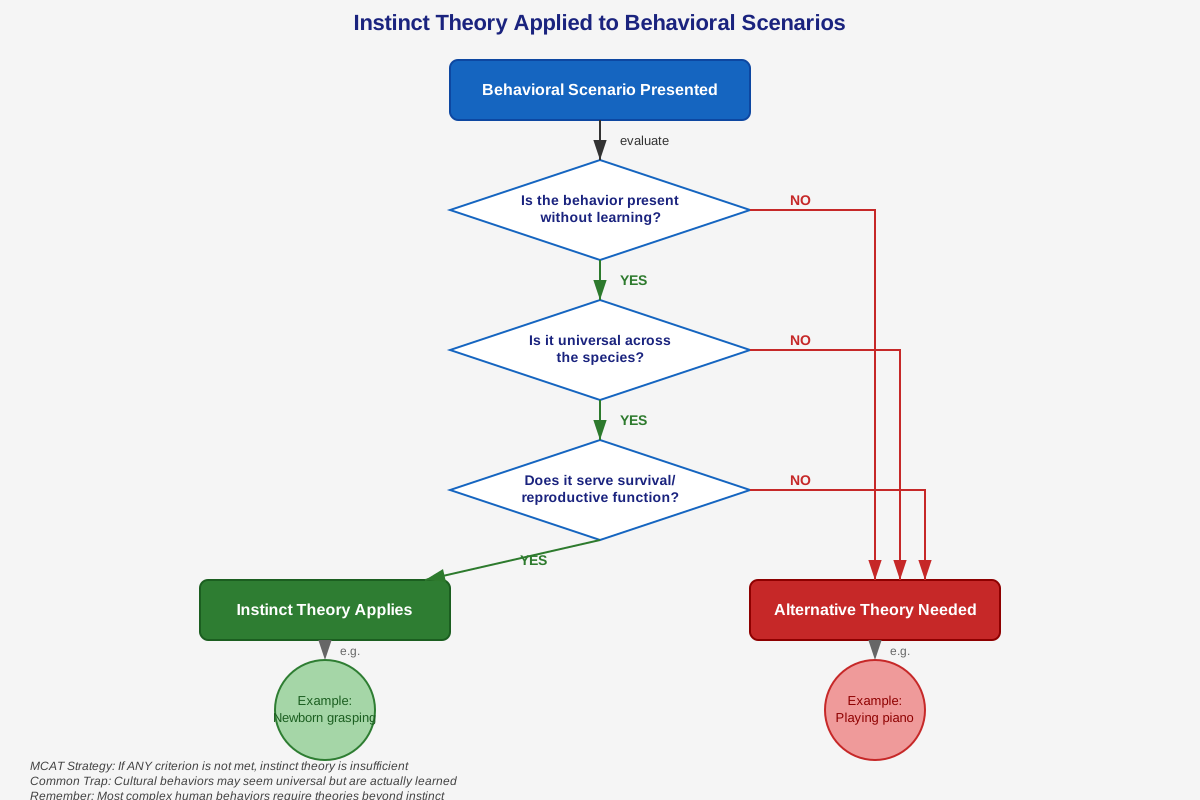
- Universality: Instinctive behaviors appear consistently across all members of a species
- Automaticity: Instincts trigger automatically in response to appropriate stimuli without conscious deliberation
- Adaptive value: Instincts evolved through natural selection because they enhanced survival and reproductive success
- Complexity: Instincts can produce elaborate behavioral sequences, not just simple reflexes
The Proliferation Problem
A critical issue that ultimately undermined instinct theory was the proliferation problem—the tendency for theorists to propose an ever-expanding list of instincts to explain every observed behavior. By the 1920s, researchers had catalogued over 10,000 supposed human instincts. This proliferation revealed a fundamental flaw: the theory had become circular and unfalsifiable. Behaviors were explained by postulating an instinct, and the existence of the instinct was "proven" by observing the behavior. This circular reasoning provided no genuine explanatory power.
Distinction Between Instincts and Reflexes
Understanding the difference between instincts and reflexes is crucial for MCAT success:
| Feature | Instinct | Reflex |
|---|---|---|
| Complexity | Complex behavioral sequences | Simple, stereotyped responses |
| Neural basis | Involves higher brain centers | Mediated by spinal cord or brainstem |
| Flexibility | Some adaptability to circumstances | Rigid, unchanging |
| Examples | Migration patterns, nest building | Knee-jerk, pupillary response |
| Consciousness | May involve some awareness | Completely automatic |
Decline of Instinct Theory
Several factors contributed to instinct theory's decline in the 1920s-1930s:
- Circular reasoning: The inability to independently verify instincts apart from the behaviors they supposedly explained
- Cross-cultural variation: Anthropological research revealed significant behavioral differences across cultures, contradicting claims of universal human instincts
- Learning research: Behaviorist demonstrations showed that complex behaviors could be learned, challenging the necessity of instinct-based explanations
- Lack of parsimony: The proliferation of proposed instincts violated the scientific principle of parsimony (Occam's razor)
- Inability to predict: The theory could not predict new behaviors, only explain existing ones post hoc
Modern Perspectives on Innate Behavior
While classical instinct theory has been abandoned, modern psychology recognizes genuine innate behavioral tendencies:
- Fixed action patterns: Stereotyped behavioral sequences triggered by specific stimuli (primarily in non-human animals)
- Prepared learning: Biological predispositions to learn certain associations more readily (e.g., fear of snakes)
- Infant reflexes: Rooting, sucking, and grasping reflexes that serve survival functions
- Attachment behaviors: Innate tendencies toward caregiver bonding
- Universal emotions: Basic emotional expressions that appear cross-culturally
These modern concepts differ from classical instinct theory by acknowledging the interaction between biological predispositions and environmental influences rather than positing rigid, deterministic instincts.
Concept Relationships
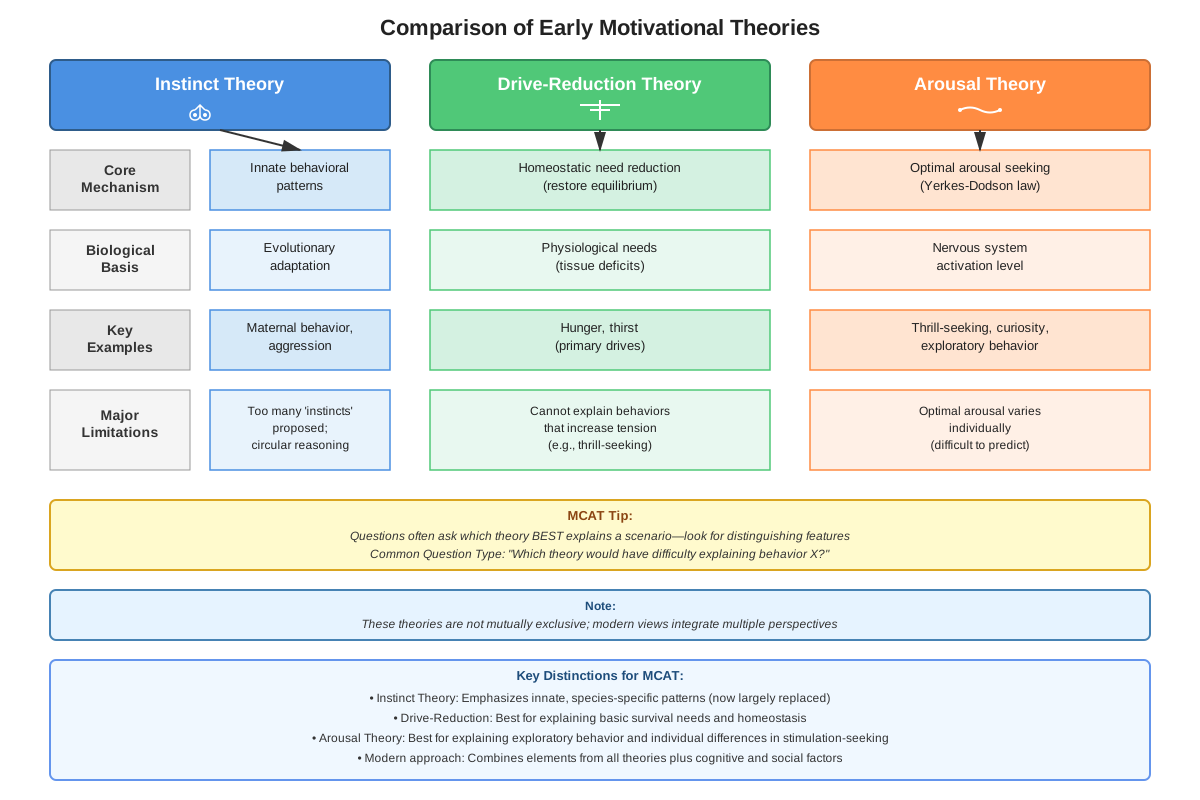
Instinct theory connects to multiple concepts within motivational psychology and broader psychological theory. The theory represents an early attempt to address the fundamental question: "What energizes and directs behavior?" This question links instinct theory directly to drive-reduction theory (which proposed that internal physiological needs create drives that motivate behavior) and arousal theory (which suggested organisms seek optimal levels of stimulation).
The relationship flows chronologically and conceptually: Instinct theory → Drive-reduction theory → Arousal theory → Humanistic theories. Each successive theory addressed limitations of its predecessor while retaining useful elements. Drive-reduction theory maintained instinct theory's emphasis on biological factors but focused on homeostatic needs rather than inherited behavioral patterns. Arousal theory further refined this by recognizing that organisms don't simply reduce tension but seek optimal stimulation levels.
Instinct theory also connects to the nature versus nurture debate, representing an extreme "nature" position. This connects to behavioral genetics, twin studies, and heritability research—all topics that may appear on the MCAT. Understanding instinct theory's biological determinism helps students recognize more balanced, interactionist perspectives in modern psychology.
Within Emotion Motivation and Stress, instinct theory relates to evolutionary explanations of emotion (emotions as evolved adaptive responses), stress responses (fight-or-flight as potentially instinctive), and motivational hierarchies (Maslow's physiological needs as closest to instinctive). The theory also connects to personality psychology through Freud's instinct-based psychoanalytic theory, linking Eros and Thanatos to personality structure and development.
High-Yield Facts
⭐ Instinct theory proposes that innate, inherited behavioral patterns explain human motivation and behavior
⭐ The theory declined primarily due to circular reasoning and the proliferation problem (over 10,000 proposed instincts by the 1920s)
⭐ William James, William McDougall, and Sigmund Freud were major contributors to instinct theory development
⭐ Instinct theory emphasizes biological determinism and minimizes the role of learning and environmental factors
⭐ The theory could not distinguish between truly innate behaviors and learned behaviors that appear universal
- Instincts differ from reflexes in complexity, involving elaborate behavioral sequences rather than simple responses
- Cross-cultural research revealing behavioral variation across societies provided evidence against universal human instincts
- Modern psychology recognizes prepared learning and fixed action patterns rather than rigid instincts
- The theory's unfalsifiability (inability to be proven wrong) violated principles of scientific theory construction
- Behaviorist research demonstrating learned complex behaviors challenged the necessity of instinct-based explanations
Quick check — test yourself on Instinct theory so far.
Try Flashcards →Common Misconceptions
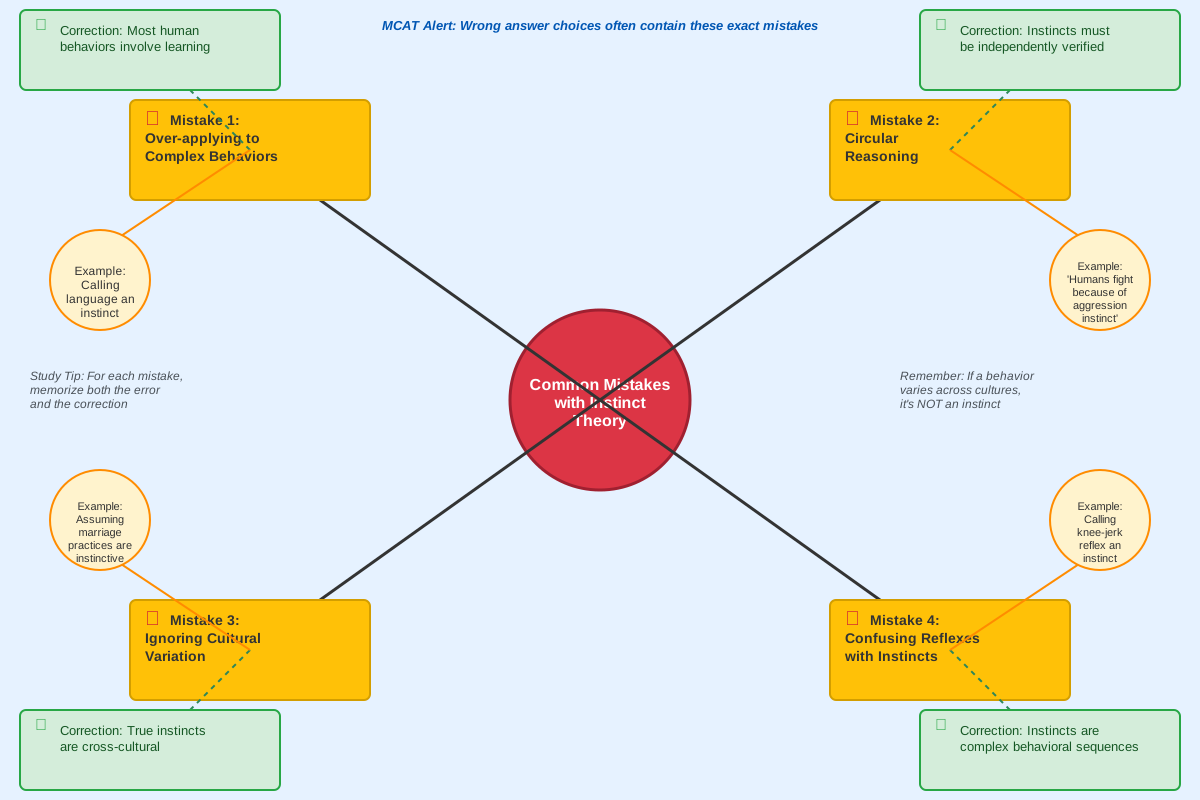
Misconception: Instinct theory was disproven because humans have no innate behavioral tendencies whatsoever.
Correction: Instinct theory was rejected not because innate tendencies don't exist, but because the theory became circular, unfalsifiable, and couldn't account for learned behaviors and cultural variation. Modern psychology recognizes genuine innate predispositions while acknowledging environmental influences.
Misconception: Instincts and reflexes are the same thing.
Correction: Reflexes are simple, automatic responses mediated by the spinal cord or brainstem (like the knee-jerk reflex), while instincts in classical theory referred to complex behavioral sequences involving higher brain centers. Instincts were proposed to be more elaborate and flexible than reflexes.
Misconception: If a behavior appears in all humans, it must be instinctive.
Correction: Universal behaviors can result from universal learning experiences or cultural transmission rather than genetic programming. For example, all cultures use language, but specific languages are learned, not instinctive. Universality alone doesn't prove innateness.
Misconception: Freud's instinct theory is the same as James's and McDougall's instinct theories.
Correction: While all three theorists used the term "instinct," Freud's psychoanalytic instincts (Eros and Thanatos) were broader motivational forces underlying personality, whereas James and McDougall proposed specific behavioral instincts. Freud's theory was more about fundamental drives than specific behavioral patterns.
Misconception: Modern evolutionary psychology is just instinct theory with a new name.
Correction: Evolutionary psychology differs fundamentally from instinct theory by proposing evolved psychological mechanisms that interact with environmental input rather than rigid behavioral programs. It emphasizes gene-environment interactions and domain-specific adaptations rather than general instincts.
Misconception: The decline of instinct theory means biology is irrelevant to understanding motivation.
Correction: Instinct theory's decline didn't eliminate biological factors from motivational psychology; it led to more sophisticated biological theories that account for learning, environmental context, and gene-environment interactions. Modern theories integrate biological and environmental factors rather than emphasizing one exclusively.
Worked Examples
Example 1: Identifying Theoretical Perspectives
Scenario: A researcher in 1915 observes that humans across all cultures show fear responses to snakes, even when they've had no previous negative experiences with snakes. The researcher concludes that humans possess an innate "fear of snakes instinct" that evolved because avoiding snakes enhanced survival.
Question: Which motivational theory does this explanation exemplify, and what limitation of this approach does modern research reveal?
Solution:
Step 1: Identify the theoretical framework. The explanation invokes an innate, inherited behavioral pattern (fear response) that is universal across humans and has evolutionary origins. This clearly exemplifies instinct theory, specifically the approach taken by early 20th-century instinct theorists who proposed numerous specific instincts.
Step 2: Recognize the circular reasoning. The researcher observes fear behavior and explains it by proposing a "fear of snakes instinct," then uses the observed behavior as evidence for the instinct's existence. This circularity was a primary criticism of instinct theory.
Step 3: Apply modern understanding. Contemporary research on snake fear reveals prepared learning—humans aren't born fearing snakes, but they're biologically predisposed to learn snake fear more readily than fear of other objects. This represents a gene-environment interaction rather than a rigid instinct.
Step 4: Connect to learning objectives. This example demonstrates why instinct theory declined (circular reasoning, inability to distinguish innate from learned responses) and how modern theories provide more nuanced explanations that account for both biological predispositions and learning.
Answer: This explanation exemplifies instinct theory's approach of proposing specific innate behavioral patterns. The limitation is that it commits circular reasoning and fails to recognize that snake fear involves prepared learning (biological predisposition to learn certain fears readily) rather than a rigid instinct. Modern research shows that snake fear develops through experience but is learned more easily than fear of other stimuli due to evolutionary preparedness.
Example 2: Comparing Motivational Theories
Scenario: An MCAT passage describes three explanations for why humans seek food:
- Theory A: Humans possess an innate "hunger instinct" that automatically triggers food-seeking behavior
- Theory B: Depletion of nutrients creates an internal drive state that motivates eating to restore homeostasis
- Theory C: Humans learn to associate food with pleasure and seek it to maintain optimal arousal levels
Question: Match each theory to the correct motivational framework and identify which would be most difficult to falsify.
Solution:
Step 1: Analyze Theory A. The reference to an "innate instinct" that "automatically triggers" behavior clearly indicates instinct theory. The emphasis on inherited, automatic behavioral patterns is the hallmark of this approach.
Step 2: Analyze Theory B. The focus on internal physiological states (nutrient depletion), drive states, and homeostasis restoration indicates drive-reduction theory. This theory, developed by Clark Hull and others, proposed that physiological needs create psychological drives that motivate behavior aimed at reducing the drive.
Step 3: Analyze Theory C. The emphasis on learning, pleasure associations, and optimal arousal levels indicates arousal theory (or possibly incentive theory). This represents a more sophisticated approach that incorporates learning and the idea that organisms don't simply reduce tension but seek optimal stimulation.
Step 4: Evaluate falsifiability. Theory A (instinct theory) would be most difficult to falsify because it's circular—the instinct is inferred from the behavior it supposedly explains. How would you prove there isn't a "hunger instinct" when the evidence for it is simply that people seek food? Theories B and C make testable predictions about physiological states and learning processes that can be empirically verified or refuted.
Answer: Theory A = Instinct theory; Theory B = Drive-reduction theory; Theory C = Arousal theory. Theory A (instinct theory) would be most difficult to falsify due to circular reasoning—the proposed instinct cannot be independently verified apart from the behavior it explains, violating the scientific principle of falsifiability.
Exam Strategy
When approaching instinct theory MCAT questions, employ these strategic approaches:
Recognition triggers: Watch for these key phrases that signal instinct theory: "innate," "inherited," "biological programming," "species-typical," "automatic," "unlearned," and "universal." Historical context clues like dates in the early 1900s or names like James, McDougall, or early Freud also indicate instinct theory.
Comparison questions: The MCAT frequently asks students to distinguish between motivational theories. Create a mental comparison table:
- Instinct theory = innate, inherited patterns
- Drive-reduction = physiological needs creating drives
- Arousal theory = seeking optimal stimulation
- Incentive theory = external rewards pulling behavior
- Humanistic = self-actualization and growth
Critical analysis approach: When asked to identify limitations or problems with instinct theory, immediately think: (1) circular reasoning, (2) proliferation problem, (3) can't distinguish innate from learned, (4) ignores cultural variation, (5) unfalsifiable. At least one of these will be the correct answer.
Process of elimination: If a question asks which theory best explains a behavior, eliminate instinct theory if: the behavior shows significant cultural variation, the behavior is clearly learned, the behavior is too specific or complex to be universal, or the passage emphasizes environmental factors. Keep instinct theory if: the behavior appears in infants before learning could occur, the behavior is truly universal across cultures, or the question specifically asks for a historical perspective.
Time allocation: Instinct theory questions typically require 60-90 seconds. Don't overthink—these questions usually test straightforward recognition and comparison rather than complex application. If you find yourself spending more than 90 seconds, you're likely overcomplicating the question.
Passage integration: When instinct theory appears in a passage, it's often presented as a historical perspective that's being challenged or refined. Look for phrases like "early theorists proposed" or "traditional views suggested" followed by "however" or "recent research shows." The passage will typically favor more modern, nuanced explanations.
Memory Techniques
INSTINCT acronym for remembering key features:
- Innate (not learned)
- Nature-based (biological determinism)
- Species-typical (universal within species)
- Triggered automatically
- Inherited (genetic basis)
- Numerous (proliferation problem)
- Circular reasoning (major flaw)
- Theory declined (1920s-1930s)
The Three Ws mnemonic for major theorists:
- William James (started with ~20 instincts)
- William McDougall (expanded to 18+ instincts)
- Wait, there's Freud too (Eros and Thanatos)
Visualization strategy: Picture a robot with rigid programming (representing instinct theory's view of behavior as biologically programmed). Then imagine the robot encountering different environments and cultures but always performing the same behaviors—this represents the theory's inability to account for cultural variation and learned behaviors. Finally, visualize the robot multiplying into thousands of copies, each labeled with a different "instinct"—this represents the proliferation problem.
Comparison memory aid: Think of motivational theories as increasingly sophisticated explanations:
- Instinct = "You were BORN to do it"
- Drive-reduction = "Your BODY needs it"
- Arousal = "You SEEK the right level"
- Incentive = "The REWARD attracts you"
- Humanistic = "You CHOOSE to grow"
Summary
Instinct theory represents a historically significant but ultimately flawed attempt to explain human motivation through innate, inherited behavioral patterns. Developed primarily by William James, William McDougall, and Sigmund Freud in the late 19th and early 20th centuries, the theory proposed that complex behaviors arise from biological programming rather than learning. The theory's core assumptions included biological determinism, universality of instinctive behaviors, and automatic triggering in response to environmental stimuli. However, instinct theory declined in the 1920s-1930s due to fundamental problems: circular reasoning (instincts were inferred from the behaviors they supposedly explained), the proliferation problem (over 10,000 proposed instincts), inability to account for cultural variation, and unfalsifiability. While classical instinct theory has been abandoned, modern psychology recognizes genuine innate predispositions such as prepared learning, infant reflexes, and fixed action patterns, but within frameworks that acknowledge gene-environment interactions rather than rigid biological determinism. For the MCAT, understanding instinct theory enables students to distinguish between motivational theories, recognize theoretical limitations, and appreciate how scientific theories evolve in response to empirical challenges.
Key Takeaways
- Instinct theory proposed that innate, inherited behavioral patterns explain motivation, but declined due to circular reasoning and the proliferation problem
- The theory emphasized biological determinism and universality while minimizing learning and environmental factors
- Major contributors included William James, William McDougall, and Sigmund Freud, each proposing different sets of instincts
- The theory's inability to distinguish innate from learned behaviors and account for cultural variation led to its abandonment
- Modern psychology recognizes innate predispositions (prepared learning, reflexes) but within interactionist frameworks rather than rigid instinct theory
- On the MCAT, instinct theory appears in comparison questions, historical context passages, and critical analysis scenarios
- Understanding instinct theory's limitations demonstrates higher-order thinking about theory evaluation and scientific progress in psychology
Related Topics
Drive-reduction theory: This theory succeeded instinct theory by proposing that physiological needs create psychological drives that motivate behavior aimed at restoring homeostasis. Mastering instinct theory provides the foundation for understanding why drive-reduction theory represented theoretical progress while maintaining emphasis on biological factors.
Arousal theory: This framework refined motivational psychology further by proposing that organisms seek optimal levels of stimulation rather than simply reducing drives. Understanding the progression from instinct theory through drive-reduction to arousal theory demonstrates the evolution of motivational psychology.
Evolutionary psychology: This modern field examines psychological adaptations shaped by natural selection. While superficially similar to instinct theory, evolutionary psychology differs by proposing domain-specific psychological mechanisms that interact with environmental input rather than rigid behavioral instincts.
Nature versus nurture debate: Instinct theory represents an extreme "nature" position in this fundamental debate. Understanding this theory enables deeper engagement with contemporary interactionist perspectives that recognize both genetic and environmental contributions to behavior.
Behavioral genetics: This field investigates genetic contributions to behavior using methods like twin studies and adoption studies. Mastering instinct theory provides historical context for understanding how modern research examines biological influences more rigorously than early instinct theorists could.
Practice CTA
Now that you've mastered the core concepts of instinct theory, it's time to solidify your understanding through active practice. Challenge yourself with MCAT-style practice questions that require you to distinguish between motivational theories, identify limitations of instinct-based explanations, and apply these concepts to novel scenarios. Use flashcards to reinforce the key differences between instinct theory and other motivational frameworks, ensuring you can quickly recognize which theory best explains a given behavior. Remember, understanding why instinct theory failed is just as important as knowing what it proposed—this critical thinking skill will serve you well across all MCAT Psychology questions. Your ability to evaluate theoretical frameworks demonstrates the sophisticated reasoning that distinguishes top-scoring students. Keep pushing forward!
Sign up free to keep reading
Create a free AnvayaPrep account to finish this MCAT guide on Instinct theory — plus flashcards and practice questions.