Overview
Extinction is a fundamental principle in behavioral psychology that describes the gradual weakening and eventual disappearance of a learned response when the reinforcement or pairing that originally established it is removed. In classical conditioning, extinction occurs when the conditioned stimulus is repeatedly presented without the unconditioned stimulus. In operant conditioning, extinction happens when a previously reinforced behavior no longer produces its reinforcing consequence. Understanding extinction is critical for the MCAT because it represents a core mechanism through which organisms adapt their behavior to changing environmental contingencies, and it appears frequently in both Psychology/Sociology and Biological and Biochemical Foundations sections.
The concept of extinction is essential for Learning and Memory because it demonstrates that learning is not merely the acquisition of new behaviors but also involves the active suppression and modification of existing associations. Extinction does not erase the original learning; rather, it involves new learning that inhibits the expression of the previously learned response. This distinction is crucial for MCAT test-takers because questions often test whether students understand that extinguished responses can return through phenomena like spontaneous recovery, renewal, and reinstatement—evidence that the original memory trace remains intact.
For the MCAT, extinction connects to broader themes in Psychology including neural plasticity, therapeutic interventions (particularly exposure therapy for anxiety disorders), habit formation and breaking, and the adaptive nature of behavior. Questions may present experimental scenarios requiring students to identify extinction procedures, predict behavioral outcomes, or distinguish extinction from related phenomena like habituation or forgetting. Mastery of extinction principles enables students to analyze complex behavioral scenarios and understand how organisms flexibly adjust their responses based on changing reward contingencies and environmental cues.
Learning Objectives
- [ ] Define Extinction using accurate Psychology terminology
- [ ] Explain why Extinction matters for the MCAT
- [ ] Apply Extinction to exam-style questions
- [ ] Identify common mistakes related to Extinction
- [ ] Connect Extinction to related Psychology concepts
- [ ] Distinguish between extinction in classical conditioning versus operant conditioning
- [ ] Explain the neurobiological mechanisms underlying extinction learning
- [ ] Predict and explain phenomena associated with extinction (spontaneous recovery, renewal, reinstatement)
- [ ] Apply extinction principles to clinical interventions and real-world behavior change
Prerequisites
- Classical Conditioning: Understanding acquisition, conditioned stimulus (CS), unconditioned stimulus (US), conditioned response (CR), and unconditioned response (UR) is essential because extinction in classical conditioning involves the CS-US relationship
- Operant Conditioning: Knowledge of reinforcement, punishment, and the relationship between behavior and consequences is necessary to understand how extinction operates in instrumental learning contexts
- Basic Neural Mechanisms: Familiarity with synaptic plasticity and the role of the amygdala and prefrontal cortex helps explain the biological basis of extinction learning
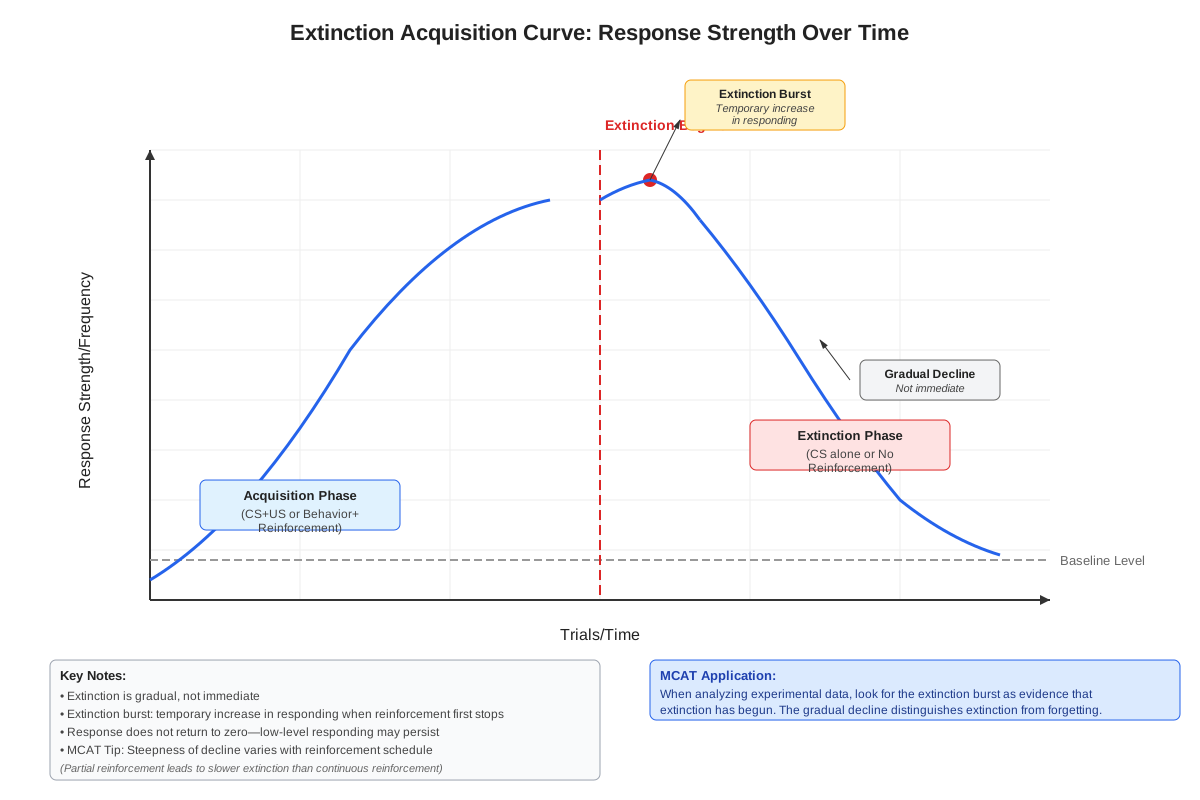
- Learning Curves: Understanding how to interpret graphs showing response strength over time is critical for analyzing extinction data on the MCAT
Why This Topic Matters
Clinical and Real-World Significance
Extinction principles form the foundation of exposure therapy, one of the most effective evidence-based treatments for anxiety disorders, phobias, and post-traumatic stress disorder (PTSD). When a patient with a spider phobia is gradually exposed to spiders without any harmful consequence, the fear response undergoes extinction. Understanding extinction also explains why addictive behaviors are so difficult to eliminate—drug-associated cues can trigger relapse even after long periods of abstinence, demonstrating that extinction is context-dependent and the original learning persists. In educational settings, extinction is used to reduce problematic behaviors by withholding attention or other reinforcers, making it a practical tool for behavior modification in schools, clinical settings, and parenting.
MCAT Exam Statistics and Question Types
Extinction appears in approximately 15-20% of MCAT Psychology/Sociology passages related to learning and memory. Questions typically fall into three categories: (1) experimental interpretation questions requiring students to identify extinction procedures in research designs, (2) application questions asking students to predict behavioral outcomes when reinforcement is withdrawn, and (3) conceptual questions testing understanding of why extinguished responses can return. The MCAT frequently presents graphs showing response rates over trials and asks students to identify the extinction phase or explain why response rates change. Passages may describe therapeutic interventions and require students to recognize extinction-based treatments or explain their mechanisms.
Common Exam Presentation Formats
The MCAT commonly presents extinction through research vignettes describing animal learning experiments (rats pressing levers, dogs salivating to tones), clinical scenarios involving phobia treatment or addiction relapse, or social psychology contexts examining attitude change and persuasion. Passages may include data tables or graphs showing declining response rates and test whether students can distinguish extinction from habituation, forgetting, or punishment. Questions often require students to predict what happens after extinction (spontaneous recovery) or explain why a behavior returns in a different context (renewal effect), testing deeper understanding beyond simple definitions.
Core Concepts
Definition and Basic Mechanism of Extinction
Extinction is the process by which a previously learned response decreases in frequency and eventually ceases when the reinforcement or pairing that established it is no longer present. Critically, extinction does not represent "unlearning" or erasure of the original association; instead, it involves new learning that inhibits the expression of the previously learned behavior. This distinction has profound implications for understanding why extinguished responses can spontaneously return.
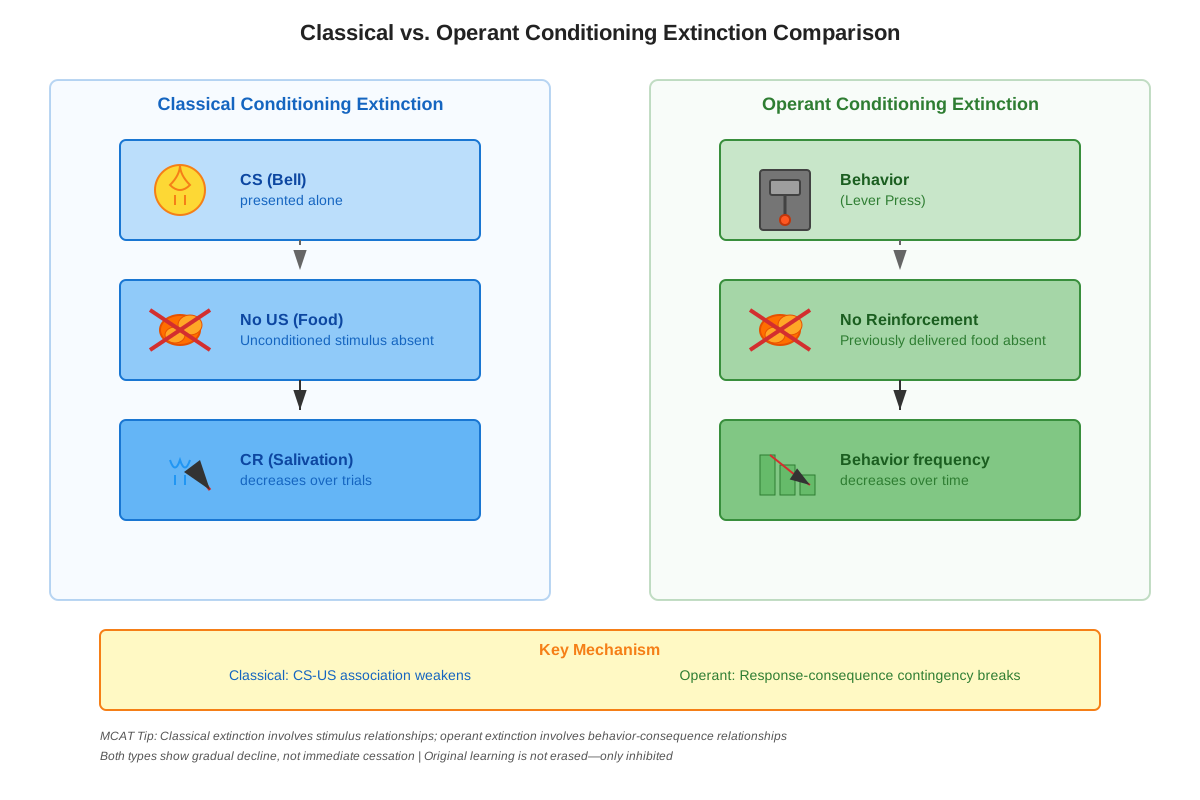
In classical conditioning, extinction occurs when the conditioned stimulus (CS) is repeatedly presented without the unconditioned stimulus (US). For example, if a dog has learned to salivate (CR) to a bell (CS) that was previously paired with food (US), extinction begins when the bell is rung repeatedly without food being presented. Over successive trials, the salivation response diminishes. In operant conditioning, extinction occurs when a behavior that was previously reinforced no longer produces the reinforcing consequence. If a rat has learned to press a lever to receive food pellets, extinction begins when lever presses no longer produce food, and the pressing behavior gradually decreases.
Extinction in Classical Conditioning
The extinction process in classical conditioning follows a predictable pattern. During the acquisition phase, the CS and US are paired repeatedly, and the CR strengthens. During the extinction phase, the CS is presented alone without the US, and the CR gradually weakens. The rate of extinction depends on several factors:
- Strength of original conditioning: Stronger original learning (more CS-US pairings) typically requires more extinction trials
- Partial reinforcement: Behaviors learned under partial reinforcement schedules are more resistant to extinction
- CS-US interval: The timing between CS and US during acquisition affects extinction rate
- Context: Environmental cues present during extinction influence whether the extinguished response will return in different settings
A critical feature of extinction in classical conditioning is that the CS does not become neutral again; rather, it acquires an inhibitory association that suppresses the CR. Evidence for this comes from spontaneous recovery—after a rest period following extinction, the CR partially returns when the CS is presented again, demonstrating that the original CS-US association was not erased.
Extinction in Operant Conditioning
In operant conditioning, extinction involves the discontinuation of reinforcement following a previously reinforced behavior. The behavioral pattern during extinction is characterized by an extinction burst—an initial increase in the frequency, intensity, or variability of the behavior before it begins to decline. For example, if a vending machine that previously dispensed snacks stops working, a person might initially press the button more forcefully and repeatedly before eventually giving up.
Several factors influence the resistance to extinction in operant conditioning:
| Factor | Effect on Extinction Resistance |
|---|---|
| Continuous reinforcement | Low resistance; behavior extinguishes quickly |
| Partial reinforcement | High resistance; behavior persists longer (partial reinforcement effect) |
| Magnitude of reinforcement | Larger reinforcers create greater resistance |
| Effort required | More effortful behaviors show greater resistance |
| Reinforcement history | Longer reinforcement history increases resistance |
The partial reinforcement extinction effect is particularly important for the MCAT. Behaviors learned under intermittent reinforcement schedules (variable ratio, variable interval, fixed ratio, fixed interval) are significantly more resistant to extinction than behaviors learned under continuous reinforcement. This explains why gambling behavior is so persistent—the variable ratio schedule of winning creates strong resistance to extinction.
Phenomena Associated with Extinction
Spontaneous Recovery
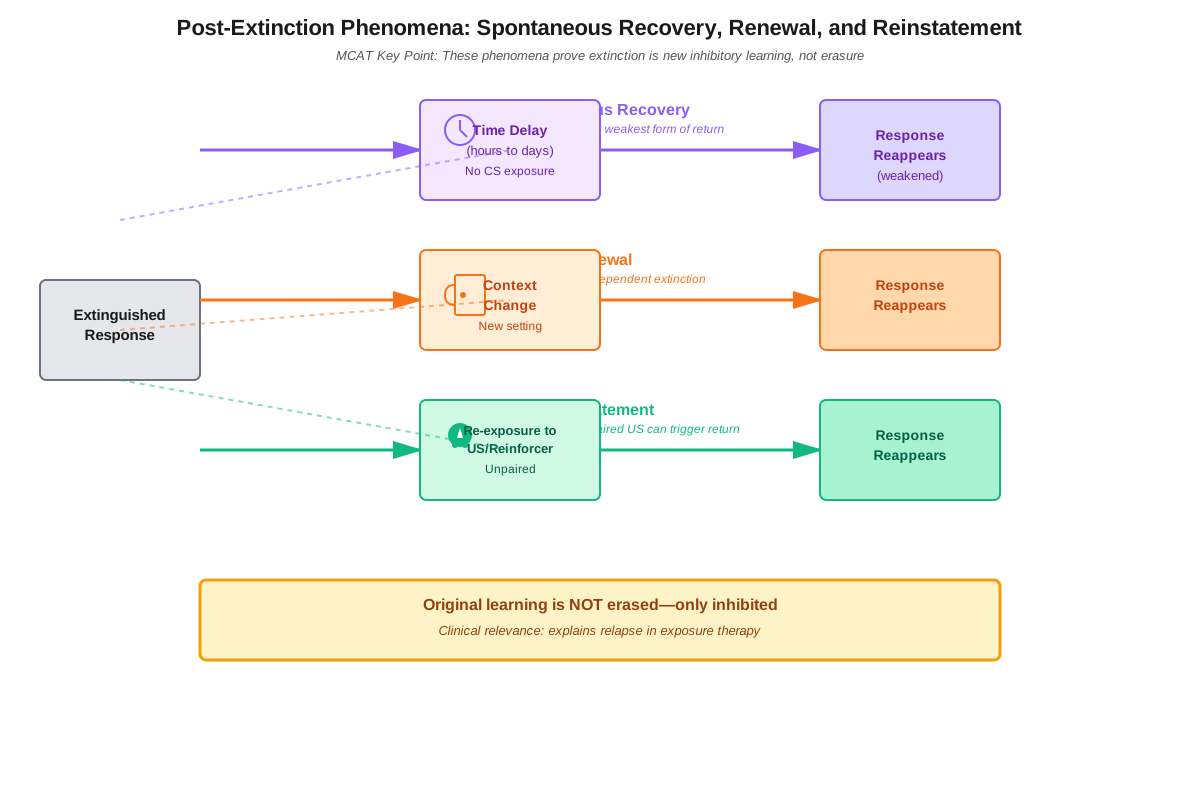
Spontaneous recovery is the reappearance of an extinguished response after a rest period, without any additional training. If a dog's salivation response to a bell has been extinguished, and then the dog is removed from the experimental context for several hours or days, presenting the bell again will elicit some salivation, though typically weaker than the original CR. This phenomenon demonstrates that extinction does not erase the original learning but rather creates a competing inhibitory association. Spontaneous recovery is typically weaker than the original response and extinguishes more quickly with repeated extinction sessions.
Renewal Effect
The renewal effect occurs when an extinguished response returns when the organism is tested in a context different from the extinction context. If conditioning occurs in Context A, extinction occurs in Context B, and testing occurs back in Context A, the CR will return. This demonstrates that extinction learning is context-dependent—the inhibitory association learned during extinction is tied to the environmental cues present during extinction training. The renewal effect has important implications for therapy: if a phobia is treated in a therapist's office but the patient returns to the original context where the fear was learned, the fear response may return.
Reinstatement
Reinstatement is the return of an extinguished response following exposure to the US alone (without the CS). If a rat's lever-pressing behavior has been extinguished, presenting free food pellets (the original reinforcer) can cause the rat to resume lever pressing. In classical conditioning, presenting the US alone after extinction can restore the CR when the CS is subsequently presented. Reinstatement suggests that the US presentation reactivates the original learning and reduces the inhibitory effect of extinction.
Neurobiological Mechanisms of Extinction
Extinction involves active learning processes mediated by specific neural circuits. The prefrontal cortex, particularly the ventromedial prefrontal cortex (vmPFC) and infralimbic cortex in rodents, plays a crucial role in extinction learning by inhibiting fear responses generated by the amygdala. During extinction, the prefrontal cortex learns to suppress the conditioned fear response, but the original fear memory in the amygdala remains intact.
The neurotransmitter NMDA (N-methyl-D-aspartate) receptors are essential for extinction learning. Blocking NMDA receptors impairs extinction, while enhancing NMDA function can facilitate extinction. This has led to research on pharmacological enhancement of exposure therapy using drugs that augment NMDA function, such as D-cycloserine. The persistence of the original memory trace explains why extinguished fears can return through spontaneous recovery, renewal, or reinstatement—the amygdala's fear memory is suppressed but not eliminated.
Extinction Versus Related Phenomena
It is crucial to distinguish extinction from similar but distinct processes:
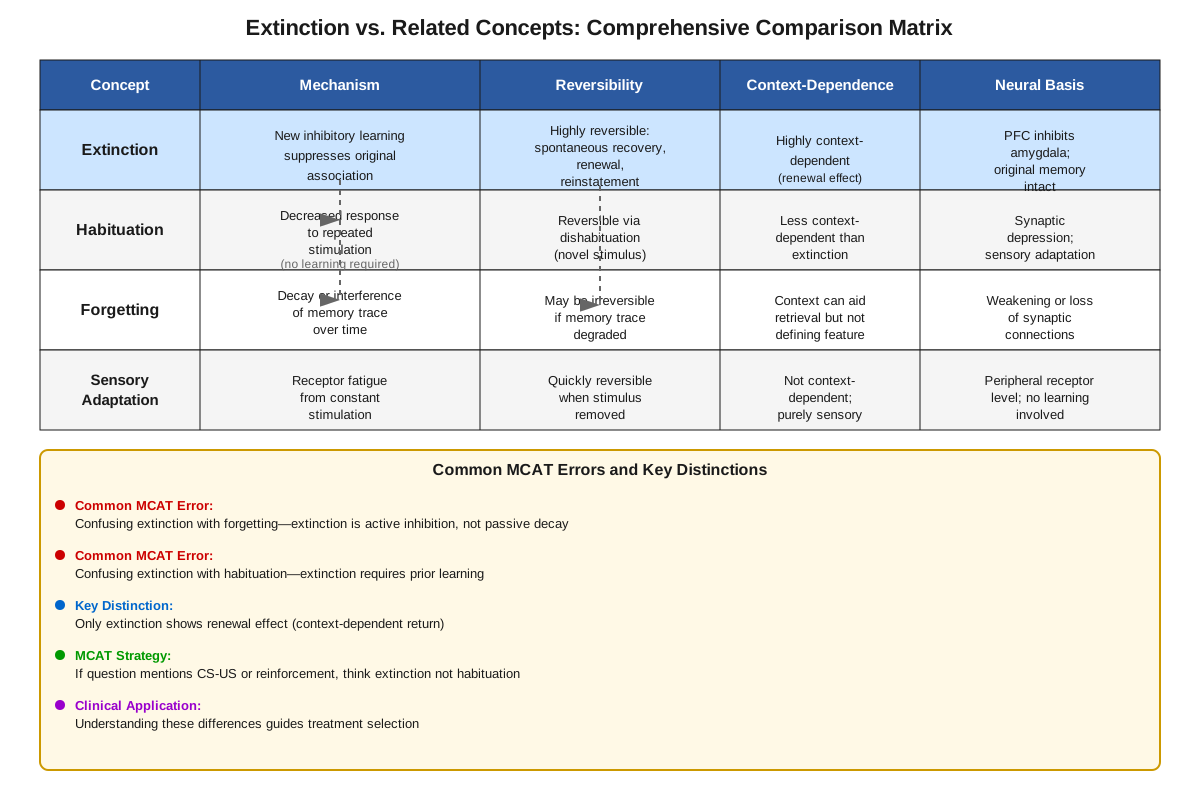
Extinction vs. Habituation: Habituation is the decrease in response to a repeated stimulus that has no significant consequences, representing a form of non-associative learning. Extinction involves the breaking of a previously learned association. Habituation occurs with novel stimuli that become familiar; extinction requires prior conditioning.
Extinction vs. Forgetting: Forgetting is the loss of memory over time due to decay or interference. Extinction is an active learning process that occurs through specific training procedures. Evidence that extinction differs from forgetting includes spontaneous recovery (forgetting would not show recovery after rest) and the fact that extinction is context-dependent (forgetting is not).
Extinction vs. Punishment: Punishment involves presenting an aversive consequence or removing a positive consequence following a behavior, which suppresses the behavior. Extinction involves simply withholding reinforcement without adding any consequence. Punishment actively suppresses behavior; extinction allows behavior to decline naturally due to lack of reinforcement.
Concept Relationships
The concepts within extinction form an interconnected network that demonstrates the complexity of behavioral modification. The core extinction process → leads to → three key return phenomena (spontaneous recovery, renewal, reinstatement) → which collectively demonstrate that → extinction is new inhibitory learning rather than erasure. This understanding → connects to → neural mechanisms (prefrontal cortex inhibition of amygdala) → which explain → why extinction is context-dependent and why extinguished responses can return.
Extinction connects backward to prerequisite topics: Classical conditioning provides the CS-US association framework that extinction modifies, while operant conditioning provides the behavior-consequence relationship that extinction disrupts. The partial reinforcement effect from operant conditioning schedules directly influences extinction resistance. Extinction connects forward to clinical applications: exposure therapy applies extinction principles to treat anxiety disorders, and understanding context-dependent extinction (renewal effect) explains why relapse occurs and informs relapse prevention strategies.
Within the broader domain of Learning and Memory, extinction demonstrates that memory is not static but dynamically regulated. The relationship can be mapped as: Initial learning (acquisition) → creates associations → which can be suppressed through extinction → but remain latent → and can be reactivated by context changes, time passage, or US re-exposure. This framework applies across both classical and operant conditioning paradigms, showing that extinction is a universal principle of behavioral adaptation.
Quick check — test yourself on Extinction so far.
Try Flashcards →High-Yield Facts
⭐ Extinction is new inhibitory learning, not erasure of the original association—the original memory remains intact but is suppressed
⭐ Spontaneous recovery demonstrates that extinction does not eliminate the original learning—after a rest period, the extinguished response partially returns
⭐ The partial reinforcement extinction effect states that behaviors learned under intermittent reinforcement are more resistant to extinction than those learned under continuous reinforcement
⭐ Extinction is context-dependent—the renewal effect shows that extinguished responses return when the organism is tested in a context different from the extinction context
⭐ The extinction burst is an initial increase in behavior frequency or intensity when reinforcement is first withheld in operant conditioning
- Reinstatement occurs when presenting the US alone after extinction causes the CR to return
- The ventromedial prefrontal cortex inhibits amygdala-based fear responses during extinction learning
- NMDA receptors are critical for extinction learning, and NMDA agonists can enhance extinction
- Exposure therapy for anxiety disorders and phobias is based on extinction principles
- In classical conditioning extinction, the CS is presented repeatedly without the US; in operant conditioning extinction, the behavior no longer produces reinforcement
- Stronger original conditioning typically requires more extinction trials to eliminate the response
- Extinction does not return the CS to a neutral state; it creates an inhibitory association
Common Misconceptions
Misconception: Extinction erases or reverses the original learning, returning the organism to its pre-conditioning state.
Correction: Extinction involves new inhibitory learning that suppresses the expression of the original association, but the original memory remains intact. Evidence includes spontaneous recovery, renewal, and reinstatement, all of which demonstrate that the original learning persists beneath the extinction.
Misconception: Extinction and habituation are the same process.
Correction: Habituation is a decrease in response to a repeated stimulus that never had significant consequences (non-associative learning), while extinction is the weakening of a previously learned association through removal of reinforcement or US pairing (associative learning). Habituation occurs with novel stimuli; extinction requires prior conditioning.
Misconception: Punishment and extinction are equivalent because both reduce behavior.
Correction: Punishment involves adding an aversive consequence or removing a positive stimulus following a behavior, actively suppressing it. Extinction involves only withholding reinforcement without adding any consequence. Punishment can produce immediate suppression; extinction produces gradual decline. Punishment can create negative emotional responses; extinction does not.
Misconception: Once a response is fully extinguished, it will never return.
Correction: Extinguished responses can return through spontaneous recovery (after time passes), renewal (in different contexts), or reinstatement (after US re-exposure). Extinction is not permanent and requires maintenance to prevent return of the original response.
Misconception: Extinction happens at the same rate regardless of how the behavior was originally learned.
Correction: The rate and resistance to extinction depend heavily on the original learning conditions. Behaviors learned under partial reinforcement schedules are much more resistant to extinction than those learned under continuous reinforcement (partial reinforcement extinction effect). Stronger original conditioning also increases extinction resistance.
Worked Examples
Example 1: Classical Conditioning Extinction Scenario
Vignette: A researcher conditions rats to fear a tone by pairing it with a mild electric shock. After 10 tone-shock pairings, all rats freeze when they hear the tone alone. The researcher then presents the tone 20 times without any shock. By the 20th trial, the rats no longer freeze to the tone. The rats are returned to their home cages for one week. When brought back to the experimental chamber and presented with the tone, the rats show moderate freezing behavior, though less than during original conditioning.
Question: Which phenomenon explains the rats' behavior when returned to the experimental chamber after one week?
Analysis:
- Identify the learning paradigm: This is classical conditioning (tone = CS, shock = US, freezing = CR)
- Identify the phases: Acquisition (tone-shock pairings) → Extinction (tone alone, 20 trials) → Rest period (one week) → Test (tone presentation)
- Identify the key observation: After extinction eliminated the freezing response, it partially returned after the rest period
- Apply extinction concepts: The return of an extinguished response after a rest period, without any additional training, is spontaneous recovery
- Explain the mechanism: Spontaneous recovery demonstrates that extinction did not erase the original tone-shock association. Instead, extinction created a new inhibitory association that suppressed freezing. During the rest period, the inhibitory association weakened, allowing the original fear memory to partially re-express itself.
Answer: Spontaneous recovery explains this phenomenon. The original fear conditioning was not erased during extinction but was suppressed by new inhibitory learning. After the rest period, this inhibition weakened, allowing the conditioned fear response to partially return.
Learning Objective Connection: This example demonstrates the application of extinction principles to experimental scenarios and illustrates why extinction is new learning rather than erasure of original associations.
Example 2: Operant Conditioning Extinction Application
Vignette: A child has learned to throw tantrums in the grocery store because tantrums reliably result in the parent buying candy (positive reinforcement). The tantrums have been reinforced approximately 80% of the time over six months. The parent decides to implement an extinction procedure by completely ignoring tantrums and never buying candy in response to them. During the first shopping trip using this approach, the child's tantrums become louder and more intense than ever before, lasting 15 minutes. The parent remains consistent. Over the next eight shopping trips, the tantrums gradually decrease in frequency and intensity, and by the tenth trip, the child no longer throws tantrums.
Question: (A) What phenomenon explains the increased intensity of tantrums during the first extinction session? (B) Why might this behavior be particularly resistant to extinction? (C) What might cause the tantrums to return even after successful extinction?
Analysis:
(A) Extinction Burst:
- When reinforcement is first withheld in operant conditioning, there is typically an initial increase in the behavior's frequency, intensity, or variability
- The child's louder and longer tantrum during the first extinction session represents an extinction burst
- This occurs because the organism initially responds to the absence of reinforcement by increasing effort, as if the reinforcer might still be obtained with more vigorous responding
- Understanding extinction bursts is critical for behavior modification because caregivers who are unaware of this phenomenon might give in during the burst, which would actually strengthen the behavior through intermittent reinforcement
(B) Partial Reinforcement Extinction Effect:
- The behavior is particularly resistant to extinction because it was learned under a partial reinforcement schedule (80% reinforcement rate)
- The partial reinforcement extinction effect states that behaviors learned under intermittent reinforcement are more resistant to extinction than those learned under continuous reinforcement
- When a behavior is only sometimes reinforced, the organism cannot easily discriminate between extinction (no reinforcement ever) and the normal pattern of intermittent reinforcement (sometimes no reinforcement)
- Six months of reinforcement history also contributes to extinction resistance
(C) Potential Return of Behavior:
- Spontaneous recovery: After a period without shopping trips, the tantrum behavior might partially return on the next trip
- Renewal effect: If extinction occurred in one grocery store but the parent takes the child to a different store, the tantrums might return because extinction is context-dependent
- Reinstatement: If the parent gives in and buys candy for any reason (even not in response to a tantrum), this could reinstate the tantrum behavior
- Accidental reinforcement: If anyone else (grandparent, other parent) reinforces the tantrum, the behavior could return
Learning Objective Connection: This example demonstrates application of extinction principles to real-world behavior modification, identification of extinction-related phenomena (extinction burst, partial reinforcement effect), and prediction of conditions under which extinguished behaviors might return.
Exam Strategy
Approaching MCAT Questions on Extinction
When encountering extinction questions on the MCAT, follow this systematic approach:
- Identify the conditioning paradigm first: Determine whether the scenario involves classical conditioning (CS-US pairing) or operant conditioning (behavior-consequence relationship). This determines which extinction mechanism applies.
- Map the experimental phases: Identify acquisition, extinction, and any test phases. Look for when reinforcement or US pairing is removed—this marks the beginning of extinction.
- Watch for return phenomena: If the question describes a rest period, context change, or US re-exposure after extinction, expect questions about spontaneous recovery, renewal, or reinstatement.
- Distinguish extinction from similar processes: Be prepared to eliminate answer choices that confuse extinction with habituation, forgetting, or punishment.
Trigger Words and Phrases
Key phrases that signal extinction in MCAT passages:
- "The reinforcement was discontinued/withdrawn/removed"
- "The CS was presented without the US"
- "The behavior no longer produced..."
- "After the response was eliminated, it returned when..."
- "The conditioned response gradually decreased"
- "Exposure therapy" or "systematic desensitization" (clinical applications of extinction)
Phrases that signal specific extinction phenomena:
- "After a rest period" → spontaneous recovery
- "In a different context/environment" → renewal effect
- "After re-exposure to the US" → reinstatement
- "Initially increased before decreasing" → extinction burst
- "More resistant to extinction" → partial reinforcement effect
Process of Elimination Tips
When evaluating answer choices:
- Eliminate "erasure" language: Any answer suggesting extinction erases or reverses original learning is incorrect
- Eliminate habituation: If the scenario involves prior conditioning/reinforcement, habituation is wrong
- Eliminate punishment: If no aversive consequence is added, punishment is incorrect
- Favor context-dependent explanations: Extinction is context-dependent, so answers acknowledging this are often correct
- Favor inhibitory learning explanations: Answers describing extinction as new learning that suppresses (rather than erases) the original association are typically correct
Time Allocation Advice
Extinction questions typically require 60-90 seconds. Spend 20-30 seconds carefully reading the scenario to identify the conditioning paradigm and phases, 20-30 seconds analyzing what phenomenon is being described, and 20-30 seconds evaluating answer choices. Do not rush—extinction questions often include subtle distinctions between similar concepts that require careful analysis.
Memory Techniques
Mnemonics for Extinction Return Phenomena
"SRR" - Spontaneous Recovery, Renewal, Reinstatement
- Spontaneous recovery: Sleep on it (time passes), response returns
- Renewal: Relocate (change context), response returns
- Reinstatement: Reintroduce US, response returns
Visualization Strategy for Extinction vs. Erasure
Visualize extinction as placing a blanket over a light rather than turning off the light. The original learning (light) is still there, intact and functional, but it's covered by new inhibitory learning (blanket). This explains why the light can shine through again (spontaneous recovery) if the blanket is removed or if you look from a different angle (renewal). This image helps remember that extinction is suppression, not elimination.
Acronym for Extinction Resistance Factors
"PRIME" factors increase resistance to extinction:
- Partial reinforcement (vs. continuous)
- Reinforcement history (longer = more resistant)
- Intensity of original conditioning (stronger = more resistant)
- Magnitude of reinforcer (larger = more resistant)
- Effort invested (more effort = more resistant)
Memory Palace for Extinction Phases
Imagine walking through your home:
- Front door (Acquisition): You learn to unlock it with a key (CS-US pairing or behavior-reinforcement)
- Living room (Extinction): The key stops working; you keep trying but the door won't open (CS without US, behavior without reinforcement)
- Bedroom (Rest period): You sleep and forget about the door problem
- Return to front door (Spontaneous recovery): You try the key again and it partially works
- Back door (Different context/Renewal): You try the same key on a different door and it works again
Summary
Extinction is a fundamental learning process in which a previously acquired response decreases and eventually ceases when the reinforcement or pairing that established it is removed. In classical conditioning, extinction occurs through repeated presentation of the conditioned stimulus without the unconditioned stimulus; in operant conditioning, it occurs when a behavior no longer produces its reinforcing consequence. Critically, extinction does not erase the original learning but instead involves new inhibitory learning that suppresses the expression of the previously learned response. This is evidenced by three key phenomena: spontaneous recovery (return after rest), renewal (return in different contexts), and reinstatement (return after US re-exposure). The partial reinforcement extinction effect demonstrates that behaviors learned under intermittent reinforcement are more resistant to extinction than those learned under continuous reinforcement. Neurobiologically, extinction involves the prefrontal cortex inhibiting amygdala-based responses, with NMDA receptors playing a crucial role. Understanding extinction is essential for the MCAT because it appears frequently in learning and memory questions, forms the basis for clinical interventions like exposure therapy, and requires students to distinguish it from related phenomena like habituation, forgetting, and punishment.
Key Takeaways
- Extinction is new inhibitory learning that suppresses (not erases) the original association, as proven by spontaneous recovery, renewal, and reinstatement
- In classical conditioning, extinction involves presenting the CS without the US; in operant conditioning, it involves withholding reinforcement for a previously reinforced behavior
- The partial reinforcement extinction effect states that intermittently reinforced behaviors are more resistant to extinction than continuously reinforced behaviors
- Extinction is context-dependent—the renewal effect shows that extinguished responses return when tested in contexts different from the extinction context
- The extinction burst is an initial increase in behavior when reinforcement is first withheld in operant conditioning
- Exposure therapy for anxiety disorders applies extinction principles by repeatedly presenting feared stimuli without negative consequences
- Extinction differs from habituation (non-associative learning), forgetting (memory decay), and punishment (adding aversive consequences)
Related Topics
Spontaneous Recovery and Savings: Deeper exploration of how extinguished responses return and how re-learning after extinction is faster than original learning, demonstrating memory retention.
Schedules of Reinforcement: Understanding fixed ratio, variable ratio, fixed interval, and variable interval schedules is essential for predicting extinction resistance and explains the partial reinforcement extinction effect.
Exposure Therapy and Systematic Desensitization: Clinical applications of extinction principles to treat anxiety disorders, phobias, and PTSD, including the role of context in treatment generalization.
Neural Mechanisms of Fear and Anxiety: The amygdala-prefrontal cortex circuitry underlying fear conditioning and extinction, including the role of the hippocampus in context-dependent extinction.
Relapse Prevention: Understanding renewal, reinstatement, and spontaneous recovery is crucial for developing strategies to maintain treatment gains and prevent return of problematic behaviors.
Behavioral Modification Techniques: Broader applications of extinction in combination with other operant conditioning principles (differential reinforcement, shaping) for behavior change.
Practice CTA
Now that you have mastered the core concepts of extinction, it's time to solidify your understanding through active practice. Complete the practice questions and flashcards associated with this topic to test your ability to apply extinction principles to MCAT-style scenarios. Pay particular attention to questions requiring you to distinguish extinction from related phenomena and to predict behavioral outcomes in complex experimental designs. Remember that extinction is a high-yield topic that appears frequently on the MCAT—investing time in practice now will pay dividends on test day. Your ability to quickly identify extinction procedures and predict return phenomena will set you apart and help you achieve your target score. You've got this!
Sign up free to keep reading
Create a free AnvayaPrep account to finish this MCAT guide on Extinction — plus flashcards and practice questions.