Overview
Retrieval cues are stimuli or pieces of information that facilitate the recall of stored memories from long-term memory. These cues act as triggers that help the brain access information that might otherwise remain inaccessible, serving as pathways or "keys" to unlock stored knowledge. In the context of Psychology and Learning and Memory, retrieval cues represent a fundamental mechanism by which the human memory system operates, bridging the gap between encoding, storage, and successful recall. Understanding retrieval cues is essential for comprehending why we sometimes remember information effortlessly in certain contexts while struggling to recall the same information in different situations.
For the MCAT, retrieval cues represent a high-yield topic that appears frequently in both discrete questions and passage-based items within the Psychological, Social, and Biological Foundations of Behavior section. The concept integrates seamlessly with broader memory theories, including encoding specificity, context-dependent memory, and state-dependent memory. MCAT questions often present experimental scenarios where participants recall information under varying conditions, requiring test-takers to identify which retrieval cues are present and predict their effects on memory performance. The topic also connects to practical applications in educational psychology, clinical settings, and everyday cognitive functioning.
The significance of Retrieval cues MCAT content extends beyond isolated memory questions. This concept interconnects with encoding processes, the levels of processing framework, priming, semantic networks, and even neurobiological substrates of memory such as hippocampal function. Mastering retrieval cues enables students to understand why context reinstatement improves eyewitness testimony, how studying in exam-like conditions enhances test performance, and why certain smells or songs can trigger vivid autobiographical memories. This topic exemplifies the applied nature of MCAT psychology, where theoretical knowledge must be translated into predictions about behavior and cognitive performance.
Learning Objectives
- [ ] Define retrieval cues using accurate Psychology terminology
- [ ] Explain why retrieval cues matters for the MCAT
- [ ] Apply retrieval cues to exam-style questions
- [ ] Identify common mistakes related to retrieval cues
- [ ] Connect retrieval cues to related Psychology concepts
- [ ] Distinguish between different types of retrieval cues (internal vs. external, semantic vs. contextual)
- [ ] Predict how the presence or absence of retrieval cues affects recall performance in experimental scenarios
- [ ] Analyze the relationship between encoding conditions and optimal retrieval cues according to the encoding specificity principle
Prerequisites
- Basic memory stages (encoding, storage, retrieval): Understanding the three-stage model of memory is essential because retrieval cues specifically facilitate the final stage—retrieval—and their effectiveness depends on how information was initially encoded.
- Long-term memory types (explicit vs. implicit): Retrieval cues operate differently across memory systems, with explicit memories being more susceptible to cue-dependent retrieval than implicit memories.
- Semantic vs. episodic memory: Different types of retrieval cues are more effective for semantic knowledge versus autobiographical episodes, making this distinction crucial for understanding cue specificity.
- Basic neural structures of memory (hippocampus, cortex): The neurobiological basis of memory helps explain how retrieval cues activate neural networks associated with stored information.
Why This Topic Matters
Clinical and Real-World Significance
Retrieval cues have profound implications across multiple domains of human experience. In clinical psychology, understanding retrieval cues helps explain why trauma survivors may experience flashbacks when exposed to sensory stimuli similar to those present during the traumatic event. Therapeutic interventions for conditions like PTSD and anxiety disorders often involve controlled exposure to retrieval cues in safe environments. In educational settings, teachers who understand retrieval cues can design learning environments that maximize student recall during examinations by incorporating similar contextual elements during instruction and testing. Law enforcement professionals rely on retrieval cue principles when interviewing witnesses, using cognitive interview techniques that reinstate the environmental and emotional context of witnessed events to improve recall accuracy.
MCAT Exam Statistics and Question Types
Retrieval cues appear in approximately 8-12% of psychology questions on the MCAT, making it a high-yield topic that warrants thorough preparation. Questions typically present experimental designs where researchers manipulate encoding or retrieval conditions, requiring students to predict outcomes based on retrieval cue principles. Common question formats include:
- Experimental analysis passages: Describing studies where participants learn information in one context and recall it in the same or different context
- Clinical vignettes: Presenting patients with memory difficulties and asking which interventions would improve recall
- Discrete questions: Testing direct knowledge of encoding specificity, context-dependent memory, or state-dependent memory
- Application scenarios: Requiring students to recommend study strategies based on retrieval cue principles
Exam Tip: When you see questions describing learning conditions followed by testing conditions, immediately consider whether retrieval cues match between encoding and retrieval phases.
Common Passage Presentations
MCAT passages frequently present retrieval cues within research scenarios examining factors that influence memory performance. A typical passage might describe an experiment where participants study vocabulary words while listening to classical music, then are tested either with or without the same music playing. Students must recognize that the music serves as a contextual retrieval cue and predict that recall will be superior when the cue is present during retrieval. Other common presentations include studies of mood-congruent memory, where emotional states serve as internal retrieval cues, or investigations of the "testing effect" where practice tests provide retrieval cues that strengthen memory traces.
Core Concepts
Definition and Fundamental Mechanisms
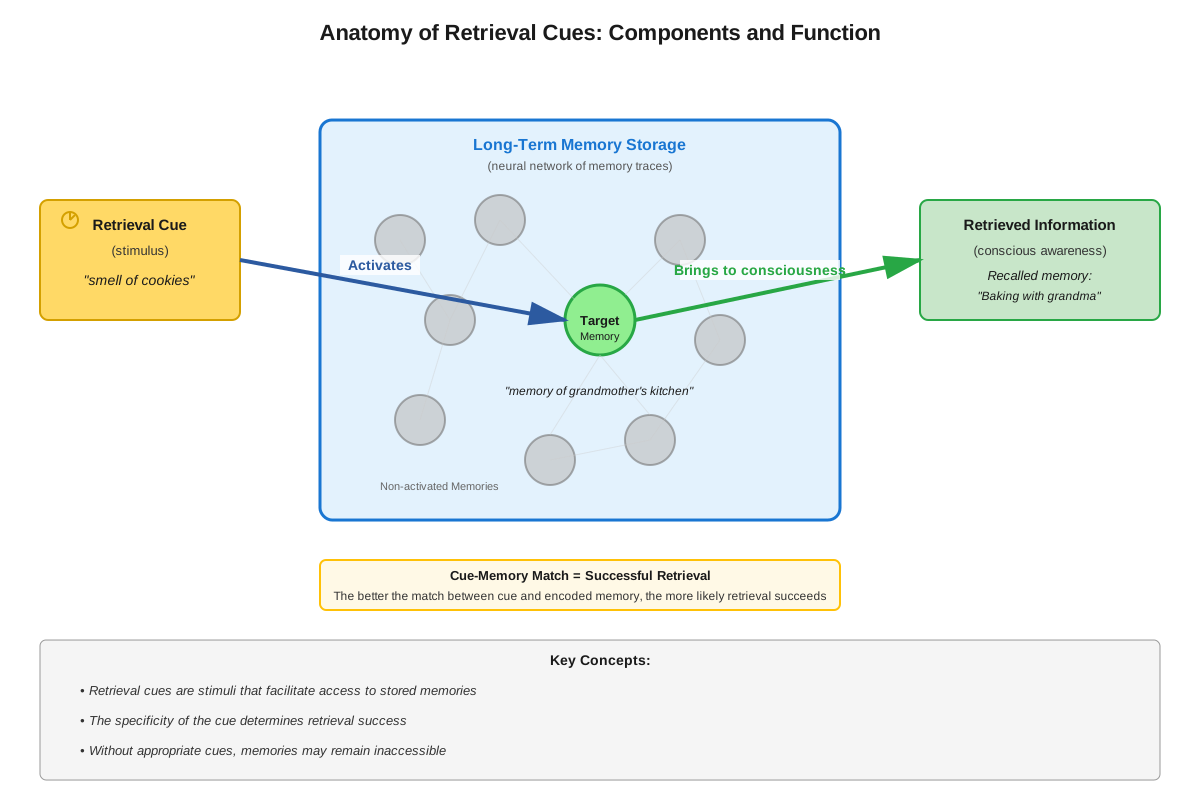
Retrieval cues are any stimuli—internal or external—that facilitate access to information stored in long-term memory. These cues work by activating the neural networks or memory traces associated with the target information, making it more accessible to conscious awareness. The effectiveness of a retrieval cue depends critically on its relationship to the original encoding context, a principle formalized in the encoding specificity principle proposed by Tulving and Thomson (1973).
The mechanism underlying retrieval cues involves pattern completion in neural networks. When information is encoded, multiple features of the learning context become associated with the memory trace, including environmental stimuli, emotional states, cognitive processes, and semantic associations. During retrieval, presenting even a subset of these associated features can trigger reactivation of the entire memory network, bringing the target information into consciousness. This process explains why a particular smell might evoke a complete childhood memory or why returning to a childhood home can trigger forgotten recollections.
Types of Retrieval Cues
Retrieval cues can be classified along multiple dimensions, each with distinct implications for memory performance:
| Type | Description | Example | MCAT Relevance |
|---|---|---|---|
| External/Environmental | Physical stimuli in the surrounding environment | Room layout, background music, lighting | Context-dependent memory experiments |
| Internal/Physiological | Internal bodily or mental states | Mood, arousal level, drug states | State-dependent memory scenarios |
| Semantic | Meaning-based associations and conceptual relationships | Category names, related concepts | Semantic network activation questions |
| Phonological | Sound-based cues | Rhymes, similar-sounding words | Less common but appears in language processing |
| Temporal | Time-based contextual information | When an event occurred | Episodic memory questions |
| Emotional | Affective states and feelings | Happiness, sadness, anxiety | Mood-congruent memory items |
Encoding Specificity Principle
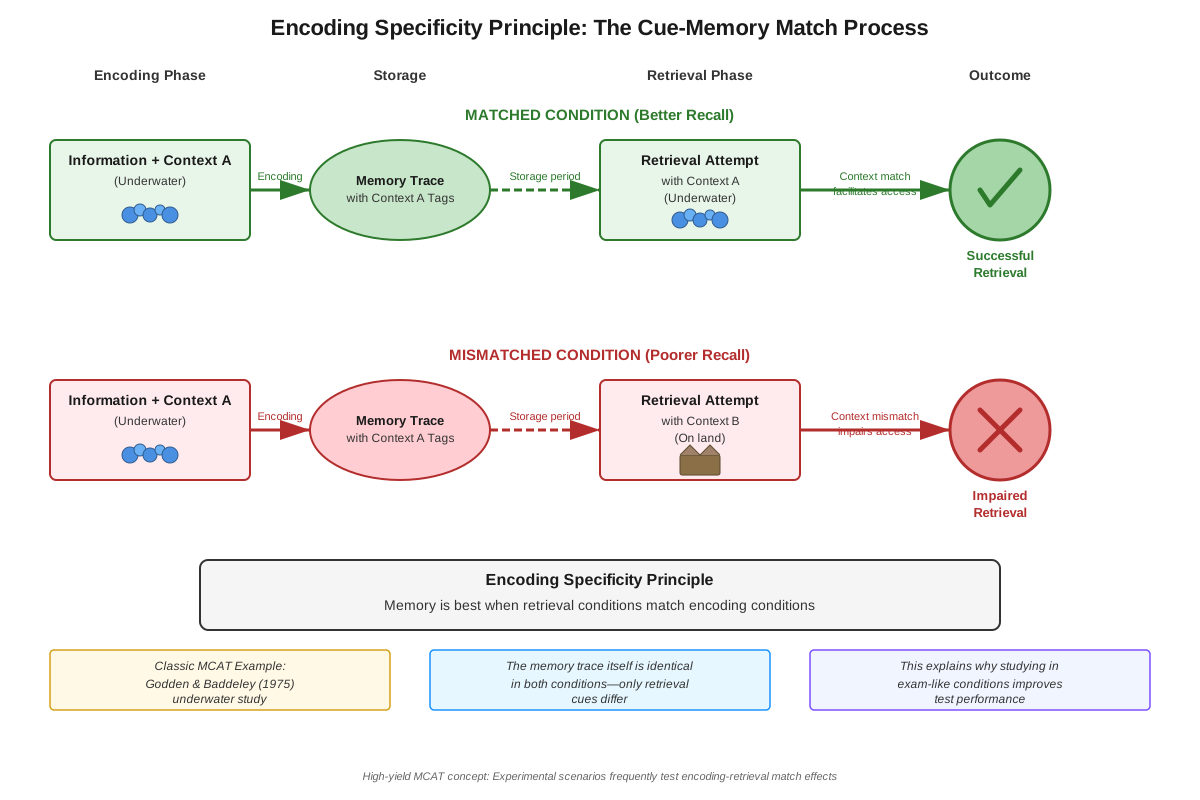
The encoding specificity principle states that memory is most effective when information available at encoding is also present at retrieval. This principle, central to understanding Retrieval cues Psychology, explains why the overlap between encoding and retrieval contexts determines recall success. The principle has three key implications:
- Cue effectiveness is relative: A cue is only effective if it was encoded along with the target information. Even a highly salient stimulus will not aid retrieval if it was not present during encoding.
- Context reinstatement improves recall: Recreating the original learning environment—physically or mentally—enhances memory performance by providing multiple retrieval cues.
- Transfer-appropriate processing: The type of processing during encoding should match the type of processing required during retrieval for optimal performance.
Context-Dependent Memory
Context-dependent memory refers to the phenomenon where recall is superior when the retrieval environment matches the encoding environment. Classic research by Godden and Baddeley (1975) demonstrated this effect by having scuba divers learn word lists either underwater or on land, then testing them in both environments. Results showed that recall was approximately 40% better when the learning and testing environments matched, illustrating the powerful effect of environmental retrieval cues.
The implications for Learning and Memory are substantial. Students who study in environments similar to their testing environment may experience enhanced recall during examinations. However, this principle also suggests a potential limitation: information learned in a specific context may be less accessible in different contexts, a phenomenon called context-dependent forgetting.
State-Dependent Memory
State-dependent memory occurs when internal physiological or psychological states serve as retrieval cues. When an individual's internal state during retrieval matches their state during encoding, recall is enhanced. This phenomenon has been demonstrated with:
- Mood states: Information encoded while happy is more easily recalled when in a happy mood (mood-congruent memory)
- Drug states: Information learned under the influence of certain substances (including caffeine or alcohol) may be better recalled in the same pharmacological state
- Arousal levels: High-arousal encoding may be best retrieved under high-arousal conditions
High-Yield Concept: State-dependent memory explains why anxious students may struggle to recall information during high-stress exams even though they knew the material while studying in a relaxed state. The internal state mismatch reduces retrieval cue effectiveness.
Priming as Implicit Retrieval Cueing
Priming represents a form of implicit memory where exposure to a stimulus influences response to a subsequent stimulus without conscious awareness. While priming differs from explicit retrieval cue usage, it demonstrates how cues can facilitate access to stored information through spreading activation in semantic networks. For example, seeing the word "doctor" primes related concepts like "nurse," "hospital," and "stethoscope," making these words easier to recognize or recall.
Priming connects to retrieval cues through the concept of spreading activation: when a retrieval cue activates a memory node, activation spreads to associated nodes, making related information more accessible. This mechanism underlies both conscious retrieval cue usage and unconscious priming effects.
Cue Overload Principle
The cue overload principle states that retrieval cue effectiveness decreases as more items become associated with the same cue. When a single cue is linked to numerous memories, it becomes less effective at discriminating among them, reducing recall probability for any specific item. This principle explains why:
- Unique, distinctive cues are more effective than common, overused cues
- Organizing information into smaller, distinct categories improves recall
- Interference occurs when multiple memories share retrieval cues
For MCAT preparation, this principle suggests that creating unique, specific retrieval cues for different concepts will be more effective than using generic study strategies across all material.
Retrieval Practice and the Testing Effect
Retrieval practice—actively recalling information rather than passively reviewing it—strengthens memory traces and creates additional retrieval routes. The testing effect demonstrates that retrieval attempts themselves serve as powerful learning events, even when recall is initially unsuccessful. Each retrieval attempt:
- Strengthens the association between cues and target information
- Creates new retrieval pathways
- Identifies gaps in knowledge for targeted review
- Enhances long-term retention more effectively than repeated studying
This concept has direct implications for MCAT preparation strategies, suggesting that practice questions and self-testing are superior to repeated reading of study materials.
Concept Relationships
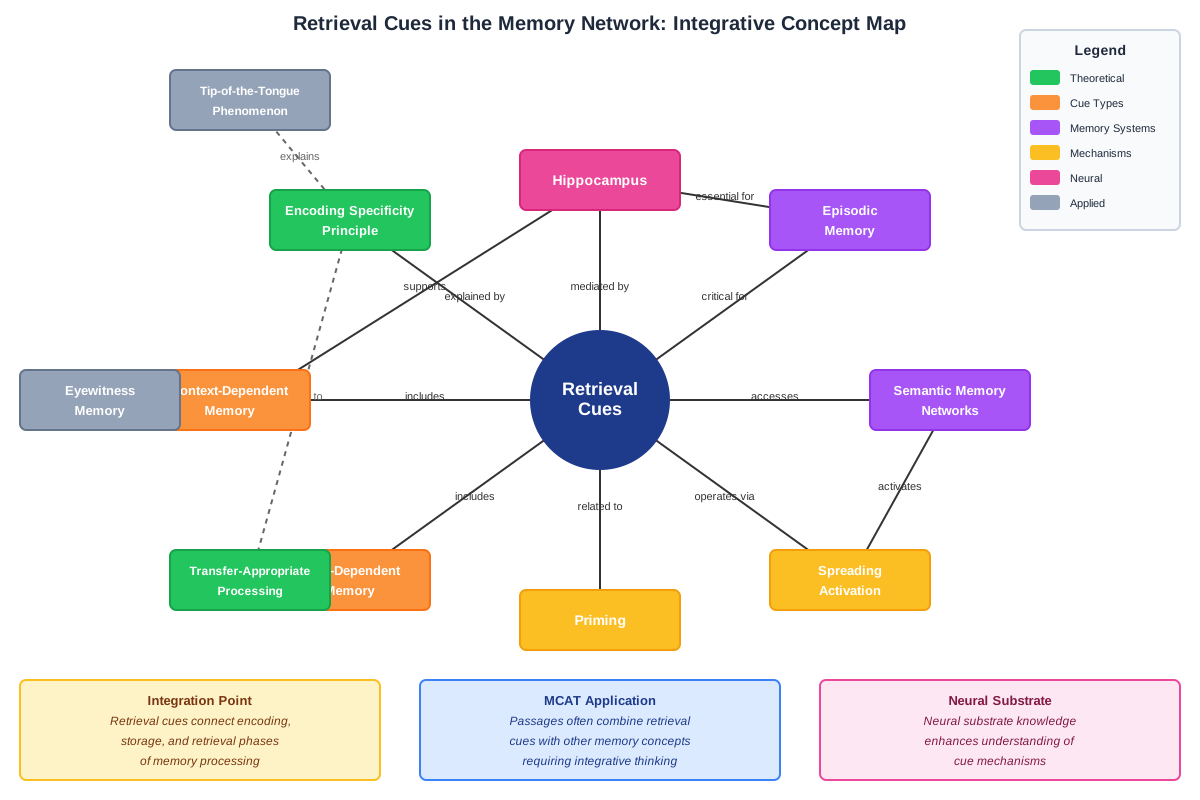
Retrieval cues function as the critical link between encoded information and successful recall, sitting at the intersection of multiple memory processes. The relationship begins with encoding, where the formation of memory traces determines which potential retrieval cues become associated with stored information. The encoding specificity principle formalizes this relationship: effective retrieval cues must have been encoded along with the target information.
Context-dependent memory and state-dependent memory represent specific applications of the encoding specificity principle, distinguished by whether the retrieval cues are external (environmental) or internal (physiological/psychological). Both phenomena demonstrate the same underlying mechanism: matching retrieval conditions to encoding conditions enhances recall by providing appropriate retrieval cues.
The relationship map flows as follows:
Encoding conditions → determine available retrieval cues → encoding specificity principle → branches into context-dependent and state-dependent memory → both influence retrieval success → which can be enhanced through retrieval practice → creating the testing effect → which strengthens future retrieval cue effectiveness
Retrieval cues also connect to semantic networks and spreading activation. When a retrieval cue activates a node in semantic memory, activation spreads to associated nodes, making related information more accessible. This mechanism underlies both priming effects and the effectiveness of semantic retrieval cues.
The cue overload principle introduces a limiting factor: as more memories become associated with a single cue, its effectiveness decreases. This creates a tension between the benefits of organized, categorical encoding (which creates shared retrieval cues) and the need for distinctive, unique cues for individual memories.
Finally, retrieval cues connect forward to forgetting mechanisms. Many instances of forgetting result not from memory trace decay but from retrieval failure—the absence of appropriate retrieval cues. This explains why "tip-of-the-tongue" phenomena occur: the information exists in memory but cannot be accessed without the right cue.
High-Yield Facts
⭐ Retrieval cues are stimuli that facilitate access to stored memories; their effectiveness depends on their presence during both encoding and retrieval (encoding specificity principle).
⭐ Context-dependent memory: recall is enhanced when the retrieval environment matches the encoding environment.
⭐ State-dependent memory: recall is enhanced when internal physiological or psychological states match between encoding and retrieval.
⭐ The encoding specificity principle states that memory performance is optimal when information available at encoding is also available at retrieval.
⭐ Cue overload occurs when a single retrieval cue becomes associated with too many memories, reducing its effectiveness for any specific memory.
- Retrieval cues can be external (environmental) or internal (physiological/psychological states).
- The testing effect demonstrates that retrieval practice strengthens memory more effectively than repeated studying.
- Priming represents implicit retrieval cueing through spreading activation in semantic networks.
- Mood-congruent memory is a form of state-dependent memory where emotional states serve as retrieval cues.
- Unique, distinctive retrieval cues are more effective than common, overused cues due to reduced cue overload.
- Retrieval failure (absence of appropriate cues) accounts for many instances of forgetting rather than actual memory trace loss.
- Transfer-appropriate processing suggests that encoding processes should match retrieval demands for optimal performance.
- Godden and Baddeley's scuba diver study (1975) is the classic demonstration of context-dependent memory effects.
Quick check — test yourself on Retrieval cues so far.
Try Flashcards →Common Misconceptions
Misconception: Retrieval cues work equally well regardless of whether they were present during encoding.
Correction: The encoding specificity principle clearly establishes that retrieval cues are only effective if they were encoded along with the target information. A cue that was not present during learning will not facilitate recall, no matter how salient or relevant it might seem.
Misconception: Context-dependent memory means you must always study in the exact room where you'll be tested.
Correction: While matching physical contexts can enhance recall, the effect is moderate and can be overcome through other strategies. More importantly, studying in varied contexts can actually improve memory flexibility and reduce context-dependency, making information accessible across different environments. Mental reinstatement of context can also provide similar benefits without physical presence.
Misconception: State-dependent memory effects are so strong that studying while caffeinated requires taking caffeine before the exam.
Correction: State-dependent memory effects exist but are typically modest in magnitude. The quality of encoding and the strength of memory traces matter far more than state matching. Additionally, relying on specific internal states creates vulnerability; it's better to encode information in ways that make it accessible across various states.
Misconception: More retrieval cues always lead to better recall.
Correction: The cue overload principle demonstrates that retrieval cue effectiveness decreases when too many memories become associated with the same cue. Quality and specificity of retrieval cues matter more than quantity. A few distinctive, unique cues are more effective than many generic, overloaded cues.
Misconception: Retrieval cues only help with explicit, conscious memory recall.
Correction: Retrieval cues influence both explicit and implicit memory systems. Priming demonstrates how cues can facilitate access to stored information without conscious awareness. However, explicit memories are generally more susceptible to retrieval cue effects than implicit memories.
Misconception: If you can't remember something, the memory trace has decayed or been lost.
Correction: Many instances of forgetting result from retrieval failure rather than actual memory loss. The information remains stored but cannot be accessed without appropriate retrieval cues. This explains why providing a hint or returning to the original context can suddenly make "forgotten" information accessible.
Misconception: Retrieval cues are the same as memory triggers in PTSD.
Correction: While related, these concepts differ in important ways. PTSD triggers are retrieval cues that involuntarily activate traumatic memories, but not all retrieval cues trigger involuntary recall, and not all involve emotional or traumatic content. Retrieval cues in typical memory function are often deliberately used to access desired information.
Worked Examples
Example 1: Experimental Design Analysis
Scenario: Researchers conduct an experiment where participants learn a list of 40 vocabulary words under one of four conditions:
- Group A: Studies in a quiet library, tested in a quiet library
- Group B: Studies in a quiet library, tested in a noisy cafeteria
- Group C: Studies in a noisy cafeteria, tested in a noisy cafeteria
- Group D: Studies in a noisy cafeteria, tested in a quiet library
The researchers measure the number of words correctly recalled by each group. Based on retrieval cue principles, predict the rank order of group performance from best to worst.
Solution:
Step 1: Identify the relevant principle. This experiment manipulates environmental context between encoding and retrieval, making context-dependent memory and the encoding specificity principle most relevant.
Step 2: Apply the encoding specificity principle. Groups where the study and test environments match (Groups A and C) should outperform groups where environments mismatch (Groups B and D) because environmental retrieval cues present during encoding are also available during retrieval.
Step 3: Consider potential additional factors. The quiet library might provide better initial encoding due to reduced distraction, potentially giving Group A an advantage over Group C. However, the question focuses on retrieval cue effects, and both matched-context groups should show superior recall compared to mismatched groups.
Step 4: Predict rank order:
- Group A (quiet→quiet): Best performance due to context match AND optimal encoding environment
- Group C (noisy→noisy): Second best due to context match, despite less optimal encoding
- Groups B and D (tied): Both show context mismatch, reducing retrieval cue effectiveness
Answer: A > C > B = D
Connection to learning objectives: This example demonstrates application of retrieval cue principles to experimental scenarios, a common MCAT question format. It requires understanding that context-dependent memory effects arise from the match/mismatch between encoding and retrieval environments, not from the absolute quality of either environment alone.
Example 2: Clinical Application
Scenario: A patient reports difficulty remembering conversations with their therapist. The patient mentions that therapy sessions occur in the morning when they feel alert and focused, but they try to recall the conversations in the evening when feeling tired and stressed. The therapist wants to improve the patient's recall of therapeutic content. Which intervention would be most effective based on retrieval cue principles?
A) Schedule therapy sessions in the evening when the patient typically tries to recall the content
B) Have the patient take detailed notes during sessions to create external memory aids
C) Teach the patient to mentally reinstate their morning alertness state before attempting recall
D) Increase session frequency to strengthen memory traces through repetition
Solution:
Step 1: Identify the memory problem. The patient experiences a state-dependent memory issue: encoding occurs during an alert morning state, while retrieval attempts occur during a tired evening state. This internal state mismatch reduces retrieval cue effectiveness.
Step 2: Evaluate each option through the lens of retrieval cue theory:
Option A: Scheduling sessions when the patient typically attempts recall would create state-dependent memory matching. The patient would encode information in a tired/stressed state and retrieve it in the same state. However, this might compromise encoding quality due to reduced alertness.
Option B: Note-taking creates external retrieval cues and reduces dependence on internal state matching. This addresses the problem but doesn't directly leverage retrieval cue principles about state-dependent memory.
Option C: Mental reinstatement of the encoding state provides internal retrieval cues without requiring actual state matching. This directly applies state-dependent memory principles by recreating the internal context present during encoding.
Option D: Repetition strengthens memories but doesn't address the state-mismatch problem that's causing retrieval difficulty.
Step 3: Select the best answer. Option C most directly addresses the state-dependent memory issue by providing appropriate internal retrieval cues. It's also practical and doesn't compromise encoding quality.
Answer: C
Additional considerations: In clinical practice, a combination approach might be optimal—using mental reinstatement (C) while also implementing external memory aids (B). However, for MCAT purposes, identifying the option that most directly applies the tested principle (state-dependent memory and retrieval cues) is essential.
Connection to learning objectives: This example demonstrates clinical application of retrieval cue concepts and requires distinguishing between different types of retrieval cues (internal vs. external) and their appropriate applications.
Exam Strategy
Approaching MCAT Questions on Retrieval Cues
When encountering questions about retrieval cues, follow this systematic approach:
- Identify the memory phase being tested: Determine whether the question focuses on encoding, storage, or retrieval. Retrieval cue questions specifically concern the relationship between encoding and retrieval conditions.
- Map encoding and retrieval conditions: Create a mental or written comparison of what's present during learning versus testing. Look for matches and mismatches in:
- Physical environment
- Internal states (mood, arousal, drug states)
- Semantic context
- Temporal factors
- Apply the encoding specificity principle: Predict that performance will be better when retrieval conditions match encoding conditions.
- Watch for cue overload scenarios: If the question involves multiple items associated with the same cue, consider whether cue effectiveness might be reduced.
Trigger Words and Phrases
Recognize these high-yield phrases that signal retrieval cue questions:
- "Participants studied in [context A] and were tested in [context B]"
- "Recall was better when..."
- "Which condition would result in the best memory performance?"
- "The presence of [stimulus] during testing..."
- "Context-dependent" or "state-dependent"
- "Encoding specificity"
- "Reinstatement of context"
- "Matching conditions"
- "Environmental cues"
- "Internal states"
Exam Tip: When you see a question describing different conditions during learning and testing, immediately think "retrieval cues and encoding specificity." This framing will guide you toward the correct answer.
Process-of-Elimination Strategies
Eliminate answers that:
- Suggest retrieval cues work regardless of encoding conditions (violates encoding specificity)
- Confuse encoding quality with retrieval cue effectiveness
- Claim that more cues always improve recall (ignores cue overload)
- Suggest that physical context is the only type of retrieval cue (ignores internal states, semantic cues)
- Imply that forgetting always means memory trace loss (ignores retrieval failure)
Favor answers that:
- Emphasize matching between encoding and retrieval conditions
- Recognize the distinction between context-dependent and state-dependent memory
- Acknowledge that retrieval failure differs from memory loss
- Apply the encoding specificity principle correctly
- Consider cue distinctiveness and specificity
Time Allocation Advice
Retrieval cue questions typically require moderate time investment (60-90 seconds for discrete questions, 90-120 seconds for passage-based items). The conceptual framework is straightforward, but applying it requires careful analysis of experimental conditions. Don't rush through the comparison of encoding and retrieval contexts—this analysis is the key to answering correctly.
For passage-based questions, invest time upfront in understanding the experimental design, particularly noting what differs between conditions. This initial investment pays dividends when answering multiple questions about the same study.
Memory Techniques
Acronym: MATCH
Remember that retrieval cues work best when conditions MATCH:
- Memory performance improves with matching
- Availability of cues at encoding and retrieval
- Type of cue matters (context vs. state)
- Cue overload reduces effectiveness
- Hints and context reinstatement help retrieval
Visualization Strategy: The Key and Lock Metaphor
Visualize retrieval cues as keys and memories as locked boxes:
- Encoding creates both the lock (memory) and the key (retrieval cue) simultaneously
- Retrieval requires the correct key (matching cue) to open the lock (access memory)
- Encoding specificity: Only keys created during encoding will fit the lock
- Cue overload: One key trying to open too many locks becomes ineffective
- Context-dependent memory: The key includes environmental features
- State-dependent memory: The key includes internal state features
Mnemonic for Types of Retrieval Cues: "STEP"
Remember the main categories of retrieval cues with STEP:
- Semantic (meaning-based associations)
- Temporal (time-based context)
- Environmental (external physical cues)
- Physiological (internal state cues)
Memory Palace Technique
Create a mental journey through your study environment:
- Room 1 (Encoding Room): Visualize information being learned with specific contextual details (posters on walls, music playing, your emotional state)
- Hallway (Storage): Information travels through this neutral space
- Room 2 (Retrieval Room): Imagine trying to recall information; when this room matches Room 1, doors open easily; when it differs, doors are locked
This spatial metaphor reinforces the importance of matching encoding and retrieval contexts.
Summary
Retrieval cues are stimuli or pieces of information that facilitate access to memories stored in long-term memory, functioning as triggers that activate neural networks associated with target information. The effectiveness of retrieval cues is governed by the encoding specificity principle, which states that memory performance is optimal when information available at encoding is also present at retrieval. This principle manifests in context-dependent memory (environmental cues) and state-dependent memory (internal physiological or psychological cues), both demonstrating that matching retrieval conditions to encoding conditions enhances recall. The cue overload principle introduces an important limitation: as more memories become associated with a single cue, its effectiveness for any specific memory decreases, emphasizing the importance of distinctive, specific cues. Retrieval practice itself serves as a powerful learning tool through the testing effect, strengthening memory traces and creating additional retrieval pathways. For MCAT success, students must recognize retrieval cue scenarios in experimental designs, predict performance based on encoding-retrieval matches, and distinguish between retrieval failure and actual memory loss.
Key Takeaways
- Retrieval cues are stimuli that facilitate memory access; their effectiveness depends on presence during both encoding and retrieval (encoding specificity principle)
- Context-dependent memory occurs when environmental cues match between learning and testing; state-dependent memory involves internal physiological or psychological state matching
- The cue overload principle states that retrieval cue effectiveness decreases when too many memories share the same cue, making distinctive cues more valuable
- Many instances of forgetting result from retrieval failure (absence of appropriate cues) rather than actual memory trace loss
- Retrieval practice through testing strengthens memory more effectively than repeated studying, creating the testing effect
- MCAT questions on retrieval cues typically present experimental scenarios requiring prediction of recall performance based on encoding-retrieval condition matches
- Mental reinstatement of encoding context can provide retrieval cue benefits without requiring physical presence in the original environment
Related Topics
Encoding Processes and Levels of Processing: Understanding how information is initially processed and stored provides the foundation for comprehending which retrieval cues become associated with memories. The depth of processing during encoding influences both memory strength and the types of retrieval cues that will be effective.
Forgetting and Interference Theory: Retrieval cues connect directly to theories of forgetting, particularly the distinction between storage failure and retrieval failure. Interference theory explains how competing memories can reduce retrieval cue effectiveness through proactive and retroactive interference.
Semantic Networks and Spreading Activation: The mechanism by which retrieval cues activate associated information relies on spreading activation through semantic networks. Understanding network models of memory illuminates how cues trigger related concepts and memories.
Memory Consolidation and Reconsolidation: Each retrieval attempt not only accesses stored information but also triggers reconsolidation processes that can strengthen or modify memories. This connects retrieval cues to the dynamic nature of memory storage.
Neurobiological Basis of Memory: The hippocampus and cortical regions involved in memory storage provide the neural substrate for retrieval cue effectiveness. Understanding pattern completion in neural networks explains the mechanism underlying cue-triggered recall.
Practice CTA
Now that you've mastered the core concepts of retrieval cues, it's time to solidify your understanding through active practice. Challenge yourself with MCAT-style practice questions that require you to analyze experimental designs, predict recall performance based on encoding-retrieval matches, and distinguish between different types of retrieval cues. Use flashcards to reinforce high-yield facts, particularly the encoding specificity principle and the distinction between context-dependent and state-dependent memory. Remember: retrieval practice itself is one of the most powerful learning tools available. Each practice question you attempt strengthens your memory traces and creates additional retrieval pathways for test day. Your investment in active recall now will pay dividends when you encounter these concepts under timed exam conditions. You've got this!
Sign up free to keep reading
Create a free AnvayaPrep account to finish this MCAT guide on Retrieval cues — plus flashcards and practice questions.