Overview
Collective behavior refers to the spontaneous, relatively unstructured, and often short-lived actions of groups of people who respond to ambiguous or uncertain situations. Unlike organized social movements or institutionalized group activities, collective behavior emerges when traditional norms and social structures provide insufficient guidance for action. This phenomenon encompasses a wide range of activities including crowds, mobs, riots, panics, crazes, fads, rumors, and mass hysteria. Understanding collective behavior is fundamental to Sociology because it reveals how individuals act differently in group contexts compared to their typical behavior patterns, and how social order can temporarily break down or transform under specific conditions.
For the MCAT, collective behavior represents a high-yield topic within the Demographics and Social Change unit of the Psychological, Social, and Biological Foundations of Behavior section. The exam frequently tests students' ability to distinguish between different types of collective behavior, identify the social and psychological mechanisms that drive group actions, and analyze how collective behavior relates to broader patterns of social change. Questions often present scenarios involving crowd dynamics, social contagion, or emergent norms, requiring students to apply sociological frameworks to real-world situations.
The study of collective behavior Sociology connects intimately with other core concepts including social movements, group dynamics, conformity, social influence, and theories of social change. While social movements represent organized, sustained efforts toward specific goals, collective behavior typically emerges more spontaneously and lacks formal structure. Understanding this distinction, along with the various forms and mechanisms of collective behavior, provides essential context for analyzing how societies respond to crises, how cultural trends emerge and spread, and how individual behavior transforms within group settings—all critical themes for collective behavior MCAT questions.
Learning Objectives
- [ ] Define collective behavior using accurate Sociology terminology
- [ ] Explain why collective behavior matters for the MCAT
- [ ] Apply collective behavior to exam-style questions
- [ ] Identify common mistakes related to collective behavior
- [ ] Connect collective behavior to related Sociology concepts
- [ ] Distinguish between different types of collective behavior (crowds, mobs, riots, panics, crazes, fads)
- [ ] Analyze the role of emergent norms and social contagion in collective behavior
- [ ] Evaluate the conditions that facilitate or inhibit collective behavior formation
- [ ] Compare and contrast collective behavior with organized social movements
Prerequisites
- Basic group dynamics: Understanding how individuals behave differently in groups versus alone is essential for recognizing the transformative nature of collective behavior
- Social norms and deviance: Knowledge of how norms regulate behavior helps explain what happens when normal social structures break down during collective behavior episodes
- Conformity and social influence: Familiarity with concepts like normative and informational social influence provides the foundation for understanding how collective behavior spreads through groups
- Basic sociological theories: Understanding functionalist, conflict, and symbolic interactionist perspectives helps frame different explanations for collective behavior phenomena
Why This Topic Matters
Collective behavior has profound real-world significance in understanding social phenomena ranging from peaceful protests and social movements to dangerous riots and mass panics. Healthcare professionals encounter collective behavior in various contexts: during public health emergencies (panic buying, vaccine hesitancy waves), in hospital settings (family responses to crises), and in community health initiatives (health fads, wellness trends). Understanding the mechanisms behind collective behavior enables medical professionals to anticipate and manage group responses during emergencies, communicate effectively during public health campaigns, and recognize how social contagion affects health behaviors.
On the MCAT, collective behavior appears in approximately 3-5% of Psychological, Social, and Biological Foundations questions, making it a moderately high-yield topic. Questions typically appear in two formats: passage-based scenarios describing crowd behavior, social movements, or cultural trends requiring analysis through sociological frameworks; and discrete questions testing definitional knowledge and the ability to distinguish between types of collective behavior. The exam particularly favors questions that require students to identify the type of collective behavior from a description, explain the mechanisms driving the behavior, or predict outcomes based on sociological principles.
Common exam presentations include: research passages describing experimental studies of crowd behavior or social contagion; scenarios involving public responses to disasters or crises; descriptions of cultural phenomena like fads or crazes requiring classification; and questions asking students to distinguish collective behavior from related concepts like social movements or formal organizations. The MCAT emphasizes application over memorization, so students must be able to recognize collective behavior principles in novel contexts rather than simply recalling definitions.
Core Concepts
Definition and Characteristics of Collective Behavior
Collective behavior is defined as relatively spontaneous and unstructured behavior by groups of people responding to ambiguous or uncertain situations where conventional norms provide inadequate guidance. This sociological concept, central to understanding collective behavior Sociology, encompasses several defining characteristics that distinguish it from other forms of group activity.
The key characteristics include: spontaneity (emerging quickly without extensive planning), limited duration (typically short-lived compared to institutionalized behaviors), weak social boundaries (unclear membership and fluid participation), emergence of new norms (development of situation-specific behavioral guidelines), and emotional arousal (heightened affect and reduced rational deliberation). Unlike formal organizations or established social institutions, collective behavior lacks clear leadership structures, formal rules, and predetermined goals.
Types of Collective Behavior
Collective behavior manifests in several distinct forms, each with unique characteristics:
Crowds represent temporary gatherings of people in physical proximity who share a common focus. Herbert Blumer identified four crowd types:
| Crowd Type | Characteristics | Example |
|---|---|---|
| Casual crowd | Minimal interaction, little unity, temporary | People waiting at a bus stop |
| Conventional crowd | Deliberate formation, follows established norms | Theater audience, classroom |
| Expressive crowd | Emotional release, personal gratification | Concert attendees, religious revival |
| Acting crowd | Focused on specific goal, potentially volatile | Protest crowd, mob |
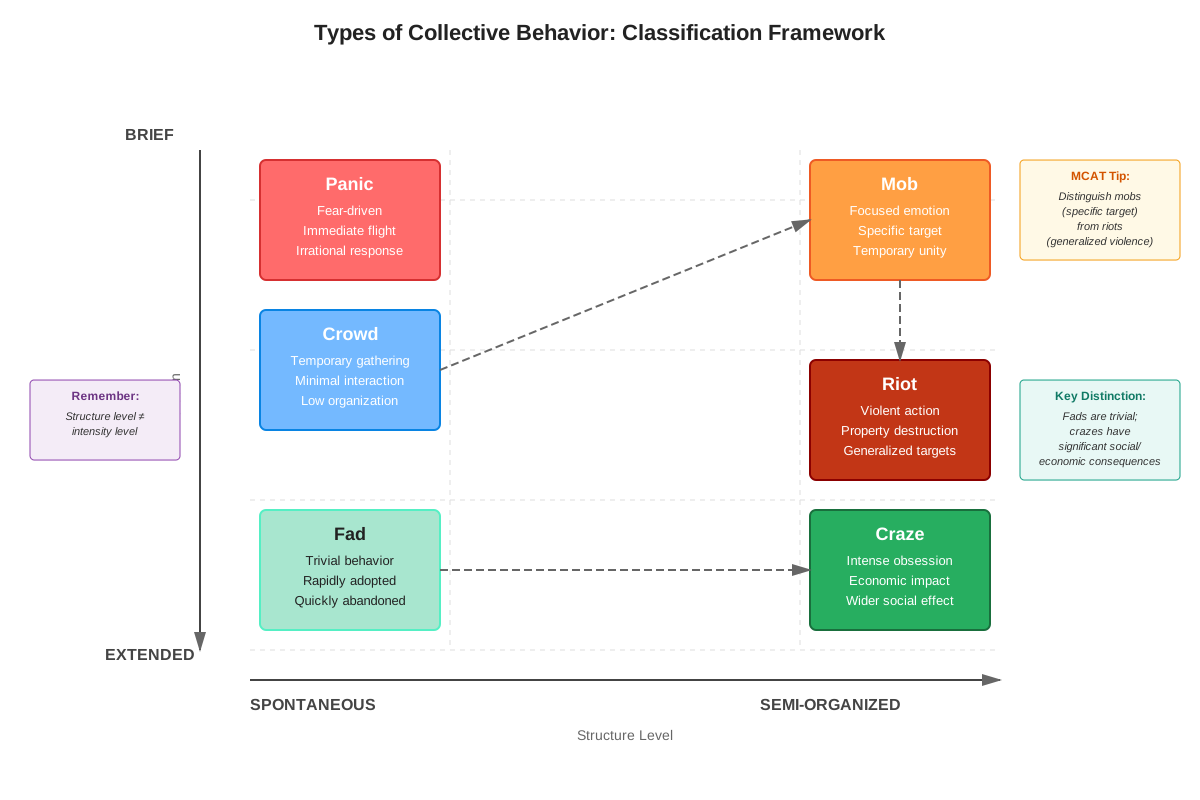
Mobs are emotionally charged crowds focused on a specific target or action, often involving aggressive or destructive behavior. Mobs exhibit high emotional intensity, clear focus on a target, and potential for violence. Historical examples include lynchings and vigilante justice, though mobs can also form around less violent objectives.
Riots represent violent collective behavior involving property destruction and attacks on people or institutions. Riots typically emerge from perceived injustice, frustration, or social tension, and involve breakdown of normal social control mechanisms. Unlike mobs with specific targets, riots involve more generalized violence and destruction.
Panics occur when people react to perceived threats with irrational, self-destructive collective behavior. Panic involves intense fear, breakdown of cooperative behavior, and competitive flight responses. Classic examples include theater fires where trampling occurs, or financial panics involving bank runs.
Mass hysteria represents collective anxiety or fear spreading through a population, often based on ambiguous threats or misinformation. Unlike panic, mass hysteria doesn't necessarily involve physical flight but rather psychological symptoms or irrational beliefs spreading through social contagion.
Crazes and fads are temporary enthusiasms for particular behaviors, objects, or ideas. Fads are short-lived, trivial trends (fashion trends, viral challenges), while crazes involve more intense, sometimes economically significant enthusiasm (investment bubbles, Beanie Babies). Both demonstrate how collective behavior can be positive or neutral rather than destructive.
Rumors represent unverified information spreading through informal communication networks. Rumors emerge in ambiguous situations where people seek information, and they often distort as they spread through serial transmission.
Theoretical Explanations for Collective Behavior
Several theoretical frameworks explain why and how collective behavior emerges:
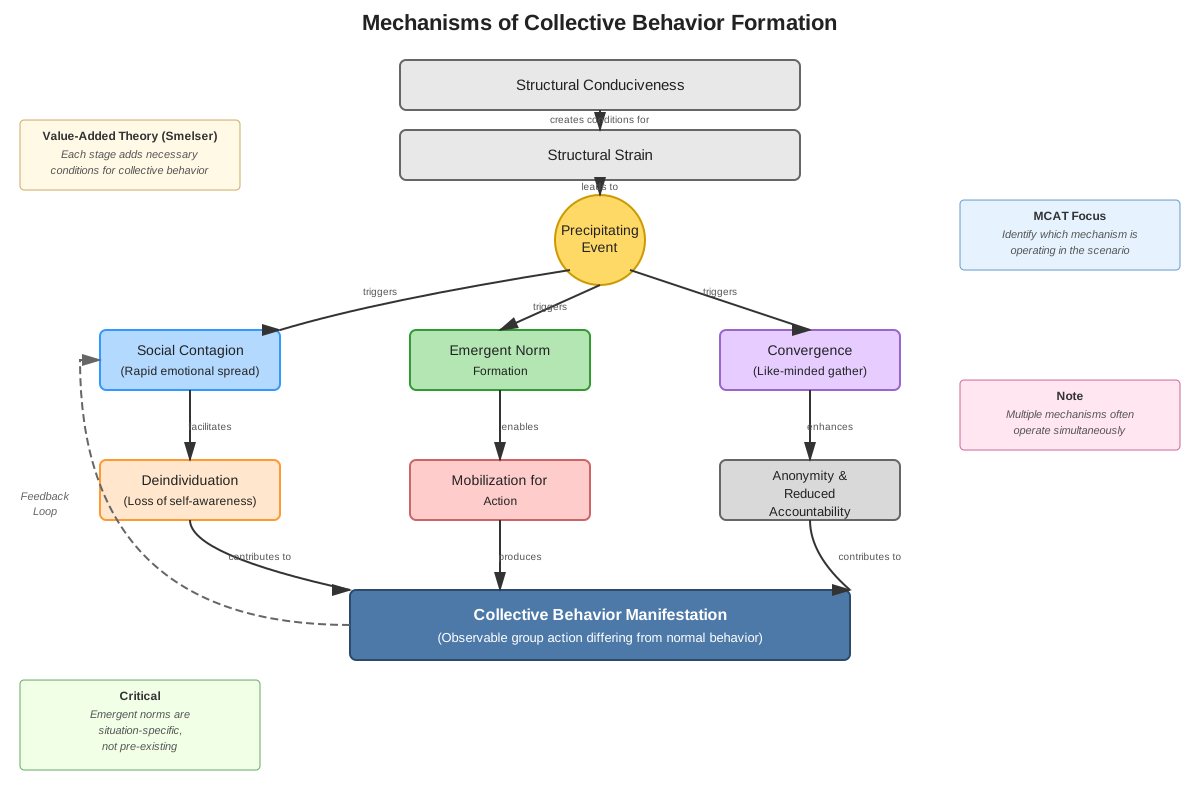
Contagion Theory (Gustave Le Bon) proposes that individuals in crowds experience a "collective mind" where rational thought diminishes and emotional contagion spreads rapidly. According to this perspective, anonymity in crowds reduces personal responsibility, leading to primitive, impulsive behavior. While influential historically, this theory has been criticized for oversimplifying crowd psychology and portraying crowd members as irrational.
Convergence Theory argues that collective behavior occurs when people with similar predispositions, values, or motivations gather together. Rather than the crowd transforming individuals, this theory suggests that like-minded people converge in the same location, making collective action appear coordinated. This explains why not all crowds become mobs—only those where participants share relevant predispositions.
Emergent Norm Theory (Ralph Turner and Lewis Killian) proposes that collective behavior follows new norms that emerge within the specific situation. When conventional norms prove inadequate, group members develop situation-specific guidelines through interaction. This theory emphasizes that crowd behavior is not irrational but rather follows different norms than everyday behavior. Emergent norms develop through: keynoter actions (influential individuals modeling behavior), communication among participants, and selective perception (noticing behaviors that fit emerging patterns).
Value-Added Theory (Neil Smelser) identifies six conditions necessary for collective behavior:
- Structural conduciveness: Social conditions that make collective behavior possible
- Structural strain: Social problems or tensions creating frustration
- Growth and spread of generalized belief: Shared explanation for the strain
- Precipitating factors: Specific events triggering action
- Mobilization for action: Leadership or communication organizing participants
- Social control: Failure of authorities to prevent or suppress the behavior
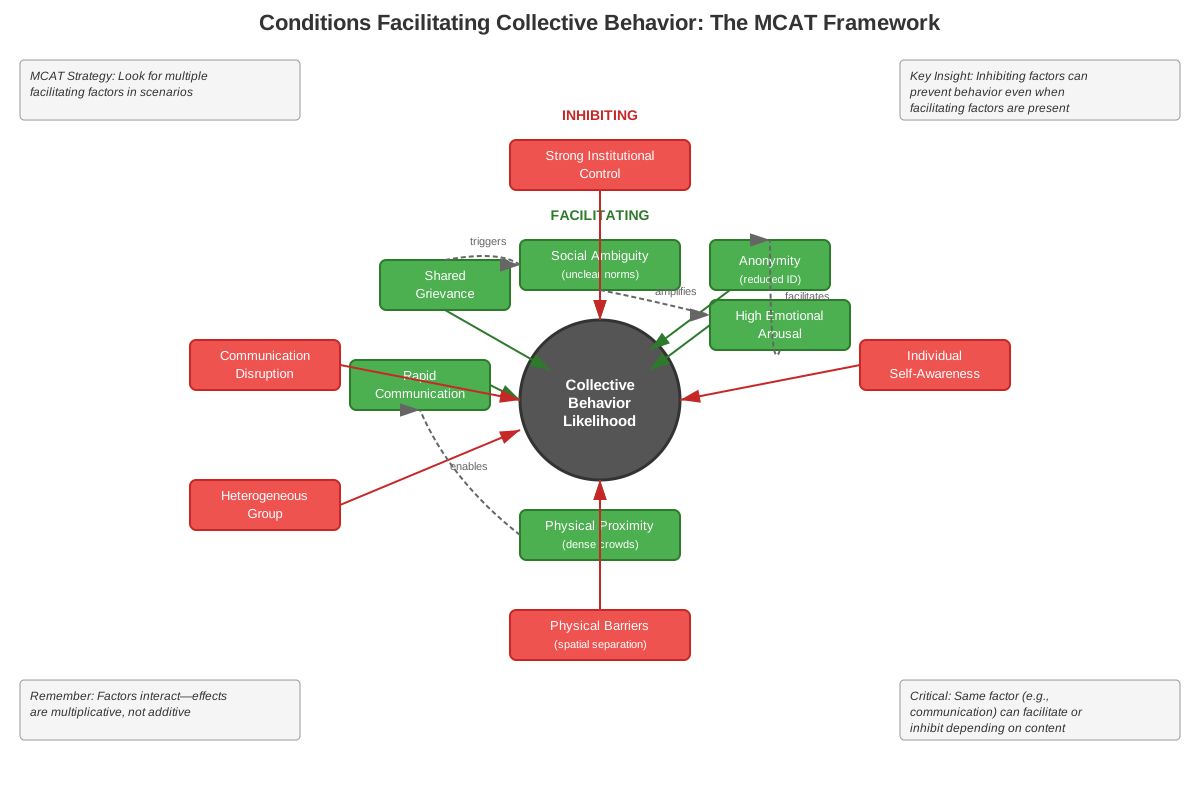
This theory explains why collective behavior occurs in some situations but not others, emphasizing that multiple conditions must align.
Social Contagion and Diffusion
Social contagion refers to the rapid spread of emotions, behaviors, or beliefs through a population, similar to disease transmission. This mechanism underlies many forms of collective behavior, from panic spreading through crowds to fads diffusing through social networks. Social contagion operates through: emotional contagion (automatic mimicry of others' emotional expressions), behavioral modeling (observational learning and imitation), and informational cascades (people following others' actions as information about appropriate behavior).
The speed and extent of social contagion depend on: network density (how interconnected people are), homophily (similarity among network members), threshold effects (how many others must adopt before an individual does), and communication channels (face-to-face versus mediated interaction).
Collective Behavior versus Social Movements
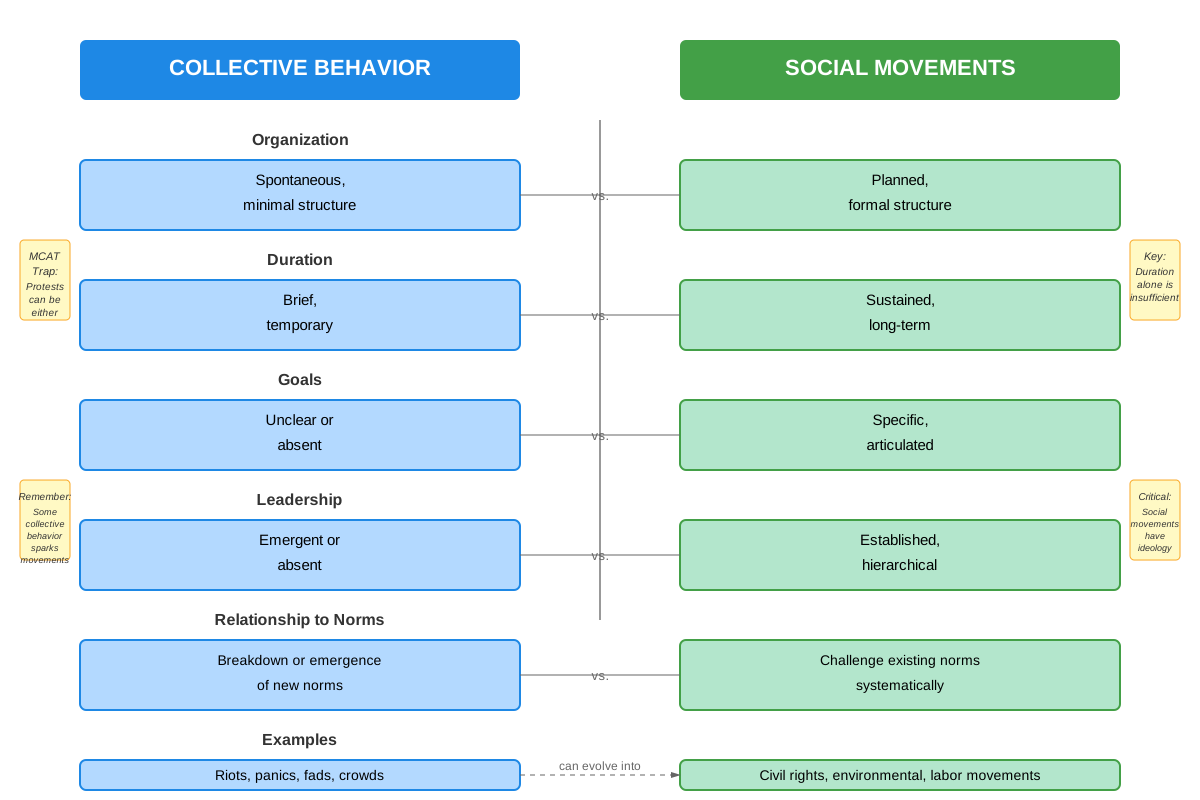
A critical distinction for the MCAT involves differentiating collective behavior from social movements. While both involve group action, they differ fundamentally:
| Feature | Collective Behavior | Social Movements |
|---|---|---|
| Duration | Short-lived, temporary | Sustained over time |
| Organization | Spontaneous, unstructured | Organized, structured |
| Goals | Often unclear or emergent | Explicit, defined objectives |
| Leadership | Minimal or emergent | Established leadership |
| Norms | Emergent, situation-specific | Developed, institutionalized |
| Membership | Fluid, unclear boundaries | Defined membership |
Social movements may incorporate collective behavior episodes (protests, demonstrations) but represent more sustained, organized efforts toward social change. Understanding this distinction helps analyze how temporary collective behavior can sometimes crystallize into lasting social movements.
Concept Relationships
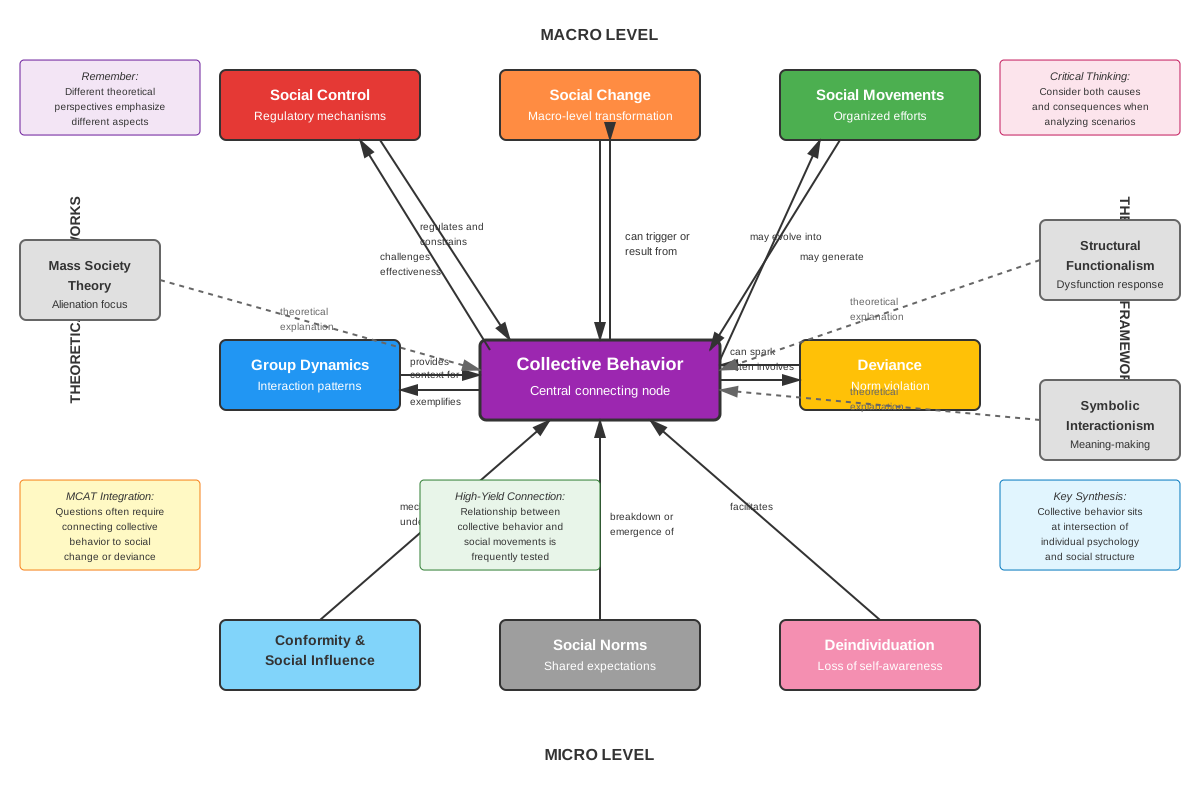
The concepts within collective behavior form an interconnected framework where understanding one element illuminates others. Collective behavior serves as the overarching concept, encompassing all the specific types (crowds, mobs, riots, panics, fads, rumors). Each type represents a particular manifestation shaped by specific conditions and mechanisms.
The theoretical explanations—contagion theory, convergence theory, emergent norm theory, and value-added theory—provide competing and complementary frameworks for understanding why collective behavior occurs. Emergent norm theory directly explains how crowds develop behavioral guidelines, which connects to the characteristic of collective behavior involving new norms. Social contagion represents a mechanism that operates across multiple types of collective behavior, explaining how emotions, behaviors, and beliefs spread rapidly through crowds, contributing to panics, riots, and fads alike.
The relationship flows: Ambiguous situations → Inadequate conventional norms → Emergence of collective behavior → Development of emergent norms or Social contagion → Specific manifestations (crowds, mobs, riots, etc.) → Potential transformation into social movements (if sustained and organized).
Collective behavior connects to prerequisite concepts through several pathways: Conformity and social influence provide the psychological mechanisms underlying social contagion and emergent norm adoption. Group dynamics explain how individual behavior transforms in collective contexts. Social norms establish the baseline from which collective behavior deviates, making the concept of emergent norms meaningful.
The topic also connects forward to Demographics and Social Change by explaining how societies respond to crises, how cultural innovations spread, and how temporary collective episodes can catalyze lasting social transformation. Understanding collective behavior provides essential context for analyzing social movements, cultural change, and demographic shifts—all critical topics within MCAT Sociology.
Quick check — test yourself on Collective behavior so far.
Try Flashcards →High-Yield Facts
⭐ Collective behavior is spontaneous, relatively unstructured group behavior that emerges in ambiguous situations where conventional norms provide inadequate guidance
⭐ Emergent norm theory explains collective behavior as following new, situation-specific norms that develop through group interaction rather than representing irrational mob mentality
⭐ The four types of crowds are casual (minimal interaction), conventional (follows norms), expressive (emotional release), and acting (goal-focused, potentially volatile)
⭐ Social movements differ from collective behavior in being sustained, organized, and having explicit goals, while collective behavior is temporary, spontaneous, and loosely structured
⭐ Value-added theory identifies six necessary conditions for collective behavior: structural conduciveness, structural strain, generalized belief, precipitating factors, mobilization, and failure of social control
- Mobs are emotionally charged crowds focused on specific targets, while riots involve more generalized violence and destruction
- Panic represents irrational, self-destructive collective behavior in response to perceived threats, often involving competitive flight
- Social contagion explains the rapid spread of emotions, behaviors, or beliefs through populations via emotional contagion, behavioral modeling, and informational cascades
- Convergence theory attributes collective behavior to like-minded individuals gathering together rather than crowds transforming individuals
- Mass hysteria involves collective anxiety spreading through populations based on ambiguous threats, often without physical flight responses
- Fads are short-lived, trivial trends while crazes involve more intense enthusiasm, but both demonstrate non-destructive collective behavior
- Contagion theory (Le Bon) proposed that crowds develop a "collective mind" with reduced rationality, though this view is now considered oversimplified
Common Misconceptions
Misconception: All collective behavior is violent, destructive, or irrational → Correction: Collective behavior encompasses a wide range of phenomena including neutral or positive activities like fads, crazes, and expressive crowds at concerts. Emergent norm theory demonstrates that collective behavior follows situation-specific norms rather than representing pure irrationality.
Misconception: Collective behavior and social movements are the same thing → Correction: Collective behavior is spontaneous, temporary, and unstructured, while social movements are sustained, organized efforts with explicit goals and established leadership. Social movements may incorporate collective behavior episodes but represent fundamentally different phenomena.
Misconception: People in crowds lose all individual identity and rational thought → Correction: While contagion theory proposed this idea, modern research shows that individuals in crowds retain agency and decision-making capacity. Emergent norm theory better explains crowd behavior as following new norms rather than abandoning rationality entirely.
Misconception: Convergence theory and contagion theory explain the same phenomenon → Correction: These theories offer competing explanations. Contagion theory argues that crowds transform individuals, while convergence theory maintains that like-minded people simply gather together, with no transformation occurring.
Misconception: All crowds will eventually become mobs or riots → Correction: Most crowds remain casual, conventional, or expressive without becoming acting crowds. The transformation to mob or riot requires specific conditions outlined in value-added theory, including structural strain, precipitating events, and failure of social control.
Misconception: Rumors are a form of mass communication rather than collective behavior → Correction: Rumors represent collective behavior because they emerge spontaneously in ambiguous situations, spread through informal networks, and often distort through transmission—all characteristics of collective behavior rather than formal communication.
Misconception: Panic always involves physical flight from danger → Correction: While panic often involves flight, mass hysteria represents a related phenomenon involving collective anxiety without necessarily fleeing. Both represent collective responses to perceived threats but manifest differently.
Worked Examples
Example 1: Identifying Type of Collective Behavior
Scenario: During a city-wide power outage lasting several hours, unverified reports spread through social media that the outage was caused by a terrorist attack. Despite official statements denying this, thousands of residents began stockpiling food and water, with some stores experiencing aggressive confrontations between customers competing for supplies. Within 24 hours, authorities confirmed the outage resulted from equipment failure, and normal behavior resumed.
Analysis:
Step 1: Identify the key features of the behavior described. The scenario involves: spontaneous emergence, response to ambiguous situation (power outage with unclear cause), spread of unverified information (rumors), temporary duration, and competitive behavior for resources.
Step 2: Classify the collective behavior types present. Multiple forms appear: Rumors (unverified reports of terrorism spreading through social networks), panic (competitive, self-interested behavior in response to perceived threat), and potentially mob behavior (aggressive confrontations at stores).
Step 3: Apply theoretical frameworks. Emergent norm theory explains how new behavioral norms (aggressive competition for supplies) emerged in the ambiguous situation. Social contagion explains how fear and rumors spread rapidly through social networks. Value-added theory conditions are present: structural conduciveness (power outage creating vulnerability), structural strain (fear of terrorism), generalized belief (terrorist attack explanation), precipitating factor (power outage itself), mobilization (social media spreading information), and inadequate social control (inability to immediately correct misinformation).
Step 4: Distinguish from related concepts. This is collective behavior rather than a social movement because it's temporary, spontaneous, and lacks organization or explicit goals beyond individual survival.
Conclusion: This scenario primarily illustrates panic and rumor as forms of collective behavior, driven by ambiguous circumstances and social contagion, with emergent norms replacing conventional shopping behavior.
Example 2: Applying Value-Added Theory
Scenario: A research passage describes a university where: (1) budget cuts have eliminated popular programs (structural strain), (2) the campus layout allows large gatherings (structural conduciveness), (3) students share beliefs that administration ignores their concerns (generalized belief), (4) administration announces further cuts via impersonal email (precipitating factor), (5) student leaders call for a protest (mobilization), and (6) campus security is understaffed (weak social control). The passage asks what outcome is most likely.
Analysis:
Step 1: Recognize that the scenario systematically presents all six conditions from Smelser's value-added theory, suggesting collective behavior is highly likely.
Step 2: Evaluate which conditions are strongest. All six conditions are present and clearly described, creating maximum likelihood for collective behavior emergence.
Step 3: Predict the type of collective behavior. Given the organized mobilization by student leaders and explicit goals (opposing budget cuts), this situation could evolve from collective behavior (initial protest) toward a social movement if sustained. The immediate outcome would likely be an acting crowd (goal-focused protest).
Step 4: Consider what would prevent collective behavior. Strengthening social control (increased security presence, administration engagement with concerns) or removing structural strain (reversing cuts) would reduce likelihood according to value-added theory.
Step 5: Distinguish answer choices. Correct answers would recognize high likelihood of collective behavior given all six conditions. Incorrect answers might suggest: no collective behavior will occur (ignoring the theory), violent riot (not supported—no indication of violence), or immediate social movement formation (premature—movements require sustained organization).
Conclusion: Value-added theory predicts collective behavior (likely a protest or demonstration) is highly probable when all six conditions align, making this a high-yield framework for analyzing MCAT scenarios about crowd formation and collective action.
Exam Strategy
When approaching MCAT questions on collective behavior, employ this systematic strategy:
Trigger Word Recognition: Watch for phrases indicating collective behavior: "spontaneous gathering," "crowd response," "temporary enthusiasm," "unverified information spreading," "panic," "riot," "mob," "fad," or "craze." These signal that the question tests collective behavior concepts. Also note phrases indicating what collective behavior is NOT: "organized movement," "sustained campaign," "formal organization," or "established institution."
Type Classification Strategy: When asked to identify the type of collective behavior, use this decision tree:
- Is it information spreading? → Likely rumor
- Is there intense fear and flight? → Likely panic or mass hysteria
- Is it a temporary enthusiasm? → Likely fad or craze
- Is it a gathering of people? → Determine crowd type (casual, conventional, expressive, or acting)
- Is there focused aggression? → Likely mob
- Is there generalized violence? → Likely riot
Theory Application: Questions often require applying theoretical frameworks. Quickly identify which theory is relevant:
- If the question emphasizes emotional spread or "crowd mentality" → Contagion theory
- If it emphasizes similar people gathering → Convergence theory
- If it describes new behavioral rules emerging → Emergent norm theory
- If it lists multiple conditions or asks what's missing → Value-added theory
Collective Behavior vs. Social Movement Distinction: This is a frequent trap. Use duration, organization, and goal clarity as quick discriminators. If the scenario describes something lasting weeks/months with leaders and explicit goals → social movement. If it's hours/days, spontaneous, with unclear goals → collective behavior.
Process of Elimination: Eliminate answers that:
- Confuse collective behavior with formal organizations
- Attribute all crowd behavior to irrationality (overly simplistic contagion theory)
- Ignore the spontaneous, temporary nature of collective behavior
- Misclassify types (e.g., calling a fad a panic, or a mob a riot)
Time Allocation: Collective behavior questions typically require 60-90 seconds. Spend 20-30 seconds identifying the type and relevant theory, then 30-60 seconds evaluating answer choices. Don't overthink—these questions usually test straightforward application of definitions and theories.
Memory Techniques
MNEMONIC for Types of Collective Behavior: "Can Cats Eat Mice, Rats, Frogs, Peacefully?"
- Crowds
- Crazes
- Expressive crowds
- Mobs
- Riots
- Fads
- Panics
MNEMONIC for Four Crowd Types: "Can Cats Ever Act?"
- Casual (minimal interaction)
- Conventional (follows norms)
- Expressive (emotional release)
- Acting (goal-focused)
MNEMONIC for Value-Added Theory's Six Conditions: "Some Students Get Pretty Mad Sometimes"
- Structural conduciveness
- Structural strain
- Generalized belief
- Precipitating factors
- Mobilization
- Social control (failure of)
Visualization for Emergent Norm Theory: Picture a crowd at a concert where initially everyone sits quietly (conventional norms). One person stands and cheers (keynoter), others notice and stand (communication), soon everyone is standing and cheering (emergent norm established). This visual captures how new norms emerge through interaction.
Acronym for Collective Behavior Characteristics: "SWEDE"
- Spontaneous
- Weak boundaries
- Emergent norms
- Duration (limited)
- Emotional arousal
Contrast Memory Aid: Remember "COLLECTIVE = TEMPORARY" and "MOVEMENT = SUSTAINED" to quickly distinguish these commonly confused concepts.
Summary
Collective behavior represents spontaneous, relatively unstructured group responses to ambiguous situations where conventional norms prove inadequate. This fundamental sociological concept encompasses diverse phenomena including crowds (casual, conventional, expressive, and acting), mobs, riots, panics, mass hysteria, fads, crazes, and rumors. Understanding collective behavior requires mastering multiple theoretical frameworks: contagion theory emphasizes emotional spread and reduced rationality; convergence theory attributes collective action to like-minded individuals gathering; emergent norm theory explains how situation-specific behavioral guidelines develop through interaction; and value-added theory identifies six necessary conditions for collective behavior emergence. Social contagion mechanisms—emotional contagion, behavioral modeling, and informational cascades—explain how behaviors and beliefs spread rapidly through populations. Critical for MCAT success is distinguishing collective behavior (temporary, spontaneous, unstructured) from social movements (sustained, organized, goal-directed). The topic connects broadly to group dynamics, social influence, conformity, and social change, making it essential for analyzing how societies respond to crises and how individual behavior transforms in collective contexts.
Key Takeaways
- Collective behavior is spontaneous, temporary, and emerges when conventional norms fail to guide behavior in ambiguous situations
- The four crowd types—casual, conventional, expressive, and acting—represent increasing levels of interaction and emotional intensity
- Emergent norm theory best explains collective behavior as following new, situation-specific norms rather than representing pure irrationality
- Value-added theory's six conditions (structural conduciveness, strain, generalized belief, precipitating factors, mobilization, and failed social control) predict when collective behavior will occur
- Collective behavior differs fundamentally from social movements in duration, organization, structure, and goal clarity
- Social contagion explains rapid spread of emotions, behaviors, and beliefs through emotional contagion, modeling, and informational cascades
- Multiple types of collective behavior (rumors, panics, fads, riots, mobs) can be distinguished by their specific characteristics and manifestations
Related Topics
Social Movements: Building on collective behavior, social movements represent organized, sustained efforts toward social change with explicit goals and established leadership structures. Understanding collective behavior provides foundation for analyzing how movements mobilize participants and maintain momentum.
Group Dynamics and Social Influence: These topics explore the psychological mechanisms underlying collective behavior, including conformity, obedience, groupthink, and social facilitation. Mastering these concepts deepens understanding of why individuals behave differently in collective contexts.
Deviance and Social Control: Collective behavior often involves deviation from conventional norms, making theories of deviance and mechanisms of social control directly relevant. Understanding how societies maintain order illuminates why collective behavior emerges when control mechanisms fail.
Cultural Change and Diffusion: Fads, crazes, and other forms of collective behavior represent mechanisms through which cultural innovations spread, connecting to broader patterns of cultural change and the diffusion of innovations through populations.
Mass Media and Communication: Modern collective behavior increasingly involves social media and mass communication, making understanding of media effects, information cascades, and digital social networks essential for analyzing contemporary collective behavior phenomena.
Practice CTA
Now that you've mastered the core concepts of collective behavior, it's time to solidify your understanding through active practice. Challenge yourself with MCAT-style practice questions that require you to identify types of collective behavior, apply theoretical frameworks to novel scenarios, and distinguish collective behavior from related concepts. Use flashcards to reinforce definitions, theoretical perspectives, and the characteristics of different collective behavior types. Remember: the MCAT tests application, not just memorization, so focus on practicing with realistic scenarios that mirror exam passages. Your ability to quickly recognize collective behavior principles in complex vignettes will directly translate to points on test day. You've built a strong foundation—now apply it!
Sign up free to keep reading
Create a free AnvayaPrep account to finish this MCAT guide on Collective behavior — plus flashcards and practice questions.