Overview
The independent variable is a foundational concept in research methodology that appears frequently across the MCAT's Psychological, Social, and Biological Foundations of Behavior section. In experimental research design, the independent variable represents the factor that researchers deliberately manipulate or vary to observe its effect on another variable. Understanding this concept is essential not only for interpreting research studies presented in MCAT passages but also for critically evaluating the validity of experimental designs and causal claims made in scientific literature.
For MCAT success, students must recognize that the independent variable serves as the presumed cause in a cause-and-effect relationship being tested. When researchers hypothesize that "X causes Y," X represents the independent variable—the factor under the researcher's control that is systematically changed or assigned to different groups. This concept forms the backbone of experimental design and appears in approximately 15-20% of Sociology and psychology passages on the MCAT, often embedded within descriptions of research studies testing social phenomena, behavioral interventions, or biological mechanisms with social implications.
The independent variable concept connects intimately with other critical Research Methods and Statistics topics including dependent variables, control variables, confounding variables, and experimental design principles. Mastery of this topic enables students to quickly parse complex research passages, identify study limitations, evaluate whether causal conclusions are justified, and distinguish between experimental and correlational research designs—all high-yield skills for the MCAT. Furthermore, understanding independent variables provides the foundation for interpreting statistical analyses, recognizing operational definitions, and evaluating the internal and external validity of research findings presented in exam passages.
Learning Objectives
- [ ] Define Independent variable using accurate Sociology terminology and distinguish it from other variable types
- [ ] Explain why Independent variable matters for the MCAT and identify its frequency in exam passages
- [ ] Apply Independent variable concepts to exam-style questions involving research design interpretation
- [ ] Identify common mistakes related to Independent variable recognition and classification
- [ ] Connect Independent variable to related Sociology concepts including causation, experimental design, and validity
- [ ] Differentiate between manipulated and measured independent variables in various research contexts
- [ ] Evaluate whether a study's design allows for causal inferences based on independent variable manipulation
- [ ] Recognize operational definitions of independent variables in MCAT research passages
Prerequisites
- Basic understanding of scientific method: Necessary to comprehend how variables fit into hypothesis testing and research design
- Familiarity with cause-and-effect relationships: Required to understand why researchers manipulate independent variables to establish causation
- Knowledge of experimental vs. observational studies: Essential for recognizing when true independent variable manipulation occurs versus when variables are merely measured
- Understanding of research hypotheses: Needed to identify which variable is predicted to cause changes in another variable
Why This Topic Matters
Clinical and Real-World Significance
Independent variables are central to evidence-based medicine and public health interventions. When researchers test whether a new therapy reduces depression symptoms, the therapy type is the independent variable. When public health officials evaluate whether an educational campaign reduces smoking rates, the campaign exposure is the independent variable. Understanding independent variables allows healthcare professionals to critically evaluate treatment efficacy claims, assess intervention studies, and make informed decisions about patient care based on research evidence. In sociology and public health contexts, identifying independent variables helps researchers understand social determinants of health, evaluate policy interventions, and establish which factors genuinely influence health outcomes versus those that merely correlate with them.
MCAT Examination Statistics
Independent variable identification appears in approximately 15-20% of passages in the Psychological, Social, and Biological Foundations of Behavior section. Questions may directly ask students to identify the independent variable in a described study, or they may require students to recognize limitations in causal claims based on whether true independent variable manipulation occurred. The MCAT frequently presents research scenarios where students must distinguish between independent and dependent variables, identify confounding variables that threaten internal validity, or evaluate whether a study design supports causal conclusions. This topic also appears in questions about experimental design, operational definitions, and research ethics.
Common MCAT Passage Contexts
Independent variables typically appear in passages describing: (1) experimental interventions testing behavioral or social interventions, (2) studies comparing different groups or conditions, (3) research examining effects of social factors on health outcomes, (4) methodological critiques requiring evaluation of study design, and (5) passages presenting correlational data where students must recognize the absence of true independent variable manipulation. The MCAT often embeds independent variable concepts within longer passages about health disparities, behavioral interventions, social psychology experiments, or epidemiological studies.
Core Concepts
Definition and Fundamental Characteristics
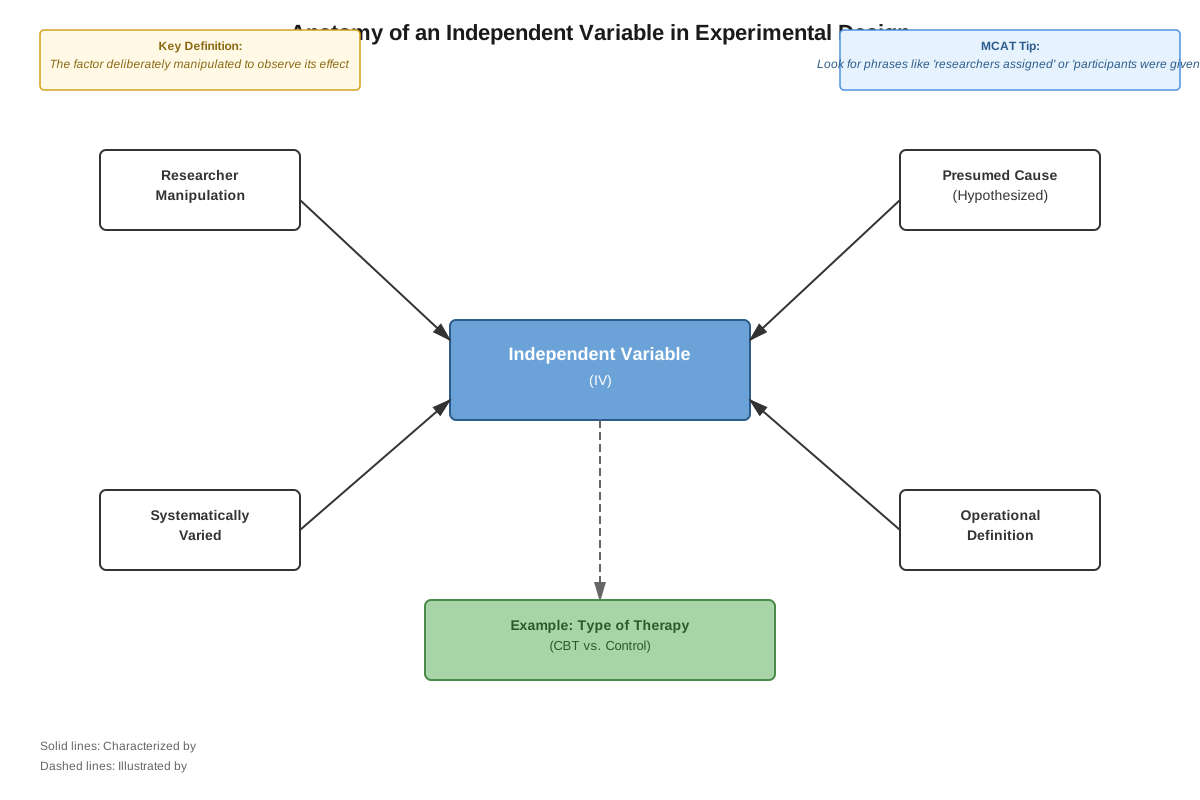
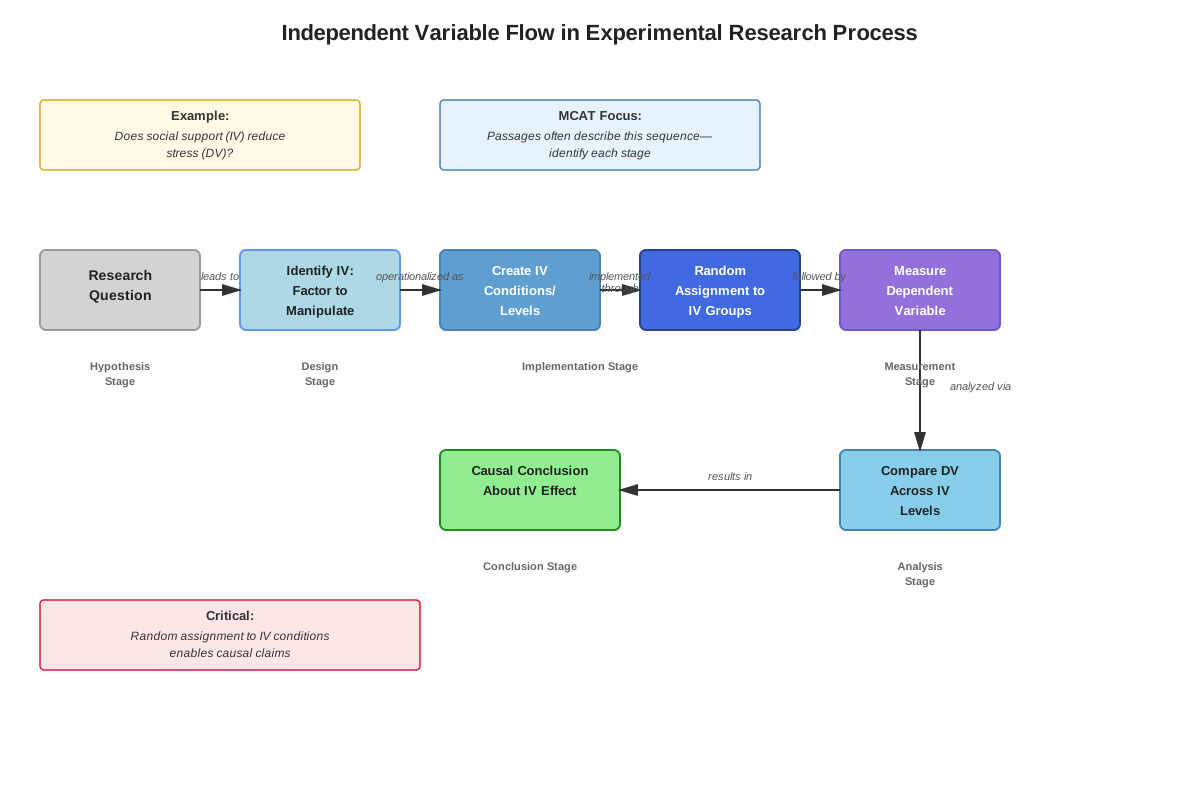
The independent variable (IV) is the variable in an experiment that researchers systematically manipulate, control, or select to determine its effect on another variable. It represents the presumed cause in a hypothesized cause-and-effect relationship. The independent variable is "independent" because its values are determined by the researcher's experimental design rather than being influenced by other variables in the study. In a true experiment, researchers assign participants to different levels or conditions of the independent variable, then measure outcomes to determine whether the manipulation produced changes.
Key characteristics of independent variables include:
- Researcher control: The researcher determines the values, levels, or conditions of the independent variable
- Temporal precedence: The independent variable occurs before or is present when measuring the dependent variable
- Hypothesized causality: The independent variable is predicted to cause changes in the dependent variable
- Operational definition: The independent variable must be clearly defined in measurable, concrete terms
Types of Independent Variables
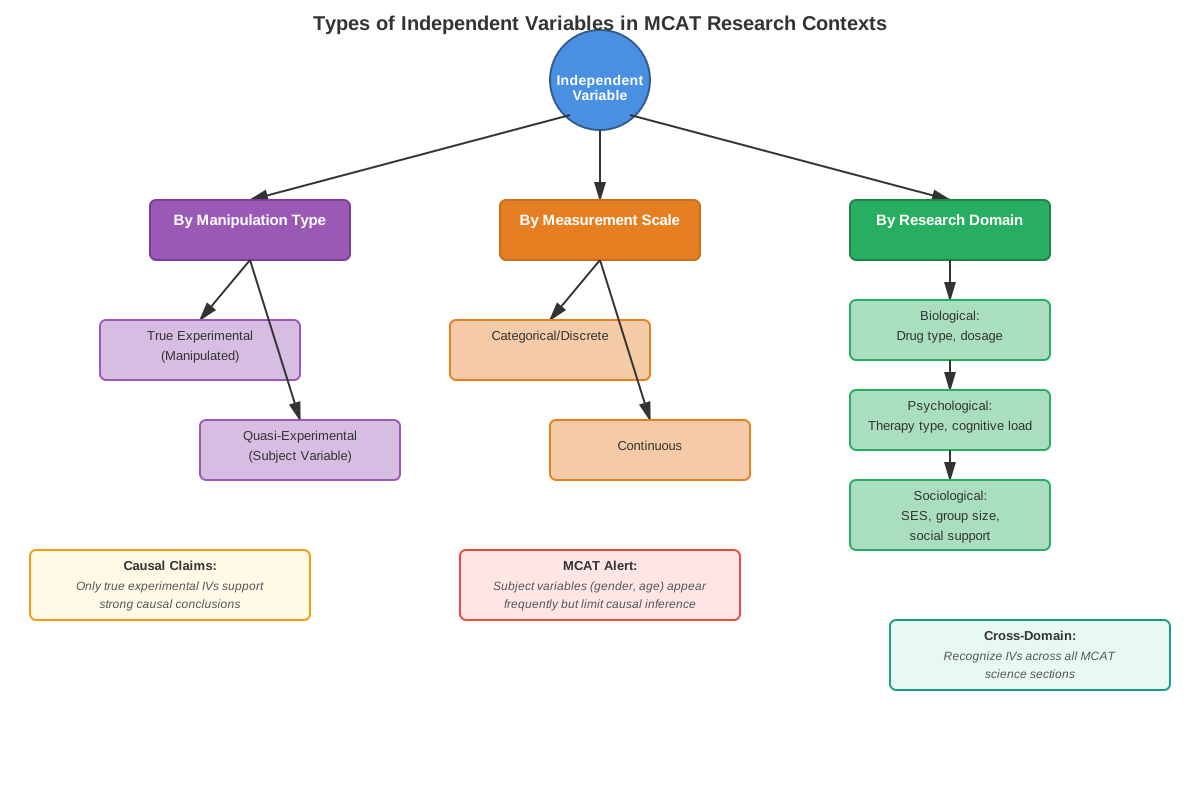
Independent variables can be classified into several categories relevant for MCAT passages:
Manipulated Independent Variables: These are variables that researchers actively change or assign. For example, in a study testing whether cognitive-behavioral therapy (CBT) reduces anxiety, researchers might randomly assign participants to receive either CBT or no treatment. The treatment condition (CBT vs. control) is a manipulated independent variable. This type allows for the strongest causal inferences.
Subject/Participant Variables: These are pre-existing characteristics that researchers select or measure but cannot manipulate for practical or ethical reasons. Examples include age, gender, socioeconomic status, or ethnicity. While researchers may compare groups based on these variables, they cannot randomly assign participants to different levels. Studies using only subject variables are technically quasi-experimental or correlational rather than truly experimental, limiting causal conclusions.
Situational Variables: These are environmental or contextual factors that researchers manipulate. For example, researchers might vary room temperature, noise level, or social context to examine effects on behavior or performance.
Levels and Conditions of Independent Variables
Independent variables must have at least two levels or conditions to allow comparison. These levels represent different values or categories of the independent variable:
- Binary/Dichotomous: Two levels (e.g., treatment vs. control; male vs. female)
- Categorical: Multiple discrete categories (e.g., low, medium, high socioeconomic status)
- Continuous: Measured on a continuous scale, though often grouped into categories for analysis (e.g., dosage amounts, duration of exposure)
The number and nature of levels affect the complexity of the research design and the types of conclusions researchers can draw. MCAT passages often describe studies with multiple independent variables (factorial designs) where researchers examine how different factors interact.
Operational Definitions
An operational definition specifies exactly how researchers measure or manipulate the independent variable in concrete, observable terms. For MCAT passages, recognizing operational definitions is crucial for evaluating study validity. For example:
- Conceptual definition: "Social support"
- Operational definition: "Number of close friends participants report having" or "Assignment to weekly group therapy sessions"
Poor operational definitions threaten construct validity—the degree to which the independent variable actually represents the theoretical concept researchers intend to study. MCAT questions may ask students to identify limitations in how independent variables were operationalized.
Independent Variables in Different Research Designs
| Research Design | Independent Variable Characteristics | Causal Inference Strength | MCAT Example |
|---|---|---|---|
| True Experiment | Randomly assigned manipulation | Strong | Randomly assigning participants to meditation training vs. control group |
| Quasi-Experiment | Non-random assignment to conditions | Moderate | Comparing students who chose to attend tutoring vs. those who didn't |
| Correlational Study | Measured, not manipulated | Weak/None | Measuring both stress levels and illness frequency |
| Natural Experiment | Naturally occurring variation | Moderate | Comparing communities before/after policy implementation |
Distinguishing Independent from Dependent Variables
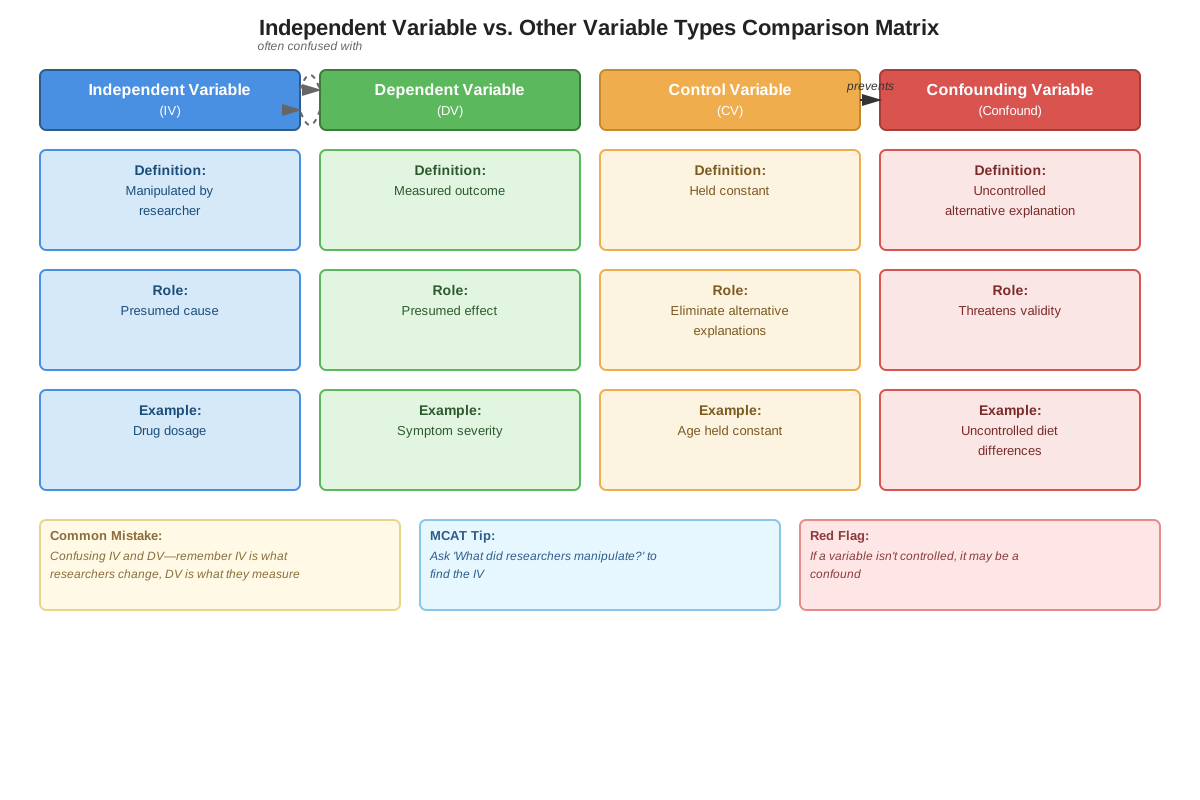
The dependent variable (DV) is the outcome that researchers measure to determine whether the independent variable had an effect. A simple rule: the independent variable is what researchers change or select; the dependent variable is what they measure as a result. In the hypothesis "Increased social support reduces depression," social support is the independent variable (the presumed cause) and depression is the dependent variable (the presumed effect).
MCAT passages may present complex scenarios where multiple variables are measured. Students must identify which variable is hypothesized to influence others. Temporal order provides a key clue: the independent variable typically comes first chronologically or logically in the causal sequence.
Control and Confounding Variables
Understanding independent variables requires distinguishing them from control variables (factors held constant to prevent them from influencing results) and confounding variables (unmeasured factors that vary systematically with the independent variable and could provide alternative explanations for results). Strong experimental designs control potential confounds through random assignment, matching, or statistical control, ensuring that only the independent variable differs systematically between groups.
Concept Relationships
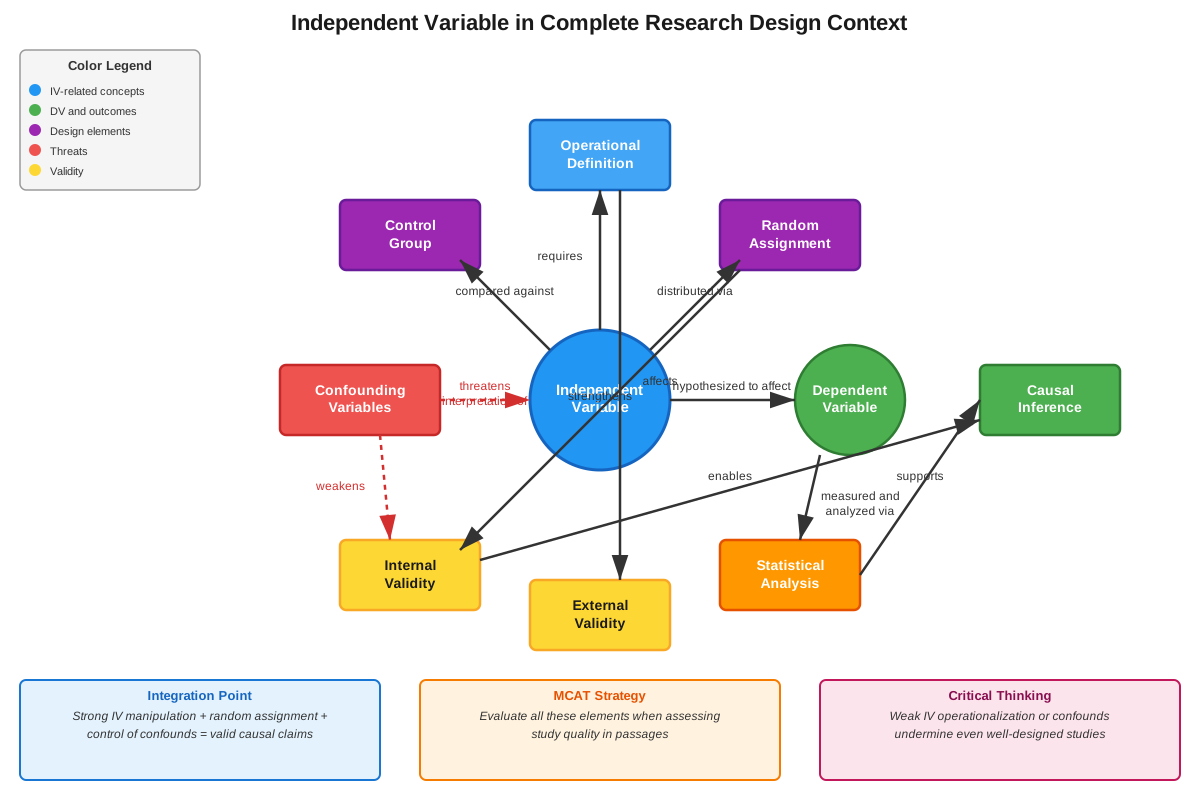
The independent variable concept sits at the center of a network of interconnected research methodology concepts. Understanding these relationships is essential for MCAT success:
Independent Variable → Dependent Variable: This represents the fundamental hypothesized causal relationship in experimental research. Researchers manipulate the independent variable to observe changes in the dependent variable. This directional relationship forms the basis for testing cause-and-effect hypotheses.
Independent Variable ← → Experimental Design: The nature and number of independent variables determine the research design type. Single independent variables with two levels create simple experimental designs, while multiple independent variables create factorial designs. The way researchers assign participants to independent variable levels (random vs. non-random) determines whether the design is truly experimental or quasi-experimental.
Independent Variable ← → Internal Validity: Proper manipulation and control of the independent variable is essential for internal validity—the degree to which a study can support causal conclusions. When confounding variables are not controlled, they threaten internal validity by providing alternative explanations for observed effects.
Independent Variable ← → Operational Definitions: Every independent variable requires an operational definition specifying exactly how it is manipulated or measured. Poor operational definitions threaten construct validity—whether the independent variable actually represents the theoretical concept of interest.
Independent Variable → Statistical Analysis: The type of independent variable (categorical vs. continuous; number of levels) determines appropriate statistical tests. Understanding independent variables helps interpret statistical results presented in MCAT passages.
Independent Variable ← → Research Ethics: Some potential independent variables cannot be manipulated for ethical reasons (e.g., randomly assigning people to smoke cigarettes), limiting researchers to quasi-experimental or correlational designs with subject variables.
High-Yield Facts
⭐ The independent variable is the factor that researchers manipulate or select to determine its effect on the dependent variable; it represents the presumed cause in a cause-and-effect relationship.
⭐ True experiments require random assignment of participants to different levels of the independent variable; without random assignment, the study is quasi-experimental or correlational, limiting causal inferences.
⭐ Independent variables must have at least two levels or conditions to allow comparison between groups or conditions.
⭐ Subject variables (age, gender, ethnicity, pre-existing characteristics) can serve as independent variables but cannot be randomly assigned, making them weaker for establishing causation.
⭐ The operational definition of an independent variable specifies exactly how it is manipulated or measured in concrete, observable terms.
- Independent variables precede dependent variables temporally or logically in the hypothesized causal sequence.
- Confounding variables threaten internal validity by providing alternative explanations for observed relationships between independent and dependent variables.
- Factorial designs include multiple independent variables, allowing researchers to examine interaction effects.
- Control variables are held constant across all conditions to prevent them from influencing the dependent variable.
- The strength of causal inferences depends on whether the independent variable was truly manipulated versus merely measured or selected.
Quick check — test yourself on Independent variable so far.
Try Flashcards →Common Misconceptions
Misconception: The independent variable is always the variable that changes during the experiment.
Correction: While the independent variable does vary across conditions, the dependent variable also changes (hopefully in response to the independent variable manipulation). The key distinction is that researchers control and manipulate the independent variable, while they measure the dependent variable as an outcome. The independent variable is what researchers change; the dependent variable is what changes as a result.
Misconception: Any variable measured first in a study is automatically the independent variable.
Correction: Temporal order alone does not determine which variable is independent. The independent variable is determined by the research hypothesis and design—specifically, which variable is hypothesized to cause changes in another. In correlational studies where researchers measure multiple variables simultaneously, neither may be a true independent variable since neither is manipulated.
Misconception: Studies can only have one independent variable.
Correction: Research designs frequently include multiple independent variables. Factorial designs systematically vary two or more independent variables simultaneously, allowing researchers to examine both main effects (effects of each independent variable separately) and interaction effects (whether the effect of one independent variable depends on the level of another).
Misconception: Subject variables like age or gender are not independent variables because they cannot be manipulated.
Correction: Subject variables can function as independent variables in research designs, even though they cannot be randomly assigned. However, studies using only subject variables are quasi-experimental rather than truly experimental, which limits the strength of causal conclusions. MCAT passages may describe such studies and ask about their limitations.
Misconception: The independent variable must be the variable that shows the most change or variation in a study.
Correction: The amount of change or variation in a variable does not determine whether it is independent or dependent. The independent variable is defined by its role in the research design (what researchers manipulate) and the hypothesis (the presumed cause), not by how much it varies. In fact, independent variables in some designs may have only two levels with minimal quantitative difference.
Misconception: If two variables are correlated, the one measured first must be the independent variable causing changes in the other.
Correction: Correlation does not establish causation or identify independent variables. In purely correlational research, neither variable is truly independent because neither is manipulated. Both variables are simply measured, and the correlation could result from: (1) X causing Y, (2) Y causing X, (3) a third variable causing both, or (4) coincidence. Only experimental manipulation of an independent variable allows causal inferences.
Worked Examples
Example 1: Identifying Independent Variables in a Social Psychology Study
Passage Summary: Researchers hypothesized that stereotype threat reduces academic performance among minority students. They recruited 120 college students (60 African American, 60 White) and randomly assigned half of each ethnic group to one of two conditions. In the "stereotype threat" condition, students were told that the test they would take measures intellectual ability and that previous research has shown ethnic differences in performance. In the "reduced threat" condition, students were told the test was simply a problem-solving exercise being developed and that no group differences had been found. All students then completed the same 20-item test, and researchers recorded the number of correct answers.
Question: Identify all independent variables in this study and classify each as manipulated or subject variable.
Solution:
Step 1: Identify what researchers manipulated or selected for comparison.
- Researchers created two different testing conditions (stereotype threat vs. reduced threat)
- Researchers selected participants based on ethnicity (African American vs. White)
Step 2: Determine which variables are hypothesized to cause changes in outcomes.
- The testing condition is hypothesized to affect performance
- Ethnicity is included to examine whether stereotype threat effects differ by ethnic group
Step 3: Classify each independent variable.
Independent Variable 1: Testing Condition (Stereotype Threat vs. Reduced Threat)
- Type: Manipulated independent variable
- Levels: Two (stereotype threat, reduced threat)
- Justification: Researchers actively created and randomly assigned participants to these conditions. This is the primary independent variable of interest.
Independent Variable 2: Ethnicity (African American vs. White)
- Type: Subject/participant variable
- Levels: Two (African American, White)
- Justification: This is a pre-existing characteristic that researchers selected but could not manipulate or randomly assign. It serves as a second independent variable in this factorial design.
Step 4: Identify the dependent variable for clarity.
- Dependent variable: Test performance (number of correct answers)
- This is what researchers measured as the outcome
Step 5: Evaluate causal inference strength.
Because testing condition was randomly assigned (manipulated), researchers can make causal claims about its effects. However, because ethnicity is a subject variable, any differences between ethnic groups could be due to confounding factors beyond ethnicity itself. The study can establish that stereotype threat manipulations cause performance changes but must be cautious about attributing ethnic group differences solely to ethnicity.
Connection to Learning Objectives: This example demonstrates how to identify multiple independent variables, distinguish manipulated from subject variables, and evaluate the strength of causal inferences based on independent variable type—all critical skills for MCAT passages.
Example 2: Evaluating Study Design Limitations
Passage Summary: A researcher interested in the relationship between social media use and depression recruited 200 college students and asked them to report: (1) average hours per day spent on social media over the past month, and (2) complete a depression symptom questionnaire. The researcher found a significant positive correlation (r = 0.45, p < 0.01) between social media use and depression scores. The researcher concluded that "social media use causes increased depression among college students."
Question: Evaluate whether this study design supports the researcher's causal conclusion. Identify any independent variable issues that limit causal inference.
Solution:
Step 1: Determine whether there is a true independent variable.
- The researcher measured both social media use and depression scores
- Neither variable was manipulated or assigned by the researcher
- Both variables were simply measured as they naturally occurred
Conclusion: This is a correlational study with no true independent variable manipulation.
Step 2: Evaluate temporal precedence.
- Both variables were measured simultaneously (retrospectively for the past month)
- The design does not establish which variable came first
- Depression could have preceded and caused increased social media use, rather than vice versa
Step 3: Identify potential confounding variables.
- Many third variables could explain the correlation:
- Social isolation might cause both increased social media use (as compensation) and depression
- Stressful life events might cause both increased social media use (as coping) and depression
- Personality traits might predispose individuals to both behaviors
Step 4: Evaluate the causal claim.
The researcher's conclusion that "social media use causes increased depression" is not supported by this study design because:
- No independent variable manipulation: The researcher did not assign participants to different levels of social media use, so this is not an experiment
- Lack of temporal precedence: The design cannot establish whether social media use preceded depression
- Uncontrolled confounds: Alternative explanations cannot be ruled out
- Correlation ≠ Causation: The study only establishes association, not causation
Step 5: Identify what would be needed for causal inference.
To support causal claims, the researcher would need to:
- Randomly assign participants to different levels of social media use (e.g., high use vs. restricted use)
- Measure depression before and after the manipulation
- Control potential confounding variables
- Establish that changes in the independent variable (social media use) preceded changes in the dependent variable (depression)
MCAT Application: This type of question is extremely common on the MCAT. Students must recognize when study designs lack true independent variable manipulation and therefore cannot support causal conclusions, even when significant correlations are found. Watch for passages that describe correlational findings but make causal claims—these often appear in questions asking about study limitations.
Exam Strategy
Approaching MCAT Questions on Independent Variables
Step 1: Identify the Research Question or Hypothesis
Begin by determining what the researchers are trying to test. The independent variable will be the factor hypothesized to cause changes in the outcome of interest. Look for phrases like "the effect of X on Y" or "whether X influences Y"—X is typically the independent variable.
Step 2: Look for Manipulation or Assignment Language
Key trigger words indicating independent variables include:
- "Randomly assigned to..."
- "Participants were divided into groups receiving..."
- "Researchers manipulated..."
- "Conditions included..."
- "Participants were exposed to..."
Step 3: Apply the "What Did Researchers Control?" Test
Ask yourself: What did researchers decide or control about participants' experiences? The answer is usually the independent variable. What did researchers measure as a result? That's typically the dependent variable.
Step 4: Evaluate Causal Inference Strength
For questions about study limitations or conclusions:
- True manipulation + random assignment = strong causal inference
- Subject variables only = weak causal inference
- No manipulation (correlational) = no causal inference
Trigger Words and Phrases
Independent Variable Indicators:
- "Manipulated," "assigned," "administered," "exposed to"
- "Treatment condition," "experimental group," "control group"
- "Levels of," "conditions," "groups"
- "Predictor variable" (in statistical contexts)
Question Stems to Watch For:
- "What is the independent variable in this study?"
- "Which factor did researchers manipulate?"
- "What limits causal conclusions in this study?"
- "The study design is best described as..." (requires identifying whether true independent variable manipulation occurred)
Process of Elimination Tips
When identifying independent variables:
- Eliminate outcomes: If a variable is described as a result, outcome, or measurement of change, it's likely the dependent variable, not independent
- Eliminate constants: Variables held constant across all conditions are control variables, not independent variables
- Eliminate unmeasured factors: True independent variables must be explicitly defined and implemented in the study design
- Eliminate variables measured after the outcome: Independent variables must precede or co-occur with (not follow) dependent variables
Time Allocation
Independent variable questions typically require 60-90 seconds:
- 20-30 seconds: Identify the research hypothesis and what was manipulated
- 20-30 seconds: Distinguish independent from dependent variables
- 20-30 seconds: Evaluate answer choices or consider study limitations
Don't overthink these questions—the independent variable is usually clearly stated in well-designed MCAT passages. If you're spending more than 90 seconds, you may be overcomplicating the question.
Memory Techniques
The "I CAUSE D" Mnemonic
Independent variable
Causes changes in
Another variable
Under researcher control
Systematically manipulated
Examined for
Dependent variable effects
The "CRIME" Framework for Variable Identification
Cause (Independent variable is the presumed cause)
Researcher controls it (Independent variable is manipulated)
Initial in sequence (Independent variable comes first)
Measured outcome is different (That's the dependent variable)
Experimental assignment (Random assignment strengthens causal claims)
Visualization Strategy
Picture an experiment as a machine:
- INPUT (what you put in) = Independent Variable
- MACHINE (the process) = Participants/experimental procedure
- OUTPUT (what comes out) = Dependent Variable
The researcher controls the INPUT (independent variable) and measures the OUTPUT (dependent variable) to see if changing the input changes the output.
The "Before and After" Rule
Before: Independent variable (the cause must come before the effect)
After: Dependent variable (the effect comes after the cause)
If you can't determine temporal order from the passage, identify which variable the researchers hypothesized would influence the other—that's your independent variable.
Acronym for Study Design Strength: "RICE"
Random assignment (strongest)
Independent variable manipulation (required for experiments)
Correlational measurement only (weakest)
Ethical constraints (may prevent manipulation)
This helps remember that random assignment to manipulated independent variables provides the strongest evidence for causation.
Summary
The independent variable represents the cornerstone of experimental research design and appears frequently in MCAT passages testing research methodology and critical thinking. As the factor that researchers systematically manipulate or select to examine its effects on outcomes, the independent variable embodies the presumed cause in hypothesized cause-and-effect relationships. Mastery of this concept requires understanding that true independent variables are under researcher control, must have at least two levels for comparison, and require clear operational definitions. The distinction between manipulated independent variables (which allow strong causal inferences when combined with random assignment) and subject variables (which limit causal conclusions) is particularly high-yield for MCAT success. Students must rapidly identify independent variables in research passages, evaluate whether study designs support causal claims, recognize when correlational studies lack true independent variable manipulation, and understand how confounding variables threaten internal validity. The ability to distinguish independent from dependent variables, recognize operational definitions, and evaluate study design limitations based on independent variable characteristics is essential for success on research methodology questions that appear throughout the Psychological, Social, and Biological Foundations of Behavior section.
Key Takeaways
- The independent variable is the factor researchers manipulate or select to examine its effect on the dependent variable; it represents the presumed cause in experimental research
- True experiments require random assignment to different levels of a manipulated independent variable to support strong causal inferences
- Subject variables (pre-existing characteristics like age, gender, or ethnicity) can serve as independent variables but cannot be randomly assigned, limiting causal conclusions
- Independent variables must be operationally defined in concrete, measurable terms and must have at least two levels or conditions for comparison
- Correlational studies that only measure variables without manipulation lack true independent variables and cannot establish causation, regardless of correlation strength
- Distinguishing independent from dependent variables requires identifying which variable is hypothesized to cause changes in another and which variable researchers control versus measure
- Understanding independent variables is essential for evaluating internal validity, recognizing confounding variables, and critically assessing research claims in MCAT passages
Related Topics
Dependent Variables: The outcomes that researchers measure to determine whether the independent variable had an effect; mastering independent variables naturally leads to understanding dependent variables and the relationship between them.
Confounding Variables: Unmeasured factors that vary systematically with the independent variable and threaten internal validity; understanding independent variables is prerequisite to recognizing confounds.
Experimental Design: The overall structure of research studies, including true experiments, quasi-experiments, and correlational designs; independent variable manipulation is the key feature distinguishing these designs.
Random Assignment: The process of using chance to assign participants to different levels of the independent variable; this technique strengthens causal inferences by controlling confounds.
Operational Definitions: Concrete specifications of how variables are measured or manipulated; every independent variable requires an operational definition for research to be replicable.
Internal and External Validity: The degree to which studies support causal conclusions (internal) and generalize to other contexts (external); proper independent variable manipulation is essential for internal validity.
Statistical Analysis: Different statistical tests are appropriate for different types of independent variables; understanding independent variables enables interpretation of statistical results in research passages.
Practice CTA
Now that you've mastered the concept of independent variables, it's time to solidify your understanding through active practice. Complete the practice questions and flashcards associated with this topic to test your ability to rapidly identify independent variables in complex research scenarios, distinguish them from dependent and confounding variables, and evaluate study design limitations. Remember that research methodology questions reward systematic thinking and careful attention to what researchers actually manipulated versus merely measured. Each practice question you complete strengthens your pattern recognition for MCAT test day. You've built a strong foundation—now apply it to achieve mastery!
Sign up free to keep reading
Create a free AnvayaPrep account to finish this MCAT guide on Independent variable — plus flashcards and practice questions.