Overview
The area of polygons is a foundational topic in SAT math that appears consistently across multiple questions in both the calculator and no-calculator sections. Understanding how to calculate the area of various polygons—from simple triangles and rectangles to complex composite figures—is essential for success on the exam. This topic tests not only computational skills but also spatial reasoning, the ability to decompose complex shapes into simpler components, and the application of multiple geometric formulas in tandem.
On the SAT, polygon area questions frequently integrate with other mathematical concepts including coordinate geometry, algebraic manipulation, and proportional reasoning. Students may encounter problems requiring them to find missing dimensions given an area, determine the area of shaded regions, or work with polygons positioned on the coordinate plane. The SAT area of polygons questions are designed to assess conceptual understanding rather than mere formula memorization, often presenting scenarios where students must identify which formula applies or how to break down an irregular shape strategically.
Mastery of polygon areas connects directly to broader geometric principles including similarity, scaling, coordinate geometry, and three-dimensional figures. The skills developed here—pattern recognition, strategic problem decomposition, and formula application—transfer to volume calculations, surface area problems, and real-world modeling scenarios that appear throughout the Math section. Given that area problems appear in approximately 10-15% of SAT Math questions, this topic represents a high-yield investment of study time with direct score improvement potential.
Learning Objectives
- [ ] Identify key features of area of polygons
- [ ] Explain how area of polygons appears on the SAT
- [ ] Apply area of polygons to answer SAT-style questions
- [ ] Calculate areas of triangles using multiple methods (base-height, Heron's formula, coordinate formula)
- [ ] Decompose composite and irregular polygons into standard shapes for area calculation
- [ ] Solve multi-step problems involving area relationships and algebraic expressions
Prerequisites
- Basic algebraic manipulation: Essential for solving equations when area is given and a dimension must be found, or when working with variable expressions for dimensions
- Understanding of exponents and square units: Area is always measured in square units, requiring comfort with squared quantities and their manipulation
- Coordinate plane fundamentals: Many SAT area problems place polygons on coordinate grids, requiring the ability to read coordinates and calculate distances
- Properties of basic geometric shapes: Recognition of triangles, rectangles, parallelograms, trapezoids, and their defining characteristics enables proper formula selection
Why This Topic Matters
In real-world applications, area calculations are fundamental to fields ranging from architecture and construction to agriculture, urban planning, and environmental science. Professionals regularly calculate floor space, land parcels, material requirements, and coverage areas—all direct applications of polygon area concepts. Interior designers determine carpet needs, farmers calculate field sizes for crop rotation, and engineers compute surface areas for structural components.
On the SAT, area of polygons appears in approximately 3-5 questions per test, representing roughly 5-8% of the total Math section. These questions span difficulty levels from straightforward formula application to complex multi-step problems requiring strategic thinking. The College Board consistently includes area problems because they effectively assess mathematical reasoning, spatial visualization, and the ability to connect multiple concepts—skills essential for college-level STEM coursework.
Common SAT question formats include: finding the area of a triangle given coordinates of vertices; calculating shaded regions between overlapping shapes; determining unknown dimensions when area and one dimension are provided; working with scale factors and how they affect area; and solving word problems where area relationships drive the solution. Questions may appear as multiple-choice, student-produced response (grid-in), or as part of multi-part problems in the calculator or no-calculator sections.
Core Concepts
Rectangles and Squares
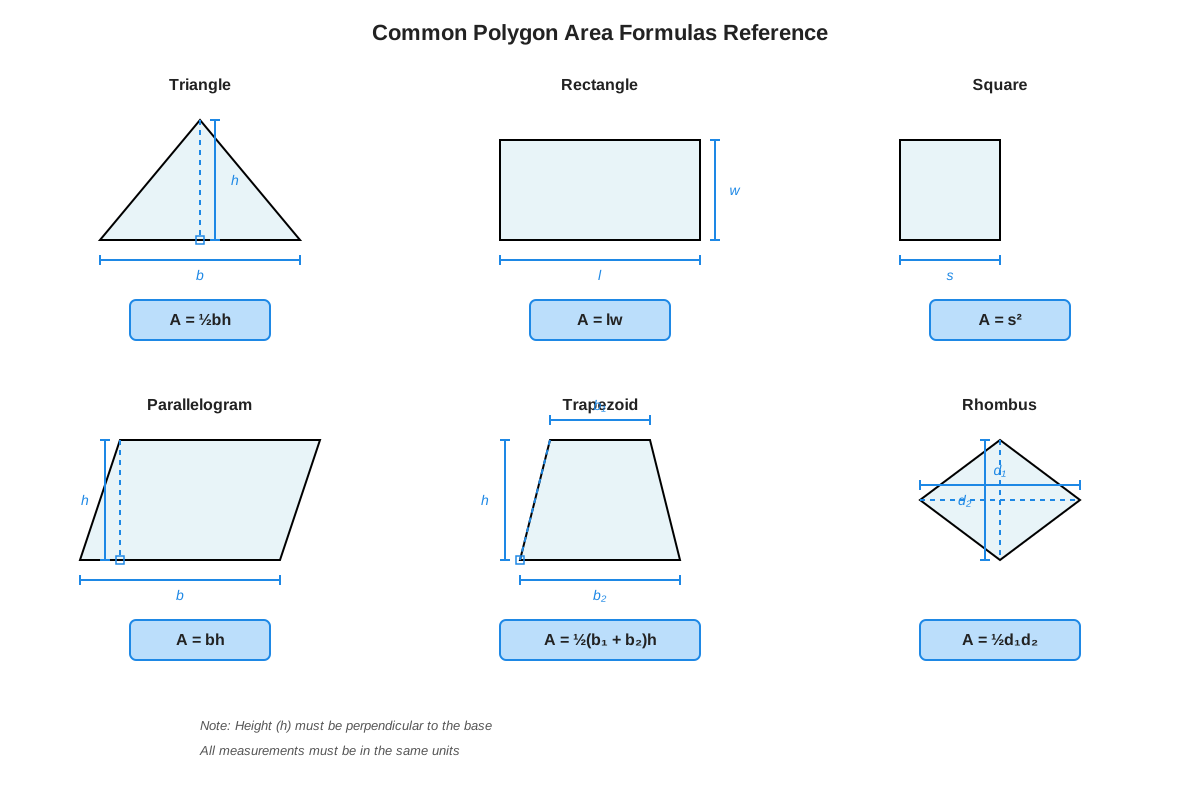
The area of a rectangle is calculated using the formula A = length × width (A = lw). This is the most fundamental area formula and serves as the foundation for understanding all other polygon areas. A square is a special rectangle where all sides are equal, so its area formula simplifies to A = s², where s represents the side length.
Rectangle: A = l × w
Square: A = s²
On the SAT, rectangle problems often involve:
- Finding a missing dimension when area and one dimension are given
- Working with perimeter and area simultaneously
- Calculating areas of rectangular regions on coordinate planes
- Solving optimization problems involving maximum or minimum areas
Triangles
The area of a triangle can be calculated using several methods, and SAT questions may require any of them:
Method 1: Base-Height Formula
The standard formula A = ½bh, where b is the base and h is the perpendicular height to that base. Any side can serve as the base; the height must be perpendicular to the chosen base.
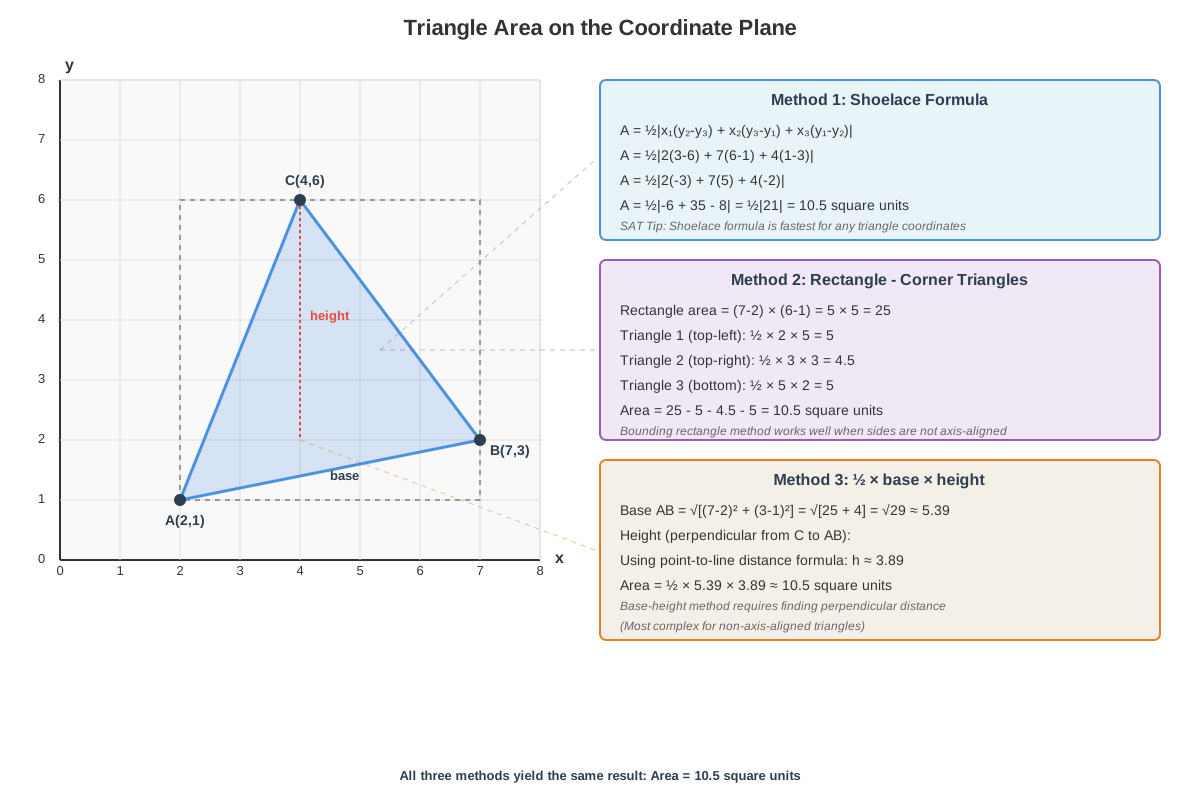
A = ½ × base × height = ½bhMethod 2: Coordinate Formula
When triangle vertices are given as coordinates (x₁, y₁), (x₂, y₂), (x₃, y₃), use:
A = ½|x₁(y₂ - y₃) + x₂(y₃ - y₁) + x₃(y₁ - y₂)|Method 3: Heron's Formula
When all three side lengths (a, b, c) are known but no height is given:
s = (a + b + c)/2  (semi-perimeter)
A = √[s(s-a)(s-b)(s-c)]
The SAT most commonly tests the base-height formula and coordinate formula. Students must recognize that the height must be perpendicular to the base—a frequent source of errors.
Parallelograms
A parallelogram has area A = base × height (A = bh), where the height is the perpendicular distance between parallel sides, not the length of a slanted side. This is identical to the rectangle formula because a rectangle is a special type of parallelogram.
A = b × hKey distinction: The height is NOT the same as the side length unless the parallelogram is a rectangle. Students must identify or calculate the perpendicular height, which may require using trigonometry or the Pythagorean theorem.
Trapezoids
A trapezoid (or trapezium) has one pair of parallel sides called bases. The area formula is:
A = ½(b₁ + b₂)hwhere b₁ and b₂ are the lengths of the parallel sides (bases) and h is the perpendicular height between them. This formula can be understood as the average of the two bases multiplied by the height.
Regular Polygons
A regular polygon has all sides equal and all angles equal. While specific formulas exist for regular polygons, the SAT typically expects students to decompose them into triangles or use the general formula:
A = ½ × perimeter × apothemwhere the apothem is the perpendicular distance from the center to the midpoint of a side. For a regular hexagon, students might also use the fact that it can be divided into six equilateral triangles.
Composite Figures
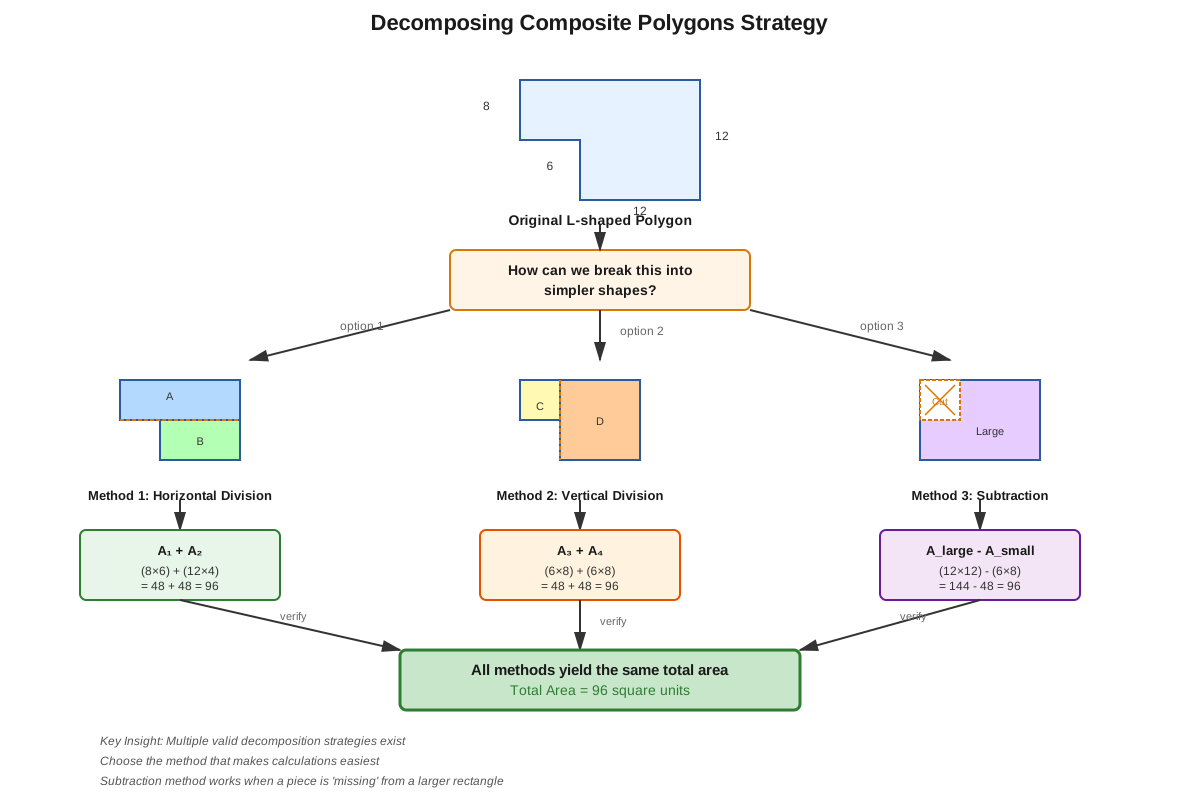
Composite figures are shapes formed by combining or subtracting standard polygons. The SAT frequently tests the ability to:
- Decompose complex shapes into recognizable polygons
- Calculate the area of each component
- Add or subtract areas appropriately
Strategies for composite figures:
- Identify all component shapes
- Draw auxiliary lines to create standard polygons
- For shaded regions, calculate the larger area and subtract the unshaded area
- Look for symmetry to simplify calculations
Comparison of Polygon Area Formulas
| Polygon | Formula | Key Variables |
|---|---|---|
| Rectangle | A = lw | l = length, w = width |
| Square | A = s² | s = side length |
| Triangle | A = ½bh | b = base, h = height (perpendicular) |
| Parallelogram | A = bh | b = base, h = height (perpendicular) |
| Trapezoid | A = ½(b₁ + b₂)h | b₁, b₂ = parallel sides, h = height |
| Regular Polygon | A = ½Pa | P = perimeter, a = apothem |
Concept Relationships
The area formulas for polygons form a hierarchical relationship where more complex shapes build upon simpler ones. The rectangle formula (A = lw) serves as the foundation → which leads to → the parallelogram formula (A = bh), since a parallelogram can be transformed into a rectangle by cutting and rearranging → which connects to → the triangle formula (A = ½bh), as any triangle is exactly half of a parallelogram with the same base and height.
The trapezoid formula represents a synthesis: it can be derived by decomposing a trapezoid into two triangles or by viewing it as an average of two parallel rectangles. Composite figures require mastery of all basic formulas plus the strategic thinking to decompose irregular shapes → which connects back to → coordinate geometry when vertices are given as ordered pairs, requiring the coordinate distance formula to find side lengths or the coordinate area formula for triangles.
Understanding these relationships enables flexible problem-solving: when one approach seems difficult, students can often find an alternative method by recognizing how shapes relate to one another. For example, a parallelogram problem might be solved by dropping a perpendicular to create a rectangle and right triangle, then using the Pythagorean theorem to find the needed height.
High-Yield Facts
⭐ The area of any triangle equals one-half the base times the perpendicular height: A = ½bh
⭐ Area is always expressed in square units (cm², m², units², etc.)
⭐ The height of a parallelogram or triangle must be perpendicular to the base—slant height does not equal perpendicular height
⭐ When a polygon is placed on a coordinate plane, the coordinate formula or counting square units are valid approaches
⭐ For composite figures, area of shaded region = total area - unshaded area
- A square with side length s has both area s² and perimeter 4s; these are different values with different units
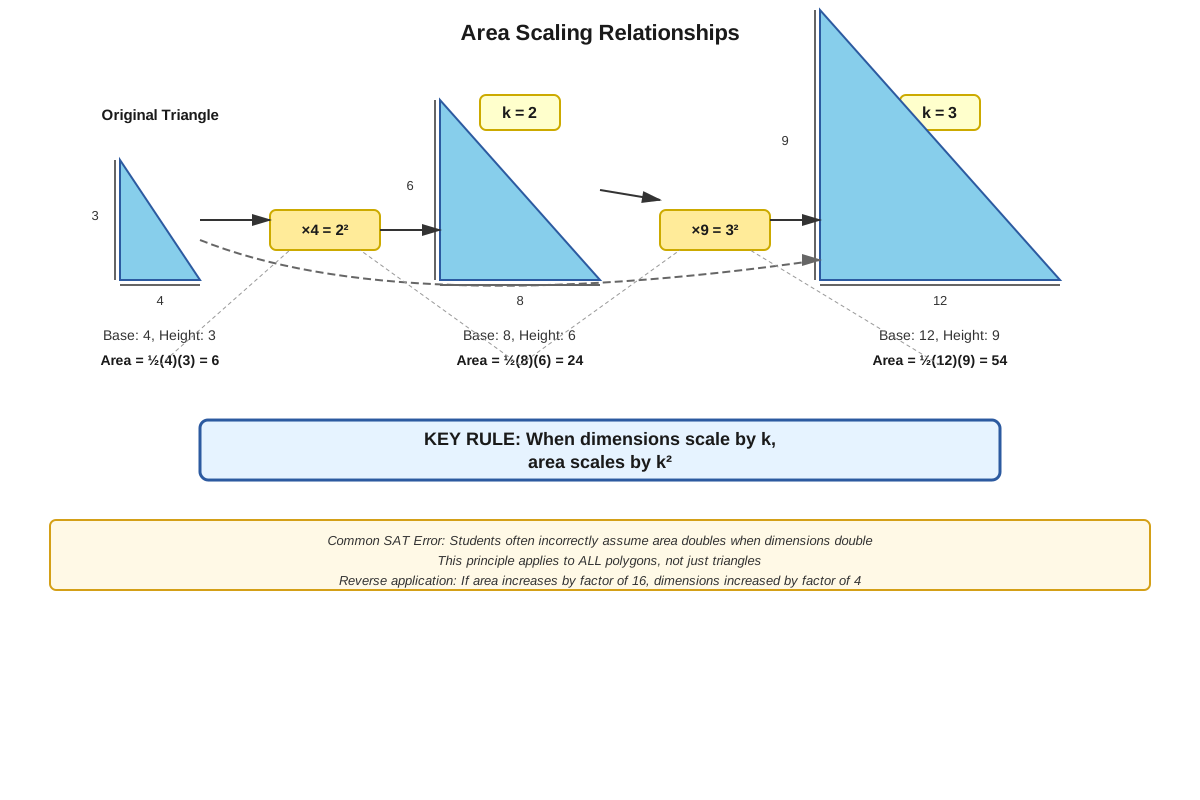
- Doubling all dimensions of a polygon multiplies the area by 4 (scale factor squared)
- The area of a trapezoid uses the average of the two parallel bases: A = ½(b₁ + b₂)h
- Any side of a triangle can serve as the base; choose the one that makes finding the height easiest
- Regular polygons can be divided into congruent triangles radiating from the center
- When coordinates are given, the distance formula d = √[(x₂-x₁)² + (y₂-y₁)²] helps find side lengths
- A rectangle and parallelogram with the same base and height have equal areas
Quick check — test yourself on Area of polygons so far.
Try Flashcards →Common Misconceptions
Misconception: The area of a triangle is base times height.
Correction: The area of a triangle is ONE-HALF base times height (A = ½bh). Forgetting the ½ factor is one of the most common errors and will result in an answer exactly twice the correct value.
Misconception: The slant side of a parallelogram can be used as the height in the area formula.
Correction: The height must be the perpendicular distance between parallel sides, not the length of a slanted side. The slant side is longer than the perpendicular height unless the parallelogram is a rectangle.
Misconception: All quadrilaterals use the same area formula.
Correction: Different quadrilaterals require different formulas. Rectangles use A = lw, parallelograms use A = bh, trapezoids use A = ½(b₁ + b₂)h, and general quadrilaterals may require decomposition into triangles.
Misconception: When dimensions double, area doubles.
Correction: When all linear dimensions are multiplied by a scale factor k, the area is multiplied by k². Doubling dimensions quadruples the area; tripling dimensions multiplies area by 9.
Misconception: The base of a triangle must be the bottom horizontal side.
Correction: Any side of a triangle can serve as the base. Choose the side that makes identifying or calculating the perpendicular height most convenient. The triangle's orientation doesn't affect which side can be the base.
Misconception: Heron's formula is always the best method for finding triangle area.
Correction: Heron's formula is useful when all three sides are known but no height is given. However, it involves more calculation than the base-height formula. On the SAT, if a height can be determined or if coordinates are given, other methods are typically faster and less error-prone.
Worked Examples
Example 1: Triangle on Coordinate Plane
Problem: Triangle ABC has vertices at A(2, 3), B(8, 3), and C(5, 9). What is the area of triangle ABC?
Solution:
Step 1: Visualize or sketch the triangle
Notice that points A and B have the same y-coordinate (y = 3), so segment AB is horizontal.
Step 2: Identify a convenient base and height
Since AB is horizontal, it makes an excellent base. The length of AB is:
AB = 8 - 2 = 6 units
Step 3: Find the perpendicular height
The height is the perpendicular distance from point C to line AB. Since AB lies on the line y = 3, and C is at y = 9, the height is:
h = 9 - 3 = 6 units
Step 4: Apply the triangle area formula
A = ½bh = ½(6)(6) = ½(36) = 18 square units
Alternative approach using coordinate formula:
A = ½|x₁(y₂ - y₃) + x₂(y₃ - y₁) + x₃(y₁ - y₂)|
A = ½|2(3 - 9) + 8(9 - 3) + 5(3 - 3)|
A = ½|2(-6) + 8(6) + 5(0)|
A = ½|-12 + 48 + 0|
A = ½|36| = 18 square units
Connection to learning objectives: This problem demonstrates how area of polygons appears on the SAT through coordinate geometry integration, requiring students to identify key features (horizontal base) and apply appropriate formulas.
Example 2: Composite Figure with Shaded Region
Problem: A rectangle has dimensions 12 cm by 8 cm. Inside the rectangle, a triangle is drawn with vertices at three corners of the rectangle. What is the area of the shaded region outside the triangle but inside the rectangle?
Solution:
Step 1: Calculate the area of the rectangle
A_rectangle = length × width = 12 × 8 = 96 cm²
Step 2: Determine the triangle's dimensions
A triangle with vertices at three corners of the rectangle has:
- Base = one side of the rectangle = 12 cm
- Height = the perpendicular side of the rectangle = 8 cm
Step 3: Calculate the area of the triangle
A_triangle = ½bh = ½(12)(8) = ½(96) = 48 cm²
Step 4: Find the shaded area
A_shaded = A_rectangle - A_triangle = 96 - 48 = 48 cm²
Key insight: The triangle occupies exactly half the rectangle's area. This is always true when a triangle's vertices are at three corners of a rectangle—a useful pattern to recognize for quick problem-solving.
Step 5: Verify the answer makes sense
The shaded region (48 cm²) equals the triangle area (48 cm²), which is logical given the symmetry of the configuration. The two regions are equal.
Connection to learning objectives: This problem requires decomposing a composite figure, applying multiple area formulas, and using subtraction to find a shaded region—all common SAT question types.
Exam Strategy
When approaching SAT area of polygons questions, follow this systematic process:
1. Identify the shape(s): Determine whether you're working with a single standard polygon, a composite figure, or a shaded region problem. Look for familiar shapes even within complex diagrams.
2. Extract given information: Mark all provided dimensions, angles, or coordinates directly on the diagram. If no diagram is provided, sketch one immediately—visual representation prevents errors.
3. Determine what's missing: Identify whether you need to find a missing dimension before calculating area. Common scenarios include using the Pythagorean theorem to find a height or using coordinate geometry to find a side length.
4. Select the appropriate formula: Match the polygon type to its formula. For composite figures, plan which shapes you'll use for decomposition before calculating.
Trigger words and phrases to watch for:
- "Shaded region" → signals subtraction of areas
- "Coordinates" or "vertices at" → suggests coordinate plane approach
- "Perpendicular" → confirms you're given the actual height, not a slant
- "Regular polygon" → all sides and angles equal; look for symmetry
- "Inscribed" or "circumscribed" → involves relationships between shapes
- "Scale factor" or "similar" → area changes by the square of the linear scale factor
Process-of-elimination tips:
- Eliminate answers with wrong units (area must be square units)
- Eliminate answers larger than the total figure area (for shaded regions)
- Eliminate answers that don't match the scale of the diagram
- Check if your answer is reasonable by estimating (e.g., a triangle should be less than a rectangle with the same base and height)
Time allocation: Straightforward area problems should take 30-60 seconds. Multi-step composite figure problems may require 90-120 seconds. If a problem requires more than 2 minutes, mark it and return later—don't let one question consume excessive time.
Exam Tip: Always double-check that you've used the perpendicular height, not a slant side. This single error accounts for a large percentage of incorrect area answers on the SAT.
Memory Techniques
Triangle Area Mnemonic: "Before Halving" → Base × Height, then divide by 2 (A = ½bh)
Trapezoid Formula Memory: Think "Average the bases, multiply by height" → A = ½(b₁ + b₂)h is the same as [(b₁ + b₂)/2] × h
Perpendicular Height Visualization: Picture a flagpole standing on the base—it must stand straight up (perpendicular), not lean at an angle. The flagpole's height is what you use in area formulas.
Composite Figure Strategy - "DACS":
- Decompose the figure into standard shapes
- Assign formulas to each component
- Calculate each area
- Sum or subtract as needed
Scale Factor and Area - "Square the Scale": When dimensions change by a scale factor, area changes by the scale factor squared. Double the dimensions → quadruple the area (2² = 4).
Coordinate Triangle Acronym - "XY-XY": For the coordinate formula, alternate x and y coordinates in a pattern: x₁(y₂ - y₃) + x₂(y₃ - y₁) + x₃(y₁ - y₂)
Summary
Mastery of polygon areas requires both formula knowledge and strategic problem-solving skills. The fundamental formulas—rectangle (A = lw), triangle (A = ½bh), parallelogram (A = bh), and trapezoid (A = ½(b₁ + b₂)h)—form the foundation for all SAT area questions. Critical to success is recognizing that height must always be perpendicular to the base, understanding how to decompose composite figures into standard shapes, and knowing when to apply coordinate geometry methods. Students must be comfortable working with shaded regions by subtracting areas, finding missing dimensions through algebraic manipulation, and recognizing how scale factors affect area (by the square of the linear scale factor). The SAT tests not just computational ability but conceptual understanding through multi-step problems that integrate area calculations with other mathematical concepts. Success requires careful diagram analysis, systematic formula application, and verification that answers are reasonable given the problem context.
Key Takeaways
- Area formulas must be memorized perfectly: Rectangle (lw), Triangle (½bh), Parallelogram (bh), Trapezoid (½(b₁+b₂)h)
- Height means perpendicular height: Never use a slant side length as the height in area formulas
- Composite figures require decomposition: Break complex shapes into standard polygons, calculate each area, then add or subtract
- Coordinate plane problems offer multiple approaches: Use the coordinate formula for triangles or find dimensions and apply standard formulas
- Scale factors affect area quadratically: When linear dimensions multiply by k, area multiplies by k²
- Shaded regions use subtraction: Calculate the total area, then subtract the unshaded portion
- Always verify units and reasonableness: Area must be in square units and should make sense relative to the figure's size
Related Topics
Volume of Three-Dimensional Figures: Understanding polygon areas is essential for calculating volumes of prisms, pyramids, and cylinders, where base area is a key component. Mastering 2D area concepts enables progression to 3D spatial reasoning.
Similar Figures and Proportions: The relationship between scale factors and area (area scales by k²) extends to understanding similarity ratios, a frequent SAT topic that combines geometry and proportional reasoning.
Coordinate Geometry: Many area problems integrate coordinate plane concepts, requiring students to find distances, identify shapes from coordinates, and apply geometric formulas in algebraic contexts.
Trigonometry and Right Triangles: Finding perpendicular heights often requires trigonometric ratios or the Pythagorean theorem, connecting area calculations to triangle properties and angle relationships.
Optimization Problems: Advanced applications involve finding maximum or minimum areas given constraints, combining area concepts with algebraic modeling and quadratic functions.
Practice CTA
Now that you've mastered the core concepts of polygon areas, it's time to solidify your understanding through active practice. Attempt the practice questions to apply these formulas in SAT-style contexts, and use the flashcards to reinforce formula recall and key concepts. Remember, the difference between knowing a formula and scoring points is the ability to recognize when and how to apply it under test conditions. Each practice problem you solve builds the pattern recognition and confidence needed for test day success. You've invested the time to learn—now invest the time to practice and watch your accuracy soar!
Sign up free to keep reading
Create a free AnvayaPrep account to finish this SAT guide on Area of polygons — plus flashcards and practice questions.