Overview
Right triangles are among the most frequently tested geometric figures on the SAT, appearing in approximately 15-20% of all math questions. These special triangles contain one 90-degree angle and possess unique properties that make them essential tools for solving a wide range of mathematical problems. Understanding right triangles goes far beyond memorizing the Pythagorean theorem—it requires mastery of special angle relationships, trigonometric ratios, and the ability to recognize these triangles embedded within complex geometric figures.
The SAT tests right triangle concepts both directly and indirectly. Direct questions might ask students to find missing side lengths, calculate areas, or determine angle measures. Indirect applications appear when right triangles are hidden within coordinate geometry problems, three-dimensional figures, or word problems involving distance and height. The College Board particularly favors questions that combine right triangle properties with algebraic reasoning, requiring students to set up equations based on geometric relationships.
Right triangles serve as a foundational bridge connecting pure geometry to algebra, trigonometry, and coordinate geometry. They underpin the distance formula, enable calculations in three-dimensional space, and provide the geometric basis for understanding slope and perpendicular lines. Mastering right triangles creates a framework for tackling more advanced topics including circles, trigonometric functions, and vector analysis—making this topic one of the highest-yield areas for SAT preparation.
Learning Objectives
- [ ] Identify key features of right triangles including legs, hypotenuse, and angle relationships
- [ ] Explain how right triangles appears on the SAT in various question formats and contexts
- [ ] Apply right triangles to answer SAT-style questions efficiently and accurately
- [ ] Calculate missing side lengths using the Pythagorean theorem and its variations
- [ ] Recognize and utilize special right triangles (45-45-90 and 30-60-90) to solve problems without calculation
- [ ] Determine when right triangles are embedded within other geometric figures
- [ ] Apply right triangle concepts to coordinate geometry and real-world scenarios
Prerequisites
- Basic angle measurement: Understanding degrees, angle addition, and the fact that triangle angles sum to 180° is essential for working with right triangle angle relationships
- Algebraic equation solving: Solving for variables in equations, including those with squares and square roots, is necessary for applying the Pythagorean theorem
- Radical simplification: Simplifying square roots and working with irrational numbers appears frequently in right triangle calculations
- Triangle fundamentals: Knowledge of triangle terminology (vertices, sides, angles) and basic properties provides the foundation for understanding right triangle specifics
- Exponent rules: Understanding how to work with squared terms and square roots is critical for all Pythagorean theorem applications
Why This Topic Matters
Right triangles represent one of the most practical geometric concepts with countless real-world applications. Architects use right triangle relationships to ensure structural stability and calculate roof pitches. Engineers apply these principles when designing ramps, bridges, and support structures. Navigation systems rely on right triangle calculations to determine distances and bearings. Even smartphone screens use right triangle properties to calculate diagonal measurements from width and height specifications.
On the SAT, right triangle questions appear with remarkable consistency across all test administrations. Approximately 3-5 questions per test directly involve right triangle properties, while another 2-4 questions incorporate right triangles indirectly through coordinate geometry, word problems, or complex figures. The College Board particularly favors questions that test multiple concepts simultaneously—for example, combining right triangles with algebraic expressions, requiring students to set up equations where variables represent side lengths.
Common SAT question formats include: finding missing side lengths given two sides; identifying special right triangles and using their ratios; calculating areas and perimeters; determining heights or distances in word problems; recognizing right triangles within circles, rectangles, or coordinate planes; and solving multi-step problems where right triangle properties unlock subsequent calculations. The test also frequently presents right triangles in non-standard orientations to assess whether students truly understand the concepts rather than simply recognizing familiar diagrams.
Core Concepts
Fundamental Properties of Right Triangles
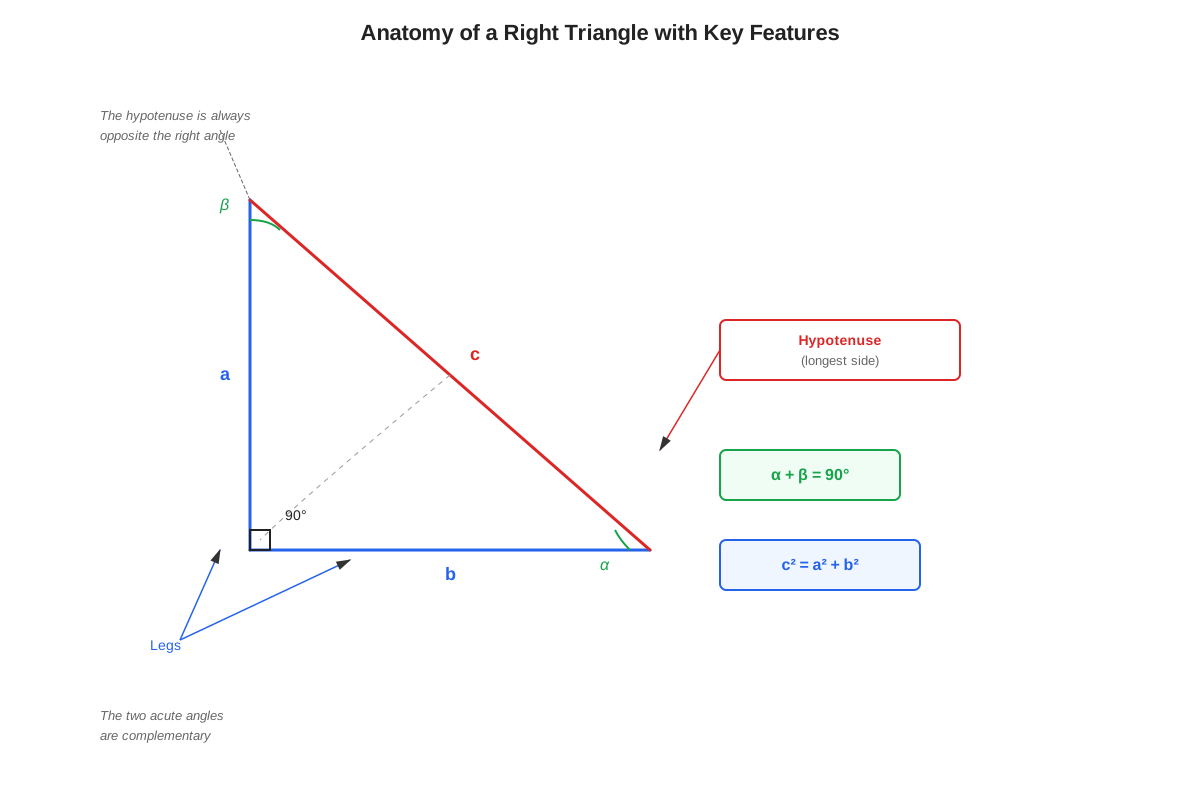
A right triangle is defined as any triangle containing exactly one right angle (90 degrees). This single defining characteristic creates a cascade of special properties that distinguish right triangles from all other triangles. The side opposite the right angle is called the hypotenuse—always the longest side of the triangle. The two sides that form the right angle are called legs, and while they may be equal in length (creating an isosceles right triangle), they are typically of different lengths.
Since the angles in any triangle must sum to 180 degrees, and one angle in a right triangle is 90 degrees, the two remaining angles must be complementary—meaning they sum to 90 degrees. This relationship proves useful when only one acute angle is known, as the other can be immediately determined by subtraction from 90 degrees. For example, if one acute angle measures 35°, the other must measure 55°.
The Pythagorean Theorem
The Pythagorean theorem stands as the most important relationship in right triangle geometry. It states that in any right triangle, the square of the hypotenuse equals the sum of the squares of the two legs. Expressed algebraically:
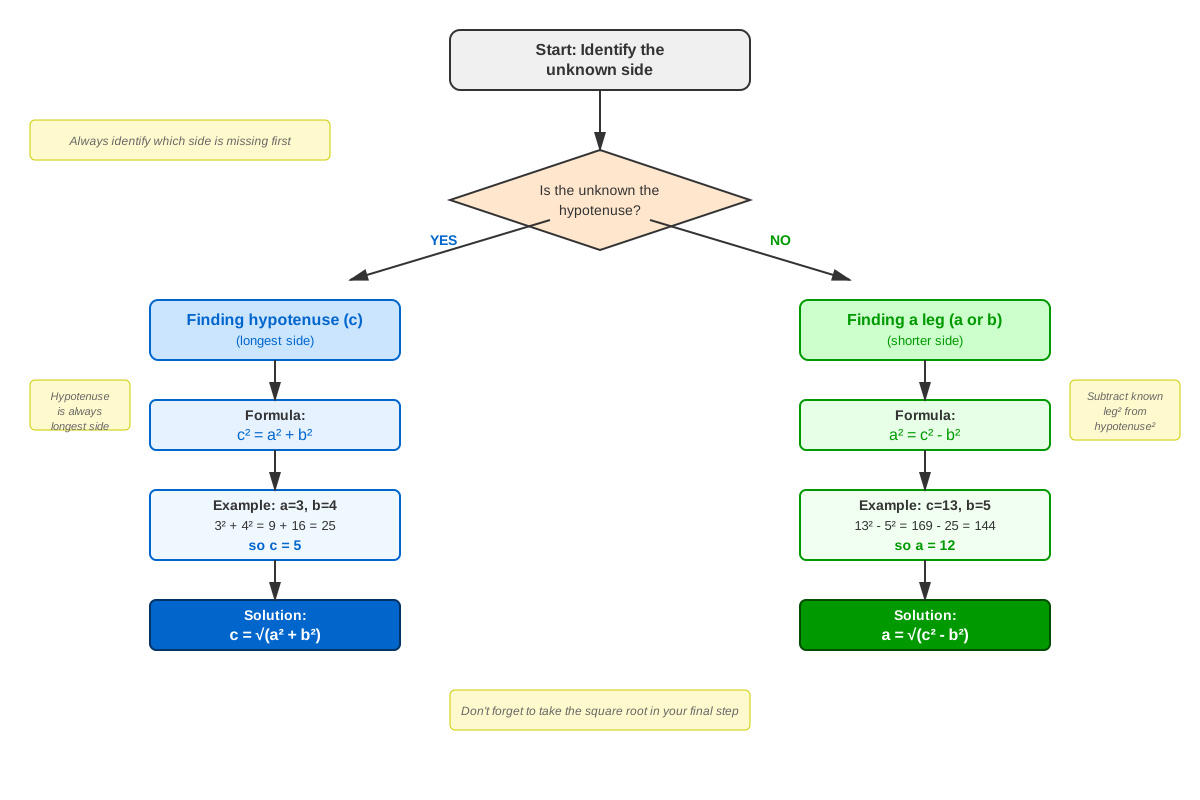
a² + b² = c²where a and b represent the legs and c represents the hypotenuse. This theorem enables calculation of any missing side when two sides are known. When solving for a leg, the equation rearranges to:
a = √(c² - b²)When solving for the hypotenuse:
c = √(a² + b²)The SAT frequently tests whether students can correctly apply these variations. Common scenarios include: given legs of 3 and 4, find the hypotenuse (answer: 5); given hypotenuse 13 and one leg 5, find the other leg (answer: 12); or given legs of 6 and 8, find the hypotenuse (answer: 10).
Pythagorean Triples
Pythagorean triples are sets of three positive integers that satisfy the Pythagorean theorem. Recognizing these patterns allows for rapid problem-solving without calculation. The most common triples that appear on the SAT include:
| Triple | Multiples | Example Application |
|---|---|---|
| 3-4-5 | 6-8-10, 9-12-15, 12-16-20 | Most common; appears in ~40% of SAT right triangle questions |
| 5-12-13 | 10-24-26, 15-36-39 | Second most common; often in coordinate geometry |
| 8-15-17 | 16-30-34 | Less common but still appears regularly |
| 7-24-25 | 14-48-50 | Occasionally appears in harder questions |
When a problem presents two sides of a right triangle that match a Pythagorean triple (or a multiple thereof), the third side can be determined instantly without calculation. This time-saving recognition is particularly valuable on the SAT's timed format.
Special Right Triangles: 45-45-90
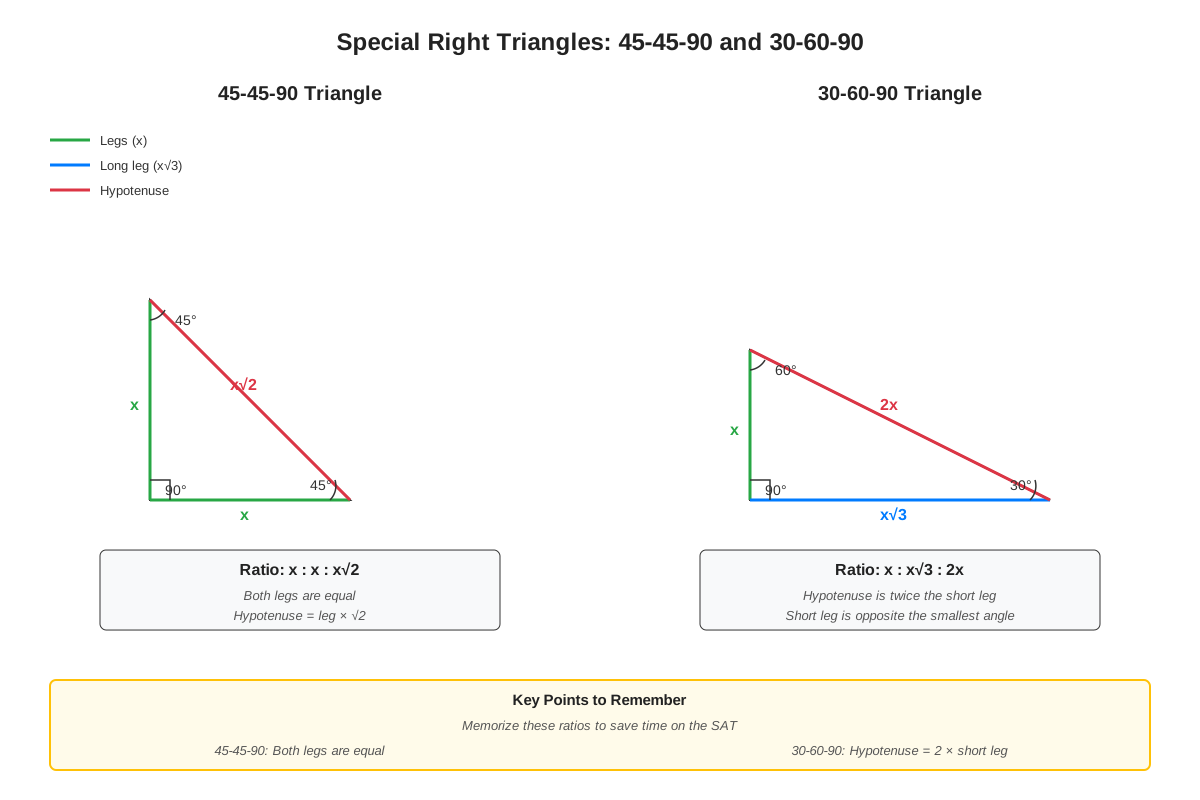
The 45-45-90 triangle is an isosceles right triangle where both acute angles measure 45 degrees and both legs are equal in length. This triangle has a fixed ratio between its sides:
leg : leg : hypotenuse = 1 : 1 : √2If each leg has length x, the hypotenuse has length x√2. Conversely, if the hypotenuse has length h, each leg has length h/√2 or h√2/2 (after rationalizing the denominator). The SAT commonly presents these triangles in several contexts:
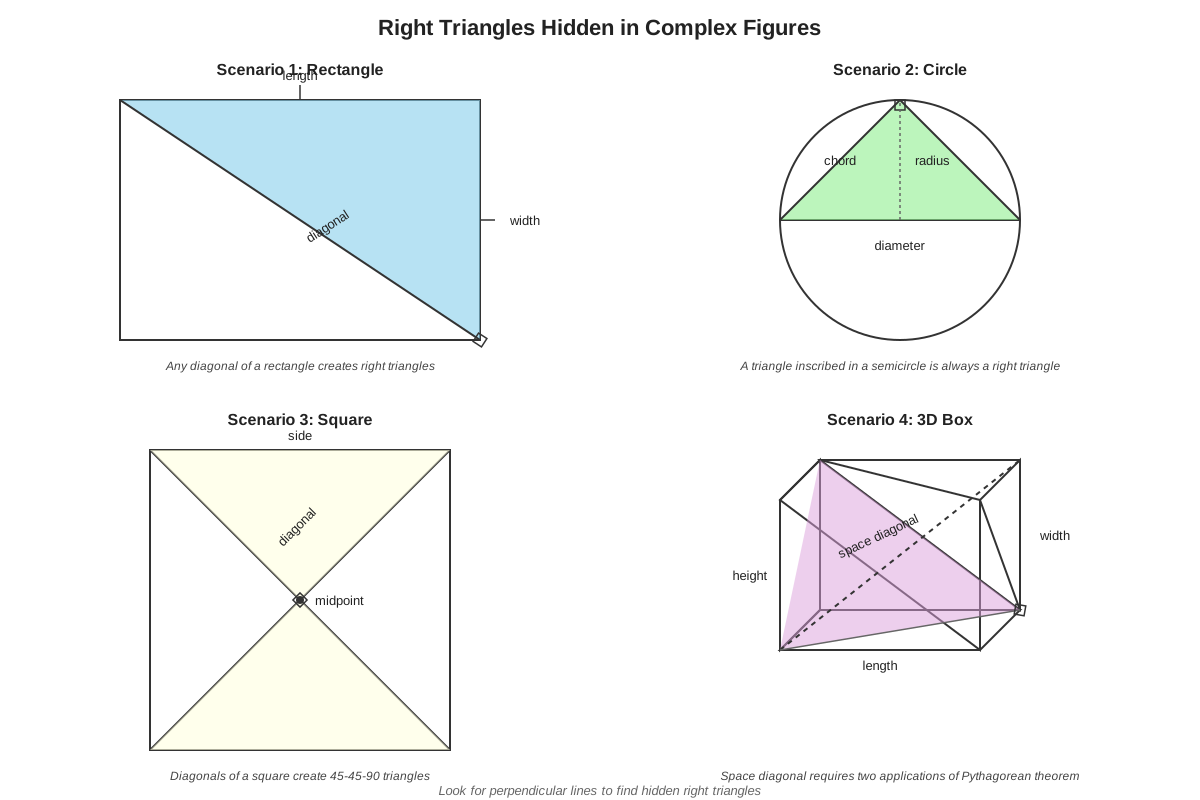
- Diagonals of squares (which divide the square into two 45-45-90 triangles)
- Isosceles right triangles in coordinate geometry
- Problems involving diagonal distances across square grids
For example, if a square has side length 6, its diagonal can be found instantly as 6√2 without using the Pythagorean theorem.
Special Right Triangles: 30-60-90
The 30-60-90 triangle derives from cutting an equilateral triangle in half. It contains angles of 30°, 60°, and 90°, with a fixed side ratio:
short leg : long leg : hypotenuse = 1 : √3 : 2The short leg is opposite the 30° angle, the long leg is opposite the 60° angle, and the hypotenuse is opposite the 90° angle. If the short leg has length x:
- Long leg = x√3
- Hypotenuse = 2x
If the hypotenuse has length h:
- Short leg = h/2
- Long leg = h√3/2
These triangles frequently appear in problems involving equilateral triangles (finding heights), hexagons, and certain trigonometry applications. The SAT particularly likes to test whether students can correctly identify which leg is which based on the angle measures.
Altitude to the Hypotenuse
When an altitude (perpendicular line) is drawn from the right angle to the hypotenuse, it creates three similar triangles: the original triangle and two smaller triangles. This configuration produces several important relationships:
- The altitude divides the hypotenuse into two segments
- The altitude's length is the geometric mean of these two segments
- Each leg is the geometric mean of the hypotenuse and the adjacent segment
These relationships, while less commonly tested than basic Pythagorean applications, appear in more challenging SAT questions that assess deeper geometric understanding.
Area Calculations
The area of a right triangle follows the standard triangle formula, but the perpendicular legs serve as the base and height:
Area = (1/2) × leg₁ × leg₂This straightforward calculation becomes more complex when the SAT provides the hypotenuse and one leg, requiring students to first find the missing leg using the Pythagorean theorem before calculating area. Some questions reverse this process, providing the area and one side, requiring students to find other dimensions.
Concept Relationships
The Pythagorean theorem serves as the central hub connecting all right triangle concepts. It directly enables calculation of missing sides, which then allows for area determination and perimeter calculation. The theorem also validates Pythagorean triples—these integer solutions emerge naturally from the equation a² + b² = c².
Special right triangles (45-45-90 and 30-60-90) represent specific applications of the Pythagorean theorem where the angle measures create predictable side ratios. These ratios can be derived using the Pythagorean theorem: for a 45-45-90 triangle with legs of length 1, the hypotenuse equals √(1² + 1²) = √2. For a 30-60-90 triangle with short leg 1 and hypotenuse 2, the long leg equals √(2² - 1²) = √3.
The relationship flows as follows:
Right Angle Definition → Complementary Acute Angles → Pythagorean Theorem → Pythagorean Triples (special integer cases) and Special Right Triangles (special angle cases) → Area and Perimeter Calculations → Applications in Coordinate Geometry and Word Problems
Right triangles also connect to prerequisite knowledge: algebraic equation solving enables application of the Pythagorean theorem, while radical simplification allows for proper expression of answers. Looking forward, right triangle mastery enables understanding of trigonometric ratios (sine, cosine, tangent), the distance formula in coordinate geometry (which derives from the Pythagorean theorem), and three-dimensional geometry where right triangles appear in cross-sections and diagonal calculations.
Quick check — test yourself on Right triangles so far.
Try Flashcards →High-Yield Facts
⭐ The Pythagorean theorem (a² + b² = c²) applies only to right triangles, where c is always the hypotenuse
⭐ In a 45-45-90 triangle, if each leg = x, then hypotenuse = x√2
⭐ In a 30-60-90 triangle, sides are in ratio 1 : √3 : 2 (short leg : long leg : hypotenuse)
⭐ The most common Pythagorean triple is 3-4-5 and its multiples (6-8-10, 9-12-15, etc.)
⭐ The two acute angles in a right triangle are always complementary (sum to 90°)
- The hypotenuse is always the longest side of a right triangle and is always opposite the right angle
- Pythagorean triple 5-12-13 appears frequently in coordinate geometry problems
- The diagonal of a square with side s equals s√2 (creating two 45-45-90 triangles)
- The altitude of an equilateral triangle with side s equals (s√3)/2 (creating two 30-60-90 triangles)
- Area of a right triangle = (1/2) × leg₁ × leg₂, where the legs are perpendicular
- When a right triangle appears in the coordinate plane, the legs are often parallel to the axes
- The distance formula d = √[(x₂-x₁)² + (y₂-y₁)²] derives directly from the Pythagorean theorem
- Pythagorean triple 8-15-17 appears less frequently but is worth memorizing for time savings
Common Misconceptions
Misconception: The Pythagorean theorem can be applied to any triangle.
Correction: The Pythagorean theorem applies exclusively to right triangles. Using it on acute or obtuse triangles produces incorrect results. Always verify the presence of a right angle before applying a² + b² = c².
Misconception: In the Pythagorean theorem, it doesn't matter which side is labeled c.
Correction: The variable c must always represent the hypotenuse (the longest side, opposite the right angle). Assigning c to a leg will produce an incorrect equation and wrong answer.
Misconception: In a 30-60-90 triangle, the side opposite the 30° angle is longer than the side opposite the 60° angle.
Correction: The longer leg is always opposite the larger acute angle. In a 30-60-90 triangle, the side opposite 60° is √3 times longer than the side opposite 30°. The ratio is 1 : √3 : 2, not √3 : 1 : 2.
Misconception: All right triangles with integer sides are Pythagorean triples.
Correction: While all Pythagorean triples form right triangles, not all right triangles have integer sides. For example, a right triangle with legs of 2 and 3 has a hypotenuse of √13, which is irrational. Pythagorean triples are special cases where all three sides happen to be integers.
Misconception: The area of a right triangle requires the hypotenuse.
Correction: The area formula for a right triangle uses the two legs as base and height: Area = (1/2) × leg₁ × leg₂. The hypotenuse is not needed for area calculation, though it may need to be found first if only one leg and the hypotenuse are given.
Misconception: In a 45-45-90 triangle, all sides are equal.
Correction: In a 45-45-90 triangle, the two legs are equal to each other, but the hypotenuse is longer—specifically √2 times the length of each leg. Only equilateral triangles have all three sides equal, and equilateral triangles do not contain right angles.
Misconception: When simplifying √8 in a right triangle problem, the answer is 2√2, but this can be left as √8.
Correction: While mathematically equivalent, the SAT expects radicals to be simplified. Always reduce √8 to 2√2, √18 to 3√2, √12 to 2√3, etc. Answer choices are typically presented in simplified form.
Worked Examples
Example 1: Multi-Step Problem with Pythagorean Theorem
Problem: In rectangle ABCD, AB = 12 and BC = 5. Point E is on side CD such that CE = 3. What is the length of AE?
Solution:
Step 1: Visualize the problem. Draw rectangle ABCD with AB as the bottom side (length 12) and BC as the right side (length 5). Point E is on the top side CD, 3 units from corner C.
Step 2: Recognize that AE is not a side of the rectangle, so we need to create a right triangle. Drop a perpendicular from E to side AB, or recognize that we can use coordinates.
Step 3: Use coordinate geometry approach. Place A at origin (0, 0). Then:
- B is at (12, 0)
- C is at (12, 5)
- D is at (0, 5)
- E is 3 units from C along CD, so E is at (12 - 3, 5) = (9, 5)
Step 4: Create right triangle AEF where F is the point (9, 0) directly below E. This creates a right triangle with:
- Horizontal leg AF = 9
- Vertical leg FE = 5
- Hypotenuse AE = ?
Step 5: Apply Pythagorean theorem:
AE² = 9² + 5²
AE² = 81 + 25
AE² = 106
AE = √106
Answer: √106
Connection to Learning Objectives: This problem demonstrates how right triangles appear embedded within other geometric figures (rectangles) and requires applying the Pythagorean theorem after setting up the appropriate right triangle—a common SAT approach.
Example 2: Special Right Triangle Application
Problem: An equilateral triangle has a perimeter of 24. What is the area of the triangle?
Solution:
Step 1: Find the side length. If perimeter = 24 and all three sides are equal:
Side length = 24 ÷ 3 = 8
Step 2: Recognize that to find area, we need the height. When we draw an altitude from any vertex to the opposite side in an equilateral triangle, it creates two 30-60-90 triangles.
Step 3: In the 30-60-90 triangle created:
- The hypotenuse is the original side = 8
- The short leg (half the base) = 4
- The long leg (the height) = ?
Step 4: Apply the 30-60-90 ratio (1 : √3 : 2). If the hypotenuse is 8, then:
- Short leg = 8/2 = 4 ✓ (confirms our setup)
- Long leg (height) = 4√3
Step 5: Calculate area using the triangle area formula:
Area = (1/2) × base × height
Area = (1/2) × 8 × 4√3
Area = 16√3
Answer: 16√3
Connection to Learning Objectives: This problem shows how special right triangles (30-60-90) appear within other geometric figures and demonstrates the efficiency of using memorized ratios rather than calculating with the Pythagorean theorem.
Exam Strategy
When approaching sat right triangles questions, begin by identifying whether a right angle is explicitly marked or implied. Look for the small square symbol in a corner, perpendicular lines, or contextual clues like "perpendicular," "altitude," or figures involving rectangles and squares. If no right angle is visible, check whether the problem involves coordinate geometry with horizontal and vertical lines—these create right triangles even when not explicitly drawn.
Trigger words and phrases that signal right triangle problems include: "perpendicular," "altitude," "height," "diagonal," "distance between two points," "rectangular," "square," and "right angle." In word problems, phrases like "ladder against a wall," "ramp," "guy wire," or "line of sight" typically indicate right triangle applications.
For process of elimination, remember these principles:
- If two sides are given and you're finding the third, the hypotenuse must be longer than either leg
- In special right triangles, answers will contain √2 (for 45-45-90) or √3 (for 30-60-90)
- Pythagorean triple problems will have integer answers or simple multiples
- If an answer choice doesn't satisfy a² + b² = c², eliminate it immediately
Time allocation strategy: Spend 5-10 seconds checking if the given sides match a Pythagorean triple or special right triangle ratio before calculating. This recognition can save 30-45 seconds per problem. For example, if you see sides 9 and 12, immediately recognize the 3-4-5 triple (multiplied by 3) and conclude the hypotenuse is 15 rather than calculating 9² + 12² = 81 + 144 = 225, then √225 = 15.
When a right triangle isn't immediately visible, look for opportunities to create one by:
- Drawing an altitude or perpendicular line
- Connecting two points in coordinate geometry
- Identifying diagonals in rectangles or squares
- Recognizing that radii perpendicular to chords create right triangles in circles
Always write down the Pythagorean theorem with the correct variables before substituting values. This prevents the common error of placing a leg value where the hypotenuse should be. Label your diagram clearly with given information and what you're solving for.
Memory Techniques
Pythagorean Theorem Mnemonic: "A squared plus B squared equals C squared, where C is the Climb (hypotenuse—the side you'd climb up, being the longest)."
Special Triangle Ratios Visualization:
- 45-45-90: Picture a square cut diagonally. The sides are equal (1:1) and the diagonal is longer (√2). Remember "Square cut = √2"
- 30-60-90: Picture a triangle with angles that look like a "2" (30-60-90 adds to 180, and the hypotenuse ratio is 2). The ratio 1 : √3 : 2 can be remembered as "One small, Root-three medium, Two large"
Pythagorean Triples Acronym: "3-4-5 FIRST" (Frequent In Right-triangle SAT Tests). Then remember "5-12-13 SECOND" (Standard Exam Choice, Often Needed Daily). These two triples and their multiples cover approximately 70% of SAT Pythagorean triple questions.
Complementary Angles Memory Aid: In a right triangle, the two acute angles are "complete each other to 90°"—think of them as completing a right angle together.
Hypotenuse Identification: "Hypotenuse is high-est"—it's always the longest side, opposite the largest angle (90°).
Area Formula Reminder: "Right triangle area uses the right angle sides"—the two legs that form the right angle serve as base and height.
Summary
Right triangles represent a cornerstone of SAT geometry, appearing in 15-20% of math questions either directly or embedded within other problems. These triangles are defined by their single 90-degree angle, which creates the fundamental relationship expressed in the Pythagorean theorem: a² + b² = c², where c is the hypotenuse. Mastery requires recognizing Pythagorean triples (especially 3-4-5 and 5-12-13 with their multiples) for rapid calculation and understanding special right triangles—the 45-45-90 triangle with ratio 1:1:√2 and the 30-60-90 triangle with ratio 1:√3:2. Success on SAT right triangle questions depends on quickly identifying when right triangles are present (including when they're hidden in rectangles, coordinate planes, or word problems), selecting the appropriate solution method (Pythagorean theorem, special triangle ratios, or Pythagorean triples), and executing calculations accurately while simplifying radicals properly. The ability to visualize right triangles within complex figures and recognize their properties without extensive calculation distinguishes high-scoring students from average performers.
Key Takeaways
- The Pythagorean theorem (a² + b² = c²) is the fundamental relationship in right triangles, where c always represents the hypotenuse
- Memorize Pythagorean triples 3-4-5 and 5-12-13 (plus their multiples) to solve problems instantly without calculation
- Special right triangles have fixed ratios: 45-45-90 uses 1:1:√2 and 30-60-90 uses 1:√3:2
- The two acute angles in any right triangle are complementary (sum to 90°)
- Right triangles often appear hidden within other figures—look for perpendicular lines, rectangles, squares, and coordinate geometry
- Area of a right triangle equals (1/2) × leg₁ × leg₂, using the two sides that form the right angle
- Always simplify radicals in final answers and ensure the hypotenuse is correctly identified before applying formulas
Related Topics
Coordinate Geometry and Distance Formula: The distance between two points in the coordinate plane derives directly from the Pythagorean theorem, treating horizontal and vertical distances as legs of a right triangle. Mastering right triangles makes distance and midpoint problems significantly easier.
Trigonometric Ratios: Sine, cosine, and tangent are defined using the sides of right triangles. Understanding right triangle properties provides the foundation for all trigonometry, which appears in advanced SAT math questions.
Three-Dimensional Geometry: Finding diagonals of rectangular prisms, distances in 3D space, and surface area calculations all rely on identifying right triangles within three-dimensional figures. Right triangle mastery is essential before tackling these more complex spatial problems.
Circle Geometry: Radii perpendicular to chords, tangent lines meeting radii, and inscribed angles often create right triangles. Many circle problems become solvable once the embedded right triangle is identified.
Similar Triangles: Right triangles with the same acute angles are similar, and the altitude to the hypotenuse creates similar triangles. This connection enables solving complex proportion problems.
Practice CTA
Now that you've mastered the core concepts of right triangles, it's time to solidify your understanding through active practice. Work through the practice questions to test your ability to recognize right triangles in various contexts, apply the Pythagorean theorem efficiently, and utilize special triangle ratios. Use the flashcards to drill the essential facts—Pythagorean triples, special triangle ratios, and key formulas—until they become automatic. Remember, the difference between knowing these concepts and scoring points on test day lies in repeated, focused practice. Each problem you solve strengthens your pattern recognition and builds the confidence needed to tackle any right triangle question the SAT presents. You've got this!
Sign up free to keep reading
Create a free AnvayaPrep account to finish this SAT guide on Right triangles — plus flashcards and practice questions.