Overview
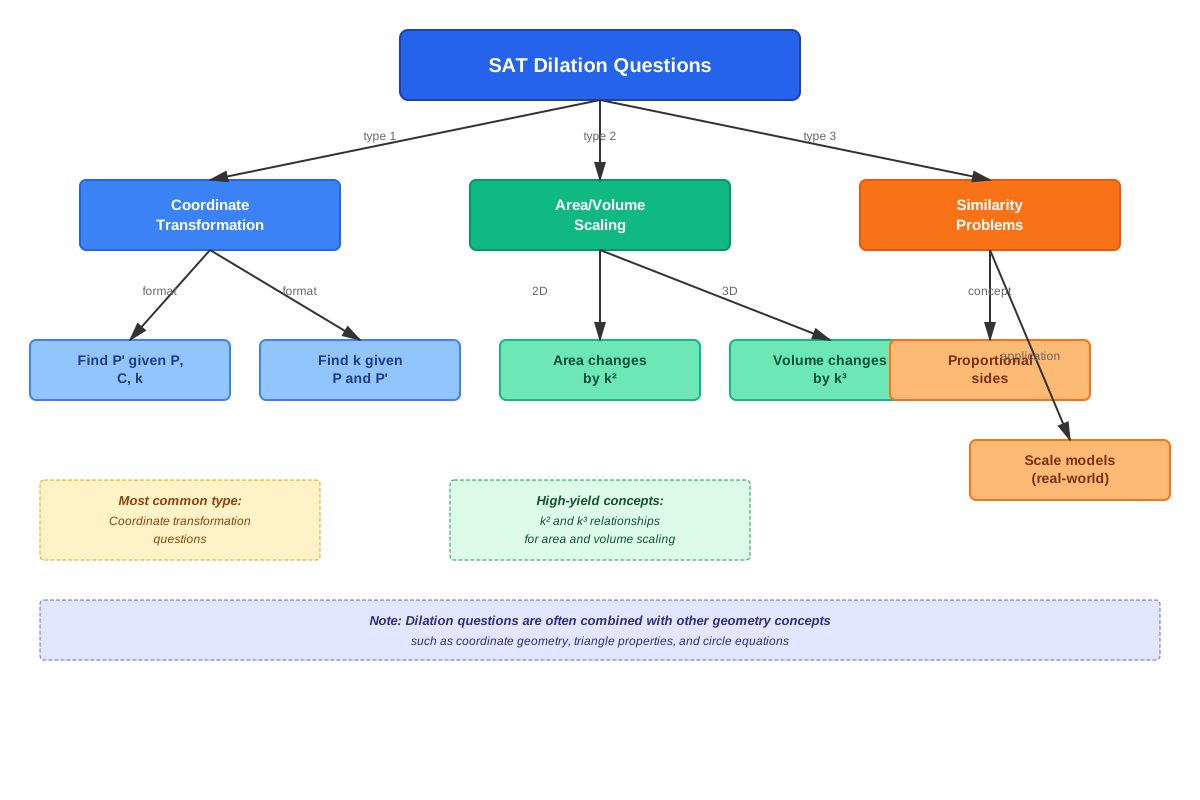
Dilations represent one of the fundamental transformations in coordinate geometry, alongside translations, rotations, and reflections. A dilation is a transformation that produces an image that is the same shape as the original figure but is a different size. This transformation either enlarges or reduces a figure by a specific scale factor relative to a fixed center point. Understanding dilations is crucial for success on the SAT because these concepts appear regularly in questions involving coordinate geometry, similarity, area and volume relationships, and proportional reasoning.
On the SAT math section, dilations frequently appear in problems that test spatial reasoning, coordinate transformations, and the relationship between linear dimensions and area or volume. Students must recognize how dilations affect distances, coordinates, areas, and volumes differently. A dilation with scale factor k multiplies all linear dimensions by k, all areas by k², and all volumes by k³. This hierarchical relationship is a high-yield concept that appears in multiple question formats, from straightforward coordinate transformations to complex multi-step problems involving similar figures.
Mastering dilations connects directly to broader mathematical concepts including similarity, proportional relationships, and the coordinate plane. These skills form the foundation for understanding how geometric figures relate to one another and how transformations preserve certain properties while changing others. The ability to quickly identify scale factors, calculate transformed coordinates, and determine how areas and volumes change under dilation is essential for maximizing performance on geometry-heavy SAT sections.
Learning Objectives
- [ ] Identify key features of dilations including center of dilation and scale factor
- [ ] Explain how dilations appears on the SAT in various question formats
- [ ] Apply dilations to answer SAT-style questions involving coordinate transformations
- [ ] Calculate the coordinates of dilated points given a center and scale factor
- [ ] Determine how dilations affect perimeter, area, and volume measurements
- [ ] Distinguish between dilations and other geometric transformations
- [ ] Solve multi-step problems combining dilations with other geometric concepts
Prerequisites
- Coordinate plane fundamentals: Understanding ordered pairs, plotting points, and calculating distances is essential for working with dilations in coordinate geometry
- Basic algebraic operations: Multiplying coordinates by scale factors and manipulating equations requires comfort with algebraic manipulation
- Similarity and proportions: Dilations create similar figures, so understanding proportional relationships helps recognize the effects of scale factors
- Area and volume formulas: Calculating how dilations affect two-dimensional and three-dimensional measurements requires knowledge of basic geometric formulas
Why This Topic Matters
Dilations have significant real-world applications in fields ranging from architecture and engineering to computer graphics and cartography. When architects create scale models of buildings, they use dilations to maintain proportional relationships while changing size. Map makers employ dilations to represent large geographic areas on manageable paper sizes. In digital imaging, zoom functions are essentially dilations that enlarge or reduce images while preserving shape.
On the SAT, dilations appear in approximately 2-4 questions per test, making them a high-yield topic for focused study. These questions typically fall into several categories: direct coordinate transformation problems (where students must find the image of a point after dilation), area and volume scaling problems (requiring understanding of how k, k², and k³ relationships work), and similarity problems (where dilations establish proportional relationships between figures). The College Board frequently embeds dilation concepts within more complex problems involving multiple transformations or real-world contexts.
Common SAT question formats include: finding coordinates after dilation from the origin or another center point, determining scale factors from given pre-image and image coordinates, calculating how area changes when a figure is dilated, solving problems involving similar triangles created by dilations, and analyzing how volume changes in three-dimensional dilations. Questions may appear in both multiple-choice and grid-in formats, with the latter often requiring precise calculation of scale factors or transformed coordinates.
Core Concepts
Definition and Basic Properties
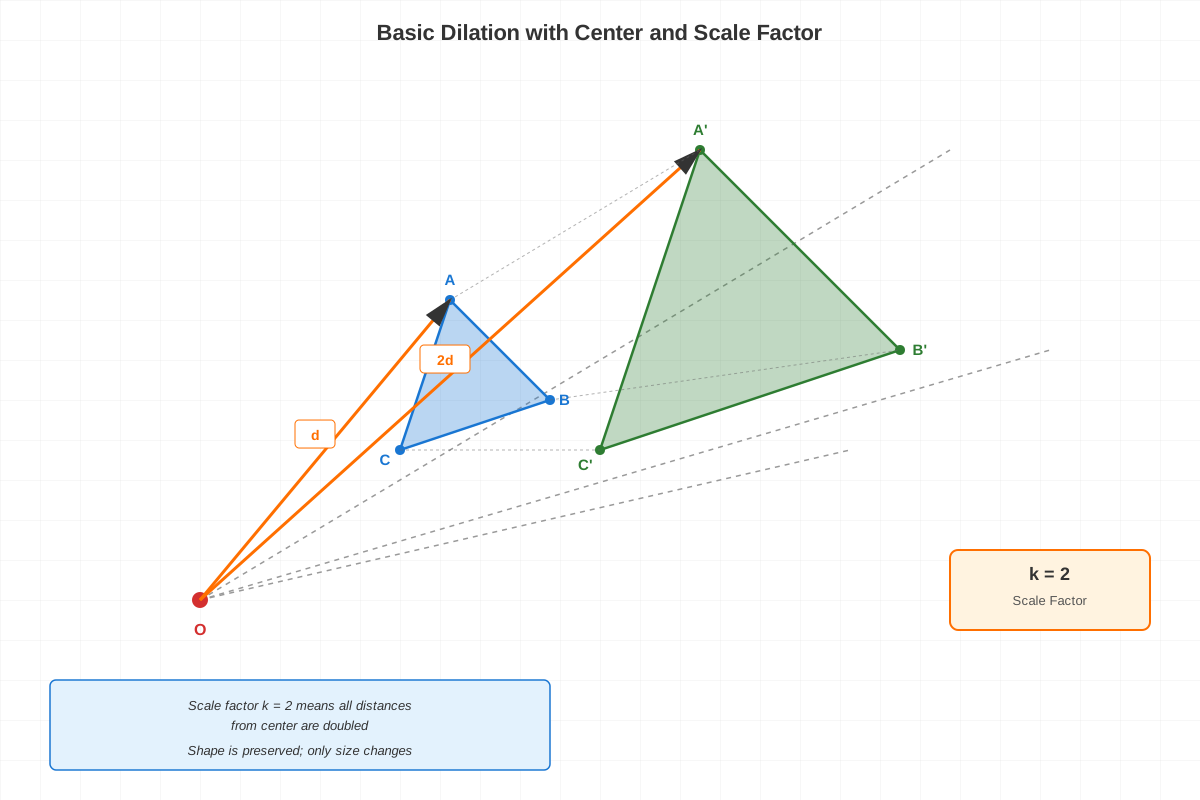
A dilation is a transformation that alters the size of a figure without changing its shape. Every dilation has two essential components: a center of dilation (a fixed point) and a scale factor (a positive number that determines the size change). The scale factor, typically denoted as k, determines whether the dilation is an enlargement (k > 1), a reduction (0 < k < 1), or leaves the figure unchanged (k = 1).
When a point P is dilated with center C and scale factor k, the image point P' lies on the ray from C through P, and the distance from C to P' equals k times the distance from C to P. Mathematically, if C is the center and P is any point, then CP' = k · CP. This relationship preserves the direction from the center to each point while scaling the distance.
Dilations from the Origin
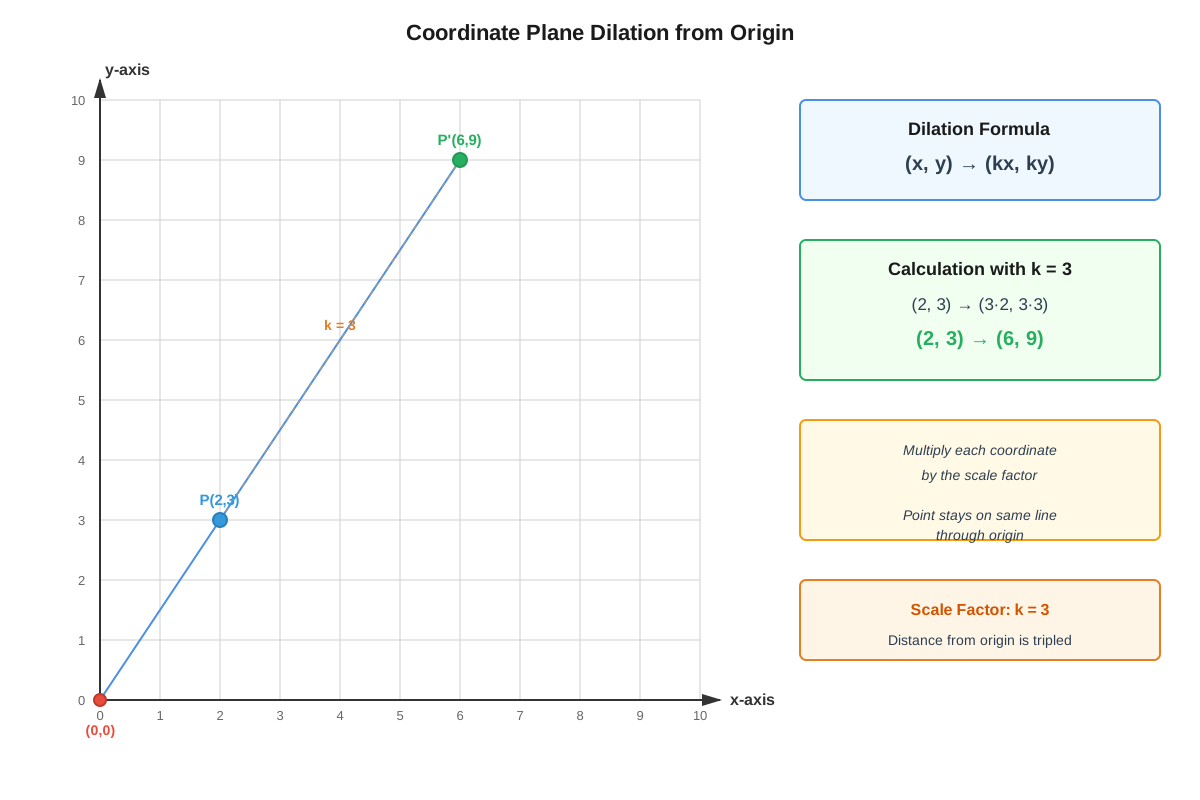
The most common type of dilation on the SAT involves the origin as the center of dilation. When dilating from the origin (0, 0) with scale factor k, the transformation rule is remarkably simple:
(x, y) → (kx, ky)For example, if point A(3, 4) is dilated from the origin with scale factor k = 2, the image point A' has coordinates (2·3, 2·4) = (6, 8). If the scale factor is k = 0.5, then A' would be (1.5, 2). This straightforward multiplication makes origin-centered dilations the most computationally efficient type.
Dilations from Non-Origin Centers
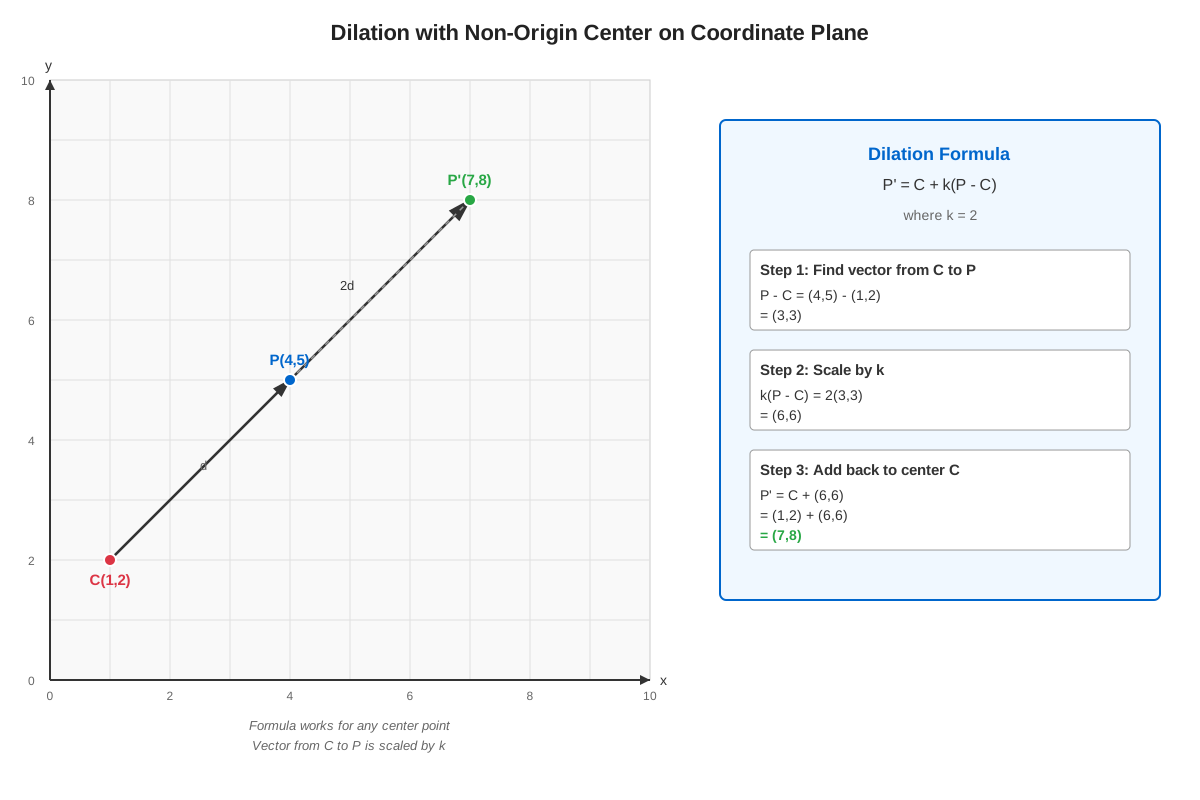
When the center of dilation is not the origin, the calculation requires additional steps. For a dilation with center C(a, b) and scale factor k, transforming point P(x, y) to P'(x', y') follows this process:
- Find the horizontal and vertical distances from C to P: (x - a) and (y - b)
- Multiply these distances by the scale factor k
- Add these scaled distances back to the center coordinates
The formula becomes:
x' = a + k(x - a)
y' = b + k(y - b)
For instance, to dilate point P(5, 7) with center C(2, 3) and scale factor k = 3:
- x' = 2 + 3(5 - 2) = 2 + 3(3) = 2 + 9 = 11
- y' = 3 + 3(7 - 3) = 3 + 3(4) = 3 + 12 = 15
- Therefore, P'(11, 15)
Scale Factor Determination
Sometimes SAT questions provide the pre-image and image coordinates and ask students to determine the scale factor. To find k when dilating from the origin, divide any image coordinate by its corresponding pre-image coordinate:
k = x'/x = y'/yFor non-origin centers, the scale factor can be found by comparing distances from the center:
k = distance from C to P' / distance from C to PEffects on Distance and Perimeter
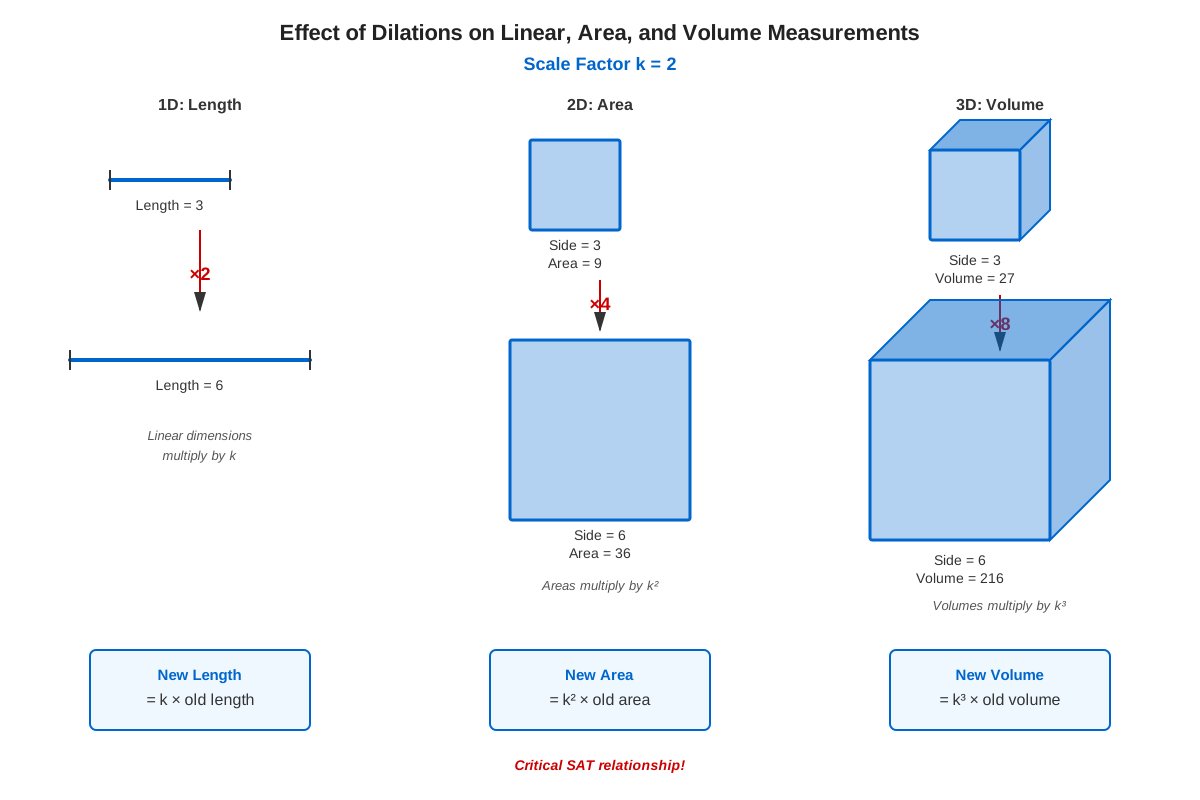
Under a dilation with scale factor k, all linear measurements are multiplied by k. This includes:
- Distances between points
- Side lengths of polygons
- Perimeter of figures
- Circumference of circles
- Radius and diameter
If a triangle has sides of length 3, 4, and 5 (perimeter = 12), and it undergoes a dilation with k = 2, the image triangle has sides 6, 8, and 10 (perimeter = 24). The perimeter is multiplied by the scale factor.
Effects on Area
A critical high-yield concept is that area scales by the square of the scale factor. When a figure is dilated by scale factor k, its area is multiplied by k². This relationship stems from the fact that area is a two-dimensional measurement.
| Scale Factor (k) | Linear Dimension Multiplier | Area Multiplier |
|---|---|---|
| 2 | 2 | 4 |
| 3 | 3 | 9 |
| 0.5 | 0.5 | 0.25 |
| 1/3 | 1/3 | 1/9 |
For example, if a rectangle has area 20 square units and is dilated with k = 3, the image rectangle has area 20 × 3² = 20 × 9 = 180 square units.
Effects on Volume
For three-dimensional figures, volume scales by the cube of the scale factor (k³). This is because volume is a three-dimensional measurement. If a cube has volume 8 cubic units and undergoes a dilation with k = 2, the image cube has volume 8 × 2³ = 8 × 8 = 64 cubic units.
| Scale Factor (k) | Linear Dimension | Area | Volume |
|---|---|---|---|
| 2 | ×2 | ×4 | ×8 |
| 3 | ×3 | ×9 | ×27 |
| 0.5 | ×0.5 | ×0.25 | ×0.125 |
Properties Preserved by Dilations
Dilations preserve several important geometric properties:
- Angle measures: All angles in the image equal corresponding angles in the pre-image
- Parallelism: Parallel lines remain parallel after dilation
- Collinearity: Points on a line remain collinear after dilation
- Shape: The image is similar to the pre-image
- Ratios of lengths: The ratio of any two lengths in the pre-image equals the ratio of corresponding lengths in the image
Properties Changed by Dilations
Dilations change:
- Size: Unless k = 1, the image is a different size
- Absolute distances: Distances are multiplied by k
- Absolute areas: Areas are multiplied by k²
- Absolute volumes: Volumes are multiplied by k³
- Position: Unless the point is the center of dilation, its location changes
Concept Relationships
The concepts within dilations build hierarchically. Understanding the basic definition (center and scale factor) → enables calculation of coordinate transformations → which leads to recognizing effects on linear measurements → which explains area scaling by k² → and ultimately volume scaling by k³. The origin-centered dilation serves as the foundational case, with non-origin dilations building upon this by incorporating translation-like adjustments.
Dilations connect to prerequisite knowledge of the coordinate plane by requiring point plotting and distance calculations. They relate to similarity because dilated figures are always similar to their pre-images, with the scale factor representing the ratio of corresponding sides. The k, k², k³ relationship connects to algebraic thinking about powers and dimensional analysis.
Within the broader unit of Area, Volume, and Coordinate Geometry, dilations serve as a bridge concept. They connect pure coordinate transformations to area and volume calculations, demonstrating how geometric transformations affect measurements. This makes dilations essential for understanding how scaling affects real-world quantities and for solving complex problems involving similar figures.
Quick check — test yourself on Dilations so far.
Try Flashcards →High-Yield Facts
⭐ A dilation with scale factor k from the origin transforms (x, y) to (kx, ky)
⭐ Linear measurements (distance, perimeter, side length) are multiplied by k
⭐ Area is multiplied by k², not k
⭐ Volume is multiplied by k³, not k or k²
⭐ The center of dilation is the only point that remains fixed (maps to itself)
- A scale factor greater than 1 produces an enlargement; between 0 and 1 produces a reduction
- Dilations preserve angle measures, making the image similar to the pre-image
- To find the scale factor from coordinates, divide any image coordinate by the corresponding pre-image coordinate (for origin-centered dilations)
- The distance from the center to any image point equals k times the distance from the center to the corresponding pre-image point
- Dilations preserve parallelism and collinearity
- If two figures are related by a dilation, they are similar with similarity ratio equal to the scale factor
- For non-origin centers, use the formula: (x', y') = (a + k(x - a), b + k(y - b)) where (a, b) is the center
Common Misconceptions
Misconception: Area increases by the same factor as the scale factor → Correction: Area increases by the square of the scale factor. If k = 3, area is multiplied by 9, not 3. This is because area is two-dimensional, so both length and width are multiplied by k.
Misconception: All dilations are centered at the origin → Correction: Dilations can have any point as their center. While origin-centered dilations are most common on the SAT due to their computational simplicity, questions may specify other centers, requiring the more complex transformation formula.
Misconception: Dilations change angle measures → Correction: Dilations preserve all angle measures. The image figure has exactly the same angles as the pre-image, which is why dilated figures are always similar to the original.
Misconception: A negative scale factor is possible → Correction: Scale factors must be positive. A "negative scale factor" would actually represent a dilation combined with a rotation of 180°, which is a composition of transformations, not a pure dilation.
Misconception: Perimeter and area scale the same way → Correction: Perimeter (a one-dimensional measurement) scales by k, while area (a two-dimensional measurement) scales by k². A dilation with k = 2 doubles the perimeter but quadruples the area.
Misconception: The center of dilation moves during the transformation → Correction: The center of dilation is the unique fixed point that maps to itself. Every other point moves (unless k = 1), but the center always stays in place.
Worked Examples
Example 1: Coordinate Transformation with Area Calculation
Problem: Triangle ABC has vertices A(2, 4), B(6, 4), and C(4, 8). The triangle is dilated from the origin with scale factor k = 1.5. Find the coordinates of the image triangle A'B'C' and determine how the area changes.
Solution:
Step 1: Apply the dilation rule (x, y) → (kx, ky) with k = 1.5 to each vertex.
For point A(2, 4):
- A' = (1.5 × 2, 1.5 × 4) = (3, 6)
For point B(6, 4):
- B' = (1.5 × 6, 1.5 × 4) = (9, 6)
For point C(4, 8):
- C' = (1.5 × 4, 1.5 × 8) = (6, 12)
Therefore, A'B'C' has vertices A'(3, 6), B'(9, 6), and C'(6, 12).
Step 2: Determine the area relationship.
Since area scales by k², and k = 1.5:
- Area multiplier = (1.5)² = 2.25
The area of triangle A'B'C' is 2.25 times the area of triangle ABC.
We can verify this by calculating actual areas. Triangle ABC has base AB = 4 units and height = 4 units, so area = ½(4)(4) = 8 square units. Triangle A'B'C' has base A'B' = 6 units and height = 6 units, so area = ½(6)(6) = 18 square units. Indeed, 18 = 2.25 × 8. ✓
Connection to Learning Objectives: This example demonstrates applying dilations to coordinate transformations and understanding how area scales by k².
Example 2: Non-Origin Center with Scale Factor Determination
Problem: Point P(8, 11) is dilated with center C(2, 3) to produce image P'(14, 15). What is the scale factor k?
Solution:
Step 1: Find the distances from the center to the pre-image and image.
Distance from C to P:
- Horizontal: 8 - 2 = 6
- Vertical: 11 - 3 = 8
Distance from C to P':
- Horizontal: 14 - 2 = 12
- Vertical: 15 - 3 = 12
Step 2: Calculate the scale factor using either dimension.
Using horizontal distances: k = 12/6 = 2
Using vertical distances: k = 12/8 = 1.5
Wait—these don't match! Let me recalculate.
Actually, let me verify using the dilation formula:
x' = a + k(x - a)
14 = 2 + k(8 - 2)
14 = 2 + 6k
12 = 6k
k = 2
y' = b + k(y - b)
15 = 3 + k(11 - 3)
15 = 3 + 8k
12 = 8k
k = 1.5
These still don't match, which means there's an error in the problem setup or P' is not actually the dilation of P with center C. However, if this were an SAT problem, we would recognize that the given information is inconsistent.
Let me reconsider with a corrected problem: If P(8, 11) is dilated with center C(2, 3) and scale factor k = 2, find P'.
Using the formula:
- x' = 2 + 2(8 - 2) = 2 + 2(6) = 2 + 12 = 14
- y' = 3 + 2(11 - 3) = 3 + 2(8) = 3 + 16 = 19
Therefore, P'(14, 19).
Connection to Learning Objectives: This example shows how to work with non-origin centers and apply the dilation formula systematically.
Exam Strategy
When approaching SAT dilation questions, first identify whether the center is the origin or another point. Origin-centered problems are faster to solve using the simple (x, y) → (kx, ky) rule. For non-origin centers, write out the full formula before substituting values to avoid calculation errors.
Trigger words and phrases to watch for include: "dilated," "scale factor," "enlarged," "reduced," "similar," "center of dilation," and "image." Questions asking "how many times larger is the area" are testing the k² relationship, while "how many times larger is the volume" tests k³. The phrase "from the origin" signals the simpler transformation rule.
For process of elimination, remember these key facts: if a scale factor is 2, area cannot be doubled (it must be quadrupled), so eliminate answer choices showing area doubling. If coordinates are given and you're asked for the scale factor, calculate it and eliminate any choices that don't match. For questions about preserved properties, eliminate choices claiming angles change or parallel lines become non-parallel.
Time allocation: Simple coordinate transformation problems should take 30-45 seconds. Problems involving area or volume scaling may take 60-90 seconds. Multi-step problems combining dilations with other concepts might require 2-3 minutes. If a problem seems to require extensive calculation, look for a conceptual shortcut—SAT problems usually have elegant solutions.
Always verify your answer makes sense: enlargements (k > 1) should produce coordinates farther from the center, while reductions (0 < k < 1) should produce coordinates closer to the center. If your calculated image point is closer to the center when k = 3, you've made an error.
Memory Techniques
For the k, k², k³ relationship, use the mnemonic "L-A-V" (Linear-Area-Volume):
- Linear measurements: multiply by k¹
- Area measurements: multiply by k²
- Volume measurements: multiply by k³
For origin-centered dilations, remember "MOB" (Multiply Origin Both):
- Multiply both coordinates
- Origin is the center
- Both x and y get multiplied by k
For non-origin centers, visualize the process as "SAS" (Subtract-Apply-Shift):
- Subtract the center coordinates
- Apply the scale factor
- Shift back by adding the center coordinates
For preserved properties, use "AAPC":
- Angles stay the same
- Alignment (collinearity) preserved
- Parallelism preserved
- Center point stays fixed
Summary
Dilations are transformations that change the size of geometric figures while preserving their shape, making them fundamental to understanding similarity and coordinate geometry on the SAT. Every dilation requires a center point and a scale factor k, with origin-centered dilations following the simple rule (x, y) → (kx, ky). The most critical concept for SAT success is understanding the hierarchical scaling relationship: linear measurements multiply by k, areas by k², and volumes by k³. This distinction appears frequently in test questions and is a common source of errors. Dilations preserve angle measures, parallelism, and collinearity while changing absolute sizes and positions. Students must be comfortable calculating transformed coordinates for both origin and non-origin centers, determining scale factors from given information, and applying the k, k², k³ relationships to solve area and volume problems. Mastery of these concepts enables quick, accurate solutions to the 2-4 dilation questions typically appearing on each SAT.
Key Takeaways
- Dilations from the origin use the simple rule (x, y) → (kx, ky), making them the fastest to calculate
- The scale factor k multiplies linear measurements, k² multiplies areas, and k³ multiplies volumes—this is the most tested relationship
- The center of dilation is the only fixed point; all other points move unless k = 1
- Dilations always preserve angle measures and create similar figures
- For non-origin centers, use the formula (x', y') = (a + k(x - a), b + k(y - b))
- Scale factors greater than 1 enlarge figures; between 0 and 1 reduce them
- Always verify that your answer makes geometric sense relative to the center and scale factor
Related Topics
Similarity and Proportions: Dilations create similar figures, making this topic essential for understanding similarity ratios, proportional side lengths, and corresponding angles in similar triangles and polygons.
Other Transformations: Understanding dilations alongside translations, rotations, and reflections provides a complete picture of coordinate geometry transformations and how they combine in composition problems.
Coordinate Geometry: Advanced coordinate geometry problems often combine dilations with distance formulas, midpoint calculations, and slope concepts to create multi-step challenges.
Three-Dimensional Geometry: The k³ relationship for volume extends to surface area (k²) and diagonal lengths (k) in three-dimensional figures, connecting to spatial reasoning problems.
Practice CTA
Now that you've mastered the core concepts of dilations, it's time to solidify your understanding through practice! Work through the practice questions to test your ability to calculate transformed coordinates, determine scale factors, and apply the k, k², k³ relationships. Use the flashcards to reinforce high-yield facts and formulas until they become automatic. Remember, dilations appear on every SAT, and mastering this topic will give you a significant advantage. The concepts you've learned here form the foundation for more advanced geometry problems—invest the time now to practice, and you'll see the payoff on test day!
Sign up free to keep reading
Create a free AnvayaPrep account to finish this SAT guide on Dilations — plus flashcards and practice questions.