Overview
SAT volume traps represent one of the most deceptive categories of geometry questions on the SAT math section. These problems appear straightforward at first glance but contain subtle complications designed to catch unprepared students. Unlike standard volume calculations that simply require applying a formula, volume traps incorporate hidden constraints, misleading diagrams, unit conversions, or multi-step reasoning that can derail even strong math students. Understanding these traps is not merely about memorizing volume formulas—it requires developing a critical eye for what the question is actually asking versus what it appears to ask.
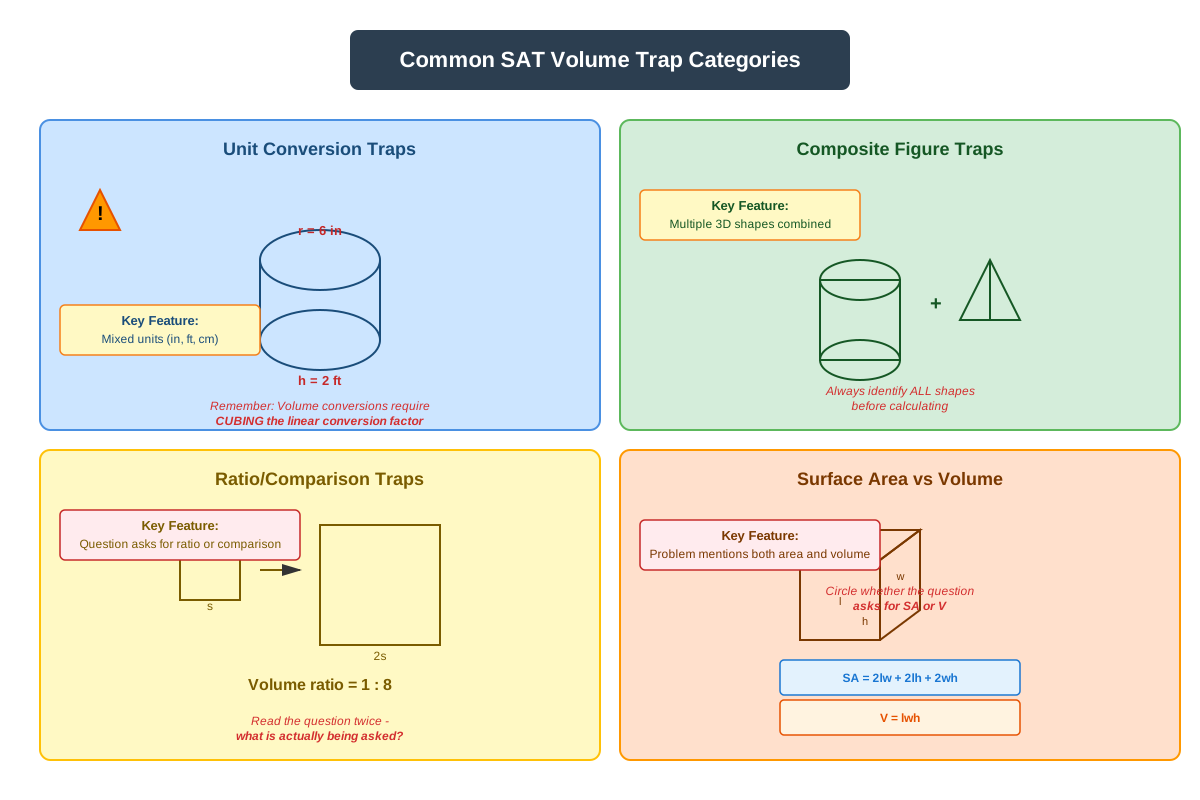
The SAT deliberately designs these questions to exploit common student assumptions and calculation errors. A typical volume trap might present a cylinder with dimensions given in different units, require finding the volume of a composite shape, or ask for a ratio rather than an absolute volume. Students who rush through these problems often fall into predictable patterns of error, which is precisely why the College Board includes them. Mastering volume traps means learning to slow down, identify red flags, and systematically verify that every aspect of the problem has been properly addressed.
Volume trap questions connect to broader SAT geometry concepts including spatial reasoning, unit analysis, proportional relationships, and algebraic manipulation. They frequently appear alongside coordinate geometry problems and may require integration of multiple mathematical concepts in a single question. Because these problems test both computational skills and critical thinking, they serve as excellent discriminators between students who have memorized procedures and those who truly understand geometric principles. For students aiming for scores above 650 on the math section, mastering volume traps is essential.
Learning Objectives
- [ ] Identify key features of SAT volume traps
- [ ] Explain how SAT volume traps appears on the SAT
- [ ] Apply SAT volume traps to answer SAT-style questions
- [ ] Recognize common misdirection techniques in volume problems
- [ ] Convert between different units of volume measurement accurately
- [ ] Distinguish between surface area and volume when both are present in a problem
- [ ] Calculate volumes of composite three-dimensional figures systematically
Prerequisites
- Basic volume formulas: Students must know formulas for rectangular prisms, cylinders, cones, spheres, and pyramids, as these form the foundation for all volume calculations
- Unit conversion: Understanding how to convert between inches/feet/yards and recognizing that volume conversions require cubing the linear conversion factor
- Algebraic manipulation: Ability to solve for variables, work with exponents, and manipulate equations is necessary for complex volume problems
- Ratio and proportion: Many volume traps involve comparing volumes or finding how volume changes with dimension changes
- Reading comprehension: Careful interpretation of word problems is critical since volume traps often hinge on subtle wording differences
Why This Topic Matters
Volume trap questions appear on virtually every SAT administration, typically comprising 1-3 questions in the math section. These questions carry the same point value as simpler problems but have significantly lower accuracy rates among test-takers, making them high-value targets for score improvement. Students who master volume traps can gain a competitive advantage, as these questions often separate score ranges in the 650-750 band where college admissions become increasingly selective.
In real-world applications, volume calculations are fundamental to fields including engineering, architecture, medicine (dosage calculations), environmental science (calculating pollution concentrations), and manufacturing (material requirements). The critical thinking skills developed by navigating volume traps—checking assumptions, verifying units, and breaking complex problems into manageable steps—transfer directly to professional problem-solving contexts.
On the SAT, volume traps most commonly appear as multiple-choice questions in the calculator-permitted section, though they occasionally surface as grid-in questions. They frequently involve cylinders and rectangular prisms, as these shapes are most familiar to students and therefore easiest to create deceptive problems around. The traps typically manifest in one of several predictable ways: unit mismatches, composite figures, asking for something other than volume (like the difference between two volumes), or requiring inverse reasoning (given volume, find a dimension).
Core Concepts
Understanding Volume Trap Mechanisms
SAT volume traps exploit specific vulnerabilities in student problem-solving approaches. The most fundamental trap involves the difference between what students expect to calculate and what the question actually requests. For example, a problem might provide all dimensions of a cylinder and ask "What is the radius?" rather than "What is the volume?" Students who automatically begin calculating volume without carefully reading the question will select a wrong answer that matches their calculation—an answer the test makers deliberately include as a distractor.
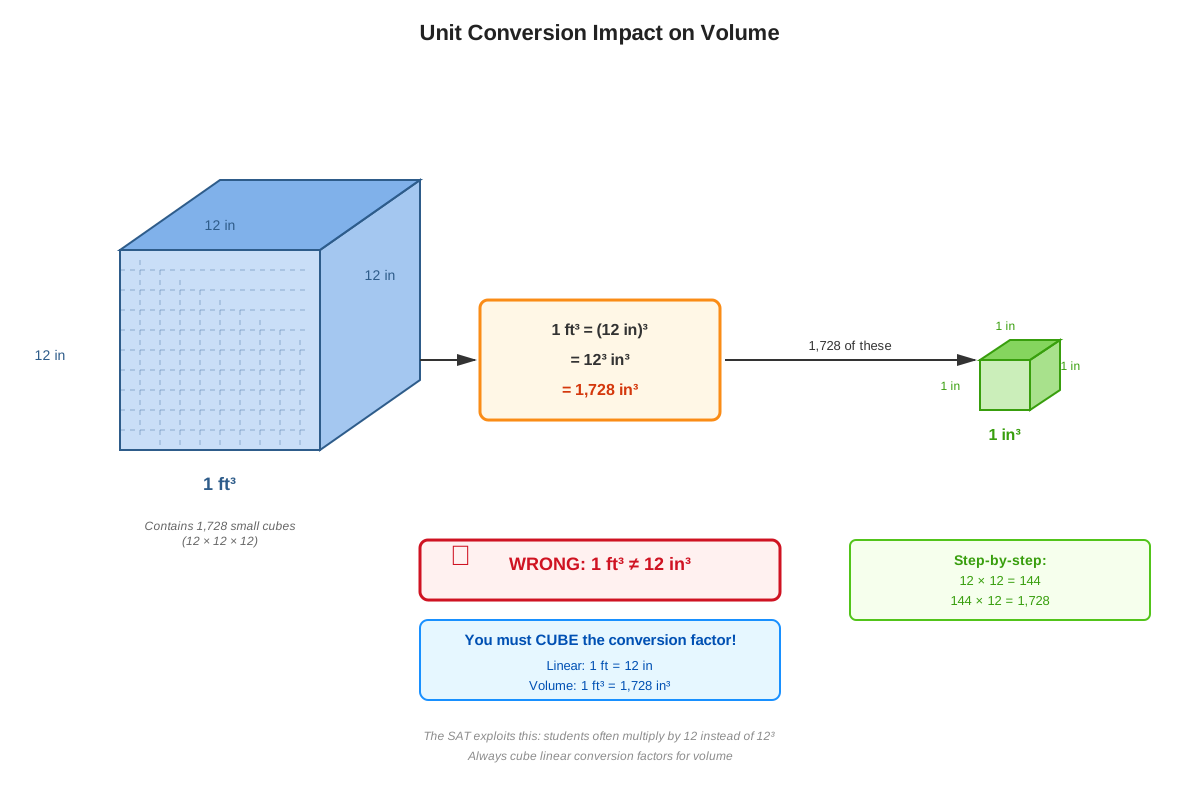
Another core mechanism involves unit inconsistency. The SAT frequently presents dimensions in mixed units (e.g., height in feet, radius in inches) knowing that students will plug numbers directly into formulas without converting. Since volume is three-dimensional, a linear conversion factor must be cubed. For instance, if 1 foot = 12 inches, then 1 cubic foot = 1,728 cubic inches (12³). This cubic relationship is a frequent source of errors.
Common Volume Formulas and Their Traps
| Shape | Formula | Common Trap |
|---|---|---|
| Rectangular Prism | V = lwh | Giving surface area formula instead; mixing up which dimension is which |
| Cylinder | V = πr²h | Using diameter instead of radius; confusing with surface area (2πrh + 2πr²) |
| Cone | V = (1/3)πr²h | Forgetting the 1/3 coefficient; confusing with cylinder volume |
| Sphere | V = (4/3)πr³ | Using diameter instead of radius; confusing with surface area (4πr²) |
| Pyramid | V = (1/3)Bh | Forgetting the 1/3 coefficient; incorrectly calculating base area B |
Each formula presents specific opportunities for traps. The cylinder volume formula is particularly trap-prone because students must remember to square the radius (not the diameter) and because cylinders appear frequently in real-world contexts that students think they understand intuitively. The SAT exploits this false confidence.
Composite Figure Traps
Composite figures—shapes formed by combining or subtracting basic geometric solids—represent advanced volume traps. These problems require students to:
- Identify the component shapes correctly
- Calculate each volume separately
- Determine whether to add or subtract volumes
- Ensure all units are consistent throughout
A classic example involves a cylinder with a cone on top. Students must recognize this as two separate calculations, use the same radius for both shapes, and add the results. The trap often involves providing the total height and requiring students to determine how much height belongs to each component.
Scaling and Proportional Volume Changes
When a three-dimensional figure's dimensions are scaled by a factor of k, the volume scales by k³. This cubic relationship is counterintuitive and frequently tested. If a cube's side length doubles, its volume increases by a factor of 8 (2³), not 2. The SAT creates traps by:
- Asking for the new volume after scaling
- Asking for the scaling factor given volume change
- Presenting problems where only some dimensions change
- Using fractional or decimal scaling factors
Unit Conversion Traps
Unit conversion errors in volume problems are among the most common mistakes on the SAT. The key principle: when converting linear measurements, the conversion factor must be cubed for volume. Consider these examples:
- Converting 2 cubic feet to cubic inches: 2 × (12³) = 2 × 1,728 = 3,456 cubic inches
- Converting 5,000 cubic centimeters to cubic meters: 5,000 ÷ (100³) = 5,000 ÷ 1,000,000 = 0.005 cubic meters
The SAT includes wrong answer choices that use the linear conversion factor (not cubed) or the squared conversion factor, knowing these represent common errors.
Volume Versus Surface Area Confusion
Many volume traps deliberately include both volume and surface area information to create confusion. Students must carefully distinguish between:
- Volume: The three-dimensional space inside a figure (cubic units)
- Surface area: The two-dimensional area covering the outside (square units)
The SAT might provide surface area and ask for volume, requiring students to work backward through formulas. Alternatively, a problem might ask for surface area while providing information that makes volume calculation tempting.
Implicit Information and Hidden Constraints
Advanced volume traps require recognizing implicit information not explicitly stated. For example:
- A "cube" means all edges are equal (l = w = h)
- A "right circular cylinder" means the axis is perpendicular to the base
- "Filled to capacity" means volume equals container volume
- "Half-full" requires calculating total volume then dividing by 2
These unstated assumptions are precisely where traps hide. The SAT rewards students who verify their understanding of what each term means.
Concept Relationships
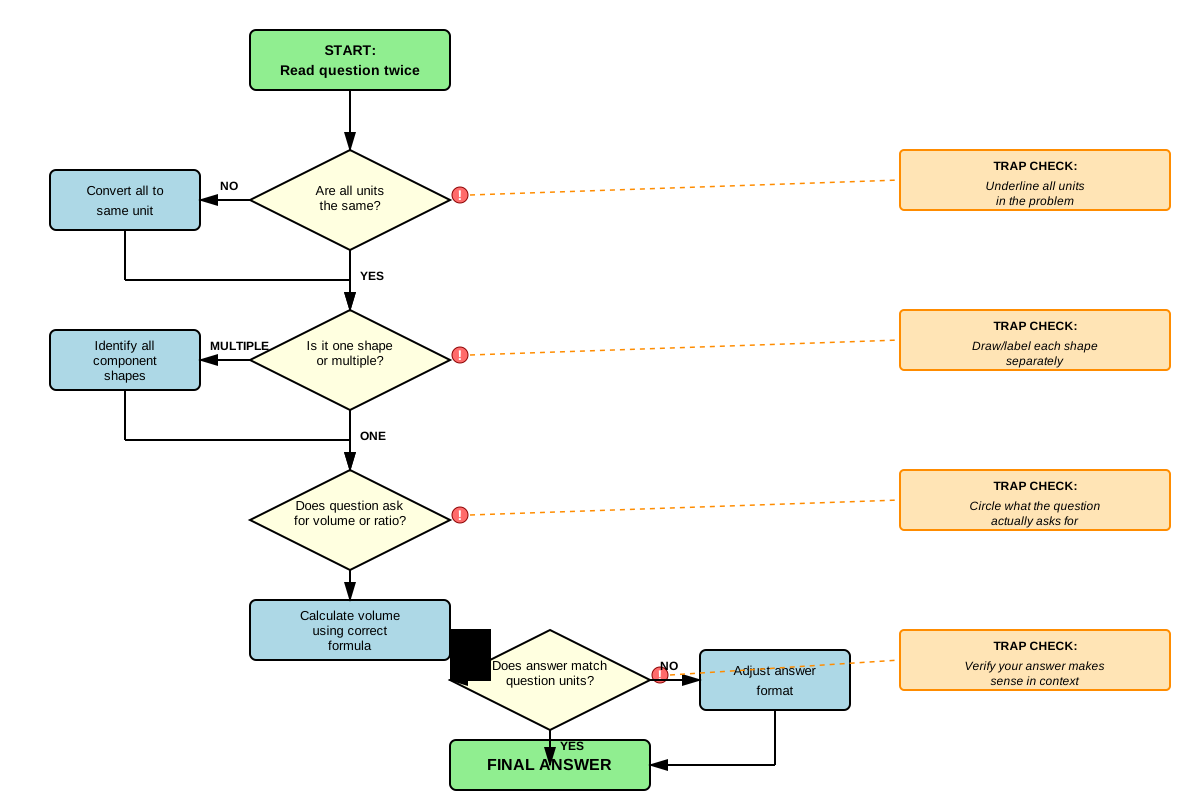
The concepts within volume traps form an interconnected web of mathematical reasoning. Unit conversion serves as the foundation, as nearly all volume traps require consistent units before calculation. This connects directly to formula application, where students must select and correctly use the appropriate volume formula. Formula application then branches into two paths: direct calculation for simple figures and composite figure decomposition for complex shapes.
Scaling relationships connect to both formula application and algebraic reasoning, as students must understand how changing dimensions affects volume proportionally. This concept links back to exponent rules from algebra, demonstrating how geometric and algebraic thinking intersect.
The relationship map flows as follows:
Careful Reading → Unit Analysis → Formula Selection → Calculation Strategy (branches to either Direct Application or Composite Decomposition) → Verification → Answer Selection
This process connects to prerequisite knowledge of basic geometry (shapes and formulas), algebra (solving for variables, working with exponents), and arithmetic (accurate calculation). The topic also relates forward to more advanced concepts like optimization problems, related rates in calculus, and three-dimensional coordinate geometry.
Quick check — test yourself on SAT volume traps so far.
Try Flashcards →High-Yield Facts
⭐ Volume scales with the cube of linear dimensions: If all dimensions double, volume increases by a factor of 8 (2³)
⭐ Unit conversion for volume requires cubing the linear conversion factor: 1 ft³ = 12³ = 1,728 in³
⭐ Cylinder volume uses radius squared, not diameter: V = πr²h, where r is half the diameter
⭐ Cones and pyramids have 1/3 in their volume formulas: V = (1/3)Bh for both shapes
⭐ The SAT frequently asks for something other than volume: Read carefully for requests about radius, height, ratios, or differences
- Volume is measured in cubic units (cm³, in³, ft³), while surface area uses square units
- For composite figures, identify whether to add or subtract component volumes based on the physical situation
- When dimensions are given in different units, convert all to the same unit before calculating
- A sphere's volume formula uses r³, making it highly sensitive to radius changes
- The SAT often provides diameter when formulas require radius, or vice versa
- Volume problems may require working backward from volume to find a dimension
- Ratio problems involving volume often require setting up proportions with cubed terms
- "Capacity" problems are volume problems in disguise
- The SAT includes wrong answers that result from common errors (using diameter instead of radius, forgetting 1/3, not converting units)
Common Misconceptions
Misconception: Volume and surface area are interchangeable concepts that measure the same thing.
Correction: Volume measures three-dimensional space (cubic units) while surface area measures two-dimensional covering (square units). They require different formulas and answer different questions about a shape.
Misconception: When converting units for volume, multiply by the linear conversion factor.
Correction: Volume conversions require cubing the linear conversion factor because volume is three-dimensional. Converting 1 ft³ to in³ requires multiplying by 12³ (1,728), not just 12.
Misconception: Doubling all dimensions of a shape doubles its volume.
Correction: Doubling all linear dimensions increases volume by a factor of 8 (2³). Volume scales with the cube of the scaling factor, not linearly.
Misconception: The cylinder volume formula uses diameter.
Correction: The formula V = πr²h uses radius, which is half the diameter. Using diameter instead of radius produces a volume four times too large (since (2r)² = 4r²).
Misconception: All volume problems ask you to calculate volume.
Correction: SAT volume traps frequently ask for a dimension (radius, height), a ratio, a difference between volumes, or how volume changes. Always read what the question actually requests.
Misconception: The formulas for cones and cylinders are the same.
Correction: A cone's volume is exactly one-third of a cylinder's volume with the same base and height: V_cone = (1/3)πr²h versus V_cylinder = πr²h.
Misconception: In composite figures, always add the volumes of component shapes.
Correction: Sometimes volumes must be subtracted, such as when a shape is removed from another (a cylindrical hole drilled through a rectangular prism) or when finding the volume of a hollow object.
Worked Examples
Example 1: Unit Conversion Trap
Problem: A cylindrical water tank has a radius of 3 feet and a height of 4 feet. What is the volume of the tank in cubic inches?
Solution:
Step 1: Identify the trap. The dimensions are given in feet, but the answer must be in cubic inches. This is a unit conversion trap.
Step 2: Choose a strategy. We can either (a) convert dimensions to inches first, then calculate volume, or (b) calculate volume in cubic feet, then convert to cubic inches. Method (a) is generally safer.
Step 3: Convert dimensions to inches.
- Radius: 3 feet × 12 inches/foot = 36 inches
- Height: 4 feet × 12 inches/foot = 48 inches
Step 4: Apply the cylinder volume formula.
V = πr²h
V = π(36)²(48)
V = π(1,296)(48)
V = 62,208π cubic inches
Step 5: Verify the answer makes sense. If we had calculated in cubic feet first: V = π(3)²(4) = 36π cubic feet. Converting: 36π × 1,728 = 62,208π cubic inches. ✓
Key Learning: Always convert all dimensions to the required unit before calculating volume. The cubic conversion factor (1,728 for feet to inches) is easy to forget under time pressure.
Example 2: Composite Figure with Scaling
Problem: A grain silo consists of a cylinder with a cone on top. The cylinder has radius 6 meters and height 15 meters. The cone has the same radius as the cylinder and height 4 meters. If a scale model is built where all dimensions are reduced by a factor of 10, what is the volume of the scale model in cubic meters?
Solution:
Step 1: Recognize this is a composite figure with scaling—two traps in one problem.
Step 2: Calculate the volume of the full-size silo.
Cylinder volume:
V_cylinder = πr²h = π(6)²(15) = π(36)(15) = 540π m³Cone volume:
V_cone = (1/3)πr²h = (1/3)π(6)²(4) = (1/3)π(36)(4) = 48π m³Total volume:
V_total = 540π + 48π = 588π m³Step 3: Apply the scaling factor. When all dimensions are reduced by a factor of 10, volume is reduced by a factor of 10³ = 1,000.
V_model = 588π ÷ 1,000 = 0.588π m³Step 4: Verify. Alternatively, we could calculate using scaled dimensions (r = 0.6 m, h_cylinder = 1.5 m, h_cone = 0.4 m) and should get the same answer.
Key Learning: For composite figures, calculate each component separately, then combine. For scaling problems, remember that volume scales with the cube of the linear scaling factor.
Exam Strategy
When approaching SAT volume problems, implement this systematic strategy:
Step 1: Read the entire question twice. Identify exactly what is being asked. Circle or underline the specific request (volume, radius, ratio, difference, etc.). Volume traps often ask for something other than volume.
Step 2: Check all units immediately. Before any calculation, verify that all dimensions use the same unit. If not, convert everything to one consistent unit. Write the conversion factor where you can see it.
Step 3: Identify the shape(s). Determine whether the problem involves a single basic shape or a composite figure. For composite figures, sketch a quick diagram showing how the shapes combine.
Step 4: Write the relevant formula(s). Don't rely on memory alone under test pressure. Write V = πr²h or V = (1/3)πr²h explicitly. This helps catch errors like forgetting the 1/3 coefficient.
Step 5: Verify radius versus diameter. This is the single most common error in cylinder, cone, and sphere problems. If the problem gives diameter, immediately calculate and write down the radius.
Exam Tip: Trigger words to watch for include "diameter" (requires dividing by 2), "capacity" (means volume), "filled" (may indicate partial volume), "scale model" (requires cubic scaling), and any mention of two different units.
Step 6: Calculate systematically. Show your work even on multiple-choice questions. This allows you to catch errors and makes it easier to resume if interrupted.
Step 7: Check your answer against the choices. If your answer doesn't match any option, common errors to check: Did you use radius instead of diameter (or vice versa)? Did you convert units? Did you include π in your answer if the choices include π? Did you answer the actual question asked?
Time allocation: Budget 1.5-2 minutes for straightforward volume problems and 2.5-3 minutes for complex composite figures or multi-step problems. If a problem is taking longer, mark it and return after completing easier questions.
Process of elimination: Wrong answers in volume trap questions often represent predictable errors. Look for answers that are 4× too large (used diameter instead of radius), 3× too large (forgot the 1/3 in cone/pyramid formulas), or off by a factor of 12 or 1,728 (unit conversion errors).
Memory Techniques
Mnemonic for shapes with 1/3: "Cones and Pyramids are Cheap—they only hold 1/3 as much as Cylinders and Prisms." This helps remember that V_cone = (1/3)V_cylinder and V_pyramid = (1/3)V_prism when they share the same base and height.
Radius vs. Diameter: Remember "Radius is Really half" or visualize a pizza: the radius goes from center to edge (half-way across), while diameter goes all the way across.
Unit Conversion Visualization: Picture a cube that's 1 foot on each side. Mentally divide each edge into 12 inches. You now have 12 × 12 × 12 = 1,728 small cubes, each 1 cubic inch. This visual reinforces why you must cube the conversion factor.
Scaling Acronym - "LCD": Linear dimensions scale by k, Circumference/perimeter scales by k, Dimensions squared (area) scale by k², Dimensions cubed (volume) scale by k³. The progression helps remember that volume requires cubing.
Formula Organization: Group formulas by the 1/3 factor:
- Full volume: Cylinder (πr²h), Rectangular prism (lwh), Sphere (4/3 πr³)
- One-third volume: Cone (1/3 πr²h), Pyramid (1/3 Bh)
RADIUS Checklist for cylinder/cone/sphere problems:
- Read what's given (radius or diameter?)
- Adjust if needed (divide diameter by 2)
- Double-check the formula (r² or r³?)
- Insert the correct value
- Units consistent?
- Square or cube correctly
Summary
SAT volume traps represent a high-yield category of geometry problems that test both computational skills and critical thinking. These questions deliberately incorporate misdirection through unit inconsistencies, composite figures, requests for values other than volume, and scaling relationships. Success requires a systematic approach: carefully reading what's actually being asked, ensuring unit consistency, correctly identifying shapes and their formulas, distinguishing between radius and diameter, and understanding how volume scales with the cube of linear dimensions. The most common traps involve using diameter instead of radius in formulas, failing to cube unit conversion factors, forgetting the 1/3 coefficient in cone and pyramid formulas, and calculating volume when the question asks for something else. Students who develop awareness of these patterns and implement a methodical problem-solving process can transform volume traps from score-killers into opportunities for demonstrating mastery.
Key Takeaways
- SAT volume traps test careful reading and attention to detail as much as formula knowledge—always verify what the question actually asks
- Unit conversion for volume requires cubing the linear conversion factor (1 ft³ = 1,728 in³, not 12 in³)
- Volume scales with the cube of linear dimensions: doubling all dimensions increases volume by a factor of 8
- Cylinder, cone, and sphere formulas use radius (not diameter)—divide diameter by 2 before calculating
- Cones and pyramids have 1/3 in their volume formulas; cylinders and prisms do not
- Composite figures require identifying component shapes, calculating each volume separately, then adding or subtracting appropriately
- Wrong answer choices often represent common errors—use this to check your work and eliminate options
Related Topics
Surface Area Traps: Similar to volume traps but focusing on two-dimensional measurements of three-dimensional objects; mastering volume traps provides the foundation for recognizing surface area misdirection.
Coordinate Geometry in Three Dimensions: Extends volume concepts to the coordinate plane, requiring calculation of distances and volumes using coordinate points; builds directly on volume formula mastery.
Optimization Problems: Advanced applications where students must maximize or minimize volume given constraints; requires fluency with volume formulas and algebraic manipulation.
Density and Concentration Problems: Real-world applications combining volume with mass or quantity, frequently appearing in science contexts; understanding volume is prerequisite to these ratio-based problems.
Similar Figures and Scaling: Explores proportional relationships in depth, including how area and volume scale differently than linear dimensions; volume trap mastery makes these concepts more intuitive.
Practice CTA
Now that you understand the mechanisms behind SAT volume traps and have strategies to avoid them, it's time to put your knowledge into action. Work through the practice questions systematically, applying the step-by-step approach outlined in the exam strategy section. Pay special attention to problems where your first instinct leads to an answer that's available but incorrect—these reveal exactly where the test makers expect students to make mistakes. Use the flashcards to reinforce formula recall and trap recognition until identifying these patterns becomes automatic. Remember: every volume trap you learn to recognize is a question you'll confidently answer correctly on test day, directly translating to a higher score. You've got this!
Sign up free to keep reading
Create a free AnvayaPrep account to finish this SAT guide on SAT volume traps — plus flashcards and practice questions.