Overview
Surface area is a fundamental geometric concept that measures the total area of all exposed faces of a three-dimensional solid. On the SAT, surface area problems test spatial reasoning, formula application, and the ability to visualize how two-dimensional faces combine to form three-dimensional objects. These questions typically involve rectangular prisms, cubes, cylinders, and occasionally more complex composite shapes. Understanding surface area is crucial because it bridges two-dimensional area concepts with three-dimensional geometry, requiring students to mentally "unfold" solids and calculate the sum of individual face areas.
The SAT frequently tests surface area in both the calculator and no-calculator sections, making it a high-yield topic that appears in approximately 2-4 questions per test. These problems often involve real-world contexts such as packaging, painting, or material coverage scenarios. Success with surface area questions requires not only memorizing formulas but also understanding when and how to apply them, recognizing which faces to include in calculations, and adapting to variations where certain faces may be excluded or modified.
Surface area connects directly to other essential math concepts including area formulas for rectangles, circles, and triangles, as well as volume calculations and coordinate geometry. Mastering surface area strengthens overall spatial reasoning skills and provides a foundation for more advanced geometric concepts. The topic also reinforces algebraic manipulation skills, as many sat surface area problems require setting up and solving equations involving unknown dimensions.
Learning Objectives
- [ ] Identify key features of surface area including the definition, units, and relationship to three-dimensional solids
- [ ] Explain how surface area appears on the SAT, including common question formats and real-world contexts
- [ ] Apply surface area formulas to answer SAT-style questions involving standard geometric solids
- [ ] Calculate the surface area of rectangular prisms, cubes, and cylinders using appropriate formulas
- [ ] Solve multi-step problems involving surface area with missing dimensions or composite shapes
- [ ] Distinguish between surface area and volume, recognizing when each concept applies to a given problem
Prerequisites
- Area formulas for basic shapes: Students must know how to calculate the area of rectangles (length × width), circles (πr²), and triangles (½ × base × height), as surface area calculations require finding the area of individual faces
- Basic algebra skills: Solving for unknown variables and manipulating equations is essential when surface area problems provide the total surface area and ask for a specific dimension
- Understanding of three-dimensional shapes: Familiarity with the properties of prisms, cylinders, and other solids helps visualize which faces contribute to total surface area
- Unit conversion: Converting between square inches, square feet, and other area units appears frequently in SAT surface area problems
Why This Topic Matters
Surface area has numerous practical applications in everyday life and professional fields. Architects calculate surface area to determine paint or siding requirements for buildings. Package designers use surface area to minimize material costs while maximizing product protection. Engineers consider surface area when designing heat exchangers, solar panels, and other systems where surface exposure matters. Medical professionals apply surface area calculations to determine appropriate medication dosages based on body surface area.
On the SAT, surface area questions appear with consistent frequency, typically 2-4 times per test administration. These questions account for approximately 3-5% of the total math section score. Surface area problems most commonly appear as multiple-choice questions in both calculator and no-calculator sections, though they occasionally appear as grid-in questions requiring numerical answers. The difficulty level ranges from straightforward formula application to complex multi-step problems involving composite shapes or missing dimensions.
Common SAT presentations include: word problems describing real-world scenarios (painting a room, wrapping a gift, covering a container), questions providing a diagram of a three-dimensional solid with labeled dimensions, problems requiring students to identify which formula applies to a given situation, and questions asking students to find a missing dimension when given the total surface area. Some questions test whether students understand that removing or adding faces changes the total surface area, particularly in composite shape problems.
Core Concepts
Definition and Fundamental Understanding
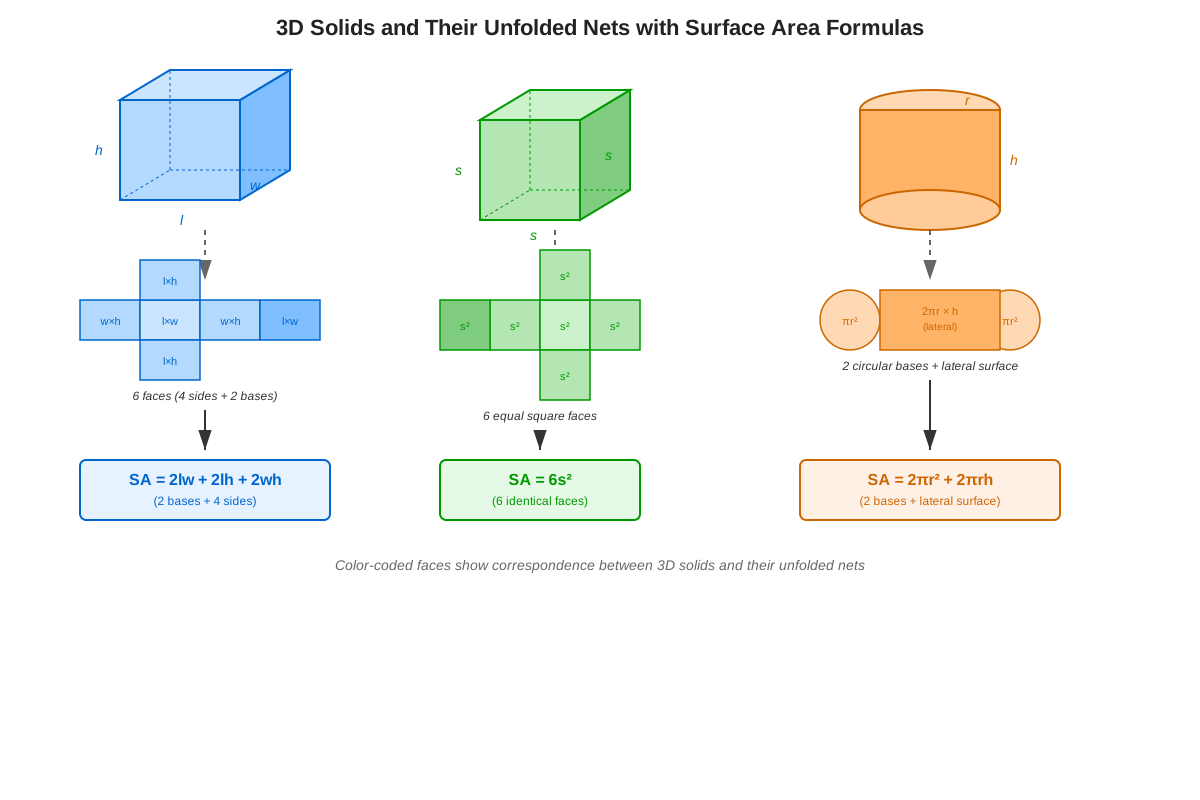
Surface area measures the total area of all exterior faces of a three-dimensional solid, expressed in square units (square inches, square feet, square centimeters, etc.). Unlike volume, which measures the space inside a solid, surface area quantifies the amount of material needed to cover the outside completely. Visualizing surface area involves imagining "unfolding" a three-dimensional object into a flat pattern called a net, then calculating the sum of all face areas.
The key principle underlying all surface area calculations is that the total surface area equals the sum of the areas of all individual faces. This additive property means students can break down complex shapes into manageable components, calculate each face area separately, then add the results. Understanding this principle is more valuable than memorizing formulas, as it enables students to handle non-standard shapes and variations.
Surface Area of Rectangular Prisms
A rectangular prism (also called a rectangular solid or box) has six rectangular faces arranged in three pairs of congruent rectangles. If the dimensions are length (l), width (w), and height (h), the surface area formula is:
SA = 2lw + 2lh + 2whThis formula can also be written as:
SA = 2(lw + lh + wh)Each term represents one pair of opposite faces: 2lw represents the top and bottom faces, 2lh represents the front and back faces, and 2wh represents the left and right side faces. The factor of 2 appears because opposite faces are congruent.
For a cube, where all edges have the same length (s), the formula simplifies to:
SA = 6s²This makes sense because a cube has six congruent square faces, each with area s².
Surface Area of Cylinders
A cylinder consists of two circular bases and one curved rectangular surface that wraps around the circles. If the radius is r and the height is h, the surface area formula is:
SA = 2πr² + 2πrhBreaking this down: 2πr² represents the combined area of the top and bottom circular bases (each circle has area πr²), while 2πrh represents the lateral (curved) surface area. The lateral surface area can be visualized by imagining cutting the cylinder vertically and unrolling it into a rectangle with height h and width equal to the circumference of the circle (2πr).
Some SAT problems ask for only the lateral surface area (excluding the bases) or only one base, so students must read carefully to determine which surfaces to include.
Composite Shapes and Modified Solids
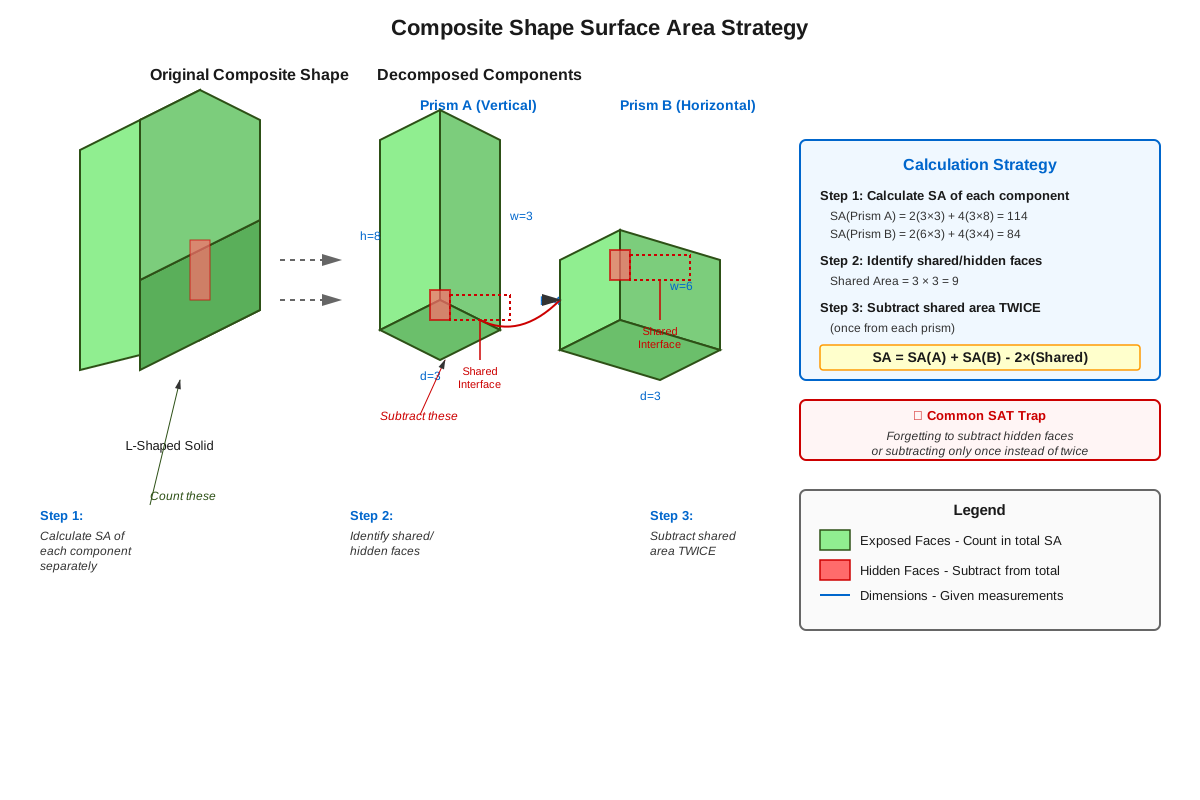
The SAT frequently tests surface area with composite shapes—solids formed by combining or removing basic shapes. For these problems, students must:
- Identify all visible exterior faces
- Exclude any interior faces where shapes connect
- Calculate the area of each visible face
- Sum all face areas
For example, if two cubes are joined face-to-face, the total surface area is less than the sum of both individual surface areas because the touching faces are no longer part of the exterior surface.
Problem-Solving Approach
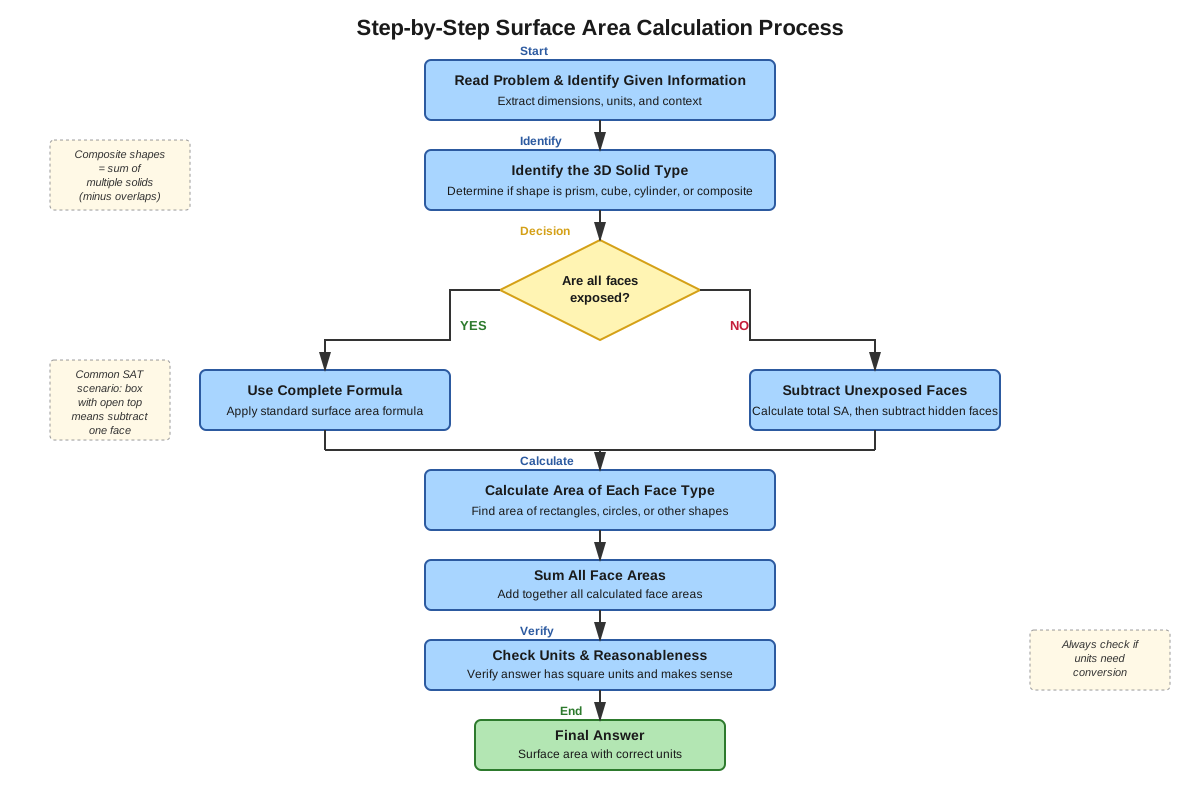
When approaching surface area problems, follow this systematic process:
- Identify the shape: Determine whether the solid is a rectangular prism, cube, cylinder, or composite shape
- List all faces: Write down each distinct face and its dimensions
- Calculate individual areas: Find the area of each face using appropriate formulas
- Sum the areas: Add all face areas to find total surface area
- Check units: Ensure the answer is in square units and matches the question's requirements
Concept Relationships
Surface area builds directly on two-dimensional area concepts, extending them into three-dimensional space. The relationship flows: basic area formulas (rectangles, circles, triangles) → surface area of individual faces → total surface area of solids. Each surface area calculation requires applying multiple area formulas and combining results.
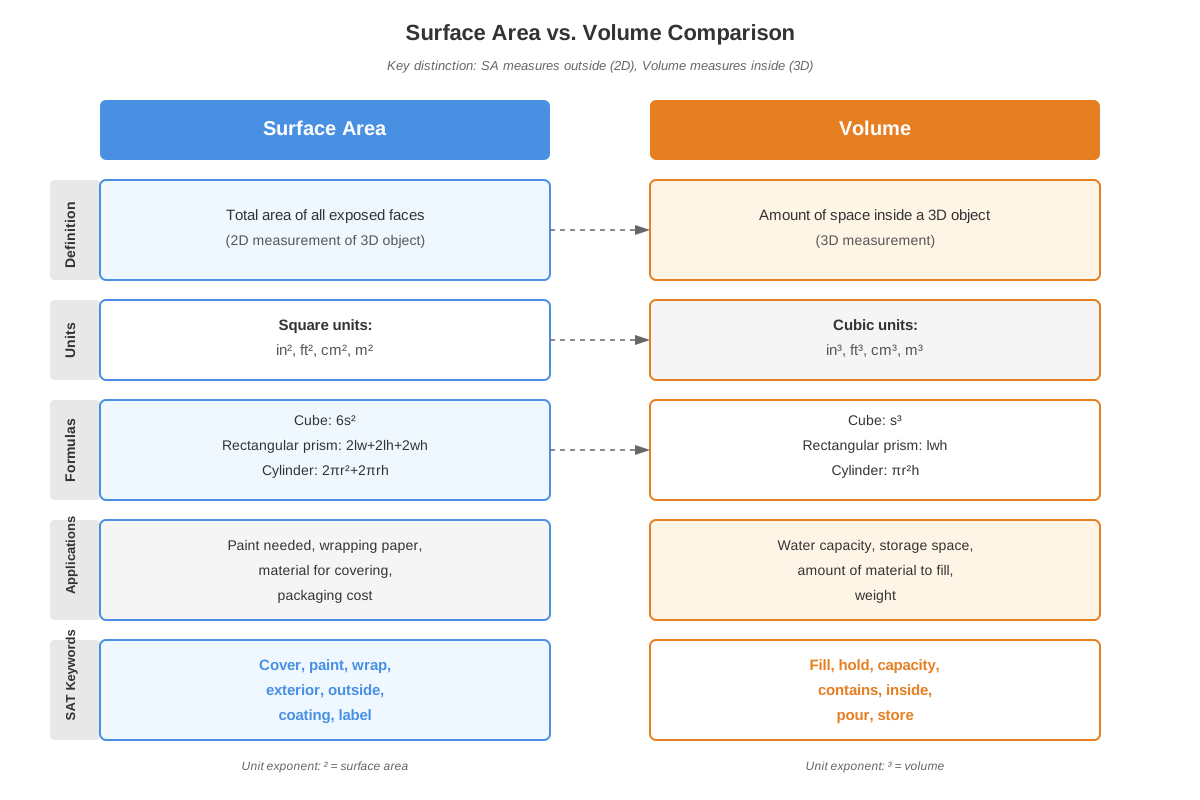
Surface area connects closely to volume as complementary measures of three-dimensional solids—surface area measures the exterior while volume measures the interior. Both concepts use the same dimensional measurements but produce different units (square units vs. cubic units). Many SAT problems test whether students can distinguish between these concepts.
The relationship to coordinate geometry appears when surface area problems involve solids positioned in three-dimensional coordinate systems or when dimensions must be calculated using distance formulas. Additionally, surface area connects to algebraic reasoning when problems provide the total surface area and require solving for unknown dimensions, necessitating equation setup and manipulation.
Within the topic itself, the concepts connect as: basic definition → rectangular prism formula → cube as special case → cylinder formula → composite shapes requiring synthesis. Mastering simpler shapes provides the foundation for handling complex composite solids.
Quick check — test yourself on Surface area so far.
Try Flashcards →High-Yield Facts
⭐ Surface area is measured in square units (ft², in², cm²), never cubic units—this distinguishes it from volume
⭐ The surface area of a rectangular prism is SA = 2lw + 2lh + 2wh, where l, w, and h represent the three dimensions
⭐ A cube's surface area is SA = 6s², where s is the edge length—this is the most commonly tested special case
⭐ The surface area of a cylinder is SA = 2πr² + 2πrh, where r is the radius and h is the height
⭐ Lateral surface area excludes the bases—for cylinders, this means using only 2πrh
- Doubling all dimensions of a solid multiplies the surface area by 4 (2²), not 2
- When two solids are joined, subtract the area of the touching faces from the total
- The net of a three-dimensional solid shows all faces laid flat in two dimensions
- Surface area problems often involve real-world contexts like painting, wrapping, or covering
- Some problems provide surface area and ask for a dimension, requiring algebraic manipulation
Common Misconceptions
Misconception: Surface area and volume are the same thing or use the same formulas.
Correction: Surface area measures the exterior covering (in square units) while volume measures interior space (in cubic units). They use completely different formulas and represent distinct properties of three-dimensional solids.
Misconception: Doubling the dimensions of a solid doubles its surface area.
Correction: Doubling all dimensions multiplies surface area by 4 (the scale factor squared). If a cube has edge length 2 and surface area 24, doubling the edge to 4 gives surface area 96, which is 24 × 4.
Misconception: A cylinder's lateral surface area is 2πr².
Correction: The term 2πr² represents the combined area of both circular bases. The lateral (curved) surface area is 2πrh, which represents the rectangle formed when the curved surface is unrolled.
Misconception: All six faces of a rectangular prism have the same area.
Correction: Only opposite faces are congruent. A rectangular prism has three pairs of congruent faces, but unless it's a cube, the three pairs have different areas.
Misconception: When calculating surface area of composite shapes, simply add the surface areas of individual components.
Correction: When shapes are joined, the touching faces are no longer part of the exterior surface and must be subtracted from the total. Only visible exterior faces contribute to surface area.
Worked Examples
Example 1: Rectangular Prism with Missing Dimension
Problem: A rectangular storage container has a length of 8 feet, a width of 5 feet, and a total surface area of 236 square feet. What is the height of the container?
Solution:
Step 1: Identify the known values and formula.
- Length (l) = 8 ft
- Width (w) = 5 ft
- Surface area (SA) = 236 ft²
- Height (h) = unknown
- Formula: SA = 2lw + 2lh + 2wh
Step 2: Substitute known values into the formula.
236 = 2(8)(5) + 2(8)(h) + 2(5)(h)Step 3: Simplify and solve for h.
236 = 80 + 16h + 10h
236 = 80 + 26h
156 = 26h
h = 6
Step 4: Verify the answer makes sense.
The height is 6 feet. Checking: 2(8×5) + 2(8×6) + 2(5×6) = 80 + 96 + 60 = 236 ✓
Answer: The height is 6 feet.
This problem demonstrates the learning objective of applying surface area formulas to solve for unknown dimensions, a common SAT question type that combines geometry with algebraic reasoning.
Example 2: Cylinder Lateral Surface Area
Problem: A cylindrical water tank has a radius of 3 meters and a height of 10 meters. The tank needs to be painted on its curved surface only (not the top or bottom). If one can of paint covers 25 square meters, how many cans are needed?
Solution:
Step 1: Identify what surface area to calculate.
The problem asks for only the curved (lateral) surface, excluding the circular bases.
Step 2: Use the lateral surface area formula for cylinders.
Lateral SA = 2πrhStep 3: Substitute values and calculate.
Lateral SA = 2π(3)(10)
Lateral SA = 60π
Lateral SA ≈ 188.5 square meters
Step 4: Determine number of paint cans needed.
Number of cans = 188.5 ÷ 25 = 7.54Since partial cans cannot be purchased, round up to 8 cans.
Answer: 8 cans of paint are needed.
This problem illustrates the importance of carefully reading what surfaces to include and demonstrates a real-world application common on the SAT. It also shows how surface area problems may require additional steps beyond the geometric calculation.
Exam Strategy
When approaching sat surface area questions, begin by carefully reading to determine exactly which surfaces the problem asks about. Watch for phrases like "all surfaces," "excluding the bottom," "lateral surface only," or "open box" that indicate which faces to include. Underline or circle these key phrases to avoid calculation errors.
Trigger words and phrases that signal surface area problems include: "paint," "wrap," "cover," "material needed," "exterior," "outside," "all faces," and "total area of surfaces." These contexts almost always indicate surface area rather than volume. Conversely, words like "fill," "capacity," "holds," or "contains" typically signal volume problems.
For process of elimination, use these strategies:
- Eliminate answers with cubic units (ft³, m³) since surface area must be in square units
- Check if the answer is reasonable by estimating—if a rectangular prism is roughly 10×10×10, surface area should be around 600, not 6,000 or 60
- For cube problems, verify that the answer is divisible by 6 (since SA = 6s²)
- If given multiple choice options, work backwards by testing whether each answer produces valid dimensions
Time allocation: Straightforward surface area problems should take 1-2 minutes, while complex multi-step problems may require 2-3 minutes. If a problem involves both surface area and another concept (like setting up an equation), allocate extra time but don't exceed 3 minutes—mark it for review if needed and move on.
Draw quick sketches when visualizing three-dimensional shapes, especially for composite solids. Label all dimensions directly on the diagram. For cylinders, write the formulas for both total surface area and lateral surface area at the top of your work to avoid confusion.
Memory Techniques
Rectangular Prism Formula Mnemonic: "Two of Each Face" reminds you that SA = 2lw + 2lh + 2wh because there are two of each type of face (top/bottom, front/back, left/right).
Cube Memory Aid: "Six Square Faces" directly translates to the formula SA = 6s², helping you remember that a cube has six identical square faces.
Cylinder Visualization: Think "Two Circles Plus a Wrapper" to remember SA = 2πr² + 2πrh. The two circles are the bases (2πr²) and the wrapper is the lateral surface (2πrh) that wraps around like a label on a can.
Units Check Acronym: "SASU" stands for "Surface Area = Square Units" to remind you that surface area is always measured in square units, never cubic units.
Composite Shape Strategy: Use "V-E-A-S" (Visualize, Enumerate faces, Add areas, Subtract overlaps) as a step-by-step process for complex shapes.
For remembering which formula applies to which shape, visualize the actual object: a cereal box for rectangular prism, a die for cube, and a soup can for cylinder. Associating formulas with familiar objects strengthens recall under test pressure.
Summary
Surface area measures the total exterior covering of three-dimensional solids in square units, representing the sum of all face areas. The SAT tests this concept through rectangular prisms (SA = 2lw + 2lh + 2wh), cubes (SA = 6s²), and cylinders (SA = 2πr² + 2πrh), often in real-world contexts involving painting, wrapping, or covering. Success requires distinguishing surface area from volume, carefully identifying which faces to include, and applying appropriate formulas. Problems may provide dimensions to find surface area or give surface area to find missing dimensions, requiring algebraic manipulation. Composite shapes demand systematic enumeration of visible faces while excluding interior surfaces where shapes connect. The key to mastering SAT surface area questions lies in understanding the underlying principle that surface area equals the sum of individual face areas, enabling flexible problem-solving beyond formula memorization. Students must read carefully to determine which surfaces the problem addresses, check that answers use square units, and verify reasonableness through estimation.
Key Takeaways
- Surface area measures exterior covering in square units; volume measures interior space in cubic units—never confuse these distinct concepts
- Master the three core formulas: rectangular prism (SA = 2lw + 2lh + 2wh), cube (SA = 6s²), and cylinder (SA = 2πr² + 2πrh)
- Always read carefully to determine which surfaces to include—problems may ask for lateral surface area only or exclude certain faces
- For composite shapes, enumerate all visible exterior faces and subtract any interior surfaces where shapes connect
- Surface area problems often require algebraic manipulation when given the total surface area and asked to find a dimension
- Estimate answers to verify reasonableness and eliminate obviously incorrect options
- Draw and label diagrams to visualize three-dimensional shapes and track which faces have been calculated
Related Topics
Volume of Three-Dimensional Solids: After mastering surface area, students should study volume formulas for the same shapes (rectangular prisms, cubes, cylinders, spheres, cones, and pyramids). Volume and surface area often appear together in SAT problems requiring students to distinguish between these complementary concepts.
Coordinate Geometry in Three Dimensions: Understanding how to position and measure three-dimensional solids in coordinate systems extends surface area concepts and enables solving more complex spatial reasoning problems.
Scale Factors and Similar Solids: Learning how changes in dimensions affect surface area and volume (surface area scales by the square of the scale factor, volume by the cube) builds on surface area foundations and appears in advanced SAT problems.
Optimization Problems: Real-world applications involving minimizing surface area for a given volume or maximizing volume for a given surface area connect surface area to practical problem-solving and appear occasionally on the SAT.
Practice CTA
Now that you've mastered the core concepts of surface area, it's time to solidify your understanding through practice. Attempt the practice questions to apply these formulas and strategies to SAT-style problems, ranging from straightforward calculations to complex multi-step scenarios. Use the flashcards to reinforce key formulas and concepts until they become automatic. Remember, surface area is a high-yield topic that appears consistently on the SAT—investing time in practice now will pay dividends on test day. Approach each practice problem systematically, draw diagrams when helpful, and check your work by verifying units and estimating reasonableness. You've got this!
Sign up free to keep reading
Create a free AnvayaPrep account to finish this SAT guide on Surface area — plus flashcards and practice questions.