Overview
Scale factors are fundamental mathematical tools that describe the proportional relationship between corresponding measurements in similar figures. On the SAT, understanding scale factors is crucial for solving problems involving geometric similarity, map reading, architectural drawings, and model representations. These problems frequently appear in both the calculator and no-calculator sections of the math portion, making this topic a high-yield area for test preparation.
Scale factors represent the multiplicative relationship between dimensions of an original figure and its scaled version. When a figure is enlarged or reduced proportionally, all linear measurements change by the same scale factor, while area changes by the square of that factor and volume by the cube. This concept bridges multiple mathematical domains including geometry, ratios, proportions, and algebraic reasoning. Students who master scale factors gain powerful problem-solving tools applicable to coordinate geometry, triangle similarity, and real-world modeling scenarios.
The SAT consistently tests scale factors through various question formats: direct calculation problems, word problems involving maps or models, coordinate plane transformations, and multi-step reasoning questions that combine scale factors with other geometric properties. Understanding this topic thoroughly provides students with efficient solution pathways for approximately 3-5 questions per test, representing a significant portion of the overall math score. Moreover, scale factor concepts underpin more advanced topics like trigonometric ratios and function transformations, making this foundational knowledge essential for comprehensive SAT math mastery.
Learning Objectives
- [ ] Identify key features of scale factors including the ratio between corresponding dimensions
- [ ] Explain how scale factors appears on the SAT in various question formats and contexts
- [ ] Apply scale factors to answer SAT-style questions involving similar figures and proportional reasoning
- [ ] Calculate the effect of scale factors on area and volume measurements
- [ ] Determine unknown dimensions using given scale factors and corresponding measurements
- [ ] Distinguish between linear, area, and volume scale factor relationships
- [ ] Solve multi-step problems combining scale factors with other geometric properties
Prerequisites
- Ratios and proportions: Scale factors are expressed as ratios and solved using proportional reasoning, forming the mathematical foundation for all scaling calculations
- Basic geometry: Understanding of perimeter, area, and volume formulas is necessary to apply scale factors to different geometric measurements
- Similar figures: Recognition that similar figures have proportional corresponding sides enables identification of when scale factors apply
- Algebraic manipulation: Setting up and solving equations involving scale factors requires comfort with variables and equation solving
- Fraction and decimal operations: Scale factors often involve non-integer values requiring fluency with rational number arithmetic
Why This Topic Matters
Scale factors have extensive real-world applications that extend far beyond the classroom. Architects use scale factors when creating blueprints, converting between model dimensions and actual building measurements. Cartographers employ scale factors on maps to represent vast geographical areas on manageable paper sizes. Engineers apply scaling principles when designing prototypes, and graphic designers use scale factors when resizing images while maintaining proportions. Medical imaging, satellite photography, and 3D printing all rely fundamentally on scale factor principles.
On the SAT, scale factor questions appear with remarkable consistency. Approximately 2-4 questions per test directly assess scale factor understanding, while an additional 2-3 questions incorporate scaling as part of multi-step problems. These questions typically appear in both multiple-choice and student-produced response formats. The College Board particularly favors questions that combine scale factors with practical contexts—map problems, model problems, and coordinate geometry transformations are especially common. Questions may ask students to find missing dimensions, calculate areas or volumes after scaling, or determine the scale factor from given information.
The topic appears in various disguises throughout the exam. Sometimes questions explicitly mention "scale factor" or "similar figures," making the concept obvious. More challenging questions embed scaling within word problems about blueprints, photographs, or recipes, requiring students to recognize the underlying proportional relationship. Coordinate geometry questions may ask about dilations centered at the origin, which are fundamentally scale factor transformations. Understanding these various manifestations ensures students can identify and solve scale factor problems regardless of presentation format.
Core Concepts
Definition and Basic Properties
A scale factor is the ratio of corresponding linear measurements between two similar figures. When figure B is a scaled version of figure A, the scale factor k is defined as:
k = (measurement in figure B) / (corresponding measurement in figure A)Scale factors can be greater than 1 (enlargement), equal to 1 (congruent figures), or between 0 and 1 (reduction). A scale factor of 2 means the new figure's dimensions are twice the original; a scale factor of 0.5 means dimensions are half the original. Importantly, the scale factor applies uniformly to all corresponding linear measurements—if one side doubles, all sides double.
The reciprocal relationship is crucial: if the scale factor from figure A to figure B is k, then the scale factor from figure B back to figure A is 1/k. This bidirectional understanding helps solve problems where the direction of scaling isn't immediately clear.
Linear Measurements and Scale Factors
All one-dimensional measurements scale directly by the scale factor. If a rectangle has length 6 cm and width 4 cm, and we apply a scale factor of 3, the new rectangle has length 18 cm and width 12 cm. This applies to:
- Side lengths of polygons
- Perimeters and circumferences
- Heights and altitudes
- Radii and diameters
- Diagonal lengths
The perimeter of a scaled figure equals the original perimeter multiplied by the scale factor. This follows logically since perimeter is the sum of side lengths, and each side length is multiplied by k.
Area and the Square of the Scale Factor
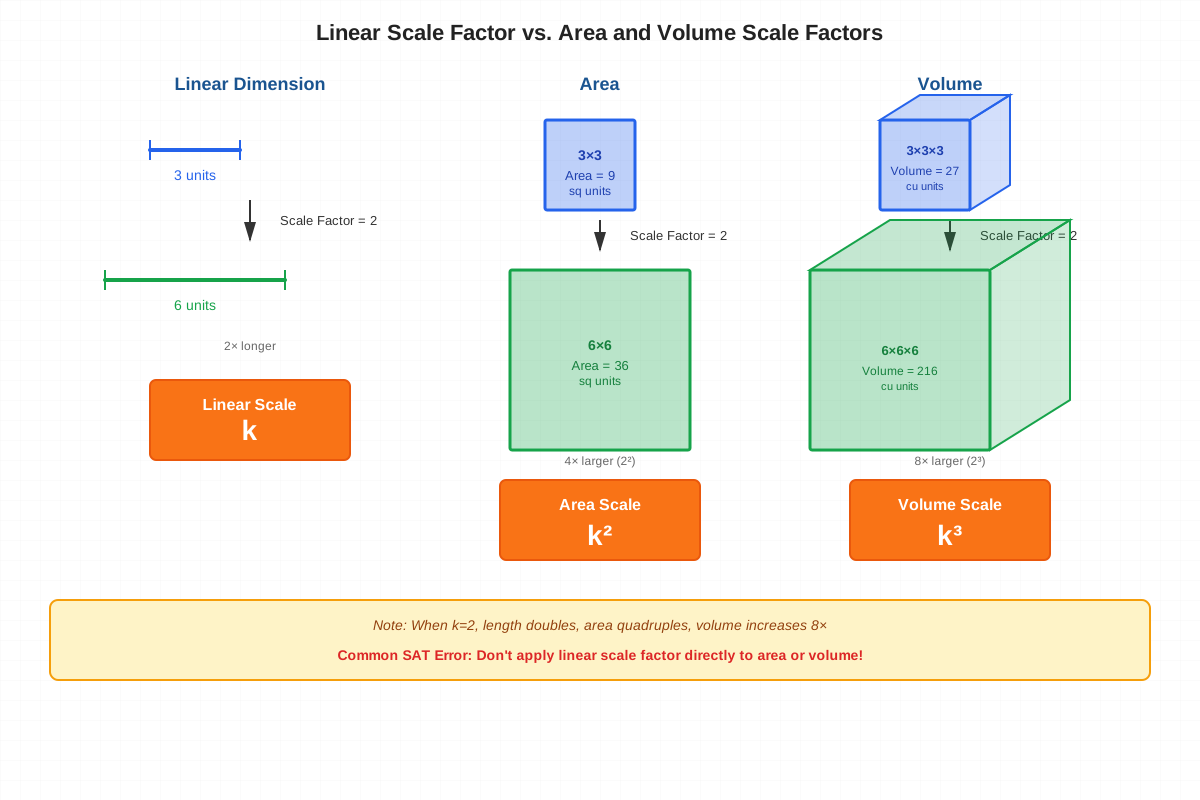
A critical concept frequently tested on the SAT scale factors questions is that area scales by the square of the linear scale factor. If the scale factor is k, then:
New Area = Original Area × k²This occurs because area involves two dimensions multiplied together. When both length and width are multiplied by k, the resulting area is multiplied by k × k = k². For example, if a triangle has area 10 cm² and is scaled by a factor of 3, the new area is 10 × 3² = 10 × 9 = 90 cm².
This principle applies to all area measurements:
- Areas of triangles, rectangles, circles, and irregular polygons
- Surface areas of three-dimensional objects
- Cross-sectional areas
Volume and the Cube of the Scale Factor
Extending the pattern, volume scales by the cube of the linear scale factor. If the scale factor is k, then:
New Volume = Original Volume × k³Volume involves three dimensions multiplied together, so scaling each dimension by k results in k × k × k = k³. A rectangular prism with volume 8 cm³ scaled by a factor of 2 has new volume 8 × 2³ = 8 × 8 = 64 cm³.
This applies to:
- Volumes of prisms, pyramids, cylinders, cones, and spheres
- Capacity measurements
- Any three-dimensional space measurement
Finding Scale Factors from Given Information
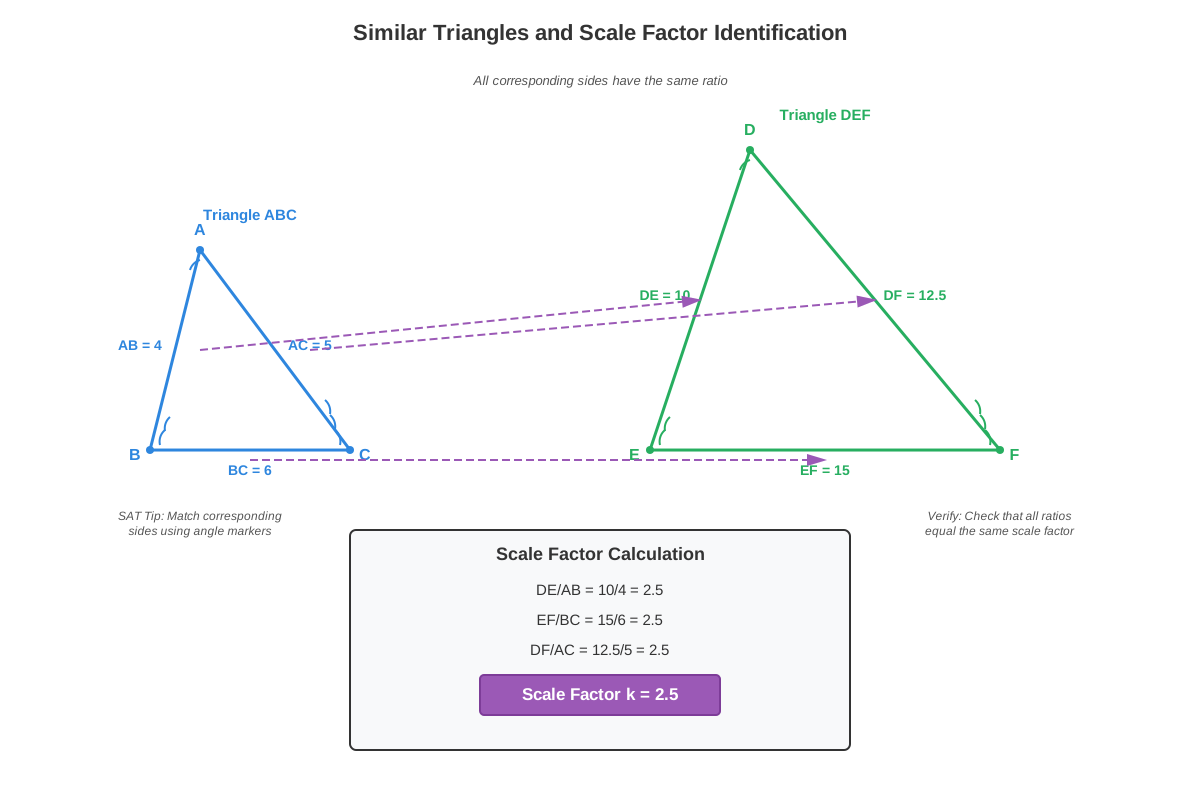
SAT problems often require determining the scale factor rather than applying a given one. To find the scale factor:
- Identify corresponding measurements in both figures
- Set up the ratio: k = (new measurement) / (original measurement)
- Simplify the ratio to find k
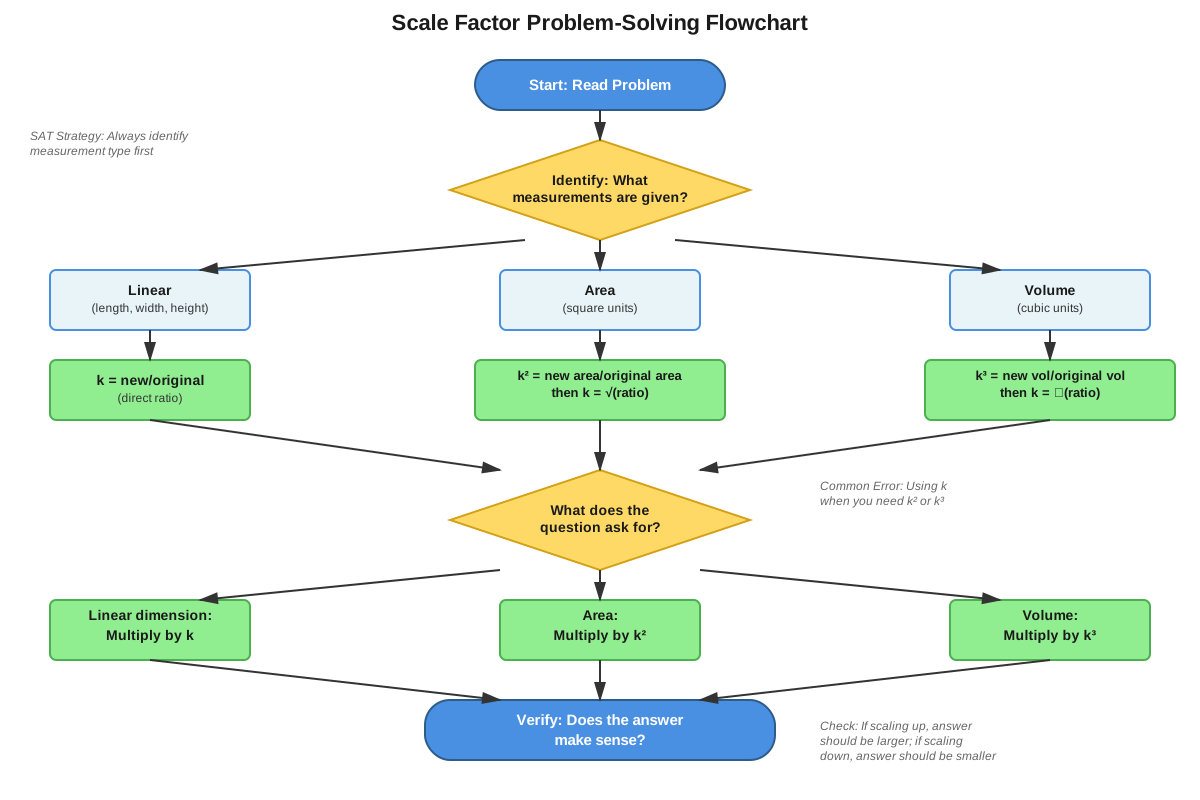
If given areas instead of linear measurements, remember that the area ratio equals k². Therefore:
k = √(New Area / Original Area)Similarly, for volumes:
k = ∛(New Volume / Original Volume)Scale Factors in Coordinate Geometry
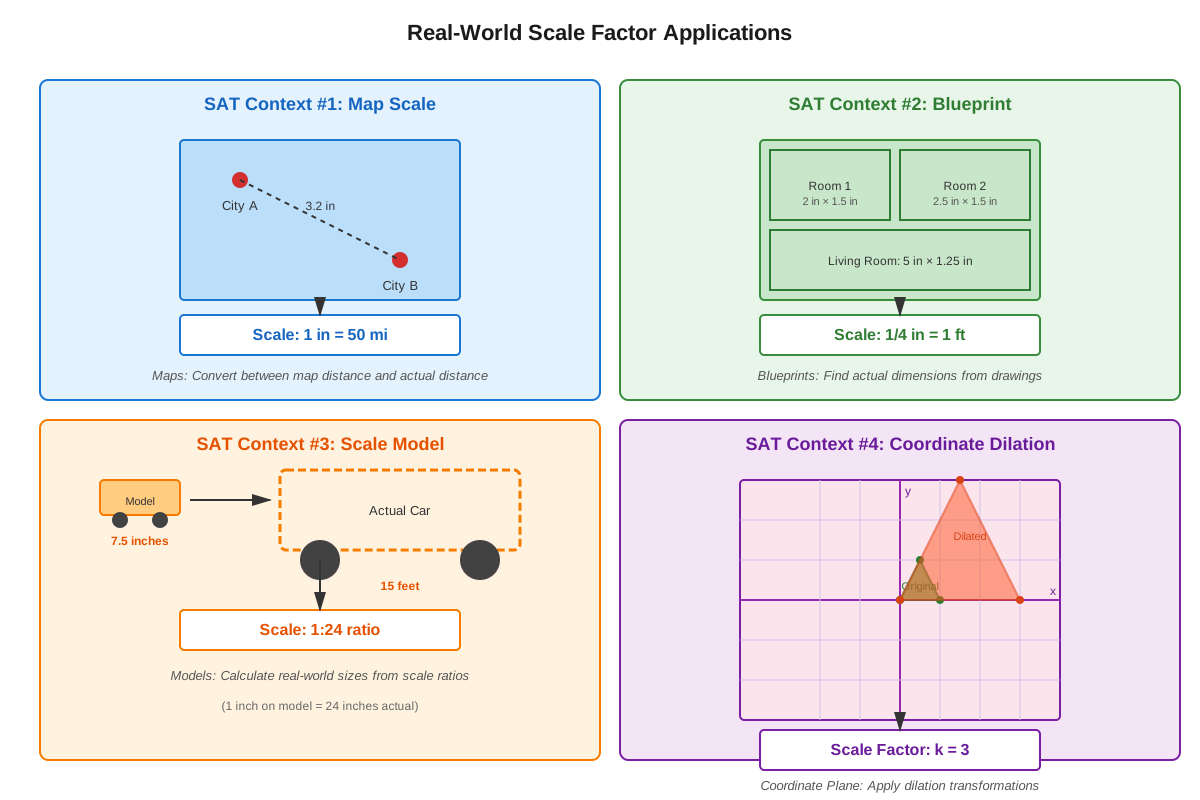
On the coordinate plane, a dilation with scale factor k centered at the origin transforms point (x, y) to point (kx, ky). Each coordinate is multiplied by the scale factor. This transformation:
- Preserves angle measures
- Maintains parallelism
- Changes distances from the origin by factor k
- Creates similar figures
For dilations centered at points other than the origin, the process involves translating the center to the origin, dilating, then translating back—though SAT questions typically use the origin as the center.
Scale Factors in Word Problems
The SAT frequently embeds scale factors in practical contexts:
| Context | Typical Scale Factor Representation |
|---|---|
| Maps | 1 inch : 50 miles or 1:600,000 |
| Blueprints | 1/4 inch = 1 foot or 1:48 |
| Models | 1:24 scale or "1/10th size" |
| Recipes | "Double the recipe" (scale factor 2) |
| Photographs | "Enlarged to 150%" (scale factor 1.5) |
Converting between these representations and numerical scale factors is essential. "1 cm represents 5 km" means 1 cm on the map corresponds to 5 km = 500,000 cm in reality, giving a scale factor of 1:500,000 or 1/500,000 when going from reality to map.
Concept Relationships
Scale factors fundamentally connect to ratios and proportions—every scale factor problem can be expressed as a proportion. The equation a/b = c/d, where a and c are corresponding measurements and b and d are their counterparts, embodies the scale factor relationship. This connection means proportion-solving techniques (cross-multiplication, equivalent ratios) directly apply to scale factor problems.
The relationship flows as: Basic Ratios → Proportional Relationships → Scale Factors → Similar Figures → Geometric Applications. Understanding that scale factors preserve shape while changing size leads directly to the concept of similarity. Two figures are similar if and only if there exists a scale factor relating their corresponding dimensions, making scale factors the defining characteristic of similarity.
Within the topic itself, concepts build hierarchically: Linear Scale Factor (foundation) → Area Scaling (square of linear) → Volume Scaling (cube of linear). Each level depends on the previous, with the exponent pattern (k¹, k², k³) corresponding to dimensionality. This pattern extends conceptually even to higher dimensions, though SAT questions remain in three dimensions or fewer.
Scale factors also connect to coordinate geometry transformations. Dilations are one of the fundamental transformations (along with translations, rotations, and reflections), and understanding scale factors as multiplicative transformations of coordinates bridges algebraic and geometric thinking. The transformation (x, y) → (kx, ky) combines function notation, coordinate manipulation, and geometric scaling.
Finally, scale factors relate to unit conversion and dimensional analysis. Converting between measurement systems (inches to feet, centimeters to meters) involves scale factors, as does understanding how unit changes affect area (square units) and volume (cubic units). This connection reinforces why area scales by k² and volume by k³—the dimensional units themselves square and cube.
Quick check — test yourself on Scale factors so far.
Try Flashcards →High-Yield Facts
⭐ The linear scale factor k applies directly to all one-dimensional measurements including side lengths, perimeter, and circumference
⭐ Area scales by k², the square of the linear scale factor, not by k itself
⭐ Volume scales by k³, the cube of the linear scale factor
⭐ To find the scale factor from areas, take the square root of the area ratio: k = √(A₂/A₁)
⭐ To find the scale factor from volumes, take the cube root of the volume ratio: k = ∛(V₂/V₁)
- Scale factors less than 1 represent reductions; scale factors greater than 1 represent enlargements
- The scale factor from figure A to figure B is the reciprocal of the scale factor from figure B to figure A
- Similar figures have the same shape but different sizes, related by a scale factor
- On coordinate planes, dilation by scale factor k centered at the origin transforms (x, y) to (kx, ky)
- Map scales like "1 inch : 50 miles" represent scale factors that must be converted to consistent units
- When a scale factor is applied twice consecutively, the combined effect is the product of the individual scale factors
- Scale factors preserve angle measures—corresponding angles in similar figures are congruent
- The ratio of corresponding side lengths in similar figures equals the scale factor
- If two figures have the same area but different shapes, they are not related by a scale factor
- Scale factors apply only to similar figures; dissimilar figures cannot be related by a single scale factor
Common Misconceptions
Misconception: Area scales by the same factor as length (if length doubles, area doubles)
Correction: Area scales by the square of the linear scale factor. If length doubles (k = 2), area quadruples (k² = 4). This occurs because area involves two dimensions, both of which are scaled.
Misconception: A scale of "1 inch = 5 feet" means the scale factor is 5
Correction: The scale factor depends on which direction you're scaling. From the drawing to reality, the scale factor is 5 feet/1 inch = 60 (after converting to consistent units). From reality to drawing, the scale factor is 1/60.
Misconception: If the scale factor is 3, then a figure with area 10 cm² becomes 30 cm²
Correction: The new area is 10 × 3² = 90 cm². Students must remember to square the scale factor for area calculations, not simply multiply.
Misconception: Scale factors can be negative
Correction: Scale factors represent ratios of lengths, which are always positive. Negative values in coordinate transformations represent reflections combined with dilations, not pure scale factors.
Misconception: The scale factor between two figures can be found by subtracting corresponding measurements
Correction: Scale factors are multiplicative relationships (ratios), not additive differences. The scale factor is found by dividing corresponding measurements: k = new/original, not by subtracting them.
Misconception: If two figures have proportional sides, their areas are also proportional by the same ratio
Correction: While the sides are proportional by scale factor k, the areas are proportional by k². The proportionality exists but with different ratios for different dimensions.
Misconception: Perimeter and area scale by the same factor
Correction: Perimeter is a linear measurement and scales by k, while area is a two-dimensional measurement and scales by k². A square with side 2 and perimeter 8 scaled by factor 3 has new side 6 and perimeter 24 (3 times original), but area increases from 4 to 36 (9 times original, which is 3²).
Worked Examples
Example 1: Multi-Step Scale Factor Problem with Area
Problem: A rectangular garden measures 12 feet by 8 feet. A landscape architect creates a scale drawing where 1 inch represents 2 feet. On the drawing, what is the area of the garden in square inches?
Solution:
Step 1: Identify the scale factor from reality to drawing.
- 1 inch on drawing = 2 feet in reality
- Scale factor k = 1 inch / 2 feet = 1 inch / 24 inches = 1/24
- (Converting to consistent units: 2 feet = 24 inches)
Step 2: Find the dimensions on the drawing.
- Original length: 12 feet = 144 inches
- Drawing length: 144 × (1/24) = 6 inches
- Original width: 8 feet = 96 inches
- Drawing width: 96 × (1/24) = 4 inches
Step 3: Calculate the area on the drawing.
- Drawing area = 6 × 4 = 24 square inches
Alternative approach using area scale factor:
- Original area = 12 × 8 = 96 square feet = 13,824 square inches
- Area scales by k² = (1/24)² = 1/576
- Drawing area = 13,824 × (1/576) = 24 square inches ✓
Connection to learning objectives: This problem requires identifying the scale factor from a word problem context, applying it to linear measurements, and understanding how area scales differently than length—demonstrating mastery of multiple core concepts.
Example 2: Finding Scale Factor from Volume
Problem: Two similar cylindrical water tanks have volumes of 250 cubic feet and 2,000 cubic feet respectively. If the smaller tank has a height of 5 feet, what is the height of the larger tank?
Solution:
Step 1: Find the scale factor using the volume relationship.
- Volume scales by k³
- k³ = V₂/V₁ = 2,000/250 = 8
- k = ∛8 = 2
Step 2: Apply the linear scale factor to find the height.
- The linear scale factor is 2 (not 8!)
- Height of larger tank = 5 × 2 = 10 feet
Step 3: Verify the answer makes sense.
- If the linear scale factor is 2, all dimensions double
- Volume should increase by 2³ = 8
- 250 × 8 = 2,000 ✓
Key insight: Students must recognize that volume information gives k³, requiring a cube root to find the linear scale factor k. This is one of the most commonly tested scale factor concepts on the SAT, as it combines multiple steps and requires careful attention to the relationship between linear and volumetric scaling.
Connection to learning objectives: This problem demonstrates the critical skill of working backward from area or volume to find the linear scale factor, then applying that factor to other linear measurements—a high-yield SAT problem type.
Exam Strategy
When approaching SAT scale factors questions, begin by identifying what type of measurement is given and what type is requested. Create a mental checklist: Is this linear (use k), area (use k²), or volume (use k³)? This immediate classification prevents the most common error—applying the wrong power of the scale factor.
Trigger words and phrases to watch for include:
- "Similar figures" or "similar triangles" → scale factor applies
- "Scale drawing," "blueprint," "map" → find the scale factor from the given ratio
- "Enlarged by," "reduced to," "scaled by" → direct scale factor given
- "Corresponding sides," "proportional" → similarity and scale factors
- "Dilation" in coordinate geometry → multiply coordinates by scale factor
- "Model" or "replica" → scaled version of original
For process of elimination, use dimensional analysis. If a question asks for area and an answer choice would result from using k instead of k², eliminate it immediately. Similarly, if the scale factor is less than 1 (reduction) but an answer choice shows an increase in measurement, eliminate it. Check whether answer choices are in the correct units—scale problems often include unit conversion traps.
Time allocation: Simple scale factor problems (given k, find one dimension) should take 30-45 seconds. Multi-step problems involving area or volume typically require 60-90 seconds. If a problem requires finding k from given information then applying it to calculate area or volume, budget up to 2 minutes. Don't spend excessive time converting units—if the problem seems to require complex conversions, look for a simpler approach or check whether the answer choices suggest a different method.
Strategic approach sequence:
- Identify what's given (dimensions, area, volume, scale factor)
- Identify what's requested (same type or different type?)
- Determine the appropriate scale factor relationship (k, k², or k³)
- Set up the equation or proportion
- Solve and verify units match the question
Exam Tip: When working with maps or blueprints, always convert to consistent units before calculating the scale factor. The SAT frequently includes answer choices that result from forgetting this conversion.
Memory Techniques
The "Dimension Power" mnemonic: Remember "1-2-3, D-S-C"
- 1 dimension (length) → scale by k¹ = k
- 2 dimensions (area) → scale by k²
- 3 dimensions (volume) → scale by k³
- Distance, Surface, Capacity
The "Square and Cube" visualization: Picture a square with side length 2 being scaled to side length 4 (scale factor k = 2). Visualize that the new square contains four copies of the original (2² = 4), not two. For volume, imagine a cube with edge 2 scaled to edge 4—it contains eight original cubes (2³ = 8), not four.
The "Reciprocal Reminder": Use the phrase "Back and Forth Flip" to remember that the scale factor from A to B is the reciprocal of the scale factor from B to A. If going from drawing to reality is ×24, then going from reality to drawing is ×(1/24).
The "Root Reversal" technique: When given area or volume and need to find the linear scale factor, remember "Square Root for Surface, Cube Root for Capacity." The alliteration helps recall which root to use.
Acronym for problem-solving: SCALE
- Similar figures? (Check if scale factor applies)
- Corresponding measurements (Identify what matches)
- Area or volume? (Determine if k² or k³ needed)
- Linear factor (Calculate or apply k)
- Evaluate answer (Check units and reasonableness)
Summary
Scale factors represent the multiplicative relationship between corresponding measurements in similar figures, forming a cornerstone concept for SAT math success. The fundamental principle is that linear measurements scale directly by the scale factor k, while area scales by k² and volume by k³. This dimensional relationship—where the exponent matches the number of dimensions—provides the key to solving virtually all scale factor problems. Students must recognize that scale factors appear in multiple contexts: explicit similarity problems, coordinate plane dilations, and practical applications involving maps, blueprints, and models. The ability to work bidirectionally—finding scale factors from given measurements or applying known scale factors to find unknown measurements—is essential. Critical skills include converting between different scale representations, distinguishing between linear and area/volume scaling, and recognizing when to use square or cube roots to find linear scale factors from area or volume ratios. Mastery requires understanding both the computational procedures and the conceptual reasoning behind why area and volume scale differently than length, enabling students to approach unfamiliar problem presentations with confidence and solve them efficiently.
Key Takeaways
- Scale factors describe proportional relationships between similar figures, with linear measurements scaling by k, area by k², and volume by k³
- The exponent pattern (1, 2, 3) corresponds directly to dimensionality—this is the most critical relationship to remember
- Finding the scale factor requires dividing corresponding measurements; finding linear scale factor from area requires square root, from volume requires cube root
- SAT problems embed scale factors in practical contexts (maps, models, blueprints) requiring recognition and extraction of the scaling relationship
- Coordinate plane dilations centered at the origin multiply each coordinate by the scale factor: (x, y) → (kx, ky)
- Scale factors less than 1 represent reductions, greater than 1 represent enlargements, and the reciprocal relationship applies when reversing direction
- Common errors include applying k to area instead of k², forgetting unit conversions in word problems, and confusing additive versus multiplicative relationships
Related Topics
Similar Triangles and Geometric Similarity: Building on scale factors, this topic explores the conditions that guarantee similarity (AA, SAS, SSS similarity theorems) and applications to indirect measurement and trigonometry. Mastering scale factors provides the foundation for understanding why similar triangles have proportional sides.
Proportional Relationships and Direct Variation: Scale factors are specific applications of proportional reasoning. Studying direct variation (y = kx) and inverse variation deepens understanding of how quantities relate multiplicatively, extending scale factor concepts to functional relationships.
Coordinate Geometry Transformations: Dilations are one of four fundamental transformations. Understanding scale factors enables study of combined transformations, composition of functions, and transformation matrices—topics that appear on advanced math sections.
Trigonometric Ratios: Sine, cosine, and tangent are ratios of sides in right triangles. The fact that these ratios remain constant for a given angle (regardless of triangle size) directly results from scale factor principles and similar triangles.
Three-Dimensional Geometry: Advanced applications of volume scaling appear in problems involving spheres, cones, and composite solids. Understanding k³ relationships is essential for optimization problems and surface-area-to-volume ratio questions.
Practice CTA
Now that you've mastered the core concepts of scale factors, it's time to solidify your understanding through active practice. Attempt the practice questions to apply these principles to SAT-style problems, testing your ability to recognize scale factor situations, perform calculations accurately, and avoid common pitfalls. Use the flashcards to reinforce high-yield facts and relationships, particularly the dimensional scaling patterns (k, k², k³) that appear repeatedly on the exam. Remember: understanding the concepts is the first step, but achieving automaticity through practice is what translates to points on test day. Each practice problem you solve strengthens your pattern recognition and builds the confidence needed to tackle scale factor questions quickly and accurately under timed conditions. You've invested the time to learn—now invest the effort to practice, and watch your mastery translate directly to SAT success!
Sign up free to keep reading
Create a free AnvayaPrep account to finish this SAT guide on Scale factors — plus flashcards and practice questions.