Overview
Circle equations form a critical component of the SAT math section, appearing regularly in both calculator and no-calculator portions of the exam. Understanding how to work with circles algebraically—recognizing their standard and general forms, identifying key features like center and radius, and manipulating these equations—is essential for achieving a competitive score. The College Board consistently includes 1-3 questions per test that directly assess circle equation knowledge, making this a high-yield topic that rewards focused preparation.
The algebraic representation of circles bridges multiple mathematical domains tested on the SAT. Circle equations connect coordinate geometry with algebraic manipulation, requiring students to apply skills in completing the square, working with squared terms, and interpreting geometric relationships through equations. This topic frequently appears alongside questions about distance formulas, graphing, and systems of equations, making it a nexus point in the SAT math curriculum.
Mastering sat circle equations provides students with powerful problem-solving tools that extend beyond isolated circle problems. The techniques learned here—particularly completing the square and recognizing transformed equations—apply to parabolas, ellipses, and other conic sections that occasionally appear on the exam. Furthermore, circle equation problems often test multiple skills simultaneously, such as finding intersection points with lines or determining tangency conditions, making this topic an efficient vehicle for demonstrating mathematical proficiency across several competency areas.
Learning Objectives
- [ ] Identify key features of circle equations including center coordinates and radius
- [ ] Explain how circle equations appears on the SAT in both standard and general forms
- [ ] Apply circle equations to answer SAT-style questions involving graphing and algebraic manipulation
- [ ] Convert between standard form and general form of circle equations using completing the square
- [ ] Determine whether a given point lies on, inside, or outside a circle using its equation
- [ ] Solve systems involving circle equations and linear equations to find intersection points
Prerequisites
- Coordinate plane fundamentals: Understanding x and y coordinates is essential for locating circle centers and plotting points relative to circles
- Distance formula: The circle equation derives directly from the distance formula, as all points on a circle are equidistant from the center
- Algebraic manipulation: Expanding binomials, combining like terms, and isolating variables are necessary for converting between equation forms
- Completing the square: This technique is crucial for transforming general form equations into standard form to identify circle features
- Pythagorean theorem: The geometric foundation of circle equations relates to right triangle relationships
Why This Topic Matters
Circle equations represent one of the most predictable and high-yield topics on the SAT math section. According to College Board data, approximately 3-5% of all SAT math questions involve circles, with roughly half of these requiring direct manipulation of circle equations. This translates to 1-3 questions per test—a significant portion considering the limited number of questions and the competitive nature of SAT scoring where every point matters.
In real-world applications, circle equations model countless phenomena: broadcast ranges for radio towers, coverage areas for cellular networks, ripple patterns in water, planetary orbits (approximated as circles), and design specifications in engineering and architecture. GPS technology relies on circle equations to triangulate positions, while urban planners use them to determine service areas for facilities. Understanding circle equations provides a mathematical framework for analyzing any situation involving equidistance from a central point.
On the SAT, circle equations typically appear in several distinct question formats: identifying the center and radius from a given equation, writing an equation given geometric information, determining whether specific points satisfy a circle equation, finding intersection points between circles and lines, and solving word problems that require translating geometric descriptions into algebraic equations. Questions may be presented as pure algebra problems, coordinate geometry scenarios, or applied contexts requiring mathematical modeling. The most challenging versions combine circle equations with other topics like systems of equations, inequalities representing regions, or optimization problems.
Core Concepts
Standard Form of Circle Equations
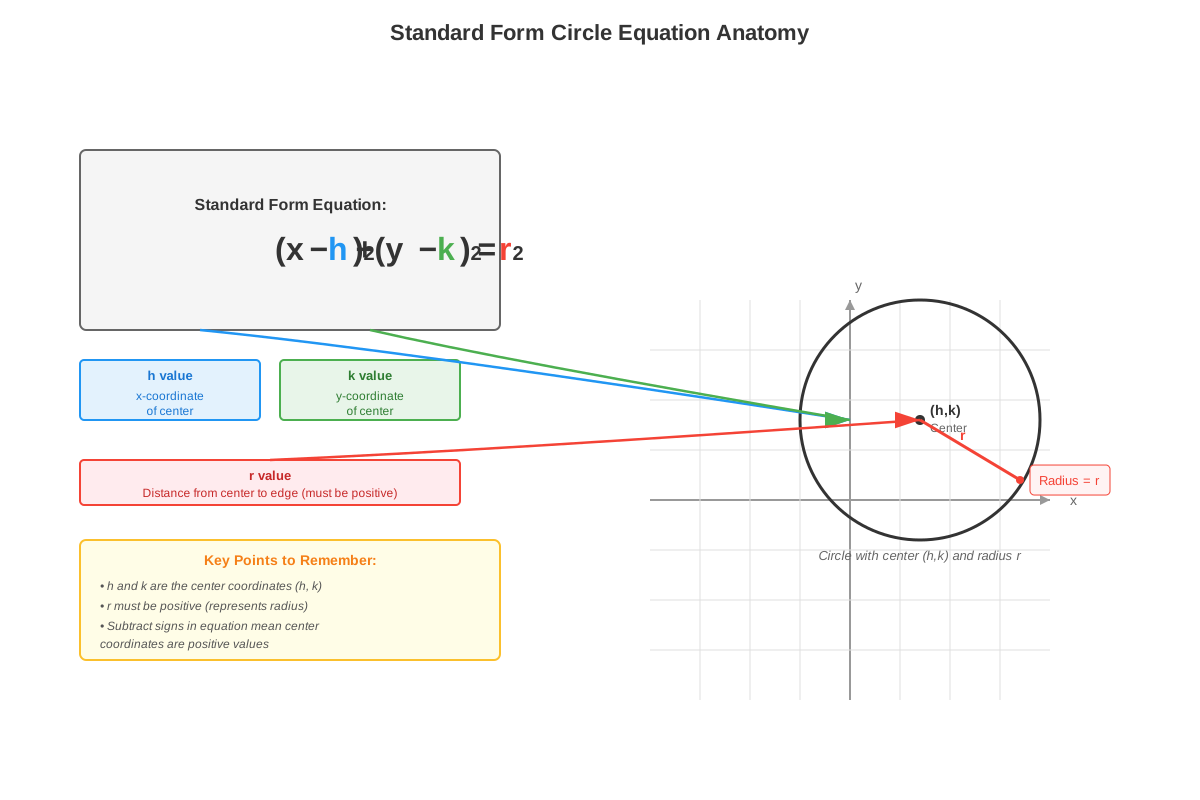
The standard form of a circle equation is the most recognizable and useful representation for identifying key features. The equation takes the form:
(x - h)² + (y - k)² = r²In this equation, the point (h, k) represents the center of the circle, and r represents the radius. The standard form directly reflects the geometric definition of a circle: the set of all points that are exactly r units away from the center point. This form derives from the distance formula, where the distance between any point (x, y) on the circle and the center (h, k) must equal the radius.
When h and k are positive, students must remember that the center coordinates have opposite signs from what appears in the equation. For example, (x - 3)² + (y - 5)² = 16 has its center at (3, 5), not (-3, -5). When the equation shows (x + 3)², this is equivalent to (x - (-3))², placing the center at x = -3. The radius is always the positive square root of the right side of the equation, so r² = 16 means r = 4, not ±4.
General Form of Circle Equations
The general form (also called expanded form) appears when the standard form is multiplied out and simplified:
x² + y² + Dx + Ey + F = 0This form is less immediately interpretable but frequently appears on the SAT because it tests whether students can convert it back to standard form. The general form always has x² and y² terms with coefficients of 1 (if coefficients differ, the equation doesn't represent a circle). The D, E, and F are constants that encode information about the center and radius, but not in an obvious way.
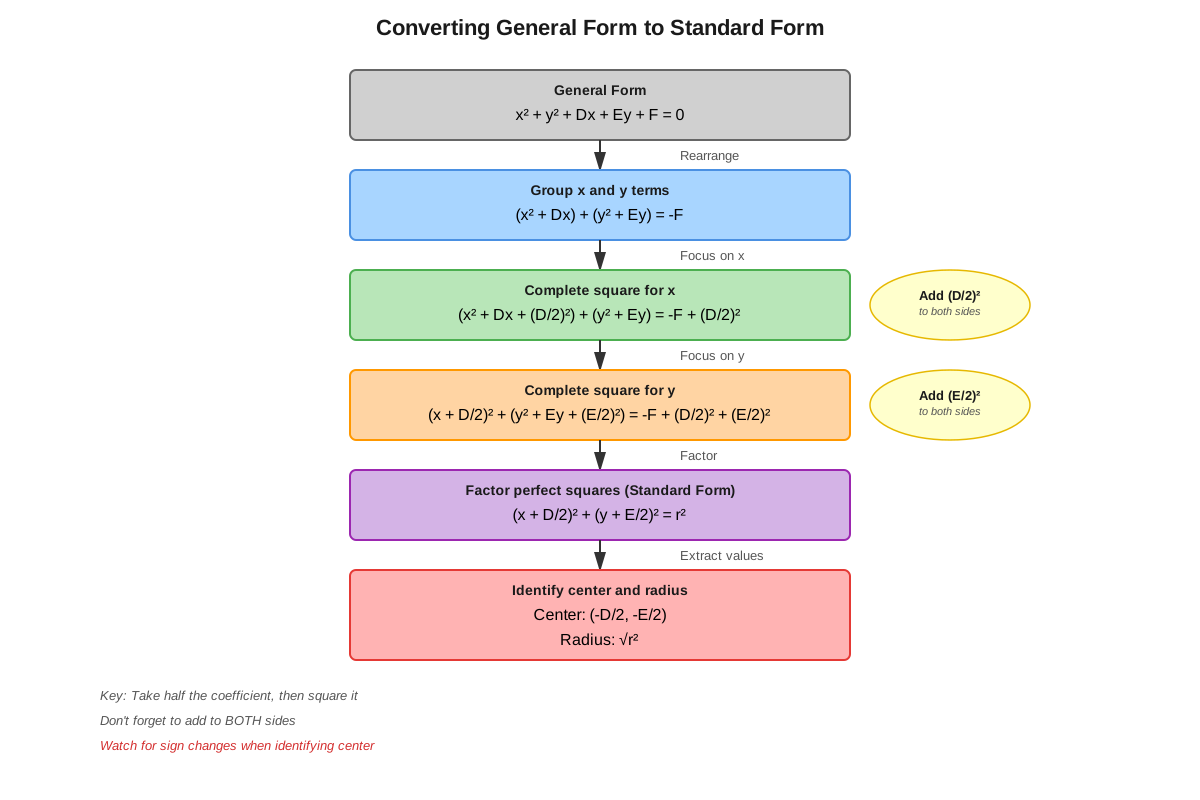
To extract the center and radius from general form, students must use completing the square on both the x and y terms. This process involves:
- Grouping x terms together and y terms together
- Moving the constant term to the right side
- Taking half of each linear coefficient, squaring it, and adding to both sides
- Factoring the perfect square trinomials
- Identifying h, k, and r from the resulting standard form
Converting Between Forms
The conversion from standard to general form is straightforward: expand the squared binomials and simplify. For example:
Starting with (x - 2)² + (y + 3)² = 25:
- Expand: (x² - 4x + 4) + (y² + 6y + 9) = 25
- Simplify: x² + y² - 4x + 6y + 13 = 25
- Standard form: x² + y² - 4x + 6y - 12 = 0
Converting from general to standard form requires completing the square, which is more complex but essential for SAT success. Consider x² + y² + 6x - 8y + 9 = 0:
- Rearrange: (x² + 6x) + (y² - 8y) = -9
- Complete the square for x: take half of 6 (which is 3), square it (getting 9), add to both sides
- Complete the square for y: take half of -8 (which is -4), square it (getting 16), add to both sides
- Result: (x² + 6x + 9) + (y² - 8y + 16) = -9 + 9 + 16
- Factor: (x + 3)² + (y - 4)² = 16
- Identify: center (-3, 4), radius 4
Key Features and Properties
| Feature | How to Identify | Example |
|---|---|---|
| Center | (h, k) from (x - h)² + (y - k)² = r² | (x - 1)² + (y + 2)² = 9 → center (1, -2) |
| Radius | √(right side) in standard form | (x - 1)² + (y + 2)² = 9 → radius = 3 |
| Diameter | 2r | If r = 3, diameter = 6 |
| Circumference | 2πr | If r = 3, circumference = 6π |
| Area | πr² | If r = 3, area = 9π |
Point-Circle Relationships
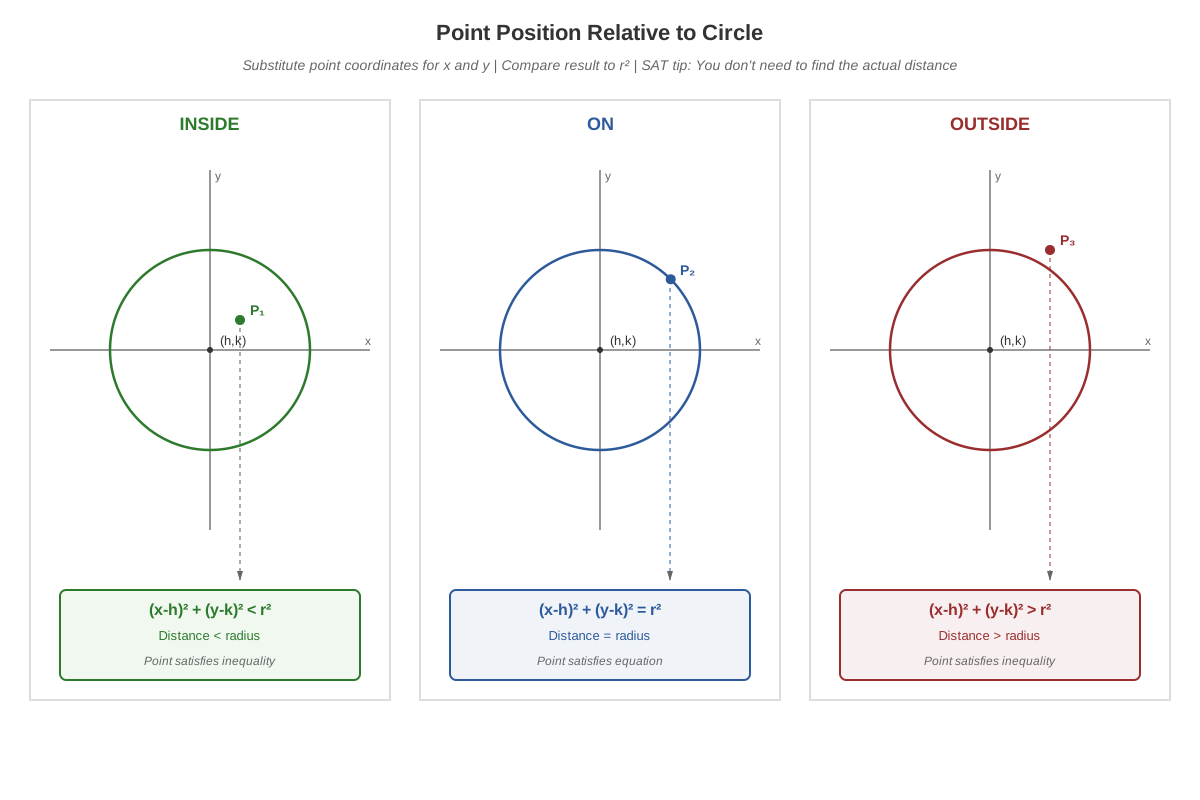
Given a circle equation and a point (a, b), students can determine the point's position relative to the circle by substituting the coordinates into the equation:
- On the circle: (a - h)² + (b - k)² = r² (equation is satisfied exactly)
- Inside the circle: (a - h)² + (b - k)² < r² (left side is less than r²)
- Outside the circle: (a - h)² + (b - k)² > r² (left side is greater than r²)
This concept frequently appears in SAT questions asking whether specific points satisfy a circle equation or in problems involving regions defined by circle inequalities.
Circles with Special Centers
Circles centered at the origin (0, 0) have particularly simple equations:
x² + y² = r²This form appears frequently on the SAT because it's easy to work with algebraically. For example, x² + y² = 25 represents a circle centered at the origin with radius 5. These circles have symmetry across both axes and both diagonals, which can simplify problem-solving.
Concept Relationships
The standard form of circle equations serves as the foundation from which all other concepts flow. Standard form → enables direct identification → of center and radius, which are the fundamental features needed to graph circles or solve geometric problems. The relationship between standard and general forms creates a bidirectional pathway: standard form → expands to → general form, while general form → completing the square → standard form.
Point-circle relationships depend on understanding the standard form equation as a distance relationship: distance formula → generates → circle equation, and substituting point coordinates → determines → position relative to circle. This connects circle equations back to the prerequisite distance formula concept.
When circle equations appear in systems with linear equations, the solution process combines circle concepts with algebraic techniques: circle equation + line equation → substitution or elimination → intersection points. This represents a synthesis of coordinate geometry and algebraic manipulation skills.
The special case of origin-centered circles represents a simplification of the general standard form: standard form with h = 0, k = 0 → simplifies to → x² + y² = r². This simplified form often appears in problems involving symmetry or when circles are combined with other origin-centered functions.
Quick check — test yourself on Circle equations so far.
Try Flashcards →High-Yield Facts
⭐ The standard form of a circle equation is (x - h)² + (y - k)² = r², where (h, k) is the center and r is the radius
⭐ To find the center from standard form, use the opposite signs of what appears in the equation: (x - 3)² means h = 3, while (x + 3)² means h = -3
⭐ The radius is always the positive square root of the right side of the equation in standard form
⭐ Converting from general form to standard form requires completing the square on both x and y terms
⭐ A point (a, b) lies on a circle if substituting it into the equation makes both sides equal
- The general form of a circle equation is x² + y² + Dx + Ey + F = 0, where both squared terms have coefficient 1
- To complete the square, take half of the linear coefficient, square it, and add it to both sides
- A circle centered at the origin has the equation x² + y² = r²
- The diameter of a circle is twice the radius, and this relationship can help solve for missing values
- If (a - h)² + (b - k)² < r², the point (a, b) is inside the circle
- If (a - h)² + (b - k)² > r², the point (a, b) is outside the circle
- The distance from the center to any point on the circle always equals the radius
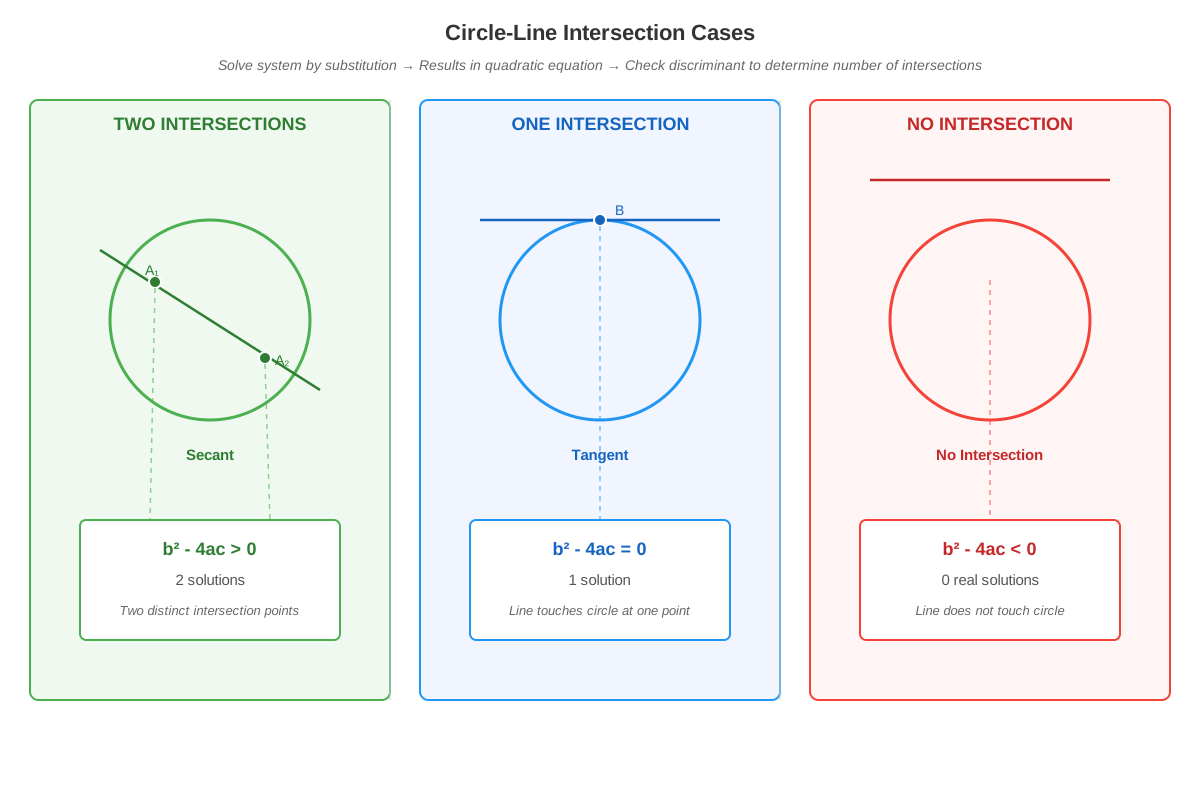
- Circle equations can intersect with lines at 0, 1, or 2 points (no intersection, tangent, or secant)
- The area enclosed by a circle is πr², which can be calculated once the radius is identified from the equation
- When both x² and y² appear with different coefficients, the equation does not represent a circle
Common Misconceptions
Misconception: The center of the circle (x - 3)² + (y - 5)² = 16 is at (-3, -5).
Correction: The center is at (3, 5). The standard form is (x - h)² + (y - k)² = r², so the center coordinates are the opposite signs of what appears in the equation. Think of it as "x minus h" and "y minus k," so (x - 3) means h = 3.
Misconception: The radius of (x - 2)² + (y + 1)² = 9 is 9.
Correction: The radius is 3, not 9. The right side of the equation represents r², so the radius is √9 = 3. Always take the square root of the right side to find the actual radius.
Misconception: When completing the square for x² + 6x, add 6² = 36 to both sides.
Correction: Take half of the coefficient first, then square it. Half of 6 is 3, and 3² = 9, so add 9 to both sides. The process is: coefficient → divide by 2 → square the result.
Misconception: The equation x² + 4y² = 16 represents a circle.
Correction: This equation represents an ellipse, not a circle. Circle equations must have identical coefficients for x² and y². If the coefficients differ (like 1 and 4 in this case), the shape is an ellipse.
Misconception: A point is on the circle if the left side of the equation is close to r².
Correction: A point is on the circle only if substituting its coordinates makes the equation exactly true. "Close" means the point is near the circle but not on it. The SAT tests precise mathematical relationships, not approximations.
Misconception: The general form x² + y² + 6x - 8y + 9 = 0 can be converted to standard form by simply moving the constant: (x² + 6x) + (y² - 8y) = -9.
Correction: This is only the first step. You must complete the square for both x and y terms by adding appropriate constants to both sides. Simply rearranging doesn't create the perfect square trinomials needed for standard form.
Worked Examples
Example 1: Converting General Form to Standard Form and Identifying Features
Problem: Given the equation x² + y² - 8x + 6y - 11 = 0, find the center and radius of the circle.
Solution:
Step 1: Rearrange by grouping x terms and y terms, moving the constant to the right side.
(x² - 8x) + (y² + 6y) = 11
Step 2: Complete the square for the x terms. The coefficient of x is -8, so take half (-4) and square it (16). Add 16 to both sides.
(x² - 8x + 16) + (y² + 6y) = 11 + 16
Step 3: Complete the square for the y terms. The coefficient of y is 6, so take half (3) and square it (9). Add 9 to both sides.
(x² - 8x + 16) + (y² + 6y + 9) = 11 + 16 + 9
Step 4: Factor the perfect square trinomials and simplify the right side.
(x - 4)² + (y + 3)² = 36
Step 5: Identify the center and radius from standard form.
- Center: (h, k) = (4, -3) [remember to use opposite signs]
- Radius: r = √36 = 6
Connection to learning objectives: This problem demonstrates the application of completing the square to identify key features of circle equations, directly addressing the objective of converting between forms and identifying centers and radius.
Example 2: Determining Point Position and Writing Equations
Problem: A circle has its center at (-2, 5) and passes through the point (1, 9).
(a) Write the equation of the circle in standard form.
(b) Determine whether the point (-5, 7) lies inside, on, or outside the circle.
Solution:
Part (a):
Step 1: Use the distance formula to find the radius. The radius is the distance from the center to any point on the circle.
r = √[(1 - (-2))² + (9 - 5)²]
r = √[(3)² + (4)²]
r = √[9 + 16]
r = √25 = 5
Step 2: Write the standard form equation using center (h, k) = (-2, 5) and r = 5.
(x - h)² + (y - k)² = r²
(x - (-2))² + (y - 5)² = 5²
(x + 2)² + (y - 5)² = 25
Part (b):
Step 1: Substitute the point (-5, 7) into the left side of the equation.
(-5 + 2)² + (7 - 5)²
= (-3)² + (2)²
= 9 + 4
= 13
Step 2: Compare the result to r² = 25.
Since 13 < 25, the point (-5, 7) lies inside the circle.
Connection to learning objectives: This problem applies circle equation concepts to answer SAT-style questions involving writing equations from geometric information and determining point-circle relationships, addressing multiple learning objectives simultaneously.
Exam Strategy
When approaching circle equation questions on the SAT, first identify which form the equation is presented in. If the equation shows squared binomials like (x - h)² and (y - k)², immediately extract the center and radius—this is standard form and requires no conversion. If the equation shows x² + y² with linear terms, recognize that completing the square will be necessary.
Trigger words to watch for: "center," "radius," "passes through," "tangent to," "intersects," "distance from," and "lies on." These phrases signal specific solution approaches and often indicate which features you need to identify.
Time management is crucial for circle equation problems. Allocate approximately 1-2 minutes for straightforward identification problems (finding center and radius from standard form) and 2-3 minutes for problems requiring completing the square or solving systems. If a problem asks multiple questions about the same circle, complete the conversion to standard form first, then use those results for all subsequent parts.
For process-of-elimination strategies, immediately eliminate answer choices that violate basic circle properties. If asked for a radius, eliminate negative values and zero. If asked for a center, eliminate choices that would place the circle inconsistently with other given information. When determining whether points lie on a circle, you can often eliminate obviously incorrect answers by rough estimation before calculating precisely.
Common SAT question patterns:
- Given general form, find center or radius (requires completing the square)
- Given geometric description, write the equation (requires standard form)
- Determine if a point satisfies the equation (requires substitution)
- Find intersection points with a line (requires solving a system)
- Identify which equation matches a graph (requires recognizing center and radius visually)
Always verify your answer makes geometric sense. If you calculate a radius of 100 for a circle that appears small on a graph, recheck your work. If your center is at (5, 3) but the graph shows a circle in the second quadrant, you've likely made a sign error.
Memory Techniques
For remembering standard form: Think "Standard form Shows Structure" - the standard form (x - h)² + (y - k)² = r² immediately shows the structure (center and radius) of the circle.
For sign changes in center coordinates: Use the mnemonic "Opposite Signs Always" (OSA). When you see (x - 3), the center x-coordinate is the opposite sign: +3. When you see (x + 3), think of it as (x - (-3)), so the center x-coordinate is -3.
For completing the square: Remember "Half, then Square" (HS). Take Half of the coefficient, then Square it. This two-step process (HS) prevents the common error of squaring first.
For the general form: Use "Don't Expect Fun" (DEF) to remember the three constants D, E, and F in x² + y² + Dx + Ey + F = 0. This reminds you that general form is less fun to work with than standard form.
Visualization strategy: Picture a circle as a "distance fence" around the center. Every point on the fence is exactly r units away. This mental image reinforces that the equation measures distance from the center, helping you remember why substituting coordinates tells you if a point is inside, on, or outside the circle.
For radius vs. r²: Remember "Right side Requires Root" - the right side of the standard form equation is r², so you need to take the square root to find the actual radius r.
Summary
Circle equations represent a high-yield SAT math topic that combines coordinate geometry with algebraic manipulation. The standard form (x - h)² + (y - k)² = r² directly reveals the center (h, k) and radius r, while the general form x² + y² + Dx + Ey + F = 0 requires completing the square to extract these features. Success with circle equations depends on mastering the conversion between forms, recognizing that center coordinates have opposite signs from what appears in the equation, and remembering that the radius is the square root of the right side. Point-circle relationships can be determined by substitution: if the result equals r², the point is on the circle; if less than r², it's inside; if greater, it's outside. These concepts frequently appear in SAT questions involving graphing, writing equations from geometric descriptions, determining point positions, and solving systems with linear equations. The key to SAT success is recognizing which form is presented, knowing the appropriate conversion technique, and accurately identifying the center and radius to answer questions efficiently.
Key Takeaways
- The standard form (x - h)² + (y - k)² = r² immediately reveals center (h, k) and radius r, with opposite signs for the center coordinates
- Converting from general form to standard form requires completing the square on both x and y terms
- The radius is always the positive square root of the right side in standard form, never negative or zero
- Substituting point coordinates into the equation determines whether the point lies on, inside, or outside the circle
- Circle equations must have identical coefficients for x² and y² (both equal to 1 in standard forms)
- Completing the square follows the pattern: take half the linear coefficient, square it, add to both sides
- Origin-centered circles have the simplified form x² + y² = r², which appears frequently on the SAT
Related Topics
Systems of Equations with Circles: Building on circle equations, students learn to solve systems involving circles and lines or two circles, finding intersection points algebraically. This extends the current topic by combining circle equations with substitution and elimination methods.
Conic Sections: Circle equations form the foundation for understanding other conic sections like ellipses, parabolas, and hyperbolas. Mastering circles enables progression to these more complex curves that occasionally appear on advanced SAT questions.
Transformations of Functions: The relationship between (x - h) and horizontal shifts in circle equations connects to broader transformation concepts. Understanding how h and k shift circles prepares students for transformations of all function types.
Distance and Midpoint Formulas: These formulas underlie circle equations and frequently appear in problems involving circles. Strengthening circle equation skills reinforces distance formula applications.
Practice CTA
Now that you've mastered the core concepts of circle equations, it's time to solidify your understanding through active practice. Attempt the practice questions to test your ability to convert between forms, identify key features, and solve SAT-style problems under timed conditions. Use the flashcards to reinforce the high-yield facts and formulas until they become automatic. Remember, circle equations appear on virtually every SAT, making your investment in this topic one of the highest-yield uses of your study time. Each practice problem you complete builds the pattern recognition and algebraic fluency that translates directly into points on test day. You've got this!
Sign up free to keep reading
Create a free AnvayaPrep account to finish this SAT guide on Circle equations — plus flashcards and practice questions.