Overview
The circumference of a circle represents one of the most fundamental measurements in geometry and appears frequently throughout the SAT Math section. Understanding circumference is essential not only for direct calculation problems but also for solving complex geometric scenarios involving circles, arcs, sectors, and even three-dimensional shapes like cylinders and spheres. The circumference is the distance around a circle—analogous to the perimeter of a polygon—and mastering this concept provides the foundation for understanding how circles behave in coordinate geometry, trigonometry, and real-world applications.
On the SAT, circumference questions appear in multiple contexts: as straightforward computational problems, within word problems involving wheels and rotations, in coordinate geometry scenarios, and as components of multi-step problems that integrate area, radius, and diameter relationships. The College Board consistently includes 2-4 questions per test that directly or indirectly require circumference knowledge, making this a high-yield topic that deserves thorough attention. Questions may ask students to find the circumference given the radius or diameter, work backward from circumference to find other measurements, or apply circumference concepts to solve practical problems involving circular motion or design.
The relationship between circumference and other circle properties creates a web of interconnected concepts that SAT test-makers frequently exploit. Understanding how circumference relates to radius, diameter, area, arc length, and sector area enables students to approach complex problems with confidence. Additionally, circumference connects to broader mathematical concepts including proportional reasoning, the constant π (pi), unit conversions, and algebraic manipulation—all skills that appear throughout the SAT Math section.
Learning Objectives
- [ ] Identify key features of circumference including its definition, formula, and relationship to other circle measurements
- [ ] Explain how circumference appears on the SAT in various question formats and difficulty levels
- [ ] Apply circumference formulas to answer SAT-style questions involving direct calculation and multi-step reasoning
- [ ] Calculate circumference when given radius, diameter, or area of a circle
- [ ] Determine radius or diameter when given the circumference
- [ ] Solve real-world application problems involving circular motion, wheels, and rotational distance
- [ ] Connect circumference concepts to arc length and sector problems
Prerequisites
- Basic algebra: Solving for variables in equations is necessary when working backward from circumference to find radius or diameter
- Understanding of π (pi): Recognizing π as approximately 3.14 or 22/7, and knowing when to use the symbol versus decimal approximation
- Fraction and decimal operations: Manipulating expressions involving π requires comfort with both exact and approximate values
- Basic geometry vocabulary: Understanding terms like radius, diameter, and chord provides the foundation for circle problems
- Unit awareness: Converting between different units of measurement (inches to feet, centimeters to meters) appears in application problems
Why This Topic Matters
Circumference has extensive real-world applications that make it relevant beyond standardized testing. Engineers use circumference calculations when designing wheels, gears, and circular components in machinery. Architects incorporate circular elements in building design and must calculate materials needed for curved structures. Athletes and coaches use circumference to measure track distances, since many running tracks feature circular or semi-circular sections. Even everyday activities like determining how much fencing is needed for a circular garden or calculating how far a bicycle travels per wheel rotation rely on circumference principles.
On the SAT specifically, circumference appears in approximately 10-15% of geometry questions, which translates to 2-4 questions per test administration. The College Board includes circumference in several question types: direct calculation problems (typically easier, appearing in the first half of a section), multi-step word problems (medium difficulty), and complex geometric reasoning questions that combine multiple concepts (harder questions in the latter portion of sections). Questions may appear in both the calculator and no-calculator sections, though more complex applications typically appear where calculators are permitted.
Common SAT question formats include: finding circumference given radius or diameter; determining how many rotations a wheel makes to travel a certain distance; calculating the perimeter of composite figures that include circular sections; finding the relationship between two circles with different radii; and solving for unknown variables when circumference is given as an algebraic expression. The test also integrates circumference with coordinate geometry, asking students to find the circumference of a circle defined by an equation in the coordinate plane.
Core Concepts
Definition and Formula
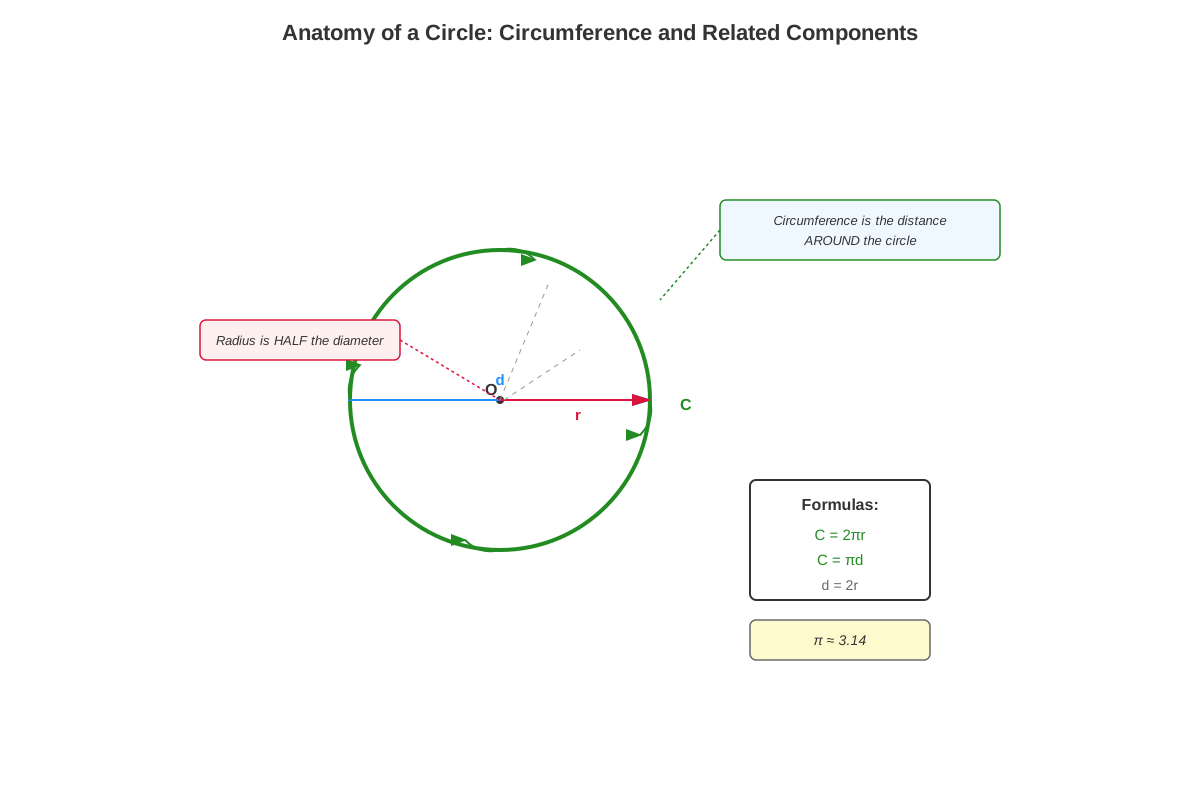
The circumference of a circle is the total distance around the circle—the one-dimensional measure of its boundary. Unlike polygons where perimeter is calculated by adding side lengths, circles require a special formula because they have no straight sides. The circumference formula derives from the mathematical constant π (pi), which represents the ratio of any circle's circumference to its diameter.
The fundamental circumference formula can be expressed in two equivalent forms:
C = πdwhere C represents circumference and d represents diameter, or:
C = 2πrwhere r represents radius. These formulas are equivalent because the diameter equals twice the radius (d = 2r). Students should memorize both forms and recognize when each is most efficient to use based on the given information.
Understanding π (Pi)
The constant π (pi) is an irrational number approximately equal to 3.14159... For SAT purposes, students should know that π ≈ 3.14 or π ≈ 22/7. However, most SAT questions either provide π in the answer choices or ask for answers in terms of π (like "6π inches"). When answers include π, students should generally leave π as a symbol rather than converting to a decimal, as this maintains precision and matches answer choice formatting.
Understanding that π represents the ratio C/d helps explain why circumference grows proportionally with diameter: a circle with twice the diameter has exactly twice the circumference. This proportional relationship appears frequently in SAT comparison questions.
Radius and Diameter Relationships
The radius (r) is the distance from the center of a circle to any point on the circle. The diameter (d) is the distance across the circle through its center—the longest possible chord. The relationship d = 2r or r = d/2 is crucial for converting between the two circumference formulas.
| Measurement | Symbol | Relationship to Others |
|---|---|---|
| Radius | r | r = d/2, r = C/(2π) |
| Diameter | d | d = 2r, d = C/π |
| Circumference | C | C = 2πr, C = πd |
Working Backward from Circumference
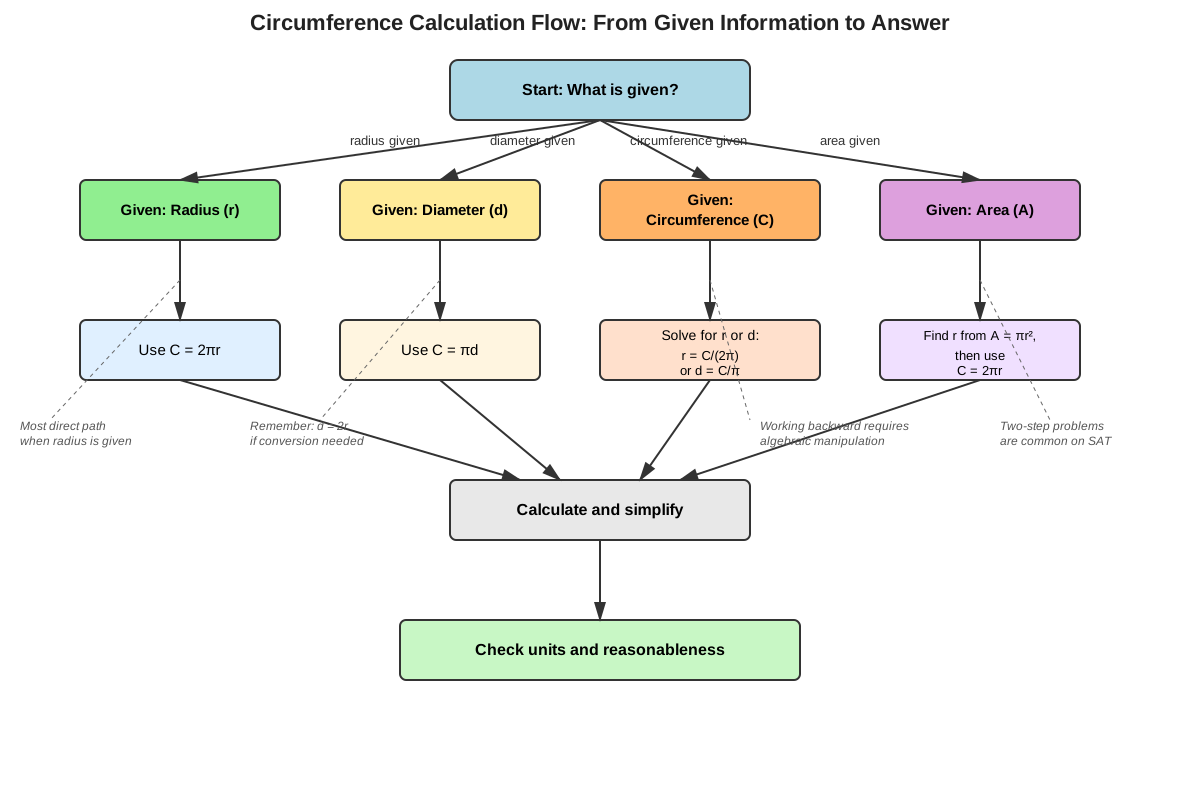
Many SAT questions provide the circumference and ask students to find the radius, diameter, or area. This requires algebraic manipulation of the circumference formula:
If C = 2πr, then solving for r gives:
r = C/(2π)If C = πd, then solving for d gives:
d = C/πThese inverse relationships are essential for multi-step problems where circumference serves as an intermediate value leading to other calculations.
Circumference in Application Problems
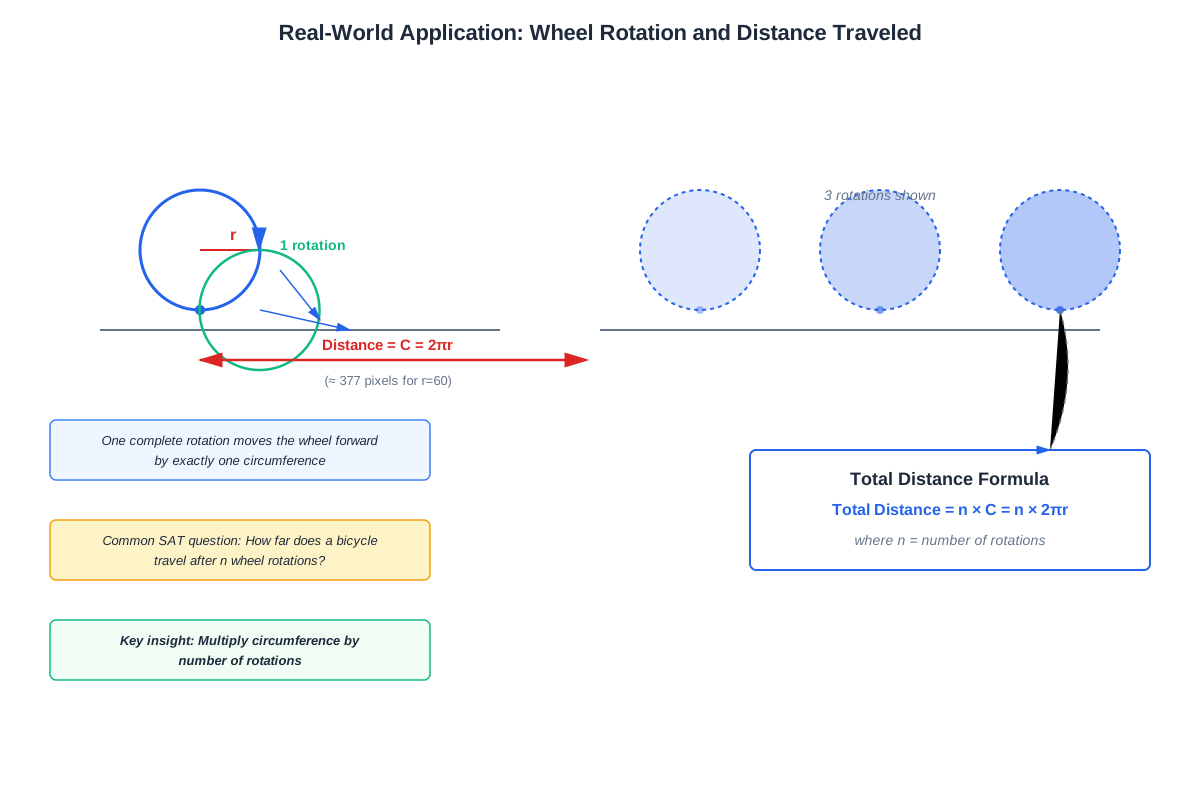
SAT word problems frequently involve circular motion, particularly wheels and rotations. When a wheel completes one full rotation, it travels a distance equal to its circumference. Therefore:
Distance traveled = Number of rotations × CircumferenceFor example, if a bicycle wheel has a diameter of 26 inches, its circumference is 26π inches. After 100 rotations, the bicycle travels 2,600π inches or approximately 8,168 inches (about 680 feet).
Composite Figures and Partial Circles
The SAT often presents figures that combine straight edges with circular arcs. The perimeter of such composite figures requires adding the lengths of straight segments to the lengths of curved sections. When a figure includes a semicircle (half circle), its curved portion has length πr (half the full circumference of 2πr). Quarter circles contribute πr/2 to the perimeter.
Circumference and Arc Length
Arc length represents a portion of the circumference corresponding to a central angle. If a central angle measures θ degrees out of 360°, the arc length equals:
Arc length = (θ/360°) × 2πrThis proportional relationship connects circumference to sector and arc problems, which frequently appear together on the SAT.
Concept Relationships
The circumference concept sits at the center of a network of circle-related measurements. The most direct relationship is between circumference and radius: knowing one immediately determines the other through the formula C = 2πr. This bidirectional relationship means circumference problems often serve as stepping stones to finding other measurements.
Circumference connects to diameter through the simpler formula C = πd, which some students find more intuitive since it directly shows that circumference is "π times as long as the diameter." The diameter-radius relationship (d = 2r) creates a triangle of interconnected measurements where any one determines the other two.
The relationship between circumference and area is less direct but equally important. Both depend on radius: C = 2πr and A = πr². When given circumference, students can find radius, then use that radius to calculate area. This two-step process appears frequently in SAT problems that test whether students can chain multiple formulas together.
Arc length extends the circumference concept to partial circles. The relationship "arc length is to circumference as central angle is to 360°" creates a proportion that students must recognize and apply. Similarly, sector area relates to total area in the same proportional way, creating parallel problem-solving approaches.
In coordinate geometry, circumference connects to the circle equation (x - h)² + (y - k)² = r². When given a circle's equation, students can identify r² and take the square root to find radius, then calculate circumference. This integration of algebra and geometry represents the type of multi-concept reasoning the SAT rewards.
Relationship Map:
Diameter ↔ Radius → Circumference → Arc Length
↓
Area → Sector Area
Quick check — test yourself on Circumference so far.
Try Flashcards →High-Yield Facts
⭐ The circumference formula C = 2πr is the most frequently tested circle formula on the SAT
⭐ When a wheel completes one rotation, it travels a distance equal to its circumference
⭐ Circumference is directly proportional to radius: doubling the radius doubles the circumference
⭐ Most SAT answer choices express circumference in terms of π rather than as decimal approximations
⭐ The diameter is always twice the radius: d = 2r
- The ratio of circumference to diameter always equals π, regardless of circle size
- Arc length equals (central angle/360°) × circumference
- A semicircle's curved edge has length πr, exactly half the full circumference
- When given area, find radius first using A = πr², then calculate circumference
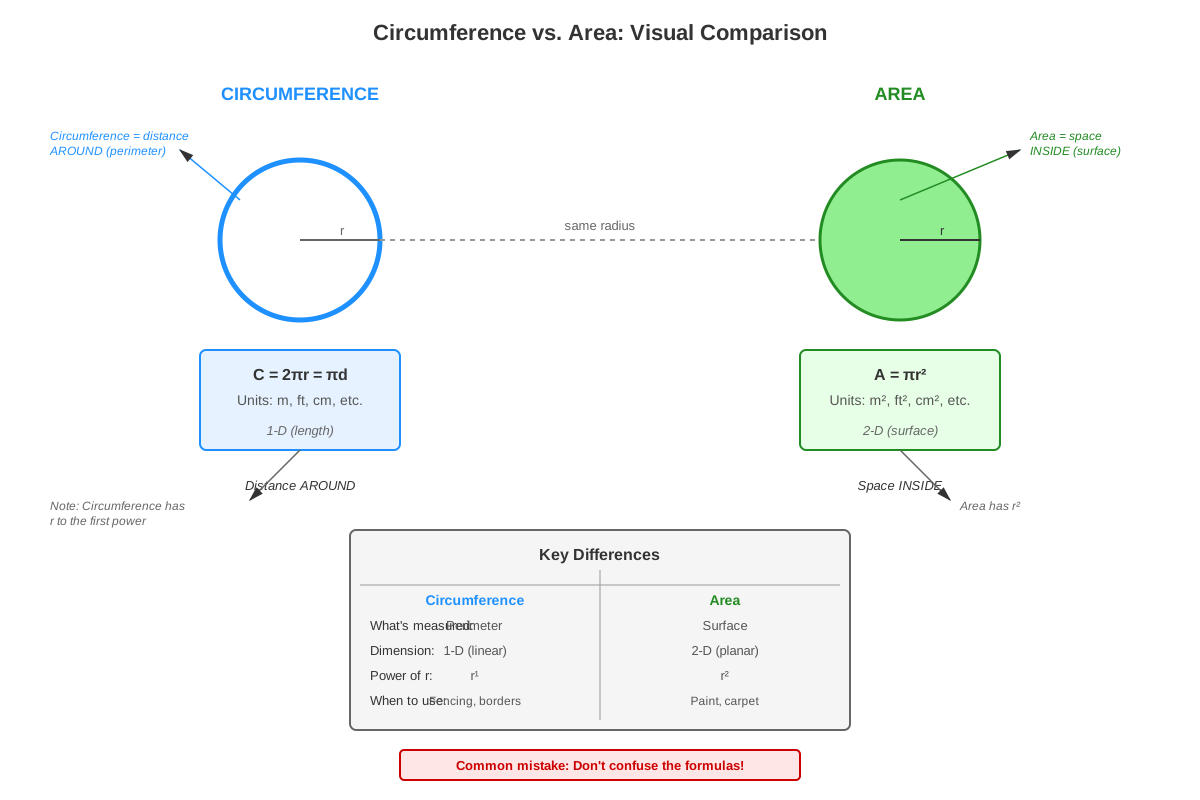
- Circumference has linear units (inches, cm, feet) while area has square units
- The circumference of a circle with radius 1 equals 2π (approximately 6.28 units)
- Converting between C = 2πr and C = πd requires recognizing that d = 2r
- Problems involving "distance around" or "perimeter of a circle" are asking for circumference
- Composite figure perimeters include only the exposed edges, not internal boundaries
Common Misconceptions
Misconception: Circumference and area formulas are interchangeable or can be confused.
Correction: Circumference (C = 2πr) measures distance around the circle with linear units, while area (A = πr²) measures space inside with square units. The formulas have different structures—circumference is linear in r, area is quadratic in r.
Misconception: π equals exactly 3.14 or 22/7.
Correction: π is an irrational number that cannot be expressed exactly as a decimal or fraction. The values 3.14 and 22/7 are approximations. On the SAT, leave answers in terms of π unless specifically instructed to use an approximation.
Misconception: Doubling the radius doubles the area and circumference equally.
Correction: Doubling the radius doubles the circumference (since C = 2πr is linear), but quadruples the area (since A = πr² is quadratic). If r becomes 2r, then C becomes 2C, but A becomes 4A.
Misconception: The perimeter of a semicircle equals half the circumference.
Correction: A semicircle's perimeter includes both the curved arc (which is half the circumference, or πr) and the diameter (2r). Therefore, the perimeter of a semicircle is πr + 2r = r(π + 2), not just πr.
Misconception: When working backward from circumference to radius, students can divide by 2 and π in either order.
Correction: From C = 2πr, to isolate r, divide by the entire coefficient 2π: r = C/(2π). Dividing by 2 first, then π, gives the same result, but dividing by π first, then 2, requires careful attention to maintain accuracy. The safest approach is r = C/(2π) in one step.
Misconception: Arc length can be found by multiplying the central angle by the radius.
Correction: Arc length requires multiplying the fraction of the circle (θ/360°) by the entire circumference (2πr), giving arc length = (θ/360°) × 2πr. Simply multiplying angle by radius ignores the proportional relationship to the full circle.
Misconception: Circumference problems always provide the radius directly.
Correction: SAT questions often provide diameter, area, or even arc length, requiring students to work backward to find radius before calculating circumference. Recognizing what information is given and what conversions are needed is essential.
Worked Examples
Example 1: Direct Calculation with Application
Problem: A circular running track has a diameter of 84 meters. If an athlete runs around the track exactly 5 times, how many meters does she run? Express your answer in terms of π.
Solution:
Step 1: Identify what's given and what's needed.
- Given: diameter d = 84 meters, number of laps = 5
- Need: total distance traveled
Step 2: Recognize that one lap around the track equals the circumference.
- Use the formula C = πd since diameter is given directly
Step 3: Calculate the circumference.
- C = π(84) = 84π meters
Step 4: Calculate total distance for 5 laps.
- Total distance = 5 × 84π = 420π meters
Answer: 420π meters
Connection to Learning Objectives: This problem applies the circumference formula to a real-world scenario (running track) and demonstrates the practical application of circular motion. It reinforces using C = πd when diameter is given and shows how circumference relates to distance traveled through multiple rotations.
Example 2: Working Backward from Circumference
Problem: The circumference of a circle is 18π centimeters. What is the area of the circle in square centimeters?
Solution:
Step 1: Identify the given information and goal.
- Given: C = 18π cm
- Need: Area (A)
Step 2: Recognize that we need radius to find area, so work backward from circumference.
- Use C = 2πr and solve for r
- 18π = 2πr
Step 3: Solve for radius.
- Divide both sides by 2π: r = 18π/(2π)
- The π cancels: r = 18/2 = 9 cm
Step 4: Calculate area using A = πr².
- A = π(9)²
- A = π(81)
- A = 81π square centimeters
Answer: 81π cm²
Connection to Learning Objectives: This multi-step problem demonstrates working backward from circumference to find radius, then using that radius to calculate area. It shows the interconnection between different circle measurements and requires algebraic manipulation of the circumference formula—both high-yield SAT skills.
Exam Strategy
When approaching circumference questions on the SAT, first identify what information is provided and what the question asks for. Circle problems often require converting between different measurements (radius ↔ diameter ↔ circumference ↔ area), so mapping out the path from given to needed helps prevent errors.
Trigger words and phrases to recognize include:
- "Distance around" → circumference
- "Perimeter of a circle" → circumference
- "One complete rotation" → distance equals circumference
- "How far does the wheel travel" → multiply rotations by circumference
- "In terms of π" → leave π as a symbol, don't convert to decimal
- "Approximately" or "to the nearest" → use π ≈ 3.14 for calculation
Process-of-elimination strategies:
- Eliminate answers with wrong units (linear vs. square)
- If the question gives radius and asks for circumference, eliminate any answer that doesn't include 2π as a factor
- If the question gives diameter, eliminate answers that include a factor of 2 (since C = πd, not 2πd)
- For comparison questions, use proportional reasoning: if radius doubles, circumference doubles, so eliminate answers suggesting other relationships
Time allocation: Straightforward circumference calculations should take 30-45 seconds. Multi-step problems involving circumference as an intermediate value may require 60-90 seconds. If a problem requires more than 2 minutes, mark it and return later—there may be a simpler approach you're missing.
Common SAT tricks to watch for:
- Providing diameter when the formula you recall uses radius (or vice versa)
- Asking for diameter or radius when you've calculated circumference
- Including both exact (in terms of π) and approximate answers in the choices
- Composite figures where you must identify which portions contribute to perimeter
- Questions that require unit conversion before or after calculation
Exam Tip: When you see π in answer choices, work symbolically throughout the problem. Only convert π to a decimal if all answer choices are decimals or the question specifically requests approximation.
Memory Techniques
Mnemonic for circumference formulas: "Cherry pies are 2 π round" helps remember C = 2πr. Alternatively, "Circles π-dance" for C = πd.
Visualization strategy: Picture a string wrapped exactly once around a circular object, then straightened out. That string's length is the circumference. This mental image helps distinguish circumference (one-dimensional, linear) from area (two-dimensional, filling the interior).
Relationship memory aid: Create a mental "formula triangle" with radius at the top, diameter and circumference at the bottom corners. The connections are: r × 2 = d, d × π = C, and r × 2π = C. Any one value determines the others.
Arc length proportion: Remember "Arc is to Circle as Angle is to Complete" (AC:AC). This helps recall that arc length/circumference = angle/360°.
Units check: Circumference has the same units as radius and diameter (both linear), while area has squared units. If your answer has square units for a circumference problem, you've calculated area instead.
Summary
Circumference represents the distance around a circle and is calculated using C = 2πr or C = πd, where r is radius and d is diameter. This fundamental measurement appears throughout SAT Math in direct calculation problems, multi-step reasoning questions, and real-world applications involving circular motion and rotations. Understanding that π represents the constant ratio of circumference to diameter (approximately 3.14) enables students to work with both exact and approximate values. The ability to work backward from circumference to find radius or diameter, then use those values to calculate other measurements like area, demonstrates the interconnected nature of circle properties. SAT questions frequently test whether students can chain multiple formulas together, recognize when to use C = 2πr versus C = πd based on given information, and apply circumference concepts to practical scenarios like wheel rotations and composite figures. Mastering circumference requires both formula memorization and flexible problem-solving skills that connect multiple geometric concepts.
Key Takeaways
- The circumference formula C = 2πr (or equivalently C = πd) is essential for all circle problems on the SAT
- Circumference measures distance around a circle with linear units, distinct from area which measures interior space with square units
- When a wheel or circular object completes one rotation, it travels a distance equal to its circumference
- Most SAT answers express circumference in terms of π rather than decimal approximations unless specifically requested
- Working backward from circumference to find radius requires algebraic manipulation: r = C/(2π)
- Arc length represents a proportional fraction of circumference based on the central angle: (θ/360°) × 2πr
- Doubling the radius doubles the circumference but quadruples the area, demonstrating different proportional relationships
Related Topics
Circle Area: After mastering circumference, students should study area calculations (A = πr²) and understand how both measurements depend on radius but scale differently. Area problems often require finding circumference as an intermediate step.
Arc Length and Sector Area: These topics extend circumference and area concepts to portions of circles, using proportional reasoning with central angles. Mastering circumference provides the foundation for understanding how arcs relate to full circles.
Coordinate Geometry of Circles: The equation (x - h)² + (y - k)² = r² connects algebraic and geometric representations of circles. Students who understand circumference can apply it to circles defined by equations in the coordinate plane.
Three-Dimensional Geometry: Cylinders, cones, and spheres all involve circular cross-sections. Understanding circumference enables calculation of surface areas and volumes for these solids, which appear in advanced SAT geometry questions.
Radian Measure: Though less common on the SAT, understanding that 2π radians equals 360° connects circumference to angular measurement and provides deeper insight into circular motion and trigonometry.
Practice CTA
Now that you've mastered the core concepts of circumference, it's time to reinforce your understanding through active practice. Attempt the practice questions to test your ability to apply these formulas in various SAT-style scenarios, from straightforward calculations to complex multi-step problems. Use the flashcards to drill the essential formulas and relationships until they become automatic. Remember, circumference appears on virtually every SAT, so the time you invest in mastering this topic will directly translate to points on test day. Approach each practice problem strategically, identifying what's given and what's needed before diving into calculations. You've got this!
Sign up free to keep reading
Create a free AnvayaPrep account to finish this SAT guide on Circumference — plus flashcards and practice questions.