Overview
Arc length is a fundamental concept in circle geometry that measures the distance along a curved portion of a circle's circumference. On the SAT math section, arc length problems test students' ability to work with proportional relationships, understand circle properties, and apply formulas in various contexts. This topic typically appears in 1-3 questions per test, making it a high-yield area for focused study.
Understanding arc length requires synthesizing knowledge of circles, angles, and proportional reasoning. The concept builds directly on familiarity with circumference formulas and angle measurements, particularly the relationship between degrees and the complete 360° rotation of a circle. SAT arc length questions often integrate multiple mathematical concepts, requiring students to identify relevant information, select appropriate formulas, and execute calculations accurately under time pressure.
Mastering arc length provides a foundation for understanding sectors, angular motion, and real-world applications involving circular paths. The topic connects to broader mathematical themes including ratios, proportions, and geometric measurement. Students who develop fluency with arc length calculations gain confidence tackling complex geometry problems and improve their overall performance on the SAT Math section.
Learning Objectives
- [ ] Identify key features of arc length including radius, central angle, and their relationship to circumference
- [ ] Explain how arc length appears on the SAT in various question formats and contexts
- [ ] Apply arc length formulas to answer SAT-style questions accurately and efficiently
- [ ] Convert between degrees and radians when calculating arc length
- [ ] Solve multi-step problems involving arc length combined with other circle properties
- [ ] Recognize when to use arc length versus other circle measurements in problem-solving scenarios
- [ ] Calculate arc length when given partial information requiring algebraic manipulation
Prerequisites
- Circle circumference formula (C = 2πr or C = πd): Arc length is fundamentally a fraction of the total circumference, making this formula essential for all calculations
- Basic angle measurement in degrees: Understanding that a complete circle contains 360° enables proportional reasoning about arc portions
- Ratio and proportion concepts: Arc length problems require setting up proportional relationships between angles and distances
- Basic algebra skills: Many arc length problems involve solving for unknown variables or manipulating equations
- Understanding of π (pi): Recognizing π as the ratio of circumference to diameter and being comfortable with both exact and approximate values
Why This Topic Matters
Arc length has numerous real-world applications that make it practically significant beyond standardized testing. Engineers use arc length calculations when designing curved roads, bridges, and architectural features. Physicists apply these concepts when analyzing circular motion, from planetary orbits to the rotation of mechanical parts. Even everyday activities like determining the distance traveled on a Ferris wheel or calculating the length of a curved running track involve arc length principles.
On the SAT, arc length appears with moderate frequency but high importance. Approximately 2-4% of SAT Math questions directly test arc length concepts, typically appearing once or twice per exam. These questions often carry medium difficulty ratings, making them accessible targets for score improvement. The College Board frequently combines arc length with other geometric concepts, creating multi-step problems that test mathematical reasoning and problem-solving skills.
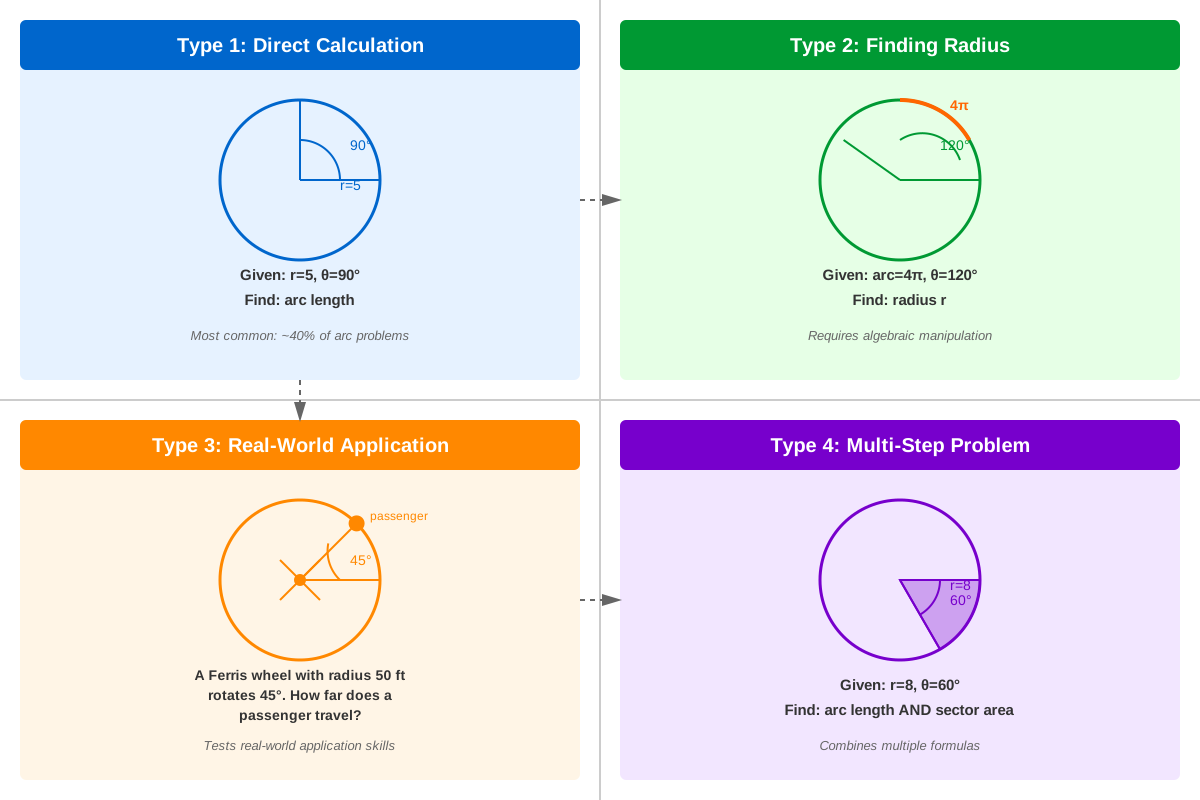
Arc length questions on the SAT commonly appear in several formats: direct calculation problems providing radius and central angle; word problems describing real-world scenarios involving circular motion; questions requiring students to work backwards from arc length to find radius or angle; and complex problems integrating arc length with area, sectors, or coordinate geometry. The topic also appears in questions involving circles on the coordinate plane, where students must first determine the radius before calculating arc length.
Core Concepts
The Arc Length Formula
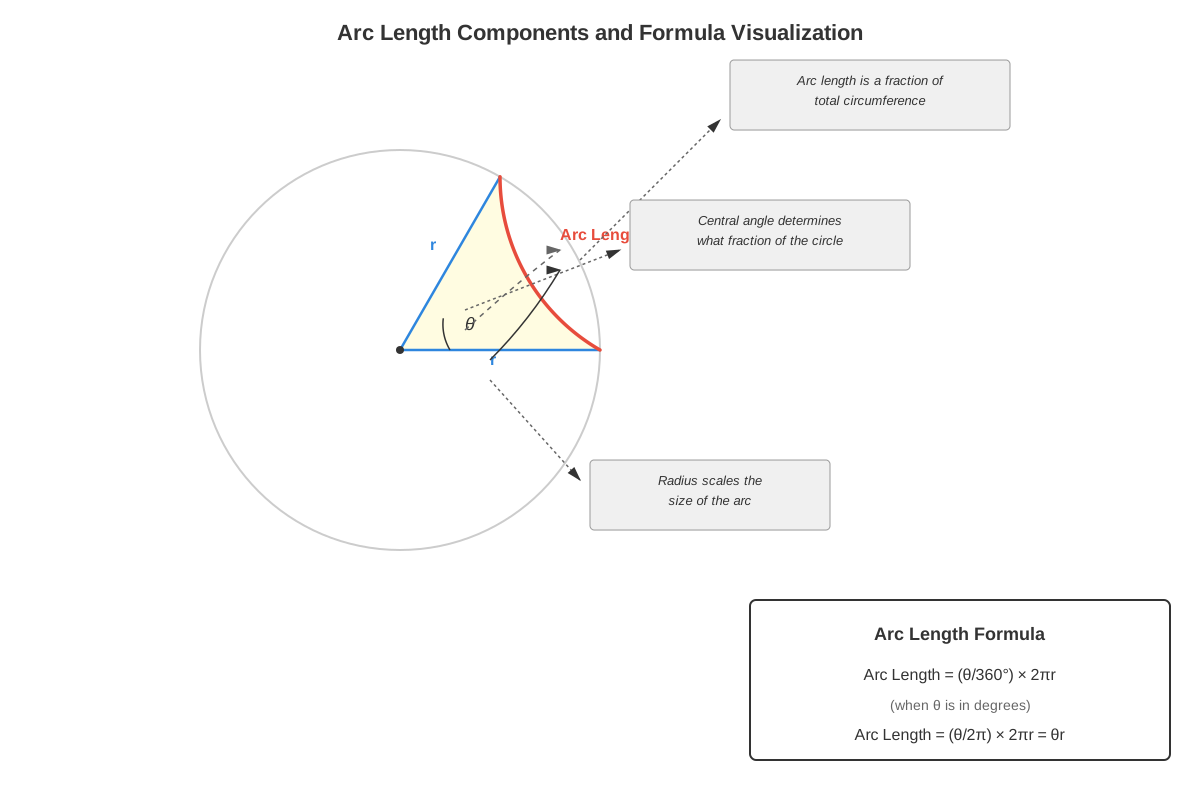
The arc length formula represents the distance along the curved edge of a circle between two points. The fundamental formula depends on whether angles are measured in degrees or radians:
For angles in degrees:
Arc Length = (θ/360°) × 2πrFor angles in radians:
Arc Length = θrWhere:
- θ (theta) represents the central angle
- r represents the radius of the circle
- π (pi) ≈ 3.14159...
The degree-based formula works through proportional reasoning: if the central angle is θ degrees out of a complete 360° rotation, then the arc length is that same fraction of the total circumference (2πr). For example, a 90° angle represents 90/360 = 1/4 of the circle, so the arc length equals 1/4 of the circumference.
Central Angles and Arc Relationships
A central angle is an angle whose vertex is located at the center of the circle, with sides (radii) extending to the circle's edge. The central angle directly determines the arc length through a proportional relationship. This relationship is linear: doubling the central angle doubles the arc length, while halving the angle halves the arc length.
The key insight is that arc length, central angle, and circumference form a proportion:
Arc Length / Circumference = Central Angle / 360°This proportion can be rearranged to solve for any unknown variable, making it a versatile tool for SAT problems. Students should recognize that this proportional relationship is the foundation of all arc length calculations.
Working with Different Angle Measures
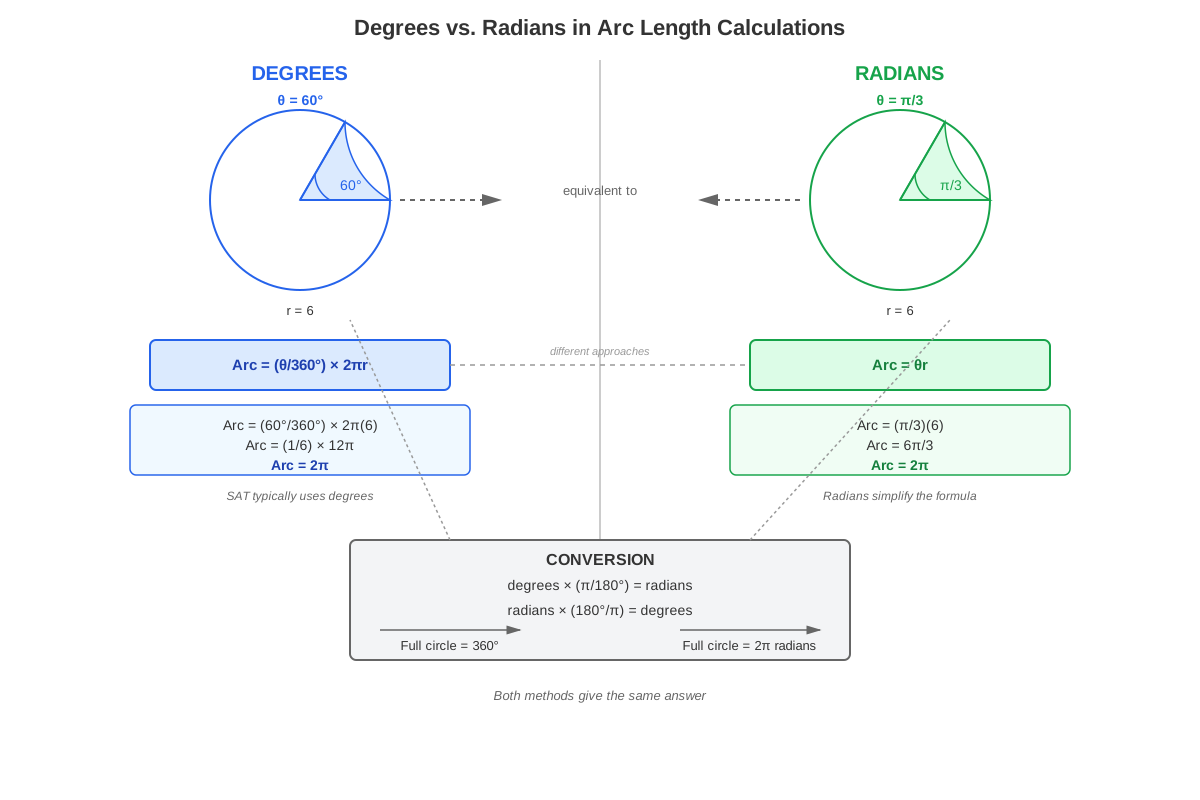
The SAT may present angles in degrees or radians, though degrees are more common. Understanding the conversion between these systems is crucial:
- 360° = 2π radians
- 180° = π radians
- 1 radian ≈ 57.3°
When working with radians, the arc length formula simplifies to s = θr (where s represents arc length). This elegant formula emerges because radians are defined as the ratio of arc length to radius, making the calculation more direct.
Radius and Its Impact
The radius plays a critical role in arc length calculations. For a fixed central angle, arc length increases linearly with radius. A circle with twice the radius has twice the arc length for the same central angle. This relationship means students must pay careful attention to whether problems provide radius or diameter, as using the wrong value leads to incorrect answers.
| Given Information | Formula to Use | Example |
|---|---|---|
| Radius and angle in degrees | (θ/360°) × 2πr | r = 6, θ = 60° → (60/360) × 2π(6) = 2π |
| Diameter and angle in degrees | (θ/360°) × πd | d = 12, θ = 60° → (60/360) × π(12) = 2π |
| Radius and angle in radians | θr | r = 6, θ = π/3 → (π/3)(6) = 2π |
Solving for Unknown Variables
SAT questions frequently require solving for radius, central angle, or other variables when given arc length. This involves algebraic manipulation of the arc length formula:
To find radius when arc length and angle are known:
r = (Arc Length × 360°) / (θ × 2π)To find central angle when arc length and radius are known:
θ = (Arc Length × 360°) / (2πr)These rearrangements require strong algebraic skills and careful attention to maintaining proper units throughout calculations.
Multiple Arcs and Combined Problems
Some SAT questions involve multiple arcs on the same circle or require comparing arcs on different circles. When working with multiple arcs on one circle, students can add or subtract arc lengths as needed. When comparing circles of different sizes, proportional reasoning becomes essential—an arc with the same central angle on a larger circle will be proportionally longer.
Concept Relationships
Arc length connects to circumference as a fractional part to a whole. The circumference formula (C = 2πr) serves as the foundation, with arc length representing a portion determined by the central angle's fraction of 360°. This relationship flows as: radius measurement → circumference calculation → proportional angle determination → arc length result.
The central angle concept bridges arc length to other circle properties. The same central angle that determines arc length also defines a sector (the pie-slice region), creating a parallel relationship: central angle → determines both → arc length (perimeter) and sector area (region). This connection frequently appears in compound SAT problems.
Arc length relates to coordinate geometry when circles are graphed on the xy-plane. Students must first apply distance formula concepts to find the radius, then use that radius in arc length calculations: coordinate points → distance formula → radius → arc length formula → solution.
The proportional reasoning underlying arc length extends to similar circles and scaling problems. When a circle's radius is multiplied by a scale factor k, the arc length for any given angle is also multiplied by k: original radius r → scaled radius kr → original arc length s → scaled arc length ks.
Quick check — test yourself on Arc length so far.
Try Flashcards →High-Yield Facts
⭐ The arc length formula for degrees is: Arc Length = (θ/360°) × 2πr, where θ is the central angle in degrees
⭐ Arc length is directly proportional to both the radius and the central angle
⭐ A 90° arc (quarter circle) has length (1/4) × 2πr = πr/2
⭐ A 180° arc (semicircle) has length (1/2) × 2πr = πr
⭐ The radian-based formula s = θr is simpler but requires the angle in radians
- A complete circle (360°) has an arc length equal to the circumference: 2πr
- Doubling the radius doubles the arc length for any fixed angle
- Arc length is always measured in linear units (inches, centimeters, etc.), not square units
- The ratio of arc length to radius equals the central angle in radians
- When the central angle equals 60°, the arc length equals πr/3
- Arc length problems often require leaving answers in terms of π rather than using decimal approximations
Common Misconceptions
Misconception: Arc length is calculated using the diameter directly in the formula (θ/360°) × 2πd without adjustment → Correction: While you can use diameter, the formula becomes (θ/360°) × πd because 2πr = πd. Using 2πd doubles the correct answer. Always verify whether you're given radius or diameter.
Misconception: The central angle can be any angle in the circle, including inscribed angles → Correction: Arc length specifically requires the central angle (vertex at the center). An inscribed angle (vertex on the circle) measures half the central angle subtending the same arc, so using it directly gives half the correct arc length.
Misconception: Arc length and arc measure are the same thing → Correction: Arc measure refers to the central angle in degrees, while arc length is the actual distance along the circle's edge measured in linear units. A 60° arc has an arc measure of 60° but an arc length of (60/360) × 2πr units.
Misconception: When the angle is given in radians, you still divide by 360° → Correction: The radian formula is simply s = θr with no division needed. Radians already represent the ratio of arc length to radius, making the calculation direct.
Misconception: Larger angles always produce larger arc lengths → Correction: While this is true for arcs on the same circle, a small angle on a large circle can produce a longer arc than a large angle on a small circle. Arc length depends on both angle and radius.
Misconception: You can add arc lengths from different circles directly → Correction: Arc lengths from circles with different radii cannot be meaningfully combined without considering the context. The same central angle produces different arc lengths on circles of different sizes.
Worked Examples
Example 1: Direct Arc Length Calculation
Problem: A circle has a radius of 9 inches. What is the length of an arc with a central angle of 40°? Express your answer in terms of π.
Solution:
Step 1: Identify the given information
- Radius (r) = 9 inches
- Central angle (θ) = 40°
- Need to find arc length
Step 2: Select the appropriate formula
Since the angle is in degrees, use: Arc Length = (θ/360°) × 2πr
Step 3: Substitute the values
Arc Length = (40°/360°) × 2π(9)
Step 4: Simplify the fraction
40/360 = 1/9
Step 5: Complete the calculation
Arc Length = (1/9) × 18π = 2π inches
Answer: The arc length is 2π inches (approximately 6.28 inches)
Connection to learning objectives: This problem demonstrates direct application of the arc length formula, requiring identification of key features (radius and central angle) and accurate calculation—core skills for SAT success.
Example 2: Working Backwards to Find Radius
Problem: An arc on a circle has a length of 5π centimeters and corresponds to a central angle of 150°. What is the radius of the circle?
Solution:
Step 1: Identify what we know and what we need
- Arc Length = 5π cm
- Central angle (θ) = 150°
- Need to find radius (r)
Step 2: Write the arc length formula
Arc Length = (θ/360°) × 2πr
Step 3: Substitute known values
5π = (150°/360°) × 2πr
Step 4: Simplify the angle fraction
150/360 = 5/12
Step 5: Substitute and solve
5π = (5/12) × 2πr
5π = (10π/12)r
5π = (5π/6)r
Step 6: Isolate r by multiplying both sides by 6/(5π)
r = 5π × (6/5π)
r = 6 cm
Answer: The radius is 6 centimeters
Connection to learning objectives: This problem requires algebraic manipulation of the arc length formula to solve for an unknown variable, demonstrating advanced application skills essential for challenging SAT questions.
Exam Strategy
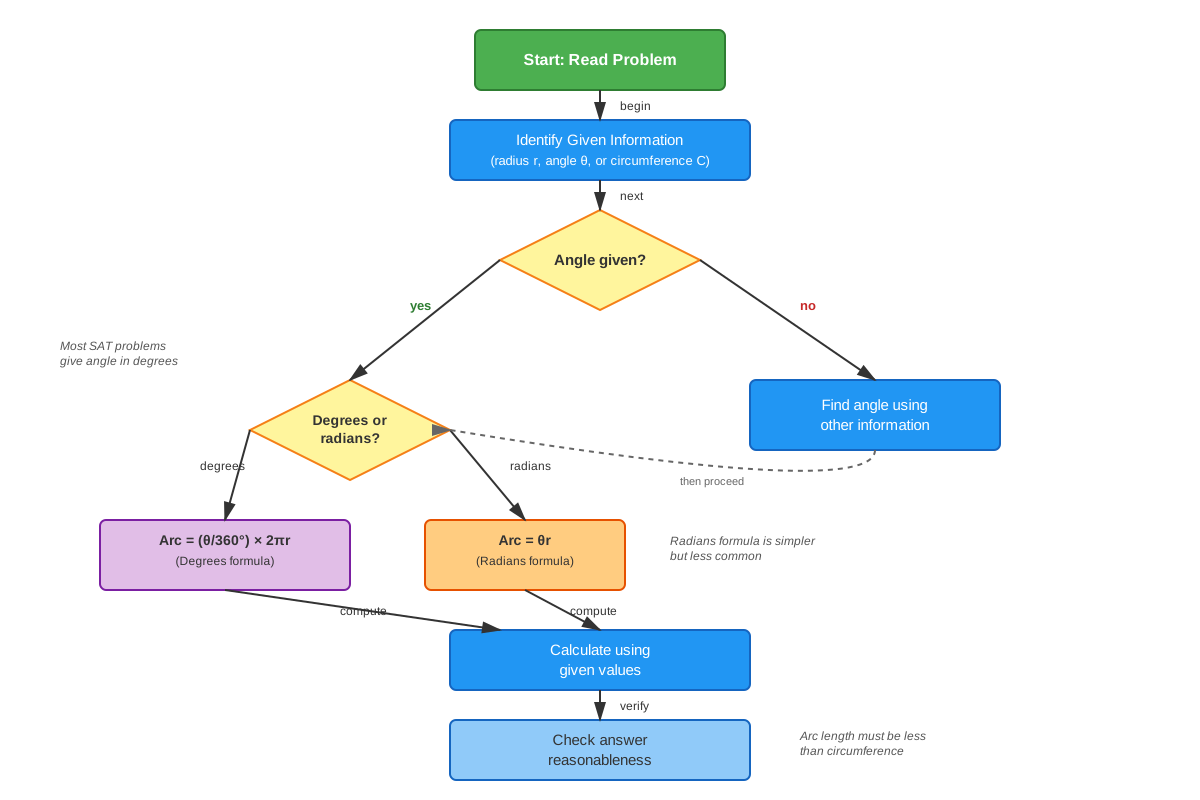
When approaching SAT arc length questions, begin by identifying all given information and clearly marking what the question asks for. Circle or underline the radius (or diameter), central angle, and any other relevant measurements. This prevents confusion between similar values and reduces careless errors.
Trigger words and phrases to watch for include: "arc," "portion of the circle," "central angle," "subtends," "distance along the curve," and "sector perimeter" (which includes arc length). Questions may describe scenarios like "a Ferris wheel rotates through an angle" or "a pendulum swings in an arc," which signal arc length applications.
For process of elimination on multiple-choice questions, use these strategies:
- Eliminate answers with incorrect units (square units instead of linear units)
- Check if answers are reasonable relative to the full circumference
- Verify that answers increase with larger angles or radii
- Look for answers in terms of π when the question requests exact values
Time allocation: Straightforward arc length calculations should take 30-60 seconds. Multi-step problems involving additional concepts may require 90-120 seconds. If a problem requires more than two minutes, mark it for review and move forward to maximize your score on easier questions.
Always verify whether the problem provides radius or diameter—this is the most common source of errors. When in doubt, write out the formula before substituting values to ensure proper setup. For questions requesting answers "in terms of π," do not convert to decimal form; leave π in the expression.
Memory Techniques
Mnemonic for the arc length formula: "Angle Over Total Times Circumference" (AOTTC)
- Angle: the central angle θ
- Over: division symbol
- Total: 360° (total degrees in a circle)
- Times: multiplication
- Circumference: 2πr
Visualization strategy: Picture a pizza. The arc length is the crust on one slice. The bigger the slice angle, the longer the crust. The bigger the pizza (radius), the longer the crust for the same slice angle. This concrete image helps remember that arc length depends on both angle and radius.
Acronym for problem-solving steps: RAFA
- Radius: Identify the radius (or convert diameter to radius)
- Angle: Note the central angle and its units
- Formula: Write the appropriate arc length formula
- Answer: Calculate and verify units
Fraction memory aid: Remember common angle fractions:
- 90° = 1/4 circle → arc length = πr/2
- 180° = 1/2 circle → arc length = πr
- 60° = 1/6 circle → arc length = πr/3
- 120° = 1/3 circle → arc length = 2πr/3
Summary
Arc length measures the distance along a circle's curved edge between two points, determined by the central angle and radius. The fundamental formula, Arc Length = (θ/360°) × 2πr for angles in degrees, derives from proportional reasoning: the arc is the same fraction of the circumference as the central angle is of 360°. Mastery requires understanding the relationship between radius, central angle, and circumference, along with the ability to manipulate the formula algebraically to solve for unknown variables. SAT questions test this concept through direct calculations, word problems involving circular motion, and multi-step problems combining arc length with other geometric properties. Success depends on carefully identifying whether problems provide radius or diameter, maintaining proper units throughout calculations, and recognizing when to express answers in terms of π versus decimal form. The concept connects broadly to proportional reasoning, circle geometry, and real-world applications involving curved paths and rotational motion.
Key Takeaways
- Arc length equals the fraction (θ/360°) of the total circumference 2πr when the angle is measured in degrees
- Always verify whether the problem provides radius or diameter before calculating
- Arc length is directly proportional to both the central angle and the radius
- Common arc lengths to memorize: quarter circle (90°) = πr/2, semicircle (180°) = πr
- The radian formula s = θr is simpler but requires converting degrees to radians
- SAT questions often require algebraic manipulation to solve for radius or angle when given arc length
- Express answers in terms of π when requested for exact values rather than decimal approximations
Related Topics
Sector Area: The region enclosed by two radii and an arc, calculated using a similar proportional formula: Area = (θ/360°) × πr². Mastering arc length provides the foundation for understanding sector calculations, as both use the same proportional reasoning with central angles.
Radians and Angle Conversion: Understanding radians as an alternative angle measurement system enables use of the simplified arc length formula s = θr. This topic deepens comprehension of the relationship between linear and angular measurements.
Circle Equations on the Coordinate Plane: Combining arc length with coordinate geometry requires finding the radius from the circle equation (x - h)² + (y - k)² = r², then applying arc length formulas. This integration appears frequently on challenging SAT problems.
Angular Velocity and Circular Motion: Physics applications involving objects moving along circular paths use arc length to calculate distance traveled. This real-world connection reinforces the practical importance of arc length concepts.
Practice CTA
Now that you've mastered the core concepts of arc length, it's time to solidify your understanding through active practice. Attempt the practice questions to test your ability to apply these formulas under exam-like conditions, and use the flashcards to reinforce key formulas and relationships. Remember, consistent practice with immediate feedback is the most effective way to build the speed and accuracy needed for SAT success. Each problem you solve strengthens your mathematical intuition and brings you closer to your target score!
Sign up free to keep reading
Create a free AnvayaPrep account to finish this SAT guide on Arc length — plus flashcards and practice questions.