Overview
Understanding the relationship between degrees and radians is a fundamental skill in circle geometry and trigonometry that appears consistently on the SAT. These two systems of angle measurement serve as the language through which mathematicians and scientists describe rotations, arc lengths, and circular motion. While degrees are more familiar from everyday use (a right angle is 90°, a full rotation is 360°), radians provide a more natural mathematical framework that connects angles directly to the radius of a circle.
On the SAT math section, questions involving degrees and radians typically appear in the context of circle problems, trigonometric functions, and coordinate geometry. Students must be comfortable converting between these two measurement systems, understanding what each unit represents geometrically, and applying these concepts to solve multi-step problems. The ability to work fluently with both systems is not merely an isolated skill—it forms the foundation for understanding arc length, sector area, and the behavior of trigonometric functions.
Mastery of this topic connects directly to broader mathematical concepts tested on the SAT, including the unit circle, trigonometric identities, and geometric transformations. Questions may ask students to convert angle measures, calculate arc lengths using radian measure, or interpret graphs of trigonometric functions where the x-axis is labeled in radians. Because these concepts integrate with multiple areas of the math curriculum, proficiency with sat degrees and radians is essential for achieving a competitive score on the exam.
Learning Objectives
- [ ] Identify key features of degrees and radians
- [ ] Explain how degrees and radians appears on the SAT
- [ ] Apply degrees and radians to answer SAT-style questions
- [ ] Convert accurately between degree and radian measures in both directions
- [ ] Calculate arc length and sector area using radian measure
- [ ] Interpret and evaluate trigonometric functions using both degree and radian inputs
- [ ] Recognize common angle measures in both systems without calculation
Prerequisites
- Basic circle properties: Understanding radius, diameter, and circumference is essential because radian measure is defined in terms of the radius
- Fraction operations: Converting between degrees and radians requires multiplying and dividing by fractions involving π
- Understanding of π: Recognizing π as the ratio of circumference to diameter (approximately 3.14159) is necessary for radian calculations
- Basic trigonometry: Familiarity with sine, cosine, and tangent functions helps contextualize why both measurement systems exist
- Proportional reasoning: Conversions rely on setting up and solving proportions based on the relationship between the two systems
Why This Topic Matters
In real-world applications, radians are the preferred unit in physics, engineering, and advanced mathematics because they simplify formulas and create direct relationships between linear and angular measurements. When calculating the speed of a rotating object, the distance traveled by a point on a wheel, or the behavior of oscillating systems, radian measure eliminates unnecessary conversion factors. Scientists and engineers use radians in everything from designing gears to modeling planetary orbits to analyzing wave patterns.
On the SAT, degrees and radians questions appear with moderate to high frequency, typically 1-3 questions per test. These questions most commonly appear in the calculator-permitted section and may be presented as multiple-choice or grid-in formats. The College Board tests this concept because it assesses both procedural fluency (can you convert?) and conceptual understanding (do you know what radians represent?). Questions range from straightforward conversions to complex problems involving arc length, sector area, or trigonometric function evaluation.
Common question formats include: asking students to convert a specific angle from degrees to radians or vice versa; providing a diagram of a circle sector and requesting the arc length or area using given angle measures; presenting trigonometric expressions where students must recognize equivalent angles in different units; and word problems involving circular motion where students must choose the appropriate measurement system. The topic frequently appears integrated with other circle concepts, making it a high-yield area for focused study.
Core Concepts
Understanding Degree Measure
Degrees represent the most familiar system of angle measurement, where a complete rotation around a circle is divided into 360 equal parts. Each degree can be further subdivided into 60 minutes, and each minute into 60 seconds, though the SAT typically works only with whole degrees or simple decimal degrees. The choice of 360 degrees for a full circle has historical roots in ancient Babylonian mathematics and astronomy, where the number 360 was convenient due to its many divisors.
Key degree measures to memorize include:
- Full rotation: 360°
- Straight angle: 180°
- Right angle: 90°
- Common acute angles: 30°, 45°, 60°
Understanding Radian Measure
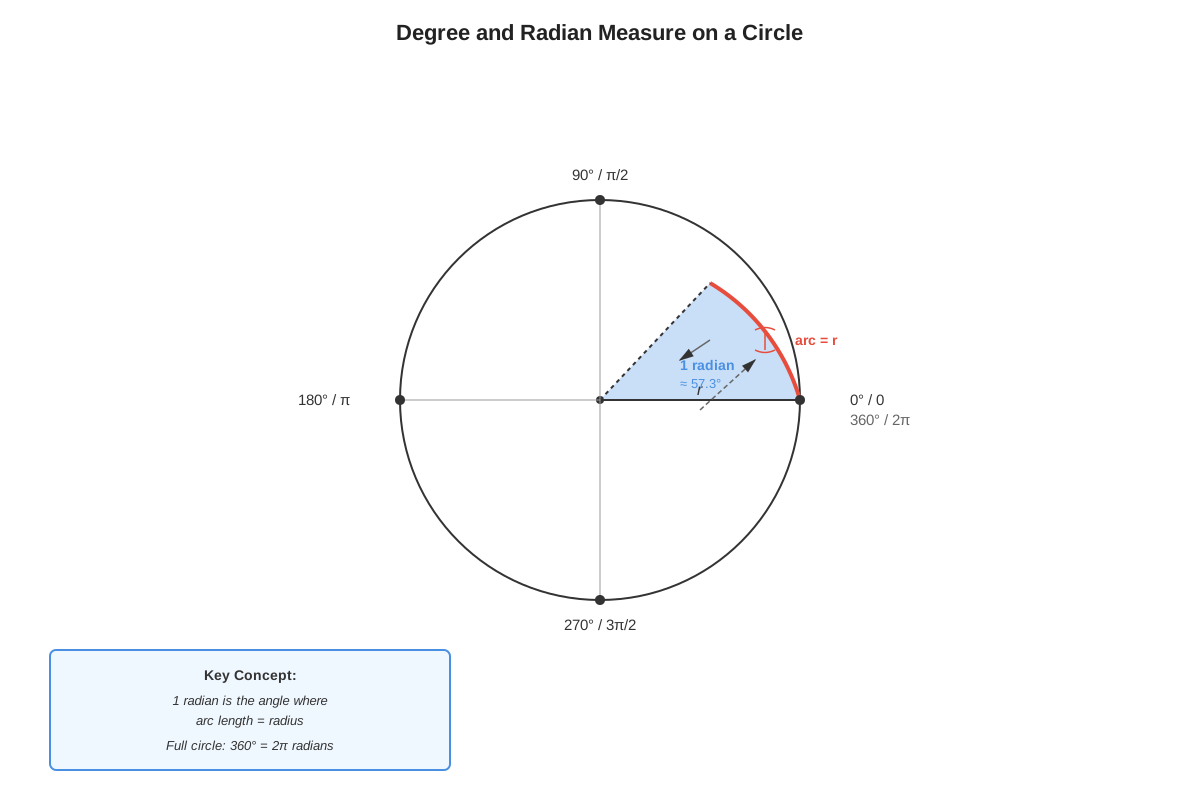
Radians provide an alternative measurement system based on the radius of the circle itself. One radian is defined as the angle subtended at the center of a circle by an arc whose length equals the radius of that circle. This definition creates a direct, natural relationship between the angle measure and the arc length, which is why radians are preferred in higher mathematics.
Since the circumference of a circle is 2πr (where r is the radius), wrapping the entire circumference around the circle creates an angle of 2π radians. This means:
- Full rotation: 2π radians
- Straight angle: π radians
- Right angle: π/2 radians
The beauty of radian measure lies in its simplicity: the arc length formula becomes simply s = rθ (where θ is in radians), compared to the more complex degree formula requiring conversion factors.
The Fundamental Conversion Relationship
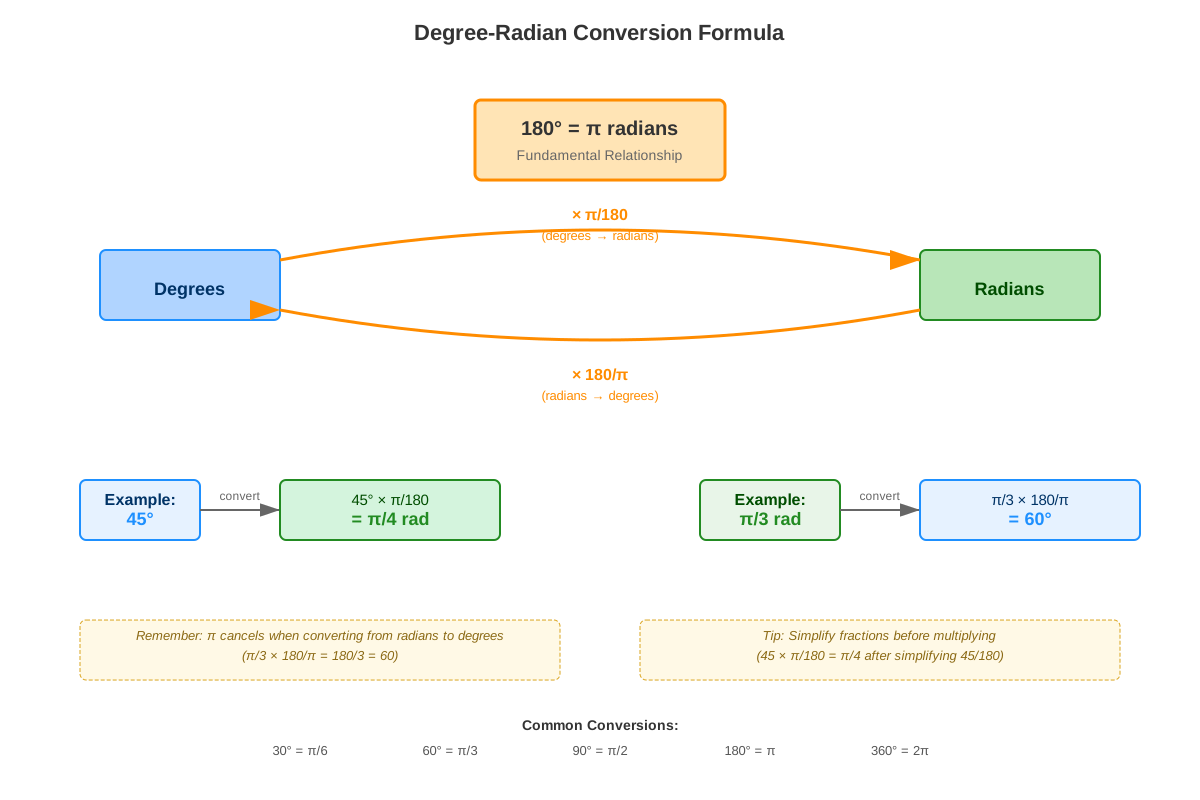
The cornerstone of working with both systems is understanding that 180° = π radians. This equivalence allows conversion between the two systems through proportional reasoning. From this fundamental relationship, we derive two conversion formulas:
To convert from degrees to radians:
radians = degrees × (π/180)To convert from radians to degrees:
degrees = radians × (180/π)These formulas work because they represent multiplication by 1 in a different form. When converting 60° to radians, for example: 60° × (π/180) = π/3 radians.
Common Angle Conversions
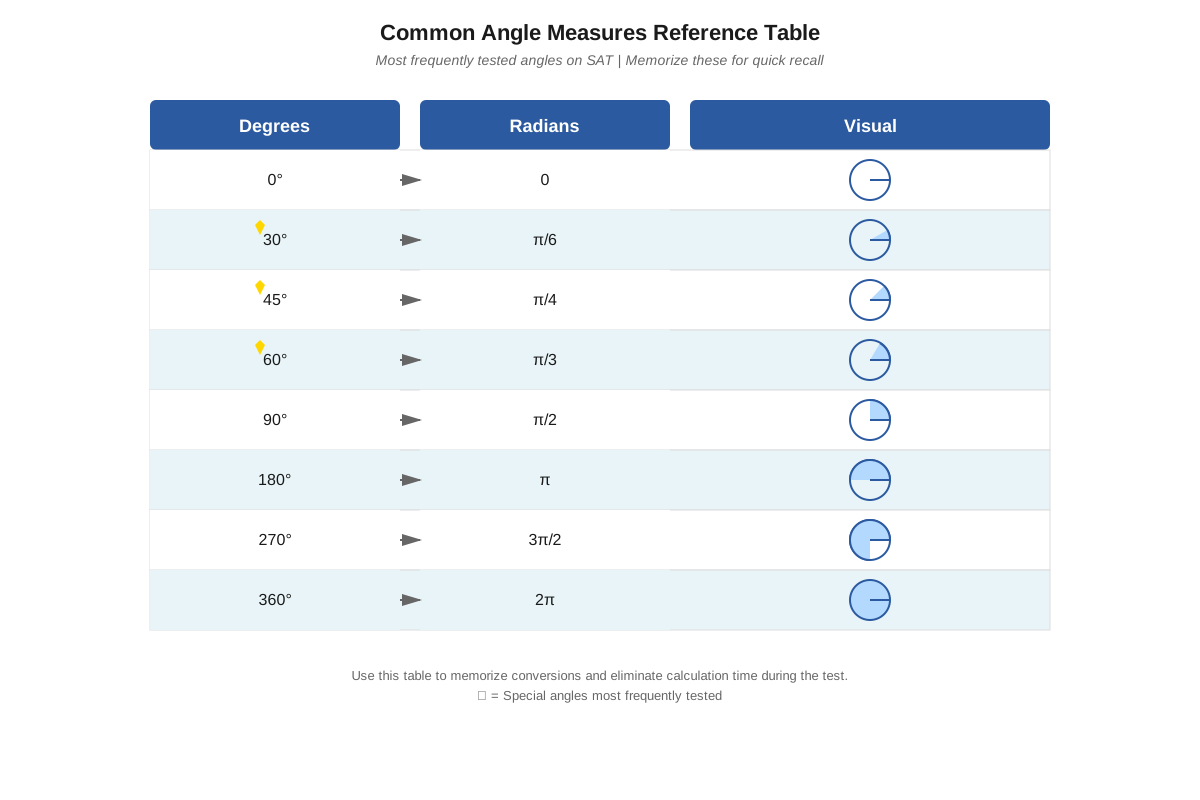
Memorizing frequently-used angle conversions saves valuable time on the SAT. The following table presents the most important conversions:
| Degrees | Radians | Decimal Radians (approx) |
|---|---|---|
| 0° | 0 | 0 |
| 30° | π/6 | 0.524 |
| 45° | π/4 | 0.785 |
| 60° | π/3 | 1.047 |
| 90° | π/2 | 1.571 |
| 120° | 2π/3 | 2.094 |
| 135° | 3π/4 | 2.356 |
| 150° | 5π/6 | 2.618 |
| 180° | π | 3.142 |
| 270° | 3π/2 | 4.712 |
| 360° | 2π | 6.283 |
Arc Length Using Radians
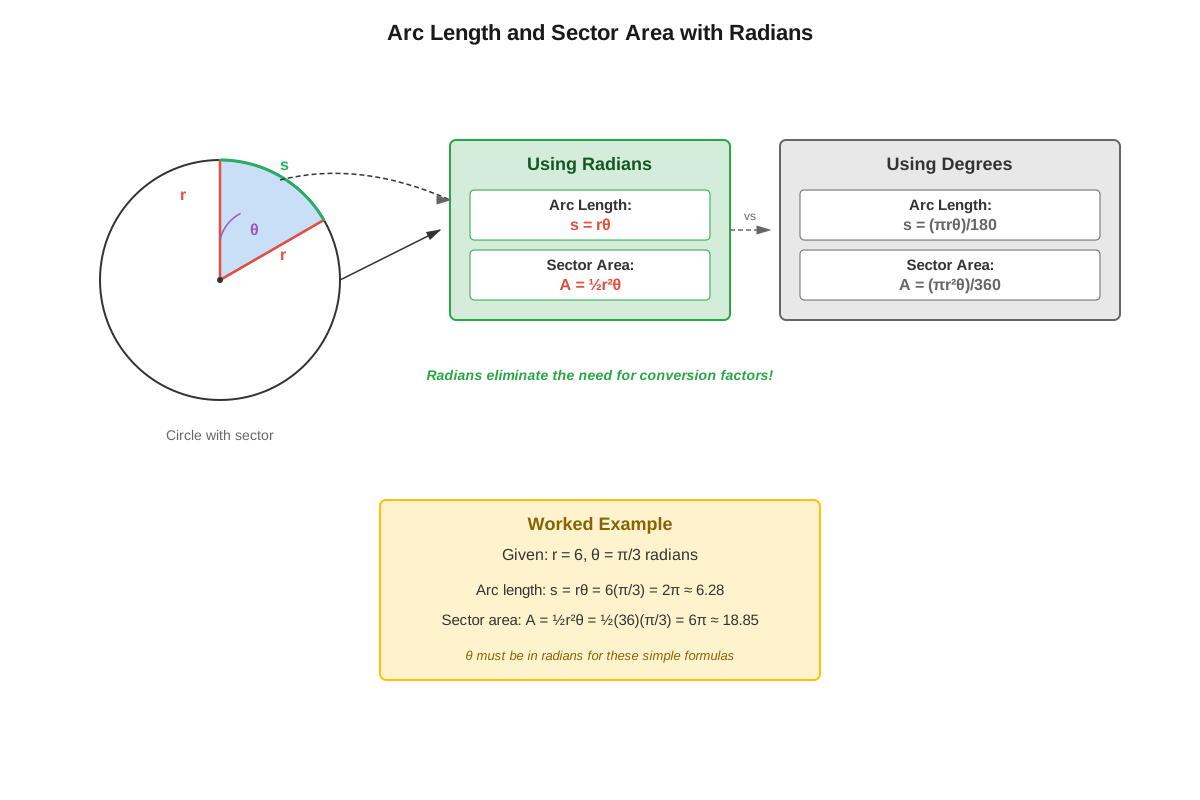
One of the most powerful applications of radian measure is calculating arc length. When an angle θ (measured in radians) is formed at the center of a circle with radius r, the length of the arc s intercepted by that angle is:
s = rθThis elegant formula only works when θ is in radians. If the angle is given in degrees, it must first be converted to radians, or the more cumbersome formula s = (πrθ)/180 must be used.
Sector Area Using Radians
Similarly, the area of a sector (a "slice" of a circle) can be calculated using radian measure. For a sector with central angle θ (in radians) and radius r:
A = (1/2)r²θThis formula parallels the arc length formula and demonstrates why radians are mathematically natural—the formulas are simple and symmetric. Compare this to the degree-based formula: A = (πr²θ)/360, which requires the conversion factor.
Trigonometric Functions and Angle Measures
Trigonometric functions (sine, cosine, tangent) can accept angles in either degrees or radians, but calculators and mathematical software typically default to radian mode. On the SAT, students must pay careful attention to whether an angle is given in degrees or radians when evaluating trigonometric expressions. For example:
- sin(30°) = 0.5
- sin(30) [in radians] ≈ -0.988
The distinction is critical and a common source of errors. Most SAT questions will clearly indicate the unit, but students should develop the habit of checking their calculator mode.
Concept Relationships
The relationship between degrees and radians forms a bidirectional conversion pathway: Degrees ↔ Conversion Factor (π/180 or 180/π) ↔ Radians. This conversion capability enables all other applications of the topic.
Once angles can be expressed in radians, they connect to arc length calculations through the formula s = rθ, which in turn relates to circumference (the arc length when θ = 2π). Similarly, radian measure connects to sector area through A = (1/2)r²θ, which relates to the total circle area (the sector area when θ = 2π gives πr²).
Both degree and radian measures serve as inputs to trigonometric functions, connecting this topic to the broader study of trigonometry and the unit circle. The unit circle itself is typically labeled with radian measures, making fluency with radians essential for understanding trigonometric values at standard angles.
The prerequisite knowledge of circle properties (radius, circumference) provides the geometric foundation, while proportional reasoning enables the conversion process. Together, these create a web of interconnected concepts: Circle Properties → Angle Measurement Systems → Arc Length/Sector Area → Trigonometric Functions.
Quick check — test yourself on Degrees and radians so far.
Try Flashcards →High-Yield Facts
⭐ 180 degrees equals π radians — this is the fundamental conversion relationship from which all other conversions derive
⭐ To convert degrees to radians, multiply by π/180 — this formula appears directly or indirectly in most conversion problems
⭐ To convert radians to degrees, multiply by 180/π — the inverse operation is equally important
⭐ A full circle contains 2π radians or 360 degrees — understanding complete rotations helps with angle relationships
⭐ Arc length formula using radians is s = rθ — this simple formula only works when θ is in radians
- A right angle measures π/2 radians or 90 degrees
- A straight angle measures π radians or 180 degrees
- Common angles: 30° = π/6, 45° = π/4, 60° = π/3
- Sector area formula using radians is A = (1/2)r²θ
- One radian is approximately 57.3 degrees (180/π)
- Radian measure is dimensionless (it's a ratio of two lengths)
- Calculator mode (degree vs. radian) must match the angle unit being used
- Negative angles represent clockwise rotation; positive angles represent counterclockwise rotation
- Angles greater than 2π radians (or 360°) represent multiple rotations
- The radian measure of an angle equals the ratio of arc length to radius: θ = s/r
Common Misconceptions
Misconception: Radians and degrees are interchangeable without conversion → Correction: Radians and degrees are different units that measure the same thing (angles) but with different scales. Using one in place of the other without conversion leads to incorrect answers, just as using feet instead of meters without conversion would be wrong.
Misconception: π/4 radians equals 4/π degrees → Correction: To convert π/4 radians to degrees, multiply by 180/π, giving (π/4) × (180/π) = 45°. The conversion is not simply inverting the fraction.
Misconception: The arc length formula s = rθ works with degrees → Correction: The formula s = rθ only works when θ is measured in radians. If θ is in degrees, you must either convert to radians first or use the formula s = (πrθ)/180.
Misconception: One radian equals one degree → Correction: One radian equals approximately 57.3 degrees (specifically, 180/π degrees). Radians are much larger units than degrees.
Misconception: All angles on the SAT are given in degrees → Correction: While degrees are more common in basic geometry problems, the SAT regularly uses radian measure, especially in trigonometry and advanced circle problems. Always check which unit is specified.
Misconception: You can add degrees and radians together → Correction: You cannot combine measurements in different units without first converting to a common unit. An angle of 30° + π/6 radians must be expressed entirely in degrees (30° + 30° = 60°) or entirely in radians (π/6 + π/6 = π/3) before combining.
Misconception: Radian measure only applies to circles → Correction: While radians are defined using circles, they measure angles in any context—triangles, polygons, rotations in coordinate planes, etc. Radians are a universal angle measurement system.
Worked Examples
Example 1: Converting Between Systems
Problem: Convert 150° to radians, expressing your answer in terms of π. Then convert 5π/6 radians to degrees.
Solution:
Part 1: Degrees to Radians
Step 1: Identify the conversion formula. To convert from degrees to radians, multiply by π/180.
Step 2: Set up the calculation:
150° × (π/180) = 150π/180Step 3: Simplify the fraction by finding the GCD of 150 and 180, which is 30:
150π/180 = (150÷30)π/(180÷30) = 5π/6 radiansPart 2: Radians to Degrees
Step 1: Identify the conversion formula. To convert from radians to degrees, multiply by 180/π.
Step 2: Set up the calculation:
(5π/6) × (180/π) = (5π × 180)/(6 × π)Step 3: Cancel π and simplify:
(5 × 180)/6 = 900/6 = 150°Connection to Learning Objectives: This example demonstrates the application of conversion formulas and shows that the two parts are inverse operations, reinforcing the bidirectional nature of the conversion process.
Example 2: Arc Length Application
Problem: A circle has a radius of 12 cm. An arc on this circle subtends a central angle of 2π/3 radians. Find the length of the arc and the area of the sector formed.
Solution:
Part 1: Arc Length
Step 1: Identify the given information:
- Radius r = 12 cm
- Central angle θ = 2π/3 radians
Step 2: Apply the arc length formula s = rθ (noting that θ is already in radians):
s = 12 × (2π/3) = 24π/3 = 8π cmStep 3: If a numerical approximation is needed:
s ≈ 8 × 3.14159 ≈ 25.13 cmPart 2: Sector Area
Step 1: Use the same given information (r = 12 cm, θ = 2π/3 radians).
Step 2: Apply the sector area formula A = (1/2)r²θ:
A = (1/2) × 12² × (2π/3) = (1/2) × 144 × (2π/3)Step 3: Simplify:
A = 72 × (2π/3) = 144π/3 = 48π cm²Step 4: Numerical approximation if needed:
A ≈ 48 × 3.14159 ≈ 150.80 cm²Connection to Learning Objectives: This example shows how radian measure simplifies calculations for arc length and sector area, demonstrating practical applications of the conversion concepts and reinforcing why radians are mathematically preferred.
Exam Strategy
When approaching sat degrees and radians questions, begin by identifying which unit the given angle is in and which unit the answer requires. Circle or underline degree symbols (°) and look for π in the expression to identify radians. This simple first step prevents the most common error: using the wrong unit.
Trigger words and phrases to watch for include: "express in terms of π" (indicating the answer should be in radians with π in the numerator), "convert to degrees/radians," "arc length," "sector area," "central angle," and "subtends." When you see "arc length" or "sector area" with a formula provided, check whether the angle is in radians—if not, convert it first.
For process-of-elimination strategies, remember that radian measures for common angles are typically simple fractions of π (like π/6, π/4, π/3, π/2). If answer choices include complex decimals or unusual fractions when the question asks for radians, those are likely incorrect. Similarly, degree measures for standard angles are typically multiples of 30° or 45°. Use this pattern recognition to eliminate implausible answers quickly.
Time allocation for these questions should be approximately 45-60 seconds for straightforward conversions and 90-120 seconds for multi-step problems involving arc length or sector area. If a conversion is taking longer than 30 seconds, you may be overcomplicating it—check whether the angle is already one of the common values you've memorized.
Exam Tip: Always verify your calculator is in the correct mode (degree or radian) before evaluating trigonometric functions. A quick check is to verify that sin(90°) = 1 in degree mode or sin(π/2) = 1 in radian mode.
Memory Techniques
For the fundamental conversion: Remember "Pi Over 180" sounds like "pie over one-eighty" to recall that degrees × π/180 = radians. The reverse is "180 Over Pi" for radians × 180/π = degrees.
For common angles, use the mnemonic "Six Four Three" to remember the denominators of the most common radian measures:
- 30° = π/6
- 45° = π/4
- 60° = π/3
Visualization strategy: Picture a circle divided like a pizza. A full pizza is 2π radians (or 360°). Half a pizza is π radians (180°). A quarter pizza is π/2 radians (90°). This concrete image helps anchor the relationship between the two systems.
For arc length: Remember "Simple Radian Times" → s = rθ. The formula is simple when you use radians, and you multiply r times θ.
Acronym for checking work: CRAM - Check units, Review formula, Apply correctly, Match answer format. This four-step check catches most common errors.
Summary
Degrees and radians represent two systems for measuring angles, with 180° equaling π radians serving as the fundamental conversion relationship. Degrees divide a circle into 360 equal parts, while radians define angles based on the radius of the circle, with one radian being the angle subtended by an arc equal in length to the radius. Converting between systems requires multiplying by π/180 (degrees to radians) or 180/π (radians to degrees). Radian measure simplifies formulas for arc length (s = rθ) and sector area (A = ½r²θ), making it the preferred unit in advanced mathematics. On the SAT, students must recognize common angle conversions, apply the correct formulas, and ensure their calculator mode matches the angle unit being used. Mastery requires both procedural fluency in conversions and conceptual understanding of what each measurement system represents geometrically.
Key Takeaways
- The fundamental relationship 180° = π radians enables all conversions between the two systems
- Multiply by π/180 to convert degrees to radians; multiply by 180/π to convert radians to degrees
- Memorize common conversions: 30° = π/6, 45° = π/4, 60° = π/3, 90° = π/2, 180° = π
- Arc length and sector area formulas are simplest when using radian measure: s = rθ and A = ½r²θ
- Always verify calculator mode matches the angle unit before evaluating trigonometric functions
- Radian measure is dimensionless and represents the ratio of arc length to radius
- SAT questions test both conversion skills and applications to circle geometry problems
Related Topics
Unit Circle and Trigonometric Functions: Understanding degrees and radians is essential for working with the unit circle, where angles are typically labeled in radians and correspond to specific sine and cosine values. Mastering this topic enables deeper study of trigonometric identities and function graphs.
Arc Length and Sector Area: These applications directly build on radian measure, using the formulas developed in this topic to solve geometric problems involving portions of circles.
Angular Velocity and Circular Motion: Physics applications involving rotating objects use radian measure to describe angular speed and relate it to linear speed, extending the concepts learned here to real-world motion problems.
Trigonometric Function Graphs: Understanding radians is crucial for interpreting graphs of sine, cosine, and tangent functions, where the x-axis is typically measured in radians and the period of these functions is expressed as 2π.
Polar Coordinates: This coordinate system uses angles (typically in radians) and distances to locate points, providing an alternative to Cartesian coordinates that's particularly useful for circular and spiral patterns.
Practice CTA
Now that you've mastered the core concepts of degrees and radians, it's time to solidify your understanding through practice. Work through the practice questions to test your conversion skills and application abilities, then use the flashcards to memorize common angle conversions until they become automatic. Remember, fluency with both measurement systems is not just about memorizing formulas—it's about developing the mathematical intuition that will serve you across multiple SAT math topics. Each practice problem you solve builds the confidence and speed you need for test day success!
Sign up free to keep reading
Create a free AnvayaPrep account to finish this SAT guide on Degrees and radians — plus flashcards and practice questions.