Overview
The SAT math section is designed not only to test mathematical knowledge but also to challenge students with carefully constructed problems that contain common pitfalls and misconceptions. Among the geometry questions that appear regularly, circle problems are particularly notorious for containing what test-prep experts call SAT circle traps—deliberate answer choices and problem setups designed to catch students who rush through calculations or make common conceptual errors. These traps exploit predictable mistakes such as confusing radius with diameter, forgetting to apply the Pythagorean theorem correctly in coordinate geometry, or miscalculating arc lengths and sector areas.
Understanding sat circle traps is essential for achieving a competitive score on the SAT because circle questions appear in approximately 10-15% of all math problems, and the difference between a good score and an excellent score often comes down to avoiding these preventable errors. The College Board strategically places incorrect answer choices that represent common mistakes, meaning that students who fall into these traps will confidently select wrong answers that "feel" right. These questions test not just whether students know circle formulas, but whether they can apply them carefully and recognize when additional steps or considerations are necessary.
Circle trap questions connect to broader mathematical concepts including coordinate geometry, trigonometry, area and perimeter relationships, and algebraic manipulation. Mastering these traps requires understanding not just the formulas themselves, but the relationships between different circle properties and how the SAT exploits gaps in that understanding. Students who learn to recognize these patterns gain a significant advantage, as they can quickly identify potential pitfalls and verify their answers before moving forward.
Learning Objectives
- [ ] Identify key features of SAT circle traps
- [ ] Explain how SAT circle traps appears on the SAT
- [ ] Apply SAT circle traps to answer SAT-style questions
- [ ] Recognize the most common incorrect answer choices in circle problems and understand why they appear
- [ ] Distinguish between radius and diameter in multi-step problems involving circles
- [ ] Calculate correct values when circles appear in coordinate plane contexts with additional geometric constraints
- [ ] Verify circle problem solutions by checking units, reasonableness, and whether all given information has been used
Prerequisites
- Basic circle formulas: Students must know that circumference = 2πr, area = πr², and understand what radius and diameter represent, as these form the foundation for recognizing when trap answers substitute one for another
- Coordinate geometry fundamentals: Understanding how to plot points, calculate distances using the distance formula, and work with equations of circles in the form (x-h)² + (y-k)² = r² is essential for coordinate plane circle traps
- Pythagorean theorem: Many circle traps involve right triangles inscribed in or circumscribed about circles, requiring the relationship a² + b² = c²
- Arc and sector relationships: Knowing that arc length and sector area are proportional to the central angle is necessary to avoid ratio-based traps
- Algebraic manipulation: Solving for variables, working with squared terms, and simplifying expressions containing π are required skills
Why This Topic Matters
Circle traps represent one of the highest-yield study areas for SAT preparation because they appear frequently and are specifically designed to separate students who have superficial knowledge from those with deep understanding. According to College Board data, circle-related questions appear in approximately 2-4 questions per SAT math section, and among these, roughly 60-70% contain at least one trap answer choice. This means that on any given SAT, students will likely encounter 2-3 opportunities to fall into circle traps, making the difference between scores in the 650 range versus 750+ range.
In real-world applications, the skills developed by mastering circle traps extend far beyond test-taking. The careful attention to units, the habit of checking whether radius or diameter is being used, and the practice of verifying that all given information has been incorporated into a solution are fundamental problem-solving skills used in engineering, architecture, physics, and any field requiring precise mathematical reasoning. The ability to recognize when an answer "looks right" but contains a subtle error is a critical thinking skill applicable to data analysis, financial calculations, and scientific research.
On the SAT specifically, circle traps most commonly appear in the following contexts: coordinate geometry problems where a circle's equation must be derived or analyzed; word problems involving circular objects where diameter and radius are both mentioned; questions about inscribed or circumscribed figures where the Pythagorean theorem must be applied; arc length and sector area problems where proportional reasoning is required; and multi-step problems where an intermediate calculation error leads to a trap answer. The test makers consistently place the "trap" answers in positions B or C, knowing that students often eliminate obviously wrong answers (A or E) but then select from the middle options without full verification.
Core Concepts
The Radius-Diameter Confusion Trap
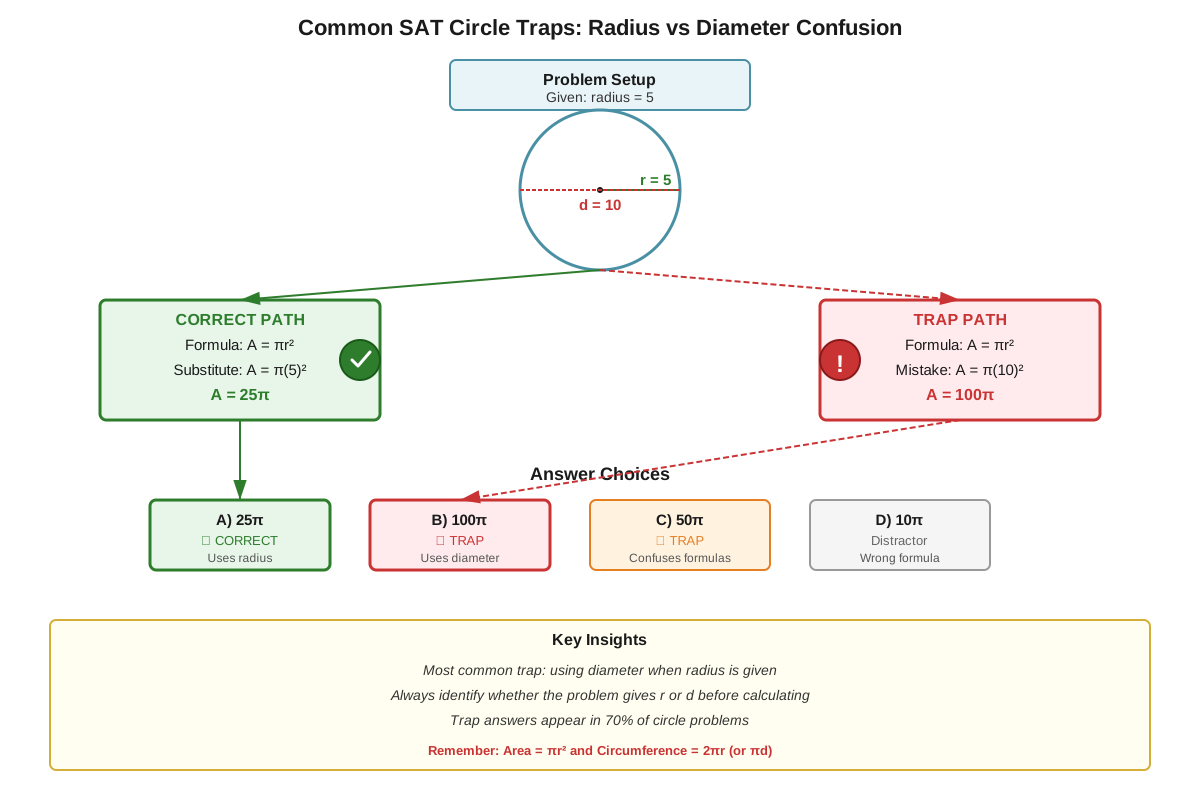
The most fundamental and frequently appearing sat circle traps involves confusing radius and diameter. The SAT deliberately constructs problems where one measurement is given (often diameter) but the formula requires the other (radius), or vice versa. For example, a problem might state "a circle has a diameter of 10" and ask for the area. The trap answer will be 100π (using diameter directly in the area formula), while the correct answer is 25π (using radius = 5).
This trap becomes more sophisticated in multi-step problems. Consider a scenario where a problem gives the circumference and asks for the area. Students must first solve for radius from C = 2πr, then use that radius in A = πr². The trap answer will often represent using the circumference value directly in some incorrect formula, or using diameter instead of radius in the final step.
Key recognition strategy: Whenever a circle problem is presented, immediately identify whether the given measurement is radius (r), diameter (d), or circumference (C), and write down the relationship you need: d = 2r. Circle the value you actually need for your formula before beginning calculations.
Coordinate Plane Circle Traps
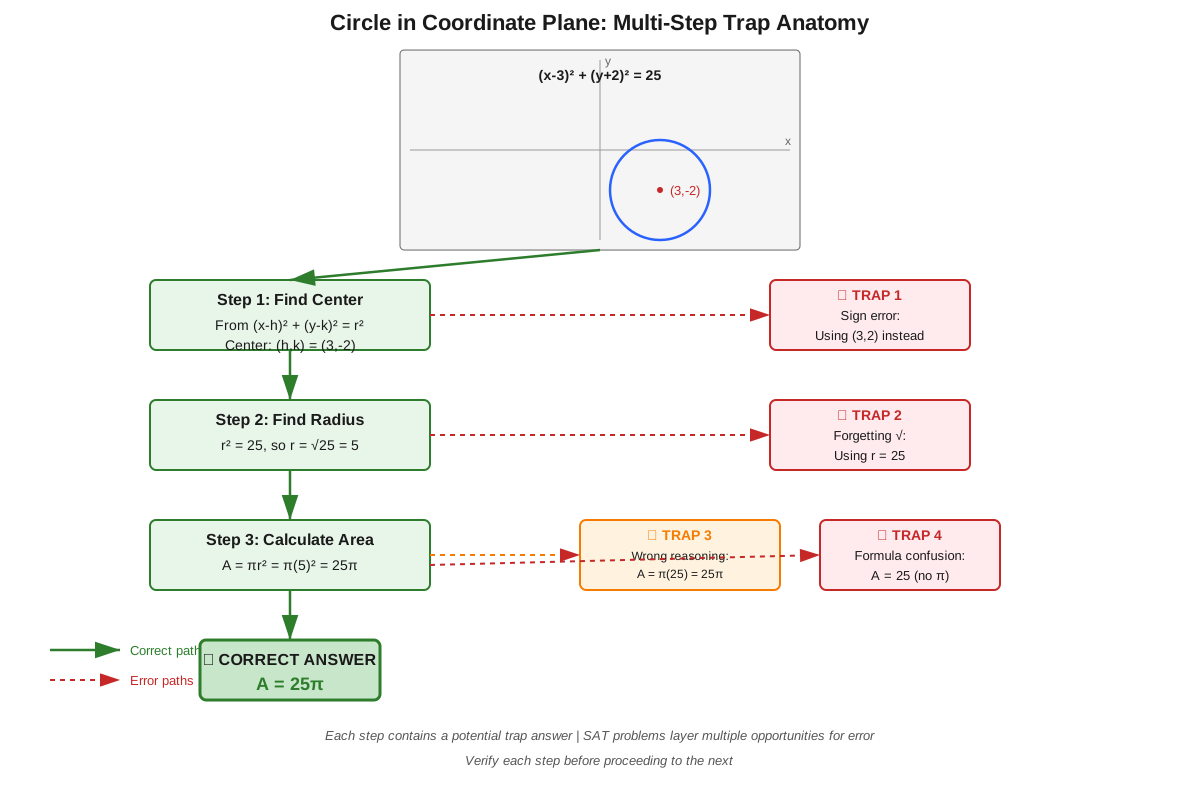
When circles appear on the coordinate plane, the standard equation (x - h)² + (y - k)² = r² creates multiple trap opportunities. The most common trap involves the signs of h and k. If a circle has center (3, -2), the equation is (x - 3)² + (y + 2)² = r², but trap answers will show (x + 3)² + (y - 2)² = r² because students forget that the equation uses subtraction, making the signs opposite to the coordinates.
Another coordinate plane trap involves calculating r² versus r. If a problem gives you points and asks for the equation, you must use the distance formula to find r, then square it for the equation. Trap answers will use r instead of r², or will use r² when the question asks for the radius itself.
| Given Information | What to Calculate | Common Trap |
|---|---|---|
| Center and point on circle | r using distance formula, then r² for equation | Using r instead of r² in equation |
| Equation of circle | Center by identifying (h, k) | Forgetting to flip signs |
| Diameter endpoints | Midpoint for center, then half the distance for radius | Using full distance as radius |
Inscribed and Circumscribed Figure Traps
When triangles, squares, or other polygons are inscribed in or circumscribed about circles, the SAT creates traps by offering answer choices that ignore the geometric relationships. For a square inscribed in a circle, the diagonal of the square equals the diameter of the circle. If the square has side length s, its diagonal is s√2, so the circle's radius is (s√2)/2. Trap answers will use s as the radius, or s√2 as the radius instead of the diameter.
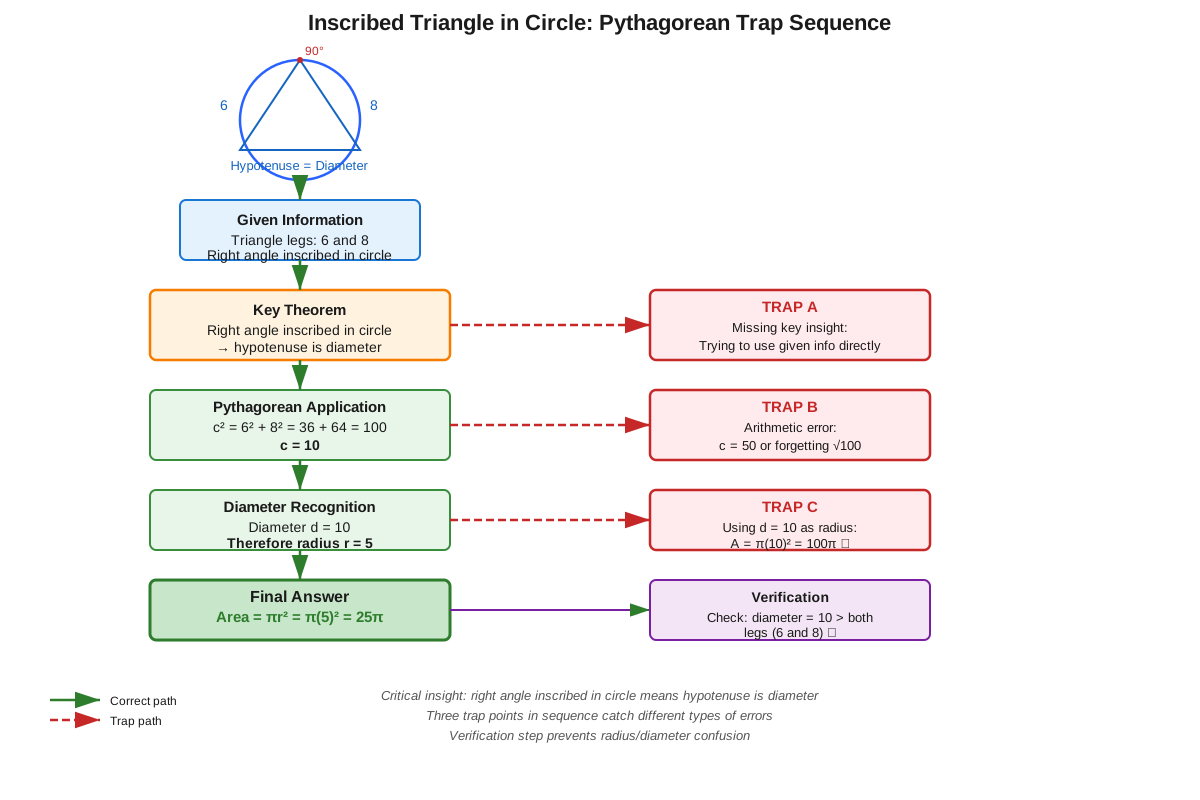
For right triangles inscribed in semicircles, the hypotenuse is always the diameter (Thales' theorem). Problems might give the legs of the right triangle and ask for the circle's area. Students must use the Pythagorean theorem to find the hypotenuse (diameter), then divide by 2 for radius, then calculate area. Trap answers skip the division by 2, or use the hypotenuse directly as the radius.
Arc Length and Sector Area Proportional Traps
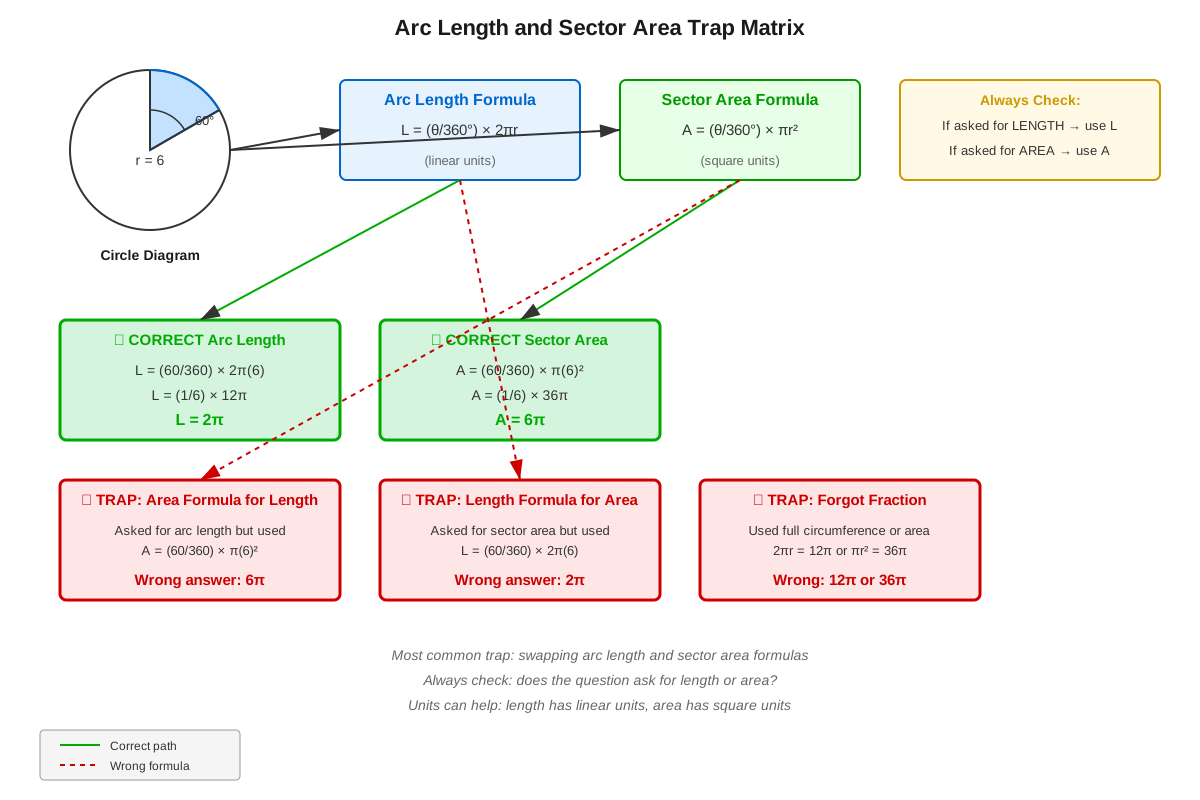
Arc length and sector area problems rely on proportional reasoning: if a central angle is θ degrees out of 360°, then the arc length is (θ/360) × 2πr and the sector area is (θ/360) × πr². The most common trap involves using the angle directly without the proportion, or using the wrong total (180° instead of 360°).
Another sophisticated trap involves giving the arc length and asking for sector area, or vice versa. Students must recognize the relationship: if arc length is L = (θ/360) × 2πr, they can solve for either θ or r, then use that in the sector area formula. Trap answers will incorrectly combine the given arc length with area formulas without proper conversion.
The "Looks Reasonable" Trap
The SAT exploits students' intuition by offering trap answers that are numerically close to the correct answer or that "look" like they could be right. For example, if the correct answer is 36π, trap answers might include 18π (using radius instead of diameter), 72π (using diameter instead of radius), or 36 (forgetting to include π). These answers are strategically chosen to match common errors while appearing plausible.
Students must develop the habit of checking units and reasonableness. If a circle has radius 6 and you calculate an area of 12π, this should trigger suspicion because the area should be larger than the circumference (12π) for any circle with radius greater than 2.
Multi-Step Circle Problems with Compound Traps
The most challenging circle problems combine multiple concepts and create opportunities for errors at each step. For example: "A circle in the xy-plane has center (2, 3) and passes through point (6, 6). What is the area of the circle?"
This requires:
- Using distance formula: r = √[(6-2)² + (6-3)²] = √[16 + 9] = √25 = 5
- Calculating area: A = πr² = π(5)² = 25π
Trap answers include:
- 5π (using r instead of r²)
- 10π (using diameter in area formula)
- 50π (using r² = 25 but doubling incorrectly)
- 25 (forgetting π)
Each trap corresponds to a specific error in the multi-step process, and the SAT knows that under time pressure, students are likely to make at least one of these mistakes.
Concept Relationships
The various SAT circle traps are interconnected through a common theme: they all exploit the gap between recognition and application. The radius-diameter confusion trap forms the foundation, as it appears in nearly every other type of trap. When working with coordinate plane circles, students must first correctly identify radius versus diameter before applying the equation form. This connects to inscribed figure traps, where finding the radius often requires using the Pythagorean theorem on a diameter or chord.
Arc length and sector area traps build upon the basic area and circumference formulas, adding a layer of proportional reasoning. These connect back to radius-diameter traps because students must use the correct radius value in the proportional calculations. The "looks reasonable" trap overlays all other traps—it's the mechanism by which incorrect answers are made appealing.
Relationship map:
Basic formulas (C = 2πr, A = πr²) → Radius vs. Diameter identification → Coordinate plane applications (equation form) → Inscribed/circumscribed figures (Pythagorean theorem) → Arc/sector proportions → Multi-step problems (combining all elements) → Verification against "looks reasonable" trap
The prerequisite knowledge of coordinate geometry enables the coordinate plane circle traps, while Pythagorean theorem knowledge enables inscribed figure traps. All traps ultimately rely on careful algebraic manipulation and attention to detail, making this topic a synthesis of multiple mathematical skills rather than an isolated concept.
Quick check — test yourself on SAT circle traps so far.
Try Flashcards →High-Yield Facts
⭐ The most common SAT circle trap is confusing radius and diameter—always identify which measurement you have and which your formula requires before calculating
⭐ In the circle equation (x - h)² + (y - k)² = r², the signs are opposite the coordinates—if center is (3, -2), the equation uses (x - 3)² and (y + 2)²
⭐ The equation of a circle uses r², not r—if you calculate radius as 5, the equation ends with = 25, not = 5
⭐ For a right triangle inscribed in a semicircle, the hypotenuse equals the diameter—use Pythagorean theorem on the legs to find diameter, then divide by 2 for radius
⭐ Arc length and sector area both use the proportion (θ/360) where θ is in degrees—forgetting this proportion is a primary trap
- When a square is inscribed in a circle, the circle's diameter equals the square's diagonal (side × √2)
- If a problem gives circumference and asks for area, you must solve for r first: r = C/(2π), then use A = πr²
- Trap answers often omit π or place it incorrectly—always verify that π appears in your final answer for area, circumference, arc length, and sector area
- The distance formula √[(x₂-x₁)² + (y₂-y₁)²] gives radius when used between center and a point on the circle
- If a circle problem seems too easy, check whether you've used all given information—unused information often indicates a missed step
- Sector area to full circle area has the same ratio as arc length to full circumference: both equal (θ/360)
- When circles appear in word problems, draw a diagram and label radius and diameter separately to avoid confusion
Common Misconceptions
Misconception: The equation of a circle with center (4, -3) is (x + 4)² + (y - 3)² = r²
Correction: The standard form uses subtraction, so signs flip: (x - 4)² + (y + 3)² = r². The equation literally means "x minus h" and "y minus k," so if h = 4, you write (x - 4), and if k = -3, you write (y - (-3)) = (y + 3).
Misconception: If a circle has diameter 8, its area is 64π
Correction: Area formula uses radius, not diameter. With diameter 8, radius is 4, so area is π(4)² = 16π. The trap answer 64π comes from incorrectly using diameter in the formula A = πd² (which doesn't exist).
Misconception: If an arc has a central angle of 60°, the arc length is 60 times the radius
Correction: Arc length requires the proportion: L = (60/360) × 2πr = (1/6) × 2πr = πr/3. The angle must be converted to a fraction of the full 360° circle, then multiplied by the full circumference.
Misconception: When finding the equation of a circle from two diameter endpoints, use the distance between them as r
Correction: The distance between diameter endpoints is the diameter (2r), not the radius. You must divide by 2 to get r, then square that value for the equation. Also, the center is the midpoint of the diameter, not one of the endpoints.
Misconception: If a problem gives you the circumference as 10π and asks for area, the area is 10π²
Correction: You must solve for radius first: C = 2πr, so 10π = 2πr, giving r = 5. Then A = πr² = π(5)² = 25π. You cannot directly convert circumference to area without finding radius as an intermediate step.
Misconception: In a multi-step problem, if you get an answer that matches one of the choices, you're done
Correction: The SAT places trap answers that match intermediate steps or common errors. Always complete all steps and verify that your answer makes sense. If you finish too quickly, you've likely fallen into a trap.
Worked Examples
Example 1: Coordinate Plane Circle with Inscribed Triangle
Problem: In the xy-plane, a circle has center C at (1, 2) and passes through point P at (4, 6). A right triangle is formed by connecting C to P, and from P perpendicular to the x-axis to point Q. What is the area of the circle?
Solution:
Step 1: Identify what we need. The area formula is A = πr², so we need to find the radius of the circle.
Step 2: The radius is the distance from center C(1, 2) to point P(4, 6) on the circle. Use the distance formula:
r = √[(x₂-x₁)² + (y₂-y₁)²]
r = √[(4-1)² + (6-2)²]
r = √[3² + 4²]
r = √[9 + 16]
r = √25
r = 5
Step 3: Now calculate the area using r = 5:
A = πr²
A = π(5)²
A = 25π
Trap answers to avoid:
- 5π (using r instead of r²)
- 10π (using diameter 10 in the area formula)
- 50π (incorrectly doubling 25π)
- 25 (forgetting π)
Connection to learning objectives: This problem demonstrates how coordinate plane circle traps combine with the radius-diameter trap. The distance formula gives radius directly, but students might mistakenly think they need to double it, or might forget to square it in the area formula.
Example 2: Arc Length with Multiple Steps
Problem: A circle has a circumference of 36π. An arc of this circle has a central angle of 40°. What is the length of this arc?
Solution:
Step 1: Recognize that we need the radius to use the arc length formula, but we're given circumference. First, find the radius:
C = 2πr
36π = 2πr
36π/(2π) = r
r = 18
Step 2: Now use the arc length formula with the proportion:
Arc length = (θ/360) × 2πr
Arc length = (40/360) × 2π(18)
Arc length = (1/9) × 36π
Arc length = 4π
Trap answers to avoid:
- 40π (using angle directly without proportion)
- 2π (using radius 18 with proportion but forgetting the 2 in 2πr)
- 720π (multiplying 40 × 18 without proper proportion)
- 36π (using full circumference, ignoring the angle)
Connection to learning objectives: This demonstrates a multi-step problem where students must first convert circumference to radius, then apply proportional reasoning for arc length. Each step contains a potential trap, and the correct answer requires completing both steps accurately.
Exam Strategy
When approaching circle problems on the SAT, implement a systematic verification process. First, read the problem and immediately identify whether you're given radius, diameter, or circumference—write "r = ?" or "d = ?" in the margin. Second, identify what the question asks for and write down the formula you'll need. Third, before calculating, check whether the formula requires radius or diameter and convert if necessary.
Trigger words to watch for:
- "diameter" or "distance across" → divide by 2 to get radius before using formulas
- "passes through" → indicates a point on the circle, use distance formula for radius
- "center at" → coordinate plane problem, watch for sign flips in equation
- "inscribed" or "circumscribed" → additional geometric relationships required
- "arc" or "sector" → proportional reasoning with (θ/360) required
Process of elimination strategy: On circle problems, immediately eliminate any answer that lacks π when the question asks for area, circumference, arc length, or sector area (unless the problem specifically asks for a numerical approximation). Next, eliminate answers that are obviously too large or too small—if a circle has radius 3, its area cannot be 3π (too small) or 36π (too large). The remaining answers typically include the correct answer and 1-2 trap answers.
Time allocation: Circle problems typically require 60-90 seconds. If you find yourself spending more than 2 minutes, you may be overcomplicating the problem or missing a key insight. In this case, flag the question, make your best guess, and return if time permits. However, don't rush—most circle trap errors occur when students move too quickly through the radius-diameter conversion or sign changes in equations.
Verification technique: After selecting an answer, perform a quick reasonableness check. If the problem involves a circle with radius 5, the circumference should be about 31 (since 2π ≈ 6.28), and the area should be about 78. If your answer is wildly different, reconsider. Also, verify that you've used all given information—if the problem mentions a specific point or angle that you didn't use, you've likely missed a step.
Memory Techniques
Radius-Diameter Mnemonic: "Remember: Radius is Required" for all circle formulas (area, circumference). If you're given diameter, you must convert.
Equation Sign Flip: Think "Subtraction Switches Signs" for the circle equation. The standard form uses subtraction: (x - h)² + (y - k)² = r², so the signs in the equation are opposite the signs of the coordinates.
Arc and Sector Proportion: Remember "360 TOTAL" → both arc length and sector area use the fraction (angle/360) multiplied by the total (full circumference or full area).
Inscribed Right Triangle: Visualize a semicircle as a "Dome" where the Diameter is the base. Any triangle with its base as the diameter and apex on the circle is a right triangle.
r² vs. r: When you see "equation of a circle," think "Equation needs Exponent" → use r², not r.
Coordinate Plane Radius: "Distance Determines" the radius when you have center and a point on the circle—use the Distance formula.
Visualization for reasonableness: Picture a circle with radius 1. Its circumference is about 6 (2π ≈ 6.28) and area is about 3 (π ≈ 3.14). Any other circle's measurements should scale proportionally—radius 2 means circumference about 12 and area about 12, radius 3 means circumference about 18 and area about 27, etc.
Summary
SAT circle traps represent a high-yield category of problems that test not just formula knowledge but careful application and attention to detail. The fundamental trap—confusing radius and diameter—appears in various forms throughout circle problems, from basic area calculations to complex coordinate geometry scenarios. Students must develop the habit of immediately identifying which measurement they have and which their formula requires, then converting before calculating. Coordinate plane circles introduce sign-flip traps in the standard equation form, where (x - h)² + (y - k)² = r² uses signs opposite to the coordinates. Inscribed and circumscribed figures require additional geometric relationships, particularly the Pythagorean theorem and the principle that a right triangle inscribed in a semicircle has its hypotenuse as the diameter. Arc length and sector area problems demand proportional reasoning using (θ/360) as the fraction of the full circle. The SAT strategically places trap answers that represent common errors at each step of multi-step problems, making verification essential. Success requires systematic problem-solving: identify given measurements, determine required measurements, convert as needed, apply formulas carefully, and verify reasonableness before selecting an answer.
Key Takeaways
- Always identify whether you have radius or diameter before applying any circle formula—this single habit prevents the most common SAT circle trap
- In the circle equation (x - h)² + (y - k)² = r², signs are opposite the coordinates and the equation uses r² not r
- For inscribed right triangles in semicircles, the hypotenuse equals the diameter; use Pythagorean theorem then divide by 2 for radius
- Arc length and sector area both require the proportion (θ/360) multiplied by the full circumference or full area
- Trap answers are strategically designed to match common errors—if a problem seems too easy or you finish very quickly, verify all steps
- Use the distance formula to find radius when given a center point and a point on the circle in coordinate geometry
- Multi-step circle problems contain compound traps where errors at any stage lead to trap answers; complete all steps and check reasonableness
Related Topics
Coordinate Geometry and Distance Formula: Mastering circle traps provides a foundation for more complex coordinate geometry problems involving parabolas, ellipses, and systems of equations. The distance formula and equation manipulation skills transfer directly to these advanced topics.
Triangle Properties and Trigonometry: Understanding inscribed and circumscribed circles connects to broader triangle geometry, including the circumcenter, incenter, and trigonometric relationships in circles. These concepts appear in more advanced SAT problems and are essential for SAT Subject Tests.
Three-Dimensional Geometry: Circle concepts extend to spheres, cylinders, and cones. The radius-diameter awareness developed through avoiding circle traps becomes even more critical when working with surface area and volume formulas in 3D.
Proportional Reasoning: The arc length and sector area problems develop proportional reasoning skills that apply to similar figures, scale factors, and ratio problems throughout the SAT math section.
Practice CTA
Now that you understand the common SAT circle traps and how to avoid them, it's time to put your knowledge into practice. Work through the practice questions to encounter these traps in realistic SAT contexts, and use the flashcards to reinforce the key formulas and trap-recognition strategies. Remember, the difference between a good score and an excellent score often comes down to avoiding these preventable errors. Each practice problem you complete builds the pattern recognition and careful problem-solving habits that will serve you on test day. You've learned the traps—now prove you can avoid them!
Sign up free to keep reading
Create a free AnvayaPrep account to finish this SAT guide on SAT circle traps — plus flashcards and practice questions.