Overview
The distance formula is a fundamental tool in coordinate geometry that allows students to calculate the straight-line distance between any two points on a coordinate plane. Derived directly from the Pythagorean theorem, this formula transforms the geometric concept of distance into an algebraic calculation that can be applied systematically to solve a wide variety of math problems. On the SAT, the distance formula appears regularly in questions involving coordinate geometry, circles, geometric shapes plotted on coordinate planes, and optimization problems.
Understanding the distance formula is essential for SAT success because it bridges multiple mathematical domains. It connects algebraic manipulation with geometric visualization, requiring students to work fluently with coordinates, radicals, and spatial reasoning. The sat distance formula questions often appear in both the calculator and no-calculator sections, testing not only computational accuracy but also conceptual understanding of how distance relates to other geometric properties. Questions may ask students to find distances directly, use distance to determine properties of geometric figures, or apply the formula in reverse to find unknown coordinates.
Mastery of this topic provides a foundation for understanding circles (where distance from center defines the radius), perpendicular bisectors, geometric proofs on the coordinate plane, and optimization problems. The distance formula frequently appears alongside other coordinate geometry concepts such as midpoint formula, slope calculations, and equations of circles. Students who develop fluency with the distance formula gain a powerful analytical tool that appears in approximately 2-4 questions per SAT exam, making it a high-yield topic worthy of focused study and practice.
Learning Objectives
- [ ] Identify key features of the distance formula, including its structure and components
- [ ] Explain how the distance formula appears on the SAT in various question formats
- [ ] Apply the distance formula to answer SAT-style questions accurately and efficiently
- [ ] Derive the distance formula from the Pythagorean theorem to understand its geometric foundation
- [ ] Recognize when to apply the distance formula versus other coordinate geometry tools
- [ ] Solve multi-step problems that combine distance formula with other geometric concepts
- [ ] Simplify radical expressions that result from distance formula calculations
Prerequisites
- Pythagorean theorem (a² + b² = c²): The distance formula is a direct application of this theorem on the coordinate plane
- Coordinate plane basics: Understanding ordered pairs (x, y) and how to plot points is essential for identifying the coordinates needed in the formula
- Simplifying radicals: Distance calculations often produce square roots that require simplification
- Substitution and order of operations: Correctly substituting coordinates and following PEMDAS ensures accurate calculations
- Basic algebraic manipulation: Squaring binomials and combining like terms appear in every distance formula application
Why This Topic Matters
The distance formula has profound real-world applications beyond standardized testing. Engineers use it to calculate shortest paths, GPS systems rely on distance calculations to provide navigation, architects apply it when designing structures, and physicists use it to analyze motion and displacement. In data science and machine learning, distance formulas (including extensions to higher dimensions) form the basis of clustering algorithms and pattern recognition systems. Urban planners use distance calculations to optimize transportation networks and emergency response times.
On the SAT, distance formula questions appear with notable frequency—typically 2-4 questions per exam across both the calculator and no-calculator sections. These questions account for approximately 3-6% of the total math score, making this a high-yield topic with excellent return on study time investment. The College Board consistently includes distance formula problems because they efficiently test multiple skills: coordinate geometry understanding, algebraic manipulation, radical simplification, and spatial reasoning.
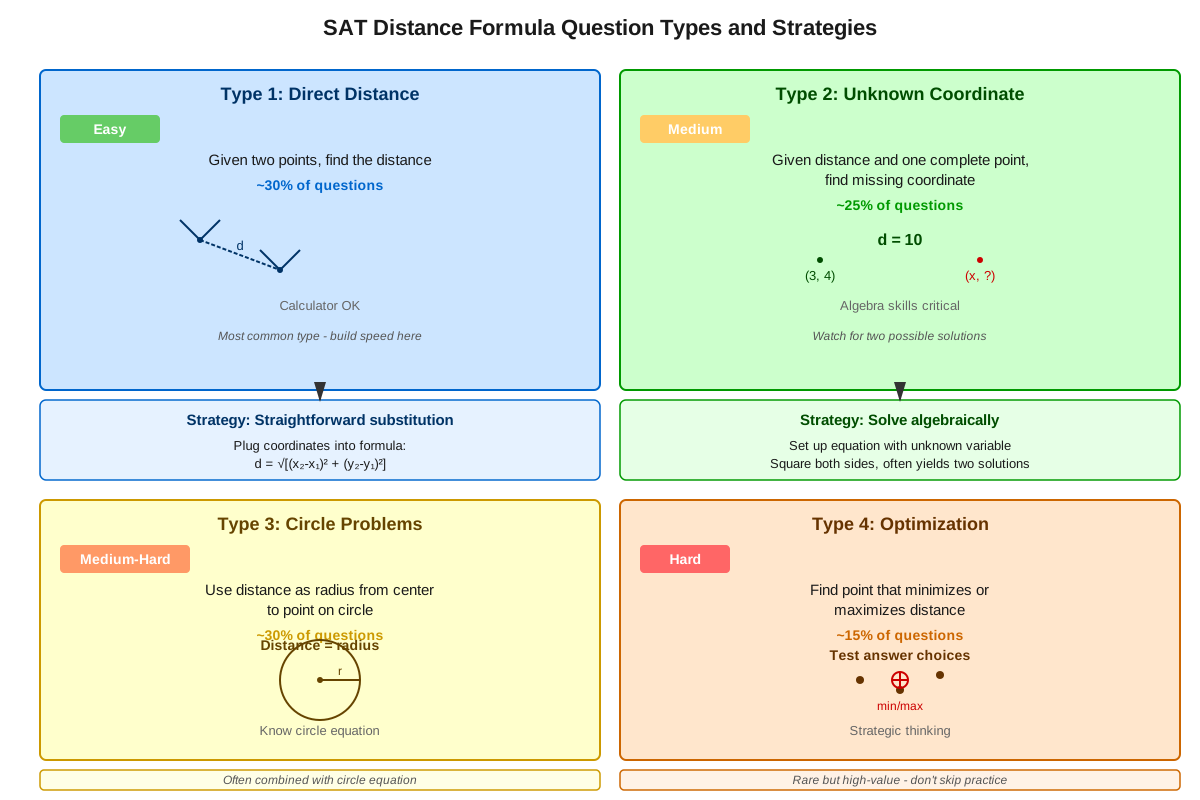
Common SAT question formats include: direct distance calculations between two given points; finding an unknown coordinate when distance and one point are given; determining whether points form specific geometric shapes (like equilateral triangles or squares) by comparing side lengths; circle problems where distance represents the radius; and optimization problems asking for maximum or minimum distances. Questions may be presented as pure coordinate geometry problems or embedded within real-world contexts like mapping, navigation, or design scenarios. The formula also appears in grid-in questions where students must calculate exact numerical answers, making computational accuracy particularly important.
Core Concepts
The Distance Formula Structure
The distance formula calculates the straight-line distance between two points (x₁, y₁) and (x₂, y₂) on a coordinate plane:
d = √[(x₂ - x₁)² + (y₂ - y₁)²]This formula consists of several key components that students must understand:
- d represents the distance (always positive or zero)
- (x₁, y₁) represents the coordinates of the first point
- (x₂, y₂) represents the coordinates of the second point
- The differences (x₂ - x₁) and (y₂ - y₁) represent horizontal and vertical displacements
- The square root encompasses the entire expression, producing the final distance value
The order of subtraction does not matter because each difference is squared, eliminating any negative signs. Whether calculating (x₂ - x₁) or (x₁ - x₂), the squared result remains identical. This property provides flexibility and reduces potential errors from sign mistakes.
Geometric Foundation: Connection to Pythagorean Theorem
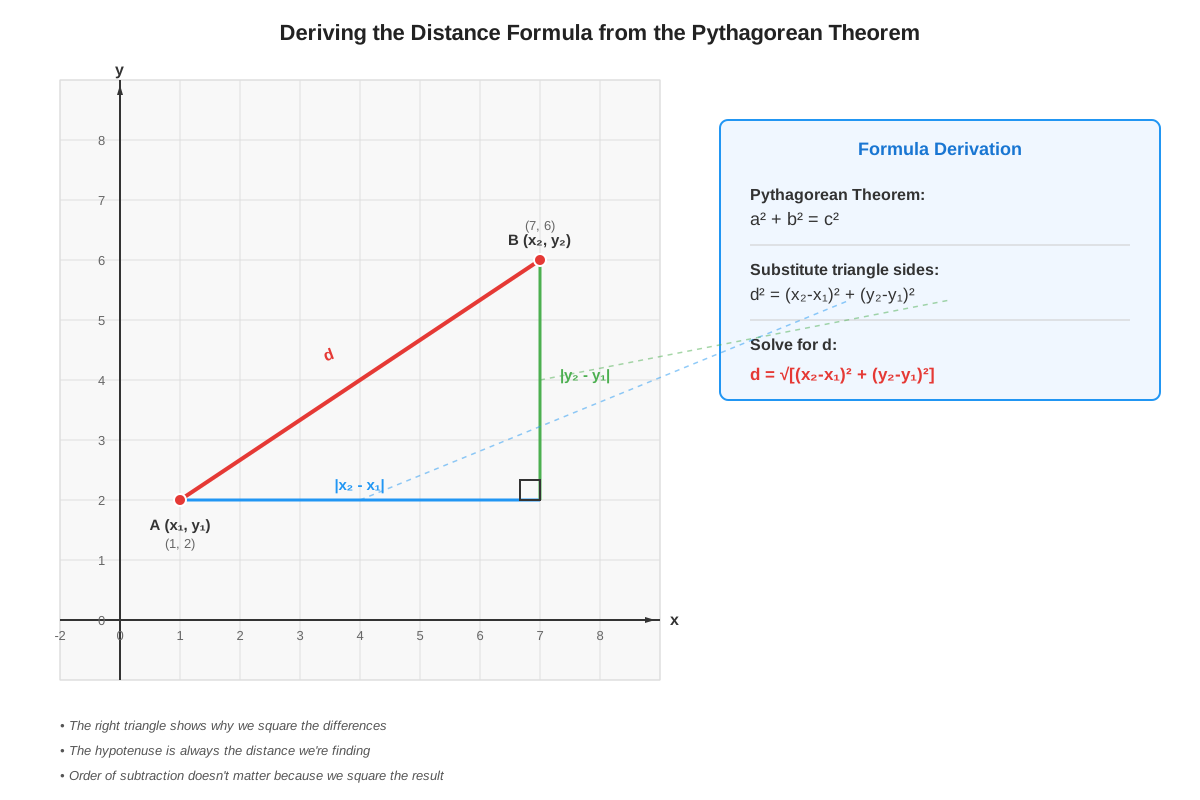
The distance formula derives directly from the Pythagorean theorem. When two points are plotted on a coordinate plane, they form the endpoints of the hypotenuse of a right triangle. The horizontal leg has length |x₂ - x₁| (the absolute difference in x-coordinates), and the vertical leg has length |y₂ - y₁| (the absolute difference in y-coordinates). The distance between the points equals the hypotenuse length.
Applying the Pythagorean theorem:
- Horizontal leg: a = |x₂ - x₁|
- Vertical leg: b = |y₂ - y₁|
- Hypotenuse (distance): c = d
Therefore: d² = (x₂ - x₁)² + (y₂ - y₁)²
Taking the square root of both sides yields the distance formula. Understanding this geometric foundation helps students visualize distance problems and recognize when the formula applies.
Step-by-Step Application Process
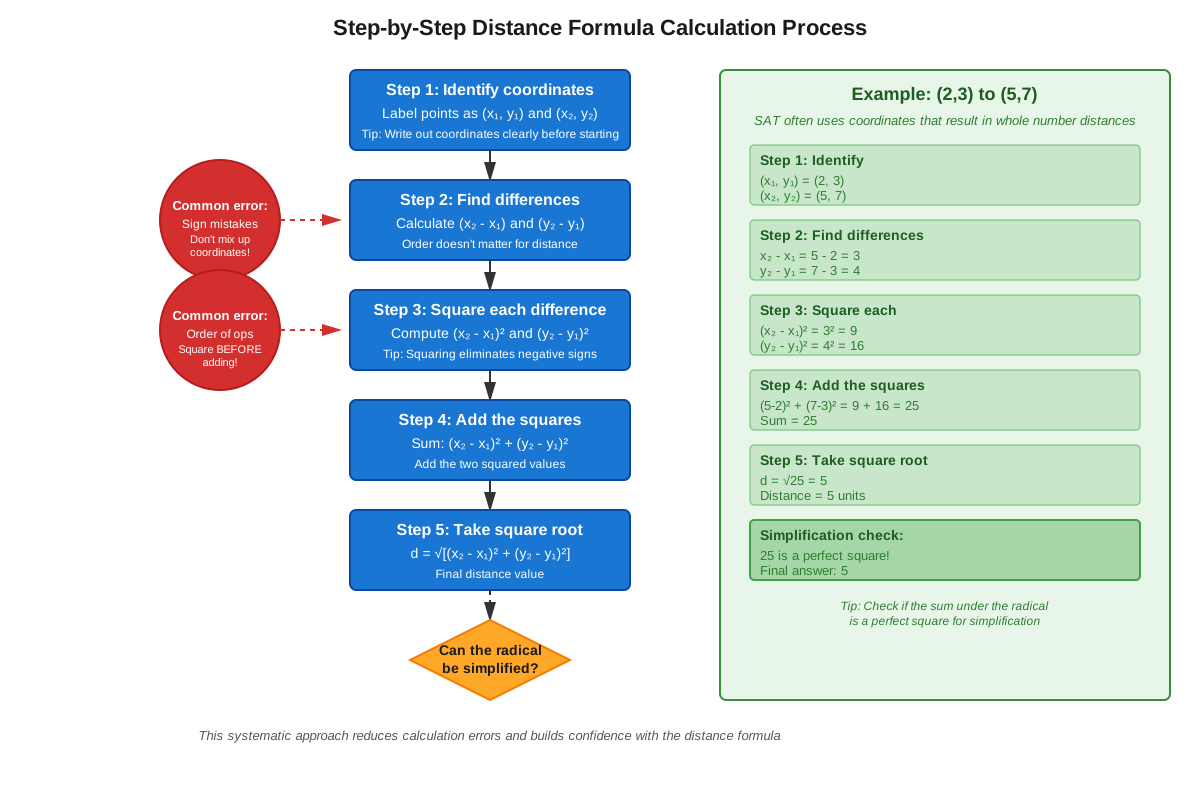
Applying the distance formula systematically minimizes errors:
- Identify and label the two points: Clearly designate which point is (x₁, y₁) and which is (x₂, y₂)
- Write the formula: d = √[(x₂ - x₁)² + (y₂ - y₁)²]
- Substitute coordinates: Replace variables with actual numerical values
- Calculate differences: Compute (x₂ - x₁) and (y₂ - y₁) separately
- Square each difference: Apply the exponent to each result
- Add the squared values: Combine the two squared terms
- Take the square root: Calculate the final distance
- Simplify if necessary: Reduce radicals to simplest form when required
Working with Different Coordinate Scenarios
The distance formula applies universally across all quadrants and special cases:
| Scenario | Example Points | Consideration | ||
|---|---|---|---|---|
| Both points in same quadrant | (2, 3) and (5, 7) | Standard application | ||
| Points in different quadrants | (-3, 4) and (2, -1) | Negative coordinates require careful subtraction | ||
| Points on same horizontal line | (1, 5) and (6, 5) | Distance equals | x₂ - x₁ | ; formula still works |
| Points on same vertical line | (3, 2) and (3, 8) | Distance equals | y₂ - y₁ | ; formula still works |
| One point at origin | (0, 0) and (a, b) | Simplifies to d = √(a² + b²) |
Radical Simplification in Distance Problems
SAT questions frequently produce distances that require radical simplification. Students must recognize perfect square factors and simplify expressions like:
- √50 = √(25 × 2) = 5√2
- √72 = √(36 × 2) = 6√2
- √45 = √(9 × 5) = 3√5
When the SAT asks for an exact answer rather than a decimal approximation, leaving the answer in simplified radical form is typically required. Understanding how to factor radicands and extract perfect squares is essential for earning full credit on these questions.
Distance Formula in Reverse: Finding Unknown Coordinates
Advanced SAT problems may provide the distance and one complete point, asking students to find possible coordinates of the second point. This requires:
- Setting up the distance formula with the known distance value
- Substituting the known point coordinates
- Squaring both sides to eliminate the square root
- Solving the resulting equation for the unknown coordinate(s)
These problems often have multiple solutions, as many points can be equidistant from a given point (forming a circle). The SAT may provide additional constraints to determine a unique solution.
Concept Relationships
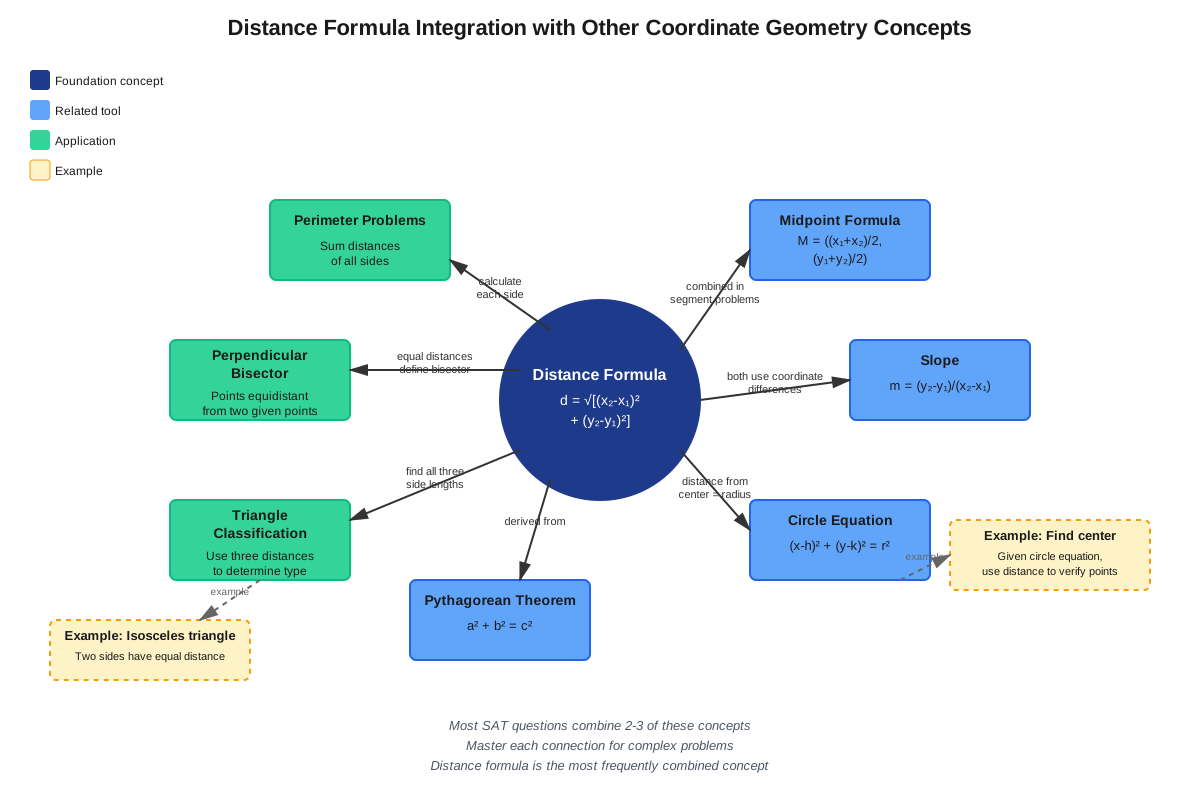
The distance formula serves as a central hub connecting multiple coordinate geometry concepts. It derives from the Pythagorean theorem, demonstrating how algebraic formulas can encode geometric relationships. This connection reinforces that coordinate geometry unifies algebra and geometry into a single analytical framework.
The distance formula relates directly to the midpoint formula—while distance measures how far apart two points are, the midpoint identifies the exact center between them. Together, these formulas enable complete analysis of line segments on the coordinate plane. The slope formula also connects, as perpendicular bisectors (which require both midpoint and slope) often appear alongside distance calculations in comprehensive geometry problems.
Circle equations depend fundamentally on the distance formula. The standard form (x - h)² + (y - k)² = r² represents all points at distance r from center (h, k). Recognizing this connection allows students to move fluidly between distance calculations and circle problems. When the SAT asks whether a point lies on, inside, or outside a circle, students calculate the distance from that point to the center and compare it to the radius.
The relationship map flows as follows:
Pythagorean Theorem → provides foundation for → Distance Formula → enables → Circle Equations and Geometric Shape Analysis → combines with → Midpoint Formula and Slope → supports → Comprehensive Coordinate Geometry Problem Solving
High-Yield Facts
⭐ The distance formula is d = √[(x₂ - x₁)² + (y₂ - y₁)²], derived directly from the Pythagorean theorem
⭐ The order of subtraction (x₂ - x₁ versus x₁ - x₂) does not affect the final result because differences are squared
⭐ Distance is always non-negative; if calculations produce a negative value, an error has occurred
⭐ When two points share the same x-coordinate (vertical line), distance simplifies to |y₂ - y₁|
⭐ When two points share the same y-coordinate (horizontal line), distance simplifies to |x₂ - x₁|
- The distance from any point (x, y) to the origin (0, 0) is √(x² + y²)
- If three points form an equilateral triangle, all three pairwise distances must be equal
- The distance formula applies identically in all four quadrants of the coordinate plane
- Radical answers should be simplified by factoring out perfect squares unless a decimal approximation is requested
- The distance between points (a, b) and (c, d) equals the distance between (c, d) and (a, b) due to symmetry
- In circle problems, distance from a point to the center determines whether the point lies on, inside, or outside the circle
- The diagonal of a rectangle with vertices at (0, 0) and (a, b) has length √(a² + b²)
Quick check — test yourself on Distance formula so far.
Try Flashcards →Common Misconceptions
Misconception: The distance formula only works for points in the first quadrant.
Correction: The distance formula works universally across all four quadrants. Negative coordinates are handled correctly through the squaring operation, which eliminates negative signs. For example, the distance from (-3, -4) to (2, 8) is calculated exactly the same way as points with positive coordinates.
Misconception: The order of subtraction matters and can produce different distances.
Correction: Because each difference is squared, (x₂ - x₁)² = (x₁ - x₂)² and (y₂ - y₁)² = (y₁ - y₂)². The squaring operation eliminates any negative signs, making the order irrelevant. Students can subtract in either direction without affecting the final answer.
Misconception: Distance can be negative if the second point is to the left or below the first point.
Correction: Distance is always non-negative by definition. It represents magnitude without direction. The square root in the distance formula always produces a positive result (or zero if the points are identical). If calculations yield a negative distance, a computational error has occurred.
Misconception: When points lie on a horizontal or vertical line, the distance formula doesn't apply.
Correction: The distance formula applies to all point pairs, including those on horizontal or vertical lines. For horizontal lines where y₁ = y₂, the formula simplifies to d = √[(x₂ - x₁)² + 0²] = |x₂ - x₁|. For vertical lines where x₁ = x₂, it simplifies to d = |y₂ - y₁|. The formula still works; it just reduces to a simpler form.
Misconception: √(a² + b²) can be simplified to a + b.
Correction: The square root of a sum does NOT equal the sum of square roots. √(a² + b²) ≠ a + b. This is a critical algebraic error. For example, √(3² + 4²) = √(9 + 16) = √25 = 5, not 3 + 4 = 7. The square root must be applied to the entire sum after adding the squared terms.
Misconception: Decimal approximations are always acceptable as final answers.
Correction: SAT questions often require exact answers in simplified radical form. For example, if the distance is √50, the answer should be simplified to 5√2 rather than approximated as 7.07. Students must read questions carefully to determine whether exact or approximate answers are requested.
Worked Examples
Example 1: Direct Distance Calculation
Problem: Find the distance between points A(-2, 5) and B(4, -3).
Solution:
Step 1: Identify the coordinates
- Point A: (x₁, y₁) = (-2, 5)
- Point B: (x₂, y₂) = (4, -3)
Step 2: Write the distance formula
d = √[(x₂ - x₁)² + (y₂ - y₁)²]
Step 3: Substitute the coordinates
d = √[(4 - (-2))² + (-3 - 5)²]
Step 4: Simplify inside the parentheses
d = √[(4 + 2)² + (-8)²]
d = √[(6)² + (-8)²]
Step 5: Calculate the squares
d = √[36 + 64]
Step 6: Add the squared values
d = √100
Step 7: Take the square root
d = 10
Answer: The distance between points A and B is 10 units.
Connection to Learning Objectives: This example demonstrates direct application of the distance formula, showing careful handling of negative coordinates and systematic calculation through each step. The problem reinforces that order of subtraction doesn't matter (4 - (-2) = 6 produces the same squared result as -2 - 4 = -6, since both square to 36).
Example 2: Finding Unknown Coordinates with Distance Constraint
Problem: Point P has coordinates (3, 7). Point Q lies on the x-axis and is exactly 5 units away from point P. What are the possible x-coordinates of point Q?
Solution:
Step 1: Identify what we know
- Point P: (3, 7)
- Point Q: (x, 0) [on x-axis means y-coordinate is 0]
- Distance PQ = 5
Step 2: Set up the distance formula
5 = √[(x - 3)² + (0 - 7)²]
Step 3: Simplify the y-component
5 = √[(x - 3)² + (-7)²]
5 = √[(x - 3)² + 49]
Step 4: Square both sides to eliminate the square root
25 = (x - 3)² + 49
Step 5: Isolate the squared term
(x - 3)² = 25 - 49
(x - 3)² = -24
Step 6: Analyze the result
Since (x - 3)² cannot equal a negative number (squares are always non-negative), there is no real solution.
Wait—let me recalculate: Actually, let me reconsider the problem setup.
Step 4 (corrected): Square both sides
25 = (x - 3)² + 49
This gives (x - 3)² = -24, which is impossible.
Realization: This problem as stated has no solution because the minimum distance from (3, 7) to any point on the x-axis is 7 units (straight down to (3, 0)). Since 5 < 7, no point on the x-axis can be exactly 5 units from (3, 7).
Alternative Problem (corrected for valid solution): If the distance were 10 units instead:
10 = √[(x - 3)² + 49]
100 = (x - 3)² + 49
51 = (x - 3)²
x - 3 = ±√51
x = 3 ± √51
Answer: x ≈ 3 + 7.14 ≈ 10.14 or x ≈ 3 - 7.14 ≈ -4.14
Connection to Learning Objectives: This example demonstrates using the distance formula in reverse to find unknown coordinates, requiring algebraic manipulation and understanding that geometric constraints may produce zero, one, or multiple solutions. It also reinforces the importance of checking whether solutions are geometrically reasonable.
Exam Strategy
When approaching SAT distance formula questions, begin by quickly sketching the coordinate plane and plotting the given points if time permits. Visual representation helps prevent sign errors and provides geometric intuition about whether the calculated answer is reasonable. A distance of 100 units between points that appear close together on your sketch signals a calculation error.
Trigger words and phrases that indicate distance formula application include: "how far apart," "distance between," "length of segment," "radius" (in circle contexts), "equidistant," and "shortest path." Questions asking whether points form specific shapes (equilateral triangles, squares, rhombuses) require comparing multiple distances using the formula repeatedly.
For process of elimination, calculate rough estimates before computing exact values. If answer choices differ significantly, approximation may eliminate 3-4 options immediately. For example, if points are roughly 3 units apart horizontally and 4 units apart vertically, the distance should be approximately 5 units (by the 3-4-5 Pythagorean triple). Answer choices of 1, 2, or 12 can be eliminated without detailed calculation.
Time allocation for distance formula questions should be approximately 1-1.5 minutes for straightforward calculations and 2-3 minutes for multi-step problems involving unknown coordinates or multiple distance comparisons. If a problem requires comparing three or more distances (like verifying an equilateral triangle), consider whether the answer choices allow for strategic elimination before calculating all distances.
Calculator usage: On calculator-permitted sections, use the calculator for arithmetic but write out the formula setup by hand to avoid input errors. The most common calculator mistakes involve incorrect parentheses grouping or forgetting to square differences before adding. On no-calculator sections, look for special cases (horizontal/vertical lines, points at origin) that simplify calculations, and recognize common Pythagorean triples (3-4-5, 5-12-13, 8-15-17) that produce integer distances.
Memory Techniques
Mnemonic for the formula structure: "Difference Squared Twice Rooted" reminds students that distance involves taking differences (x and y separately), squaring them, adding (twice means two terms), then taking the square root.
Visualization strategy: Picture the distance formula as creating a right triangle where the two points are opposite corners. The horizontal leg is the "x-difference," the vertical leg is the "y-difference," and the distance is the hypotenuse. This mental image reinforces the Pythagorean theorem connection and helps students remember why both differences are squared and added.
Acronym for application steps: "LSWSASR" (Label, Substitute, Work differences, Square, Add, Square Root)
- Label the points as (x₁, y₁) and (x₂, y₂)
- Substitute into the formula
- Work out the differences
- Square each difference
- Add the squared values
- Square Root the sum
Rhyme for remembering: "X's apart and Y's apart, square them both to make a start. Add them up beneath the root, and distance is your final fruit."
Summary
The distance formula, d = √[(x₂ - x₁)² + (y₂ - y₁)²], is an essential coordinate geometry tool that calculates straight-line distance between any two points on a plane. Derived from the Pythagorean theorem, it transforms geometric distance into algebraic calculation by treating coordinate differences as legs of a right triangle. The formula applies universally across all quadrants, with the squaring operation ensuring that subtraction order and negative coordinates are handled correctly. SAT questions test both direct application (calculating distance from given coordinates) and reverse application (finding unknown coordinates given distance constraints). Success requires careful substitution, systematic calculation through each step, and proper radical simplification. The distance formula connects to broader coordinate geometry concepts including circles, midpoints, and geometric shape analysis, making it a high-yield topic that appears in 2-4 questions per exam. Mastery involves not only computational accuracy but also geometric intuition about when the formula applies and what reasonable answers should look like.
Key Takeaways
- The distance formula d = √[(x₂ - x₁)² + (y₂ - y₁)²] derives from the Pythagorean theorem and calculates straight-line distance between coordinate points
- Subtraction order doesn't matter because differences are squared, eliminating concerns about negative results
- Distance is always non-negative; negative results indicate calculation errors
- The formula works identically in all quadrants and for all point configurations, including horizontal and vertical lines
- SAT questions require both direct application (finding distance) and reverse application (finding coordinates given distance)
- Radical simplification is often required for exact answers; recognize perfect square factors
- Visual sketching helps prevent errors and provides geometric intuition for verifying reasonableness of calculated answers
Related Topics
Midpoint Formula: Calculates the exact center point between two coordinates using ((x₁+x₂)/2, (y₁+y₂)/2). Mastering distance formula provides the foundation for understanding how midpoint and distance work together to analyze line segments completely.
Circle Equations: The standard form (x-h)² + (y-k)² = r² represents all points at distance r from center (h,k). Distance formula mastery enables students to work fluidly with circle problems, determining whether points lie on, inside, or outside circles.
Pythagorean Theorem Applications: Understanding the geometric foundation of the distance formula strengthens overall Pythagorean theorem skills, which appear throughout SAT geometry in triangles, rectangles, and three-dimensional figures.
Slope and Perpendicular Lines: Combined with distance and midpoint, slope calculations enable comprehensive analysis of geometric figures on coordinate planes, including perpendicular bisectors and altitude constructions.
Practice CTA
Now that you've mastered the theoretical foundation and strategic approach to distance formula problems, it's time to solidify your understanding through active practice. Attempt the practice questions to test your ability to apply the formula under exam-like conditions, and use the flashcards to reinforce key facts and procedures until they become automatic. Remember: the distance formula is a high-yield topic that appears consistently on every SAT, making your practice time an excellent investment toward score improvement. Approach each practice problem systematically, check your work carefully, and learn from any mistakes to build the confidence and accuracy needed for test day success!
Sign up free to keep reading
Create a free AnvayaPrep account to finish this SAT guide on Distance formula — plus flashcards and practice questions.