Overview
Box plots (also called box-and-whisker plots) are powerful visual representations of data distribution that appear regularly on the SAT exam. These diagrams display five key statistical values simultaneously, allowing test-takers to quickly analyze the spread, center, and variability of a dataset. Understanding box plots is essential for success on the SAT because they frequently appear in the Problem Solving and Data Analysis section, where students must interpret graphical data representations and draw conclusions about statistical measures.
On the SAT, box plots serve as efficient tools for comparing multiple datasets, identifying outliers, and understanding how data is distributed across different quartiles. The College Board favors box plots because they test multiple skills simultaneously: reading graphs, understanding statistical measures (median, quartiles, range), and making comparative judgments. Students who master box plots gain a significant advantage, as these questions often appear in medium-to-hard difficulty ranges where correct answers can substantially boost scores.
Box plots connect to broader math concepts including measures of central tendency, variability, and data interpretation. They build upon foundational statistical knowledge while providing a bridge to more advanced topics like standard deviation and probability distributions. The visual nature of box plots makes them particularly valuable for SAT questions that require quick analysis under time pressure, and they frequently appear alongside other data representations like histograms, scatter plots, and frequency tables in multi-part questions.
Learning Objectives
- [ ] Identify key features of box plots including the five-number summary
- [ ] Explain how box plots appears on the SAT and recognize common question formats
- [ ] Apply box plots to answer SAT-style questions involving data comparison and interpretation
- [ ] Calculate and interpret the interquartile range (IQR) from a box plot
- [ ] Compare multiple datasets using side-by-side box plots
- [ ] Determine the presence of outliers using box plot conventions
- [ ] Translate between raw data sets and their box plot representations
Prerequisites
- Basic statistical measures: Understanding mean, median, and mode is essential because box plots display the median as a central feature
- Percentiles and quartiles: Box plots are built on quartile divisions, so recognizing how data divides into quarters is fundamental
- Number line interpretation: Box plots are drawn on number lines, requiring comfort with scale reading and interval estimation
- Data ordering: Creating box plots requires arranging data from least to greatest, a foundational organizational skill
- Basic fraction and percentage concepts: Quartiles represent 25% divisions of data, connecting to proportional reasoning
Why This Topic Matters
Box plots appear in real-world applications across numerous fields including business analytics, scientific research, quality control, and social sciences. Companies use box plots to compare sales performance across regions, medical researchers employ them to analyze patient outcomes across treatment groups, and educators utilize them to compare test score distributions between different classes or schools. The ability to quickly interpret box plots enables professionals to make data-driven decisions efficiently.
On the SAT, box plots appear in approximately 2-4 questions per test, making them a high-yield topic relative to study time investment. These questions typically fall into several categories: identifying specific values from the plot (median, quartiles, range), comparing two or more datasets, determining which dataset matches a given box plot, or calculating measures like the interquartile range. Box plot questions often appear in the calculator-permitted section and may be worth 1-2 points each, with some appearing as part of multi-step problems worth additional points.
The SAT frequently presents box plots in contexts involving survey data, experimental results, or comparative studies. Common scenarios include comparing test scores between two groups, analyzing temperature variations across seasons, examining response times in different conditions, or evaluating product ratings across categories. The exam tests whether students can extract accurate information from the visual representation and apply statistical reasoning to draw valid conclusions.
Core Concepts
The Five-Number Summary
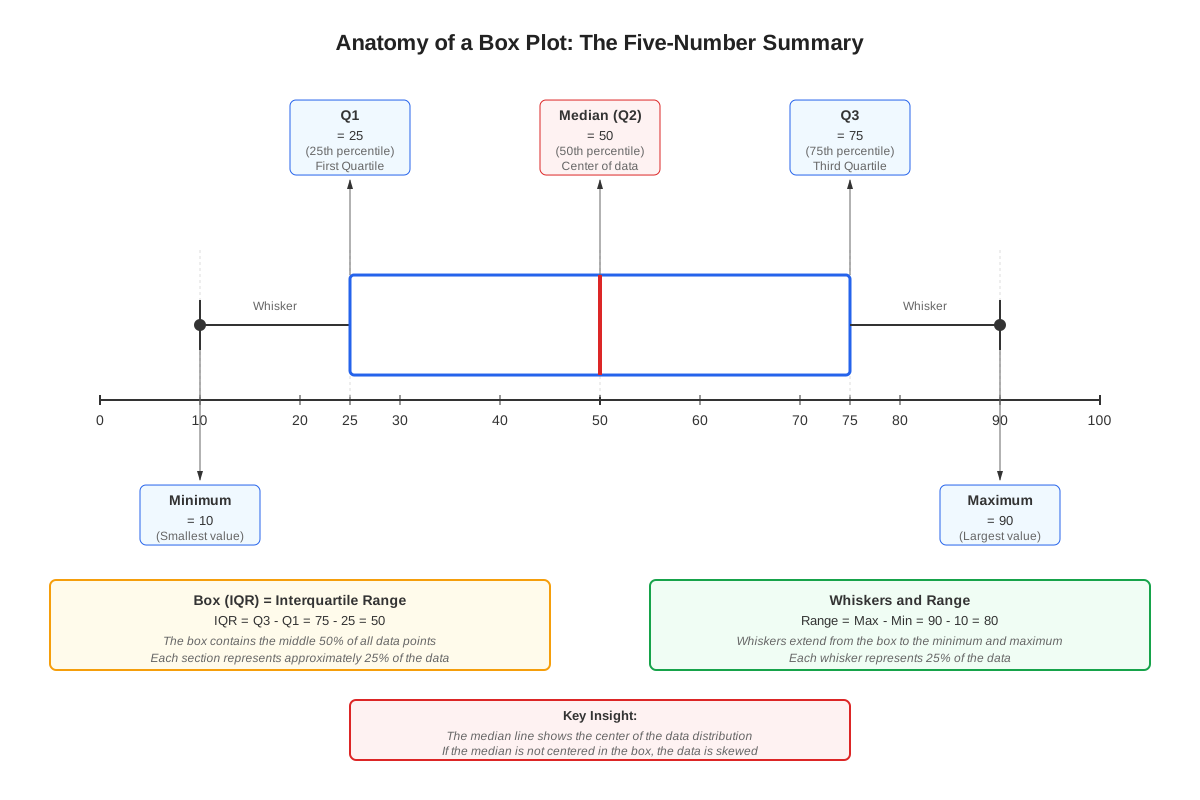
Every box plot is constructed from five critical values that completely describe the distribution of a dataset. These five numbers are: the minimum (smallest value), first quartile (Q1), median (Q2), third quartile (Q3), and maximum (largest value). Together, these values form what statisticians call the five-number summary, providing a comprehensive snapshot of data distribution without requiring every individual data point.
The minimum and maximum values define the range of the data and are represented by the endpoints of the "whiskers" (the lines extending from the box). The first quartile (Q1) marks the value below which 25% of the data falls, while the third quartile (Q3) marks the value below which 75% of the data falls. The median sits exactly in the middle, with 50% of data points below and 50% above. Understanding these five values allows students to answer most SAT box plots questions efficiently.
Anatomy of a Box Plot
The visual structure of a box plot consists of three main components: the box, the whiskers, and the median line. The box itself spans from Q1 to Q3, representing the middle 50% of the data (also called the interquartile range). A vertical line inside the box marks the median position. The whiskers extend from the edges of the box to the minimum and maximum values, showing the full range of the data.
Minimum    Q1      Median    Q3      Maximum
   |-------[========|========]-------|

   ←whisker→  ←─────box─────→ ←whisker→
The length of the box indicates data concentration—a shorter box means data is tightly clustered around the median, while a longer box indicates greater spread in the middle 50% of values. Similarly, whisker length reveals information about the extremes: short whiskers suggest data doesn't extend far from the quartiles, while long whiskers indicate outlying values or greater variability at the extremes.
Quartiles and Percentiles
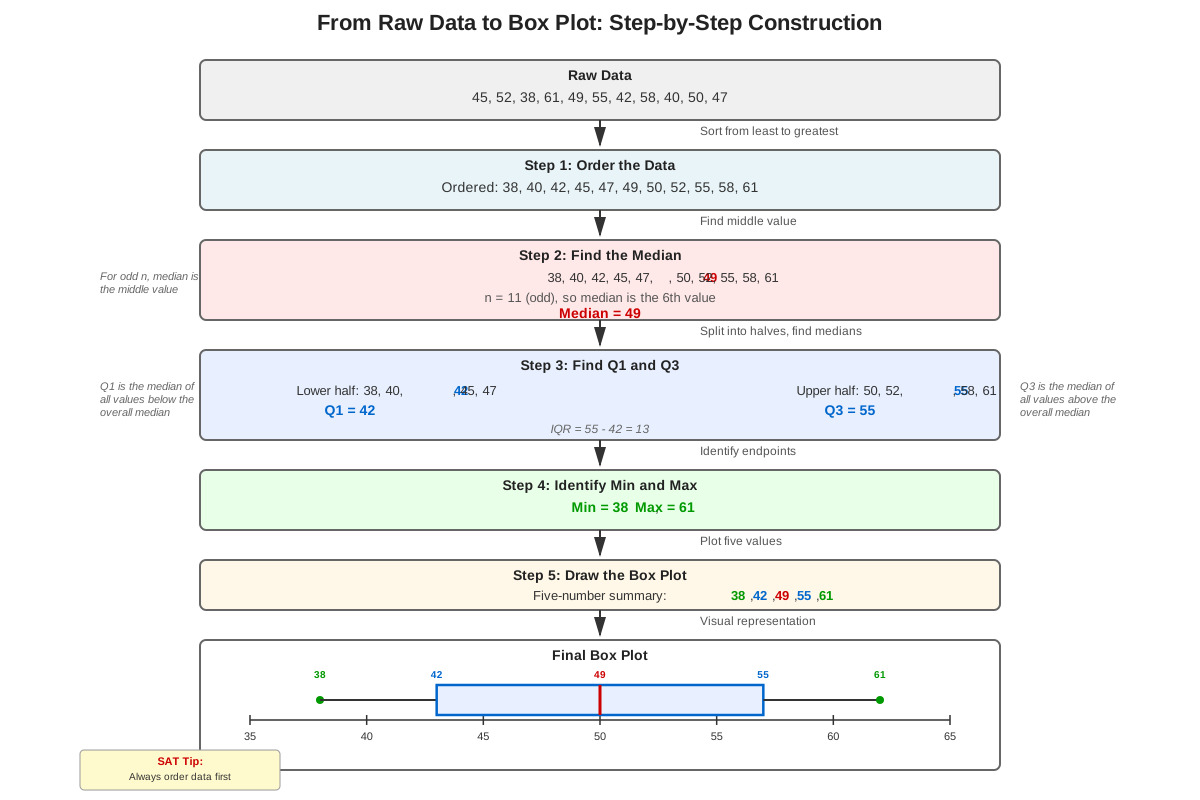
Quartiles divide ordered data into four equal parts, each containing 25% of the observations. The first quartile (Q1) is the median of the lower half of the data, the second quartile (Q2) is the overall median, and the third quartile (Q3) is the median of the upper half. On the SAT, students must understand that quartiles are specific data values, not ranges or intervals.
To find quartiles from a dataset:
- Arrange all values in ascending order
- Locate the median (Q2)—if there's an even number of values, average the two middle numbers
- Find Q1 by determining the median of all values below Q2
- Find Q3 by determining the median of all values above Q2
The relationship between quartiles and percentiles is direct: Q1 corresponds to the 25th percentile, Q2 to the 50th percentile (median), and Q3 to the 75th percentile. This connection frequently appears in SAT questions that ask students to identify what percentage of data falls within certain ranges.
Interquartile Range (IQR)
The interquartile range (IQR) measures the spread of the middle 50% of data and is calculated as Q3 - Q1. This value represents the length of the box in a box plot and serves as a robust measure of variability that isn't affected by extreme values. On the SAT, IQR questions often ask students to calculate this value directly from a box plot or compare IQRs between different datasets.
The IQR is particularly valuable because it focuses on the central tendency of data while ignoring outliers. For example, if comparing test scores between two classes, a smaller IQR indicates more consistent performance (scores clustered together), while a larger IQR suggests greater variability in student achievement. SAT questions frequently test whether students understand this interpretation.
Range and Spread
The range of a dataset is simply the difference between the maximum and minimum values (Maximum - Minimum). In a box plot, this corresponds to the total distance from the end of one whisker to the end of the other. While range provides information about the full extent of data, it's sensitive to outliers—a single extreme value can dramatically increase the range without reflecting the typical data spread.
| Measure | Formula | What It Shows | Sensitivity to Outliers |
|---|---|---|---|
| Range | Max - Min | Full data spread | Very high |
| IQR | Q3 - Q1 | Middle 50% spread | Very low |
| Box length | Q3 - Q1 | Central concentration | Low |
| Whisker length | Varies | Extreme value distance | High |
Comparing Multiple Box Plots
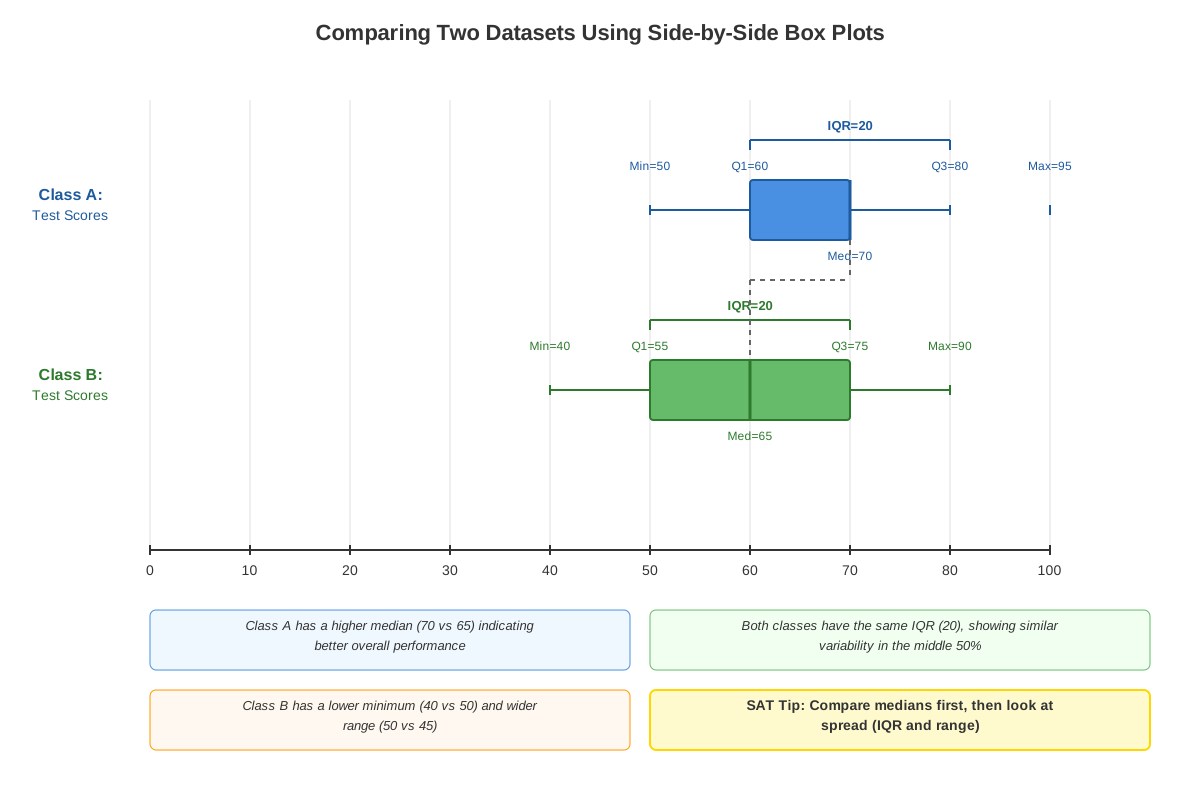
The SAT frequently presents side-by-side box plots to test comparative reasoning. When analyzing multiple box plots, students should systematically compare: medians (which dataset has a higher center?), IQRs (which has more variability?), ranges (which spans a wider interval?), and overlap (do the boxes or whiskers overlap?).
A dataset with a higher median has a greater central value, but this doesn't necessarily mean all its values are higher—there may be overlap in the ranges. When boxes don't overlap at all, the datasets are clearly separated. When boxes overlap significantly, the datasets share many similar values despite potentially different medians. Understanding these nuances is critical for SAT questions asking students to make valid conclusions from comparative box plots.
Skewness and Symmetry
Box plots reveal information about data distribution shape. A symmetric distribution shows the median line centered within the box, with whiskers of approximately equal length. A right-skewed (positively skewed) distribution has a longer right whisker and the median closer to Q1, indicating more extreme high values. A left-skewed (negatively skewed) distribution shows the opposite pattern.
On the SAT, students might need to match a box plot to a description of data distribution or determine which dataset is more skewed. The key is recognizing that skewness indicates where extreme values lie: right-skewed data has outliers or extreme values on the high end, while left-skewed data has them on the low end.
Concept Relationships
The five-number summary serves as the foundation for all box plot interpretation, directly determining the visual appearance of the plot. The minimum and maximum establish the whisker endpoints → Q1 and Q3 define the box boundaries → the median creates the internal division line. This hierarchical relationship means students must first identify these five values before making any other interpretations.
The interquartile range (IQR) emerges directly from the quartile values (Q3 - Q1) and represents the box length visually. This connects to the concept of spread and variability, which relates back to comparing multiple datasets. When students compare IQRs between box plots, they're essentially comparing box lengths, which reveals which dataset has more consistent central values.
Box plots connect to prerequisite knowledge of medians and percentiles—the median is the second quartile, and quartiles are the 25th, 50th, and 75th percentiles. This relationship bridges to broader statistical concepts like measures of central tendency and variability. Understanding box plots also prepares students for more advanced topics like standard deviation and normal distributions, where similar concepts of spread and center appear in different forms.
The visual-to-numerical translation skill required for box plots (reading values from the graph) connects to other SAT math topics involving coordinate planes, number lines, and data interpretation from various graph types. Mastering this translation builds general graph literacy essential for scatter plots, histograms, and function graphs.
Quick check — test yourself on Box plots so far.
Try Flashcards →High-Yield Facts
- ⭐ The box in a box plot always represents the middle 50% of the data (from Q1 to Q3)
- ⭐ The median is shown as a line inside the box, not necessarily at the box's center
- ⭐ The interquartile range (IQR) equals Q3 - Q1 and represents the length of the box
- ⭐ Exactly 25% of data points fall between the minimum and Q1, and another 25% between Q3 and the maximum
- ⭐ The range equals Maximum - Minimum and represents the total length from whisker end to whisker end
- The whiskers extend to the minimum and maximum values (in standard box plots without outlier notation)
- A longer box indicates greater variability in the middle 50% of data
- When comparing box plots, overlapping boxes indicate datasets share similar value ranges
- The median divides the dataset into two equal halves by count, not by range
- Box plots do not show the mean, mode, or individual data points
- Symmetric box plots have the median near the center of the box with equal whisker lengths
- The first quartile (Q1) is the 25th percentile; the third quartile (Q3) is the 75th percentile
- Box plots are particularly useful for identifying skewness and comparing distributions
Common Misconceptions
Misconception: The median line must be centered in the box.
Correction: The median can appear anywhere within the box depending on data distribution. In skewed data, the median shifts toward one quartile, appearing off-center. The median's position relative to Q1 and Q3 reveals information about distribution shape.
Misconception: The box plot shows all individual data points.
Correction: Box plots display only the five-number summary, not individual values. Multiple different datasets can produce identical box plots if they share the same five-number summary, even if the individual data points differ significantly.
Misconception: A longer box plot means more data points.
Correction: Box length (IQR) indicates spread or variability, not quantity. A dataset with 10 values can have a longer box than a dataset with 1,000 values if the smaller dataset has greater variability in its middle 50%.
Misconception: The range and IQR measure the same thing.
Correction: Range measures the full data spread (Max - Min) and is sensitive to outliers, while IQR measures only the middle 50% spread (Q3 - Q1) and is resistant to extreme values. They provide different information about data distribution.
Misconception: If one box plot's median is higher than another's, all values in the first dataset are higher.
Correction: Overlapping ranges mean datasets share values despite different medians. A dataset with a lower median can still contain values higher than some values in a dataset with a higher median, especially when ranges overlap significantly.
Misconception: The whiskers always have equal length.
Correction: Whisker length depends on the distance from quartiles to extreme values. Unequal whiskers indicate skewness—a longer right whisker suggests right-skewed data, while a longer left whisker indicates left-skewed data.
Misconception: Box plots show the mean.
Correction: Box plots display the median (the line inside the box), not the mean. The mean and median can differ significantly, especially in skewed distributions. SAT questions may test whether students confuse these measures.
Worked Examples
Example 1: Interpreting a Single Box Plot
Problem: A box plot displays student test scores with the following features: minimum at 62, Q1 at 74, median at 81, Q3 at 88, and maximum at 96.
(a) What is the interquartile range?
(b) What percentage of students scored between 74 and 88?
(c) What is the range of the test scores?
Solution:
(a) The interquartile range (IQR) is calculated as Q3 - Q1.
- IQR = 88 - 74 = 14
- The IQR is 14 points, meaning the middle 50% of students' scores span 14 points.
(b) The values 74 and 88 correspond to Q1 and Q3, respectively.
- By definition, the box (from Q1 to Q3) contains the middle 50% of data.
- Therefore, 50% of students scored between 74 and 88.
- This directly applies the learning objective of identifying key features of box plots.
(c) The range is the difference between the maximum and minimum values.
- Range = 96 - 62 = 34
- The test scores span 34 points from lowest to highest.
Key Insight: This problem tests fundamental box plot interpretation—recognizing that quartiles divide data into 25% segments and that the IQR specifically measures the middle 50% spread.
Example 2: Comparing Two Box Plots
Problem: Two box plots compare daily temperatures (in °F) for City A and City B during March:
City A: Min = 45, Q1 = 52, Median = 58, Q3 = 63, Max = 72
City B: Min = 38, Q1 = 48, Median = 58, Q3 = 67, Max = 78
(a) Which city had greater temperature variability in the middle 50% of days?
(b) Which city had the greater overall temperature range?
(c) What can you conclude about the medians?
Solution:
(a) Temperature variability in the middle 50% is measured by the IQR.
- City A: IQR = 63 - 52 = 11°F
- City B: IQR = 67 - 48 = 19°F
- City B had greater variability (19°F vs. 11°F), meaning its middle 50% of temperatures were more spread out.
(b) Overall range is Maximum - Minimum.
- City A: Range = 72 - 45 = 27°F
- City B: Range = 78 - 38 = 40°F
- City B had the greater overall range (40°F vs. 27°F).
(c) Both cities have the same median temperature of 58°F.
- This means that on the middle day (when days are ordered by temperature), both cities experienced 58°F.
- However, identical medians don't mean identical distributions—City B had much more variability both in the middle 50% and overall.
Key Insight: This problem demonstrates how to compare multiple datasets using box plots, a common SAT question type. Students must calculate and interpret both IQR and range, recognizing that these measures provide different information about data spread.
Exam Strategy
When approaching SAT box plots questions, begin by identifying the five-number summary values on the graph. Mark or mentally note the minimum, Q1, median, Q3, and maximum before reading the question carefully. Many students rush to answer without properly identifying these values, leading to careless errors.
Trigger words to watch for include: "interquartile range" (calculate Q3 - Q1), "middle 50%" (focus on the box from Q1 to Q3), "median" (the line inside the box, not the box center), "range" (maximum minus minimum), and "quartile" (specific values at 25%, 50%, or 75%). When questions ask about percentages of data, remember that each quartile division represents 25% of the dataset.
For process-of-elimination strategies, immediately eliminate answer choices that confuse median with mean, or that claim the box represents anything other than the middle 50% of data. If a question asks which dataset has "greater variability," eliminate choices that compare medians instead of IQR or range. When comparing box plots, eliminate conclusions that claim complete separation when ranges overlap, or that claim identical distributions when medians or IQRs differ.
Time Management Tip: Box plot questions typically require 45-60 seconds. Spend 15 seconds identifying the five-number summary, 20 seconds performing any calculations, and 15 seconds verifying your answer matches what the question asks. Don't waste time trying to imagine the original dataset—work directly with the five values shown.
For multi-part questions involving box plots, tackle the straightforward identification questions first (finding median, quartiles) before attempting comparative or interpretive questions. This builds confidence and ensures you capture easy points even if time runs short.
Memory Techniques
Mnemonic for the Five-Number Summary: "My Quiet Mom Quickly Makes" represents Minimum, Q1, Median, Q3, Maximum in order from left to right on the number line.
Visualization Strategy: Picture a box plot as a "data sandwich"—the box is the main filling (the middle 50% where most action happens), and the whiskers are the bread slices (the extremes that hold everything together). The median line is the toothpick holding the sandwich together at its center point.
IQR Acronym: Remember "Inside Quartile Range" emphasizes that IQR measures what's inside the box (Q3 - Q1), not the full range.
Quartile Percentages: Use your fingers to remember quartile divisions—hold up four fingers representing four equal sections. Each finger represents 25%, and the spaces between fingers represent Q1 (after first finger = 25%), Q2/median (after second finger = 50%), and Q3 (after third finger = 75%).
Skewness Direction: Remember "Long Right = Right skewed" and "Long Left = Left skewed"—the longer whisker points in the direction of the skew.
Summary
Box plots are essential visual tools for representing data distribution through five key values: minimum, first quartile (Q1), median, third quartile (Q3), and maximum. These plots efficiently display the spread, center, and variability of datasets, making them valuable for SAT questions requiring quick data interpretation. The box itself always represents the middle 50% of data, spanning from Q1 to Q3, with length equal to the interquartile range (IQR). The median line inside the box marks the 50th percentile, while whiskers extend to the minimum and maximum values. Understanding that quartiles divide data into four equal 25% segments is fundamental to interpreting box plots correctly. When comparing multiple box plots, students must systematically analyze medians (center), IQRs (middle spread), and ranges (total spread) to draw valid conclusions. Box plot questions appear regularly on the SAT, testing whether students can extract accurate numerical information from visual representations and apply statistical reasoning to real-world scenarios.
Key Takeaways
- Box plots display five critical values: minimum, Q1, median, Q3, and maximum, forming the five-number summary
- The box always represents the middle 50% of data, with length equal to the interquartile range (Q3 - Q1)
- The median line inside the box can appear anywhere depending on data distribution, not necessarily centered
- Each quartile division represents exactly 25% of the data points in the ordered dataset
- When comparing box plots, analyze medians for center, IQRs for middle variability, and ranges for total spread
- Box plots do not show means, modes, or individual data points—only the five-number summary
- Longer boxes or whiskers indicate greater spread, while shorter ones suggest data clustering
Related Topics
Histograms and Frequency Distributions: After mastering box plots, students can explore histograms, which show the actual frequency of values within intervals. While box plots emphasize quartiles and medians, histograms reveal the shape and modality of distributions more clearly.
Measures of Central Tendency: Understanding mean, median, and mode in depth complements box plot knowledge, as these measures describe data centers using different methods. Box plots specifically display medians, but SAT questions may require comparing medians to means.
Standard Deviation and Variance: These advanced measures of spread build on the concept of variability introduced through IQR. While IQR measures middle 50% spread, standard deviation measures average distance from the mean across all data points.
Scatter Plots and Correlation: Box plots can appear alongside scatter plots in SAT questions requiring multiple data interpretation skills. Both graph types test visual data analysis but focus on different aspects—distribution versus relationship.
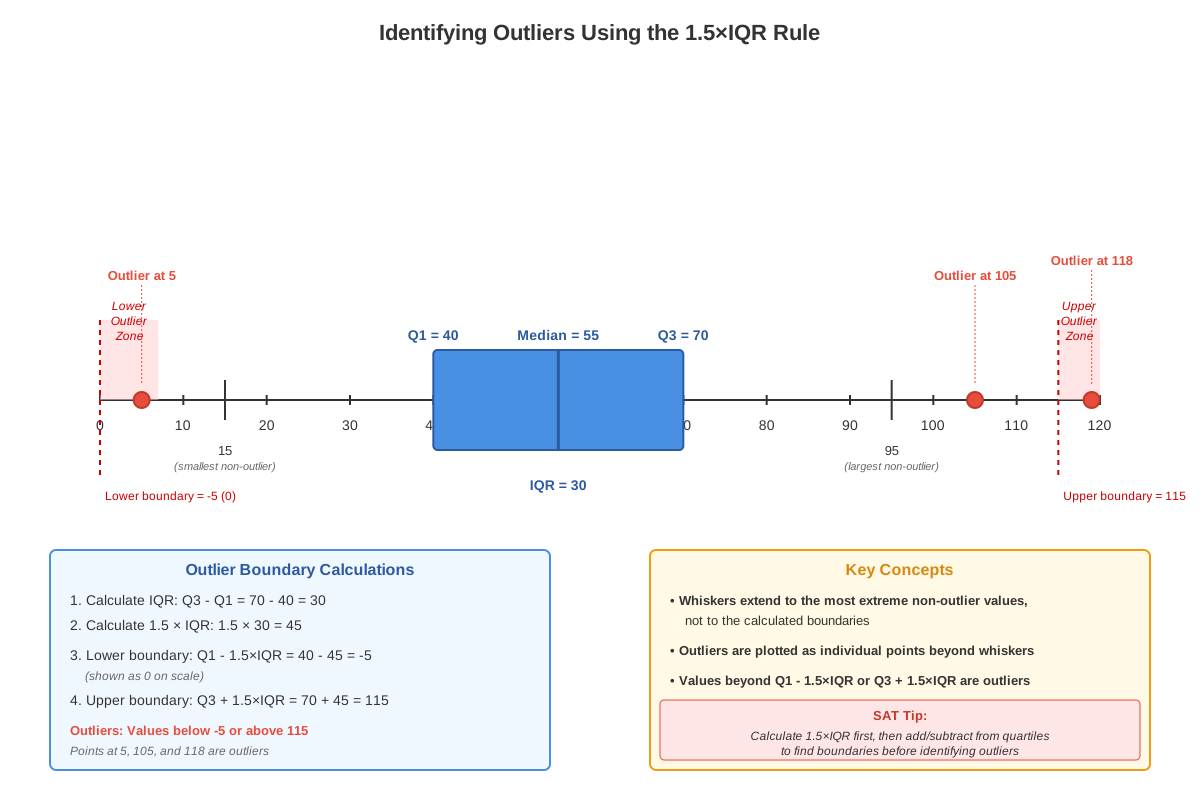
Outlier Detection: Advanced box plot applications involve identifying outliers using the 1.5×IQR rule, connecting to concepts of unusual values and data quality in statistical analysis.
Practice CTA
Now that you've mastered the fundamentals of box plots, it's time to solidify your understanding through active practice. Attempt the practice questions to apply these concepts to SAT-style problems, and use the flashcards to reinforce key definitions and formulas. Remember, box plots appear on nearly every SAT, making this time investment highly valuable for your score. The more you practice identifying the five-number summary and calculating IQR, the faster and more confident you'll become on test day. You've got this!
Sign up free to keep reading
Create a free AnvayaPrep account to finish this SAT guide on Box plots — plus flashcards and practice questions.