Overview
Histograms are one of the most frequently tested data visualization tools on the SAT math section, appearing in both the calculator and no-calculator portions of the exam. A histogram is a specialized type of bar graph that displays the frequency distribution of continuous numerical data by grouping values into intervals called bins or classes. Unlike standard bar graphs that show discrete categories, histograms reveal patterns in how data is distributed across a range of values, making them essential for understanding central tendency, spread, and the overall shape of datasets.
Understanding histograms is crucial for SAT success because these questions test multiple mathematical competencies simultaneously: reading and interpreting visual data, calculating statistical measures like mean and median, understanding frequency distributions, and making inferences about data sets. The College Board consistently includes 2-4 histogram-related questions per test, often embedding them within the Problem Solving and Data Analysis domain. These questions typically carry medium difficulty ratings but can quickly become challenging when combined with concepts like probability, percentages, or comparative analysis.
Mastery of histograms connects directly to broader statistical reasoning skills tested throughout the SAT. Histograms serve as a foundation for understanding data distribution, which relates to concepts like measures of center (mean, median, mode), measures of spread (range, standard deviation), and probability calculations. Additionally, histogram interpretation skills transfer to analyzing other data representations including box plots, dot plots, and frequency tables—all of which appear regularly on the exam. Strong histogram skills also support success in the science passages that appear in the Evidence-Based Reading and Writing section, where data interpretation is frequently required.
Learning Objectives
- [ ] Identify key features of histograms including bins, frequency, axes, and distribution shape
- [ ] Explain how histograms appears on the SAT in various question formats and difficulty levels
- [ ] Apply histograms to answer SAT-style questions involving frequency, percentages, and data interpretation
- [ ] Calculate statistical measures (mean, median, range) from histogram data
- [ ] Distinguish between histograms and other data visualization methods
- [ ] Analyze the shape and spread of distributions represented in histograms
- [ ] Solve multi-step problems combining histogram interpretation with probability or percentage calculations
Prerequisites
- Basic bar graph interpretation: Histograms build upon fundamental bar graph reading skills, requiring the ability to extract numerical information from vertical or horizontal bars
- Understanding of frequency: Students must recognize that frequency represents "how many" items fall within a particular category or range
- Number line comprehension: Histograms display continuous data along a number line, requiring comfort with intervals and ranges
- Basic arithmetic operations: Calculating totals, averages, and percentages from histogram data requires proficiency in addition, multiplication, and division
- Fraction and percentage conversions: Many histogram questions ask students to express parts of the whole as fractions or percentages
Why This Topic Matters
Histograms represent a critical intersection of mathematical reasoning and real-world data literacy. In practical applications, histograms help visualize everything from test score distributions and income ranges to age demographics and measurement data in scientific research. Medical professionals use histograms to understand patient vital sign distributions, economists analyze income inequality through histogram representations, and quality control engineers monitor manufacturing tolerances using histogram analysis. This real-world relevance makes histograms an ideal assessment tool for the SAT, which aims to measure college and career readiness.
On the SAT, histogram questions appear with remarkable consistency. Statistical analysis of recent SAT administrations reveals that approximately 3-5% of all math questions involve histogram interpretation, making this one of the highest-yield topics within Data Analysis and Statistics. These questions typically appear in both the calculator-permitted and no-calculator sections, with difficulty ratings ranging from medium to medium-hard. The College Board favors histogram questions because they efficiently assess multiple skills: visual data interpretation, proportional reasoning, statistical calculation, and logical inference.
Histogram questions on the SAT commonly take several forms: direct frequency reading ("How many students scored between 70 and 80?"), percentage calculations ("What percentage of the data falls below 50?"), statistical measure estimation ("Which interval contains the median?"), comparative analysis ("How many more items are in interval A than interval B?"), and probability questions ("If one data point is selected at random, what is the probability it falls in the highest interval?"). Questions may also ask students to identify which histogram correctly represents a described dataset or to make inferences about data not explicitly shown but implied by the distribution.
Core Concepts
Structure and Components of Histograms
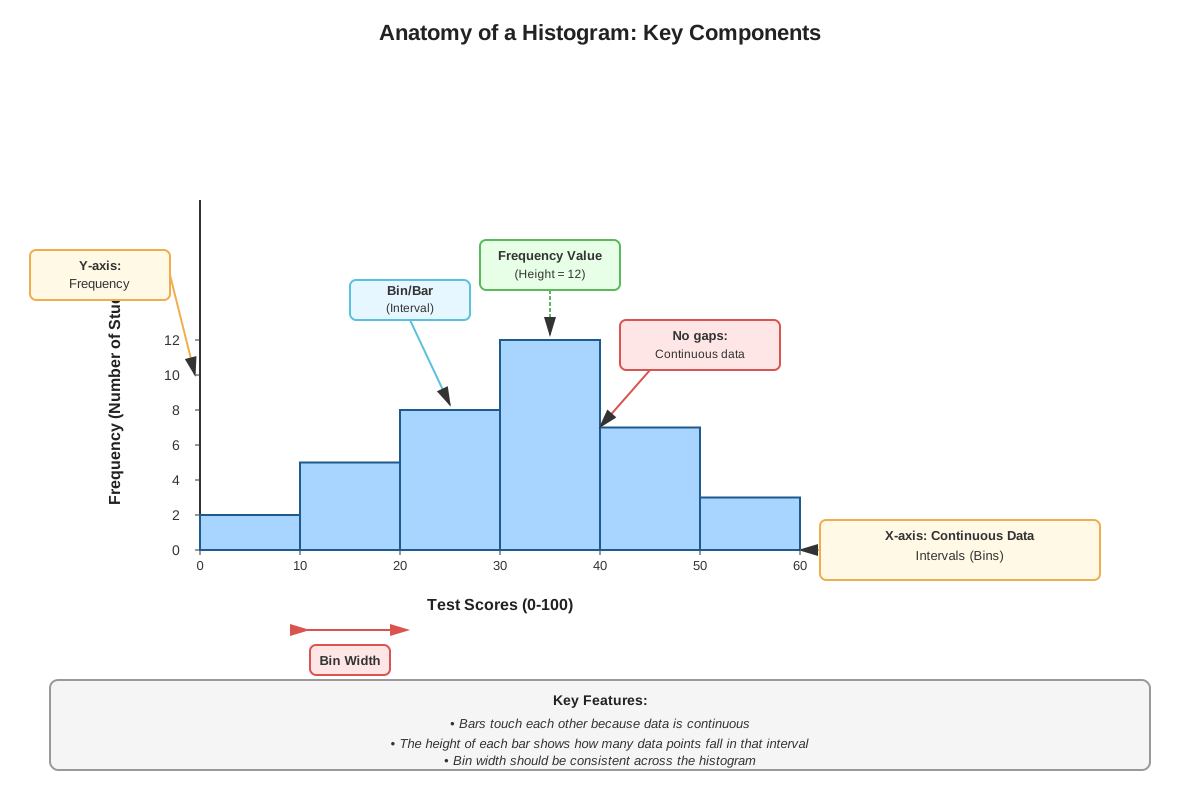
A histogram consists of several essential components that students must identify and interpret correctly. The horizontal axis (x-axis) displays the continuous variable being measured, divided into consecutive intervals called bins or classes. These bins must be equal in width for a standard histogram, though the SAT occasionally presents modified versions. The vertical axis (y-axis) represents frequency—the count of data values falling within each bin. Each bin is represented by a rectangular bar whose height corresponds to its frequency, and critically, the bars touch each other with no gaps, visually emphasizing the continuous nature of the data.
The bin width or class width determines how data is grouped and significantly affects the histogram's appearance. For example, test scores might be grouped in intervals of 10 points (60-69, 70-79, 80-89, etc.) or 20 points (60-79, 80-99, etc.). SAT questions often require students to recognize these intervals and correctly count how many data points fall within specified ranges. Understanding bin boundaries is crucial: a bin labeled "60-70" might include 60 but exclude 70 (written as [60, 70)), or it might include both endpoints [60, 70], depending on the context provided in the question.
Reading and Interpreting Histogram Data
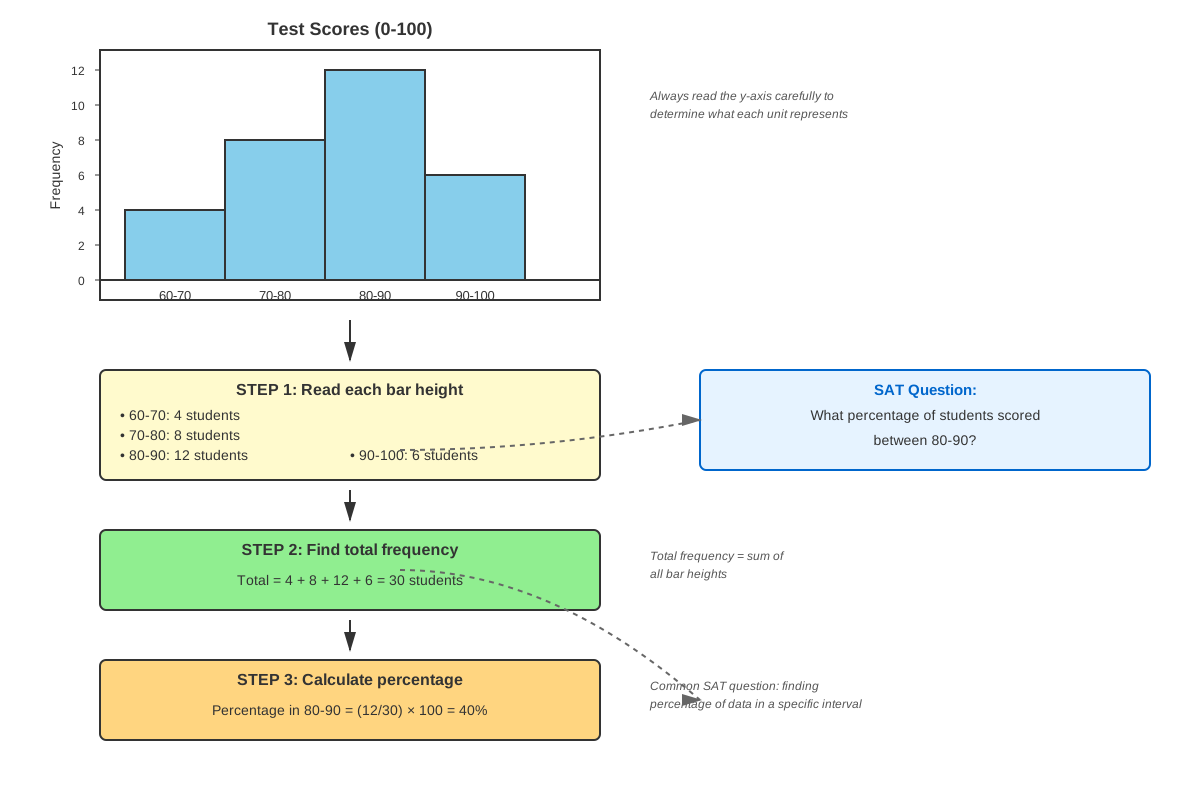
Extracting information from histograms requires systematic analysis. To find the total number of data points, students must add the frequencies (heights) of all bars. This total becomes the denominator when calculating percentages or probabilities. To determine how many data points fall within a specific range, students identify all relevant bins and sum their frequencies. For example, if asked "How many values are greater than 50?" students must add the frequencies of all bins representing values above 50.
Percentage calculations from histograms follow a consistent formula: (frequency of interest / total frequency) × 100%. If 15 out of 60 total data points fall in a particular interval, that interval represents 25% of the data. SAT questions frequently ask students to identify which interval contains a specific percentage of the data or to calculate what percentage falls above or below a certain threshold. These calculations test proportional reasoning and the ability to work flexibly between counts and percentages.
Statistical Measures from Histograms
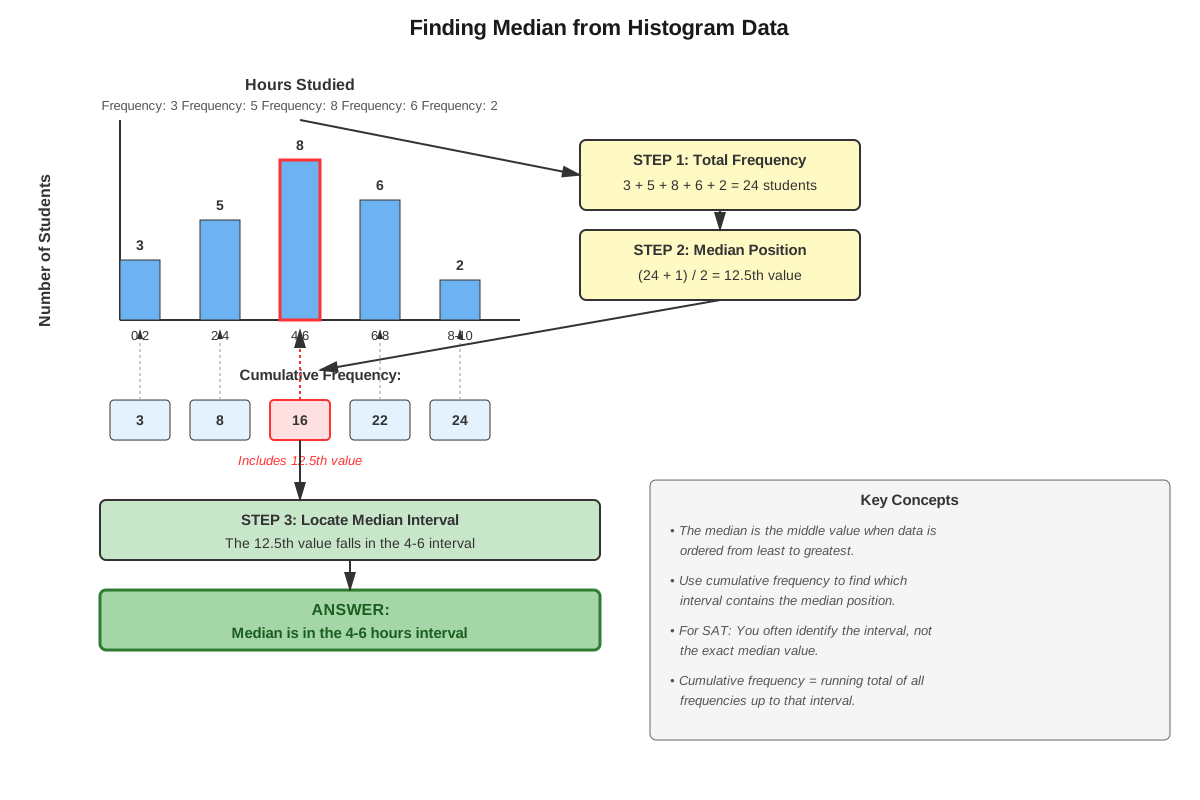
Estimating the median from a histogram requires finding the middle value when data is arranged in order. With n total data points, the median is the value at position (n+1)/2 for odd n, or the average of positions n/2 and (n/2)+1 for even n. Students must accumulate frequencies from left to right until reaching the middle position, then identify which bin contains that position. For example, with 50 total data points, the median lies at position 25.5, so students find which bin contains the 25th and 26th values.
The mean cannot be calculated exactly from a histogram without knowing individual data values, but it can be estimated by assuming all values in each bin equal the bin's midpoint. The estimated mean equals Σ(midpoint × frequency) / total frequency. While SAT questions rarely require this calculation explicitly, understanding that the mean is influenced by the distribution's shape helps answer conceptual questions about whether the mean is greater than, less than, or equal to the median.
The mode or modal class is the bin with the highest frequency—the tallest bar on the histogram. The range can be estimated as the difference between the upper boundary of the highest bin containing data and the lower boundary of the lowest bin containing data. These measures help describe the distribution's center and spread.
Distribution Shapes and Patterns
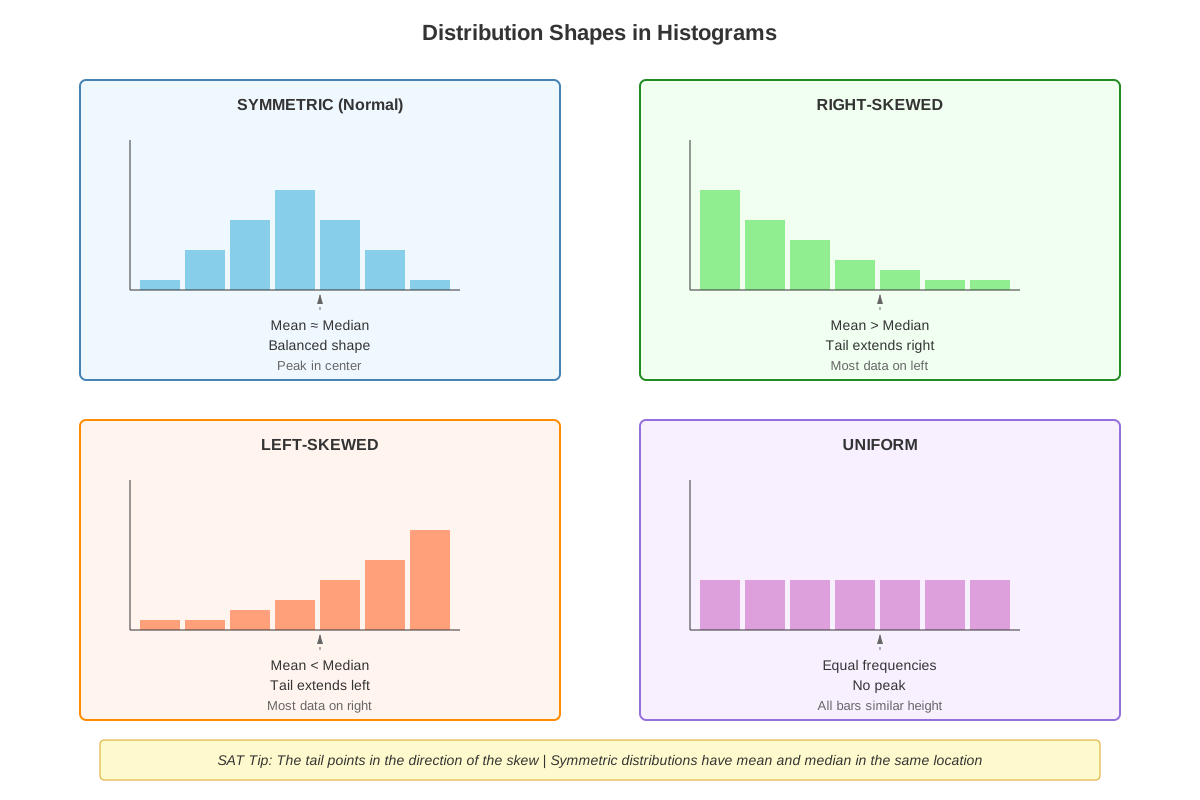
Histograms reveal the shape of the distribution, which provides insights into the data's characteristics. A symmetric distribution has bars that mirror each other around a central peak, with the left and right sides appearing roughly identical. In symmetric distributions, the mean and median are approximately equal. A skewed distribution has a longer tail on one side. Right-skewed (positively skewed) distributions have a long tail extending toward higher values, with most data concentrated on the left; in these distributions, the mean exceeds the median. Left-skewed (negatively skewed) distributions show the opposite pattern, with the tail extending toward lower values and the mean less than the median.
Uniform distributions show approximately equal frequencies across all bins, appearing as bars of similar height. Bimodal distributions display two distinct peaks, suggesting the data may represent two different groups or populations. Recognizing these patterns helps students make inferences about the underlying data and answer questions about central tendency without explicit calculation.
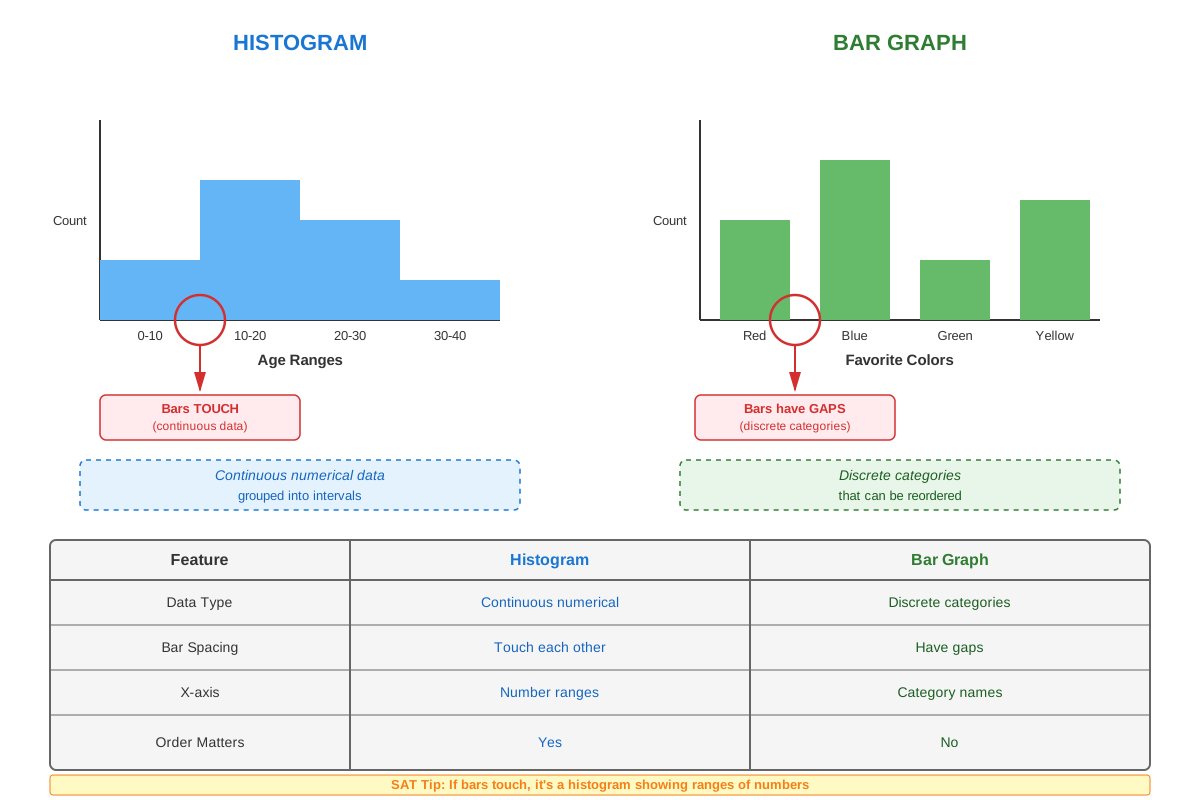
Histograms vs. Other Data Displays
Understanding what makes histograms unique helps avoid confusion with similar visualizations:
| Feature | Histogram | Bar Graph | Dot Plot |
|---|---|---|---|
| Data Type | Continuous numerical | Categorical or discrete | Discrete numerical |
| Bar Spacing | No gaps (bars touch) | Gaps between bars | Individual dots |
| X-axis | Intervals/ranges | Distinct categories | Specific values |
| Purpose | Show distribution shape | Compare categories | Show individual values |
| Frequency | Bar height | Bar height | Number of dots |
The SAT may present questions asking students to identify which type of display is most appropriate for given data or to recognize that a particular graph is a histogram rather than a standard bar graph.
Concept Relationships
The concepts within histogram analysis form an interconnected web of understanding. Bin structure → determines how → frequency is counted → which enables → percentage and probability calculations. Understanding total frequency → is essential for → calculating statistical measures like the median position. Distribution shape → influences → relationships between mean and median → which helps → make inferences about data characteristics.
Histograms connect to prerequisite knowledge through several pathways. Basic bar graph skills → extend to → histogram interpretation by adding the concept of continuous data and touching bars. Frequency understanding → deepens into → frequency distribution analysis when data is grouped into intervals. Number line comprehension → evolves into → interval and range interpretation on the histogram's horizontal axis.
Looking forward, histogram mastery enables progression to more advanced statistical concepts. Histogram interpretation → provides foundation for → understanding normal distributions and standard deviation. Frequency analysis → connects to → probability calculations when selecting random data points. Distribution shape recognition → relates to → box plot interpretation and understanding quartiles. Statistical measure estimation → builds toward → hypothesis testing and data inference in advanced mathematics.
Quick check — test yourself on Histograms so far.
Try Flashcards →High-Yield Facts
⭐ Histograms display continuous data with touching bars, while bar graphs show categorical data with separated bars
⭐ To find the total number of data points, add the frequencies (heights) of all bars
⭐ The median is located at position (n+1)/2 when n data points are arranged in order; find which bin contains this position
⭐ Percentage of data in an interval = (frequency of that interval / total frequency) × 100%
⭐ The modal class is the bin with the highest frequency (tallest bar)
- In a right-skewed distribution, the mean is greater than the median; in a left-skewed distribution, the mean is less than the median
- Bin boundaries must be carefully interpreted—check whether endpoints are included or excluded
- The range can be estimated as the difference between the highest and lowest bin boundaries containing data
- When calculating "how many values are greater than X," include all bins representing values above X
- Probability of randomly selecting a value from a specific interval = frequency of that interval / total frequency
Common Misconceptions
Misconception: Histograms and bar graphs are the same thing and can be used interchangeably.
Correction: Histograms specifically display continuous numerical data with touching bars representing intervals, while bar graphs display categorical or discrete data with separated bars. The touching bars in histograms emphasize the continuous nature of the variable being measured.
Misconception: The width of histogram bars doesn't matter; only the height represents data.
Correction: While height represents frequency in standard histograms, the width represents the interval size. When bins have different widths (rare on the SAT but possible), the area of the bar, not just height, represents frequency. Always check that bins are equal width before interpreting height alone as frequency.
Misconception: The median is always located in the tallest bar of the histogram.
Correction: The median is the middle value when data is ordered, which depends on cumulative frequency, not the mode (tallest bar). The median could be in any bin depending on how the data is distributed. Students must count from the left until reaching the middle position.
Misconception: You can calculate the exact mean from a histogram.
Correction: Without knowing individual data values, only an estimated mean can be calculated by assuming all values in each bin equal the bin's midpoint. The actual mean could differ from this estimate depending on how values are distributed within each bin.
Misconception: If a bin is labeled "60-70," it always includes both 60 and 70.
Correction: Bin boundaries follow conventions that must be determined from context. The interval might be [60, 70) including 60 but excluding 70, or [60, 70] including both. SAT questions typically clarify this through labels or context, but students must read carefully to avoid counting errors.
Worked Examples
Example 1: Multi-Step Frequency and Percentage Analysis
Question: The histogram below shows the distribution of test scores for 80 students. Each bar represents a 10-point interval.
Frequency
    |
 20 |     ████
    |     ████
 15 |     ████ ████
    |     ████ ████
 10 | ████ ████ ████ ████
    | ████ ████ ████ ████
  5 | ████ ████ ████ ████ ████
    | ████ ████ ████ ████ ████
  0 |_________________________
      60-69 70-79 80-89 90-99 100
           Test Scores
Frequencies: 60-69 (10 students), 70-79 (20 students), 80-89 (25 students), 90-99 (20 students), 100 (5 students)
(a) How many students scored 80 or above?
(b) What percentage of students scored below 80?
(c) In which interval does the median score fall?
Solution:
(a) Students scoring 80 or above fall in the bins: 80-89, 90-99, and 100.
- Frequency for 80-89: 25 students
- Frequency for 90-99: 20 students
- Frequency for 100: 5 students
- Total: 25 + 20 + 5 = 50 students
(b) Students scoring below 80 fall in bins: 60-69 and 70-79.
- Frequency for 60-69: 10 students
- Frequency for 70-79: 20 students
- Total below 80: 10 + 20 = 30 students
- Percentage: (30/80) × 100% = 37.5%
Alternative approach: Since 50 students scored 80 or above (from part a), 80 - 50 = 30 scored below 80, giving the same answer.
(c) With 80 total students, the median is the average of the 40th and 41st values when arranged in order.
- Cumulative frequency through 60-69: 10 students (positions 1-10)
- Cumulative frequency through 70-79: 10 + 20 = 30 students (positions 1-30)
- Cumulative frequency through 80-89: 30 + 25 = 55 students (positions 1-55)
Since positions 40 and 41 both fall within the cumulative range of 1-55, and specifically fall after position 30 but before position 55, the median falls in the 80-89 interval.
Example 2: Probability and Comparative Analysis
Question: A researcher recorded the ages of 60 participants in a study. The histogram shows the age distribution.
Frequency
    |
 18 |         ████
    |         ████
 12 |     ████ ████
    |     ████ ████
  6 | ████ ████ ████ ████
    | ████ ████ ████ ████
  0 |_____________________
      20-29 30-39 40-49 50-59
              Age
Frequencies: 20-29 (8 participants), 30-39 (15 participants), 40-49 (22 participants), 50-59 (15 participants)
(a) If one participant is selected at random, what is the probability they are under 40 years old?
(b) How many more participants are in the 40-49 age group than in the 20-29 age group?
Solution:
(a) Participants under 40 fall in the 20-29 and 30-39 age groups.
- Frequency for 20-29: 8 participants
- Frequency for 30-39: 15 participants
- Total under 40: 8 + 15 = 23 participants
- Total participants: 60
- Probability = 23/60
The probability can be left as a fraction or converted: 23/60 (or approximately 0.383 or 38.3%)
(b) Compare the frequencies directly:
- Frequency for 40-49: 22 participants
- Frequency for 20-29: 8 participants
- Difference: 22 - 8 = 14 more participants
This example demonstrates how histogram questions often combine multiple skills: reading frequencies, performing arithmetic operations, and applying probability concepts. The key is systematic analysis—identify relevant bins, extract frequencies, then perform the required calculation.
Exam Strategy
When approaching SAT histograms questions, begin by investing 10-15 seconds in orientation: identify what the axes represent, determine the bin width, and quickly calculate the total frequency by adding all bar heights. This total is crucial for percentage and probability calculations, so write it down immediately. Many students lose points by rushing past this step and having to recalculate multiple times.
Trigger words signal specific approaches. "How many" questions require direct frequency reading or addition of multiple bins. "What percentage" or "what fraction" questions need the formula (part/whole) × 100%. "Probability" questions use the same part/whole ratio but typically want a fraction or decimal answer. "Median" questions require finding the middle position and accumulating frequencies from left to right. "Greater than" or "less than" language demands careful attention to which bins to include—sketch a quick mark on the histogram to avoid errors.
For process of elimination, incorrect answer choices often result from predictable errors: counting only one bin when multiple should be included, using the wrong total, confusing median with mode, or misreading bin boundaries. If a calculation seems too simple, double-check that all relevant bins were included. If an answer choice equals the frequency of the tallest bar and the question asks for the median, that's likely a trap answer confusing median with mode.
Time allocation for histogram questions should be approximately 45-90 seconds depending on complexity. Simple frequency-reading questions deserve 30-45 seconds, while multi-step problems combining percentages and comparisons may require up to 90 seconds. If a question requires more than two minutes, mark it for review and move on—histogram questions rarely justify extended time investment compared to their point value. Practice identifying the question type within the first 10 seconds to gauge appropriate time commitment.
Memory Techniques
HISTOGRAM acronym for key features:
- Horizontal axis shows intervals
- Intervals must be consecutive
- Shape reveals distribution pattern
- Touching bars (no gaps)
- Order data to find median
- Greatest bar shows mode
- Range from lowest to highest bin
- Add all frequencies for total
- Mean influenced by skew
"CATS" for distinguishing histograms from bar graphs:
- Continuous data → histogram
- Adjacent bars (touching) → histogram
- Types/categories → bar graph
- Separated bars → bar graph
Median position memory trick: "Half plus one, then you're done" — for n data points, position (n+1)/2 or simply n/2 for even n, then count bins from left until reaching that position.
Skew direction visualization: "The tail tells the tale" — the direction of the longer tail indicates the skew direction. Imagine the tail as an arrow pointing right (right-skewed) or left (left-skewed). In right-skewed distributions, the mean gets "pulled" toward the tail, making it greater than the median.
Percentage formula: "Part over Party" — the part you're interested in goes over the total (the whole party of data points), then multiply by 100%.
Summary
Histograms are essential data visualization tools that display frequency distributions of continuous numerical data through touching rectangular bars. Mastering histograms for the SAT requires understanding their structural components (bins, frequency axes, intervals), extracting information through systematic frequency counting, calculating percentages and probabilities using part-to-whole ratios, and estimating statistical measures like median and mode. The median is found by identifying which bin contains the middle position when data is ordered, while the mode corresponds to the tallest bar. Distribution shape—whether symmetric, right-skewed, or left-skewed—reveals relationships between mean and median and provides insights into data characteristics. Success on SAT histogram questions demands careful attention to bin boundaries, accurate frequency summation, and recognition of trigger words that signal specific calculation approaches. Students must distinguish histograms from bar graphs by recognizing that histograms display continuous data with touching bars, while bar graphs show categorical data with separated bars. With consistent practice in reading frequencies, calculating percentages, and interpreting distribution patterns, students can confidently tackle the 3-5% of SAT math questions involving histograms.
Key Takeaways
- Histograms display continuous data with touching bars representing frequency within consecutive intervals; always add all bar heights to find the total number of data points
- To find the median, calculate position (n+1)/2, then accumulate frequencies from left to right until reaching that position to identify the containing bin
- Percentage calculations follow the formula (frequency of interest / total frequency) × 100%; this same ratio gives probability for random selection questions
- The modal class is simply the tallest bar, while the range spans from the lowest to highest bin containing data
- Distribution shape matters: in right-skewed distributions mean > median; in left-skewed distributions mean < median; in symmetric distributions mean ≈ median
- Carefully distinguish "greater than X" (include all bins above X) from "at least X" (include X's bin and all above) to avoid counting errors
- Histograms differ from bar graphs through touching bars and continuous data representation—this distinction appears frequently in SAT questions
Related Topics
Box Plots and Quartiles: After mastering histograms, students should explore box plots, which display the five-number summary (minimum, Q1, median, Q3, maximum) and provide complementary insights into data distribution. Box plots emphasize quartiles and outliers while histograms emphasize frequency distribution shape.
Dot Plots and Frequency Tables: These alternative data representations share histogram concepts but display information differently. Dot plots show individual data points, making them ideal for smaller datasets, while frequency tables present the same information as histograms in tabular format.
Measures of Center and Spread: Deep understanding of mean, median, mode, range, and standard deviation builds directly on histogram interpretation skills. These statistical measures quantify what histograms display visually.
Probability and Counting: Histogram questions frequently incorporate probability calculations, making this a natural progression. Understanding sample spaces and probability rules enhances the ability to answer complex histogram-based probability questions.
Normal Distribution and Standard Deviation: Advanced statistics courses introduce the bell curve and standard deviation, concepts that build directly on histogram shape recognition and distribution analysis skills developed here.
Practice CTA
Now that you've mastered the core concepts of histogram interpretation, it's time to solidify your understanding through active practice. Complete the practice questions to test your ability to read frequencies, calculate percentages, identify medians, and analyze distribution shapes under timed conditions. Use the flashcards to reinforce key definitions and formulas until they become automatic. Remember, histogram questions represent high-yield content on the SAT—investing 20-30 minutes in focused practice now can directly translate to correct answers and higher scores on test day. Approach each practice problem systematically, applying the strategies and techniques covered in this guide. You've built the foundation; now strengthen it through deliberate practice!
Sign up free to keep reading
Create a free AnvayaPrep account to finish this SAT guide on Histograms — plus flashcards and practice questions.