Overview
Data inference is a critical skill tested extensively on the SAT math section, requiring students to draw logical conclusions from presented data sets, graphs, tables, and statistical information. This topic goes beyond simple data reading; it demands that test-takers analyze patterns, make predictions, and evaluate the validity of claims based on quantitative evidence. On the SAT, sat data inference questions assess whether students can interpret real-world scenarios through a mathematical lens, distinguishing between what data actually shows versus what it might suggest or fail to support.
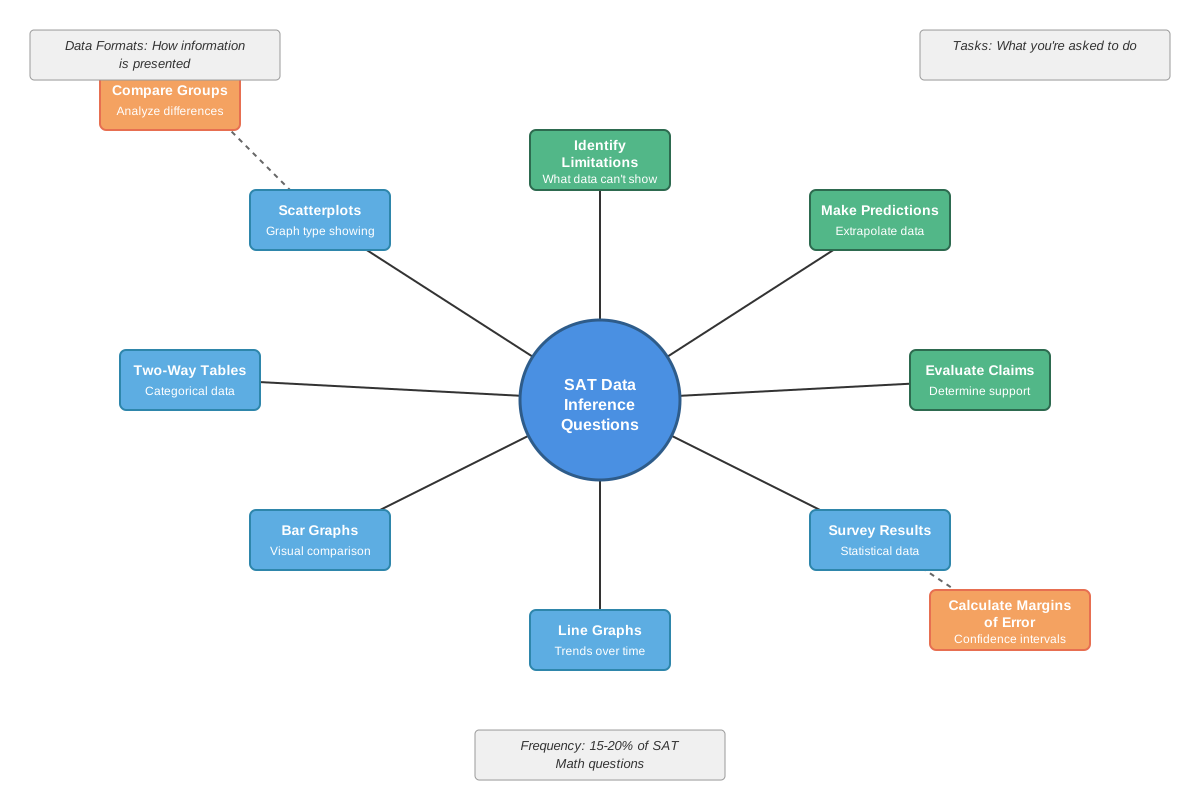
Mastering data inference is essential for SAT success because these questions appear consistently across multiple question types and difficulty levels. Students encounter data inference in contexts ranging from scatterplots and line graphs to two-way tables and survey results. The College Board emphasizes this skill because it reflects authentic reasoning abilities needed in college coursework and professional settings—the capacity to evaluate evidence, recognize limitations in data, and make sound judgments based on quantitative information.
Data inference connects fundamentally to broader mathematical concepts including statistics, probability, functions, and algebraic reasoning. It serves as the practical application layer where students demonstrate understanding of measures of central tendency, data distributions, correlation versus causation, and sampling principles. Strong data inference skills enable students to tackle complex multi-step problems that integrate multiple mathematical domains, making this topic a cornerstone of comprehensive SAT math preparation.
Learning Objectives
- [ ] Identify key features of data inference including valid conclusions, overgeneralizations, and data limitations
- [ ] Explain how data inference appears on the SAT across various question formats and data representations
- [ ] Apply data inference to answer SAT-style questions involving graphs, tables, and statistical claims
- [ ] Distinguish between correlation and causation in data presentations
- [ ] Evaluate whether specific conclusions are supported or contradicted by given data sets
- [ ] Recognize sampling bias and population limitations that affect inference validity
- [ ] Calculate and interpret margins of error and confidence intervals in survey contexts
Prerequisites
- Basic statistics concepts: Understanding mean, median, mode, and range provides the foundation for interpreting data summaries and distributions
- Graph reading skills: Ability to extract information from bar graphs, line graphs, scatterplots, and pie charts is essential for analyzing visual data representations
- Percentage calculations: Converting between fractions, decimals, and percentages enables accurate interpretation of proportional relationships in data
- Algebraic reasoning: Solving equations and working with variables supports understanding of trends and predictive models
- Ratio and proportion: Comparing quantities and scaling data requires facility with proportional relationships
Why This Topic Matters
Data inference skills extend far beyond standardized testing into virtually every academic discipline and professional field. Scientists evaluate experimental results, economists analyze market trends, healthcare professionals interpret clinical trial data, and informed citizens assess claims in news media—all requiring the ability to draw appropriate conclusions from quantitative evidence. The SAT emphasizes data inference because colleges seek students who can think critically about information rather than passively accepting claims at face value.
On the SAT math section, data inference questions appear with remarkable frequency, comprising approximately 15-20% of all math questions. These problems span both the calculator and no-calculator portions, appearing as multiple-choice questions, student-produced responses, and extended thinking problems worth multiple points. The College Board consistently includes 5-8 data inference questions per test, making this one of the highest-yield topics for focused preparation.
Common SAT presentations include scatterplots with trend lines requiring students to evaluate predictions, two-way tables testing conditional probability understanding, survey results with margin of error considerations, and comparative data displays asking students to identify valid versus invalid conclusions. Questions often embed data inference within real-world contexts like scientific studies, business scenarios, social science research, or everyday situations, requiring students to navigate both mathematical reasoning and contextual interpretation simultaneously.
Core Concepts
Understanding Valid Inferences
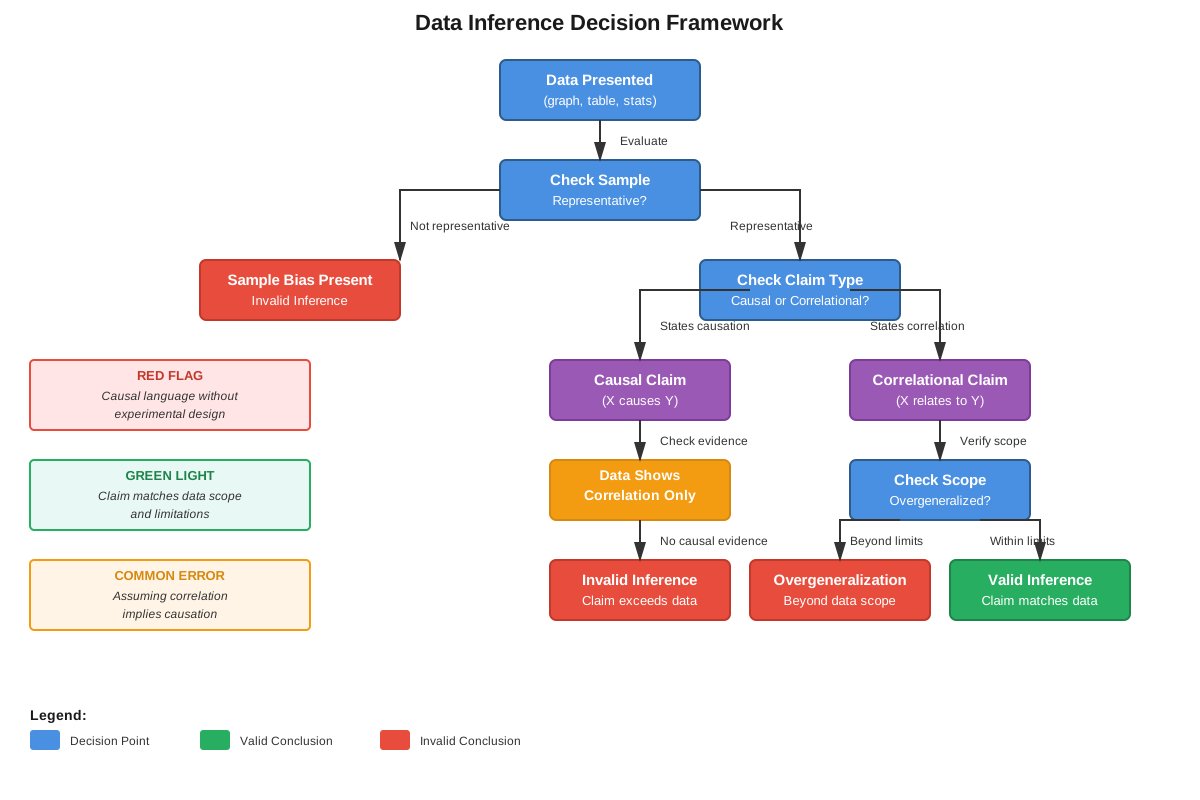
A valid inference is a conclusion that logically follows from the data presented without extending beyond what the evidence actually supports. On the SAT, distinguishing valid from invalid inferences requires careful attention to the scope, limitations, and specific characteristics of the data set. Valid inferences remain within the boundaries of the measured population, time frame, and variables actually studied.
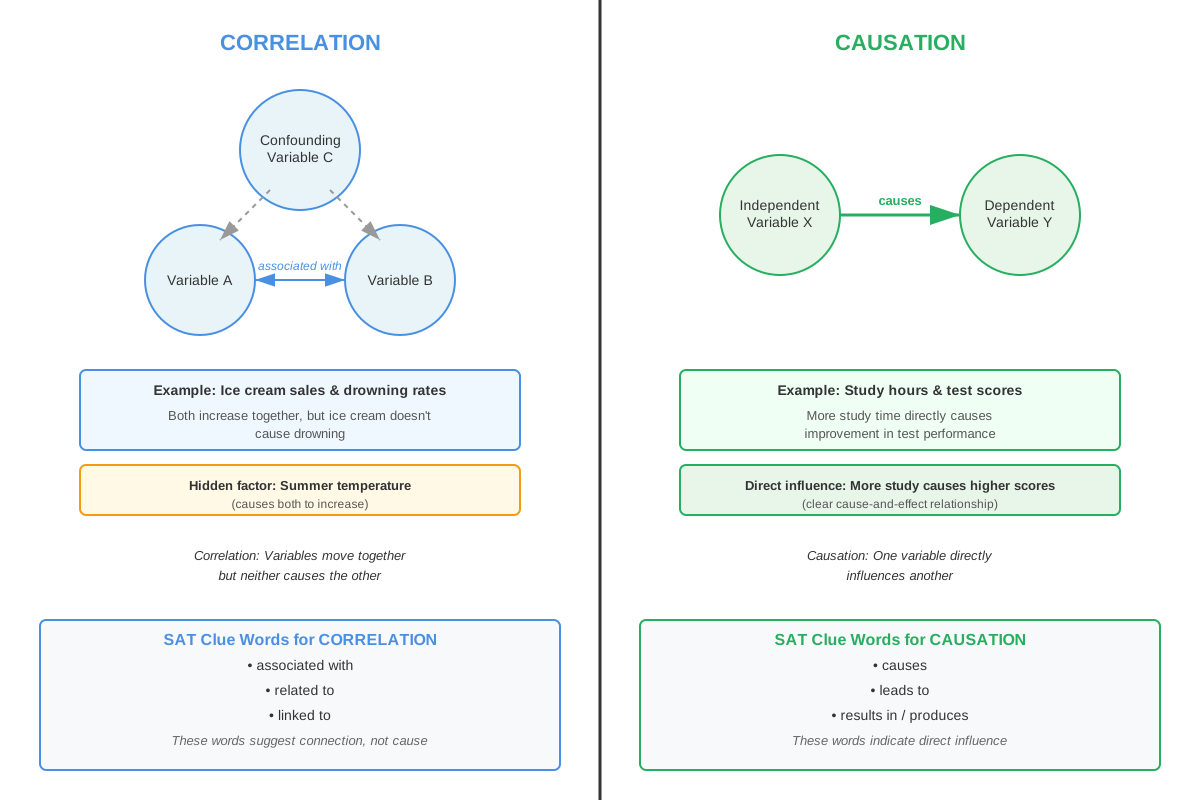
When evaluating potential inferences, students must ask: Does this conclusion directly follow from the data shown? Are there alternative explanations? Does the sample represent the population being discussed? For example, if data shows that students who ate breakfast scored higher on a test, a valid inference might be "students who ate breakfast had higher average scores than those who didn't" while an invalid inference would be "eating breakfast causes higher test scores" (confusing correlation with causation).
Data Representation Types
The SAT presents data through multiple formats, each requiring specific interpretation skills:
| Representation Type | Key Features | Common Inference Tasks |
|---|---|---|
| Scatterplots | Show relationship between two variables; may include trend lines | Evaluate predictions, assess correlation strength, identify outliers |
| Two-way tables | Display categorical data across two dimensions | Calculate conditional probabilities, compare subgroups |
| Bar graphs | Compare discrete categories | Identify greatest/least values, calculate differences |
| Line graphs | Show change over time | Analyze trends, predict future values, identify rates of change |
| Box plots | Display distribution through quartiles | Compare spreads, identify medians, assess symmetry |
Correlation vs. Causation
One of the most frequently tested concepts in sat data inference is the critical distinction between correlation (two variables changing together) and causation (one variable directly causing changes in another). The SAT regularly presents scenarios where variables are correlated and asks students to identify which conclusions are justified.
A positive correlation means variables increase together; a negative correlation means one increases as the other decreases. However, correlation alone never proves causation. Three possibilities explain correlation: Variable A causes Variable B, Variable B causes Variable A, or a third variable causes both. For example, ice cream sales and drowning deaths are correlated (both increase in summer), but neither causes the other—temperature is the confounding variable.
Sampling and Population Considerations
Sampling refers to selecting a subset of a population to study, while the population is the entire group about which conclusions are desired. Valid inferences require that samples adequately represent their populations. The SAT tests understanding of when generalizations are appropriate based on sampling methods.
A random sample gives every population member equal selection probability, supporting valid generalizations. A biased sample systematically excludes or overrepresents certain groups, limiting inference validity. For instance, surveying only students in the library about study habits creates selection bias—library users likely study more than average students. Conclusions from this sample cannot validly extend to all students.
Sample size also affects inference reliability. Larger samples generally provide more reliable estimates of population characteristics, though random selection matters more than size alone. The SAT may present scenarios where students must recognize that small or biased samples cannot support broad claims.
Margin of Error and Confidence
The margin of error quantifies uncertainty in sample-based estimates, typically expressed as "plus or minus" a certain amount. If a survey reports 60% support with a ±3% margin of error, the true population value likely falls between 57% and 63%. The SAT tests whether students can apply margins of error to evaluate claims.
Understanding margin of error requires recognizing that sample statistics are estimates, not exact population values. When comparing two groups, their confidence intervals (estimate ± margin of error) must not overlap for differences to be considered statistically meaningful. If Group A shows 52% ± 4% and Group B shows 48% ± 4%, the ranges overlap (48-56% vs. 44-52%), so no definitive difference can be claimed.
Extrapolation and Interpolation
Interpolation involves estimating values within the range of observed data, while extrapolation extends predictions beyond observed ranges. Interpolation is generally more reliable because it stays within established patterns. The SAT frequently tests whether students recognize the increased uncertainty in extrapolation.
For example, if data shows a linear relationship between study hours and test scores for 1-5 hours of study, interpolating the score for 3 hours is reasonable. However, extrapolating to predict the score for 20 hours of study assumes the pattern continues indefinitely—an assumption that may not hold. Real relationships often change outside observed ranges due to limiting factors, diminishing returns, or threshold effects.
Outliers and Their Impact
Outliers are data points that differ dramatically from other observations. On the SAT, students must recognize how outliers affect statistical measures and whether they should influence inferences. Outliers may result from measurement errors, exceptional cases, or natural variation.
Outliers strongly affect means but minimally impact medians, making median a more robust measure of central tendency for skewed distributions. When evaluating trends or relationships, students should consider whether outliers represent meaningful information or anomalies. A scatterplot showing strong linear correlation except for one distant point raises questions about whether that point should inform predictions.
Concept Relationships
Data inference integrates multiple statistical and mathematical concepts into a cohesive analytical framework. At the foundation, basic statistics (mean, median, mode, range) provide the descriptive tools for summarizing data sets, which then enable pattern recognition in how variables relate. This pattern recognition leads to correlation analysis, where students identify relationships between variables while carefully avoiding the trap of assuming causation without additional evidence.
The relationship flows: Data Collection → Data Representation → Descriptive Statistics → Pattern Analysis → Inference Generation → Validity Evaluation. Each step builds on previous ones, with validity evaluation requiring consideration of sampling methods, sample size, and potential biases that might limit generalizability.
Margin of error concepts connect to probability and confidence levels, reflecting the inherent uncertainty in sample-based estimates. These uncertainty measures then inform comparative analysis, where students must determine whether observed differences exceed random variation. Meanwhile, interpolation and extrapolation connect to function behavior and algebraic modeling, as predictions rely on assumed relationships continuing beyond observed data.
The distinction between correlation and causation serves as a critical checkpoint throughout the inference process, preventing overgeneralization. This connects to experimental design principles, where controlled studies can support causal claims while observational studies typically cannot. Understanding these interconnections enables students to approach complex, multi-layered SAT questions that test multiple concepts simultaneously.
High-Yield Facts
⭐ Correlation does not imply causation—two variables can be associated without one causing the other; always consider confounding variables
⭐ Valid inferences must stay within the scope of the data—conclusions cannot extend beyond the measured population, time frame, or variables
⭐ Random sampling is essential for generalizing to populations—biased or convenience samples cannot support broad claims
⭐ Margin of error creates a range of plausible values—point estimates alone don't capture uncertainty in sample-based conclusions
⭐ Extrapolation is less reliable than interpolation—predictions outside the observed data range assume patterns continue without evidence
- Outliers significantly affect means but have minimal impact on medians
- Sample size affects precision—larger random samples generally provide more reliable population estimates
- Overlapping confidence intervals indicate no statistically meaningful difference between groups
- Scatterplot trend lines represent average relationships—individual predictions may vary substantially
- Two-way tables enable calculation of conditional probabilities by focusing on specific subgroups
- The strength of correlation (weak, moderate, strong) affects prediction reliability
- Survey question wording and response options can introduce bias affecting inference validity
- Time-series data showing correlation doesn't establish which variable influences the other
- Percentage changes require knowing base values—a 50% increase from different starting points yields different final values
- Statistical significance differs from practical significance—small differences may be statistically real but practically unimportant
Quick check — test yourself on Data inference so far.
Try Flashcards →Common Misconceptions
Misconception: If two variables are correlated, one must cause the other → Correction: Correlation indicates association but not causation; a third variable may cause both, or the relationship may be coincidental. Always consider alternative explanations before inferring causation.
Misconception: Larger samples always produce more accurate results than smaller samples → Correction: Sample quality (randomness, lack of bias) matters more than size alone. A small random sample beats a large biased sample for valid inference. However, among random samples, larger ones do provide greater precision.
Misconception: Data showing a trend will continue indefinitely in the same pattern → Correction: Extrapolation assumes patterns persist outside observed ranges, but real-world relationships often change due to limiting factors, saturation effects, or threshold phenomena. Predictions become less reliable as they extend further from observed data.
Misconception: If a study shows no difference between groups, the groups are definitely identical → Correction: Failure to detect a difference may result from insufficient sample size, high variability, or measurement limitations rather than true equivalence. "No evidence of difference" differs from "evidence of no difference."
Misconception: The margin of error applies only to the reported percentage, not to comparisons → Correction: When comparing two groups, both margins of error matter. Confidence intervals must not overlap for differences to be considered statistically meaningful. A 3% margin of error means ±3% for each estimate.
Misconception: Outliers should always be removed from data analysis → Correction: Outliers may represent important information (exceptional cases, emerging trends) or errors. Their treatment depends on context—understanding why they occurred matters more than automatic removal.
Misconception: A scatterplot trend line guarantees accurate predictions for any x-value → Correction: Trend lines show average relationships with inherent variability. Individual predictions may differ substantially from the line, and reliability decreases outside the observed data range.
Worked Examples
Example 1: Evaluating Survey Inferences
Problem: A researcher surveys 200 randomly selected high school students about their sleep habits and finds that students who sleep 8+ hours per night have an average GPA of 3.4, while those sleeping fewer than 8 hours average 3.0. The margin of error is ±0.2 for both groups. Which conclusion is valid?
A) Sleeping 8+ hours causes higher GPAs
B) Students sleeping 8+ hours have statistically higher average GPAs than those sleeping less
C) All students who sleep 8+ hours have GPAs above 3.0
D) These results apply to all teenagers nationwide
Solution Process:
Step 1: Evaluate causation claim (Option A). The study shows correlation between sleep and GPA but doesn't establish causation. Other factors (study habits, course difficulty, stress levels) might explain both sleep patterns and grades. This is a correlation-causation confusion—invalid.
Step 2: Assess statistical comparison (Option B). Group 1: 3.4 ± 0.2 (range 3.2-3.6). Group 2: 3.0 ± 0.2 (range 2.8-3.2). The confidence intervals don't overlap, indicating a statistically meaningful difference. The conclusion stays within data scope—valid.
Step 3: Check absolute claim (Option C). The 3.4 average means some students scored above and some below. Averages don't guarantee individual values. This overgeneralizes—invalid.
Step 4: Examine population generalization (Option D). The sample includes only high school students, not all teenagers. Valid inference extends only to similar high school populations, not broader groups—invalid.
Answer: B
Key Takeaway: This problem tests multiple inference concepts: correlation vs. causation, margin of error application, understanding averages, and sampling limitations. Valid inferences must stay within data boundaries while avoiding causal claims from observational studies.
Example 2: Scatterplot Prediction Reliability
Problem: A scatterplot shows the relationship between hours spent on social media (x-axis, 0-6 hours) and homework completion percentage (y-axis) for 50 students. The data shows a negative linear correlation with r = -0.75. A trend line equation is y = -8x + 95. Which statement about predictions is most accurate?
A) A student spending 10 hours on social media will complete 15% of homework
B) Social media use causes decreased homework completion
C) For students within the 0-6 hour range, the model predicts approximately 8% less homework completion per additional social media hour
D) The model perfectly predicts homework completion for any student
Solution Process:
Step 1: Analyze Option A (extrapolation). The observed data ranges from 0-6 hours, but this predicts for 10 hours. Using the equation: y = -8(10) + 95 = 15%. While mathematically correct, this is extrapolation beyond observed data, making it unreliable. The pattern may not continue—students can't complete negative homework percentages, suggesting the linear model breaks down at extremes. Questionable validity.
Step 2: Evaluate Option B (causation). The scatterplot shows correlation (r = -0.75 indicates strong negative association) but cannot establish causation. Perhaps students with less homework spend more time on social media, or other factors affect both variables. Invalid inference.
Step 3: Assess Option C (interpolation and interpretation). The slope of -8 means each additional hour associates with 8% less completion, on average. This stays within the observed 0-6 hour range (interpolation) and correctly interprets the slope while acknowledging it's an approximation ("approximately"). Valid inference.
Step 4: Check Option D (prediction certainty). The correlation of r = -0.75 is strong but not perfect (r = 1.0 or -1.0). Individual points scatter around the trend line, so predictions have variability. Invalid—overstates precision.
Answer: C
Key Takeaway: This problem distinguishes between interpolation (reliable) and extrapolation (uncertain), tests correlation-causation understanding, and assesses recognition that statistical models predict averages with inherent variability, not exact individual outcomes.
Exam Strategy
Approaching Data Inference Questions
Begin by carefully reading the question stem to identify exactly what conclusion or inference is being evaluated. SAT data inference questions often present multiple plausible-sounding options where only one stays within the data's actual scope. Before examining answer choices, mentally note the data's boundaries: What population was studied? What time frame? What variables were measured?
Trigger words that signal data inference questions include: "Which conclusion is supported," "Based on the data," "Which statement is justified," "The results suggest," "It can be inferred," "Which claim is valid," and "The data indicates." These phrases signal that you must evaluate logical relationships between evidence and conclusions rather than simply extracting information.
Systematic Elimination Process
For multiple-choice data inference questions, use this elimination sequence:
- Eliminate causation claims from observational data: If the study didn't manipulate variables or use random assignment, cross out any answer suggesting one variable causes another
- Remove overgeneralizations: Eliminate options extending beyond the studied population, time frame, or variable range
- Check for absolute language: Words like "always," "never," "all," "none," or "proves" often signal invalid inferences that ignore variability
- Verify statistical validity: For comparisons, check whether confidence intervals overlap; for predictions, confirm they stay within observed ranges
Time Management
Data inference questions typically require 60-90 seconds each. Spend the first 20-30 seconds thoroughly understanding the data presentation and question requirements. Rushing through data interpretation leads to misreading graphs or tables, causing avoidable errors. The remaining time should focus on systematically evaluating answer choices using the elimination strategy above.
For complex questions involving multiple data representations or multi-step reasoning, budget up to 2 minutes. These extended thinking problems often carry more points, justifying additional time investment. If stuck, mark the question and return after completing easier items—fresh perspective often reveals the correct approach.
Common Trap Patterns
The SAT consistently includes wrong answers that:
- Confuse correlation with causation: Tempting options suggest causal relationships from associational data
- Extrapolate beyond data ranges: Predictions extending far outside observed values seem mathematically correct but lack reliability
- Ignore margins of error: Conclusions claiming definitive differences when confidence intervals actually overlap
- Overgeneralize from limited samples: Broad claims about populations based on small or biased samples
- Misinterpret averages: Statements about all individuals based on group means
Recognizing these patterns enables quick identification and elimination of trap answers, improving both accuracy and speed.
Memory Techniques
SCOPE Acronym for Valid Inferences
Sample: Does the sample represent the population being discussed?
Causation: Does the data support causal claims, or only correlation?
Outliers: Do unusual data points affect the conclusion inappropriately?
Population: Does the inference extend beyond the studied group?
Extrapolation: Does the prediction go beyond observed data ranges?
Before selecting an answer, mentally check each SCOPE element to verify inference validity.
Correlation-Causation Reminder
Visualize the phrase: "Correlation Can't Confirm Causation" (four C's). When you see two variables associated, picture a stop sign reminding you that association alone never proves one causes the other. This mental image prevents the most common data inference error.
Margin of Error Visualization
Picture confidence intervals as overlapping bridges. If two bridges (confidence intervals) overlap, you can walk from one to the other—meaning the groups might not truly differ. If bridges don't touch, there's a gap—a real difference exists. This spatial metaphor helps remember that overlapping intervals mean no definitive difference.
Interpolation vs. Extrapolation
INterpolation = INside the data (reliable)
EXtrapolation = EXtending beyond data (risky)
The prefixes themselves encode the concept: staying inside versus going outside observed ranges.
Sample Quality Hierarchy
Remember: Random Beats Big
(Random sampling beats big sample size)
A small random sample provides more valid inferences than a large biased sample. When evaluating sampling methods, prioritize randomness over size.
Summary
Data inference represents a critical SAT math skill requiring students to draw logical, evidence-based conclusions while recognizing the limitations inherent in data sets. Mastery involves distinguishing valid inferences that stay within data boundaries from invalid overgeneralizations, understanding that correlation does not imply causation, and recognizing how sampling methods affect the legitimacy of population generalizations. The SAT tests these concepts through diverse data representations including scatterplots, two-way tables, bar graphs, and survey results, often embedding questions in real-world contexts. Success requires systematic evaluation of whether conclusions are supported by presented evidence, whether comparisons account for margins of error and confidence intervals, and whether predictions through interpolation or extrapolation are appropriate. Students must recognize common traps including causal claims from observational data, extrapolations beyond observed ranges, and generalizations from biased samples. By applying structured approaches like the SCOPE framework and understanding the relationships between statistical concepts, students can confidently tackle data inference questions that comprise 15-20% of SAT math sections.
Key Takeaways
- Correlation never proves causation—always consider alternative explanations and confounding variables before inferring causal relationships
- Valid inferences must stay within data scope—conclusions cannot extend beyond the measured population, time frame, variables, or observed ranges
- Random sampling enables population generalization—biased or convenience samples cannot support broad claims regardless of size
- Margins of error create confidence intervals—overlapping intervals indicate no statistically meaningful difference between groups
- Interpolation (within data range) is reliable; extrapolation (beyond data range) is uncertain—predictions become less trustworthy as they extend further from observations
- Outliers affect different statistics differently—means are sensitive to extreme values while medians remain robust
- Sample quality trumps sample size—a small random sample beats a large biased sample for inference validity
Related Topics
Descriptive Statistics: Understanding measures of central tendency (mean, median, mode) and spread (range, standard deviation) provides the foundation for summarizing data sets before making inferences. Mastering data inference enables deeper analysis of what these statistics reveal about populations.
Probability and Expected Value: Data inference connects to probability through concepts like confidence levels and the likelihood that sample statistics reflect population parameters. Strong inference skills support understanding of probabilistic reasoning in uncertain situations.
Linear Regression and Modeling: Scatterplot analysis and trend line interpretation in data inference directly lead to more sophisticated regression analysis, where students quantify relationships between variables and assess model fit quality.
Experimental Design: Understanding how studies are structured—random assignment, control groups, blinding—explains why some data supports causal inferences while other data shows only correlation. This topic deepens appreciation for inference limitations.
Hypothesis Testing: Advanced statistical inference involves formal hypothesis testing with p-values and significance levels. The conceptual foundation built through SAT data inference prepares students for these college-level statistical methods.
Practice CTA
Now that you've mastered the core concepts of data inference, it's time to cement your understanding through active practice. Work through the practice questions to apply these principles to authentic SAT-style problems, testing your ability to distinguish valid from invalid inferences, recognize correlation-causation confusion, and evaluate claims based on data evidence. Use the flashcards to reinforce high-yield facts and common trap patterns, ensuring rapid recognition during timed test conditions. Remember: data inference skills improve dramatically with deliberate practice—each question you analyze strengthens your ability to think critically about quantitative evidence, a skill that will serve you not only on test day but throughout your academic and professional career. You've got this!
Sign up free to keep reading
Create a free AnvayaPrep account to finish this SAT guide on Data inference — plus flashcards and practice questions.