Overview
Experimental design is a critical component of the SAT math section that tests students' ability to understand, analyze, and evaluate scientific studies and data collection methods. This topic appears regularly on the SAT, particularly within the Problem Solving and Data Analysis domain, where students must demonstrate their understanding of how experiments are structured, how data is collected, and what conclusions can validly be drawn from different study designs.
Understanding experimental design is essential for SAT success because it bridges mathematical reasoning with real-world scientific methodology. Questions on this topic require students to think critically about causation versus correlation, identify potential sources of bias, evaluate the validity of conclusions, and understand the fundamental principles that make an experiment scientifically sound. These questions often appear in the context of word problems that describe research studies, surveys, or observational studies, requiring students to analyze the methodology and determine what conclusions are justified.
The concepts within experimental design connect directly to other SAT math topics including statistics, probability, and data interpretation. A strong grasp of experimental design principles enables students to better understand sampling methods, population versus sample distinctions, and the reliability of statistical conclusions—all of which are high-yield topics on the SAT. Moreover, these skills extend beyond the math section, as experimental design principles also appear in SAT reading passages about scientific studies, making this topic doubly valuable for test preparation.
Learning Objectives
- [ ] Identify key features of experimental design including control groups, randomization, and treatment groups
- [ ] Explain how experimental design appears on the SAT in word problems and data analysis questions
- [ ] Apply experimental design principles to answer SAT-style questions about study validity and conclusions
- [ ] Distinguish between experiments, observational studies, and surveys based on their methodological features
- [ ] Evaluate whether a causal conclusion is justified based on the study design described
- [ ] Identify sources of bias and confounding variables in described studies
- [ ] Determine appropriate sample sizes and sampling methods for different research questions
Prerequisites
- Basic statistical terminology: Understanding terms like population, sample, and variable is essential for interpreting experimental design questions
- Reading comprehension skills: Students must accurately extract information from word problems describing study designs
- Logical reasoning: The ability to distinguish between correlation and causation requires sound logical thinking
- Basic probability concepts: Understanding randomness and random selection is fundamental to experimental design principles
Why This Topic Matters
Experimental design represents one of the most practical applications of mathematics in real-world contexts. Scientists, medical researchers, social scientists, and business analysts all rely on sound experimental design principles to draw valid conclusions from data. Understanding these principles enables students to become critical consumers of information, capable of evaluating claims made in news articles, advertisements, and research studies they encounter throughout their lives.
On the SAT, experimental design questions appear with high frequency, typically comprising 2-4 questions per test administration. These questions most commonly appear in the Problem Solving and Data Analysis category and are worth approximately 5-8% of the total math score. The College Board has increasingly emphasized these questions in recent years, reflecting the growing importance of data literacy in college and career readiness.
SAT experimental design questions typically appear in several formats: (1) questions asking students to identify which conclusion is supported by a described study, (2) questions requiring students to identify flaws or limitations in a study design, (3) questions asking students to determine what type of study was conducted, and (4) questions requiring students to suggest improvements to make a study more valid. These questions are often presented as multi-sentence word problems that describe a research scenario, requiring careful reading and analysis.
Core Concepts
Types of Studies
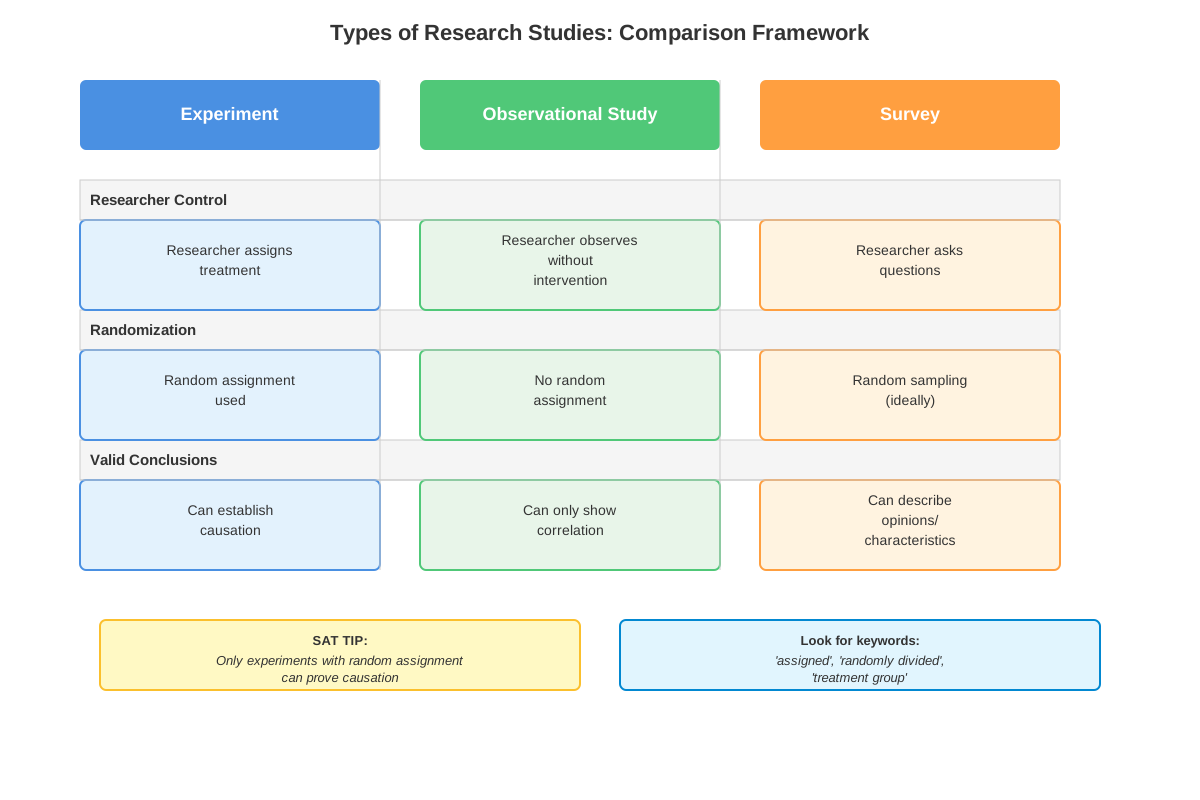
Understanding the fundamental differences between study types is crucial for SAT success. There are three primary categories of studies that appear on the exam:
Experiments are studies in which researchers actively manipulate one or more variables (called independent variables or treatment variables) and measure the effect on another variable (the dependent variable or response variable). The defining characteristic of a true experiment is that researchers assign subjects to different conditions through randomization. Only experiments can establish causal relationships because the random assignment helps ensure that any differences in outcomes are due to the treatment rather than pre-existing differences between groups.
Observational studies involve researchers observing and measuring variables without manipulating them or assigning subjects to groups. In these studies, researchers collect data on naturally occurring differences or behaviors. While observational studies can identify correlations and associations between variables, they cannot establish causation because confounding variables may explain the observed relationships.
Surveys are a specific type of observational study in which researchers collect data by asking questions to a sample of individuals. Surveys are useful for gathering information about opinions, behaviors, or characteristics but share the limitation of observational studies in that they cannot establish causal relationships.
Key Components of Experimental Design
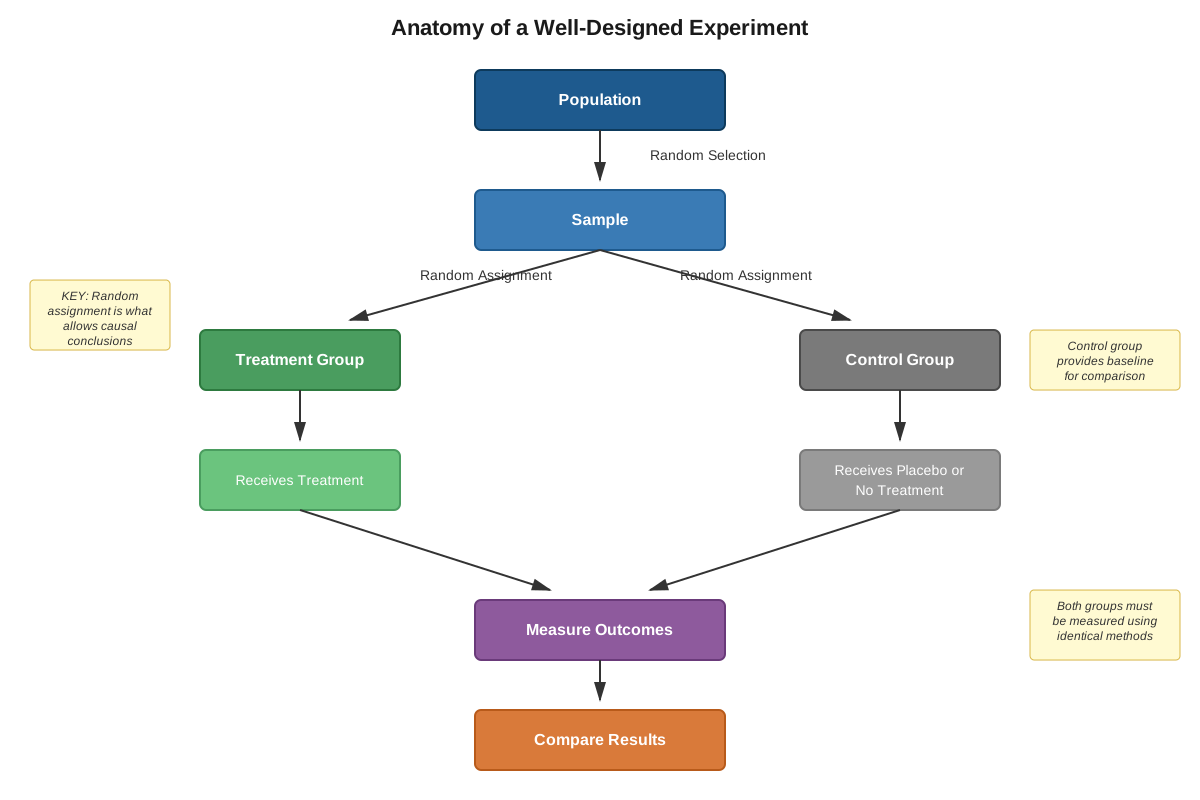
Randomization is the cornerstone of sound experimental design. When subjects are randomly assigned to treatment groups, each subject has an equal probability of being placed in any group. This process helps ensure that groups are similar in all respects except for the treatment they receive, minimizing the influence of confounding variables—factors other than the treatment that might affect the outcome.
The control group receives no treatment or receives a standard treatment for comparison purposes, while the treatment group (or experimental group) receives the intervention being tested. The control group is essential because it provides a baseline against which to measure the effect of the treatment. Without a control group, researchers cannot determine whether observed changes are due to the treatment or would have occurred anyway.
Sample size refers to the number of subjects included in a study. Larger sample sizes generally produce more reliable results because they reduce the impact of random variation and make it more likely that the sample accurately represents the population. However, the SAT typically focuses on whether a sample size is adequate rather than requiring specific calculations.
Blinding is a technique used to prevent bias in experiments. In a single-blind study, subjects don't know which treatment they're receiving. In a double-blind study, neither subjects nor researchers know who receives which treatment until after data collection is complete. This prevents expectations from influencing results.
Population and Sampling
The population is the entire group about which researchers want to draw conclusions, while the sample is the subset of the population actually studied. For conclusions to be valid for the entire population, the sample must be representative—it should reflect the characteristics of the population.
Random sampling is the process of selecting subjects from a population such that each member has an equal chance of being selected. This is different from random assignment: random sampling relates to how subjects are chosen from a population, while random assignment relates to how chosen subjects are placed into groups within an experiment.
| Concept | Definition | Purpose |
|---|---|---|
| Random Sampling | Selecting subjects from population randomly | Ensures sample represents population |
| Random Assignment | Placing subjects into groups randomly | Ensures groups are comparable; enables causal conclusions |
| Control Group | Group receiving no treatment or standard treatment | Provides comparison baseline |
| Treatment Group | Group receiving the intervention | Shows effect of treatment |
Validity and Generalizability
Internal validity refers to whether the study design allows for valid conclusions about the relationship between variables within the study itself. Experiments with proper randomization and control groups have high internal validity.
External validity (or generalizability) refers to whether conclusions from the study can be applied to other populations, settings, or times. A study might have high internal validity but low external validity if, for example, it only includes college students but claims to apply to all adults.
Bias and Confounding Variables
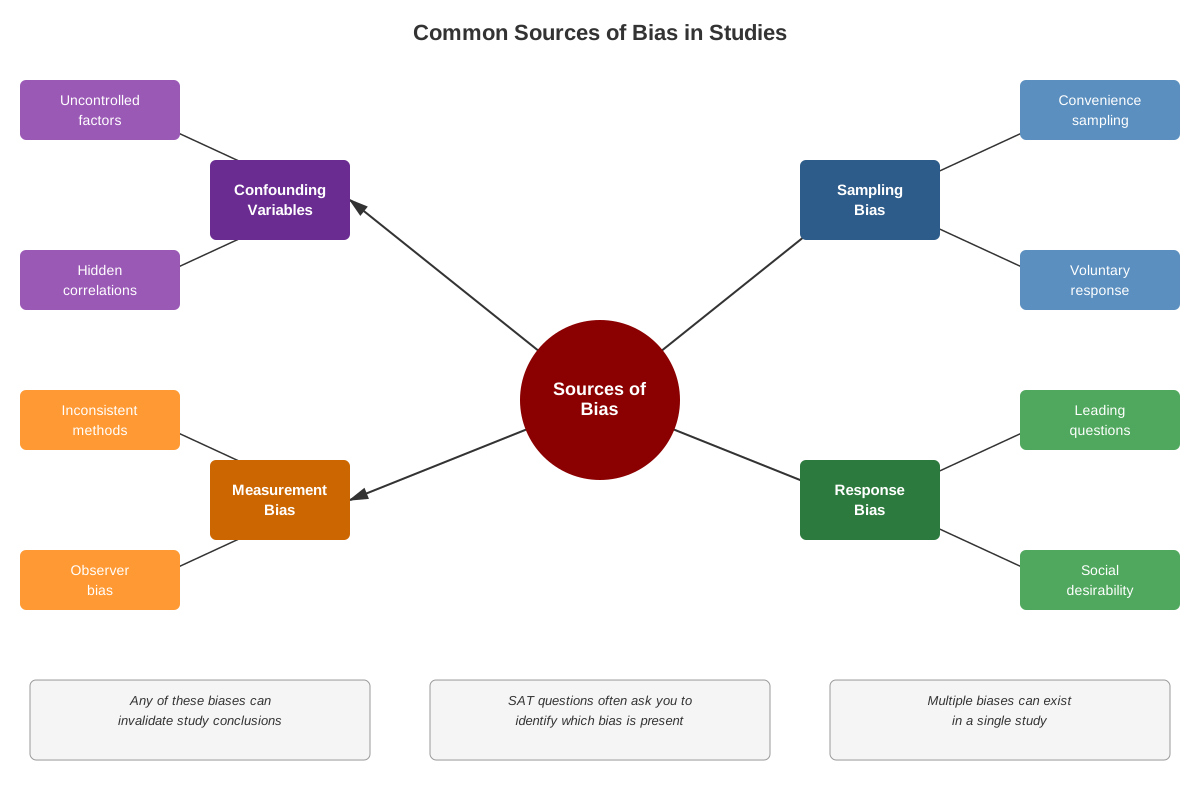
Bias is any systematic error that distorts results in a particular direction. Common sources of bias include:
- Selection bias: When the sample is not representative of the population
- Response bias: When subjects don't respond truthfully or accurately
- Measurement bias: When the measurement method systematically over- or under-estimates values
- Non-response bias: When people who don't respond differ systematically from those who do
A confounding variable is a factor that influences both the independent and dependent variables, creating a false appearance of a relationship or masking a true relationship. For example, in a study finding that coffee consumption is associated with heart disease, smoking might be a confounding variable if coffee drinkers are more likely to smoke and smoking causes heart disease.
Concept Relationships
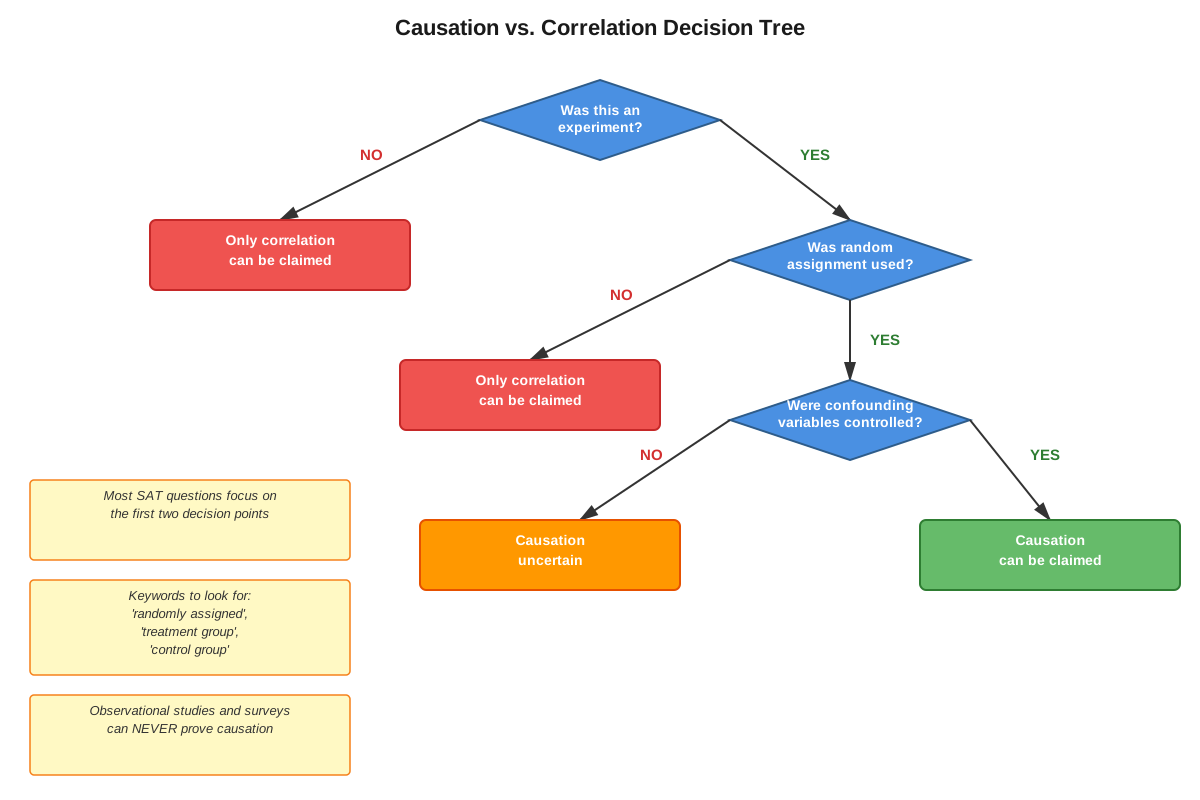
The concepts within experimental design form an interconnected framework where each element supports the others. Randomization serves as the foundation that enables causal conclusions, which distinguishes experiments from observational studies. The presence or absence of randomization determines what type of study has been conducted, which in turn determines what conclusions are valid.
Random sampling connects to generalizability: when a sample is randomly selected from a population, conclusions can be generalized to that population. However, random sampling alone doesn't enable causal conclusions—that requires random assignment within an experiment. These two types of randomization work together: random sampling determines to whom results apply, while random assignment determines whether causal conclusions are justified.
Control groups and treatment groups work together to isolate the effect of the treatment variable. The control group provides the baseline, and comparison between groups reveals the treatment effect. This comparison is only meaningful when confounding variables are controlled, which is accomplished through randomization and sometimes through blinding.
Sample size affects the reliability of all other components. Even with perfect randomization and control groups, a very small sample may produce unreliable results due to random variation. Conversely, even a large sample cannot compensate for fundamental design flaws like lack of randomization or absence of a control group.
The relationship map flows as follows: Study Question → Study Type Selection (Experiment vs. Observational) → Sampling Method (affects generalizability) → Random Assignment (in experiments only) → Control and Treatment Groups → Data Collection (with attention to bias) → Valid Conclusions (causal only if experiment; correlational if observational).
High-Yield Facts
⭐ Only experiments with random assignment can establish causal relationships; observational studies can only show correlation or association.
⭐ Random sampling (selecting subjects from population) is different from random assignment (placing subjects into groups); both serve different purposes.
⭐ Control groups are essential for comparison; without them, researchers cannot determine if changes are due to treatment or other factors.
⭐ Larger sample sizes generally produce more reliable results by reducing the impact of random variation.
⭐ Confounding variables are factors that affect both the independent and dependent variables, potentially creating false conclusions.
- A study can have random assignment without random sampling, or vice versa, or both, or neither.
- Blinding (single or double) helps prevent bias from expectations affecting results.
- Surveys and observational studies cannot establish causation regardless of sample size or statistical significance.
- A representative sample is necessary for generalizing results to the population.
- Selection bias occurs when the sample doesn't accurately represent the population of interest.
- The presence of a correlation does not imply causation unless the study is a properly designed experiment.
- Volunteer samples typically suffer from selection bias because volunteers may differ systematically from non-volunteers.
- Replication of studies increases confidence in findings and helps identify whether results are reliable.
Quick check — test yourself on Experimental design so far.
Try Flashcards →Common Misconceptions
Misconception: A large sample size makes any study valid and allows for causal conclusions.
Correction: Sample size affects reliability but doesn't change the fundamental study type. A large observational study still cannot establish causation, and a large experiment with poor design (no control group, no randomization) remains flawed.
Misconception: Random sampling and random assignment are the same thing.
Correction: Random sampling refers to how subjects are selected from a population (affects generalizability), while random assignment refers to how selected subjects are placed into experimental groups (enables causal conclusions). They serve completely different purposes.
Misconception: If two variables are strongly correlated, one must cause the other.
Correction: Correlation does not imply causation. Two variables can be correlated because one causes the other, because a third variable causes both, because of coincidence, or because the relationship is bidirectional. Only properly designed experiments can establish causation.
Misconception: Observational studies are poorly designed experiments.
Correction: Observational studies are a different type of study with different purposes, not failed experiments. They're appropriate when experiments would be unethical or impractical, and they're valuable for identifying associations that can later be tested experimentally.
Misconception: A control group must receive no treatment at all.
Correction: A control group can receive a placebo, standard treatment, or no treatment, depending on the research question. The key is that the control group provides a comparison baseline against which to measure the treatment effect.
Misconception: If a study uses random sampling, it can establish causal relationships.
Correction: Random sampling alone doesn't enable causal conclusions—that requires random assignment within an experimental design. Random sampling only affects whether results can be generalized to the population.
Misconception: Bias can be eliminated by increasing sample size.
Correction: Increasing sample size doesn't eliminate systematic bias; it only reduces random error. A biased sampling method will produce biased results regardless of sample size.
Worked Examples
Example 1: Identifying Study Type and Valid Conclusions
Problem: A researcher wants to study the effect of a new teaching method on student performance. She randomly selects 100 students from a school of 500 students. She then randomly assigns 50 students to learn with the new method and 50 students to learn with the traditional method. After one semester, she compares test scores between the two groups and finds that students using the new method scored significantly higher. Which of the following conclusions is most appropriate?
A) The new teaching method causes improved performance for all students everywhere.
B) The new teaching method is associated with improved performance in this sample, but causation cannot be determined.
C) The new teaching method causes improved performance, and results can be generalized to the 500 students at this school.
D) The new teaching method is associated with improved performance, but results cannot be generalized beyond this sample.
Solution:
Step 1: Identify the study type. The researcher randomly assigned students to groups (new method vs. traditional method), making this an experiment. Experiments can establish causal relationships.
Step 2: Evaluate random sampling. The researcher randomly selected 100 students from the school population of 500, so random sampling was used. This means results can be generalized to the school population.
Step 3: Identify the control group. The 50 students using the traditional method serve as the control group, providing a comparison baseline.
Step 4: Determine valid conclusions. Because this is an experiment with random assignment, a causal conclusion is justified (the new method causes improved performance, not just associated with it). Because random sampling was used, results can be generalized to the school population of 500 students. However, results cannot be generalized to "all students everywhere" because the sample came from only one school.
Answer: C - The study design supports a causal conclusion (due to random assignment) that can be generalized to the school population (due to random sampling), but not beyond that population.
Example 2: Identifying Confounding Variables and Study Limitations
Problem: A researcher conducts a study by surveying 1,000 adults about their exercise habits and their reported stress levels. The survey finds that people who exercise regularly report lower stress levels than those who don't exercise regularly. The researcher concludes that exercise reduces stress. Which of the following best describes a limitation of this conclusion?
A) The sample size is too small to draw any conclusions.
B) The study is an observational study, so it cannot establish that exercise causes reduced stress.
C) The study lacks a control group.
D) The study should have used random assignment.
Solution:
Step 1: Identify the study type. This is a survey, which is a type of observational study. The researcher observed naturally occurring differences in exercise habits rather than assigning people to exercise or not exercise.
Step 2: Evaluate what conclusions are valid. Observational studies can identify associations or correlations but cannot establish causal relationships. The researcher's conclusion that "exercise reduces stress" is a causal claim.
Step 3: Consider why causation cannot be established. There could be confounding variables. For example, people with more free time might both exercise more and experience less stress (because they're not overworked). Or people with better overall health might both exercise more and experience less stress. The lower stress might not be caused by exercise but by these other factors.
Step 4: Evaluate the answer choices. Choice A is incorrect because 1,000 is a reasonable sample size. Choice C is misleading because observational studies don't have control groups in the experimental sense. Choice D is incorrect because you cannot randomly assign people to exercise habits in a survey. Choice B correctly identifies the fundamental limitation: this is an observational study, which cannot establish causation.
Answer: B - The observational nature of the study means that while an association between exercise and lower stress was found, causation cannot be established. Confounding variables might explain the relationship.
Exam Strategy
When approaching SAT experimental design questions, follow this systematic process:
Step 1: Identify the study type. Look for key phrases: "randomly assigned" indicates an experiment; "observed," "surveyed," or "compared naturally occurring groups" indicates an observational study. This single determination tells you whether causal conclusions are possible.
Step 2: Check for random sampling. Look for phrases like "randomly selected from" or "random sample of." This tells you whether results can be generalized to a larger population.
Step 3: Identify control and treatment groups. In experiments, determine which group receives the intervention and which provides the comparison baseline.
Step 4: Look for potential confounding variables. Consider what other factors might explain the observed relationship.
Step 5: Match the conclusion to the study design. Causal language ("causes," "leads to," "results in") is only justified for experiments. Correlational language ("is associated with," "is related to") is appropriate for observational studies.
Exam Tip: The SAT loves to present observational studies where the researcher makes a causal claim. The correct answer will typically point out that causation cannot be established.
Trigger words to watch for:
- "Randomly assigned" = experiment = causation possible
- "Randomly selected" = random sampling = generalizability
- "Observed" or "surveyed" = observational study = no causation
- "Causes" or "results in" = causal claim (check if justified)
- "Associated with" or "correlated with" = correlational claim (always safe for observational studies)
Process of elimination tips:
- Eliminate any answer claiming causation from an observational study
- Eliminate any answer generalizing beyond the sampled population
- Eliminate any answer that ignores obvious confounding variables
- Eliminate any answer that claims a study is invalid simply because it's observational (observational studies are valid for their purpose)
Time allocation: Experimental design questions typically require 60-90 seconds. Spend 30 seconds carefully reading and identifying study type, then 30-60 seconds evaluating answer choices. Don't rush the reading phase—misidentifying the study type leads to wrong answers.
Memory Techniques
RACE - Remember what enables causal conclusions:
- Random assignment
- Active manipulation (of independent variable)
- Control group
- Experiment (not observational study)
Two R's, Two Purposes:
- Random Sampling → Generalizability (to population)
- Random Assignment → Causation (in experiments)
OCEAN - Types of bias to consider:
- Observer bias
- Confounding variables
- Expectation effects
- Assignment problems (non-random)
- Non-response bias
Visualization strategy: Picture an experiment as a branching tree. The trunk is the population. Random sampling selects a sample (first branch). Random assignment splits the sample into two branches (control and treatment). The leaves at the end represent outcomes. If both types of randomization occurred, you can trace conclusions back down the tree to the population (generalizability) and across branches (causation).
Causation vs. Correlation: Remember "Experiments Cause, Observations Correlate" (ECO-C). Only experiments establish causation; observations show correlation.
Summary
Experimental design is a high-yield SAT math topic that tests students' ability to analyze study methodology and evaluate the validity of conclusions. The fundamental principle is that only experiments with random assignment can establish causal relationships, while observational studies and surveys can only identify correlations or associations. Random sampling enables generalization to the population from which the sample was drawn, but doesn't enable causal conclusions. Key components of sound experimental design include control groups for comparison, adequate sample sizes for reliability, and randomization to minimize confounding variables. Students must be able to identify study types based on descriptions, recognize the difference between random sampling and random assignment, identify potential sources of bias and confounding, and determine which conclusions are justified based on the study design. The SAT frequently presents scenarios where researchers make causal claims based on observational data, and students must recognize that such conclusions are not justified. Success on these questions requires careful reading to identify study features, systematic evaluation of what conclusions the design supports, and matching answer choices to the appropriate scope and strength of conclusion.
Key Takeaways
- Only experiments with random assignment can establish causal relationships; observational studies show correlation only
- Random sampling (selecting from population) and random assignment (placing into groups) serve different purposes and must not be confused
- Control groups provide essential comparison baselines; without them, treatment effects cannot be isolated
- Confounding variables can create false appearances of relationships or mask true relationships
- Larger sample sizes increase reliability but don't change study type or eliminate systematic bias
- Valid conclusions must match study design: causal language requires experiments, correlational language for observational studies
- Generalizability depends on random sampling from the population of interest
Related Topics
Sampling Methods and Bias: Explores different sampling techniques (stratified, cluster, systematic) and how each affects representativeness and potential bias. Mastering experimental design provides the foundation for understanding why certain sampling methods are preferred in different contexts.
Statistical Significance and Hypothesis Testing: Builds on experimental design by examining how researchers determine whether observed differences are likely due to treatment effects or random chance. Understanding experimental design is prerequisite to interpreting p-values and confidence intervals.
Data Interpretation and Graphical Analysis: Applies experimental design principles to real data presentations, requiring students to evaluate whether graphs and tables support stated conclusions. Strong experimental design knowledge enables critical evaluation of data presentations.
Probability and Expected Value: Connects to experimental design through the concept of randomization and the role of chance in study outcomes. Understanding probability helps explain why randomization works to control confounding variables.
Practice CTA
Now that you've mastered the core concepts of experimental design, it's time to put your knowledge into practice! Work through the practice questions to reinforce your understanding of study types, randomization, and valid conclusions. The flashcards will help you memorize key distinctions and trigger words that appear frequently on the SAT. Remember, experimental design questions are highly predictable once you understand the fundamental principles—with practice, these can become some of your most reliable points on test day. You've built a strong foundation; now strengthen it through application!
Sign up free to keep reading
Create a free AnvayaPrep account to finish this SAT guide on Experimental design — plus flashcards and practice questions.