Overview
Sampling is a fundamental statistical concept that appears regularly on the SAT math section, particularly within questions involving data analysis, surveys, and experimental design. Understanding sampling allows students to evaluate how data is collected, determine whether conclusions drawn from a study are valid, and identify potential sources of bias in statistical claims. On the SAT, sampling questions test not just computational skills but also critical reasoning about how representative a sample is of a larger population.
The importance of sampling on the SAT cannot be overstated. Questions involving SAT sampling concepts frequently appear in both the calculator and no-calculator sections, often embedded within real-world scenarios such as school surveys, political polls, consumer research, or scientific studies. These questions assess whether students can distinguish between random and biased sampling methods, calculate margins of error, and understand how sample size affects the reliability of statistical inferences. Mastering sampling is essential because it connects directly to probability, statistics, and data interpretation—all high-yield areas on the exam.
From a broader mathematical perspective, sampling serves as a bridge between theoretical probability and practical data analysis. It connects to concepts like population parameters versus sample statistics, confidence intervals, and the fundamental principle that larger, more representative samples yield more reliable conclusions. Students who understand sampling principles can approach complex word problems with confidence, quickly identifying whether a study's methodology supports its conclusions—a skill that extends beyond the SAT into college-level coursework and real-world decision-making.
Learning Objectives
- [ ] Identify key features of sampling methods and distinguish between different sampling techniques
- [ ] Explain how sampling appears on the SAT, including question formats and common scenarios
- [ ] Apply sampling principles to answer SAT-style questions involving bias, representativeness, and validity
- [ ] Evaluate whether a given sampling method produces representative or biased results
- [ ] Calculate and interpret basic statistics from sample data and understand their relationship to population parameters
- [ ] Recognize the relationship between sample size and the reliability of statistical conclusions
Prerequisites
- Basic statistics terminology: Understanding terms like mean, median, and mode is essential because sampling questions often require calculating or interpreting these measures from sample data.
- Fractions, ratios, and percentages: Sampling problems frequently involve converting between these forms when discussing proportions of populations or samples.
- Basic probability concepts: Understanding random selection and equally likely outcomes helps in recognizing truly random sampling methods.
- Reading comprehension of word problems: Sampling questions are almost always presented in context, requiring careful extraction of relevant information from scenarios.
Why This Topic Matters
In the real world, sampling is the foundation of nearly all statistical research and decision-making. Political pollsters use sampling to predict election outcomes from surveying just a few thousand voters among millions. Medical researchers use sampling to test drug effectiveness without administering treatments to entire populations. Businesses use sampling to understand consumer preferences, and quality control engineers use sampling to ensure product standards without testing every single item manufactured. Understanding sampling helps students become informed citizens who can critically evaluate statistical claims in news media, advertising, and public policy debates.
On the SAT, sampling appears in approximately 2-4 questions per test, making it a high-yield topic that can significantly impact scores. These questions typically fall into several categories: identifying biased versus unbiased sampling methods (most common), determining whether a sample is representative of a population, understanding how sample size affects conclusions, and recognizing appropriate generalizations from sample data. The College Board frequently embeds sampling concepts within Problem Solving and Data Analysis questions, which constitute about 29% of the SAT Math section (17 out of 58 questions).
Sampling questions commonly appear in passages describing surveys, experiments, or studies. Typical scenarios include: a school administrator surveying students about cafeteria preferences, a researcher studying exercise habits by surveying gym members, a company testing product quality by examining a subset of manufactured items, or a biologist studying wildlife populations by capturing and tagging animals. The SAT tests whether students can identify methodological flaws that would make the sample unrepresentative and therefore invalidate the conclusions.
Core Concepts
Population vs. Sample
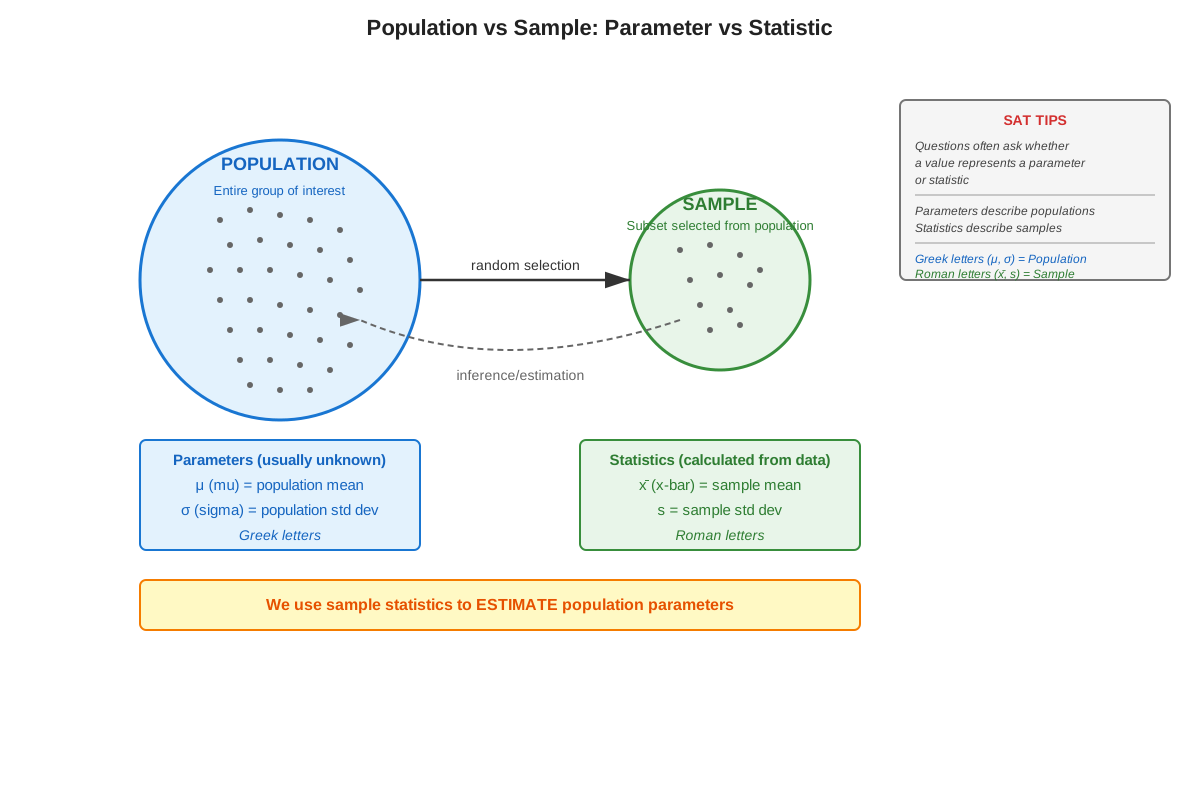
The population is the entire group about which information is desired, while a sample is a subset of the population that is actually studied or measured. This distinction is fundamental to all sampling concepts. For example, if a researcher wants to know the average height of all high school students in California (the population), they might measure 1,000 students from various schools (the sample). The goal of sampling is to use information from the sample to make inferences about the population.
A parameter is a numerical characteristic of a population (such as the true population mean), while a statistic is a numerical characteristic calculated from a sample (such as the sample mean). On the SAT, students must recognize that we use sample statistics to estimate population parameters, and the quality of this estimation depends on how the sample was selected.
Random Sampling
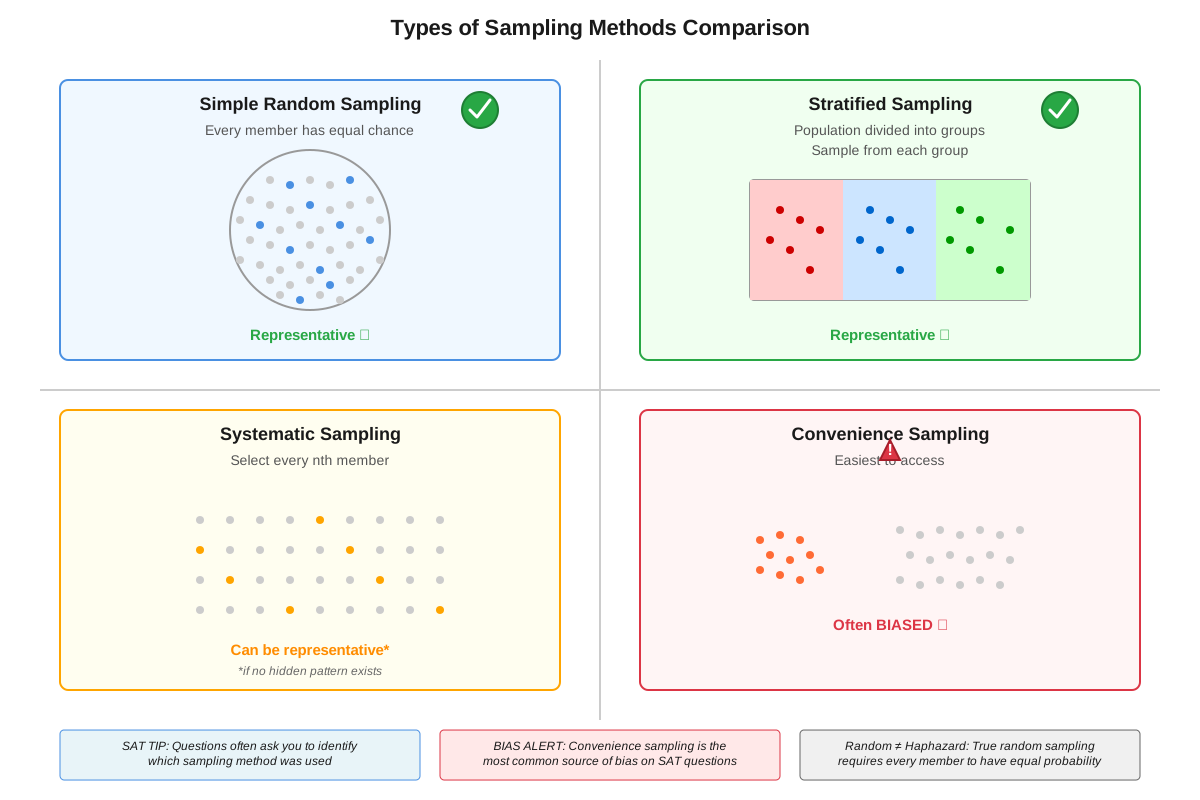
Random sampling is a method where every member of the population has an equal chance of being selected for the sample. This is the gold standard for obtaining representative samples because it minimizes bias and allows for valid statistical inferences. True random sampling might involve assigning every population member a number and using a random number generator to select sample members, or drawing names from a hat where all names have equal probability of selection.
The key advantage of random sampling is that it tends to produce samples whose characteristics mirror those of the population. While any single random sample might not perfectly represent the population due to chance variation, random sampling ensures that there is no systematic bias in the selection process. On the SAT, questions often ask students to identify whether a sampling method is truly random or contains elements that make certain population members more or less likely to be selected.
Biased Sampling Methods
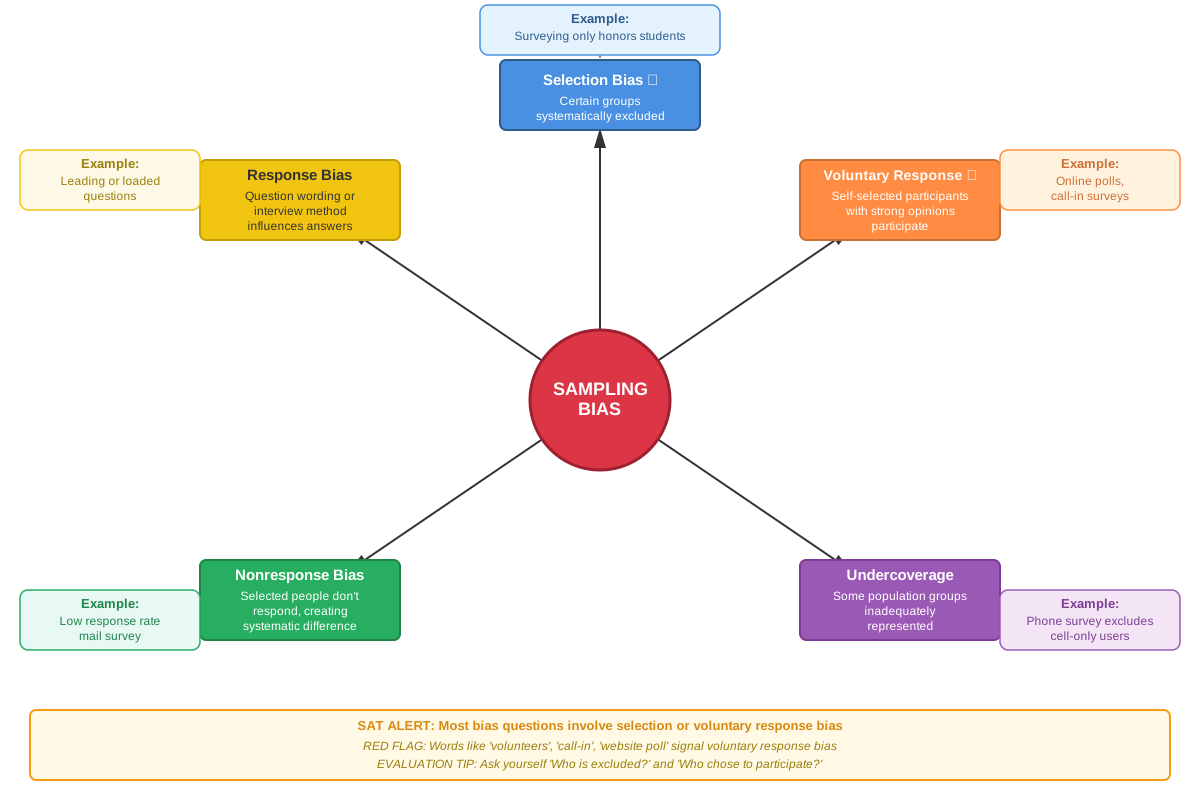
Bias in sampling occurs when the sampling method systematically favors certain members of the population over others, resulting in a sample that does not accurately represent the population. Several common types of biased sampling appear on the SAT:
Convenience sampling involves selecting individuals who are easiest to reach. For example, surveying only students in the cafeteria during first lunch period would be convenience sampling if the goal is to understand all students' opinions. This creates bias because students with different lunch periods are excluded.
Voluntary response sampling occurs when individuals choose whether to participate, such as online polls or call-in surveys. This creates bias because people with strong opinions (especially negative ones) are more likely to respond than those with moderate views.
Systematic exclusion happens when the sampling method automatically excludes certain population segments. For example, conducting a phone survey during business hours would systematically exclude people who work during those times.
Sample Size and Reliability
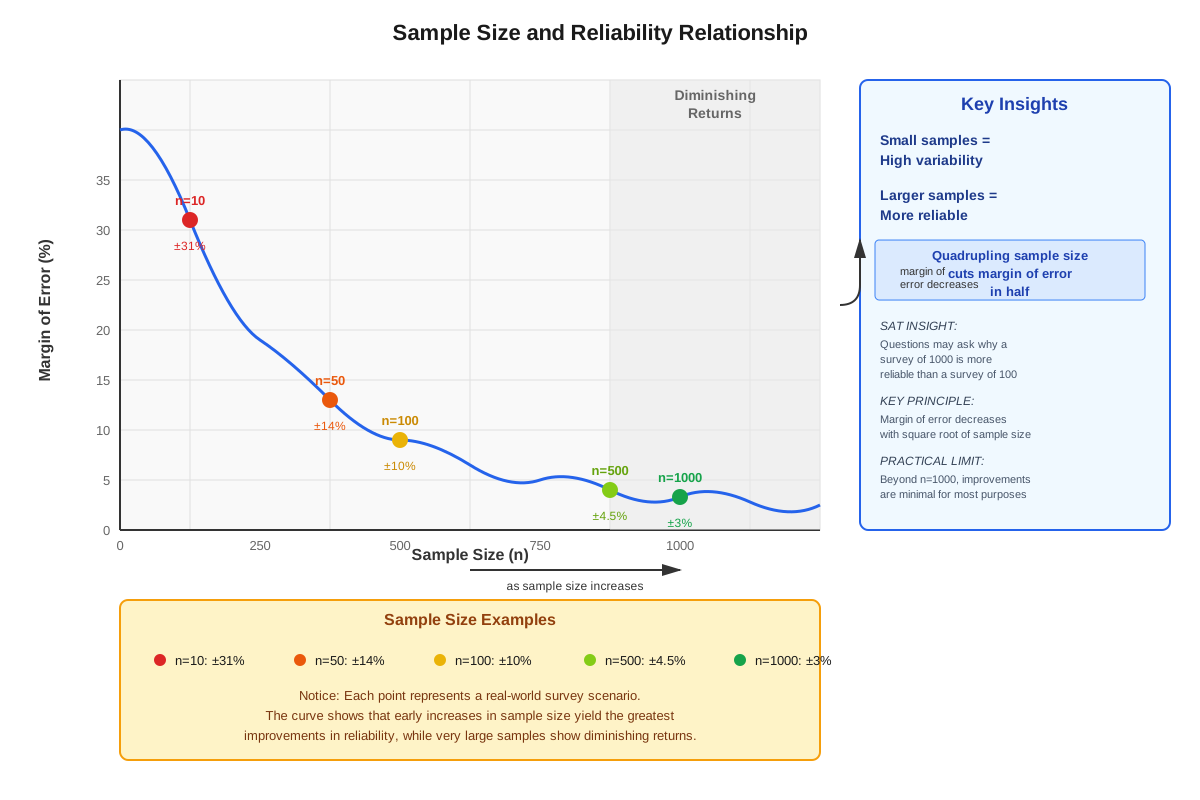
The sample size (often denoted as n) significantly affects the reliability of conclusions drawn from sample data. Larger samples generally provide more reliable estimates of population parameters because they reduce the impact of random variation. However, even a large sample cannot overcome bias in the sampling method—a biased sample of 10,000 people is still biased.
On the SAT, students should understand that:
- Larger random samples produce more precise estimates than smaller random samples
- A small random sample is generally better than a large biased sample
- Doubling the sample size does not double the precision; the relationship follows more complex statistical principles
- Very small samples (n < 30) are particularly unreliable for making population inferences
Representativeness
A representative sample is one whose characteristics closely match those of the population. Representativeness is the ultimate goal of good sampling because it allows valid generalization from sample to population. A sample can only be representative if the sampling method gives all relevant population segments a fair chance of inclusion.
For example, if a population is 60% female and 40% male, a representative sample should have approximately the same gender ratio. Similarly, if studying opinions across age groups, a representative sample should include appropriate proportions of each age group. The SAT often presents scenarios where students must identify whether a sample is representative or whether certain groups are over- or under-represented.
Margin of Error
The margin of error represents the range within which the true population parameter is likely to fall, based on sample data. While detailed calculations are beyond SAT scope, students should understand that margin of error decreases as sample size increases, and that all sample-based estimates have some uncertainty. A poll reporting "52% support with a margin of error of ±3%" means the true population support is likely between 49% and 55%.
Concept Relationships
The concepts within sampling form a logical hierarchy. The fundamental distinction between population and sample establishes why sampling is necessary—we cannot always measure entire populations. This leads directly to the need for random sampling methods that ensure representativeness. When random sampling is not used, various forms of bias can occur, making the sample unrepresentative. The sample size affects how precisely a representative sample estimates population parameters, but cannot fix problems caused by bias. All these concepts converge on the ultimate goal: achieving a representative sample that allows valid inferences about the population.
Sampling connects to prerequisite topics in several ways. Understanding basic statistics (mean, median, mode) is necessary because these measures are calculated from sample data and used to estimate population parameters. Probability concepts underlie random sampling—the idea that each population member has an equal probability of selection. Ratios and percentages are used to compare sample proportions to population proportions and to express margins of error.
The relationship map flows as follows:
Population (what we want to know about) → Sample (what we actually measure) → Sampling Method (how we select the sample) → Random Sampling (unbiased method) OR Biased Sampling (flawed method) → Sample Size (affects precision) → Representative Sample (goal) → Valid Inferences (conclusion)
High-Yield Facts
⭐ Random sampling gives every population member an equal chance of selection and is the best method for obtaining representative samples.
⭐ Convenience sampling (selecting whoever is easiest to reach) typically produces biased samples that do not represent the population.
⭐ Voluntary response sampling (self-selected participants) tends to over-represent people with strong opinions and produces biased results.
⭐ A sample is only representative if the sampling method gives all relevant population segments fair inclusion chances.
⭐ Larger sample sizes increase reliability and reduce margin of error, but cannot fix bias in the sampling method.
- A biased sample of any size cannot support valid conclusions about the population.
- Systematic exclusion of population segments (by time, location, or access method) creates bias.
- Conclusions from a sample can only be generalized to the population from which the sample was drawn.
- Stratified random sampling (randomly sampling from each population subgroup) can improve representativeness for diverse populations.
- The margin of error decreases as sample size increases, but the relationship is not linear.
- A sample statistic (like sample mean) is used to estimate a population parameter (like population mean).
Quick check — test yourself on Sampling so far.
Try Flashcards →Common Misconceptions
Misconception: Larger samples are always better, regardless of how they were collected. → Correction: Sample size only improves reliability if the sampling method is unbiased. A large convenience sample is still biased and cannot support valid population inferences. A smaller random sample is preferable to a larger biased sample.
Misconception: Surveying people who volunteer to participate produces representative results because you get many responses. → Correction: Voluntary response sampling creates systematic bias because people who choose to respond differ from those who do not. People with extreme opinions (especially complaints) are disproportionately likely to participate, making the sample unrepresentative.
Misconception: If a sample includes some members from each population subgroup, it is automatically representative. → Correction: Representativeness requires that subgroups be included in proportions that match the population. A sample that includes 90% of one group and 10% of another is not representative if the population is evenly split.
Misconception: Random sampling means haphazardly selecting whoever happens to be available. → Correction: True random sampling requires a systematic process ensuring equal selection probability for all population members. Haphazard selection is actually convenience sampling and typically introduces bias.
Misconception: You can fix a biased sampling method by increasing the sample size. → Correction: Bias is a systematic error in the sampling method that affects samples of any size. Increasing sample size only reduces random variation, not systematic bias. A biased method remains biased regardless of how many people are sampled.
Misconception: If a sample accurately predicts one population characteristic, the sampling method must be good. → Correction: A biased sample might occasionally produce accurate results by chance, but this does not validate the method. Good sampling methods are evaluated by their process (whether they give equal selection chances), not by whether one particular sample happened to match the population.
Worked Examples
Example 1: Identifying Biased Sampling
Question: A high school principal wants to determine whether students support extending the school day by 30 minutes. She decides to survey students by standing outside the library after school and asking students who exit the library whether they support the proposal. Of the 50 students surveyed, 35 support the extension. The principal concludes that 70% of all students support extending the school day. Which of the following best explains why this conclusion may not be valid?
A) The sample size is too small to draw conclusions about all students.
B) The sampling method may produce a biased sample because students who stay after school may differ from the general student population.
C) The principal should have surveyed exactly 100 students to get a valid result.
D) Random variation means the true percentage could be anywhere from 0% to 100%.
Solution:
Step 1: Identify the population and sample.
- Population: All students at the high school
- Sample: 50 students exiting the library after school
Step 2: Evaluate the sampling method.
The principal used convenience sampling—she surveyed whoever was available at a specific location and time. This is not random sampling.
Step 3: Identify potential bias.
Students who stay after school to use the library may systematically differ from the general student population. They might be more academically motivated, have fewer after-school obligations, or already spend extra time at school. These students might be more willing to extend the school day than students who leave immediately or who never use the library.
Step 4: Evaluate each answer choice.
- Choice A mentions sample size, but 50 students could be adequate if randomly selected. The problem is bias, not size.
- Choice B correctly identifies that the sampling location and time create systematic bias.
- Choice C incorrectly suggests a specific sample size would fix the problem; the issue is the method, not the number.
- Choice D overstates uncertainty; while random variation exists, the main problem is systematic bias.
Answer: B
This question demonstrates the SAT's focus on identifying biased sampling methods. The key insight is recognizing that convenience sampling at a specific location and time systematically excludes or under-represents certain population segments.
Example 2: Evaluating Sample Representativeness
Question: A researcher wants to study the exercise habits of adults in a large city. She obtains a list of all registered voters in the city and uses a random number generator to select 500 people from this list. She then surveys these 500 people about their exercise habits. Which of the following populations can the researcher reliably draw conclusions about based on this sample?
A) All adults in the city
B) All registered voters in the city
C) All people who exercise regularly in the city
D) All adults in the entire state
Solution:
Step 1: Identify the sampling frame.
The sampling frame (the list from which the sample is drawn) consists of all registered voters in the city. The researcher used random selection from this frame.
Step 2: Determine what population the sample represents.
A sample can only represent the population from which it was drawn. Since the sample was randomly selected from registered voters, it can represent registered voters in the city.
Step 3: Evaluate each answer choice.
- Choice A (all adults in the city): Not all adults are registered voters. Young adults, non-citizens, and people who haven't registered are systematically excluded. The sample cannot represent this broader population.
- Choice B (all registered voters in the city): This matches the sampling frame. Random selection from this population allows valid inferences about this population.
- Choice C (all people who exercise regularly): The sample was not selected based on exercise habits, so it represents the general population of registered voters, not specifically exercisers.
- Choice D (all adults in the entire state): The sample only includes city residents, so it cannot represent the broader state population.
Answer: B
This question illustrates the principle that conclusions can only be generalized to the population from which the sample was drawn. Even though the researcher used proper random sampling, the sampling frame limits the scope of valid conclusions. This is a subtle but important concept on the SAT.
Exam Strategy
When approaching SAT sampling questions, follow this systematic process:
Step 1: Identify the population and sample. Read carefully to determine what group the researcher wants to learn about (population) versus what group was actually studied (sample). These are often different, which is the source of many correct answers.
Step 2: Evaluate the sampling method. Look for keywords indicating the selection process: "randomly selected," "volunteers," "convenient," "available," "first to arrive," etc. Random selection is good; everything else typically indicates bias.
Step 3: Check for systematic exclusion. Ask yourself: "Does this sampling method automatically exclude certain types of people?" If surveying at a specific time, who cannot participate? If surveying at a specific location, who won't be there? If using a specific contact method (phone, email, in-person), who is unreachable?
Step 4: Match conclusions to the sampling frame. Valid conclusions can only apply to the population from which the sample was drawn. If the sample came from registered voters, conclusions apply to registered voters, not all adults.
Trigger words for biased sampling:
- "Volunteers" or "voluntary" → voluntary response bias
- "Convenient," "available," "nearby," "accessible" → convenience sampling bias
- "First [number] people" → systematic exclusion of later arrivals
- Specific times (e.g., "during lunch," "after school") → temporal bias
- Specific locations (e.g., "at the gym," "in the library") → location bias
Trigger words for random sampling:
- "Randomly selected," "random sample"
- "Each member had an equal chance"
- "Using a random number generator"
- "Drawing names from a hat"
Process of elimination tips:
- Eliminate answers that claim sample size alone determines validity
- Eliminate answers that suggest specific "magic numbers" for sample size
- Eliminate answers that claim biased samples can represent populations if large enough
- Keep answers that identify systematic exclusion or bias in the sampling method
Time allocation: Sampling questions typically require 60-90 seconds. Spend most of this time carefully reading the scenario to identify the sampling method. Once you've identified whether the method is random or biased, the correct answer usually becomes clear.
Memory Techniques
RANDOM mnemonic for characteristics of good sampling:
- Representative of the population
- All members have equal selection chance
- No systematic exclusion
- Determined by chance, not convenience
- Objective selection process
- Minimizes bias
The "Who's Missing?" technique: When evaluating any sampling method, always ask "Who's missing?" or "Who can't participate?" This immediately reveals systematic exclusion and bias. If you can identify a group that cannot be in the sample, the method is biased.
VCS acronym for common biased methods:
- Voluntary response (self-selected participants)
- Convenience sampling (easiest to reach)
- Systematic exclusion (some groups cannot participate)
Visualization strategy: Picture the population as a large circle containing different colored dots representing different groups. A representative sample should look like a miniature version of the population circle, with colors in the same proportions. A biased sample would have colors in different proportions or missing colors entirely.
Size vs. Method mantra: "Size matters only if the method is right." Repeat this when tempted to choose answers about sample size. This reminds you that sampling method (random vs. biased) is more important than sample size.
Summary
Sampling is a critical SAT math topic that tests understanding of how data is collected and whether conclusions drawn from samples are valid. The fundamental principle is that a sample must be representative of the population to support valid inferences, and representativeness requires random sampling methods that give all population members equal selection chances. Biased sampling methods—including convenience sampling, voluntary response sampling, and methods that systematically exclude population segments—produce unrepresentative samples regardless of size. Students must be able to identify sampling methods, recognize sources of bias, understand that conclusions can only be generalized to the population from which the sample was drawn, and evaluate whether a given sampling approach supports the researcher's conclusions. Success on SAT sampling questions requires careful reading to identify the population, sample, and sampling method, followed by systematic evaluation of whether the method could produce bias.
Key Takeaways
- Random sampling (equal selection probability for all population members) is the only method that reliably produces representative samples
- Convenience sampling and voluntary response sampling are biased methods that cannot support valid population inferences
- Sample size affects precision but cannot overcome bias in the sampling method
- Conclusions from a sample can only be generalized to the population from which the sample was drawn
- Systematic exclusion of population segments (by time, location, or access method) creates bias that invalidates conclusions
- Always ask "Who's missing?" to identify potential bias in any sampling method
- The SAT tests conceptual understanding of sampling validity more than computational skills
Related Topics
Experimental Design: Understanding sampling provides the foundation for evaluating experiments, including concepts like random assignment, control groups, and confounding variables. Mastering sampling makes experimental design questions more accessible.
Confidence Intervals and Margin of Error: These topics build directly on sampling concepts, quantifying the uncertainty inherent in using sample statistics to estimate population parameters.
Hypothesis Testing: Statistical hypothesis testing relies on proper sampling to ensure that conclusions about population differences or relationships are valid.
Data Interpretation and Analysis: Many SAT questions require interpreting graphs, tables, and statistical summaries. Understanding sampling helps evaluate whether the data collection method supports the presented conclusions.
Probability and Counting: Random sampling connects to probability concepts, particularly the idea that each population member has an equal probability of selection.
Practice CTA
Now that you understand the core principles of sampling, it's time to reinforce your knowledge through practice. Attempt the practice questions to test your ability to identify biased sampling methods, evaluate representativeness, and apply these concepts to SAT-style scenarios. Use the flashcards to memorize key definitions and high-yield facts. Remember: sampling questions reward careful reading and systematic thinking. With practice, you'll quickly recognize the patterns and confidently identify the correct answers. Every sampling question you master brings you closer to your target SAT score!
Sign up free to keep reading
Create a free AnvayaPrep account to finish this SAT guide on Sampling — plus flashcards and practice questions.