Overview
Frequency tables are one of the most fundamental tools in data analysis and statistics, serving as a systematic method for organizing and summarizing categorical or numerical data. On the SAT math section, frequency tables appear regularly as a way to test students' ability to interpret data, calculate probabilities, find measures of central tendency, and draw meaningful conclusions from organized information. These tables display how often different values or categories occur within a dataset, making complex information accessible and analyzable at a glance.
Understanding frequency tables is essential for SAT success because they form the foundation for numerous question types in the Problem Solving and Data Analysis domain. Questions involving frequency tables often integrate multiple mathematical concepts, requiring students to move fluidly between reading data, performing calculations, and applying statistical reasoning. The SAT frequently presents frequency tables in two-way (contingency) formats, where students must analyze relationships between two categorical variables, or in simple one-way formats that track a single variable across different categories or ranges.
Mastery of frequency tables connects directly to broader mathematical concepts including probability, percentages, ratios, proportions, and statistical measures like mean, median, and mode. These tables serve as the organizational structure that makes other statistical analyses possible, and the skills developed through working with frequency tables—careful data interpretation, systematic calculation, and logical reasoning—transfer directly to more complex data visualization formats like histograms, bar graphs, and scatter plots that also appear on the SAT.
Learning Objectives
- [ ] Identify key features of frequency tables including rows, columns, totals, and categorical labels
- [ ] Explain how frequency tables appears on the SAT in both one-way and two-way formats
- [ ] Apply frequency tables to answer SAT-style questions involving data interpretation and analysis
- [ ] Calculate conditional probabilities and relative frequencies from two-way frequency tables
- [ ] Determine measures of central tendency (mean, median, mode) from frequency table data
- [ ] Analyze relationships between categorical variables using two-way frequency tables
- [ ] Convert between frequency counts and percentages or proportions accurately
Prerequisites
- Basic arithmetic operations: Addition, subtraction, multiplication, and division are essential for calculating totals, finding percentages, and determining statistical measures from frequency table data
- Understanding of fractions, decimals, and percentages: Converting between these forms is necessary when calculating relative frequencies and probabilities from frequency tables
- Basic probability concepts: Familiarity with the fundamental probability formula (favorable outcomes / total outcomes) enables interpretation of frequency data in probabilistic terms
- Reading and interpreting tables: General table literacy, including understanding row and column headers, is required to extract information correctly
Why This Topic Matters
Frequency tables represent one of the most practical statistical tools used across virtually every field that deals with data—from business and economics to medicine, social sciences, and engineering. In real-world applications, frequency tables help organizations track customer preferences, medical researchers analyze treatment outcomes across different patient groups, educators evaluate test score distributions, and businesses understand demographic patterns in their markets. The ability to construct, read, and analyze frequency tables is a fundamental data literacy skill that extends far beyond standardized testing.
On the SAT, frequency tables appear in approximately 10-15% of all math questions, making them a high-yield topic that deserves focused attention. These questions typically appear in the Problem Solving and Data Analysis section and range from straightforward data retrieval to complex multi-step problems involving conditional probability, percentage calculations, and statistical inference. The College Board consistently includes 2-4 questions per test that either directly present frequency tables or require students to interpret data that could be organized in frequency table format.
Common SAT question formats involving frequency tables include: calculating the probability of selecting an item with specific characteristics from a two-way table; determining what percentage of a subgroup has a particular attribute; finding missing values when given row or column totals; comparing relative frequencies across different categories; and identifying which statements about the data are supported by the table. Questions often combine frequency table interpretation with other mathematical skills, such as solving equations, working with ratios, or calculating weighted averages, making them excellent vehicles for testing integrated mathematical reasoning.
Core Concepts
What is a Frequency Table?
A frequency table is an organized display that shows how many times each value, category, or range of values appears in a dataset. The "frequency" refers to the count or number of occurrences of each item. These tables transform raw, unorganized data into a structured format that reveals patterns, distributions, and relationships that might otherwise remain hidden in a list of individual data points.
Frequency tables can be categorized into two main types:
- One-way frequency tables: Display the distribution of a single categorical or numerical variable
- Two-way frequency tables (also called contingency tables or cross-tabulations): Display the relationship between two categorical variables simultaneously
Components of a Frequency Table
Every well-constructed frequency table contains several essential elements:
- Categories or Classes: The distinct values or ranges being counted, typically listed in the leftmost column or top row
- Frequency Counts: The number of observations falling into each category
- Totals: Row totals, column totals, and grand totals that sum the frequencies
- Labels: Clear headers identifying what each row and column represents
One-Way Frequency Tables
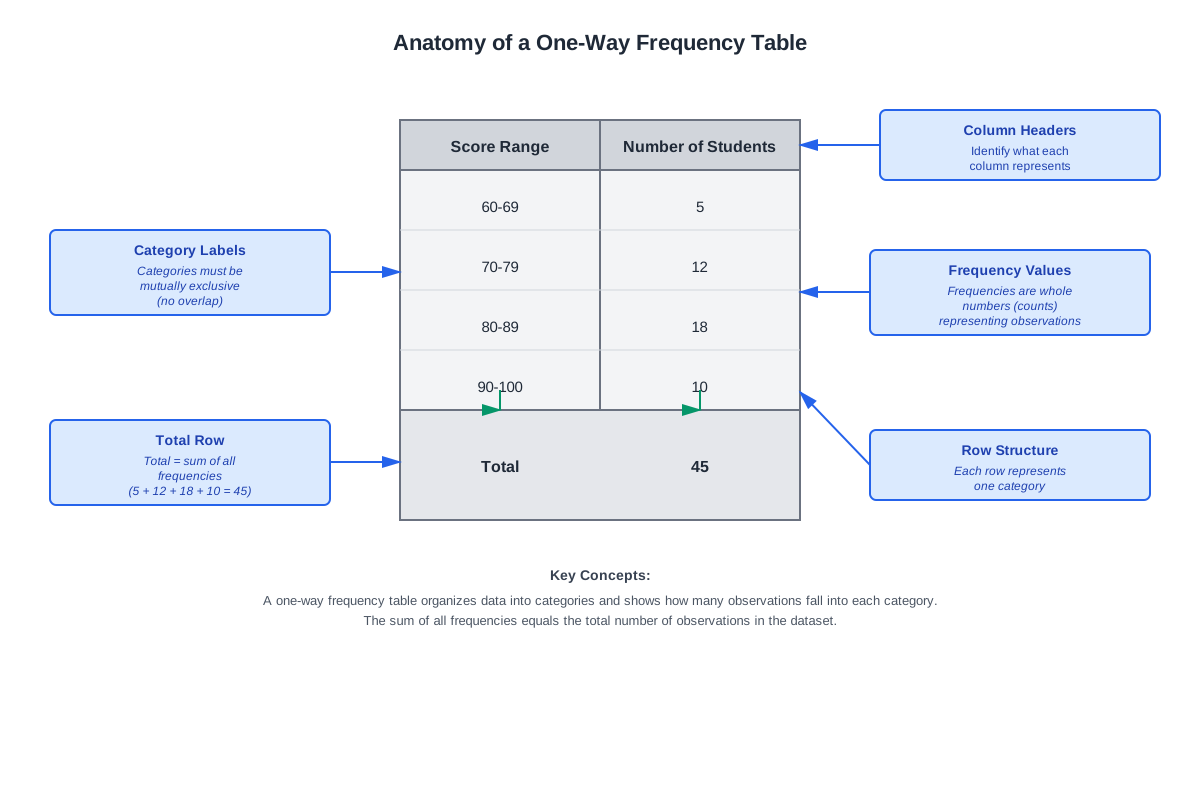
A one-way frequency table organizes data for a single variable. For example, if surveying students about their favorite subject, the table might look like:
| Subject | Frequency |
|---|---|
| Math | 45 |
| Science | 38 |
| English | 52 |
| History | 35 |
| Total | 170 |
From this table, students can quickly determine that English is the most popular subject (highest frequency) and that 170 students total were surveyed. To find what percentage prefers Math, divide 45 by 170 and multiply by 100, yielding approximately 26.5%.
Two-Way Frequency Tables
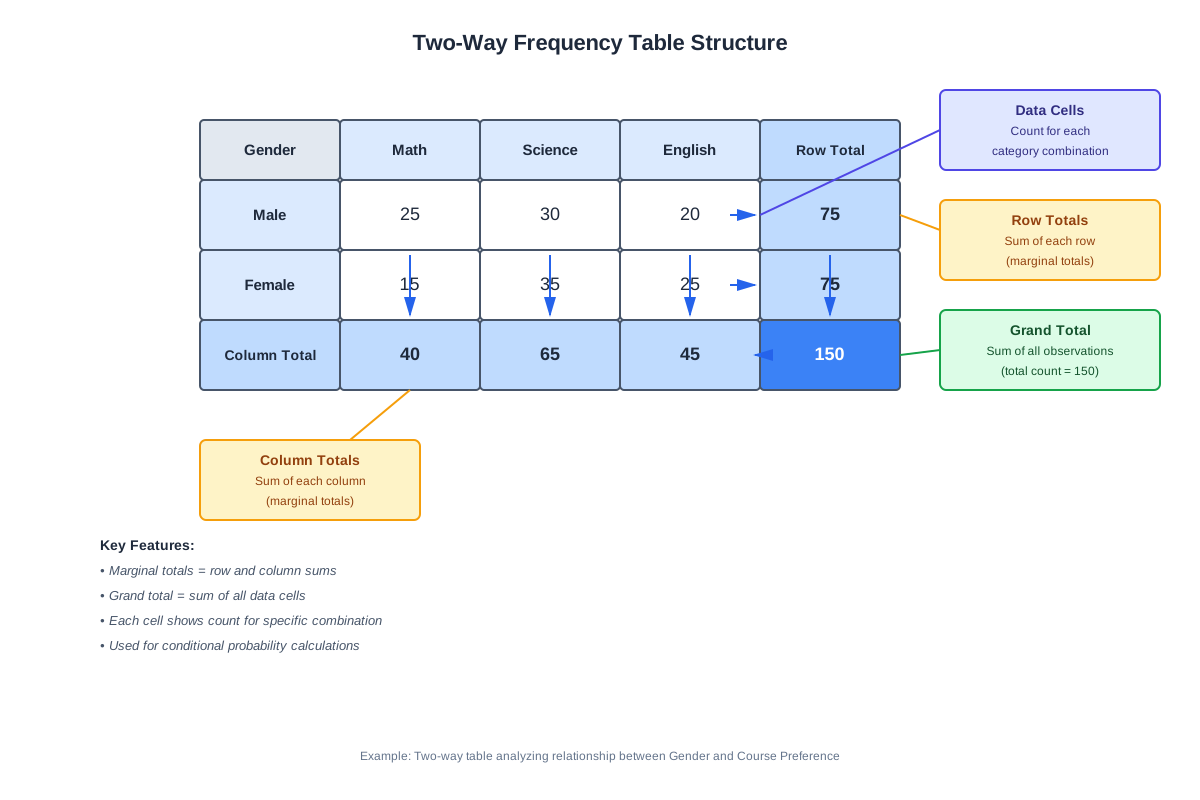
Two-way frequency tables are more complex and appear more frequently on the SAT because they test multiple analytical skills simultaneously. These tables organize data according to two categorical variables, with one variable defining the rows and another defining the columns. Each cell in the interior of the table shows the frequency of observations that fall into both categories simultaneously.
Consider this example tracking student participation in sports by grade level:
| Grade | Plays Sports | Doesn't Play Sports | Row Total |
|---|---|---|---|
| 9th | 45 | 30 | 75 |
| 10th | 52 | 28 | 80 |
| 11th | 38 | 37 | 75 |
| 12th | 41 | 34 | 75 |
| Column Total | 176 | 129 | 305 |
This table reveals multiple layers of information: the total number of students surveyed (305), how many students are in each grade, how many students overall play sports (176), and how these characteristics intersect (for example, 45 ninth-graders play sports).
Calculating Relative Frequency
Relative frequency expresses each frequency as a proportion or percentage of the total, rather than as a raw count. This is calculated by dividing the frequency of a specific category by the total number of observations:
Relative Frequency = (Frequency of Category) / (Total Observations)Relative frequencies are particularly useful for comparing distributions when the total sample sizes differ. On the SAT, questions often ask students to determine "what percent" or "what fraction" of a group has a certain characteristic—these are relative frequency questions.
Conditional Probability from Frequency Tables
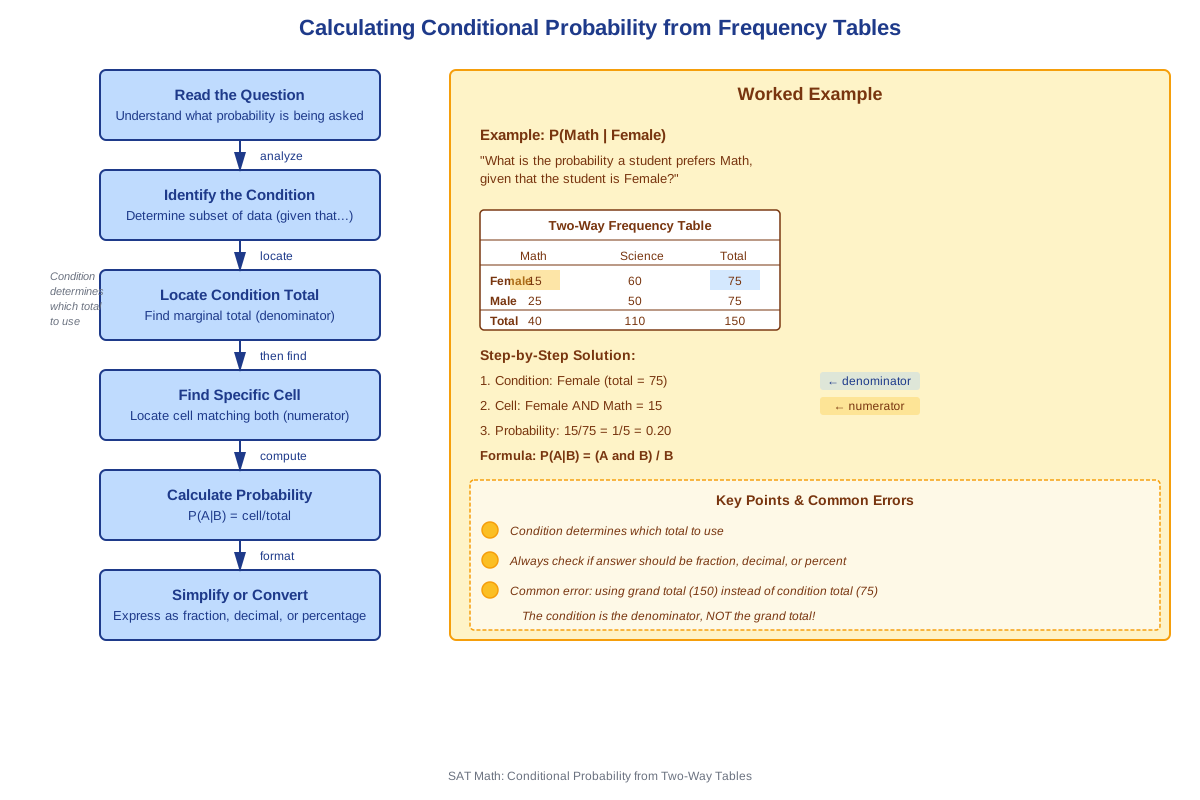
One of the most important SAT applications of two-way frequency tables involves calculating conditional probability—the probability that one event occurs given that another event has already occurred. The notation P(A|B) reads as "the probability of A given B."
Using the sports participation table above, if asked "What is the probability that a student plays sports given that they are in 10th grade?", the calculation focuses only on the 10th-grade row:
P(Plays Sports | 10th Grade) = 52/80 = 0.65 or 65%The denominator is the row total (all 10th graders), not the grand total, because the condition "given that they are in 10th grade" restricts the sample space to only 10th-grade students.
Marginal Distributions
The marginal distribution refers to the totals shown in the margins (edges) of a two-way frequency table—the row totals and column totals. These marginal totals show the distribution of each variable independently, without considering the other variable. In the sports table, the column totals (176 and 129) represent the marginal distribution of sports participation across all grades, while the row totals represent the marginal distribution of students across grade levels.
Joint Frequencies
Joint frequencies are the values in the interior cells of a two-way table, representing the frequency of observations that satisfy both categorical conditions simultaneously. In the sports table, the value 52 (10th graders who play sports) is a joint frequency because it requires both conditions to be met: the student must be in 10th grade AND play sports.
Concept Relationships
The concepts within frequency tables build upon each other in a logical hierarchy. At the foundation lies the basic frequency table structure (categories and counts) → which enables calculation of totals and marginal distributions → which in turn allows for relative frequency calculations → which form the basis for probability calculations → which extend to conditional probability when working with two-way tables.
Frequency tables connect directly to prerequisite knowledge of basic arithmetic (needed for calculating totals), fractions and percentages (needed for relative frequencies), and fundamental probability (needed for interpreting frequencies as likelihoods). The relationship flows as: Raw Data → Frequency Table → Relative Frequencies → Probabilities and Statistical Measures.
Within the broader SAT math curriculum, frequency tables serve as a bridge concept connecting multiple domains. They link to: Data visualization (frequency tables often accompany or can be converted to bar graphs and histograms) → Probability (tables provide the data structure for calculating various probabilities) → Statistics (measures like mean, median, and mode can be calculated from frequency data) → Ratios and proportions (comparing frequencies across categories involves ratio reasoning).
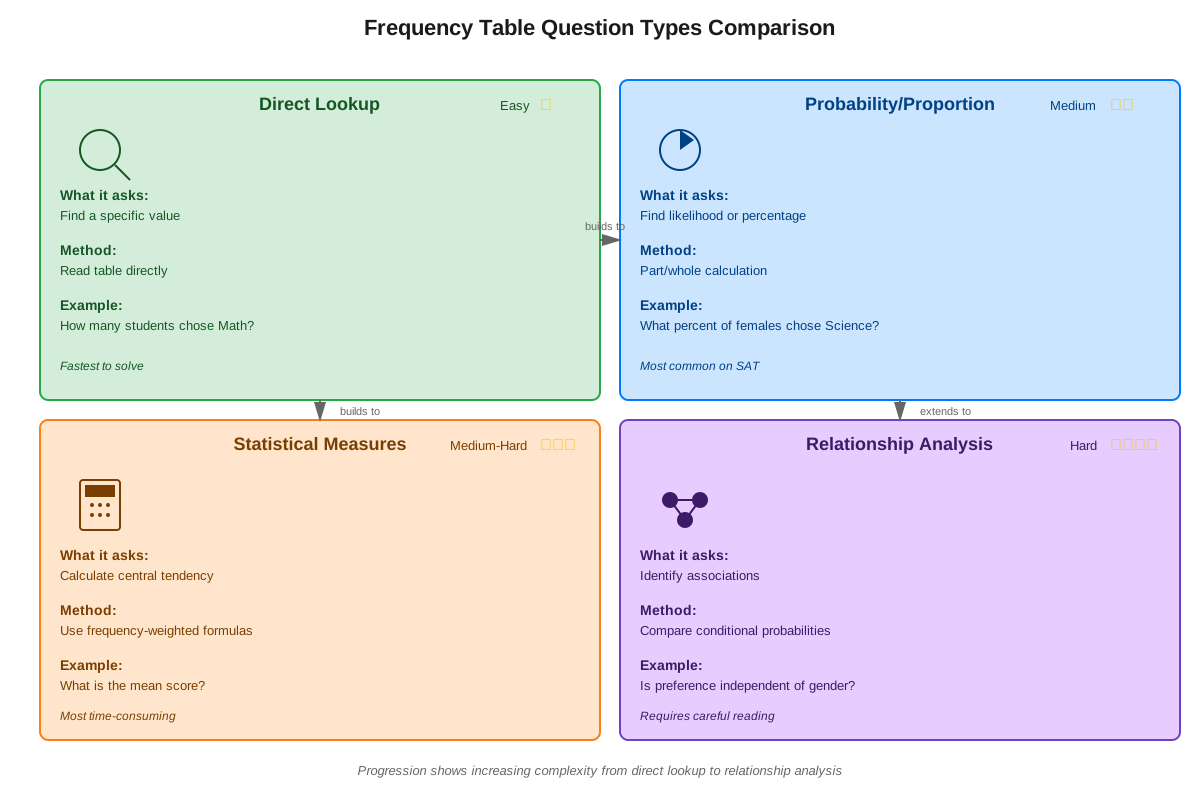
The progression of complexity in frequency table questions follows this pattern: Simple data retrieval → Calculating totals → Finding percentages → Determining conditional probabilities → Analyzing relationships between variables → Making inferences about populations based on sample data.
High-Yield Facts
⭐ Two-way frequency tables organize data by two categorical variables simultaneously, with one variable defining rows and the other defining columns
⭐ Conditional probability from a frequency table requires dividing the joint frequency by the appropriate marginal total (row or column), not the grand total
⭐ Relative frequency equals the frequency of a category divided by the total number of observations, often expressed as a percentage
⭐ The sum of all frequencies in a row must equal the row total; the sum of all row totals must equal the grand total
⭐ When calculating "what percent of [subgroup] has [characteristic]," the denominator is the subgroup total, not the grand total
- Joint frequencies appear in the interior cells of a two-way table and represent observations meeting both categorical conditions
- Marginal distributions (row and column totals) show the distribution of each variable independently
- The grand total appears in the bottom-right corner of a two-way frequency table and represents all observations
- To find the probability of randomly selecting an item with specific characteristics, divide the frequency of that characteristic by the total number of items
- Frequency tables can be used to calculate mean by multiplying each value by its frequency, summing these products, and dividing by the total frequency
Quick check — test yourself on Frequency tables so far.
Try Flashcards →Common Misconceptions
Misconception: When calculating conditional probability, students use the grand total as the denominator instead of the conditional total.
Correction: For P(A|B), the denominator must be the total for condition B only, not all observations. If finding the probability someone plays sports given they're in 10th grade, divide by the 10th-grade total, not the total number of all students.
Misconception: Students confuse "what percent of sports players are in 10th grade" with "what percent of 10th graders play sports."
Correction: These are different conditional probabilities with different denominators. The first divides by the total number of sports players (column total); the second divides by the total number of 10th graders (row total). Always identify which group forms the condition ("given that...").
Misconception: Believing that relative frequency and frequency are the same thing.
Correction: Frequency is the raw count of observations, while relative frequency is the proportion or percentage that count represents of the total. A category might have a frequency of 40 but a relative frequency of 0.25 (or 25%) if the total is 160.
Misconception: Adding percentages from a frequency table without considering that they may be calculated from different totals.
Correction: Percentages calculated from different base totals cannot be directly added. For example, if 60% of 9th graders and 70% of 10th graders play sports, you cannot conclude that 130% of students play sports. Each percentage has a different denominator.
Misconception: Assuming that the largest frequency in a table automatically represents more than 50% of the total.
Correction: The largest frequency is simply the mode (most common value), but it may represent any percentage of the total depending on how the data is distributed. A category could have the highest frequency of 30 out of 200 total observations, representing only 15%.
Misconception: Thinking that missing values in a frequency table cannot be determined.
Correction: If row totals, column totals, or the grand total are provided, missing interior values can be calculated using subtraction. The structure of the table creates equations that allow solving for unknowns.
Worked Examples
Example 1: Two-Way Frequency Table with Conditional Probability
Problem: A school surveyed 200 students about whether they have a pet and whether they prefer cats or dogs. The results are shown in the table below:
| Has a Pet | Doesn't Have a Pet | Total | |
|---|---|---|---|
| Prefers Cats | 45 | 35 | 80 |
| Prefers Dogs | 72 | 48 | 120 |
| Total | 117 | 83 | 200 |
Question: What is the probability that a randomly selected student who has a pet prefers dogs?
Solution:
Step 1: Identify what type of probability is being asked. The phrase "given that" or "who has a pet" indicates this is a conditional probability: P(Prefers Dogs | Has a Pet).
Step 2: Identify the condition. The condition is "has a pet," which corresponds to the "Has a Pet" column. This means we only consider students in this column.
Step 3: Find the relevant frequencies. Looking at the "Has a Pet" column:
- Students who have a pet AND prefer dogs: 72
- Total students who have a pet: 117
Step 4: Calculate the conditional probability:
P(Prefers Dogs | Has a Pet) = 72/117Step 5: Simplify if needed. Both numbers are divisible by 9:
72/117 = 8/13 ≈ 0.615 or approximately 61.5%Answer: The probability is 8/13 or approximately 0.615 (61.5%).
Key Insight: The denominator (117) is the column total for "Has a Pet," NOT the grand total (200), because the condition restricts our sample space to only students who have pets.
Example 2: Finding Missing Values and Calculating Percentages
Problem: A company surveyed employees about their commute method and work location. The incomplete table is shown below:
| Remote | In-Office | Total | |
|---|---|---|---|
| Drives | 0 | 84 | 84 |
| Public Transit | 0 | ? | 56 |
| Total | 40 | 160 | 200 |
Questions:
(a) How many in-office employees use public transit?
(b) What percentage of all employees work remotely?
Solution:
Part (a): Finding the missing value
Step 1: Identify what we know about the "Public Transit" row:
- Remote workers who use public transit: 0 (remote workers don't commute)
- Row total for public transit: 56
- We need to find: In-office workers who use public transit
Step 2: Use the row total equation:
Remote (Public Transit) + In-Office (Public Transit) = Row Total
0 + ? = 56
Step 3: Solve for the missing value:
In-Office (Public Transit) = 56Answer (a): 56 in-office employees use public transit.
Part (b): Calculating percentage of remote workers
Step 1: Identify the relevant frequencies:
- Total remote workers: 40 (column total)
- Total employees: 200 (grand total)
Step 2: Calculate the percentage:
Percentage = (40/200) × 100% = 0.20 × 100% = 20%Answer (b): 20% of all employees work remotely.
Key Insight: When finding missing values, use the relationship that each row sum equals its row total, each column sum equals its column total, and all row totals sum to the grand total. For percentage questions, always identify whether the question asks for a percentage of the total population or a percentage of a subgroup.
Exam Strategy
When approaching sat frequency tables questions on the SAT, begin by carefully reading the table structure before looking at the question. Identify what each row represents, what each column represents, and locate the totals. This 10-15 second investment prevents misreading the data later.
Trigger words and phrases that indicate specific calculation types:
- "Given that..." or "among those who..." → Conditional probability; use the subgroup total as denominator
- "What percent of..." → Relative frequency calculation; identify the correct total for the denominator
- "Randomly selected" → Probability calculation; frequency divided by appropriate total
- "How many more..." → Subtraction of two frequencies
- "What fraction..." → Create a fraction with frequency as numerator and appropriate total as denominator
Process-of-elimination strategies:
- Eliminate answer choices that exceed 100% when the question asks for a percentage or probability
- Eliminate answers that are larger than the grand total when the question asks for a count
- Check if answer choices are close to simple fractions (1/2, 1/3, 1/4) and verify by quick mental math
- For conditional probability questions, eliminate any answer that uses the grand total as denominator when a subgroup is specified
Time allocation: Frequency table questions typically require 45-90 seconds. Simple data retrieval questions should take 30-45 seconds, while complex conditional probability or multi-step questions may require up to 90 seconds. If a question requires more than two minutes, mark it and return later.
Systematic approach:
- Read the question first to know what you're looking for (30% of students waste time by reading the entire table before knowing what's being asked)
- Identify whether you need a count, percentage, probability, or comparison
- Locate the relevant row(s) and column(s)
- Determine the correct denominator (this is where most errors occur)
- Perform the calculation
- Check that your answer makes logical sense (e.g., a probability should be between 0 and 1)
Exam Tip: When you see a two-way frequency table, immediately verify that each row sum equals its row total and each column sum equals its column total. This takes 10 seconds and catches data entry errors in the question, which occasionally occur.
Memory Techniques
CORD Mnemonic for conditional probability from frequency tables:
- Condition identifies the denominator
- Outcome identifies the numerator
- Restrict your focus to the relevant row or column
- Divide outcome by condition total
"Row or Column, Not the Whole": When calculating conditional probabilities, remember this phrase to avoid using the grand total. The condition specifies either a row or column, and that becomes your denominator.
Visualization strategy: Picture a frequency table as a city grid. The interior cells are buildings, the row totals are the populations of each street, the column totals are the populations of each avenue, and the grand total is the entire city population. When asked about "people on Main Street who work in retail," you only count Main Street's population (row total), not the whole city.
The "Given That" Rule: Whenever you see "given that" in a probability question, physically circle or underline the condition. This condition tells you which row or column total becomes your denominator. The word "given" literally means "given this restriction on the sample space."
Percentage Denominator Check: Create the acronym PART to remember percentage calculations:
- Part (the specific frequency you're interested in)
- Appropriate (choose the appropriate total)
- Relative (to what group?)
- Total (use that group's total as denominator)
Summary
Frequency tables are essential organizational tools that display how often different values or categories appear in a dataset, and they represent a high-yield topic for SAT math success. The two main types—one-way and two-way frequency tables—require students to extract data, calculate totals, determine relative frequencies, and compute conditional probabilities. Mastery requires understanding that the structure of the table (rows, columns, interior cells, and marginal totals) creates a system where each component relates mathematically to the others. The most critical skill is identifying the correct denominator for percentage and probability calculations: use the grand total for overall percentages, use row or column totals for conditional probabilities, and always let the question's wording guide which total is appropriate. Success with frequency tables demands careful reading of both the table structure and the question, systematic identification of relevant data, and precise calculation using the appropriate frequencies and totals.
Key Takeaways
- Frequency tables organize categorical or numerical data by counting occurrences in each category, with two-way tables showing relationships between two variables simultaneously
- The interior cells contain joint frequencies (both conditions met), while marginal totals (row and column sums) show each variable's distribution independently
- Conditional probability questions require using the conditional group's total as the denominator, not the grand total—the phrase "given that" signals which subgroup to focus on
- Relative frequency converts raw counts to proportions or percentages by dividing a category's frequency by the appropriate total
- Missing values in frequency tables can be calculated using the constraint that row sums equal row totals and column sums equal column totals
- Always verify which group the question asks about ("percent of sports players" vs. "percent of 10th graders") to identify the correct denominator
- Frequency tables connect to multiple SAT math domains including probability, statistics, percentages, and ratios, making them integrative assessment tools
Related Topics
Histograms and Bar Graphs: These visual representations display the same information as frequency tables in graphical form, requiring students to translate between tabular and visual data formats. Mastering frequency tables provides the foundation for interpreting these graphs.
Probability and Sample Spaces: Frequency tables provide concrete data for calculating various types of probabilities, including simple, compound, and conditional probabilities. Understanding frequency tables enables more sophisticated probability problem-solving.
Measures of Central Tendency: Mean, median, and mode can all be calculated from frequency table data, requiring students to work with grouped data rather than individual values. This extends frequency table skills into descriptive statistics.
Scatter Plots and Correlation: While frequency tables organize categorical data, scatter plots organize numerical data to show relationships between variables. The analytical skills developed with frequency tables transfer to interpreting correlation and trend analysis.
Statistical Inference: Advanced applications of frequency tables include using sample data to make inferences about populations, calculating margins of error, and determining statistical significance—topics that appear in higher-level SAT questions.
Practice CTA
Now that you've mastered the core concepts of frequency tables, it's time to solidify your understanding through active practice. Complete the practice questions to test your ability to extract data, calculate conditional probabilities, and solve multi-step problems involving frequency tables. Use the flashcards to reinforce key definitions and formulas until they become automatic. Remember: frequency tables appear on virtually every SAT, and the skills you've developed here—careful data interpretation, systematic calculation, and logical reasoning—will serve you across the entire math section. Your investment in mastering this high-yield topic will pay dividends on test day!
Sign up free to keep reading
Create a free AnvayaPrep account to finish this SAT guide on Frequency tables — plus flashcards and practice questions.