Overview
The interquartile range (IQR) is a fundamental measure of statistical spread that appears regularly on the SAT and represents one of the most testable concepts in the Data Analysis and Statistics domain. Unlike the range, which considers only the maximum and minimum values, the interquartile range focuses on the middle 50% of a dataset, making it resistant to outliers and extreme values. This characteristic makes the IQR particularly valuable for understanding data distribution patterns and comparing variability across different datasets.
On the SAT, questions involving the interquartile range typically require students to calculate quartiles, interpret box plots, analyze data spread, and understand how changes to a dataset affect measures of variability. The SAT interquartile range questions often integrate multiple statistical concepts, requiring students to demonstrate both computational skills and conceptual understanding. These questions may present data in various formats—including lists, tables, dot plots, histograms, and box plots—testing a student's ability to extract relevant information and apply the appropriate statistical reasoning.
Mastering the interquartile range is essential not only for direct IQR calculation questions but also for understanding broader math concepts related to data analysis, including percentiles, outlier identification, and comparative statistics. The IQR serves as a bridge between basic descriptive statistics (mean, median, mode) and more sophisticated analytical techniques, making it a cornerstone concept for students aiming to excel in the SAT Math section's data analysis questions.
Learning Objectives
- [ ] Identify key features of interquartile range
- [ ] Explain how interquartile range appears on the SAT
- [ ] Apply interquartile range to answer SAT-style questions
- [ ] Calculate the first quartile (Q1), third quartile (Q3), and IQR from ordered datasets
- [ ] Interpret box plots to determine the interquartile range visually
- [ ] Analyze how adding, removing, or modifying data points affects the IQR
- [ ] Use the IQR to identify potential outliers using the 1.5×IQR rule
Prerequisites
- Median calculation: The IQR depends on finding quartiles, which are essentially medians of data subsets; understanding how to find the median of ordered data is fundamental to quartile calculation
- Data ordering: Datasets must be arranged in ascending order before calculating quartiles; this basic organizational skill is essential for all IQR problems
- Basic arithmetic operations: Computing the IQR requires subtraction and occasionally multiplication (for outlier detection); fluency with these operations ensures accurate calculations
- Understanding of percentiles: Quartiles are specific percentiles (25th, 50th, 75th), so familiarity with the percentile concept provides context for what quartiles represent
Why This Topic Matters
The interquartile range has significant real-world applications across numerous fields. In medicine, researchers use the IQR to report the spread of patient data when distributions are skewed or contain outliers. In economics, the IQR helps analyze income distributions and identify economic disparities. Quality control engineers employ the IQR to detect manufacturing defects and maintain product consistency. Climate scientists use it to understand temperature variability while minimizing the impact of extreme weather events. These practical applications demonstrate why the SAT emphasizes this concept—it represents genuine analytical thinking that students will encounter in college and professional contexts.
On the SAT, interquartile range questions appear with notable frequency, typically comprising 2-4 questions per test administration. These questions most commonly appear in the calculator-permitted section and account for approximately 8-12% of all data analysis questions. The SAT presents IQR problems in several formats: direct calculation from a dataset (40% of IQR questions), interpretation of box plots (35%), analysis of how data changes affect the IQR (15%), and multi-step problems combining IQR with other statistical measures (10%).
The SAT strategically integrates IQR questions with other statistical concepts, creating problems that test multiple skills simultaneously. Students might encounter questions asking them to compare the IQR across different groups, determine which measure of spread (range, IQR, or standard deviation) is most appropriate for a given situation, or identify how outliers affect different statistical measures. Box plot interpretation questions frequently require students to extract the IQR visually, making this a high-yield skill for test day.
Core Concepts
Definition and Calculation of Quartiles
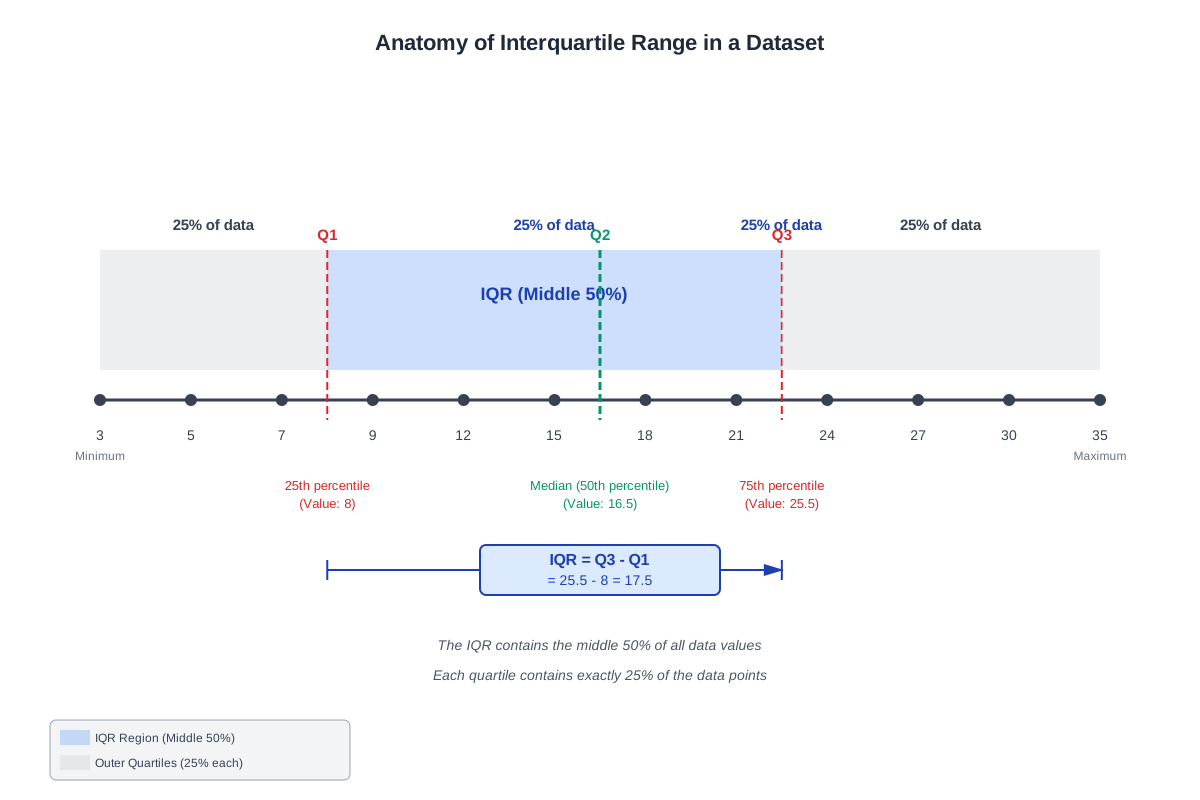
The interquartile range is defined as the difference between the third quartile (Q3) and the first quartile (Q1) of a dataset. To understand the IQR, students must first master quartile calculation. Quartiles divide an ordered dataset into four equal parts, with each part containing approximately 25% of the data points.
The first quartile (Q1) represents the 25th percentile—the value below which 25% of the data falls. The second quartile (Q2) is the median or 50th percentile. The third quartile (Q3) represents the 75th percentile—the value below which 75% of the data falls. The interquartile range specifically measures the spread of the middle 50% of the data by calculating Q3 - Q1.
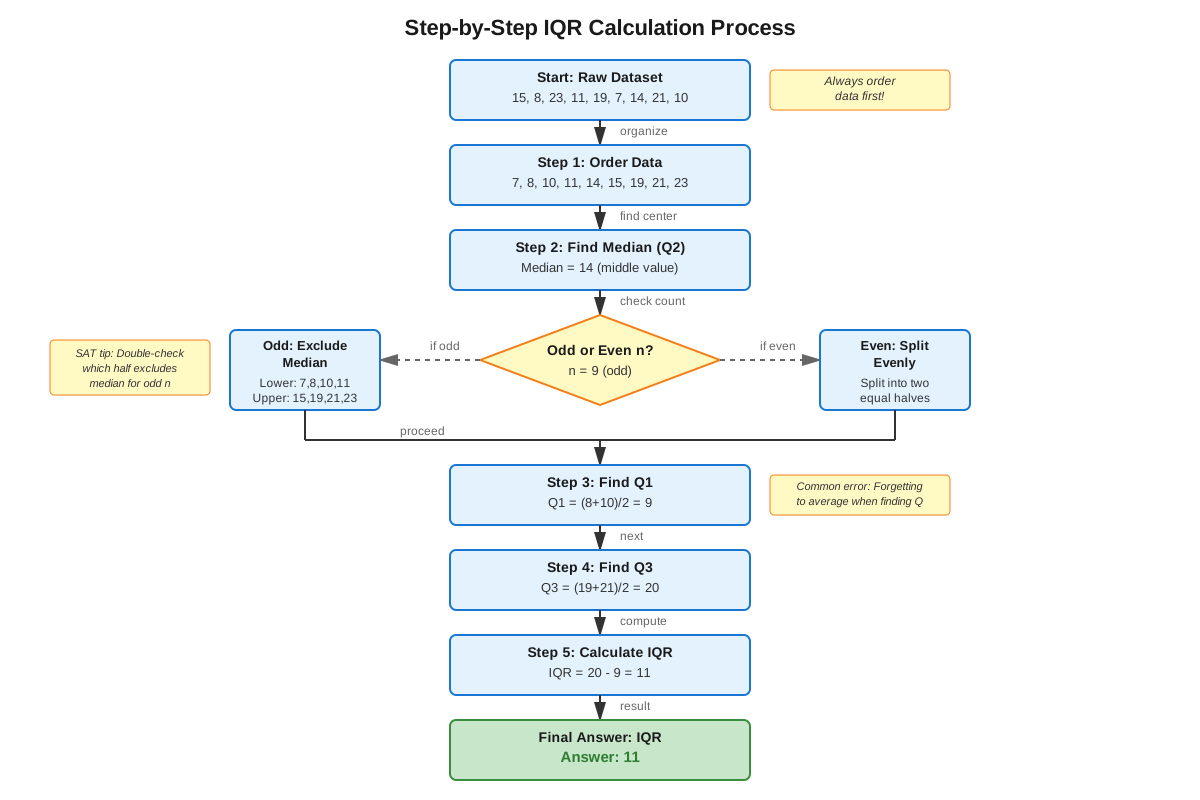
To calculate quartiles systematically:
- Arrange the dataset in ascending order
- Find the median (Q2) of the entire dataset
- Find the median of the lower half (all values below Q2) to determine Q1
- Find the median of the upper half (all values above Q2) to determine Q3
- Calculate IQR = Q3 - Q1
Handling Even and Odd Dataset Sizes
The method for finding quartiles varies slightly depending on whether the dataset contains an odd or even number of values. For datasets with an odd number of values, the median is the middle value, and this median is excluded when dividing the data into lower and upper halves. For datasets with an even number of values, the median is the average of the two middle values, and the data naturally splits into two equal halves.
Consider the dataset: 2, 5, 7, 9, 11, 13, 15
- This dataset has 7 values (odd)
- Q2 (median) = 9 (the 4th value)
- Lower half: 2, 5, 7 → Q1 = 5
- Upper half: 11, 13, 15 → Q3 = 13
- IQR = 13 - 5 = 8
Now consider: 3, 6, 8, 10, 12, 14, 16, 18
- This dataset has 8 values (even)
- Q2 = (10 + 12)/2 = 11
- Lower half: 3, 6, 8, 10 → Q1 = (6 + 8)/2 = 7
- Upper half: 12, 14, 16, 18 → Q3 = (14 + 16)/2 = 15
- IQR = 15 - 7 = 8
Box Plots and Visual Representation
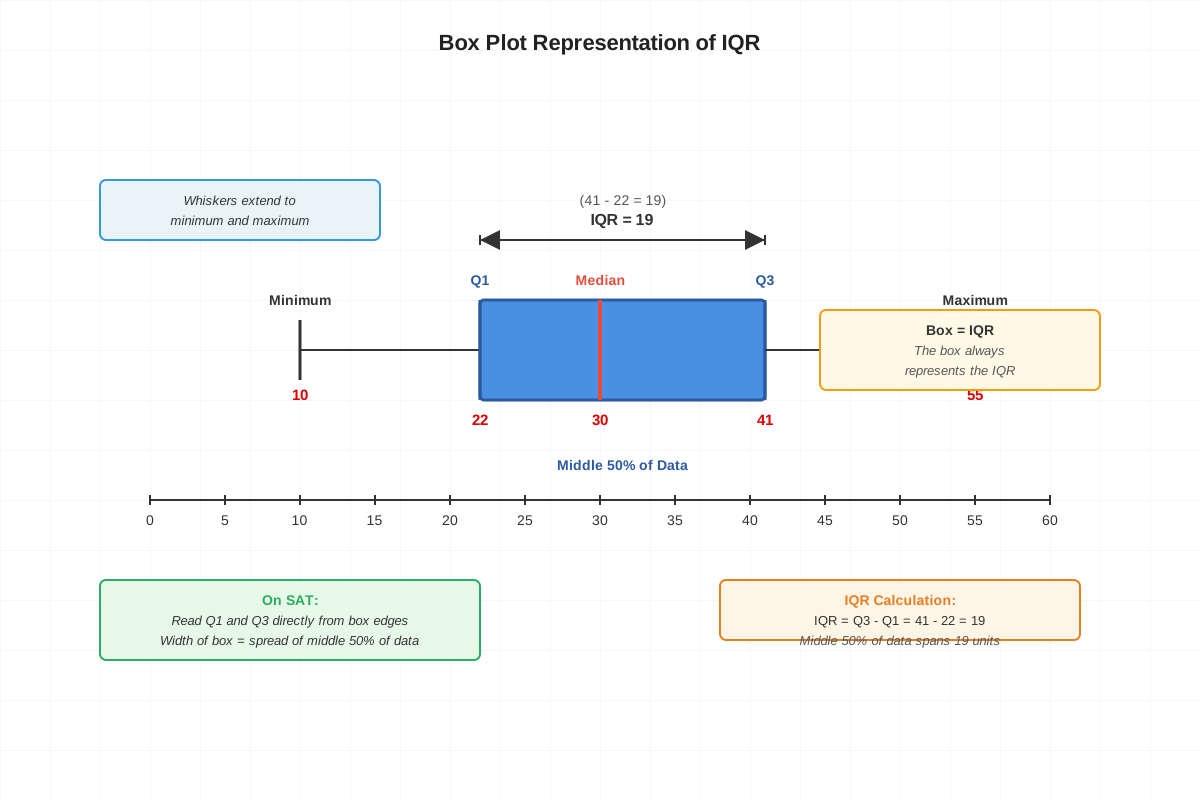
Box plots (also called box-and-whisker plots) provide a visual representation of the five-number summary: minimum, Q1, median (Q2), Q3, and maximum. The "box" portion extends from Q1 to Q3, making the width of the box equal to the IQR. This visual representation allows students to determine the IQR instantly by examining the box width.
The anatomy of a box plot includes:
- Left whisker: extends from the minimum to Q1
- Left edge of box: Q1
- Line inside box: median (Q2)
- Right edge of box: Q3
- Right whisker: extends from Q3 to the maximum
The IQR is immediately visible as the horizontal distance from the left edge to the right edge of the box. This makes box plots particularly efficient for comparing variability across multiple datasets—the wider the box, the larger the IQR and the greater the spread in the middle 50% of the data.
Resistance to Outliers
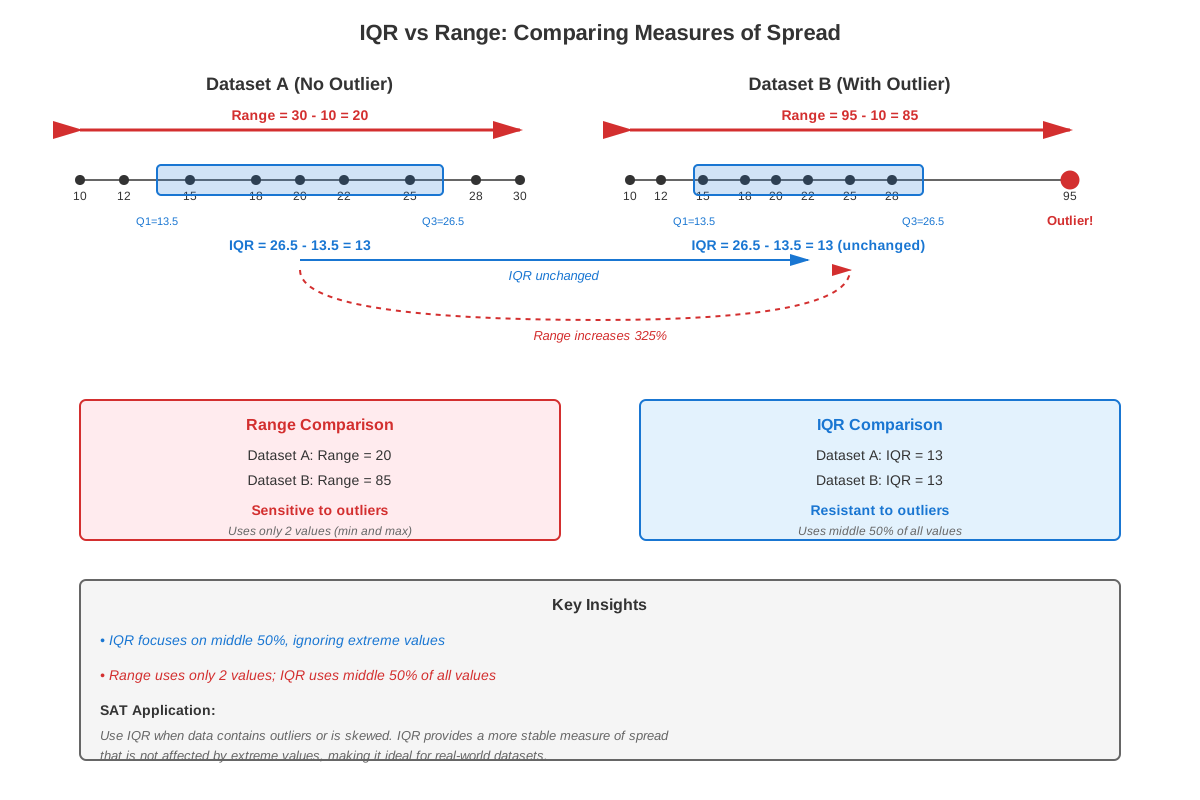
A critical property of the interquartile range is its resistance to outliers. Unlike the range, which can be dramatically affected by a single extreme value, the IQR focuses exclusively on the middle 50% of the data. This makes the IQR a robust measure of spread that provides reliable information about data variability even when outliers are present.
| Measure of Spread | Affected by Outliers? | Best Used When |
|---|---|---|
| Range | Yes (highly sensitive) | Data has no outliers and uniform distribution |
| Interquartile Range | No (resistant) | Data contains outliers or is skewed |
| Standard Deviation | Yes (moderately sensitive) | Data is approximately normally distributed |
The 1.5×IQR Rule for Outlier Detection
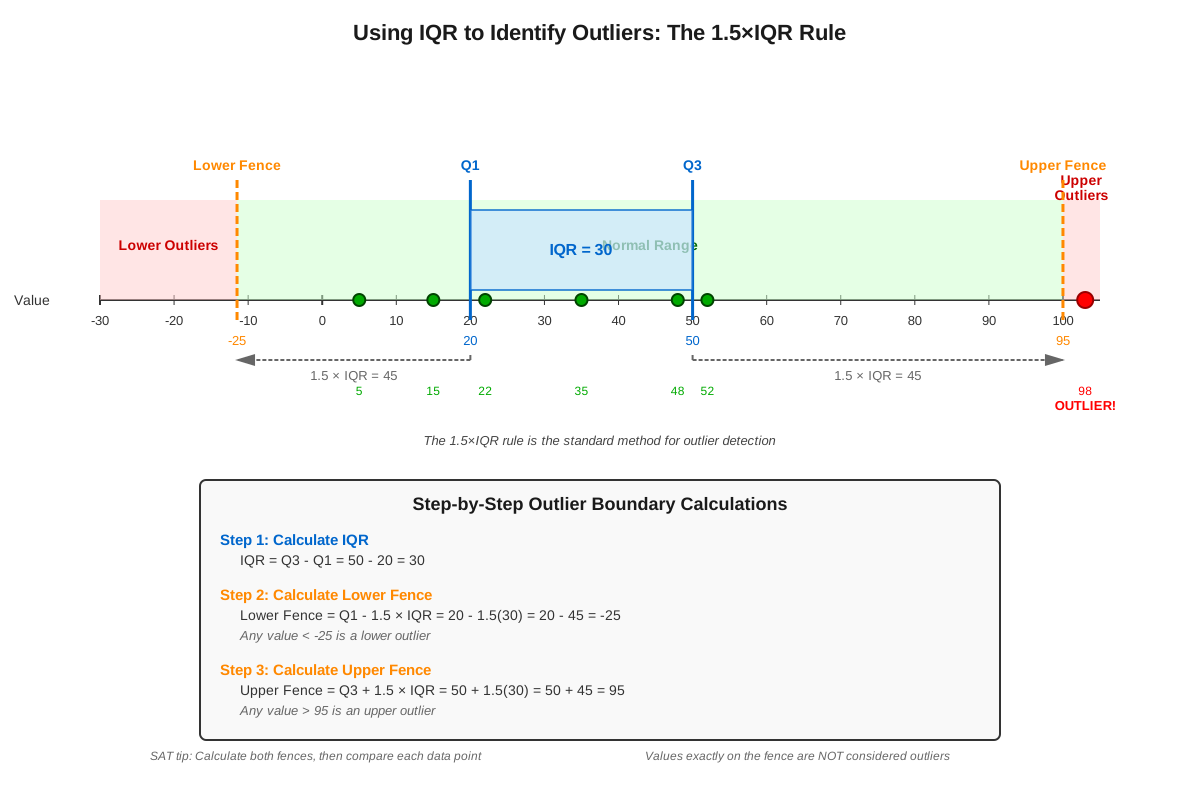
The IQR serves as the foundation for a standard method of identifying potential outliers in a dataset. The 1.5×IQR rule defines outliers as values that fall more than 1.5 times the IQR below Q1 or above Q3.
Specifically:
- Lower boundary = Q1 - 1.5×IQR
- Upper boundary = Q3 + 1.5×IQR
- Any value below the lower boundary or above the upper boundary is considered a potential outlier
This rule appears occasionally on the SAT, particularly in questions asking students to identify which values in a dataset are outliers or to determine whether a specific value would be considered unusual.
Effects of Data Transformations on IQR
Understanding how changes to a dataset affect the IQR is a sophisticated skill tested on the SAT. When every value in a dataset is transformed by the same operation, the IQR responds predictably:
- Adding or subtracting a constant: Does NOT change the IQR (the spread remains the same)
- Multiplying or dividing by a constant: Changes the IQR by the same factor
- Adding a single outlier: Typically does NOT change the IQR (demonstrating its resistance)
- Removing values from the middle of the distribution: May change the IQR significantly
For example, if a dataset has an IQR of 12 and every value is multiplied by 3, the new IQR becomes 36. However, if 5 is added to every value, the IQR remains 12 because the spacing between values hasn't changed.
Concept Relationships
The interquartile range exists within a network of interconnected statistical concepts. At its foundation, the IQR depends on quartile calculation, which in turn relies on the ability to find the median of a dataset. The median serves as Q2 and also as the reference point for dividing data into upper and lower halves, making it the conceptual anchor for all quartile work.
The relationship flows as follows: Data ordering → Median calculation → Quartile identification → IQR computation → Outlier detection → Data interpretation
The IQR connects horizontally to other measures of spread, including the range and standard deviation. While these three measures all quantify variability, they differ in their sensitivity to extreme values and their computational methods. Understanding when to use each measure requires recognizing their relative strengths: the range for quick approximations, the IQR for robust analysis with outliers present, and standard deviation for normally distributed data.
The IQR also connects upward to more advanced concepts like box plots, which provide visual representations of the five-number summary. Box plots make the IQR immediately visible and facilitate comparisons across multiple datasets. Additionally, the IQR enables outlier identification through the 1.5×IQR rule, creating a bridge between descriptive statistics and data quality assessment.
Finally, the IQR relates to percentiles more broadly. Since Q1 is the 25th percentile and Q3 is the 75th percentile, the IQR represents the range spanning the 25th through 75th percentiles. This connection helps students understand that the IQR captures the "typical" middle range of values, excluding the extreme quarters on both ends.
High-Yield Facts
⭐ The interquartile range is calculated as Q3 - Q1, representing the spread of the middle 50% of the data
⭐ The IQR is resistant to outliers, making it more reliable than the range when extreme values are present
⭐ In a box plot, the IQR is represented by the width of the box (the distance from the left edge to the right edge)
⭐ Adding or subtracting the same constant to every data value does NOT change the IQR
⭐ Multiplying or dividing every data value by the same constant multiplies or divides the IQR by that constant
- Q1 represents the 25th percentile and Q3 represents the 75th percentile of the dataset
- When finding quartiles, the dataset must first be arranged in ascending order
- For odd-sized datasets, exclude the median when dividing the data into lower and upper halves
- The 1.5×IQR rule identifies outliers as values below Q1 - 1.5×IQR or above Q3 + 1.5×IQR
- A larger IQR indicates greater variability in the middle 50% of the data
- The IQR can never be negative (since Q3 ≥ Q1 in any ordered dataset)
- Two datasets can have the same median but very different IQRs, indicating different spreads
Quick check — test yourself on Interquartile range so far.
Try Flashcards →Common Misconceptions
Misconception: The IQR includes all data between the minimum and maximum values.
Correction: The IQR specifically measures the spread of only the middle 50% of the data, from Q1 to Q3, excluding the lowest 25% and highest 25% of values.
Misconception: The median should be included when calculating Q1 and Q3 for all datasets.
Correction: For datasets with an odd number of values, the median is excluded when dividing the data into lower and upper halves. For even-sized datasets, the data naturally splits without this issue.
Misconception: Adding 10 to every value in a dataset will increase the IQR by 10.
Correction: Adding a constant to every value shifts the entire distribution but does not change the spread. The IQR remains unchanged because Q3 and Q1 both increase by the same amount, making their difference constant.
Misconception: The IQR and the range measure the same thing.
Correction: The range measures the spread from the absolute minimum to maximum (100% of the data spread), while the IQR measures only the spread of the middle 50%. The IQR is resistant to outliers, whereas the range is highly sensitive to extreme values.
Misconception: A dataset with a larger IQR always has a larger range.
Correction: While datasets with larger IQRs often have larger ranges, this is not always true. A dataset could have a small IQR (tightly clustered middle values) but a large range due to extreme outliers at both ends.
Misconception: The IQR can be calculated from a box plot by measuring from the left whisker to the right whisker.
Correction: The whiskers extend to the minimum and maximum (or to the boundaries excluding outliers), but the IQR is specifically the width of the box itself, from the left edge (Q1) to the right edge (Q3).
Misconception: If two datasets have the same IQR, they have the same distribution.
Correction: Multiple datasets can share the same IQR while having completely different medians, ranges, shapes, and overall distributions. The IQR captures only one aspect of the data—the spread of the middle 50%.
Worked Examples
Example 1: Calculating IQR from a Dataset
Problem: A student records the number of hours spent studying each week over 11 weeks: 8, 12, 15, 18, 20, 22, 24, 26, 28, 30, 35. Calculate the interquartile range.
Solution:
Step 1: Verify the data is in ascending order.
The data is already ordered: 8, 12, 15, 18, 20, 22, 24, 26, 28, 30, 35
Step 2: Find the median (Q2).
With 11 values (odd), the median is the 6th value: Q2 = 22
Step 3: Find Q1 (median of the lower half).
Lower half (excluding the median): 8, 12, 15, 18, 20
With 5 values, Q1 is the 3rd value: Q1 = 15
Step 4: Find Q3 (median of the upper half).
Upper half (excluding the median): 24, 26, 28, 30, 35
With 5 values, Q3 is the 3rd value: Q3 = 28
Step 5: Calculate the IQR.
IQR = Q3 - Q1 = 28 - 15 = 13
Answer: The interquartile range is 13 hours.
Connection to Learning Objectives: This example demonstrates the systematic process for calculating the IQR from a dataset, addressing the objective to "apply interquartile range to answer SAT-style questions" and "calculate Q1, Q3, and IQR from ordered datasets."
Example 2: Analyzing Data Transformations and Box Plots
Problem: A dataset has Q1 = 40, median = 55, and Q3 = 70.
(a) What is the IQR?
(b) If every value in the dataset is multiplied by 2 and then 5 is subtracted, what is the new IQR?
(c) Using the 1.5×IQR rule, what is the upper boundary for identifying outliers in the original dataset?
Solution:
Part (a):
IQR = Q3 - Q1 = 70 - 40 = 30
Part (b):
When every value is multiplied by 2:
- New Q1 = 40 × 2 = 80
- New Q3 = 70 × 2 = 140
- IQR after multiplication = 140 - 80 = 60
When 5 is subtracted from every value:
- New Q1 = 80 - 5 = 75
- New Q3 = 140 - 5 = 135
- Final IQR = 135 - 75 = 60
The IQR is multiplied by 2 (due to multiplication) but unchanged by the subtraction. New IQR = 60.
Part (c):
Upper boundary = Q3 + 1.5×IQR
Upper boundary = 70 + 1.5(30) = 70 + 45 = 115
Any value above 115 would be considered a potential outlier.
Answer: (a) IQR = 30; (b) New IQR = 60; (c) Upper boundary = 115
Connection to Learning Objectives: This multi-part problem addresses "analyze how adding, removing, or modifying data points affects the IQR" and "use the IQR to identify potential outliers using the 1.5×IQR rule," demonstrating sophisticated understanding of IQR properties.
Exam Strategy
When approaching SAT questions involving the interquartile range, begin by identifying the format in which data is presented. If the question provides a box plot, immediately locate the edges of the box—these represent Q1 and Q3, making the IQR calculation straightforward. If the data is presented as a list, quickly count the number of values to determine whether the dataset has an odd or even number of elements, as this affects the quartile calculation method.
Trigger words and phrases that signal IQR questions include: "interquartile range," "spread of the middle 50%," "Q1 and Q3," "box plot," "resistant to outliers," "which measure of spread is most appropriate," and "identify potential outliers." When a question asks about how data changes affect statistical measures, the IQR is often involved because of its unique properties regarding transformations.
For process-of-elimination strategies, remember these key principles:
- If a question asks which measure is most affected by outliers, eliminate the IQR (it's resistant)
- If answer choices include negative values for an IQR, eliminate them immediately (IQR cannot be negative)
- When a question describes adding a constant to all values, eliminate any answer choice showing the IQR changed
- If comparing two box plots, the dataset with the wider box has the larger IQR—eliminate answers inconsistent with this
Time allocation for IQR questions should typically be 60-90 seconds for straightforward calculation problems and up to 2 minutes for multi-step problems involving transformations or outlier detection. If a dataset has more than 15 values, double-check that the question actually requires full calculation—sometimes the SAT provides enough information through a box plot or summary statistics to answer without computing from raw data.
Exam Tip: On calculator-permitted sections, use your calculator to find medians of larger datasets by entering values and using statistical functions. However, for small datasets (fewer than 10 values), manual calculation is often faster and reduces the risk of data entry errors.
Always verify that data is ordered before calculating quartiles. A common time-wasting error is attempting to find quartiles from unordered data. If the SAT presents data in a table or scattered format, take 10 seconds to mentally or physically reorder it before proceeding.
Memory Techniques
IQR Calculation Mnemonic: "Order, Middle, Halves, Subtract" (OMHS)
- Order: Arrange data in ascending order
- Middle: Find the median (Q2)
- Halves: Find medians of lower half (Q1) and upper half (Q3)
- Subtract: Calculate Q3 - Q1
Quartile Percentile Connection: Remember "Quarters of Percentiles" - Q1 is 25% (1/4), Q2 is 50% (2/4), Q3 is 75% (3/4). The pattern of quarters helps recall which percentile each quartile represents.
Transformation Rules: Use the acronym "AMEN" for transformation effects:
- Add/subtract a constant: No change to IQR
- Multiply/divide by a constant: IQR changes by that factor
- Extreme values (outliers): No effect on IQR
- New middle values: May change IQR
Box Plot Visualization: Picture a "BOX" where:
- Boundaries are Q1 and Q3
- Outside are the whiskers (min and max)
- X marks the median inside
1.5 Rule Memory: Think "One and a Half Times Out" - multiply the IQR by one and a half, then go that distance out from Q1 (downward) and Q3 (upward) to find outlier boundaries.
Summary
The interquartile range is a robust measure of statistical spread that quantifies the variability of the middle 50% of a dataset by calculating the difference between the third quartile (Q3) and first quartile (Q1). Unlike the range, the IQR is resistant to outliers and extreme values, making it particularly valuable for analyzing skewed distributions or datasets containing unusual observations. To calculate the IQR, students must arrange data in ascending order, find the median to divide the dataset into halves, determine Q1 as the median of the lower half and Q3 as the median of the upper half, then subtract Q1 from Q3. The IQR appears frequently on the SAT in various contexts: direct calculation from datasets, interpretation of box plots where the IQR is represented by the box width, analysis of how data transformations affect spread, and application of the 1.5×IQR rule for outlier detection. Understanding that adding or subtracting constants does not change the IQR while multiplying or dividing by constants scales the IQR proportionally is essential for answering transformation questions correctly. Mastery of the interquartile range enables students to analyze data distributions effectively, compare variability across groups, and make informed decisions about which statistical measures are most appropriate for different situations.
Key Takeaways
- The IQR measures the spread of the middle 50% of data and is calculated as Q3 - Q1, making it resistant to outliers and extreme values
- To find quartiles, always order the data first, then find the median (Q2), followed by the medians of the lower half (Q1) and upper half (Q3)
- In box plots, the IQR is visually represented by the width of the box, allowing for quick visual comparison of variability across datasets
- Adding or subtracting a constant to all values does not change the IQR, but multiplying or dividing by a constant scales the IQR by that same factor
- The 1.5×IQR rule identifies potential outliers as values below Q1 - 1.5×IQR or above Q3 + 1.5×IQR
- The IQR is the preferred measure of spread when data contains outliers or is significantly skewed, whereas standard deviation is better for normally distributed data
- SAT questions frequently test IQR through box plot interpretation, data transformation analysis, and multi-step problems combining multiple statistical concepts
Related Topics
Standard Deviation: While the IQR measures spread using quartiles, standard deviation quantifies variability by measuring the average distance of data points from the mean. Understanding both measures allows students to choose the most appropriate measure for different data distributions and answer comparative questions on the SAT.
Box Plots and Five-Number Summary: Box plots provide visual representations of the minimum, Q1, median, Q3, and maximum. Mastering box plot interpretation builds directly on IQR knowledge and enables quick visual analysis of data distributions, a high-yield skill for SAT data analysis questions.
Outlier Detection and Data Quality: The 1.5×IQR rule serves as a foundation for more sophisticated outlier detection methods. Understanding how to identify and interpret outliers is essential for data analysis questions that ask about unusual observations or data quality issues.
Percentiles and Quartiles: Since quartiles are specific percentiles (25th, 50th, 75th), deeper exploration of percentiles extends IQR knowledge to more general position measures. This connection helps students understand relative standing and ranking questions on the SAT.
Comparing Distributions: Mastering the IQR enables students to compare variability across multiple groups or datasets, a common SAT question type. This skill extends to analyzing which group has more consistent data, greater spread, or more extreme values.
Practice CTA
Now that you have thoroughly studied the interquartile range, it's time to solidify your understanding through active practice. Attempt the practice questions designed specifically for this topic, focusing on applying the systematic calculation methods and transformation rules you've learned. Use the flashcards to reinforce key definitions, formulas, and properties until you can recall them instantly. Remember that mastery comes through repeated application—each practice problem strengthens your ability to recognize IQR questions quickly and solve them accurately under timed conditions. Your investment in deliberate practice now will translate directly into points on test day. You've built a strong conceptual foundation; now demonstrate your mastery through confident, accurate problem-solving!
Sign up free to keep reading
Create a free AnvayaPrep account to finish this SAT guide on Interquartile range — plus flashcards and practice questions.