Overview
The line of best fit, also known as a trend line or regression line, is a fundamental concept in data analysis that appears consistently on the SAT math section. This statistical tool represents the linear relationship between two variables in a scatter plot by drawing a straight line that best approximates the overall pattern of the data points. Understanding how to interpret, analyze, and apply lines of best fit is crucial for success on the SAT, as these questions test both conceptual understanding and practical problem-solving skills.
On the SAT, line of best fit questions typically appear in the Problem Solving and Data Analysis domain, which comprises approximately 17% of the math section. These questions require students to interpret scatter plots, understand the meaning of slope and y-intercept in context, make predictions using the line, and evaluate the strength of relationships between variables. The College Board frequently integrates this topic with real-world scenarios involving trends, predictions, and data interpretation, making it one of the most practical and applicable mathematical concepts tested.
Mastering the sat line of best fit connects directly to broader mathematical concepts including linear equations, coordinate geometry, and statistical reasoning. This topic serves as a bridge between algebraic manipulation and data interpretation, requiring students to translate between graphical representations, equations, and contextual meanings. Success with line of best fit questions demonstrates mathematical maturity and the ability to apply abstract concepts to concrete situations—skills that are highly valued on the SAT and beyond.
Learning Objectives
- [ ] Identify key features of line of best fit including slope, y-intercept, and direction
- [ ] Explain how line of best fit appears on the SAT in various question formats
- [ ] Apply line of best fit to answer SAT-style questions involving predictions and interpretations
- [ ] Determine whether a line of best fit shows positive, negative, or no correlation
- [ ] Interpret the real-world meaning of slope and y-intercept in context-based problems
- [ ] Evaluate the reliability of predictions made using a line of best fit
- [ ] Calculate and estimate values using the equation of a line of best fit
Prerequisites
- Linear equations and slope-intercept form (y = mx + b): Essential for understanding the equation of a line of best fit and interpreting its components
- Coordinate plane and graphing: Necessary for visualizing scatter plots and understanding how lines relate to data points
- Basic algebraic manipulation: Required for solving equations and finding specific values using the line of best fit
- Understanding of variables and their relationships: Fundamental for interpreting what the x and y variables represent in context
- Reading and interpreting graphs: Critical for extracting information from scatter plots and trend lines
Why This Topic Matters
In real-world applications, lines of best fit are ubiquitous tools used across numerous fields. Scientists use them to identify trends in experimental data, economists employ them to forecast market behavior, medical researchers apply them to understand relationships between health factors, and businesses utilize them for sales projections and strategic planning. The ability to interpret trends and make data-driven predictions is a fundamental skill in our increasingly data-centric world.
On the SAT, line of best fit questions appear with remarkable consistency, typically showing up 2-3 times per test administration. These questions account for approximately 5-8% of the total math section, making them high-yield content for focused study. The College Board favors this topic because it assesses multiple competencies simultaneously: graphical interpretation, algebraic reasoning, contextual understanding, and critical thinking about data reliability.
Common SAT question formats include: interpreting the meaning of slope or y-intercept in a real-world context, using the line equation to make predictions, determining which equation best represents a given scatter plot, identifying whether correlation is positive or negative, evaluating the appropriateness of extrapolation, and understanding residuals or deviations from the line. Questions often embed the line of best fit within scenarios involving time-series data, comparative studies, or experimental results, requiring students to navigate both mathematical and contextual complexity.
Core Concepts
Definition and Purpose of Line of Best Fit
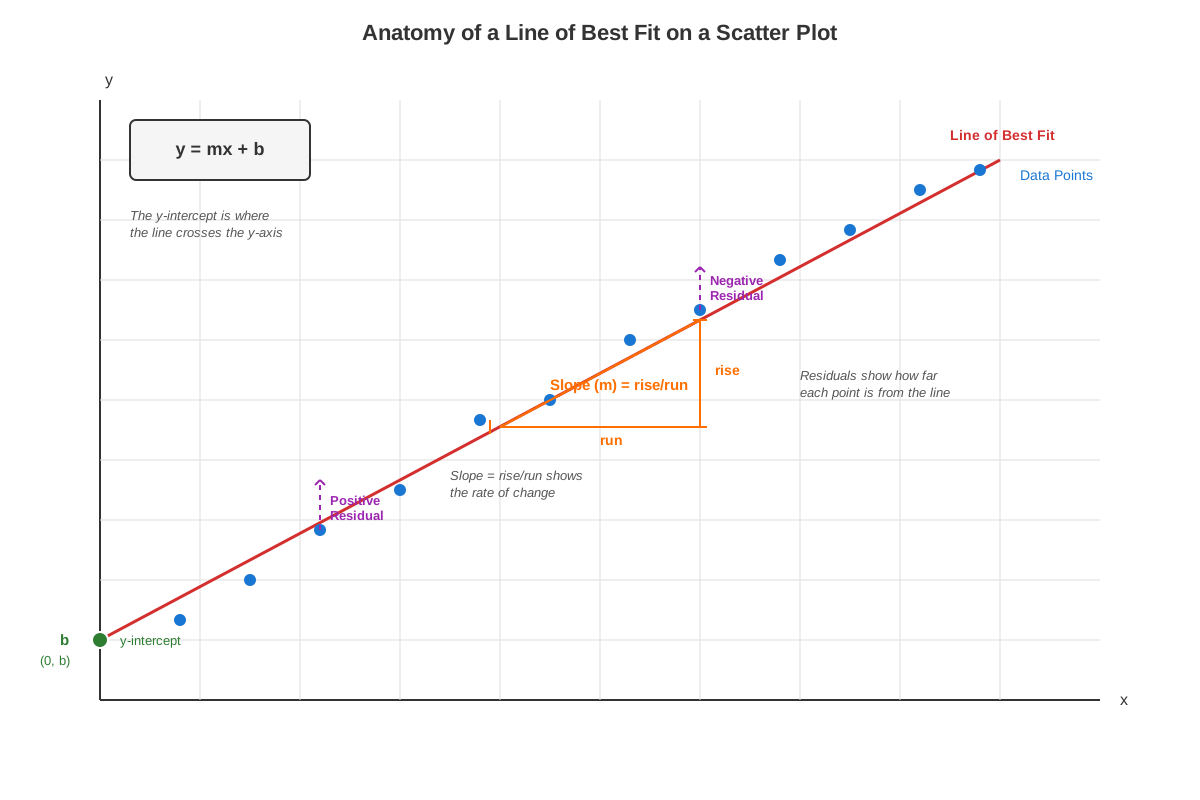
A line of best fit is a straight line drawn through a scatter plot of data points that best represents the overall trend or relationship between two variables. Unlike a line that connects specific points, the line of best fit aims to minimize the overall distance between itself and all data points collectively. This line serves as a mathematical model that captures the general pattern in the data while acknowledging that individual points may deviate from this pattern.
The primary purpose of a line of best fit is to identify and quantify relationships between variables, enabling predictions and interpretations. When examining a scatter plot, the line of best fit provides a simplified representation of complex data, making it easier to understand trends and make informed estimates about values not explicitly shown in the dataset.
Components of the Line of Best Fit Equation
The line of best fit follows the standard linear equation format:
y = mx + bWhere:
- y represents the dependent variable (the outcome being predicted)
- x represents the independent variable (the input or predictor)
- m represents the slope (rate of change)
- b represents the y-intercept (starting value when x = 0)
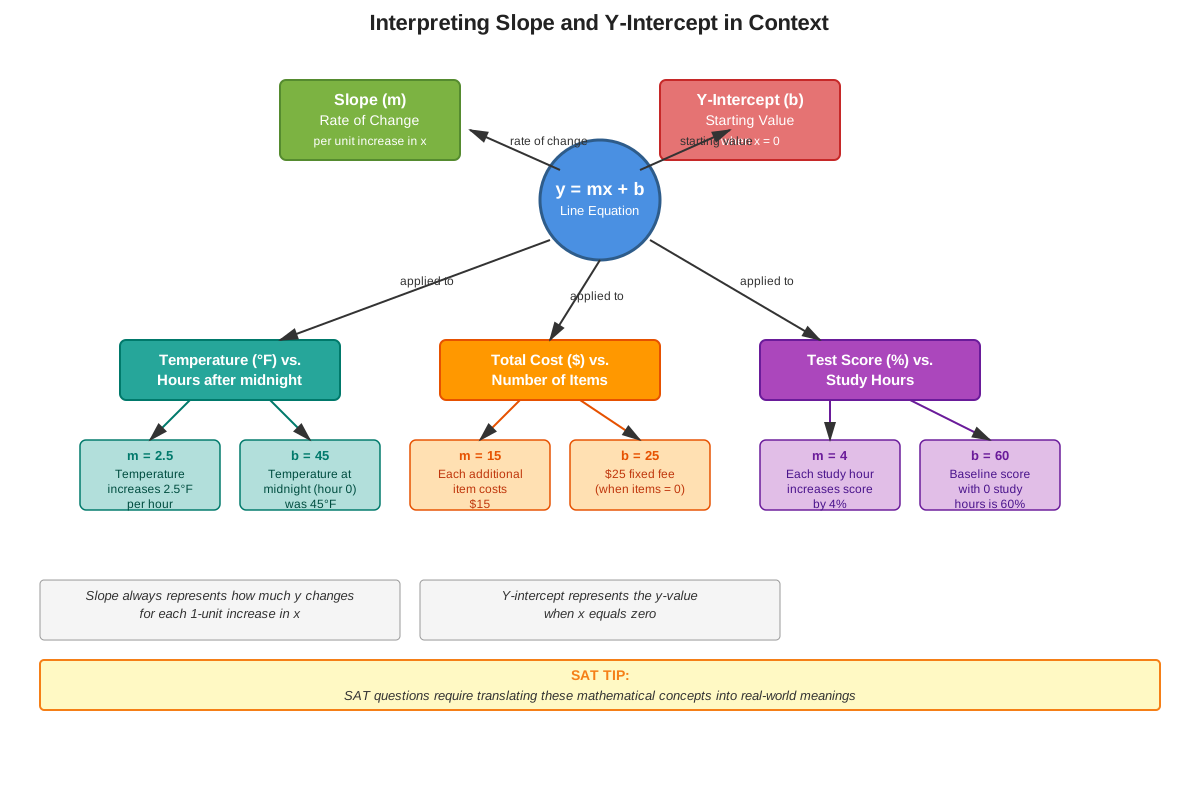
Understanding each component's contextual meaning is crucial for SAT success. The slope indicates how much y changes for each one-unit increase in x. A positive slope means the variables increase together, while a negative slope indicates an inverse relationship. The y-intercept represents the predicted value of y when x equals zero, though this may not always have practical meaning depending on the context.
Types of Correlation
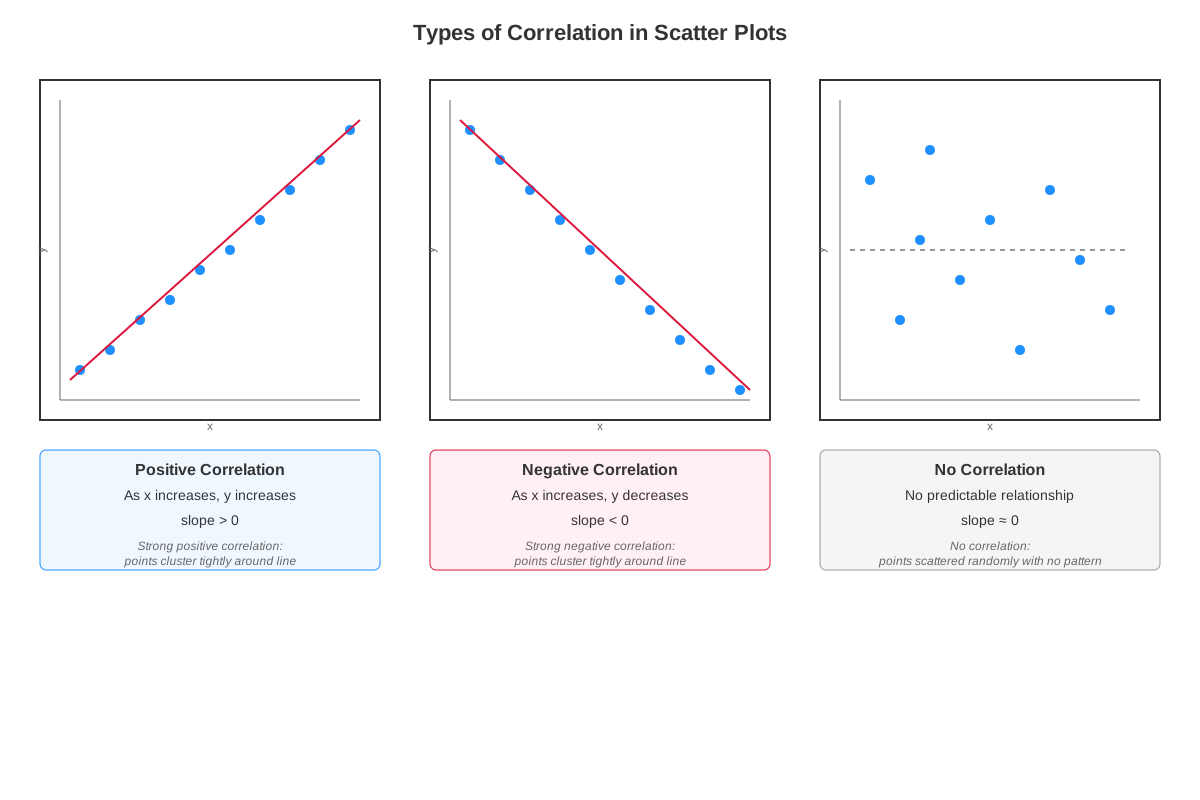
The relationship between variables shown by a line of best fit can be classified into three categories:
| Correlation Type | Slope Direction | Interpretation | Example |
|---|---|---|---|
| Positive Correlation | Upward (positive slope) | As x increases, y increases | Study time vs. test scores |
| Negative Correlation | Downward (negative slope) | As x increases, y decreases | Car age vs. resale value |
| No Correlation | Horizontal or scattered | No clear relationship | Shoe size vs. test scores |
The strength of correlation refers to how closely the data points cluster around the line of best fit. Strong correlation means points lie close to the line, while weak correlation shows greater scatter. On the SAT, students must distinguish between the existence of correlation and its strength.
Interpreting Slope in Context
The slope of a line of best fit carries specific meaning that must be interpreted within the problem's context. For example, if a line of best fit for "hours studied" (x) versus "test score" (y) has a slope of 5, this means that for each additional hour studied, the test score is predicted to increase by 5 points. The SAT frequently asks students to identify what the slope represents or to select the correct interpretation from multiple choices.
Key considerations for slope interpretation:
- The slope's units are always (units of y) per (units of x)
- The magnitude indicates the rate of change
- The sign indicates the direction of the relationship
- Context determines whether the slope value is practically significant
Interpreting Y-Intercept in Context
The y-intercept represents the predicted value of y when x equals zero. However, this value may or may not be meaningful depending on whether x = 0 is within the reasonable range of the data. For instance, if x represents years since 2000, the y-intercept would represent the predicted value in the year 2000. If x represents a person's age, a y-intercept might not have practical meaning since age zero may be outside the data's scope.
SAT questions often test whether students can recognize when a y-intercept has practical significance versus when it's merely a mathematical artifact of the equation. Critical thinking about the domain of the data is essential.
Making Predictions Using the Line of Best Fit
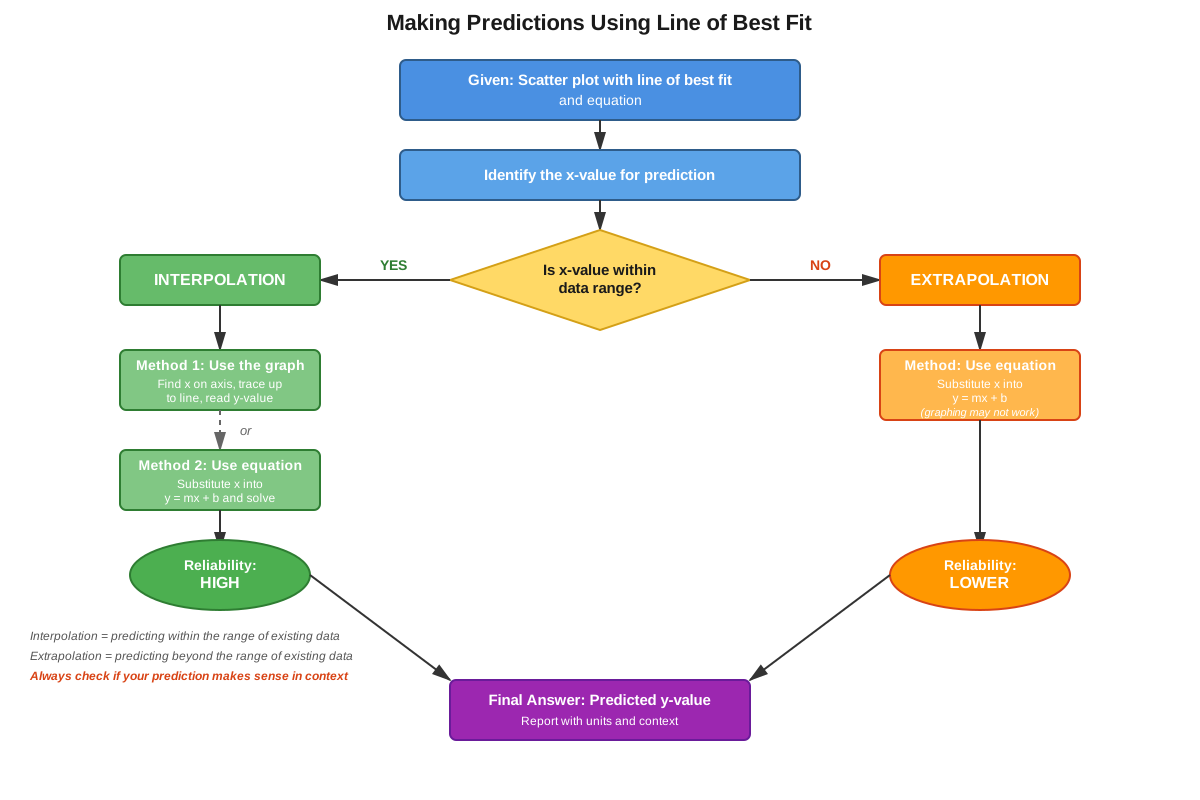
One of the most common SAT applications involves using the line of best fit equation to predict values. This process involves two types of prediction:
- Interpolation: Predicting values within the range of observed data (generally reliable)
- Extrapolation: Predicting values outside the range of observed data (less reliable)
To make a prediction, substitute the given x-value into the equation and solve for y, or substitute the given y-value and solve for x. The SAT may present the equation explicitly or require students to derive it from a graph.
Residuals and Goodness of Fit
A residual is the vertical distance between an actual data point and the predicted value on the line of best fit. Residuals indicate how well the line models the data:
Residual = Actual value - Predicted valuePositive residuals occur when actual values exceed predictions (points above the line), while negative residuals occur when actual values fall below predictions (points below the line). While the SAT rarely requires residual calculations, understanding that the line of best fit minimizes the sum of squared residuals helps explain why it's positioned where it is.
Scatter Plot Analysis
When analyzing a scatter plot with a line of best fit, students should systematically evaluate:
- The overall direction of the relationship (positive, negative, or none)
- The strength of the relationship (how tightly clustered the points are)
- The presence of outliers (points far from the line that may affect its position)
- The appropriateness of a linear model (whether a straight line adequately represents the pattern)
The SAT may present scatter plots where a linear model is not ideal, testing whether students can recognize when a line of best fit is inappropriate for the data pattern.
Concept Relationships
The line of best fit concept builds directly upon foundational knowledge of linear equations and the slope-intercept form. Understanding y = mx + b is prerequisite to interpreting the equation of a line of best fit, as the same algebraic principles apply. The slope and y-intercept maintain their mathematical definitions while gaining additional contextual significance.
Within the topic itself, concepts flow logically: Scatter plot creation → Pattern recognition → Line of best fit construction → Equation determination → Interpretation and prediction. Each step depends on the previous one, creating a coherent analytical process.
The line of best fit connects to broader statistical concepts including correlation coefficients (which quantify relationship strength), causation versus correlation (understanding that correlation doesn't imply causation), and data modeling (using mathematical functions to represent real-world phenomena). While the SAT doesn't typically test correlation coefficients directly, understanding that they measure what the line of best fit represents visually enhances conceptual mastery.
This topic also relates to systems of equations when determining where two lines of best fit intersect, domain and range when considering appropriate prediction intervals, and function notation when the line of best fit is expressed as f(x) rather than y. These connections demonstrate how line of best fit serves as an integrative concept that bridges multiple mathematical domains.
Quick check — test yourself on Line of best fit so far.
Try Flashcards →High-Yield Facts
⭐ The slope of a line of best fit represents the rate of change between the two variables and must be interpreted in context with appropriate units.
⭐ The y-intercept represents the predicted value of y when x = 0, but may not always have practical meaning depending on the data's domain.
⭐ Positive correlation means both variables increase together (upward slope); negative correlation means one increases as the other decreases (downward slope).
⭐ Interpolation (predicting within the data range) is more reliable than extrapolation (predicting outside the data range).
⭐ The line of best fit minimizes the overall distance to all data points but typically doesn't pass through most individual points.
- A strong correlation means data points cluster tightly around the line of best fit, while weak correlation shows greater scatter.
- Correlation does not imply causation—two variables can be correlated without one causing the other.
- Outliers are data points that lie far from the line of best fit and can significantly influence the line's position.
- The equation of a line of best fit can be used to solve for either variable given the other.
- On the SAT, line of best fit questions often require translating between graphical, algebraic, and verbal representations.
- The domain of the data determines the reasonable range for making predictions using the line of best fit.
- A horizontal line of best fit (slope = 0) indicates no relationship between the variables.
Common Misconceptions
Misconception: The line of best fit must pass through most or all of the data points.
Correction: The line of best fit represents the overall trend and typically passes through few, if any, actual data points. It minimizes the total distance to all points collectively, not individually.
Misconception: A steep slope always indicates a strong correlation.
Correction: Slope steepness indicates the rate of change, not correlation strength. A line can have a steep slope with weak correlation (scattered points) or a gentle slope with strong correlation (tightly clustered points). Correlation strength is determined by how closely points cluster around the line, regardless of slope.
Misconception: The y-intercept always has practical meaning in real-world contexts.
Correction: The y-intercept only has practical meaning when x = 0 falls within the reasonable domain of the data. For example, if x represents years since 1990, the y-intercept represents the value in 1990, which may be meaningful. However, if x represents a person's height, a y-intercept (height = 0) has no practical interpretation.
Misconception: Correlation between two variables means one causes the other.
Correction: Correlation indicates a relationship between variables but does not establish causation. Two variables can be correlated due to coincidence, a third confounding variable, or a complex indirect relationship. The SAT may test this distinction by asking whether a correlation implies a causal relationship.
Misconception: Predictions made using the line of best fit are always accurate.
Correction: The line of best fit provides estimates based on the overall trend, but individual predictions may differ from actual values. Predictions are most reliable within the range of observed data (interpolation) and become less reliable when extended beyond this range (extrapolation). The strength of correlation also affects prediction reliability.
Misconception: All data relationships can be modeled with a line of best fit.
Correction: A linear model (straight line) is only appropriate when the relationship between variables is approximately linear. Some relationships are exponential, quadratic, or follow other patterns that a straight line cannot adequately represent. The SAT may present scenarios where a linear model is inappropriate.
Worked Examples
Example 1: Interpreting Slope and Making Predictions
Problem: A researcher studies the relationship between hours of sleep (x) and reaction time in milliseconds (y) for a group of participants. The line of best fit for the data is given by the equation y = -15x + 350.
a) What does the slope represent in this context?
b) What does the y-intercept represent?
c) Predict the reaction time for someone who sleeps 7 hours.
Solution:
a) Interpreting the slope: The slope is -15, which means that for each additional hour of sleep, the reaction time decreases by 15 milliseconds. The negative slope indicates an inverse relationship—more sleep correlates with faster (lower) reaction times. The units are milliseconds per hour.
b) Interpreting the y-intercept: The y-intercept is 350, which represents the predicted reaction time when x = 0 (zero hours of sleep). In this context, it suggests that someone with no sleep would have a reaction time of 350 milliseconds. However, this may be an extrapolation beyond the reasonable data range, as the study likely didn't include participants with zero sleep.
c) Making a prediction: To find the reaction time for 7 hours of sleep, substitute x = 7 into the equation:
y = -15(7) + 350
y = -105 + 350
y = 245
The predicted reaction time for someone who sleeps 7 hours is 245 milliseconds.
Connection to learning objectives: This example demonstrates how to interpret slope and y-intercept in context (objectives 1 and 5) and apply the line of best fit to make predictions (objective 3).
Example 2: Analyzing a Scatter Plot and Determining Correlation
Problem: A scatter plot shows the relationship between the number of hours students spend on social media per day (x-axis) and their GPA (y-axis). The line of best fit has a negative slope and passes approximately through the points (2, 3.5) and (6, 2.5).
a) What type of correlation does this represent?
b) Estimate the equation of the line of best fit.
c) If a student spends 4 hours on social media, what GPA would the line predict?
d) Is it appropriate to use this line to predict the GPA of a student who spends 15 hours on social media?
Solution:
a) Type of correlation: The negative slope indicates a negative correlation. As social media usage increases, GPA tends to decrease. This is an inverse relationship between the variables.
b) Estimating the equation: First, calculate the slope using the two given points:
m = (y₂ - y₁)/(x₂ - x₁) = (2.5 - 3.5)/(6 - 2) = -1/4 = -0.25Now use point-slope form with point (2, 3.5):
y - 3.5 = -0.25(x - 2)
y - 3.5 = -0.25x + 0.5
y = -0.25x + 4
The estimated equation is y = -0.25x + 4.
c) Making a prediction: Substitute x = 4:
y = -0.25(4) + 4 = -1 + 4 = 3The line predicts a GPA of 3.0 for a student spending 4 hours on social media.
d) Evaluating appropriateness: Using the line to predict GPA for 15 hours of social media usage would be extrapolation beyond the observed data range (which appears to be roughly 0-8 hours based on the given points). This prediction would be less reliable because the relationship may not continue linearly at extreme values. Additionally, a GPA cannot be negative, but the equation would predict y = -0.25(15) + 4 = 0.25, which is unrealistically low and suggests the linear model breaks down at extreme values.
Connection to learning objectives: This example requires identifying correlation type (objective 4), applying the line to answer questions (objective 3), and evaluating prediction reliability (objective 6).
Exam Strategy
When approaching SAT line of best fit questions, begin by carefully reading the context to understand what each variable represents. Identify whether the question asks for interpretation (what does the slope mean?), calculation (find a predicted value), or evaluation (is this prediction reliable?). This initial classification helps determine the appropriate solution approach.
Trigger words and phrases to watch for include: "best represented by," "according to the line of best fit," "predicted value," "rate of change," "for each increase," "when x equals zero," and "based on the trend." These phrases signal specific aspects of the line of best fit that the question targets.
For interpretation questions, focus on units and context. The slope's units are always (y-units) per (x-units), and the correct answer will reflect this relationship. Eliminate answer choices that reverse the variables or use incorrect units. For y-intercept questions, consider whether x = 0 falls within the reasonable data domain.
For calculation questions, write down the equation if provided, or extract it from the graph. Substitute the given value carefully, and double-check which variable is given and which must be found. Show your work systematically to avoid arithmetic errors.
For graphical questions where you must identify which equation matches a scatter plot, use the slope's sign (positive/negative) to eliminate options immediately. Then check whether the y-intercept appears reasonable based on where the line crosses the y-axis.
Process-of-elimination strategies: If a question asks about correlation strength, eliminate answers that confuse slope steepness with correlation strength. If asked about causation, eliminate any answer that claims one variable causes the other based solely on correlation. For prediction questions, eliminate answers that fall far outside the reasonable range suggested by the data.
Time allocation: Most line of best fit questions can be solved in 60-90 seconds. If a question requires extensive calculation, ensure you're not overcomplicating it—the SAT rarely requires complex arithmetic. If stuck, move on and return later, as these questions are worth the same points as simpler ones.
Memory Techniques
Slope interpretation mnemonic: "RISE over RUN means Y per X" — Remember that slope represents how much y changes per unit change in x, with units of (y-units)/(x-units).
Correlation direction: "Positive = Partners" — In positive correlation, the variables move together as partners (both increase or both decrease). "Negative = Nemesis" — In negative correlation, the variables oppose each other like nemeses (one increases while the other decreases).
Interpolation vs. Extrapolation: "INTER = INTERNAL" (within the data range, more reliable) and "EXTRA = EXTERNAL" (outside the data range, less reliable).
Y-intercept meaning: Visualize the y-axis as a "starting line" where x = 0. The y-intercept is where you "start" before any x-value is added. Ask yourself: "Does a starting point of zero make sense in this context?"
Equation components: Use the acronym "YMXB" (pronounced "Y-mix-bee") to remember the order: Y = MX + B. Associate M with "Movement" (slope shows how y moves as x changes) and B with "Beginning" (y-intercept is the beginning value).
Scatter plot analysis: Use the checklist "DSOS" — Direction (positive/negative/none), Strength (strong/weak), Outliers (any unusual points?), Suitability (is a linear model appropriate?).
Summary
The line of best fit is a fundamental statistical tool that models the linear relationship between two variables in a scatter plot. Represented by the equation y = mx + b, it provides a mathematical framework for understanding trends, making predictions, and interpreting data relationships. The slope indicates the rate of change between variables with specific contextual meaning and appropriate units, while the y-intercept represents the predicted value when the independent variable equals zero. SAT questions test the ability to interpret these components in context, distinguish between positive and negative correlation, make predictions through interpolation and extrapolation, and evaluate the reliability and appropriateness of linear models. Success requires integrating algebraic skills with contextual reasoning, recognizing that correlation does not imply causation, and understanding that predictions are most reliable within the observed data range. Mastering line of best fit questions demands both computational accuracy and conceptual understanding of how mathematical models represent real-world relationships.
Key Takeaways
- The line of best fit equation y = mx + b models the linear relationship between two variables, where slope (m) represents rate of change and y-intercept (b) represents the starting value
- Slope must always be interpreted with appropriate units (y-units per x-unit) and contextual meaning specific to the problem scenario
- Positive correlation means variables increase together; negative correlation means one increases as the other decreases; correlation strength depends on how tightly points cluster around the line
- Interpolation (predicting within the data range) is more reliable than extrapolation (predicting outside the data range)
- The y-intercept only has practical meaning when x = 0 falls within the reasonable domain of the data
- Correlation between variables does not establish causation—other factors may explain the relationship
- SAT questions require translating between graphical, algebraic, and verbal representations of the line of best fit
Related Topics
Correlation Coefficients (r and r²): These numerical measures quantify the strength and direction of linear relationships, providing a mathematical complement to the visual representation of the line of best fit. Understanding correlation coefficients deepens comprehension of what "strong" versus "weak" correlation means quantitatively.
Residual Analysis: Examining the differences between actual data points and predicted values helps evaluate model quality and identify patterns that a linear model may not capture. This topic extends line of best fit understanding to more sophisticated statistical analysis.
Non-Linear Models: Exponential, quadratic, and other non-linear functions can model relationships that don't follow straight-line patterns. Mastering line of best fit provides the foundation for understanding when linear models are insufficient and alternative approaches are needed.
Two-Way Tables and Conditional Probability: These topics also appear in the SAT Data Analysis domain and complement line of best fit by addressing categorical rather than continuous data relationships.
Systems of Linear Equations: Finding intersection points of multiple lines of best fit applies algebraic skills in a statistical context, demonstrating how different trends can be compared mathematically.
Practice CTA
Now that you've mastered the core concepts of line of best fit, it's time to solidify your understanding through active practice. Attempt the practice questions to apply these concepts in SAT-style scenarios, and use the flashcards to reinforce key definitions and relationships. Remember, the difference between understanding a concept and mastering it for test day lies in deliberate practice. Each question you work through builds the pattern recognition and problem-solving speed essential for SAT success. You've built a strong foundation—now transform that knowledge into points!
Sign up free to keep reading
Create a free AnvayaPrep account to finish this SAT guide on Line of best fit — plus flashcards and practice questions.