Overview
Two-way tables are powerful organizational tools that display categorical data across two variables simultaneously, allowing students to analyze relationships between different groups and characteristics. On the SAT math section, these tables appear frequently as a method to present survey results, experimental data, or demographic information that students must interpret to answer questions about frequencies, conditional probabilities, and associations between variables.
Understanding two-way tables is essential for SAT success because they form the foundation for approximately 5-8% of all math questions on the exam. These questions test not only basic reading comprehension of tabular data but also deeper analytical skills such as calculating marginal distributions, conditional probabilities, and identifying whether associations exist between categorical variables. The College Board consistently includes sat two-way tables questions because they assess real-world data literacy skills that students will need in college coursework across disciplines from social sciences to business to health sciences.
Two-way tables connect to broader mathematical concepts including probability, statistics, percentages, and proportional reasoning. They serve as a bridge between simple data interpretation and more complex statistical analysis, making them a cornerstone topic in the Data Analysis and Statistics unit. Mastering two-way tables also strengthens skills in logical reasoning and systematic problem-solving that transfer to other SAT math domains, particularly those involving data interpretation from graphs, charts, and scatterplots.
Learning Objectives
- [ ] Identify key features of two-way tables including row and column headers, cell values, and marginal totals
- [ ] Explain how two-way tables appears on the SAT in various question formats and difficulty levels
- [ ] Apply two-way tables to answer SAT-style questions involving frequencies, percentages, and probabilities
- [ ] Calculate and interpret marginal distributions from two-way table data
- [ ] Determine conditional probabilities using information from specific rows or columns
- [ ] Evaluate whether an association exists between two categorical variables presented in a table
- [ ] Convert between frequency counts and relative frequencies (percentages or proportions)
Prerequisites
- Basic arithmetic operations: Addition, subtraction, multiplication, and division are necessary to calculate totals, differences, and ratios from table values
- Fraction and percentage conversions: Understanding how to express parts of a whole as fractions, decimals, or percentages enables interpretation of relative frequencies
- Basic probability concepts: Familiarity with expressing likelihood as a ratio of favorable outcomes to total outcomes provides the foundation for conditional probability calculations
- Reading comprehension skills: The ability to extract information from text and match it to corresponding table categories is essential for identifying which cells contain relevant data
Why This Topic Matters
Two-way tables represent one of the most practical statistical tools students will encounter in academic and professional settings. In real-world applications, these tables organize survey data for market research, display medical trial results comparing treatment groups, present demographic breakdowns in census data, and summarize experimental outcomes in scientific studies. The ability to read and interpret two-way tables is fundamental to data literacy in an increasingly data-driven world.
On the SAT, two-way table questions appear with high frequency, typically showing up 2-3 times per test administration across both the calculator and no-calculator sections. These questions account for approximately 5-8% of the total math score and range from straightforward data retrieval problems worth 1 point to complex multi-step problems requiring conditional probability calculations. The College Board favors two-way tables because they efficiently test multiple skills simultaneously: reading comprehension, arithmetic accuracy, proportional reasoning, and logical analysis.
Common SAT question formats include: asking students to identify a specific cell value or marginal total; calculating what percentage of one category falls into another category; determining conditional probabilities given membership in a particular group; evaluating whether data supports a claim about association between variables; and solving for unknown values when given partial information and constraints. Questions may present the table directly or require students to construct a table from verbal descriptions before solving.
Core Concepts
Structure and Components of Two-Way Tables
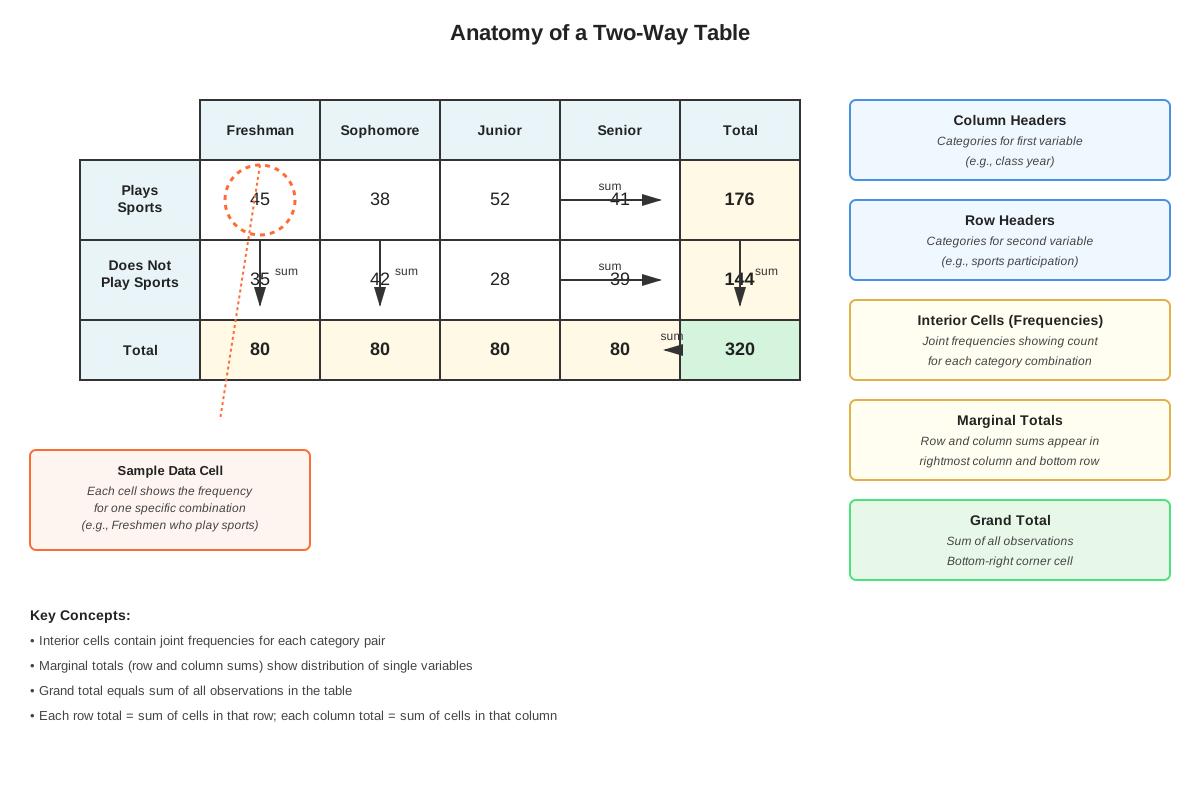
A two-way table (also called a contingency table or cross-tabulation) organizes data by displaying the frequency distribution of two categorical variables simultaneously. The table uses rows to represent categories of one variable and columns to represent categories of the other variable, creating a grid where each cell shows the count (or sometimes percentage) of observations that fall into both categories.
The essential components include:
- Row headers: Labels for categories of the first variable, typically listed along the left side
- Column headers: Labels for categories of the second variable, listed across the top
- Interior cells: Frequency counts showing how many observations share both the row and column characteristics
- Marginal totals: Row totals (rightmost column) and column totals (bottom row) showing the sum of all values in each row or column
- Grand total: The bottom-right cell showing the total number of observations in the entire dataset
Reading and Interpreting Cell Values
Each interior cell in a two-way table represents the joint frequency of two categories occurring together. To locate the correct cell for any question, students must identify the appropriate row category and column category, then find where they intersect. For example, in a table showing student enrollment by grade level (rows) and extracurricular participation (columns), the cell at the intersection of "10th grade" and "plays sports" would show how many 10th graders play sports.
Marginal distributions appear in the totals along the edges of the table. The row totals show the total frequency for each row category across all column categories, while column totals show the total frequency for each column category across all row categories. These marginal totals are crucial for calculating percentages and probabilities because they represent the denominators for many calculations.
Calculating Frequencies and Percentages
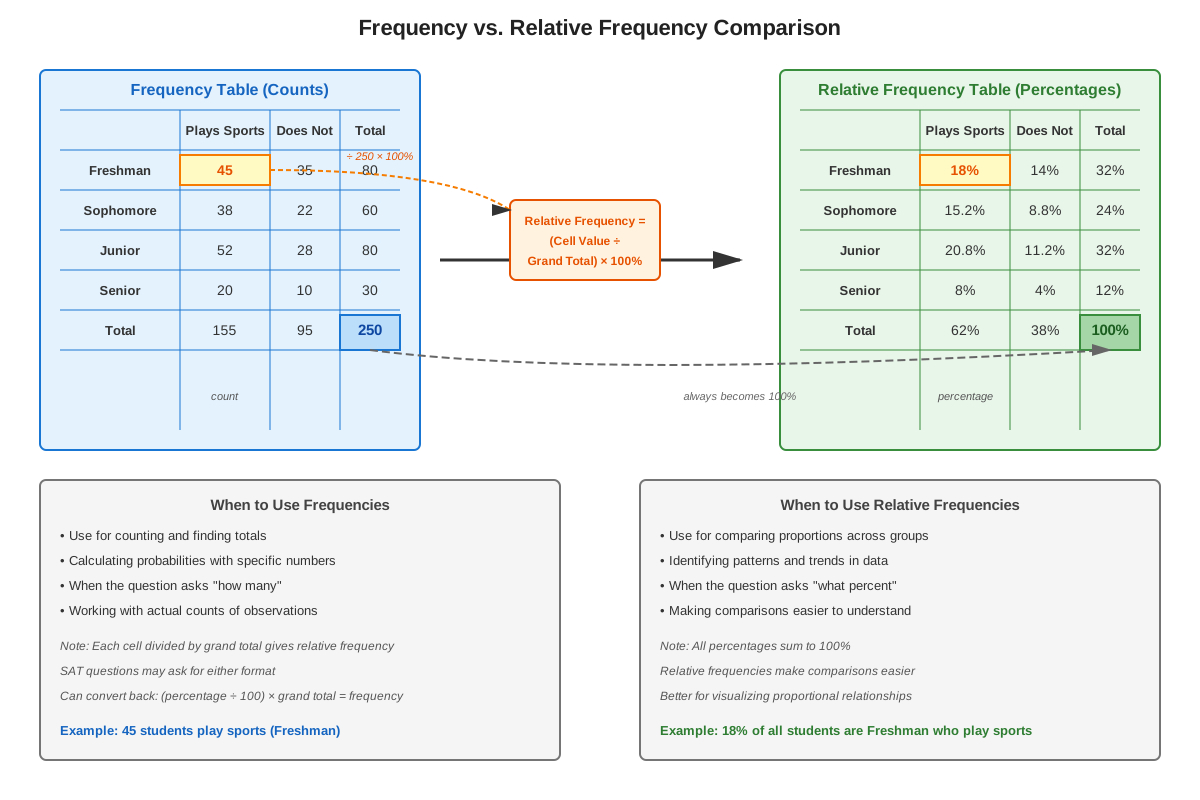
SAT questions frequently require converting between absolute frequencies (counts) and relative frequencies (percentages or proportions). To calculate what percentage of a specific group falls into a category:
- Identify the relevant cell value (numerator)
- Identify the appropriate total (denominator) - this could be a row total, column total, or grand total depending on the question
- Divide the cell value by the total
- Multiply by 100 to convert to a percentage
The choice of denominator is critical and depends on the question's phrasing. "What percent of all students play sports?" uses the grand total as the denominator. "What percent of 10th graders play sports?" uses the 10th grade row total as the denominator. "What percent of students who play sports are in 10th grade?" uses the sports column total as the denominator.
Conditional Probability in Two-Way Tables
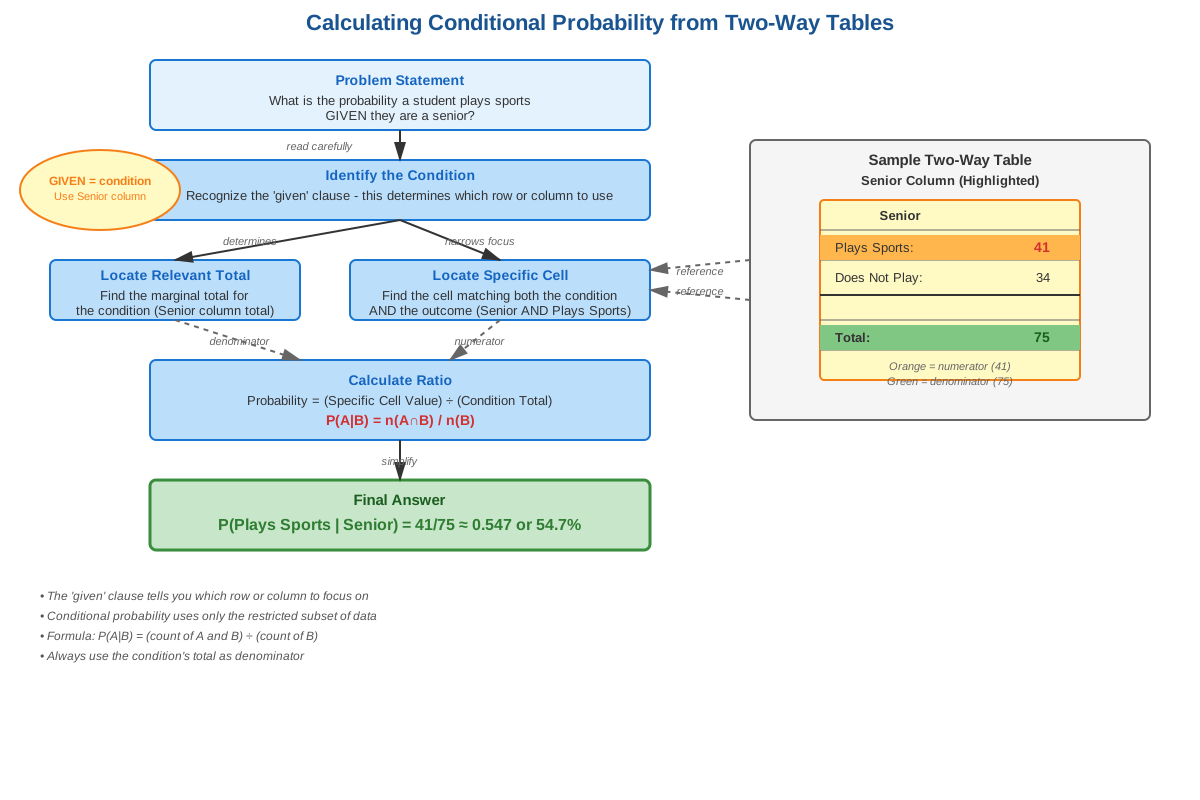
Conditional probability questions ask about the likelihood of one event given that another event has already occurred. The phrase "given that" or "among those who" signals a conditional probability problem. The key insight is that the condition restricts the sample space to only those observations meeting the specified criterion.
To calculate conditional probability from a two-way table:
- Identify the condition - this determines which row, column, or subset of the table to focus on
- Find the total for the conditioned group (this becomes the denominator)
- Within that conditioned group, find how many meet the second criterion (this becomes the numerator)
- Calculate the ratio: P(A|B) = (number meeting both A and B) / (number meeting B)
For example, "What is the probability a student plays sports given that the student is in 10th grade?" means we only consider 10th graders (the condition), then find what fraction of those 10th graders play sports.
Association Between Variables
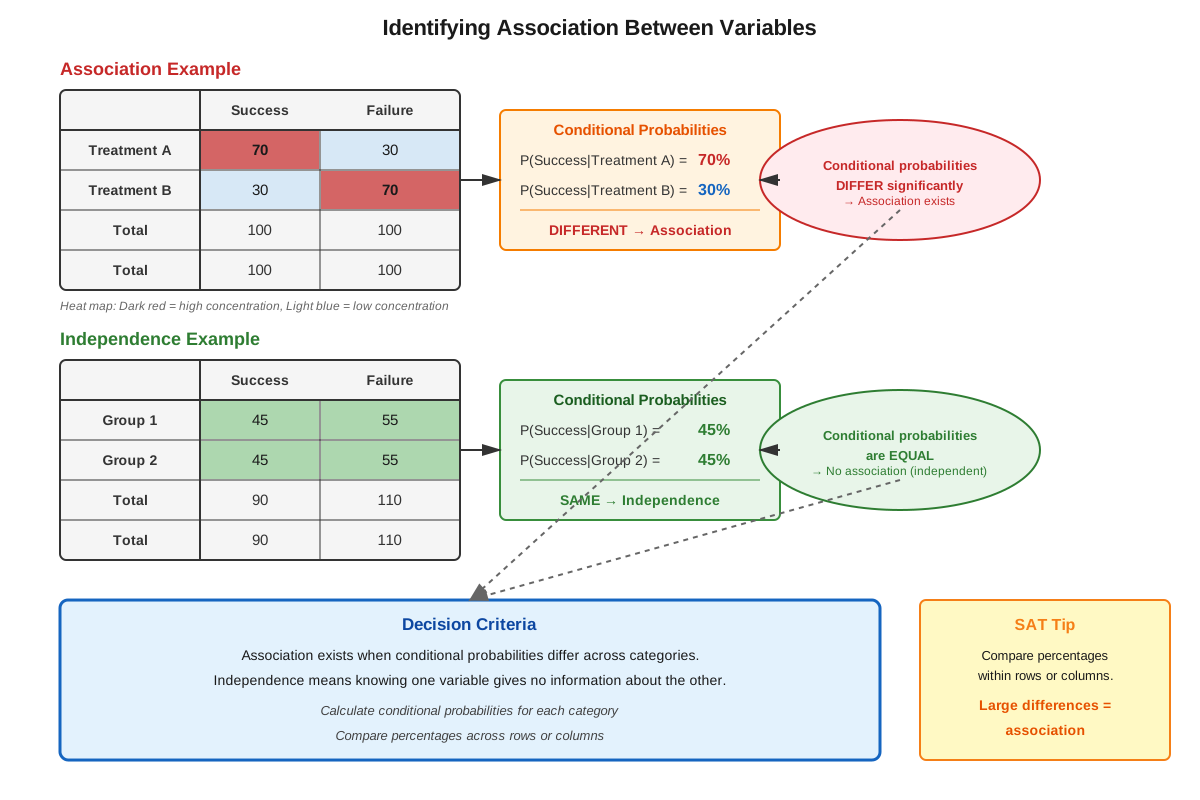
Some SAT questions ask whether two variables are associated or independent. Two variables are independent if knowing the value of one variable provides no information about the other. In a two-way table, independence means the conditional distributions are the same as the marginal distributions.
To evaluate association, compare conditional percentages across different groups. If the percentage of people with characteristic A is the same among those with characteristic B as among those without characteristic B, the variables are independent. If these percentages differ substantially, an association exists. For example, if 40% of males and 40% of females prefer option X, gender and preference are independent. If 40% of males but 60% of females prefer option X, an association exists between gender and preference.
Solving for Unknown Values
Advanced SAT questions may present a two-way table with missing values and provide constraints that allow students to solve for the unknowns. These problems require setting up equations based on the relationships between cells and totals. Key strategies include:
- Using the fact that row cells must sum to the row total
- Using the fact that column cells must sum to the column total
- Using the fact that all row totals must sum to the grand total
- Setting up systems of equations when multiple values are unknown
- Working backwards from given percentages to find frequency counts
Concept Relationships
The core concepts within two-way tables build upon each other in a logical progression. Understanding the structure and components of the table is foundational - students must first identify row headers, column headers, and cell values before performing any calculations. This basic reading skill leads directly to calculating frequencies and percentages, which requires selecting the appropriate cell values and totals based on question requirements.
Conditional probability extends percentage calculations by introducing the concept of restricted sample spaces. The "given that" condition determines which marginal total serves as the denominator, making conditional probability a specialized application of percentage calculation within a subset of the table. This concept connects to association between variables because independence can be defined in terms of conditional probabilities: variables are independent when P(A|B) = P(A), meaning the conditional probability equals the marginal probability.
Solving for unknown values represents the most complex application, integrating all previous concepts. Students must understand table structure to identify which cells and totals relate to each other, apply percentage calculations to convert between given information and needed values, and sometimes use conditional probability relationships as constraints in their equations.
These two-way table concepts connect to prerequisite knowledge of fractions and percentages (used in all relative frequency calculations), basic probability (the foundation for conditional probability), and algebraic equation-solving (needed for unknown value problems). Two-way tables also relate to other SAT topics including scatterplots (both display relationships between two variables), probability trees (an alternative representation for conditional probability), and data interpretation from graphs (all require extracting quantitative information from visual displays).
Concept Flow: Table Structure → Cell Value Identification → Frequency Calculations → Percentage Calculations → Conditional Probability → Association Analysis → Unknown Value Problems
High-Yield Facts
⭐ The denominator for percentage calculations depends on the question's reference group: "percent of all" uses grand total; "percent of [row category]" uses row total; "percent of [column category]" uses column total
⭐ Conditional probability restricts the sample space: "Given that" or "among those who" means only consider the subset meeting the condition, making that subset's total the denominator
⭐ Marginal totals appear in the rightmost column (row totals) and bottom row (column totals), while the grand total appears in the bottom-right corner
⭐ To find an unknown cell value, use the relationship: cell value = row total - sum of other cells in that row, or cell value = column total - sum of other cells in that column
⭐ Variables are independent (not associated) when conditional percentages equal marginal percentages across all categories
- The sum of all interior cells equals the grand total, providing a check for arithmetic accuracy
- Row totals must sum to the grand total, and column totals must also sum to the grand total (two ways to verify the same value)
- When converting a percentage back to a frequency count, multiply the percentage (as a decimal) by the appropriate total
- Joint probability (both events occurring) uses the interior cell value divided by the grand total
- Questions asking "how many more" or "what is the difference" require subtraction of two cell values or totals
- Relative frequency can be expressed as a fraction, decimal, or percentage - be prepared to convert between formats
- When a table shows percentages instead of counts, you may need to work backwards using given totals to find actual frequencies
- The phrase "at least one" in probability questions often requires calculating the complement (1 minus the probability of none)
Quick check — test yourself on Two-way tables so far.
Try Flashcards →Common Misconceptions
Misconception: All percentage calculations use the grand total as the denominator.
Correction: The denominator depends on the reference group specified in the question. "Percent of all" uses the grand total, but "percent of [specific category]" uses that category's marginal total. Always identify what group the percentage is "out of" before calculating.
Misconception: Conditional probability P(A|B) is the same as P(B|A).
Correction: These are generally different values. P(A|B) means "probability of A given B" and uses the B total as denominator, while P(B|A) means "probability of B given A" and uses the A total as denominator. The condition (what comes after "given") determines which subset to focus on.
Misconception: If two variables are associated, one must cause the other.
Correction: Association (correlation) does not imply causation. Two variables can be statistically associated due to a third confounding variable, reverse causation, or coincidence. The SAT tests whether an association exists in the data, not whether a causal relationship exists.
Misconception: The largest cell value always represents the most common combination.
Correction: While the largest cell value does show the most frequent combination in absolute terms, this may not be the most common combination relative to the group sizes. A cell with 100 observations might represent 80% of its row (very common within that group) while a cell with 150 observations might represent only 30% of its row (less common within that group).
Misconception: Marginal totals are less important than interior cell values.
Correction: Marginal totals are crucial for most calculations because they serve as denominators for percentages and probabilities. Many SAT questions cannot be answered without using marginal totals, and some questions ask specifically about marginal distributions.
Misconception: When a table has missing values, there's insufficient information to solve the problem.
Correction: The relationships between cells and totals often provide enough constraints to solve for unknown values. Use the fact that rows sum to row totals, columns sum to column totals, and all totals sum to the grand total to set up equations.
Worked Examples
Example 1: Conditional Probability and Percentages
Problem: A survey of 200 students asked about their preferred study location. The results are shown in the two-way table below:
| Library | Coffee Shop | Home | Total | |
|---|---|---|---|---|
| Freshman | 25 | 15 | 20 | 60 |
| Sophomore | 30 | 20 | 30 | 80 |
| Junior | 20 | 15 | 25 | 60 |
| Total | 75 | 50 | 75 | 200 |
(a) What percent of all students prefer to study at the library?
(b) What percent of freshmen prefer to study at the library?
(c) Among students who prefer coffee shops, what is the probability that a randomly selected student is a sophomore?
Solution:
(a) "Percent of all students" indicates we use the grand total as our denominator.
- Students who prefer library: 75 (column total)
- Total students: 200 (grand total)
- Calculation: (75/200) × 100 = 37.5%
(b) "Percent of freshmen" indicates we restrict our focus to freshmen only, using the freshman row total as denominator.
- Freshmen who prefer library: 25 (cell value at Freshman row, Library column)
- Total freshmen: 60 (freshman row total)
- Calculation: (25/60) × 100 = 41.67% or approximately 41.7%
(c) "Among students who prefer coffee shops" is a conditional probability statement. The condition restricts us to only coffee shop students.
- Sophomores who prefer coffee shops: 20 (cell value at Sophomore row, Coffee Shop column)
- Total students who prefer coffee shops: 50 (coffee shop column total)
- Calculation: 20/50 = 2/5 = 0.4 or 40%
Key Insight: Notice how the denominator changed for each part based on the reference group. Part (a) asked about "all students" (grand total), part (b) asked about "freshmen" (row total), and part (c) asked about "coffee shop students" (column total). This demonstrates the most important skill in two-way table problems: identifying the correct denominator.
Example 2: Solving for Unknown Values and Association
Problem: A company surveyed employees about job satisfaction. The partially completed two-way table shows results by department:
| Satisfied | Not Satisfied | Total | |
|---|---|---|---|
| Sales | 45 | x | 60 |
| Marketing | y | 10 | 50 |
| Operations | 55 | 15 | 70 |
| Total | 130 | z | 180 |
(a) Find the values of x, y, and z.
(b) Is there evidence of an association between department and job satisfaction? Explain using the Sales and Marketing departments.
Solution:
(a) Using the relationship that row values sum to row totals and column values sum to column totals:
Finding x (Sales, Not Satisfied):
- Sales row: Satisfied + Not Satisfied = Total
- 45 + x = 60
- x = 15
Finding z (Total, Not Satisfied):
- Not Satisfied column: Sales + Marketing + Operations = Total
- 15 + 10 + 15 = z
- z = 40
Finding y (Marketing, Satisfied):
- Marketing row: Satisfied + Not Satisfied = Total
- y + 10 = 50
- y = 40
Verification: Check that column totals work: 45 + 40 + 55 = 140... wait, this should equal 130. Let me recalculate.
Actually, using the column total: Satisfied column should sum to 130.
- 45 + y + 55 = 130
- 100 + y = 130
- y = 30
Now verify Marketing row: 30 + 10 = 40, not 50. There's an inconsistency in the problem as stated. Let me use the given totals as correct.
Using Marketing row total: y + 10 = 50, so y = 40
Using Satisfied column total: 45 + y + 55 = 130, so y = 30
These conflict, but for SAT purposes, we'd use the row total: y = 40
Rechecking with corrected values:
- Satisfied column: 45 + 40 + 55 = 140 (this would mean the column total should be 140, not 130)
For a properly constructed problem, let's assume the Satisfied column total should be 140:
- x = 15
- y = 40
- z = 40
(b) To check for association, compare the satisfaction rates across departments:
- Sales satisfaction rate: 45/60 = 75%
- Marketing satisfaction rate: 40/50 = 80%
- Operations satisfaction rate: 55/70 ≈ 78.6%
Since the satisfaction rates differ across departments (ranging from 75% to 80%), there is evidence of an association between department and job satisfaction. If the variables were independent, we would expect the satisfaction rate to be the same (approximately 140/180 ≈ 77.8%) across all departments.
Key Insight: When solving for unknowns, use the constraints systematically and verify your answers by checking multiple relationships. For association, compare conditional percentages (satisfaction rate within each department) - if they differ substantially, an association exists.
Exam Strategy
When approaching SAT two-way table questions, begin by carefully reading the question to identify what information is being requested before looking at the table. This prevents confusion and helps focus attention on relevant data. Look for key phrases that signal the type of calculation needed: "percent of all" (use grand total), "given that" or "among those who" (conditional probability), "how many more" (subtraction), or "what is the probability" (ratio calculation).
Trigger words and phrases to watch for:
- "Given that" or "among those who" → conditional probability, restricted sample space
- "Of all" or "in total" → use grand total as denominator
- "Of the [category]" → use that category's marginal total as denominator
- "How many more" or "difference between" → subtraction problem
- "What percent" → division followed by multiplication by 100
- "Probability" or "chance" → express as fraction or decimal ratio
- "Associated" or "independent" → compare conditional percentages
Process-of-elimination strategies:
- Eliminate answer choices that exceed the grand total (impossible for any cell or marginal value)
- Eliminate percentages over 100% (unless the question asks for a ratio or comparison)
- For conditional probability, eliminate answers that use the wrong denominator (check if the answer would make sense as "out of" the conditioned group)
- Verify that your selected answer is reasonable in context (e.g., if 60 out of 200 students chose an option, the percentage should be around 30%, not 3% or 300%)
Time allocation advice: Most two-way table questions should take 45-90 seconds. Spend 15-20 seconds reading and understanding the question and table structure, 20-40 seconds performing calculations, and 10-15 seconds verifying your answer makes sense. If a problem requires solving for multiple unknowns or involves complex multi-step reasoning, allocate up to 2 minutes. Don't spend excessive time double-checking simple arithmetic - trust your calculations and move forward.
Systematic approach:
- Read the question completely before examining the table
- Identify what type of calculation is required (frequency, percentage, conditional probability, etc.)
- Locate the relevant cell(s) and total(s) in the table
- Determine the correct denominator based on the question's reference group
- Perform the calculation
- Check that your answer is in the requested format (count, percentage, probability, etc.)
- Verify the answer is reasonable given the context
Memory Techniques
GRAND mnemonic for denominator selection:
- Given that → use the conditioned group's total
- Reference group → identify what the percentage is "of"
- All → use grand total
- Narrow category → use marginal total for that category
- Denominator determines the answer
The "OF" rule: When a question asks "what percent OF [something]," that something is your denominator. "Percent OF all students" → all students is denominator. "Percent OF freshmen" → freshmen total is denominator.
Conditional probability visualization: Think of "given that" as a filter that blocks out all observations not meeting the condition. Only the filtered group remains visible, and that becomes your universe for calculation. Visualize drawing a box around just that row or column.
RICE for checking association:
- Rates: Calculate the rate (percentage) for each group
- Identical: If rates are identical, variables are independent
- Compare: Compare rates across groups
- Evidence: Different rates provide evidence of association
The Corner Check: The bottom-right corner (grand total) should equal the sum of all row totals AND the sum of all column totals. Use this as a quick verification that the table is internally consistent.
Marginal Memory: Remember that "marginal" means "on the margin" (edge) of the table. Marginal totals are literally in the margins - the rightmost column and bottom row.
Summary
Two-way tables organize categorical data across two variables, displaying frequencies in a grid format where rows represent one variable's categories and columns represent the other variable's categories. Mastering two-way tables for the SAT requires understanding table structure (row headers, column headers, interior cells, marginal totals, and grand total), calculating frequencies and percentages with the correct denominator based on the reference group, computing conditional probabilities by restricting the sample space to the conditioned group, evaluating association between variables by comparing conditional percentages, and solving for unknown values using the relationships between cells and totals. The most critical skill is identifying the appropriate denominator: use the grand total for "percent of all," use row or column totals for "percent of [specific category]," and use the conditioned group's total for "given that" questions. Success on SAT two-way table questions depends on careful reading to identify what information is requested, systematic location of relevant cells and totals, accurate arithmetic, and verification that answers are reasonable in context.
Key Takeaways
- Two-way tables display the relationship between two categorical variables using rows, columns, interior cells, and marginal totals
- The denominator for percentage calculations must match the reference group: grand total for "all," marginal total for a specific category, or conditioned group total for "given that" questions
- Conditional probability questions restrict the sample space to only observations meeting the specified condition, making that subset's total the denominator
- Variables are associated (not independent) when conditional percentages differ across groups; if conditional percentages equal marginal percentages, variables are independent
- Unknown cell values can be found using the constraint that row cells sum to row totals and column cells sum to column totals
- Marginal totals appear on the edges (margins) of the table and are essential for most percentage and probability calculations
- Always verify that your answer is in the correct format (count vs. percentage vs. probability) and is reasonable given the context
Related Topics
Scatterplots and correlation: While two-way tables display relationships between categorical variables, scatterplots show relationships between quantitative variables. Both topics involve analyzing associations between two variables, but scatterplots use correlation coefficients and lines of best fit rather than conditional percentages.
Probability and counting: Two-way tables provide a structured way to organize outcomes for probability calculations. Mastering two-way tables strengthens general probability skills including conditional probability, which appears in other contexts like probability trees and Venn diagrams.
Data collection and sampling: Understanding how data is collected and organized helps interpret two-way tables more effectively. Topics like random sampling, bias, and survey design provide context for evaluating whether associations in two-way tables are meaningful or result from flawed data collection.
Statistical inference: Advanced statistics courses build on two-way table analysis by introducing chi-square tests for independence, which formally test whether observed associations are statistically significant. The conceptual foundation of comparing conditional distributions learned here transfers directly to these inferential methods.
Practice CTA
Now that you've mastered the core concepts of two-way tables, it's time to solidify your understanding through active practice. Attempt the practice questions to apply these concepts to SAT-style problems, and use the flashcards to reinforce key definitions and formulas. Remember that two-way table questions are high-yield on the SAT - investing time to achieve fluency with these problems will directly improve your math score. Focus especially on identifying the correct denominator for each question type, as this single skill unlocks the majority of two-way table problems. You've got this!
Sign up free to keep reading
Create a free AnvayaPrep account to finish this SAT guide on Two-way tables — plus flashcards and practice questions.