Overview
Residuals basics form a critical component of data analysis and statistics on the SAT Math section. A residual represents the difference between an observed data point and the value predicted by a regression model or line of best fit. Understanding residuals allows students to evaluate how well a mathematical model fits real-world data, identify outliers, and interpret the accuracy of predictions. On the SAT, residual questions test both computational skills and conceptual understanding of how data points relate to trend lines.
This topic bridges multiple mathematical domains, connecting linear functions, coordinate geometry, and statistical reasoning. Students must be comfortable reading scatter plots, interpreting lines of best fit, and performing calculations with both positive and negative values. The SAT frequently presents residual questions in context, requiring students to understand what residuals mean in real-world scenarios—such as predicting sales, analyzing scientific data, or evaluating trends over time.
Mastering sat residuals basics provides essential skills for the Problem Solving and Data Analysis domain, which comprises approximately 15% of SAT math questions. Beyond the exam, residual analysis represents a fundamental tool in statistics, data science, and scientific research, making this knowledge valuable for college-level coursework and professional applications. Students who understand residuals can critically evaluate claims based on data and recognize when models accurately represent reality versus when they fail to capture important patterns.
Learning Objectives
- [ ] Identify key features of Residuals basics
- [ ] Explain how Residuals basics appears on the SAT
- [ ] Apply Residuals basics to answer SAT-style questions
- [ ] Calculate residuals given data points and a line of best fit
- [ ] Interpret the meaning of positive and negative residuals in context
- [ ] Analyze residual plots to evaluate model fit quality
- [ ] Determine which data points have the largest residuals
Prerequisites
- Linear equations and functions: Understanding slope-intercept form (y = mx + b) is essential because residuals measure deviations from linear models
- Coordinate plane and ordered pairs: Residuals involve comparing actual y-values to predicted y-values at specific x-coordinates
- Basic arithmetic with signed numbers: Calculating residuals requires subtracting predicted values from actual values, often resulting in negative numbers
- Scatter plots and data visualization: Residual questions always involve interpreting graphical representations of data points
Why This Topic Matters
Residual analysis represents one of the most practical statistical tools students encounter on the SAT. In real-world applications, scientists use residuals to evaluate experimental models, economists assess forecasting accuracy, and businesses determine whether predictive models reliably estimate future performance. Medical researchers analyze residuals to identify patients who respond unusually to treatments, while engineers use residual analysis to detect manufacturing defects.
On the SAT, residual questions appear with moderate frequency—typically 1-2 questions per test—but carry high importance because they assess multiple skills simultaneously: algebraic manipulation, graphical interpretation, and contextual reasoning. These questions often appear in the calculator-permitted section and may be presented as multiple-choice or student-produced response formats. The College Board considers residual understanding a key indicator of college readiness in quantitative fields.
Common SAT presentations include: scatter plots with lines of best fit where students must identify which point has the largest residual; word problems requiring calculation of specific residual values; questions asking students to interpret what a positive or negative residual means in context; and residual plot analysis where students evaluate whether a linear model appropriately fits the data. Understanding residuals also supports success on related topics like correlation, causation, and data modeling.
Core Concepts
Definition of Residuals
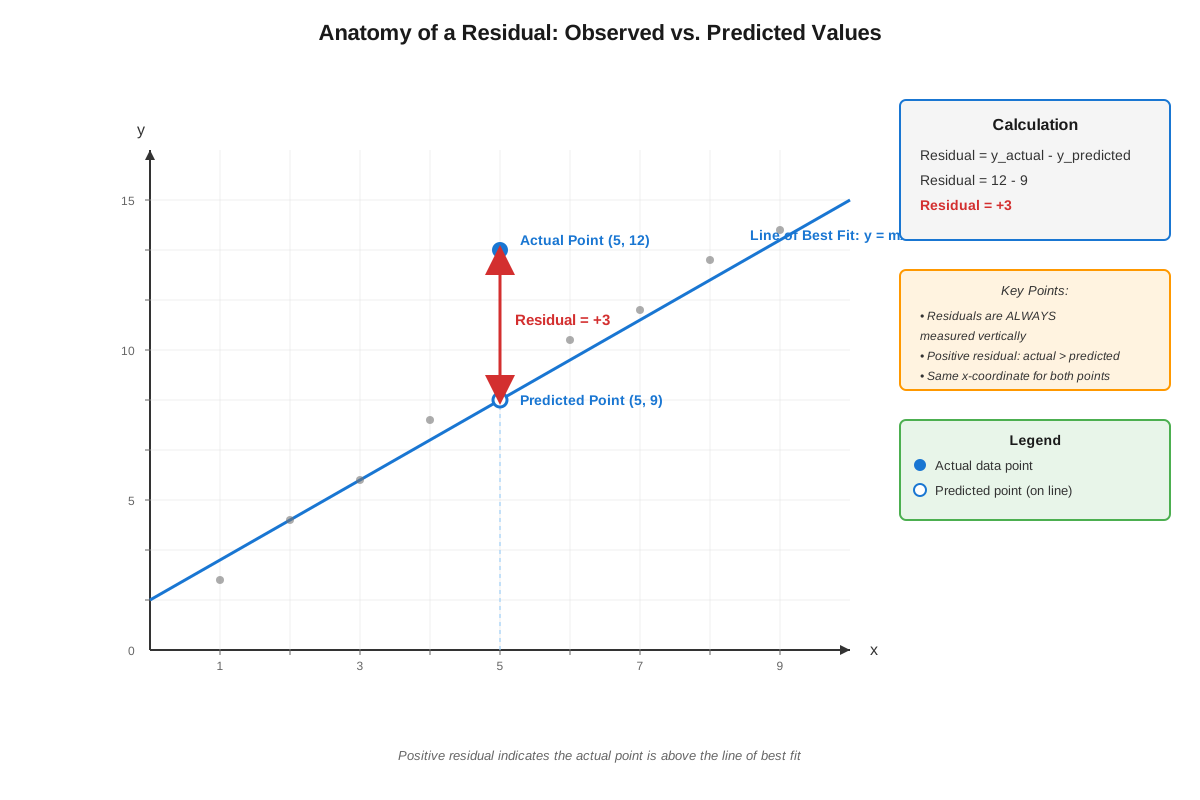
A residual is the vertical distance between an actual data point and the corresponding predicted value on a regression line or line of best fit. Mathematically, the residual for any data point is calculated as:
Residual = Actual value - Predicted value
Residual = y_actual - y_predicted
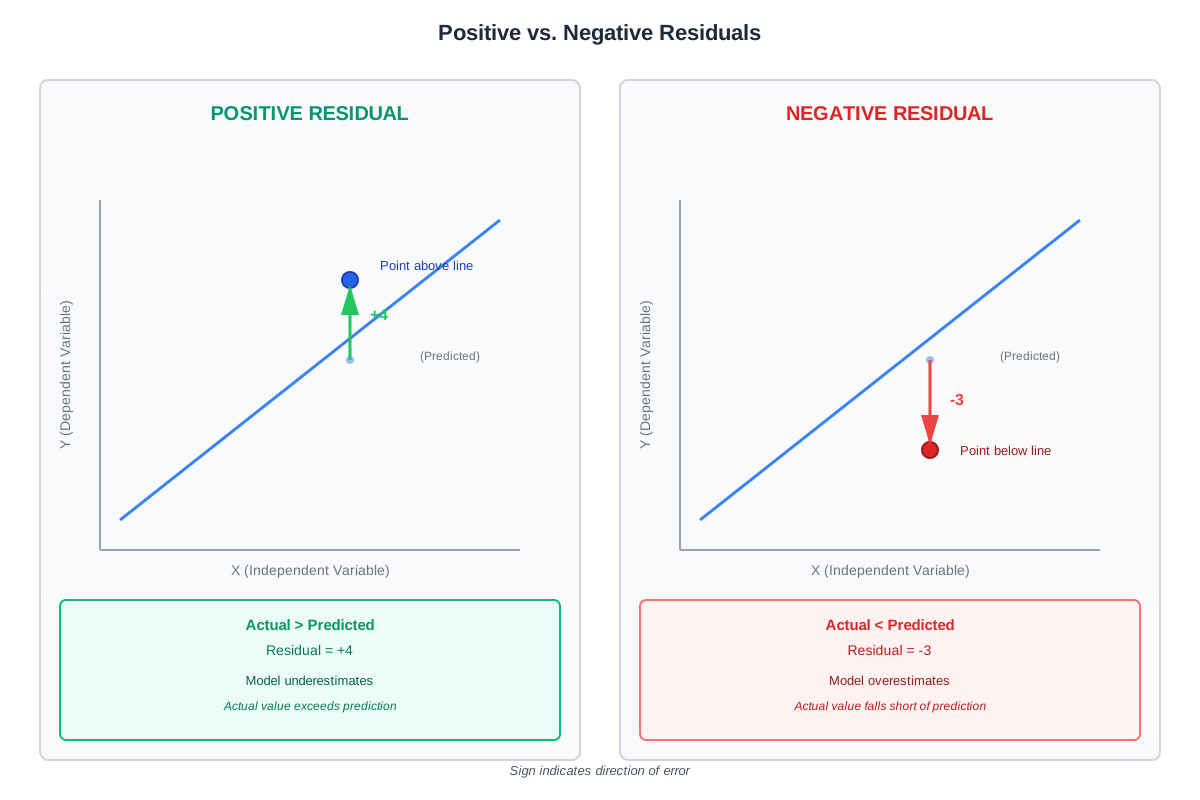
When a data point lies above the line of best fit, the actual value exceeds the predicted value, resulting in a positive residual. Conversely, when a point falls below the line, the actual value is less than predicted, producing a negative residual. Points that fall exactly on the line have a residual of zero, though this rarely occurs with real data.
Calculating Residuals Step-by-Step
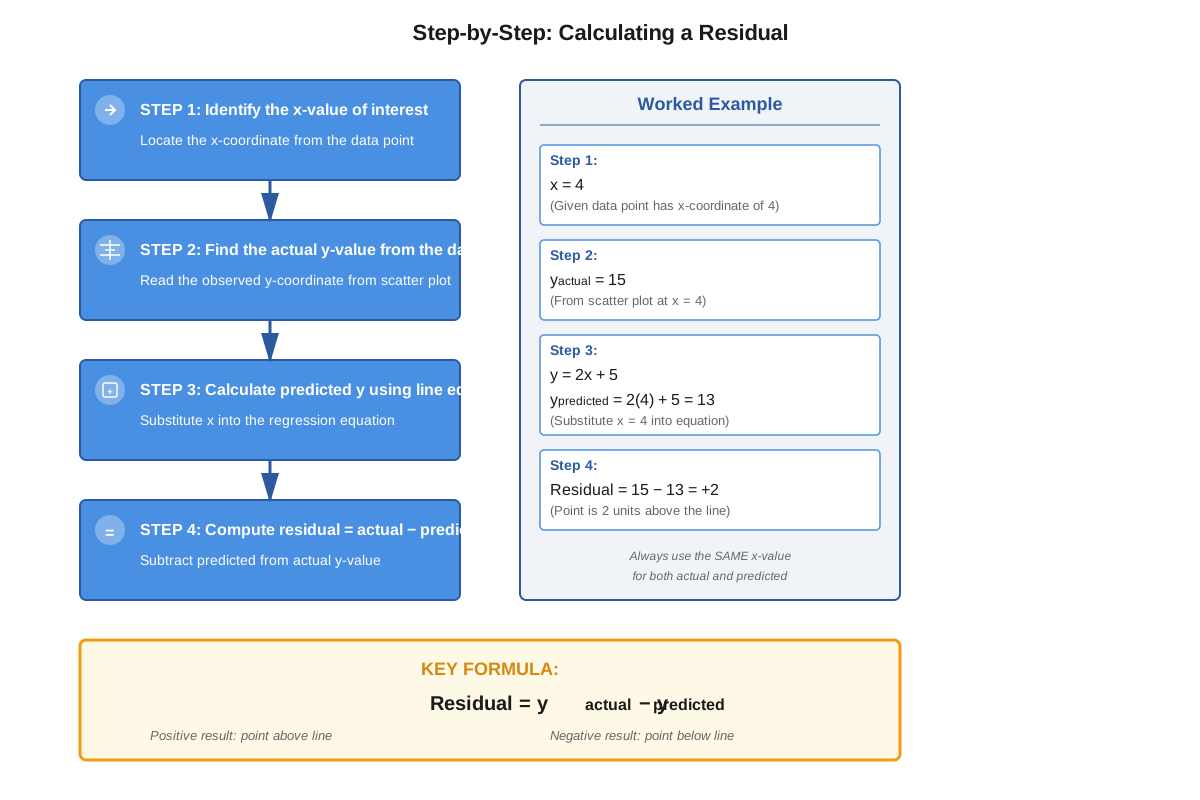
To calculate a residual, follow this systematic process:
- Identify the x-coordinate of the data point in question
- Substitute the x-value into the equation of the line of best fit to find the predicted y-value
- Locate the actual y-value from the data point or table
- Subtract the predicted value from the actual value: Residual = y_actual - y_predicted
- Interpret the sign: Positive means above the line; negative means below the line
For example, if a line of best fit has equation y = 2x + 3, and there's a data point at (4, 15):
- Predicted value: y = 2(4) + 3 = 11
- Actual value: 15
- Residual: 15 - 11 = 4 (positive, indicating the point is above the line)
Interpreting Residuals in Context
The SAT emphasizes contextual interpretation of residuals. Students must translate mathematical results into meaningful statements about real-world situations. Consider a scenario where x represents hours studied and y represents test scores, with a line of best fit predicting scores based on study time.
| Residual Value | Mathematical Meaning | Contextual Interpretation |
|---|---|---|
| +5 | Point is 5 units above the line | Student scored 5 points higher than predicted |
| -3 | Point is 3 units below the line | Student scored 3 points lower than predicted |
| 0 | Point lies on the line | Student scored exactly as predicted |
| +12 | Point is 12 units above the line | Student significantly outperformed expectations |
A positive residual indicates the model underestimated the actual value, while a negative residual shows the model overestimated it. This distinction frequently appears in SAT questions asking students to identify which statement correctly describes a residual.
Residual Plots
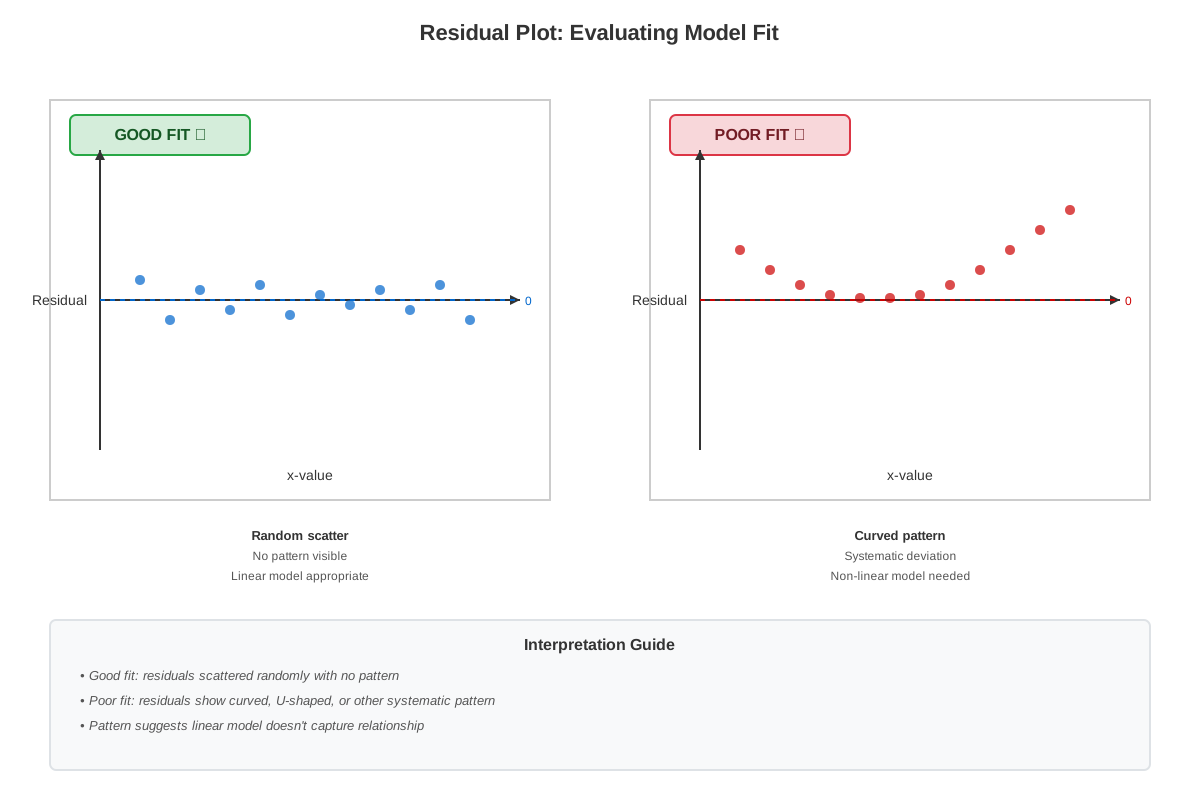
A residual plot displays residuals on the vertical axis against the independent variable (or predicted values) on the horizontal axis. These plots help evaluate whether a linear model appropriately fits the data. On a residual plot:
- The horizontal axis represents the x-values (independent variable)
- The vertical axis represents the residual values
- A horizontal line at y = 0 represents perfect predictions
- Points above this line correspond to positive residuals
- Points below correspond to negative residuals
Characteristics of good model fit: Residuals appear randomly scattered around zero with no discernible pattern, roughly equal numbers of positive and negative residuals, and consistent spread across all x-values.
Characteristics of poor model fit: Residuals show a curved pattern (suggesting a nonlinear relationship), residuals consistently increase or decrease (indicating the model systematically over- or under-predicts), or residuals cluster in groups (suggesting missing variables).
Magnitude of Residuals
The magnitude (absolute value) of a residual indicates how far a data point deviates from the model, regardless of direction. Larger magnitude residuals represent greater prediction errors. On the SAT, questions often ask students to identify which data point has the largest residual, requiring comparison of absolute values.
For residuals of +7, -9, +3, and -2, the point with residual -9 has the largest magnitude (9 units from the line), even though +7 is the largest positive residual. Students must distinguish between "largest residual" (most positive) and "largest magnitude residual" (farthest from the line).
Sum of Residuals Property
For a properly fitted line of best fit (least-squares regression line), the sum of all residuals equals zero. This property ensures the line balances positive and negative deviations. While SAT questions rarely test this directly, understanding this principle helps students recognize that a good model doesn't systematically over- or under-predict—it balances errors in both directions.
Concept Relationships
Residuals connect directly to lines of best fit, as residuals cannot exist without a model to compare against. The process flows: scatter plot data → line of best fit → predicted values → residuals. Understanding linear equations enables calculation of predicted values, which forms the foundation for residual computation.
The relationship between residuals and model accuracy is inverse: smaller residuals indicate better fit, while larger residuals suggest poor predictive power. This connects to correlation strength—strongly correlated data produces smaller residuals, while weakly correlated data yields larger, more variable residuals.
Residual analysis leads naturally to outlier identification. Data points with unusually large residuals (in magnitude) represent outliers that don't follow the general trend. This connects to data interpretation skills, where students must decide whether outliers represent errors, special cases, or evidence that the model needs refinement.
The conceptual flow: Scatter plot → Line of best fit → Predicted values → Residual calculation → Residual interpretation → Model evaluation → Outlier identification
High-Yield Facts
⭐ A residual equals the actual y-value minus the predicted y-value: Residual = y_actual - y_predicted
⭐ Positive residuals indicate points above the line of best fit; the model underestimated the actual value
⭐ Negative residuals indicate points below the line of best fit; the model overestimated the actual value
⭐ The magnitude of a residual measures the distance from the point to the line, regardless of direction
⭐ A residual of zero means the data point lies exactly on the line of best fit
- Residual plots with random scatter around zero indicate good linear model fit
- Patterns in residual plots (curves, trends) suggest a linear model is inappropriate
- The sum of all residuals for a least-squares regression line equals zero
- Larger magnitude residuals represent greater prediction errors or potential outliers
- Residuals have the same units as the dependent variable (y-axis)
- On the SAT, residual questions often require both calculation and contextual interpretation
- The largest residual (by magnitude) identifies the point farthest from the line of best fit
Quick check — test yourself on Residuals basics so far.
Try Flashcards →Common Misconceptions
Misconception: Residual = predicted value - actual value → Correction: The correct formula is Residual = actual value - predicted value. The order matters because it determines the sign. Reversing the subtraction inverts all signs, making positive residuals negative and vice versa.
Misconception: A negative residual means the data point is bad or wrong → Correction: Negative residuals are normal and expected. They simply indicate the actual value was less than predicted. A good model has both positive and negative residuals balanced around zero.
Misconception: The largest residual is always the most positive one → Correction: "Largest residual" can mean largest magnitude (farthest from the line) or most positive value. On the SAT, context determines which interpretation applies. A residual of -10 has larger magnitude than +3, even though +3 is more positive.
Misconception: Residuals measure horizontal distance from the line → Correction: Residuals measure vertical distance only. They represent the difference in y-values (actual vs. predicted) at a given x-coordinate, not the perpendicular or horizontal distance to the line.
Misconception: If all residuals are small, the model proves causation → Correction: Small residuals indicate good fit and strong correlation, but correlation never proves causation. A model can fit data well even when no causal relationship exists between variables.
Misconception: Residual plots should show a clear pattern → Correction: Good residual plots show random scatter with no pattern. Patterns in residual plots indicate the linear model doesn't appropriately fit the data and a different model type may be needed.
Worked Examples
Example 1: Calculating and Interpreting a Residual
Problem: A researcher studies the relationship between hours of sleep (x) and test scores (y). The line of best fit is y = 8x + 20. One student slept 6 hours and scored 74 on the test. Calculate the residual and interpret its meaning.
Solution:
Step 1: Identify the given information
- Line of best fit: y = 8x + 20
- Actual data point: (6, 74)
- x = 6 hours of sleep
- y_actual = 74 (test score)
Step 2: Calculate the predicted value
Substitute x = 6 into the equation:
y_predicted = 8(6) + 20 = 48 + 20 = 68
Step 3: Calculate the residual
Residual = y_actual - y_predicted
Residual = 74 - 68 = 6
Step 4: Interpret the result
The residual is +6, which is positive. This means:
- The actual test score (74) was 6 points higher than predicted (68)
- The data point lies 6 units above the line of best fit
- The model underestimated this student's performance
- This student scored better than expected based on sleep hours alone
Connection to learning objectives: This example demonstrates calculating residuals (objective 4) and interpreting positive residuals in context (objective 5).
Example 2: Identifying the Largest Residual from a Graph
Problem: A scatter plot shows five data points with a line of best fit y = -2x + 10. The points are: A(1, 9), B(2, 4), C(3, 5), D(4, 3), and E(5, -2). Which point has the largest residual by magnitude?
Solution:
Step 1: Calculate predicted values for each point
For point A (x = 1): y_predicted = -2(1) + 10 = 8
For point B (x = 2): y_predicted = -2(2) + 10 = 6
For point C (x = 3): y_predicted = -2(3) + 10 = 4
For point D (x = 4): y_predicted = -2(4) + 10 = 2
For point E (x = 5): y_predicted = -2(5) + 10 = 0
Step 2: Calculate residuals for each point
Point A: Residual = 9 - 8 = +1
Point B: Residual = 4 - 6 = -2
Point C: Residual = 5 - 4 = +1
Point D: Residual = 3 - 2 = +1
Point E: Residual = -2 - 0 = -2
Step 3: Compare magnitudes
| Point | Residual | Magnitude |
|---|---|---|
| A | +1 | 1 |
| B | -2 | 2 |
| C | +1 | 1 |
| D | +1 | 1 |
| E | -2 | 2 |
Step 4: Identify the answer
Points B and E both have residuals with magnitude 2, which is the largest. Both points are 2 units away from the line of best fit. Point B is 2 units below the line (negative residual), and point E is 2 units below the line (negative residual).
Answer: Points B and E have the largest residuals by magnitude (both equal to 2).
Connection to learning objectives: This example applies residual concepts to SAT-style questions (objective 3) and demonstrates determining which points have the largest residuals (objective 7).
Exam Strategy
When approaching SAT residual questions, follow this systematic strategy:
Trigger words to recognize: Look for "residual," "predicted value," "line of best fit," "regression line," "above/below the line," "overestimate/underestimate," and "actual versus predicted." These signal residual-based questions.
Step-by-step approach:
- Identify what the question asks: calculation, interpretation, or comparison
- Locate or determine the line of best fit equation
- Find the relevant data point(s) coordinates
- Calculate predicted values using the line equation
- Compute residuals using the formula: actual - predicted
- Interpret results in context if required
Process of elimination tips:
- Eliminate answer choices that reverse the residual sign (if a point is above the line, the residual must be positive)
- Rule out options that confuse "largest" with "most positive" when magnitude is intended
- Discard interpretations that claim residuals prove causation
- Eliminate choices that describe horizontal rather than vertical distance
Time allocation: Residual questions typically require 1.5-2 minutes. Spend 30 seconds understanding the context, 45 seconds on calculations, and 30 seconds verifying your answer makes sense. If a question requires multiple residual calculations, budget an additional 30 seconds per calculation.
Common traps to avoid: Don't subtract in the wrong order (predicted - actual instead of actual - predicted). Don't confuse the sign of the residual with its magnitude. Don't assume the point farthest from the origin has the largest residual—distance from the line matters, not distance from the origin.
Exam Tip: Always check whether the question asks for "largest residual" (most positive), "smallest residual" (most negative), or "largest magnitude residual" (farthest from line). These are different questions with potentially different answers.
Memory Techniques
Residual Formula Mnemonic: "Actual Minus Predicted" → AMP (like amplifying the difference between reality and prediction)
Sign Memory Device: "Positive means Point is Pushed up" (above the line). Three P's help remember positive residuals correspond to points above the line.
Visualization Strategy: Picture the line of best fit as a tightrope. Data points above the tightrope have "climbed up" (positive residuals), while points below have "fallen down" (negative residuals). The distance they've climbed or fallen is the magnitude.
Calculation Sequence Acronym: FLIP
- Find the x-coordinate
- Locate predicted y (using the line equation)
- Identify actual y
- Perform subtraction (actual - predicted)
Context Interpretation Memory: "Positive residuals = model was Pessimistic (underestimated); Negative residuals = model was Naive (overestimated)"
Summary
Residuals represent the fundamental tool for evaluating how well mathematical models fit real data. By calculating the difference between actual and predicted values, residuals quantify prediction errors and reveal patterns in model performance. The core formula—Residual = actual value - predicted value—produces positive values when points lie above the line of best fit and negative values when points fall below. On the SAT, residual questions test computational accuracy, graphical interpretation, and contextual reasoning simultaneously. Students must calculate residuals from equations and coordinates, interpret what positive and negative residuals mean in real-world scenarios, identify which data points have the largest residuals by magnitude, and analyze residual plots to evaluate model appropriateness. Mastering residuals requires comfort with linear equations, coordinate geometry, and signed number arithmetic, while providing essential skills for data analysis questions that comprise a significant portion of SAT math content.
Key Takeaways
- Residuals equal actual value minus predicted value: the vertical distance from a data point to the line of best fit
- Positive residuals indicate points above the line (model underestimated); negative residuals indicate points below (model overestimated)
- The magnitude of a residual measures prediction error regardless of direction; larger magnitudes indicate poorer predictions
- Calculate residuals by substituting x into the line equation to find predicted y, then subtracting from actual y
- Residual plots with random scatter indicate good linear fit; patterns suggest the linear model is inappropriate
- SAT questions require both computational skills and contextual interpretation of what residuals mean in real situations
- Always verify whether questions ask for largest residual (most positive), smallest residual (most negative), or largest magnitude (farthest from line)
Related Topics
Correlation and Causation: Understanding residuals provides foundation for evaluating correlation strength and recognizing that even strong correlations (small residuals) don't prove causation. Mastering residuals enables critical analysis of statistical claims.
Lines of Best Fit and Regression: Residuals cannot exist without a model to compare against. Deeper study of regression techniques, including least-squares methods, builds on residual concepts to optimize model fit.
Outliers and Data Analysis: Large magnitude residuals identify potential outliers. Further study explores how outliers affect statistical measures and when they should be investigated versus excluded.
Nonlinear Models: When residual plots show patterns, nonlinear models (quadratic, exponential) may fit better. Understanding residuals provides the diagnostic tool for recognizing when to apply advanced modeling techniques.
Standard Deviation and Variance: Residuals connect to measures of spread. The standard deviation of residuals quantifies typical prediction error, linking residual analysis to broader statistical concepts.
Practice CTA
Now that you've mastered the fundamentals of residuals, it's time to solidify your understanding through active practice. Attempt the practice questions to apply these concepts to SAT-style problems, and use the flashcards to reinforce key definitions and formulas. Remember, residual questions reward systematic thinking and careful attention to signs—skills that improve dramatically with focused practice. Each problem you solve strengthens your ability to quickly recognize residual questions on test day and execute the correct approach with confidence. You've built the foundation; now practice will make these skills automatic!
Sign up free to keep reading
Create a free AnvayaPrep account to finish this SAT guide on Residuals basics — plus flashcards and practice questions.