Overview
Outliers are data points that differ significantly from other observations in a dataset. In the context of SAT statistics and data analysis questions, understanding outliers is crucial because they can dramatically affect measures of central tendency (mean, median, mode) and measures of spread (range, standard deviation). An outlier might represent an error in data collection, a rare but genuine observation, or simply an extreme value that doesn't follow the pattern of the rest of the data.
On the SAT math section, outliers appear frequently in questions involving data interpretation, statistical reasoning, and graphical analysis. Students must be able to identify outliers visually in scatter plots, box plots, and dot plots, as well as determine their impact on various statistical measures. The College Board tests whether students can recognize how removing or adding an outlier changes the mean versus the median, understand which measure of center is more "resistant" to outliers, and interpret real-world scenarios where outliers provide meaningful information.
Mastering outliers connects directly to broader statistical literacy required throughout the SAT math section. This topic bridges descriptive statistics, data visualization, and quantitative reasoning. Questions about outliers often appear alongside concepts like standard deviation, interquartile range, and correlation in scatter plots. Understanding outliers also strengthens analytical skills needed for Problem Solving and Data Analysis questions, which constitute approximately 15% of the SAT math section and represent some of the highest-yield content for score improvement.
Learning Objectives
- [ ] Identify key features of outliers in various data representations
- [ ] Explain how outliers appears on the SAT in different question formats
- [ ] Apply outliers to answer SAT-style questions accurately and efficiently
- [ ] Determine the effect of outliers on mean, median, and other statistical measures
- [ ] Distinguish between resistant and non-resistant measures of center and spread
- [ ] Analyze scatter plots to identify outliers and assess their impact on correlation
- [ ] Calculate whether a data point qualifies as an outlier using the 1.5×IQR rule
Prerequisites
- Basic arithmetic operations: Essential for calculating means, medians, and ranges when analyzing datasets with potential outliers
- Understanding of mean and median: Required to compare how these measures respond differently to extreme values
- Familiarity with data visualization: Necessary to identify outliers visually in graphs, plots, and charts
- Knowledge of range and spread: Helps understand how outliers affect the variability of a dataset
- Basic set notation and ordering: Needed to arrange data values and identify extreme observations
Why This Topic Matters
In real-world applications, outliers carry significant importance across multiple fields. In medical research, an outlier might represent an adverse drug reaction requiring investigation. In business analytics, outlier sales figures could indicate fraud or exceptional market opportunities. Climate scientists examine temperature outliers to understand extreme weather events. Quality control engineers use outlier detection to identify manufacturing defects. Understanding outliers develops critical thinking skills about data reliability, measurement error, and the difference between typical patterns and exceptional cases.
On the SAT, outliers appear in approximately 2-4 questions per test, making this a high-yield topic for focused study. Questions typically fall into three categories: (1) identifying outliers from data displays like box plots or scatter plots, (2) determining how outliers affect statistical measures, and (3) interpreting the meaning of outliers in context. The College Board frequently tests whether students understand that the mean is sensitive to outliers while the median is resistant. Questions may present a dataset, ask students to calculate the mean, then add or remove an outlier and recalculate to observe the change.
Common SAT question formats include: scatter plot analysis where students must identify points that don't fit the general trend; box plot interpretation where outliers appear as individual points beyond the whiskers; word problems describing survey data where one response is dramatically different from others; and comparative questions asking which statistical measure would change most if an outlier were removed. These questions often appear in the calculator-permitted section and may be presented as multiple-choice or student-produced response (grid-in) formats.
Core Concepts
Definition and Identification of Outliers
An outlier is an observation that lies an abnormal distance from other values in a dataset. While this definition seems straightforward, identifying outliers requires both visual inspection and mathematical criteria. On the SAT, students encounter outliers in multiple contexts and must recognize them through different methods.
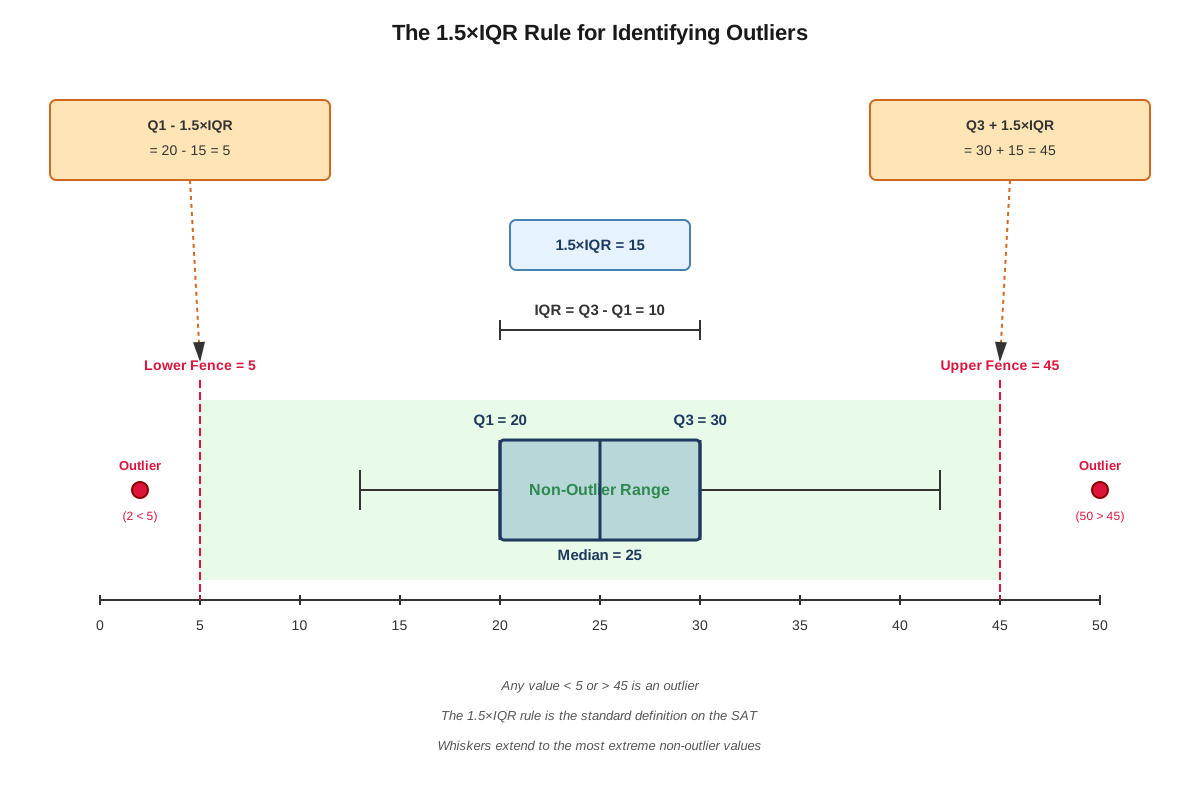
The most common mathematical definition uses the Interquartile Range (IQR) method. A data point is considered an outlier if it falls below Q1 - 1.5×IQR or above Q3 + 1.5×IQR, where Q1 is the first quartile, Q3 is the third quartile, and IQR = Q3 - Q1. This 1.5×IQR rule provides an objective criterion for outlier identification and is the standard method used in constructing box plots.
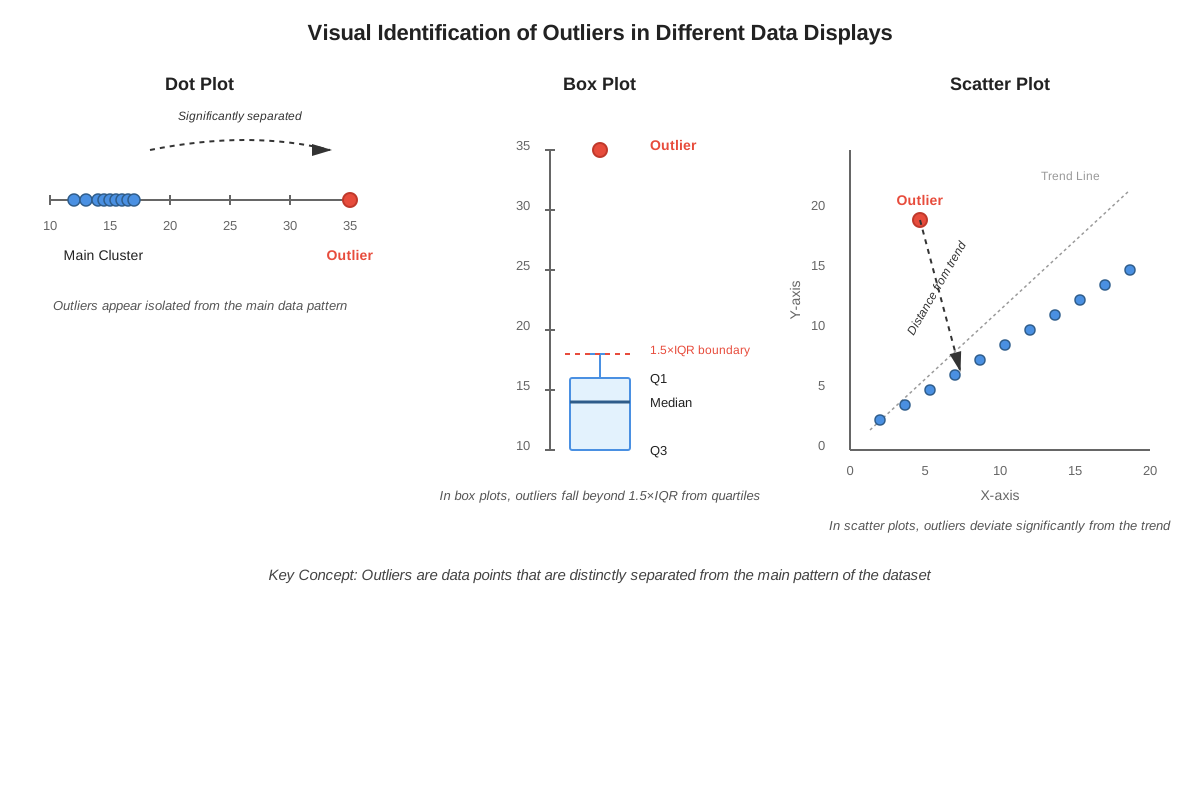
Visual identification involves examining data displays for points that appear isolated or distant from the main cluster of data. In a dot plot, outliers appear as dots separated from the main group by noticeable gaps. In scatter plots, outliers are points that deviate significantly from the overall pattern or trend line. In box plots, outliers are explicitly shown as individual points beyond the whiskers, which extend to 1.5×IQR from the quartiles.
Impact on Measures of Central Tendency
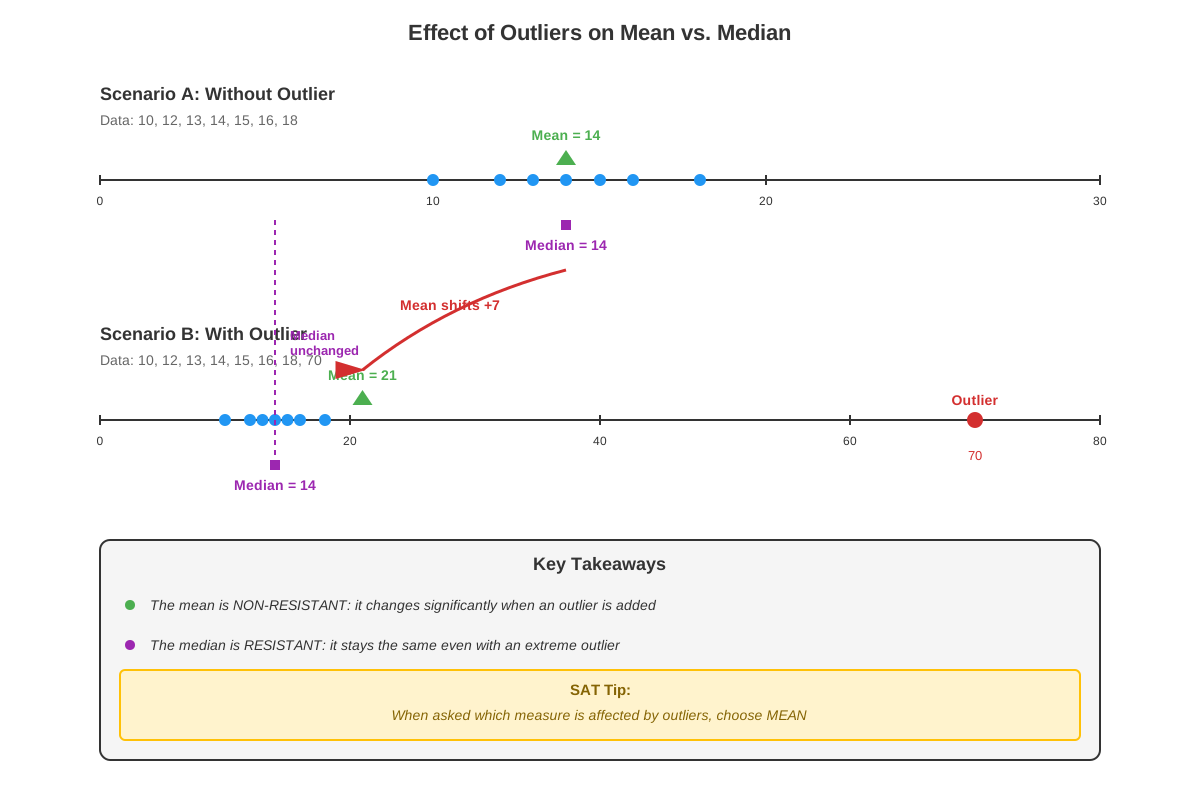
Understanding how outliers affect different statistical measures is crucial for SAT success. The mean (arithmetic average) is highly sensitive to outliers because it incorporates every value in its calculation. A single extreme value can pull the mean substantially toward it. For example, in the dataset {2, 3, 4, 5, 6}, the mean is 4. If we add an outlier of 50, the new dataset {2, 3, 4, 5, 6, 50} has a mean of approximately 11.67—nearly triple the original mean.
The median (middle value when data is ordered) is resistant to outliers, meaning it remains relatively stable even when extreme values are present. Using the same example, the median of {2, 3, 4, 5, 6} is 4, and the median of {2, 3, 4, 5, 6, 50} is 4.5—only a slight increase despite the dramatic outlier. This resistance makes the median a more reliable measure of center when outliers are present.
The mode (most frequent value) is completely unaffected by outliers unless the outlier itself becomes the most frequent value, which is rare. This makes the mode the most resistant measure, though it's less commonly tested on the SAT.
| Measure | Sensitivity to Outliers | SAT Testing Frequency |
|---|---|---|
| Mean | High (non-resistant) | Very High |
| Median | Low (resistant) | High |
| Mode | Very Low (resistant) | Low |
Impact on Measures of Spread
Outliers also dramatically affect measures of variability. The range (maximum - minimum) is extremely sensitive to outliers because it depends entirely on the two most extreme values. A single outlier can increase the range substantially. In the dataset {10, 12, 13, 14, 15}, the range is 5. Adding an outlier of 50 changes the range to 40.
Standard deviation measures how spread out data points are from the mean. Because it involves squaring the deviations from the mean, outliers have an amplified effect on standard deviation. A single extreme value can significantly increase the standard deviation, making the data appear more variable than the typical values suggest.
The Interquartile Range (IQR), which measures the spread of the middle 50% of data, is resistant to outliers. Since IQR only considers values between Q1 and Q3, extreme values beyond these quartiles don't affect it. This makes IQR the preferred measure of spread when outliers are present, just as median is the preferred measure of center.
Outliers in Scatter Plots
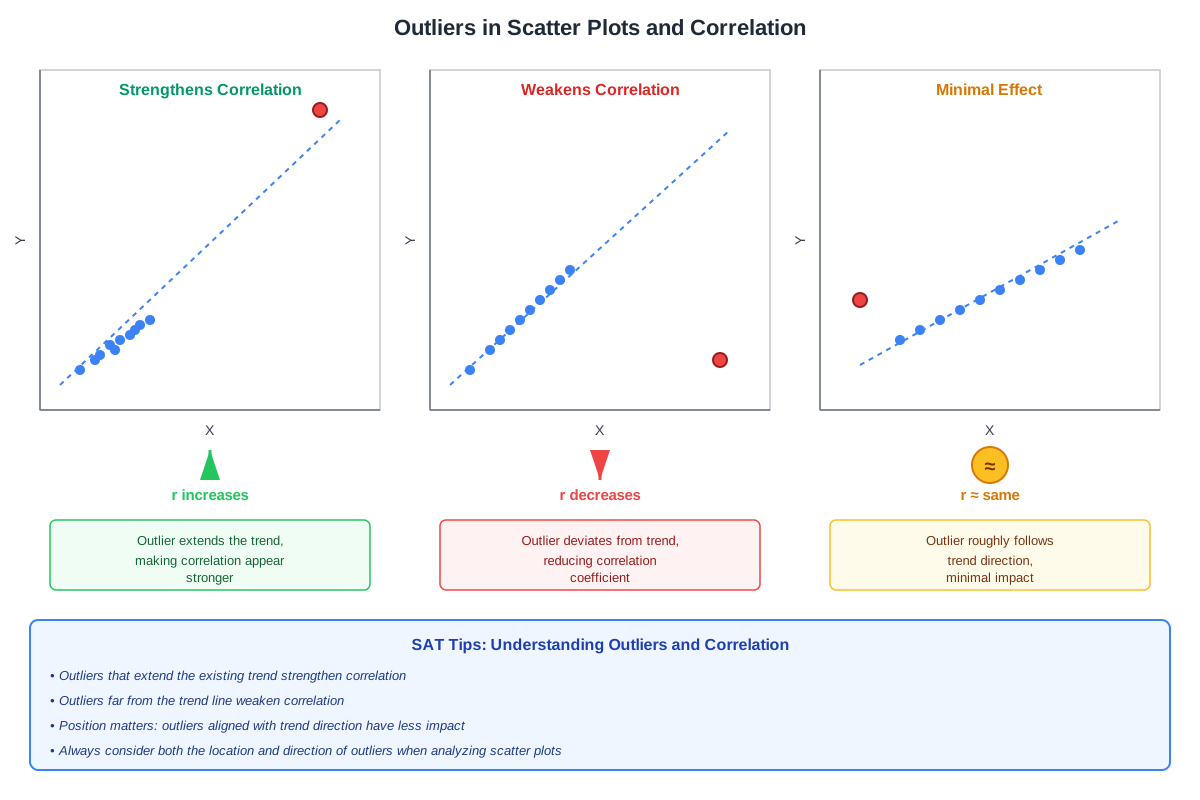
On the SAT, scatter plot questions frequently involve identifying outliers and understanding their impact on correlation and trend lines. In a scatter plot, an outlier is a point that doesn't follow the general pattern established by the other points. This could mean a point far above or below a trend line, or a point isolated from the main cluster of data.
Influential outliers are those that significantly affect the slope or position of a regression line. A point with an extreme x-value (far from the mean of x-values) has more leverage and can pull the trend line toward it. The SAT may ask whether removing an outlier would make a correlation stronger or weaker, or whether it would change the slope of a line of best fit.
When analyzing scatter plots, students should distinguish between outliers in the x-direction, y-direction, or both. A point might have a typical x-value but an extreme y-value (vertical outlier), or vice versa. The most influential outliers typically have extreme values in both dimensions.
Contextual Interpretation
The SAT emphasizes interpreting outliers within real-world contexts. An outlier isn't just a mathematical anomaly—it represents something meaningful in the situation being studied. Questions may present survey data where one respondent gave an unusual answer, experimental results where one trial produced unexpected outcomes, or demographic data where one region differs dramatically from others.
Students must determine whether an outlier represents: (1) a measurement or recording error that should be investigated or corrected, (2) a genuine but rare occurrence that provides valuable information, or (3) an indication that the data comes from multiple populations. The SAT tests whether students can make reasonable judgments about outliers based on context rather than simply applying mechanical rules.
Concept Relationships
The concept of outliers serves as a central hub connecting multiple statistical ideas. Outliers → directly affect → measures of central tendency (mean, median, mode), with the mean being most sensitive and median being resistant. This relationship is bidirectional: understanding how to calculate mean and median enables students to predict and verify the impact of outliers.
Outliers → are identified using → measures of spread (specifically IQR), creating a circular relationship where spread measures both define outliers and are affected by them. The 1.5×IQR rule → determines → outlier boundaries → which appear as → whisker endpoints in box plots.
Data visualization → enables → visual outlier identification → which complements → mathematical outlier criteria. Scatter plots, box plots, and dot plots each reveal outliers differently, requiring students to translate between visual and numerical representations.
Outliers → influence → correlation strength in scatter plots → which affects → predictive accuracy of trend lines. Strong outliers can weaken correlation coefficients or create misleading regression lines, connecting this topic to linear relationships and modeling.
The resistance of statistical measures creates a hierarchy: mode (most resistant) → median (moderately resistant) → mean (non-resistant) → range (extremely non-resistant). This hierarchy helps students quickly determine which measures will change most when outliers are added or removed.
High-Yield Facts
⭐ The mean is sensitive to outliers while the median is resistant, making median the better measure of center when extreme values are present
⭐ A data point is an outlier if it falls below Q1 - 1.5×IQR or above Q3 + 1.5×IQR, the standard mathematical definition used in box plots
⭐ Outliers always increase the range because they extend the distance between minimum and maximum values
⭐ In a box plot, outliers appear as individual points beyond the whiskers, which extend to 1.5×IQR from the quartiles
⭐ Removing a high outlier decreases the mean but has minimal effect on the median, a frequently tested comparison on the SAT
- The IQR (Interquartile Range) is resistant to outliers because it only considers the middle 50% of data
- Standard deviation increases when outliers are present because deviations are squared in its calculation
- In scatter plots, outliers are points that deviate significantly from the overall pattern or trend line
- An outlier in one context might not be an outlier in another; context matters for interpretation
- Multiple outliers on the same side (all high or all low) have a cumulative effect on the mean
- The mode is unaffected by outliers unless the outlier value itself becomes the most frequent
- Outliers can make a distribution skewed, pulling the tail in the direction of the extreme value
- When comparing two datasets, the one with outliers will typically have a larger standard deviation
- Removing an outlier from a small dataset has a more dramatic effect than removing one from a large dataset
- In real-world SAT contexts, outliers often represent errors, rare events, or exceptional cases requiring investigation
Quick check — test yourself on Outliers so far.
Try Flashcards →Common Misconceptions
Misconception: All extreme values are outliers that should be removed from analysis.
Correction: Outliers are defined by specific mathematical criteria (like the 1.5×IQR rule) and may represent genuine, valuable data points. Not all extreme values qualify as outliers, and legitimate outliers shouldn't automatically be discarded without investigation.
Misconception: The median is completely unaffected by outliers.
Correction: While the median is resistant to outliers, it can still change slightly when outliers are added or removed, especially in small datasets. The key distinction is that the median changes much less than the mean does.
Misconception: Outliers always make the mean higher than the median.
Correction: High outliers pull the mean above the median, but low outliers pull the mean below the median. The direction of the effect depends on whether the outlier is above or below the main data cluster.
Misconception: If a point looks far away on a graph, it's definitely an outlier.
Correction: Visual distance alone doesn't define outliers; mathematical criteria must be applied. A point might appear distant due to graph scaling but not meet the 1.5×IQR threshold. Conversely, in compressed scales, outliers might not look as extreme as they mathematically are.
Misconception: Removing an outlier always makes the data "better" or more accurate.
Correction: Outliers often contain important information about variability, rare events, or data quality issues. Removing outliers without justification can bias results and hide meaningful patterns. The SAT tests understanding of when outliers are informative versus problematic.
Misconception: The range is a resistant measure of spread like the IQR.
Correction: The range is extremely sensitive to outliers because it depends entirely on the minimum and maximum values. The IQR is resistant because it only considers the middle 50% of data, ignoring extreme values.
Misconception: In a scatter plot, any point far from the trend line is an outlier.
Correction: Scatter plot outliers should be distant from the overall pattern of points, not just from a calculated trend line. A point might be far from the line but still consistent with the general scatter of data, especially if correlation is weak.
Worked Examples
Example 1: Identifying and Analyzing Outliers
Problem: A teacher records the number of books read by students in a month: {3, 4, 4, 5, 5, 5, 6, 6, 7, 15}. Determine if 15 is an outlier using the 1.5×IQR rule, then calculate how removing it affects the mean and median.
Solution:
Step 1: Order the data (already ordered) and find quartiles.
- n = 10 values
- Median (Q2) = (5 + 5)/2 = 5
- Q1 = median of lower half {3, 4, 4, 5, 5} = 4
- Q3 = median of upper half {5, 6, 6, 7, 15} = 6
Step 2: Calculate IQR and outlier boundaries.
- IQR = Q3 - Q1 = 6 - 4 = 2
- Lower boundary = Q1 - 1.5×IQR = 4 - 1.5(2) = 4 - 3 = 1
- Upper boundary = Q3 + 1.5×IQR = 6 + 1.5(2) = 6 + 3 = 9
Step 3: Determine if 15 is an outlier.
- Since 15 > 9 (upper boundary), 15 is an outlier.
Step 4: Calculate statistics with the outlier.
- Mean = (3+4+4+5+5+5+6+6+7+15)/10 = 60/10 = 6
- Median = 5 (already calculated)
Step 5: Calculate statistics without the outlier.
- New dataset: {3, 4, 4, 5, 5, 5, 6, 6, 7}
- Mean = (3+4+4+5+5+5+6+6+7)/9 = 45/9 = 5
- Median = 5 (middle value of 9 numbers)
Analysis: Removing the outlier decreased the mean from 6 to 5 (a 16.7% decrease), while the median remained unchanged at 5. This demonstrates that the median is resistant to outliers while the mean is sensitive to them—a key concept frequently tested on the SAT.
Example 2: Scatter Plot Outlier Impact
Problem: A scatter plot shows the relationship between hours studied (x-axis) and test scores (y-axis) for 20 students. Most points cluster around a positive linear trend, with scores increasing as study time increases. One point shows a student who studied 8 hours but scored only 45%, while students who studied similar amounts scored 80-90%. How would removing this outlier affect the correlation and the slope of the line of best fit?
Solution:
Step 1: Identify the outlier characteristics.
- The point (8 hours, 45%) is an outlier because it deviates significantly from the positive trend
- It has a typical x-value (8 hours is within the range of other students) but an extremely low y-value
- This is a vertical outlier that doesn't follow the pattern
Step 2: Analyze impact on correlation.
- The outlier weakens the positive correlation because it contradicts the general pattern
- With the outlier, the correlation coefficient r is closer to 0 than it would be without it
- Removing the outlier would strengthen the positive correlation, moving r closer to +1
Step 3: Analyze impact on slope.
- The outlier pulls the line of best fit downward, decreasing its slope
- Without this point, the line would be steeper, showing a stronger positive relationship
- The y-intercept would likely increase as well, since the line wouldn't be pulled down by the low outlier
Step 4: Contextual interpretation.
- This outlier might represent a student who studied but didn't understand the material, was ill during the test, or misreported study time
- The outlier provides valuable information: study time alone doesn't guarantee high scores
- For predictive purposes, removing it would create a more accurate model for typical students
Conclusion: Removing the outlier would strengthen the correlation (increase r), increase the slope of the line of best fit, and improve the model's predictive accuracy for typical cases. This example demonstrates how outliers in scatter plots affect both correlation strength and regression line characteristics.
Exam Strategy
When approaching SAT questions about outliers, begin by identifying the data representation format: box plot, scatter plot, dot plot, or numerical list. Each format requires slightly different identification strategies. For box plots, immediately look for individual points beyond the whiskers—these are explicitly marked outliers. For scatter plots, scan for points isolated from the main cluster or far from any apparent trend line. For numerical data, quickly order the values mentally and look for gaps or extreme values.
Trigger words and phrases that signal outlier questions include: "extreme value," "unusual observation," "data point that doesn't fit the pattern," "significantly different from," "affect the mean more than the median," "resistant measure," and "if this value were removed." When you see these phrases, immediately think about the distinction between resistant (median, IQR) and non-resistant (mean, range, standard deviation) measures.
For questions asking how removing an outlier affects statistics, use this efficient process:
- Identify whether the outlier is high or low relative to other data
- Predict: high outliers increase the mean; low outliers decrease it
- Remember: median changes minimally or not at all
- Range always decreases when any outlier is removed
- Standard deviation decreases when outliers are removed
Process of elimination works well for outlier questions. If a choice claims the median changes dramatically when an outlier is removed, eliminate it immediately—this contradicts the resistant property of the median. If a choice suggests removing a high outlier increases the mean, eliminate it—the mean must decrease. If asked which measure is most affected by an outlier, eliminate any choice suggesting the median or IQR.
Time allocation: Most outlier questions can be solved in 60-90 seconds. Don't waste time calculating exact values unless specifically asked. For comparison questions ("which changes more?"), qualitative reasoning about resistant versus non-resistant measures is faster than calculation. Reserve detailed calculations for grid-in questions requiring specific numerical answers.
When questions provide context (survey data, experimental results, etc.), spend 5-10 seconds considering what the outlier might represent in that situation. The SAT occasionally asks interpretation questions where understanding the real-world meaning matters more than mathematical calculation.
Memory Techniques
MRIN - Remember which measures are resistant to outliers:
- Median - Resistant
- IQR - Resistant
- Not mean or range - Non-resistant
"The Mean is Mean to Outliers" - The mean changes dramatically (is "mean" or harsh) when outliers are present, while the median is "nice" and stays relatively stable.
1.5 IQR Rule Visualization: Picture a box plot as a house. The box is the main house (Q1 to Q3), the whiskers are the yard fence extending 1.5 times the width of the house (1.5×IQR), and outliers are neighbors who live beyond the fence. This visual helps remember that outliers fall outside 1.5×IQR from the quartiles.
HIGH and LOW mnemonic:
- High outliers Increase the mean, Greater than median, Hoist the range
- Low outliers Lower the mean, Outlier pulls down, Widen the range
Scatter Plot Outliers: Remember "Off the Path" - outliers in scatter plots are Off the Pattern, Away from the Trend, Hurt correlation. This acronym reminds you that scatter plot outliers deviate from the overall pattern and weaken correlation.
Resistance Ranking: Create a mental scale from most to least resistant: Mode > Median > Mean > Range. Visualize this as a strength ladder where mode is the strongest (most resistant) and range is the weakest (least resistant).
Summary
Outliers are data points that differ significantly from other observations in a dataset, identified either visually through graphs or mathematically using the 1.5×IQR rule (values below Q1 - 1.5×IQR or above Q3 + 1.5×IQR). Understanding outliers is essential for SAT success because they appear frequently in data analysis questions and dramatically affect statistical measures. The mean is highly sensitive to outliers and changes substantially when extreme values are added or removed, while the median is resistant and remains relatively stable. Similarly, range and standard deviation are sensitive to outliers, whereas IQR is resistant. In scatter plots, outliers are points that deviate from the overall pattern and can weaken correlations or influence trend lines. SAT questions test whether students can identify outliers in various representations, predict their impact on different statistical measures, and interpret their meaning in real-world contexts. Mastering the distinction between resistant and non-resistant measures is the key to efficiently answering outlier questions.
Key Takeaways
- Outliers are mathematically defined as values below Q1 - 1.5×IQR or above Q3 + 1.5×IQR, providing an objective identification criterion
- The mean is sensitive to outliers while the median is resistant—this is the most frequently tested concept on the SAT
- Removing a high outlier decreases the mean but has minimal effect on the median; removing a low outlier increases the mean
- In box plots, outliers appear as individual points beyond the whiskers; in scatter plots, they deviate from the overall pattern
- Range and standard deviation are non-resistant measures that increase when outliers are present, while IQR is resistant
- Outliers in scatter plots weaken correlation and can significantly influence the slope and position of trend lines
- Context matters: outliers may represent errors, rare events, or valuable information depending on the situation
Related Topics
Standard Deviation and Variance: Understanding how outliers affect these measures of spread builds on outlier concepts and appears in advanced SAT statistics questions. Mastering outliers provides the foundation for understanding why standard deviation increases dramatically with extreme values.
Box Plots and Five-Number Summary: Box plots explicitly display outliers and use the 1.5×IQR rule in their construction. Deep knowledge of outliers enhances box plot interpretation skills.
Correlation and Regression: Scatter plot outliers directly impact correlation coefficients and regression lines. Understanding outliers is prerequisite knowledge for advanced questions about line of best fit and predictive modeling.
Skewness and Distribution Shape: Outliers often create skewed distributions, pulling the tail toward extreme values. This topic extends outlier concepts to broader distribution analysis.
Data Collection and Sampling: Understanding outliers helps evaluate data quality and identify potential measurement errors or sampling issues, connecting statistical analysis to research methodology.
Practice CTA
Now that you've mastered the core concepts of outliers, it's time to reinforce your learning through active practice. Attempt the practice questions to test your ability to identify outliers, predict their impact on statistical measures, and interpret them in context. Use the flashcards to memorize key facts like the 1.5×IQR rule and the distinction between resistant and non-resistant measures. Remember: understanding outliers gives you a significant advantage on SAT data analysis questions, which are among the most predictable and high-yield topics on the exam. Every practice problem you complete builds the pattern recognition and strategic thinking needed for test day success!
Sign up free to keep reading
Create a free AnvayaPrep account to finish this SAT guide on Outliers — plus flashcards and practice questions.