Overview
Scatterplots are one of the most frequently tested graphical representations in the SAT math section, appearing in approximately 10-15% of all data analysis questions. A scatterplot is a two-dimensional graph that displays the relationship between two quantitative variables by plotting individual data points on a coordinate plane. Each point represents a single observation, with its position determined by its values on both the x-axis (independent variable) and y-axis (dependent variable). Understanding scatterplots is essential not only for interpreting data visually but also for recognizing patterns, identifying correlations, making predictions, and evaluating the strength of relationships between variables.
The SAT tests scatterplot knowledge in multiple ways: identifying positive, negative, or no correlation; interpreting lines of best fit; understanding outliers and their impact; calculating and interpreting slope and y-intercept in context; and making predictions based on trend lines. Questions may ask students to determine which equation best models the data, identify unusual data points, or explain what specific features of the graph represent in real-world contexts. Mastery of scatterplots requires both mathematical computation skills and the ability to translate between graphical, numerical, and verbal representations of data.
Scatterplots connect to broader mathematical concepts including linear functions, systems of equations, statistical measures, and algebraic modeling. They serve as a bridge between pure algebra and applied statistics, requiring students to understand coordinate geometry while also thinking critically about data relationships. This topic integrates seamlessly with questions about linear regression, correlation coefficients, and data interpretation—all high-yield areas on the SAT that frequently appear in both the calculator and no-calculator sections.
Learning Objectives
- [ ] Identify key features of scatterplots including correlation direction, strength, and outliers
- [ ] Explain how scatterplots appear on the SAT in various question formats and contexts
- [ ] Apply scatterplot concepts to answer SAT-style questions involving interpretation and prediction
- [ ] Determine the equation of a line of best fit from a scatterplot and interpret its parameters
- [ ] Distinguish between correlation and causation in scatterplot contexts
- [ ] Evaluate the appropriateness of using a linear model for a given dataset
- [ ] Calculate and interpret residuals and their significance in model accuracy
Prerequisites
- Coordinate plane fundamentals: Understanding x and y axes, plotting points, and reading coordinates is essential for interpreting any scatterplot
- Linear equations (y = mx + b): Recognizing slope and y-intercept allows students to connect algebraic equations to graphical trend lines
- Basic statistical concepts: Familiarity with mean, median, and range helps in understanding data distribution and identifying outliers
- Function notation: Understanding f(x) notation is necessary for interpreting prediction equations derived from scatterplots
Why This Topic Matters
Scatterplots represent a critical intersection of algebra, geometry, and statistics that appears extensively in real-world applications. Scientists use scatterplots to identify relationships between variables in research studies, economists analyze market trends through scatter diagrams, and medical professionals track patient outcomes over time using these visualizations. The ability to read and interpret scatterplots is fundamental to data literacy in the modern world, where decision-making increasingly relies on visual data representation.
On the SAT, scatterplot questions appear with remarkable consistency, typically comprising 2-4 questions per test administration. These questions appear in both the calculator and no-calculator sections, though more complex interpretation questions tend to appear in the calculator-permitted portion. The College Board frequently embeds scatterplots within word problems that require students to extract information from graphs, make predictions using trend lines, or identify which mathematical model best represents the displayed data. Questions range from straightforward interpretation (identifying correlation type) to complex multi-step problems requiring calculation of predicted values and evaluation of model accuracy.
Common SAT question formats include: determining which equation best models the data shown; identifying the meaning of slope or y-intercept in context; predicting a y-value for a given x-value using the line of best fit; identifying outliers and explaining their significance; and comparing multiple scatterplots to determine which shows the strongest correlation. Understanding these patterns allows students to approach scatterplot questions strategically and efficiently.
Core Concepts
Components of a Scatterplot
A scatterplot consists of several essential elements that students must identify and interpret. The horizontal axis (x-axis) typically represents the independent variable—the variable that is manipulated or chosen first. The vertical axis (y-axis) represents the dependent variable—the variable that responds to or depends on the independent variable. Each plotted point represents one observation or data pair, with its coordinates (x, y) showing the values of both variables for that particular case.
The scale of each axis determines how data is displayed and must be read carefully, as SAT questions often use non-standard intervals. The origin (0, 0) may or may not be visible on the graph, and students should note whether axes begin at zero or some other value, as this affects visual interpretation of relationships.
Types of Correlation
Correlation describes the relationship between two variables as displayed in a scatterplot. Understanding correlation types is fundamental to SAT success:
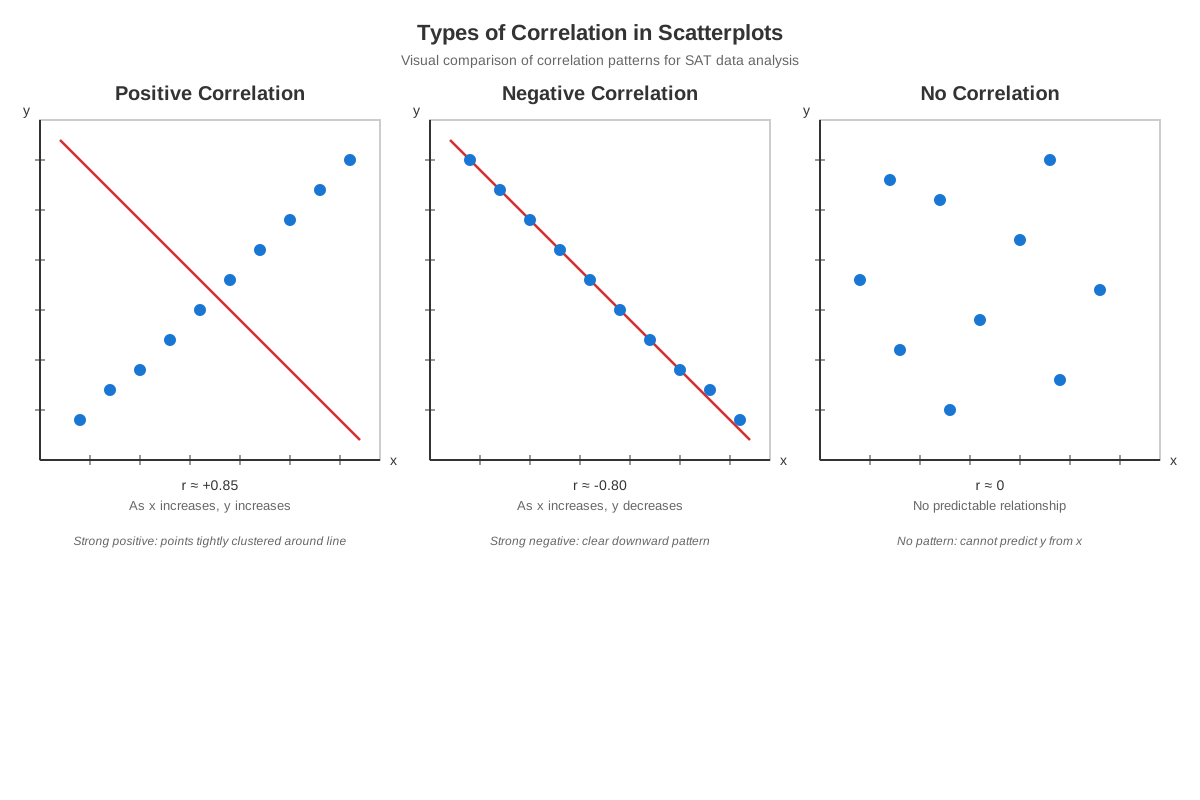
Positive correlation occurs when both variables increase together—as x increases, y tends to increase. The data points form a pattern that rises from left to right. Examples include the relationship between study time and test scores, or height and weight in adolescents.
Negative correlation occurs when one variable increases as the other decreases—as x increases, y tends to decrease. The data points form a pattern that falls from left to right. Examples include the relationship between car age and resale value, or altitude and temperature.
No correlation (or zero correlation) occurs when there is no apparent relationship between the variables. The data points appear randomly scattered with no discernible pattern. Examples might include shoe size and test scores, or birth month and height.
Strength of Correlation
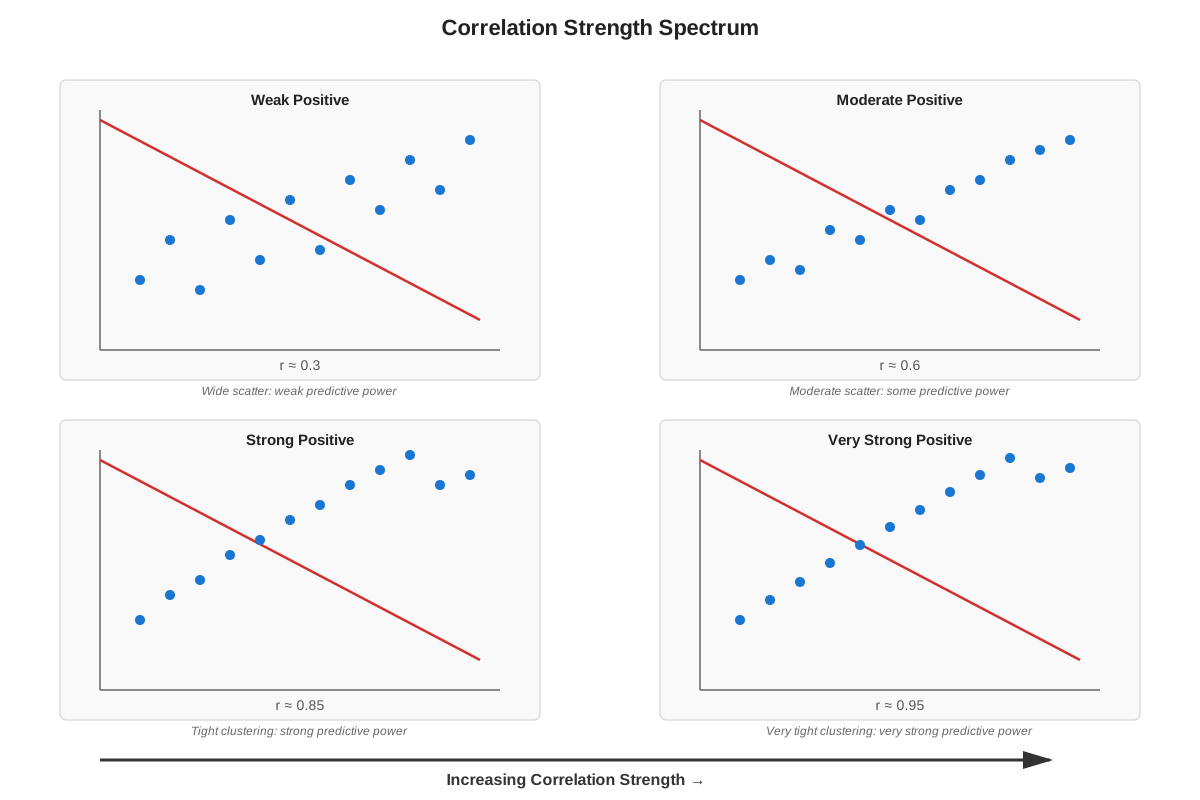
Beyond direction, correlation has strength—how closely the data points cluster around a trend line:
- Strong correlation: Points cluster tightly around an imaginary line, with minimal scatter
- Moderate correlation: Points show a general trend but with noticeable scatter
- Weak correlation: Points show a slight trend but are widely dispersed
The SAT expects students to make qualitative judgments about correlation strength by visual inspection, though actual correlation coefficients (r-values) are rarely calculated.
Line of Best Fit
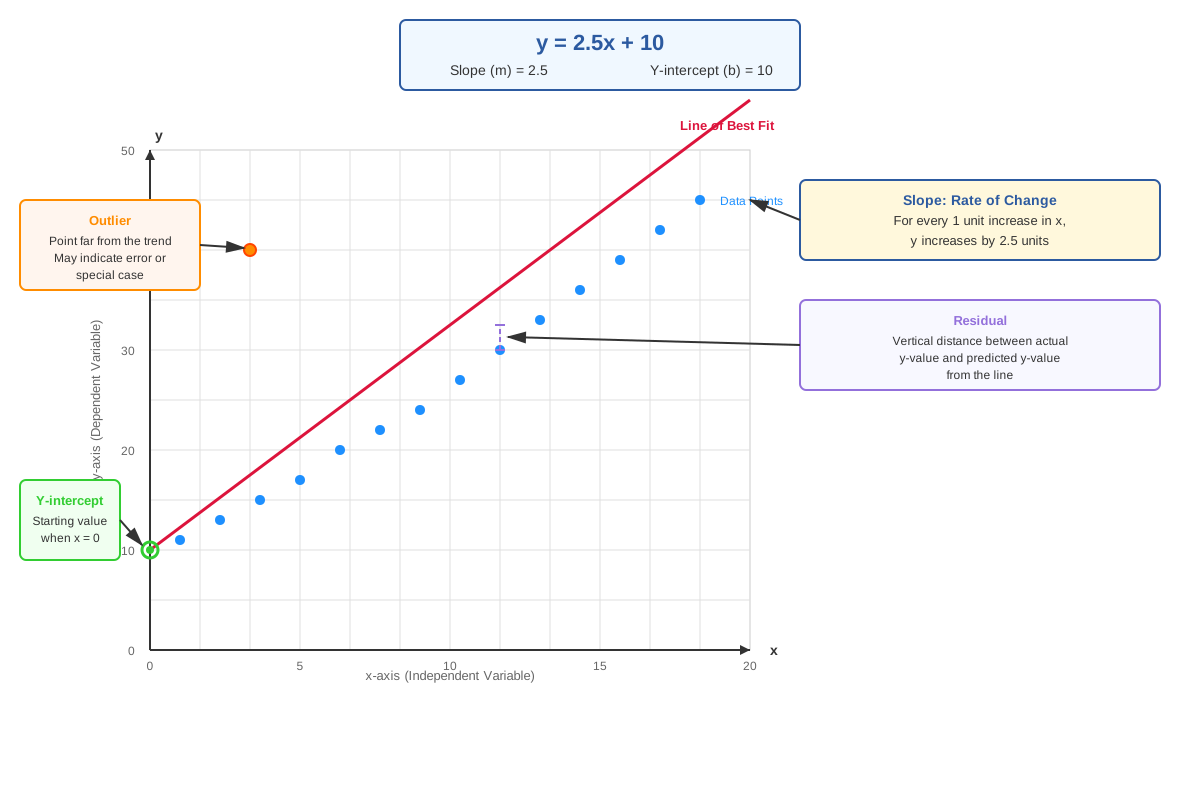
The line of best fit (or trend line or regression line) is a straight line drawn through a scatterplot that best represents the overall trend of the data. This line minimizes the total distance between itself and all data points. On the SAT, the line of best fit is typically provided, and students must interpret or use it rather than calculate it.
The equation of the line of best fit follows the form y = mx + b, where:
- m represents the slope—the rate of change in y for each unit increase in x
- b represents the y-intercept—the predicted value of y when x equals zero
y = mx + bInterpreting these parameters in context is crucial. For example, if a scatterplot shows the relationship between hours studied (x) and test score (y) with equation y = 5x + 60, the slope of 5 means each additional hour of study predicts a 5-point increase in test score, while the y-intercept of 60 represents the predicted score with zero hours of study.
Outliers
An outlier is a data point that lies far from the general pattern of the other points. Outliers can significantly affect the line of best fit, especially in small datasets. On the SAT, students must:
- Identify outliers visually
- Explain what an outlier might represent in context
- Understand that removing an outlier typically changes the slope and/or y-intercept of the line of best fit
For example, in a scatterplot showing the relationship between car weight and fuel efficiency, an outlier might represent a hybrid vehicle that achieves unusually high fuel efficiency for its weight.
Making Predictions
One primary use of scatterplots is interpolation (predicting within the range of observed data) and extrapolation (predicting beyond the range of observed data). To make predictions:
- Identify the x-value for which you need to predict y
- Use the equation of the line of best fit
- Substitute the x-value into the equation
- Solve for y
Interpolation is generally more reliable because it predicts within the observed data range. Extrapolation is less reliable because it assumes the trend continues beyond observed values, which may not be accurate.
Residuals
A residual is the difference between an observed y-value and the predicted y-value from the line of best fit:
Residual = Observed y - Predicted yPositive residuals indicate the actual value is above the line of best fit; negative residuals indicate the actual value is below the line. While detailed residual analysis is rare on the SAT, understanding that residuals measure prediction error helps students evaluate model accuracy.
Correlation vs. Causation
A critical concept that appears on the SAT is distinguishing between correlation and causation. Just because two variables show correlation does not mean one causes the other. There may be:
- Coincidental correlation: No real relationship, just random chance
- Common cause: A third variable causes both observed variables
- Reverse causation: The assumed effect actually causes the assumed cause
- True causation: One variable directly causes changes in the other
The SAT frequently includes questions asking students to identify whether a causal relationship can be inferred from a scatterplot alone (the answer is typically "no" without additional experimental evidence).
Concept Relationships
The concepts within scatterplots build upon each other in a logical progression. Understanding the coordinate plane and plotting points enables recognition of correlation patterns (positive, negative, or none). Identifying correlation leads to understanding the line of best fit, which connects to linear equations and their components (slope and y-intercept). The line of best fit enables predictions through interpolation and extrapolation, while understanding residuals allows evaluation of prediction accuracy. Outliers affect all these concepts by potentially distorting the line of best fit and correlation strength.
Scatterplots connect to prerequisite topics through multiple pathways: linear functions provide the algebraic foundation for trend line equations; coordinate geometry enables point plotting and distance interpretation; statistical measures help identify unusual values and data spread. These connections extend forward to more advanced topics like correlation coefficients, regression analysis, and hypothesis testing.
The relationship map flows as follows:
Coordinate Plane → Data Points → Pattern Recognition → Correlation Type & Strength → Line of Best Fit → Equation Interpretation → Predictions → Residual Analysis → Model Evaluation
Quick check — test yourself on Scatterplots so far.
Try Flashcards →High-Yield Facts
⭐ Positive correlation: As x increases, y increases; points rise from left to right
⭐ Negative correlation: As x increases, y decreases; points fall from left to right
⭐ Line of best fit equation y = mx + b: m is slope (rate of change), b is y-intercept (value when x = 0)
⭐ Slope interpretation: The change in y for each one-unit increase in x, always interpreted in context
⭐ Outliers: Data points far from the general pattern that can significantly affect the line of best fit
- No correlation: Points show no discernible pattern; variables are unrelated
- Interpolation: Predicting within the data range; more reliable than extrapolation
- Extrapolation: Predicting beyond the data range; assumes trend continues
- Strong correlation: Points cluster tightly around the trend line
- Y-intercept interpretation: The predicted y-value when x equals zero, meaningful only if x = 0 is within reasonable context
- Correlation does not imply causation: A relationship between variables does not prove one causes the other
- Residual: The difference between observed and predicted values; measures prediction error
- Removing an outlier: Typically changes the slope and/or y-intercept of the line of best fit
Common Misconceptions
Misconception: Correlation always means causation—if two variables are related in a scatterplot, one must cause the other.
Correction: Correlation only indicates that two variables change together; causation requires experimental evidence showing that changes in one variable directly produce changes in the other. Many correlations result from coincidence or common underlying factors.
Misconception: The line of best fit must pass through most or all of the data points.
Correction: The line of best fit minimizes overall distance to all points but typically passes through very few actual data points. It represents the general trend, not individual observations.
Misconception: A y-intercept always has meaningful real-world interpretation.
Correction: The y-intercept only has practical meaning if x = 0 is within the reasonable range of the data. For example, in a scatterplot relating car age to value, a y-intercept might represent the value of a brand-new car, but in a plot relating adult height to shoe size, x = 0 (zero height) is meaningless.
Misconception: Extrapolation is just as reliable as interpolation.
Correction: Extrapolation assumes the observed trend continues beyond the data range, which is often unrealistic. Many relationships change behavior outside observed ranges (e.g., linear growth may become exponential or plateau).
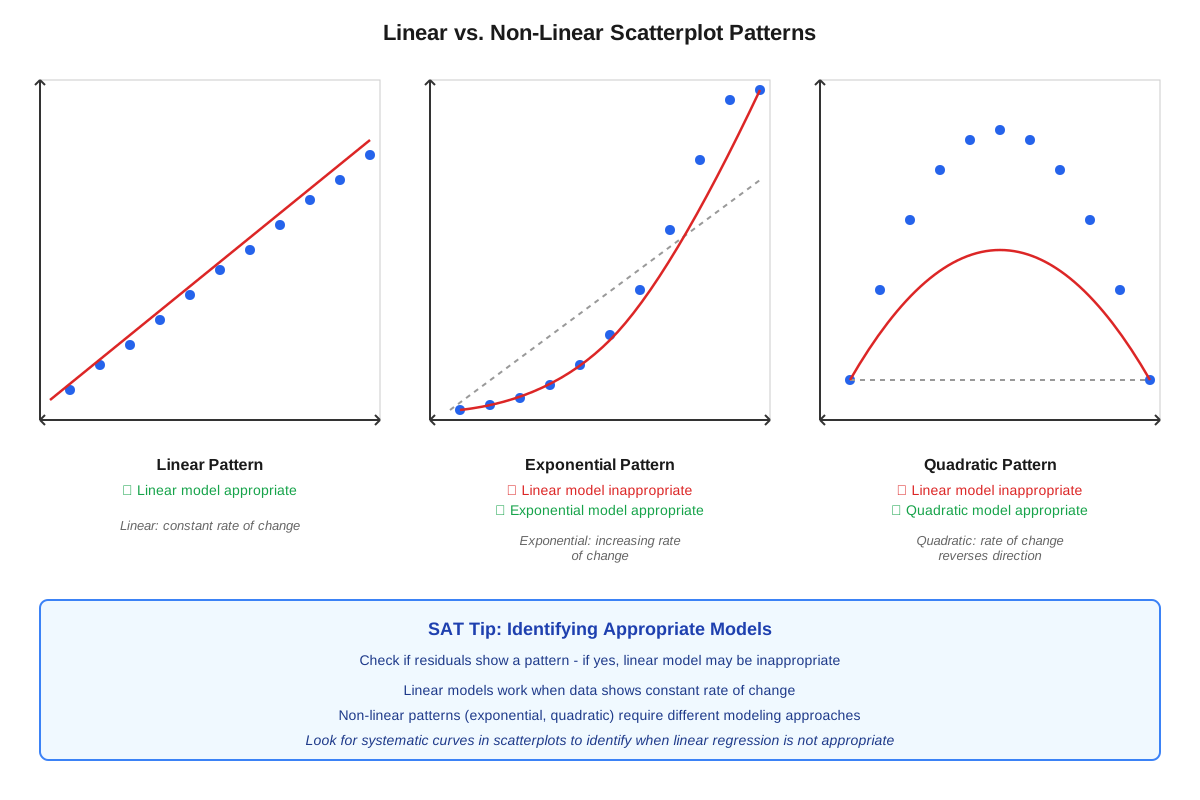
Misconception: All scatterplots should show linear relationships.
Correction: While the SAT primarily tests linear relationships, real data may show curved patterns, exponential growth, or no pattern at all. Students should recognize when a linear model is inappropriate for the displayed data.
Misconception: Outliers should always be ignored or removed from analysis.
Correction: Outliers may represent important information—measurement errors, special cases, or interesting exceptions. Their significance depends on context, and they should be investigated rather than automatically discarded.
Misconception: A steeper line always indicates a stronger correlation.
Correction: Slope (steepness) measures rate of change, while correlation strength measures how closely points cluster around the line. A steep line with widely scattered points shows weak correlation, while a gentle slope with tightly clustered points shows strong correlation.
Worked Examples
Example 1: Interpreting Slope and Making Predictions
Problem: A scatterplot shows the relationship between the number of hours a plant receives sunlight per day (x-axis) and its height in centimeters after 30 days (y-axis). The line of best fit has the equation y = 2.5x + 8.
(a) Interpret the slope in context.
(b) Interpret the y-intercept in context.
(c) Predict the height of a plant that receives 6 hours of sunlight per day.
Solution:
(a) The slope is 2.5, which means for each additional hour of sunlight per day, the plant's height after 30 days increases by an average of 2.5 centimeters. This represents the rate of growth associated with increased sunlight exposure.
(b) The y-intercept is 8, which represents the predicted height (8 centimeters) of a plant that receives zero hours of sunlight per day after 30 days. This might represent baseline growth from stored energy or artificial light, though x = 0 may not be practically meaningful if plants cannot survive without any light.
(c) To predict the height for x = 6 hours:
y = 2.5(6) + 8
y = 15 + 8
y = 23
The predicted height is 23 centimeters.
Connection to Learning Objectives: This example demonstrates identifying key features (slope and y-intercept), explaining their contextual meaning, and applying the equation to make predictions—all essential SAT skills.
Example 2: Analyzing Outliers and Correlation
Problem: A scatterplot displays the relationship between students' absences (x-axis) and their final exam scores (y-axis) for a class of 25 students. Most points show a clear negative correlation, with scores decreasing as absences increase. However, one student with 12 absences scored 95%, while most students with similar absence rates scored between 60-70%.
(a) Identify the outlier and explain what it represents.
(b) How would removing this outlier likely affect the line of best fit?
(c) What might explain this outlier in real-world terms?
Solution:
(a) The outlier is the point (12, 95)—representing a student with 12 absences who scored 95%. This point lies far above the general negative trend where high absences correspond to lower scores.
(b) Removing this outlier would likely make the line of best fit steeper (more negative slope) because the outlier "pulls" the line upward on the right side. Without it, the line would more accurately reflect the strong negative relationship between absences and scores for the typical students. The y-intercept might also increase slightly.
(c) This outlier might represent an exceptional student who learns material independently despite missing class, someone who was absent for legitimate reasons but studied extensively at home, or possibly someone who had access to makeup instruction. It demonstrates that while correlation exists for most students, individual cases can deviate significantly from the trend.
Connection to Learning Objectives: This example requires identifying key features (outliers), explaining their significance, and understanding how they affect the overall model—critical skills for SAT scatterplot questions.
Exam Strategy
When approaching SAT scatterplot questions, follow this systematic process:
Step 1: Identify what the question asks. SAT questions may ask for interpretation (what does the slope mean?), prediction (what is the y-value for a given x?), or evaluation (which equation best fits the data?). Understanding the question type determines your approach.
Step 2: Examine the axes carefully. Note what each axis represents, the units used, and the scale intervals. Many students make errors by misreading scales or confusing which variable is independent versus dependent.
Step 3: Assess the correlation. Quickly determine if the relationship is positive, negative, or absent, and estimate the strength. This helps eliminate wrong answer choices in multiple-choice questions.
Trigger words to watch for:
- "Best represented by" or "best modeled by" → requires matching equation to visual pattern
- "Predicted" or "estimated" → requires using the line of best fit equation
- "Interpret" → requires explaining slope or y-intercept in context
- "Outlier" or "unusual" → requires identifying points far from the trend
- "Correlation" vs. "causation" → requires distinguishing relationship from cause-effect
Process of elimination tips:
- If the scatterplot shows positive correlation, eliminate any equations with negative slopes
- If the y-intercept appears above the x-axis, eliminate equations with negative y-intercepts
- If asked about causation, eliminate answers that claim one variable causes the other without experimental evidence
- For prediction questions, eliminate answers that fall far outside the reasonable range suggested by the data
Time allocation: Spend 30-45 seconds reading the graph and understanding what it represents, then 45-60 seconds solving the specific question. Don't rush the interpretation phase—errors in understanding the context lead to wrong answers even with correct calculations.
Memory Techniques
PNNS for Correlation Types: Positive (up-right), Negative (down-right), No correlation, Strength varies
Slope Interpretation Formula: "For each [one unit increase in x-variable], the [y-variable] [increases/decreases] by [slope value] [y-units]"
Y = MX + B Memory Aid: "Mountains have slopes" (m is slope), "Base camp is where you start" (b is y-intercept/starting value)
Outlier Visualization: Picture outliers as "lonely points" standing far from their friends—they don't fit the group pattern
Correlation ≠ Causation Reminder: "Correlation Can't Confirm Causation" (four C's)
Interpolation vs. Extrapolation: "Interpolation stays internal (inside the data range); Extrapolation goes extra far (outside the data range)"
Residual Memory: "Residual = Real minus Regression" (observed minus predicted)
Summary
Scatterplots are essential graphical tools that display relationships between two quantitative variables through plotted points on a coordinate plane. Mastery requires understanding correlation types (positive, negative, or none) and strength, interpreting lines of best fit through their equations (y = mx + b), and making predictions through interpolation and extrapolation. The slope represents the rate of change between variables, while the y-intercept represents the predicted value when the independent variable equals zero—both must be interpreted in context. Outliers are data points that deviate significantly from the general pattern and can substantially affect the line of best fit. Critical thinking about correlation versus causation is essential, as scatterplots show relationships but cannot prove that one variable causes changes in another without additional experimental evidence. SAT questions test these concepts through interpretation, prediction, and evaluation tasks that require both computational skills and contextual understanding.
Key Takeaways
- Scatterplots display relationships between two quantitative variables; correlation can be positive, negative, or absent, with varying strength
- The line of best fit equation y = mx + b enables predictions, where slope (m) is the rate of change and y-intercept (b) is the starting value
- Always interpret slope and y-intercept in the context of the specific variables being measured
- Outliers are points far from the general pattern that significantly affect the line of best fit when included
- Correlation does not prove causation—additional experimental evidence is required to establish cause-and-effect relationships
- Interpolation (predicting within the data range) is more reliable than extrapolation (predicting beyond the data range)
- Read axes carefully, noting scales, units, and which variable is independent versus dependent
Related Topics
Linear Functions and Equations: Understanding function notation, graphing lines, and solving for variables extends scatterplot skills to pure algebraic contexts and enables deeper analysis of trend line equations.
Statistical Measures (Mean, Median, Standard Deviation): These concepts complement scatterplot analysis by providing numerical summaries of data distribution and variability, helping identify outliers mathematically rather than just visually.
Systems of Equations: Finding intersection points of multiple lines relates to scatterplot analysis when comparing different trend lines or determining where two relationships produce equal outcomes.
Exponential and Quadratic Functions: After mastering linear scatterplots, students can extend their understanding to non-linear relationships that appear in more advanced data analysis contexts.
Probability and Data Analysis: Scatterplots form part of broader statistical reasoning skills tested on the SAT, including interpreting tables, charts, and other data representations.
Practice CTA
Now that you've mastered the core concepts of scatterplots, it's time to solidify your understanding through active practice. Attempt the practice questions to apply these concepts in SAT-style scenarios, and use the flashcards to reinforce key definitions and relationships. Remember, scatterplot questions are high-yield on the SAT—investing time in practice now will pay dividends on test day. Each practice problem you solve strengthens your pattern recognition and builds the confidence needed to tackle any scatterplot question efficiently and accurately!
Sign up free to keep reading
Create a free AnvayaPrep account to finish this SAT guide on Scatterplots — plus flashcards and practice questions.