Overview
Quadratic functions represent one of the most frequently tested topics in SAT math, appearing in approximately 10-15% of all math questions on the exam. These functions, characterized by their distinctive parabolic shape and second-degree polynomial form, serve as a bridge between linear relationships and more complex mathematical models. Understanding quadratic functions is not merely about memorizing formulas—it requires developing intuition about how these functions behave, how their graphs relate to their equations, and how to manipulate them efficiently under timed testing conditions.
The SAT tests quadratic functions through multiple lenses: algebraic manipulation, graphical interpretation, real-world modeling, and problem-solving applications. Students must be comfortable switching between different representations of quadratics (standard form, vertex form, and factored form) and extracting meaningful information from each. Questions may ask about vertex location, axis of symmetry, roots, y-intercepts, or the effects of transformations. Additionally, quadratic functions frequently appear in word problems involving projectile motion, area optimization, and profit maximization.
Mastery of quadratic functions creates a foundation for understanding polynomial behavior more broadly and connects directly to concepts like systems of equations, inequalities, and function transformations. This topic integrates algebraic skills (factoring, completing the square, using the quadratic formula) with geometric reasoning (interpreting parabolas, understanding symmetry) and analytical thinking (determining maximum/minimum values, analyzing rates of change). Success with quadratic functions on the SAT requires both computational fluency and conceptual understanding—the ability to recognize which approach will most efficiently solve a given problem.
Learning Objectives
- [ ] Identify key features of quadratic functions including vertex, axis of symmetry, roots, y-intercept, and direction of opening
- [ ] Explain how quadratic functions appear on the SAT across multiple question formats and difficulty levels
- [ ] Apply quadratic functions to answer SAT-style questions involving graphs, equations, and real-world contexts
- [ ] Convert between different forms of quadratic equations (standard, vertex, and factored) to extract relevant information
- [ ] Determine the number and nature of solutions to quadratic equations using discriminant analysis
- [ ] Solve optimization problems involving quadratic functions by identifying maximum or minimum values
- [ ] Interpret the meaning of parameters and coefficients in quadratic models within real-world contexts
Prerequisites
- Linear functions and their graphs: Understanding slope, y-intercept, and linear equations provides the foundation for comparing linear and quadratic behavior
- Basic algebraic manipulation: Expanding expressions, combining like terms, and isolating variables are essential for working with quadratic equations
- Factoring techniques: Recognizing common factors, difference of squares, and factoring trinomials enables solving quadratic equations efficiently
- Coordinate plane fundamentals: Plotting points and interpreting graphs is necessary for visualizing quadratic functions
- Exponent rules: Understanding how to work with squared terms and simplify expressions with powers is crucial for quadratic manipulation
Why This Topic Matters
Quadratic functions model countless real-world phenomena where relationships involve squared terms. Projectile motion follows parabolic paths—whether analyzing a basketball's trajectory, a fountain's water arc, or a rocket's flight. Business applications include profit optimization, where revenue and cost functions often produce quadratic profit models. Engineering relies on quadratic relationships in structural design, optics (parabolic mirrors and lenses), and signal processing. Even biology uses quadratic models for population growth under certain constraints.
On the SAT, quadratic functions appear in approximately 4-6 questions per test, making them one of the highest-yield topics for focused study. These questions span both the calculator and no-calculator sections, appearing as multiple-choice and grid-in formats. The College Board tests quadratics through direct algebraic questions (solve for x), graphical interpretation (identify vertex or roots from a graph), word problems requiring quadratic modeling, and questions about function transformations. Understanding quadratics is also essential for tackling more complex problems involving systems of equations where one equation is quadratic, or inequalities with quadratic expressions.
Common SAT question types include: identifying the vertex of a parabola from its equation; determining how many solutions a quadratic equation has; finding the value of a constant that produces specific roots; interpreting the meaning of the vertex in a real-world context; matching equations to graphs; and solving optimization problems. The topic frequently appears in multi-step problems that combine several skills, making it a discriminator between good and excellent scores.
Core Concepts
Standard Form of Quadratic Functions
The standard form of a quadratic function is expressed as:
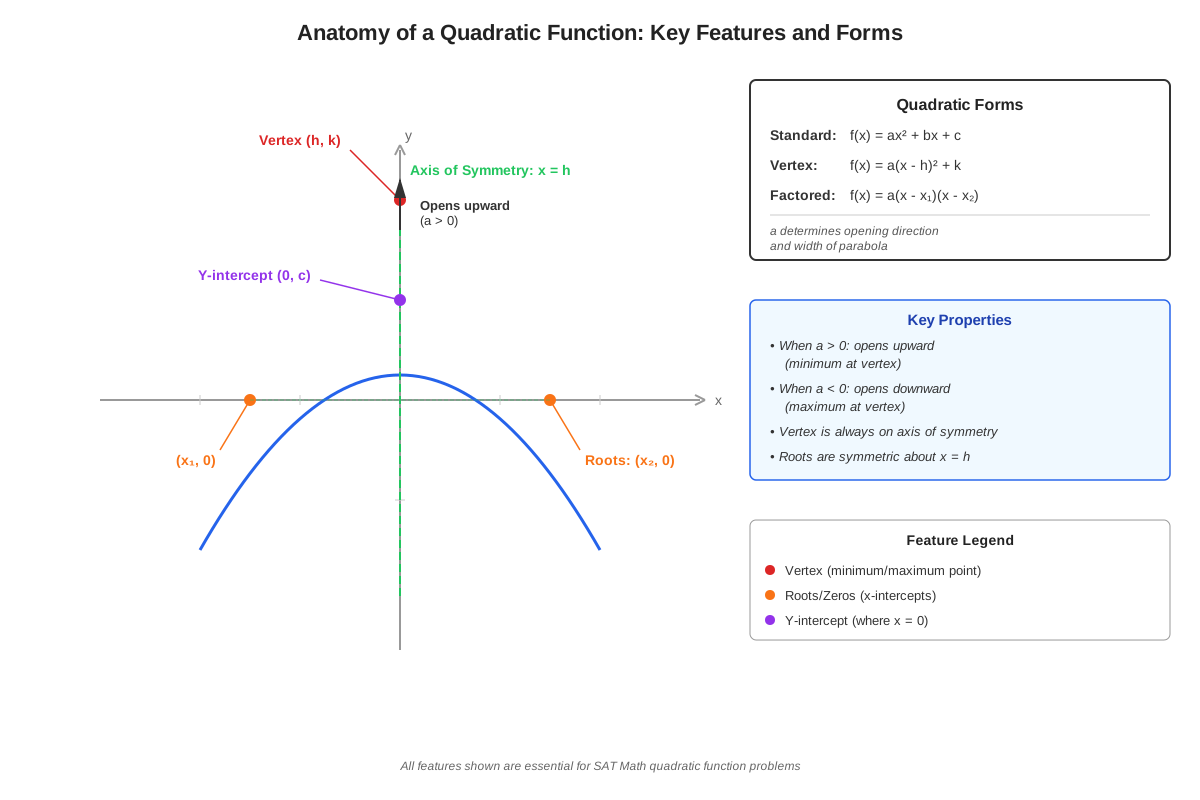
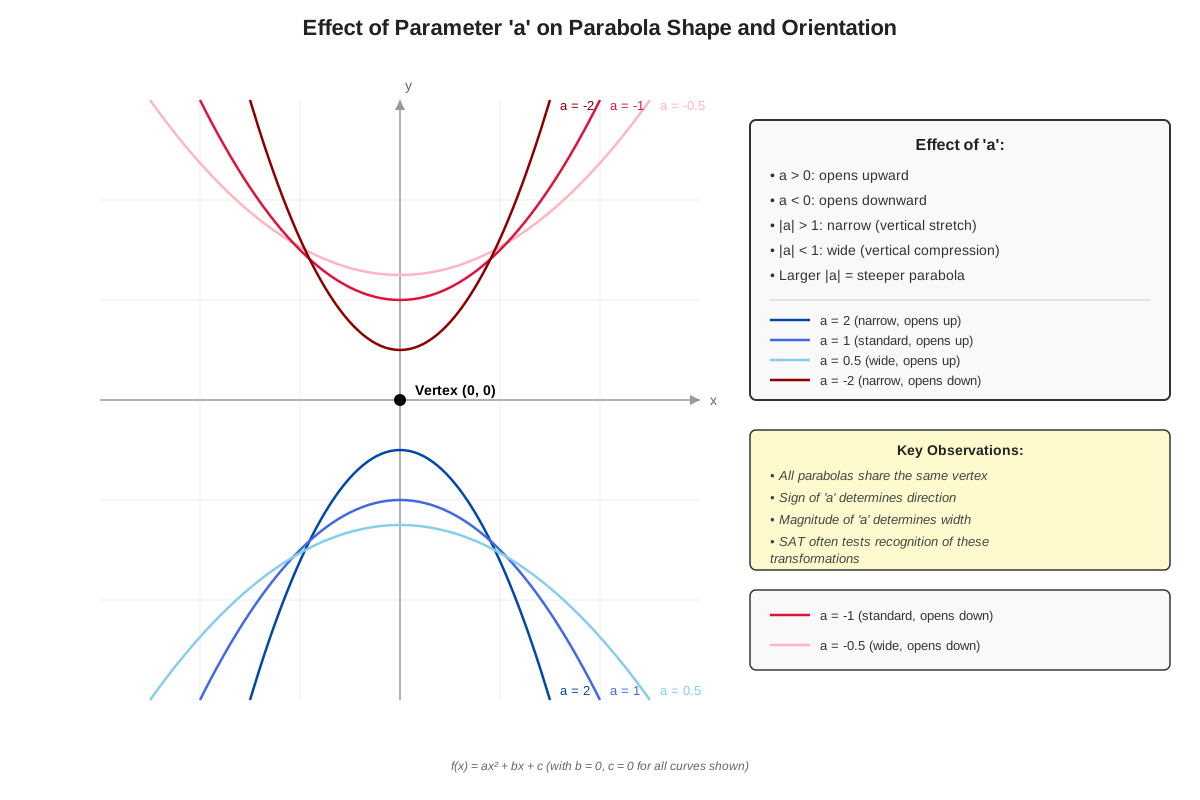
f(x) = ax² + bx + cwhere a, b, and c are constants and a ≠ 0. The coefficient a determines the parabola's direction and width: when a > 0, the parabola opens upward (has a minimum point); when a < 0, it opens downward (has a maximum point). The absolute value of a affects the parabola's width—larger |a| values create narrower parabolas, while smaller |a| values create wider ones.
The constant c represents the y-intercept, the point where the parabola crosses the y-axis (when x = 0). The coefficient b influences the parabola's horizontal position and, combined with a, determines the location of the axis of symmetry. From standard form, the axis of symmetry can be calculated using x = -b/(2a), and the vertex x-coordinate is also -b/(2a).
Vertex Form of Quadratic Functions
The vertex form provides immediate visual information about the parabola's key features:
f(x) = a(x - h)² + kIn this form, the point (h, k) represents the vertex of the parabola—the highest or lowest point depending on whether the parabola opens downward or upward. The value of a maintains the same meaning as in standard form (direction and width). The vertex form is particularly useful for quickly identifying the maximum or minimum value of the function (which is k) and the input value where this occurs (which is h).
To convert from standard form to vertex form, use the completing the square method. The axis of symmetry in vertex form is simply the vertical line x = h, making it immediately apparent from the equation.
Factored Form of Quadratic Functions
The factored form (also called intercept form) reveals the function's roots or zeros:
f(x) = a(x - r₁)(x - r₂)where r₁ and r₂ are the x-intercepts or roots of the function—the values of x where f(x) = 0. These are the points where the parabola crosses the x-axis. When a quadratic can be factored, this form provides the fastest route to finding solutions. The axis of symmetry lies exactly halfway between the two roots: x = (r₁ + r₂)/2.
Not all quadratic functions can be easily factored with integer values. When roots are irrational or complex, other forms or solution methods become more practical.
The Quadratic Formula
For any quadratic equation ax² + bx + c = 0, the solutions can be found using the quadratic formula:
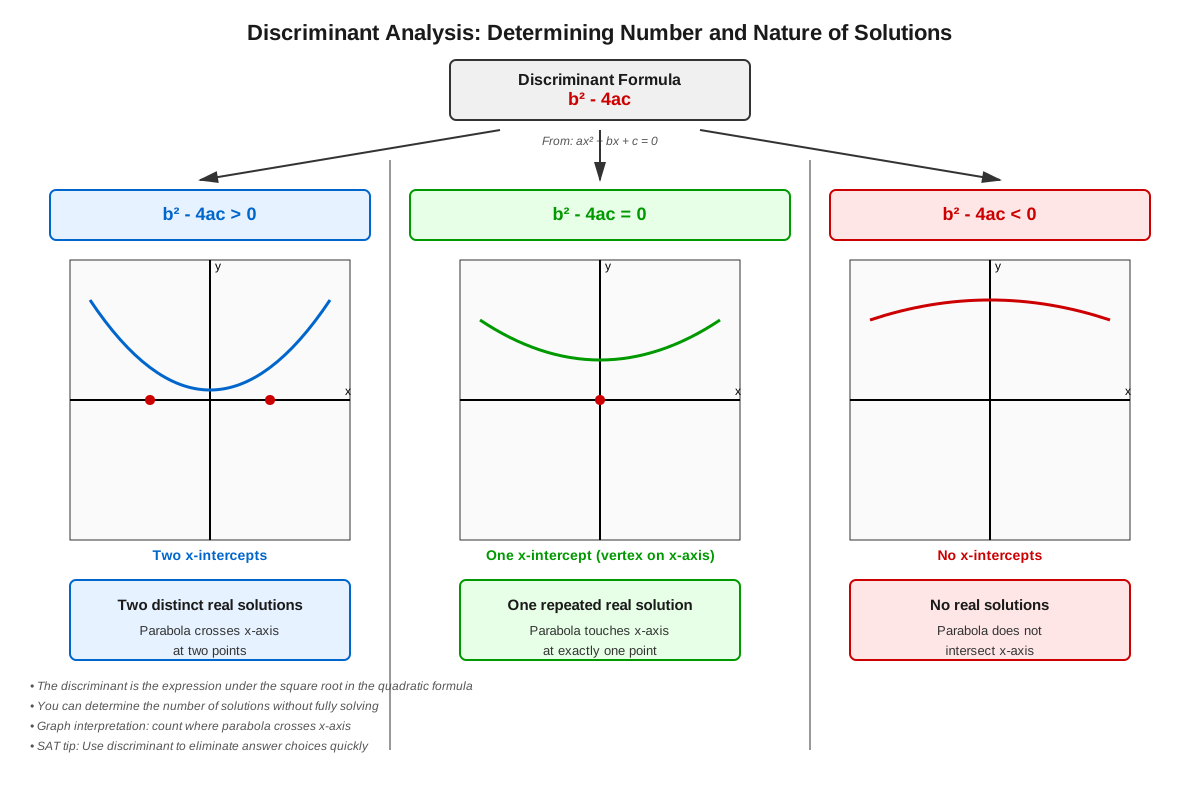
x = [-b ± √(b² - 4ac)] / (2a)This formula works for all quadratic equations, regardless of whether they factor nicely. The expression under the square root, b² - 4ac, is called the discriminant and provides crucial information about the nature of solutions:
| Discriminant Value | Number of Real Solutions | Graph Behavior |
|---|---|---|
| b² - 4ac > 0 | Two distinct real solutions | Parabola crosses x-axis twice |
| b² - 4ac = 0 | One real solution (repeated root) | Parabola touches x-axis at vertex |
| b² - 4ac < 0 | No real solutions (two complex) | Parabola doesn't touch x-axis |
Key Features and Their Identification
The vertex represents the turning point of the parabola and is the location of the function's maximum or minimum value. For upward-opening parabolas (a > 0), the vertex is a minimum; for downward-opening parabolas (a < 0), it's a maximum. The y-coordinate of the vertex represents the optimal value in many real-world applications.
The axis of symmetry is a vertical line passing through the vertex, dividing the parabola into two mirror-image halves. Every point on one side of this line has a corresponding point at the same distance on the other side with the same y-value.
The domain of all quadratic functions is all real numbers (−∞, ∞), as x can take any value. The range depends on the vertex and direction: for upward-opening parabolas, the range is [k, ∞) where k is the y-coordinate of the vertex; for downward-opening parabolas, the range is (−∞, k].
Transformations of Quadratic Functions
Understanding how changes to the equation affect the graph is essential for SAT success. Starting from the parent function f(x) = x²:
- Vertical shifts: f(x) = x² + k shifts the parabola k units up (k > 0) or down (k < 0)
- Horizontal shifts: f(x) = (x - h)² shifts the parabola h units right (h > 0) or left (h < 0)
- Vertical stretches/compressions: f(x) = ax² stretches the parabola vertically when |a| > 1 and compresses it when 0 < |a| < 1
- Reflections: f(x) = -x² reflects the parabola across the x-axis
These transformations can be combined, and recognizing them quickly helps match equations to graphs on the SAT.
Concept Relationships
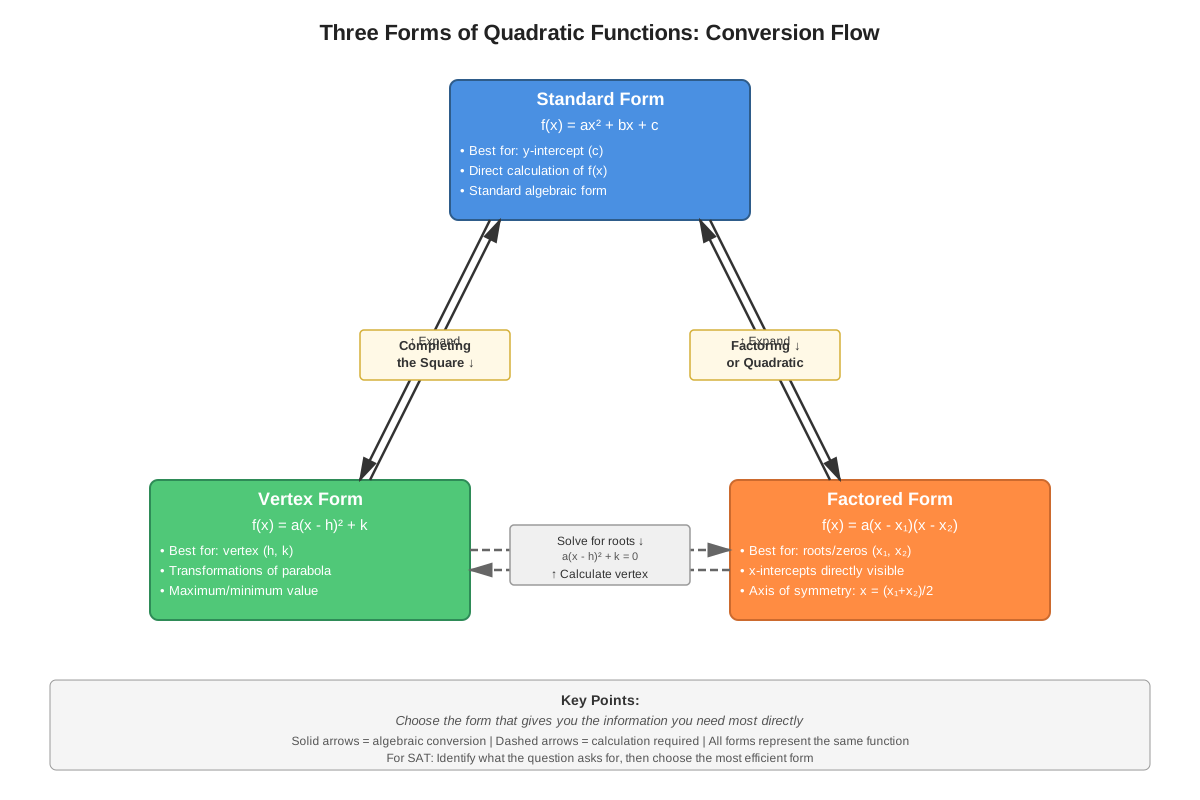
The three forms of quadratic functions are interconnected representations of the same mathematical relationship. Standard form (ax² + bx + c) serves as the starting point and connects directly to the quadratic formula and discriminant analysis. Through completing the square, standard form transforms into vertex form (a(x - h)² + k), which reveals the parabola's optimal point. Through factoring, standard form becomes factored form (a(x - r₁)(x - r₂)), which exposes the roots.
The relationship flows as: Standard Form → (completing the square) → Vertex Form → (identify maximum/minimum). Alternatively: Standard Form → (factoring or quadratic formula) → Factored Form → (identify roots and axis of symmetry). The axis of symmetry serves as a connecting concept, calculable from any form: from standard form using x = -b/(2a), from vertex form as x = h, or from factored form as x = (r₁ + r₂)/2.
The discriminant (b² - 4ac) connects algebraic and graphical understanding by predicting how many times the parabola intersects the x-axis without actually solving the equation. This bridges equation-solving with graph interpretation. The coefficient a appears in all three forms and consistently controls both direction (sign of a) and width (magnitude of a), creating a unifying thread across representations.
Quadratic functions build upon linear functions by introducing the squared term, which creates curvature instead of constant slope. This connects to the broader concept of polynomial functions, where quadratics are the simplest non-linear polynomials. Understanding quadratics prepares students for systems of equations (linear-quadratic systems), quadratic inequalities, and more complex function analysis.
High-Yield Facts
⭐ The vertex form f(x) = a(x - h)² + k immediately reveals the vertex at point (h, k)
⭐ The axis of symmetry from standard form is always x = -b/(2a)
⭐ When a > 0, the parabola opens upward and has a minimum value; when a < 0, it opens downward and has a maximum value
⭐ The discriminant b² - 4ac determines the number of real solutions: positive means two, zero means one, negative means none
⭐ The y-intercept of any quadratic function in standard form is simply the constant term c
- The factored form a(x - r₁)(x - r₂) shows that the roots are r₁ and r₂, not -r₁ and -r₂
- The vertex lies exactly on the axis of symmetry, halfway between the two x-intercepts when they exist
- To convert from standard to vertex form, complete the square by taking half of the b coefficient, squaring it, and adjusting
- The range of a quadratic function depends on both the vertex's y-coordinate and the direction the parabola opens
- In real-world problems, the vertex often represents the optimal value (maximum profit, minimum cost, highest point, etc.)
- A quadratic function can have zero, one, or two x-intercepts, but always has exactly one y-intercept
- The quadratic formula works for all quadratic equations, even when factoring is difficult or impossible
- Multiplying the entire quadratic function by a constant affects the a value, changing both direction (if negative) and width
Quick check — test yourself on Quadratic functions so far.
Try Flashcards →Common Misconceptions
Misconception: The vertex form is f(x) = a(x + h)² + k, so if the equation is f(x) = (x - 3)² + 2, the vertex is at (-3, 2).
Correction: The vertex form is f(x) = a(x - h)² + k, meaning the vertex is at (h, k). The sign inside the parentheses is opposite to the x-coordinate of the vertex. For f(x) = (x - 3)² + 2, the vertex is at (3, 2), not (-3, 2).
Misconception: If a quadratic equation has no real solutions, it has no solutions at all.
Correction: When the discriminant is negative, the quadratic equation has two complex (imaginary) solutions, not zero solutions. For SAT purposes, "no real solutions" means the parabola doesn't cross the x-axis, but solutions still exist in the complex number system.
Misconception: The roots of f(x) = (x - 4)(x + 2) are 4 and 2.
Correction: The roots are the values that make each factor equal to zero. Setting (x - 4) = 0 gives x = 4, and setting (x + 2) = 0 gives x = -2. The roots are 4 and -2, not 4 and 2.
Misconception: A larger value of a always makes the parabola wider.
Correction: The absolute value of a determines width. When |a| > 1, the parabola is narrower than the parent function; when 0 < |a| < 1, it's wider. The sign of a determines direction (up or down), not width.
Misconception: The axis of symmetry is a horizontal line.
Correction: The axis of symmetry for a quadratic function is always a vertical line with equation x = h (where h is the x-coordinate of the vertex). It's perpendicular to the x-axis, not parallel to it.
Misconception: To find the vertex from standard form, just plug in x = 0.
Correction: Plugging in x = 0 gives the y-intercept, not the vertex. To find the vertex from standard form ax² + bx + c, first calculate the x-coordinate using x = -b/(2a), then substitute this value back into the function to find the y-coordinate.
Misconception: If a quadratic has only one solution, it must be x = 0.
Correction: A quadratic has one solution (a repeated root) when the discriminant equals zero, meaning the vertex touches the x-axis. This solution can be any real number, not just zero. For example, (x - 5)² = 0 has one solution: x = 5.
Worked Examples
Example 1: Converting Forms and Finding Key Features
Problem: Given the quadratic function f(x) = 2x² - 12x + 10, find the vertex, axis of symmetry, and determine whether the function has a maximum or minimum value. What is that optimal value?
Solution:
Step 1: Identify the form and coefficients.
The function is in standard form with a = 2, b = -12, and c = 10.
Step 2: Determine direction and whether there's a max or min.
Since a = 2 > 0, the parabola opens upward, meaning the function has a minimum value (at the vertex).
Step 3: Find the axis of symmetry.
Using the formula x = -b/(2a):
x = -(-12)/(2·2) = 12/4 = 3
The axis of symmetry is the line x = 3.
Step 4: Find the vertex.
The x-coordinate of the vertex is 3 (same as the axis of symmetry). To find the y-coordinate, substitute x = 3 into the original function:
f(3) = 2(3)² - 12(3) + 10
f(3) = 2(9) - 36 + 10
f(3) = 18 - 36 + 10
f(3) = -8
The vertex is at (3, -8).
Step 5: State the minimum value.
Since the parabola opens upward and the vertex is at (3, -8), the minimum value of the function is -8, occurring when x = 3.
Connection to Learning Objectives: This example demonstrates identifying key features of quadratic functions (vertex, axis of symmetry, minimum value) from standard form, which directly addresses the first and third learning objectives.
Example 2: Real-World Application with Optimization
Problem: A company's profit P (in thousands of dollars) from producing x hundred units of a product is modeled by P(x) = -2x² + 16x - 24. How many units should the company produce to maximize profit, and what is the maximum profit?
Solution:
Step 1: Identify what we're looking for.
We need to find the maximum value of the profit function and the production level where it occurs. This means finding the vertex of the parabola.
Step 2: Determine if there's a maximum or minimum.
The coefficient a = -2 < 0, so the parabola opens downward, confirming there is a maximum value at the vertex.
Step 3: Find the x-coordinate of the vertex (optimal production level).
Using x = -b/(2a):
x = -16/(2·(-2)) = -16/(-4) = 4
Step 4: Find the y-coordinate of the vertex (maximum profit).
Substitute x = 4 into the profit function:
P(4) = -2(4)² + 16(4) - 24
P(4) = -2(16) + 64 - 24
P(4) = -32 + 64 - 24
P(4) = 8
Step 5: Interpret the results in context.
Since x represents hundreds of units, x = 4 means 400 units. Since P is in thousands of dollars, P = 8 means $8,000.
Answer: The company should produce 400 units to maximize profit, and the maximum profit is $8,000.
Alternative approach using vertex form:
We could convert to vertex form by completing the square:
P(x) = -2x² + 16x - 24
P(x) = -2(x² - 8x) - 24
P(x) = -2(x² - 8x + 16 - 16) - 24
P(x) = -2((x - 4)² - 16) - 24
P(x) = -2(x - 4)² + 32 - 24
P(x) = -2(x - 4)² + 8
From this form, we immediately see the vertex is (4, 8), confirming our answer.
Connection to Learning Objectives: This example applies quadratic functions to a real-world SAT-style question, demonstrates converting between forms, and shows how to solve optimization problems—addressing multiple learning objectives simultaneously.
Exam Strategy
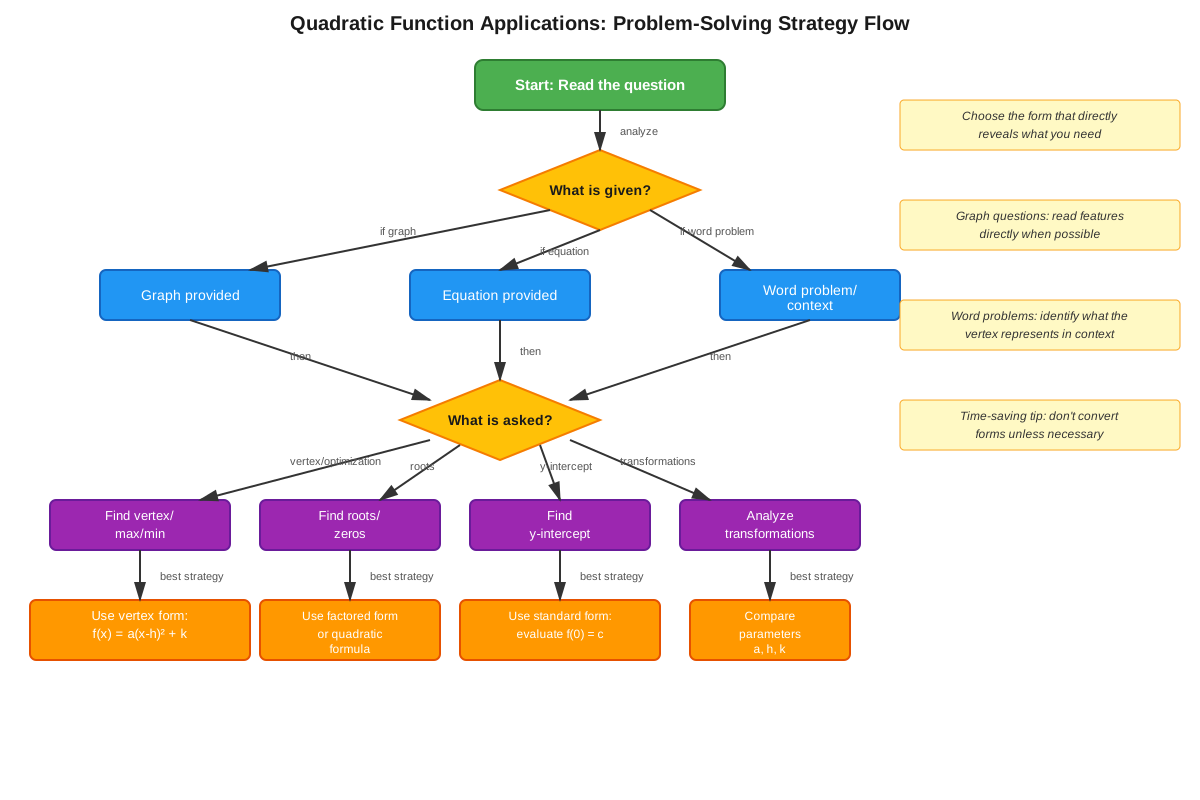
When approaching SAT questions on quadratic functions, first identify what form the equation is in and what information the question asks for. If you need the vertex, check whether the equation is already in vertex form—if so, you can read the answer directly. If it's in standard form and you need the vertex, calculate x = -b/(2a) rather than completing the square unless specifically required, as it's faster.
Trigger words and phrases to watch for include: "maximum value" or "minimum value" (find the vertex), "crosses the x-axis" or "solutions" (find roots), "axis of symmetry" (find x = -b/(2a) or the midpoint between roots), "y-intercept" (identify c in standard form or evaluate f(0)), and "how many solutions" (analyze the discriminant or count x-intercepts on a graph).
For graph-matching questions, quickly check three features: direction (does a match?), vertex location (does it match the equation's vertex?), and x-intercepts (do they match the roots?). Eliminate answer choices that fail any of these tests. When graphs are provided, extract information visually rather than algebraically when possible—it's faster to read a vertex from a graph than to calculate it from an equation.
Process-of-elimination tips: If a question asks which equation matches a graph showing a downward-opening parabola, immediately eliminate any choice with positive a. If the vertex is clearly not on the y-axis, eliminate any equation in vertex form with h = 0. If a parabola crosses the x-axis twice, eliminate any equation whose discriminant you can quickly determine is negative or zero.
Time allocation: Simple identification questions (finding c, determining direction) should take 30-45 seconds. Standard vertex or root calculations should take 60-90 seconds. Multi-step word problems involving quadratics may require 2-3 minutes. If you're spending more than 2 minutes on a quadratic question, mark it and move on—you can return with fresh perspective. On no-calculator sections, look for factoring opportunities before reaching for the quadratic formula, as factoring is faster when possible.
Memory Techniques
Vertex Form Mnemonic: "Vertex form Visibly shows (h, k)" - Remember that vertex form f(x) = a(x - h)² + k directly reveals the vertex coordinates.
Discriminant Decision Tree: Use "Positive = Pair, Zero = Zing (one), Negative = None" to remember that positive discriminant gives two solutions, zero gives one, and negative gives no real solutions.
Axis of Symmetry: Think "Bisect Between" - the axis of symmetry bisects (cuts in half) the distance between the two roots, and its formula uses b: x = -b/(2a).
Direction Determination: "Positive Points Up" - when a is positive, the parabola points upward like a cup that holds water. When a is negative, it's upside down and spills water.
Completing the Square: Remember the phrase "Half, Square, Add and Subtract" (HSAS) - take Half of the b coefficient, Square it, Add it inside the parentheses, and Subtract it outside to maintain equality.
Visualization Strategy: Always sketch a quick parabola when solving problems. Mark the vertex, axis of symmetry, and any known intercepts. This visual reference prevents sign errors and helps verify that your answer makes sense. Even a rough sketch showing whether the parabola opens up or down can prevent careless mistakes.
Summary
Quadratic functions, expressed in the form f(x) = ax² + bx + c, represent parabolic relationships that appear frequently on the SAT across multiple question types. Mastery requires fluency with three equivalent forms—standard, vertex, and factored—and the ability to extract relevant information from each. The coefficient a determines both direction (positive opens upward, negative opens downward) and width, while the vertex represents the function's optimal value. Key features include the axis of symmetry (x = -b/(2a) from standard form), roots (found through factoring, the quadratic formula, or reading from factored form), and the y-intercept (the constant c). The discriminant (b² - 4ac) predicts the number of real solutions without solving. Success on SAT quadratic questions requires recognizing which form or method will most efficiently answer each question, whether that's reading directly from vertex form, factoring when possible, or applying the quadratic formula when necessary. Real-world applications typically involve optimization problems where the vertex represents maximum profit, minimum cost, or optimal dimensions.
Key Takeaways
- Quadratic functions have three interchangeable forms (standard, vertex, factored), each revealing different key features most efficiently
- The vertex represents the maximum or minimum value of the function, with its location determined by the sign of coefficient a
- The axis of symmetry x = -b/(2a) divides the parabola into mirror-image halves and passes through the vertex
- The discriminant b² - 4ac determines the number of real solutions: positive (two), zero (one), or negative (none)
- Converting between forms strategically—completing the square for vertex form, factoring for roots—saves time on the SAT
- In real-world problems, the vertex typically represents the optimal value being sought (maximum height, minimum cost, etc.)
- Visual confirmation through quick sketches prevents errors and helps verify that algebraic solutions make sense
Related Topics
Systems of Equations with Quadratics: Building on quadratic function mastery, students learn to solve systems where one equation is linear and one is quadratic, finding intersection points that represent solutions to both equations simultaneously. This extends graphical interpretation skills and introduces scenarios with zero, one, or two solutions.
Quadratic Inequalities: Understanding quadratic functions enables solving inequalities like x² - 5x + 6 < 0, which requires finding roots and testing intervals. This topic combines quadratic solving skills with number line analysis and interval notation.
Polynomial Functions: Quadratics serve as the foundation for understanding higher-degree polynomials. Concepts like end behavior, turning points, and roots extend naturally from quadratic analysis to cubic and quartic functions.
Function Transformations: The transformation principles learned with quadratics (shifts, stretches, reflections) apply to all function families, making quadratics an ideal introduction to this broader topic that appears throughout advanced mathematics.
Exponential and Logarithmic Functions: After mastering quadratic models, students can compare and contrast different function families, understanding when quadratic models are appropriate versus exponential growth models in real-world contexts.
Practice CTA
Now that you've mastered the core concepts of quadratic functions, it's time to solidify your understanding through active practice. Attempt the practice questions to apply these strategies under test-like conditions, and use the flashcards to reinforce key formulas and concepts until they become automatic. Remember, the SAT rewards both accuracy and speed—concepts you understand deeply are concepts you can apply quickly. Every practice problem you solve builds the pattern recognition and confidence you'll need on test day. You've got this!
Sign up free to keep reading
Create a free AnvayaPrep account to finish this SAT guide on Quadratic functions — plus flashcards and practice questions.