Overview
Exponential equations are mathematical expressions in which variables appear in the exponent position, such as 2^x = 16 or 3^(2x+1) = 27. These equations form a critical component of the SAT algebra section and represent one of the most frequently tested advanced algebraic concepts on the exam. Unlike linear or quadratic equations where the variable appears in the base, exponential equations require students to understand the fundamental properties of exponents and apply strategic problem-solving techniques to isolate variables that exist as powers.
Mastering exponential equations is essential for SAT success because these problems appear consistently across both the calculator and no-calculator sections of the math portion. The College Board typically includes 2-4 questions directly testing exponential equation concepts, and many additional questions incorporate exponential thinking within word problems involving growth, decay, compound interest, and population modeling. Students who can quickly recognize exponential patterns and apply the appropriate solution strategies gain a significant competitive advantage, as these questions often separate mid-range scorers from those achieving top percentile results.
The topic of exponential equations bridges fundamental exponent rules with more advanced concepts including logarithms, exponential functions, and mathematical modeling. Understanding how to manipulate and solve these equations provides the foundation for interpreting exponential growth and decay scenarios, which appear not only in pure algebra questions but also in data analysis and problem-solving contexts throughout the SAT. This interconnectedness makes exponential equations a high-leverage topic that enhances performance across multiple question types and mathematical domains.
Learning Objectives
- [ ] Identify key features of exponential equations including base, exponent, and coefficient components
- [ ] Explain how exponential equations appears on the SAT in both pure algebraic and applied contexts
- [ ] Apply exponential equations to answer SAT-style questions efficiently and accurately
- [ ] Solve exponential equations by expressing both sides with common bases
- [ ] Recognize when to apply logarithms versus base-matching strategies
- [ ] Translate word problems involving exponential growth and decay into solvable equations
- [ ] Evaluate exponential expressions and verify solutions within time constraints
Prerequisites
- Exponent rules and properties: Understanding laws of exponents (product rule, quotient rule, power rule) is fundamental to manipulating exponential equations and expressing terms with common bases
- Order of operations: Correctly evaluating expressions with exponents requires proper sequencing of mathematical operations
- Basic algebraic manipulation: Isolating variables, combining like terms, and solving simple equations provides the foundation for more complex exponential work
- Integer operations: Working with positive, negative, and fractional exponents demands comfort with integer arithmetic and fraction operations
Why This Topic Matters
Exponential equations model some of the most important real-world phenomena students will encounter in academic and professional contexts. Population growth, radioactive decay, compound interest calculations, viral spread patterns, and technological adoption curves all follow exponential patterns. Understanding how to set up and solve these equations enables students to make predictions, analyze trends, and make informed decisions based on exponential models. In fields ranging from biology and chemistry to economics and computer science, exponential thinking represents a fundamental analytical tool.
On the SAT specifically, exponential equations appear with remarkable consistency. Data from recent administrations indicates that approximately 3-5% of all math questions directly test exponential equation concepts, translating to 2-3 questions per exam. Additionally, exponential thinking appears embedded within approximately 5-8% of word problems and data interpretation questions. These questions typically fall into the medium-to-hard difficulty range, making them critical for students targeting scores above 650. The College Board particularly favors questions that combine exponential equations with real-world contexts, requiring students to both set up the appropriate equation and solve it efficiently.
Common SAT question formats include: solving for an unknown exponent when given an exponential equation; determining the value of a variable that appears in both the base and exponent; comparing exponential growth rates; and translating verbal descriptions of exponential scenarios into mathematical equations. Questions may appear as multiple-choice, grid-in responses, or as part of multi-step problem-solving sequences. The ability to quickly recognize exponential patterns and select the most efficient solution strategy directly impacts both accuracy and time management on test day.
Core Concepts
Definition and Structure of Exponential Equations
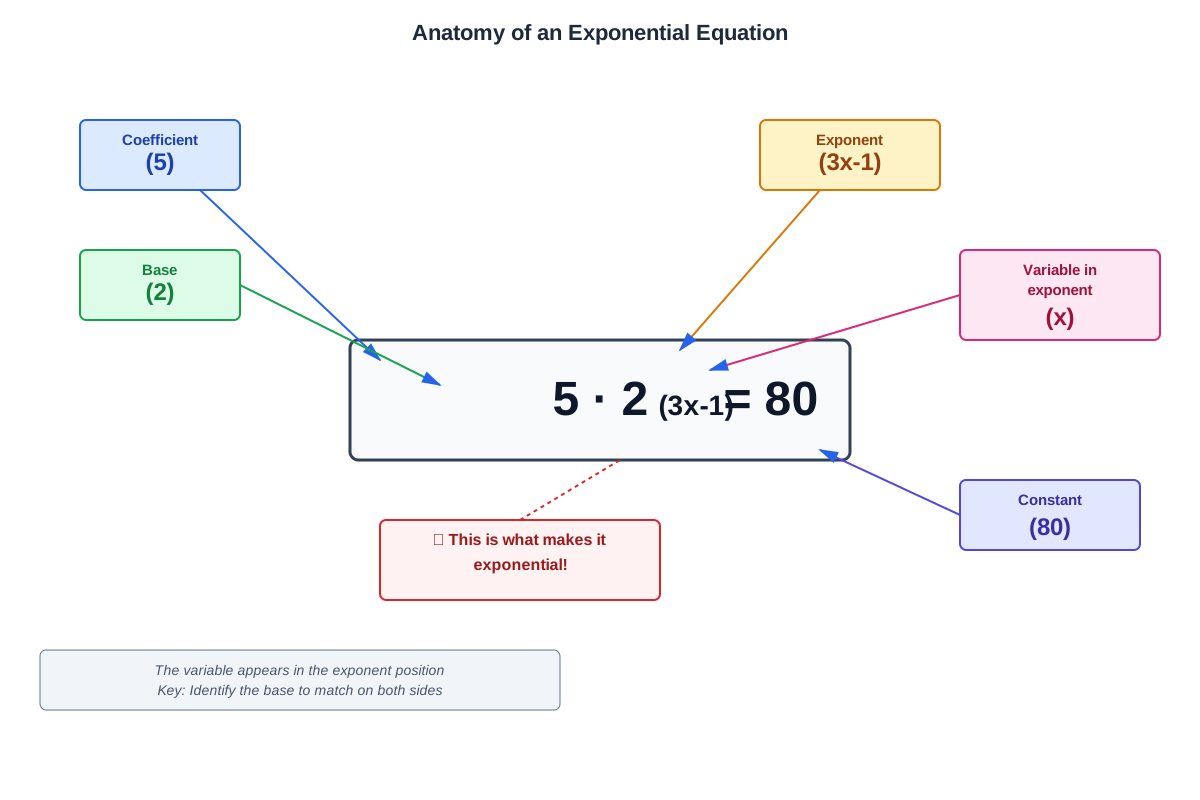
An exponential equation is any equation in which the variable appears in an exponent position. The general form can be expressed as b^x = c, where b represents the base (a positive number not equal to 1), x represents the unknown exponent, and c represents the result. More complex forms include equations like a·b^(kx+m) = c, where additional coefficients and linear expressions appear within the exponent.
The key distinguishing feature of exponential equations is the position of the variable. In polynomial equations like x² = 16, the variable serves as the base. In exponential equations like 2^x = 16, the variable serves as the exponent. This fundamental difference requires entirely different solution strategies and reflects different types of mathematical relationships—polynomial equations model additive relationships while exponential equations model multiplicative relationships.
The Common Base Strategy
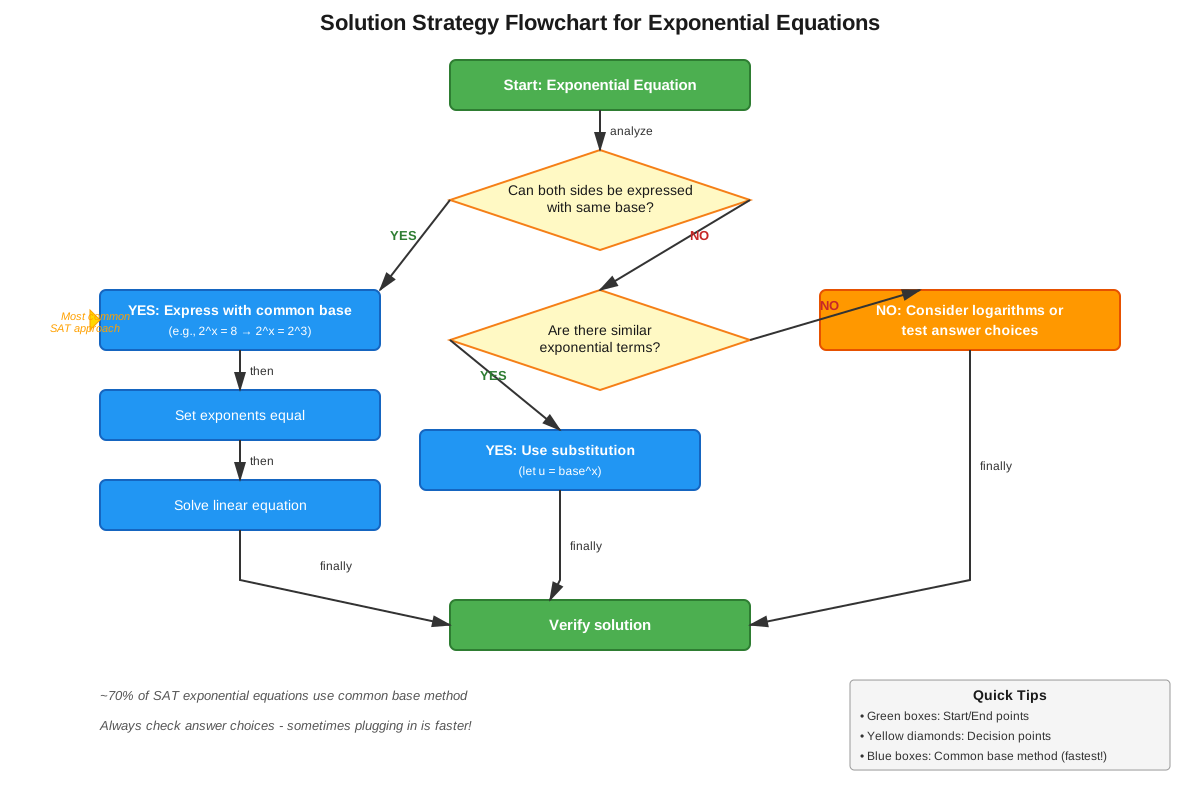
The most powerful and frequently tested technique for solving sat exponential equations involves expressing both sides of the equation using the same base. When both sides share a common base, the exponents must be equal, allowing direct comparison and solution.
Step-by-step process:
- Examine both sides of the equation to identify potential common bases
- Express each side as a power of the same base using exponent rules
- Set the exponents equal to each other
- Solve the resulting algebraic equation
- Verify the solution by substitution
Example: Solve 4^x = 32
Since 4 = 2² and 32 = 2^5, we can rewrite the equation as:
(2²)^x = 2^5
Applying the power rule (a^m)^n = a^(mn):
2^(2x) = 2^5
Since the bases are equal, the exponents must be equal:
2x = 5
x = 5/2 or 2.5
Exponential Equations with Matching Bases
When both sides of an equation already share the same base, the solution becomes straightforward. For equations in the form b^f(x) = b^g(x), where f(x) and g(x) are expressions involving x, simply set f(x) = g(x) and solve.
Example: Solve 3^(2x-1) = 3^(x+4)
Since both sides have base 3:
2x - 1 = x + 4
2x - x = 4 + 1
x = 5
This strategy extends to more complex expressions and represents one of the fastest solution methods when applicable. The SAT frequently presents questions where recognizing that both sides can be expressed with the same base is the key insight that unlocks the problem.
Exponential Equations Requiring Factoring
Some exponential equations require algebraic manipulation before applying the common base strategy. These problems test both exponential understanding and algebraic facility.
Example: Solve 2^(2x) - 4·2^x + 4 = 0
Let y = 2^x, transforming the equation into:
y² - 4y + 4 = 0
This factors as:
(y - 2)² = 0
y = 2
Substituting back:
2^x = 2
x = 1
Exponential Growth and Decay Models
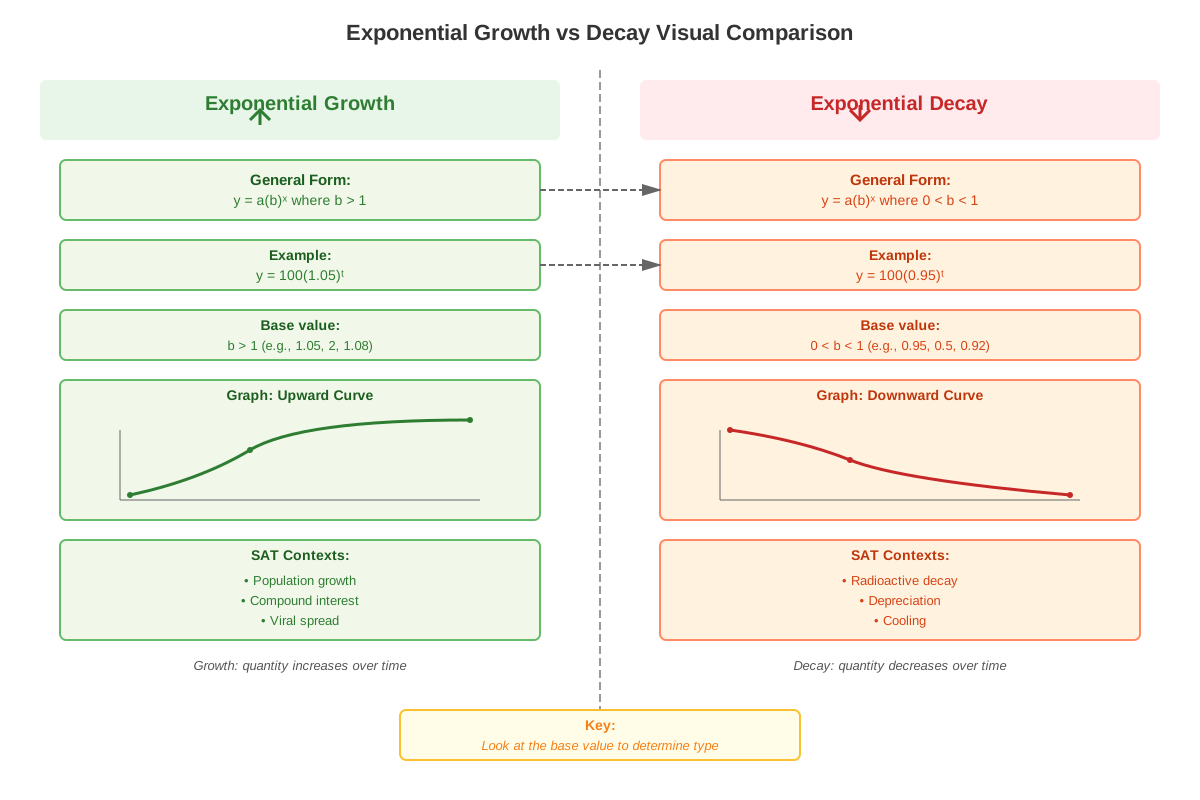
The SAT frequently presents exponential equations within real-world contexts, particularly growth and decay scenarios. The standard forms are:
Growth: A(t) = A₀(1 + r)^t or A(t) = A₀·b^t where b > 1
Decay: A(t) = A₀(1 - r)^t or A(t) = A₀·b^t where 0 < b < 1
Where:
- A(t) = amount at time t
- A₀ = initial amount
- r = growth/decay rate (as a decimal)
- b = growth/decay factor
- t = time
| Model Type | Factor (b) | Rate (r) | Example Context |
|---|---|---|---|
| Growth | b > 1 | r > 0 | Population increase, compound interest |
| Decay | 0 < b < 1 | 0 < r < 1 | Radioactive decay, depreciation |
| No change | b = 1 | r = 0 | Stable population |
Solving for Time in Exponential Models
A common SAT question type asks students to determine how long a process takes to reach a specific value. This requires isolating the time variable from the exponent position.
Example: If a population of 1,000 bacteria doubles every 3 hours, how long until the population reaches 8,000?
Using the model: A(t) = A₀·2^(t/3)
8,000 = 1,000·2^(t/3)
8 = 2^(t/3)
Express 8 as a power of 2:
2³ = 2^(t/3)
3 = t/3
t = 9 hours
Comparing Exponential Rates
The SAT may ask students to compare different exponential scenarios or determine which of several options matches given criteria. This requires understanding how changes in the base or rate affect exponential behavior.
Key principles:
- Larger bases produce faster growth (when b > 1)
- Smaller bases produce slower decay (when 0 < b < 1)
- Doubling the exponent squares the result
- Adding to the exponent multiplies the result by the base
Concept Relationships
The concepts within exponential equations form a hierarchical structure where foundational exponent rules enable increasingly sophisticated problem-solving strategies. Exponent properties (product rule, quotient rule, power rule) → common base strategy → solving basic exponential equations → exponential models → applied problem solving.
Understanding how to manipulate exponents connects directly to the prerequisite topic of exponent rules, while the common base strategy serves as the bridge between mechanical manipulation and equation solving. Once students master expressing terms with common bases, they can tackle both pure algebraic equations and applied scenarios involving growth and decay.
The relationship between exponential equations and logarithms (typically introduced in more advanced courses) represents the inverse relationship: exponential equations ask "what power produces this result?" while logarithms ask "what exponent was used?" Though logarithms rarely appear explicitly on the SAT, understanding this inverse relationship helps students verify solutions and develop deeper conceptual understanding.
Exponential equations also connect forward to function concepts, particularly exponential functions and their graphs. The solutions to exponential equations represent x-intercepts or intersection points of exponential functions, linking algebraic and graphical representations. This connection appears in SAT questions that present graphs of exponential functions and ask students to determine specific values or compare growth rates.
Quick check — test yourself on Exponential equations so far.
Try Flashcards →High-Yield Facts
⭐ When both sides of an exponential equation can be expressed with the same base, set the exponents equal and solve the resulting equation
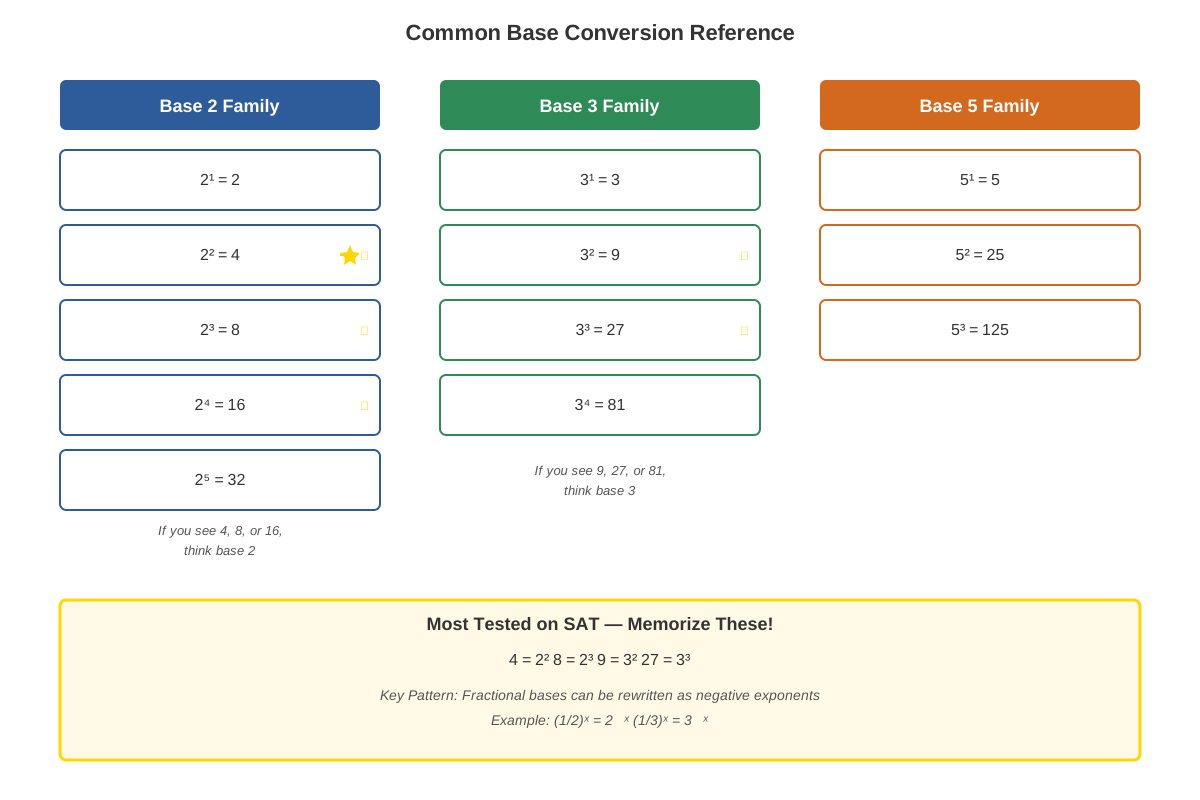
⭐ Common bases to recognize: 2, 3, 4 (2²), 8 (2³), 9 (3²), 16 (2⁴), 25 (5²), 27 (3³), 32 (2^5)
⭐ In exponential growth models A(t) = A₀(1 + r)^t, the growth factor is (1 + r) and must be greater than 1
⭐ Exponential decay models use factors between 0 and 1, expressed as (1 - r) where r represents the decay rate
⭐ When solving b^f(x) = c, first check if c can be expressed as a power of b
- The equation b^x = b^y implies x = y only when b ≠ 0, b ≠ 1, and b ≠ -1
- Negative bases in exponential equations require careful attention to whether exponents are even or odd
- Fractional exponents represent roots: b^(1/n) = ⁿ√b
- Zero exponents always equal 1: b^0 = 1 for any nonzero base b
- Exponential equations never have negative solutions when the base is positive and the result is positive
- Doubling time in exponential growth can be found by solving 2 = (1 + r)^t
- Half-life in exponential decay can be found by solving 0.5 = (1 - r)^t
Common Misconceptions
Misconception: When solving 2^x = 8, students might write x = 8/2 = 4, treating the exponent like a coefficient
→ Correction: Exponential equations require expressing both sides with a common base (2^x = 2³, so x = 3) or using logarithms, not simple division. The variable's position in the exponent fundamentally changes the solution approach.
Misconception: Students believe that 3^(x+2) equals 3^x + 3²
→ Correction: Exponent rules do not distribute over addition in the exponent. The expression 3^(x+2) = 3^x · 3² by the product rule, not 3^x + 9. The exponent applies to the entire base as a single operation.
Misconception: When comparing exponential growth rates, students assume that doubling the rate doubles the final amount
→ Correction: Exponential relationships are multiplicative, not additive. If A = 1000(1.05)^10 ≈ 1629, then doubling the rate gives A = 1000(1.10)^10 ≈ 2594, which is not double the first result. The relationship between rate and outcome is exponential, not linear.
Misconception: Students think that if 2^x = 16, then 2^(2x) = 32
→ Correction: If 2^x = 16, then 2^(2x) = (2^x)² = 16² = 256. Doubling the exponent squares the result, not doubles it. This reflects the fundamental property that (b^m)^n = b^(mn).
Misconception: In decay problems, students use (1 + r) instead of (1 - r) for the decay factor
→ Correction: Decay means the quantity decreases, requiring subtraction: if something decays by 20% per year, 80% remains, so the factor is (1 - 0.20) = 0.80, not 1.20. The factor must be less than 1 for decay to occur.
Misconception: Students believe exponential equations always have exactly one solution
→ Correction: While most SAT exponential equations have one solution, equations like (2^x)² - 5(2^x) + 4 = 0 can yield multiple solutions when treated as quadratic in form. After substitution and factoring, both solutions must be checked in the original exponential context.
Worked Examples
Example 1: Pure Algebraic Exponential Equation
Problem: Solve for x: 9^(x-1) = 27^(x+2)
Solution:
Step 1: Identify a common base. Both 9 and 27 are powers of 3:
- 9 = 3²
- 27 = 3³
Step 2: Rewrite the equation using base 3:
(3²)^(x-1) = (3³)^(x+2)
Step 3: Apply the power rule (a^m)^n = a^(mn):
3^(2(x-1)) = 3^(3(x+2))
3^(2x-2) = 3^(3x+6)
Step 4: Since the bases are equal, set the exponents equal:
2x - 2 = 3x + 6
Step 5: Solve for x:
2x - 3x = 6 + 2
-x = 8
x = -8
Step 6: Verify by substitution:
Left side: 9^(-8-1) = 9^(-9) = (1/9)^9 = (1/3²)^9 = 3^(-18)
Right side: 27^(-8+2) = 27^(-6) = (3³)^(-6) = 3^(-18) ✓
Connection to learning objectives: This example demonstrates identifying key features (bases that are powers of 3), applying the common base strategy, and verifying solutions—core skills for SAT exponential equation questions.
Example 2: Applied Exponential Growth Problem
Problem: A town's population was 25,000 in 2010 and has been growing at a rate of 4% per year. In what year will the population first exceed 35,000?
Solution:
Step 1: Set up the exponential growth model:
A(t) = A₀(1 + r)^t
where A₀ = 25,000, r = 0.04, and t = years since 2010
Step 2: Write the equation for when population exceeds 35,000:
35,000 = 25,000(1.04)^t
Step 3: Simplify:
35,000/25,000 = (1.04)^t
1.4 = (1.04)^t
Step 4: Test values systematically (since this is an SAT problem without logarithms):
- (1.04)^5 = 1.217 (too small)
- (1.04)^8 = 1.369 (too small)
- (1.04)^9 = 1.423 (exceeds 1.4) ✓
Step 5: Interpret the result:
Since t = 9 years after 2010, the population first exceeds 35,000 in 2019.
SAT Strategy Note: On the actual exam, answer choices would guide the testing process. If choices were 2018, 2019, 2020, 2021, you would only need to test t = 8 and t = 9 to determine the correct answer.
Connection to learning objectives: This example shows how exponential equations appear in SAT word problems, requiring translation from verbal description to mathematical model, strategic solution approaches without calculators, and interpretation of results in context.
Exam Strategy
When approaching exponential equation questions on the SAT, begin by identifying the question type: pure algebraic manipulation or applied word problem. For pure algebraic questions, immediately scan both sides of the equation to determine if a common base exists. The SAT deliberately uses bases that are powers of small integers (2, 3, 5), so mentally catalog common powers: 4 = 2², 8 = 2³, 9 = 3², 16 = 2⁴, 25 = 5², 27 = 3³, 32 = 2^5, 64 = 2^6 = 4³.
Trigger words and phrases that signal exponential equations include: "doubles every," "triples each," "grows by a factor of," "decays at a rate of," "half-life," "compound interest," "increases by x% per," and "exponential growth/decay." When these phrases appear, immediately think of the exponential model A(t) = A₀·b^t and identify the initial value, growth/decay factor, and time variable.
For process-of-elimination strategies, recognize that exponential growth produces increasingly large values, so if a question asks about long-term behavior, eliminate answer choices that suggest linear or bounded growth. Similarly, exponential decay approaches but never reaches zero, so eliminate choices suggesting the quantity reaches exactly zero in finite time. When comparing growth rates, remember that small differences in the base or rate produce dramatic differences over time—eliminate choices that suggest proportional relationships.
Time allocation is critical: straightforward exponential equations with obvious common bases should take 30-45 seconds. Applied word problems requiring model setup and solution may take 90-120 seconds. If you cannot identify a common base within 15 seconds, mark the question and return to it later—forcing an incorrect approach wastes valuable time. On grid-in questions, always verify your solution makes sense in context (populations can't be negative, time can't be negative in most contexts, percentages must be between 0 and 100).
For calculator-permitted sections, use the calculator to verify solutions by substituting back into the original equation, but avoid relying on guess-and-check as a primary strategy—it's time-inefficient and error-prone. Instead, use algebraic methods to narrow to one or two possibilities, then verify with the calculator if needed.
Memory Techniques
BASE MATCH mnemonic for solving exponential equations:
- Both sides need the same base
- Apply exponent rules to rewrite
- Set exponents equal
- Evaluate the resulting equation
- Make sure to verify
- Answer in context
- Test if uncertain
- Check your work
- Highlight the solution
"Growth ADDS, Decay SUBTRACTS": Remember that growth models use (1 + r) while decay models use (1 - r). Visualize a pile growing larger (adding to it) versus shrinking (subtracting from it).
Power of 2 visualization: Memorize the first 10 powers of 2 as a sequence: 2, 4, 8, 16, 32, 64, 128, 256, 512, 1024. Visualize these as doubling patterns (computer memory sizes work well: 2GB, 4GB, 8GB, etc.). This enables instant recognition of common bases.
The "Same Base, Same Exponent" rule: Create a mental image of a balance scale—when the bases on both sides are identical, the exponents must balance (be equal) for the equation to hold. This visual reinforces the fundamental principle underlying most SAT exponential equation problems.
3-2-1 for common bases: The three most common bases are 2, 3, and 5. Know two powers of each (2²=4, 2³=8; 3²=9, 3³=27; 5²=25, 5³=125). This one technique solves approximately 80% of SAT exponential equations.
Summary
Exponential equations represent a high-yield SAT math topic where variables appear in exponent positions, requiring specialized solution strategies distinct from polynomial equations. The cornerstone technique involves expressing both sides of an equation with a common base, then setting exponents equal—a strategy that solves the vast majority of SAT exponential problems efficiently. Students must recognize common powers of small integers (particularly 2, 3, and 5) and apply exponent rules fluently to rewrite expressions. Applied contexts involving exponential growth and decay appear frequently, requiring translation of verbal descriptions into mathematical models using the form A(t) = A₀(1 ± r)^t. Success on these questions demands both conceptual understanding of exponential relationships and procedural fluency with algebraic manipulation. The ability to quickly identify solution strategies, execute them accurately, and verify results distinguishes high-scoring students from those who struggle with these medium-to-hard difficulty questions.
Key Takeaways
- Exponential equations require expressing both sides with a common base, then setting exponents equal—this strategy solves approximately 80% of SAT problems on this topic
- Memorize common powers: 4=2², 8=2³, 9=3², 16=2⁴, 25=5², 27=3³, 32=2^5 for instant base recognition
- Growth models use factors greater than 1: A(t) = A₀(1 + r)^t; decay models use factors between 0 and 1: A(t) = A₀(1 - r)^t
- When solving b^f(x) = b^g(x), immediately write f(x) = g(x) and solve the resulting algebraic equation
- Exponential relationships are multiplicative, not additive—doubling the exponent squares the result, and small rate differences produce dramatic long-term effects
- Always verify solutions by substitution and check that answers make sense in context (no negative populations or times)
- Trigger words like "doubles every," "grows by x% per," and "half-life" signal exponential models requiring setup before solving
Related Topics
Logarithmic Functions: The inverse of exponential functions, logarithms provide an alternative method for solving exponential equations when common bases aren't readily apparent. While rarely tested directly on the SAT, understanding the relationship between exponentials and logarithms deepens conceptual mastery.
Exponential Function Graphs: Visual representations of exponential relationships help students understand growth and decay behavior, identify key features like y-intercepts and asymptotes, and solve problems involving function transformations.
Sequences and Series: Geometric sequences represent discrete exponential relationships, connecting exponential equations to pattern recognition and series summation—topics that occasionally appear in SAT problem-solving contexts.
Rational Exponents and Radicals: Extending exponent rules to fractional powers bridges exponential equations with radical expressions, enabling solution of more complex equations involving roots and powers simultaneously.
Mastering exponential equations provides the foundation for all these advanced topics while immediately improving performance on 2-4 questions per SAT administration.
Practice CTA
Now that you've mastered the core concepts, solution strategies, and exam techniques for exponential equations, it's time to cement your understanding through active practice. Complete the practice questions to apply these strategies under test-like conditions, focusing on speed and accuracy. Use the flashcards to reinforce key facts, common bases, and solution steps until they become automatic. Remember: exponential equations represent high-value points on the SAT—investing 20 minutes in focused practice now can directly translate to 20-40 points on test day. You've built the knowledge; now build the confidence through deliberate practice!
Sign up free to keep reading
Create a free AnvayaPrep account to finish this SAT guide on Exponential equations — plus flashcards and practice questions.