Overview
Rational exponents represent one of the most powerful and frequently tested concepts in SAT math, bridging the gap between exponential notation and radical expressions. A rational exponent is simply an exponent expressed as a fraction, where the numerator indicates the power and the denominator indicates the root. For example, x^(1/2) is equivalent to the square root of x, while x^(3/4) means the fourth root of x cubed. Understanding this relationship is crucial because the SAT regularly presents problems that require students to convert between radical and exponential forms, simplify complex expressions, and solve equations involving fractional powers.
Mastering rational exponents is essential for SAT success because these expressions appear across multiple question types in both the calculator and no-calculator sections. Students encounter rational exponents in algebraic manipulation problems, equation-solving scenarios, function analysis questions, and even in applied contexts involving growth and decay. The College Board specifically tests whether students can fluently translate between different representations of the same mathematical relationship, making rational exponents a high-yield topic that directly impacts scores.
Beyond their immediate test relevance, rational exponents connect fundamentally to broader mathematical concepts including polynomial operations, function transformations, and exponential relationships. They serve as the foundation for understanding more advanced topics like logarithms and power functions, while simultaneously reinforcing core algebraic skills such as factoring, simplifying expressions, and applying properties of exponents. Students who develop strong competency with rational exponents gain a significant advantage not only on the SAT but also in future mathematical coursework.
Learning Objectives
- [ ] Identify key features of rational exponents and distinguish them from integer exponents
- [ ] Explain how rational exponents appears on the SAT across different question formats
- [ ] Apply rational exponents to answer SAT-style questions efficiently and accurately
- [ ] Convert fluently between radical notation and rational exponent notation
- [ ] Simplify complex expressions involving rational exponents using exponent properties
- [ ] Solve equations containing rational exponents using algebraic techniques
- [ ] Evaluate numerical expressions with rational exponents without a calculator
Prerequisites
- Integer exponents and exponent rules: Understanding properties like x^a · x^b = x^(a+b) is essential because these same rules apply to rational exponents
- Radical notation and simplification: Familiarity with square roots, cube roots, and higher-order roots enables quick translation between radical and exponential forms
- Fraction operations: Adding, subtracting, multiplying, and dividing fractions is necessary for manipulating rational exponents algebraically
- Basic algebraic manipulation: Skills in factoring, distributing, and isolating variables form the foundation for solving equations with rational exponents
- Order of operations: Knowing when to apply exponents versus other operations prevents common calculation errors
Why This Topic Matters
Rational exponents appear in real-world applications across science, engineering, economics, and technology. Compound interest calculations, population growth models, radioactive decay, and sound intensity measurements all rely on exponential expressions that frequently involve fractional powers. In physics, the relationship between energy and frequency involves rational exponents, while in biology, allometric scaling laws use fractional powers to relate body size to metabolic rate. Understanding rational exponents enables students to model and analyze these phenomena mathematically.
On the SAT, rational exponents appear with remarkable consistency, showing up in approximately 2-4 questions per test administration. These questions span multiple difficulty levels and appear in both multiple-choice and student-produced response formats. The College Board particularly favors questions that test conceptual understanding rather than mere computation, asking students to recognize equivalent expressions, identify errors in algebraic reasoning, or apply exponent properties in novel contexts. Questions involving rational exponents frequently appear in the Heart of Algebra and Passport to Advanced Math content domains.
Common SAT question types include: simplifying expressions with multiple rational exponents, solving equations where the variable appears in a base raised to a rational power, converting between radical and exponential notation, evaluating numerical expressions without a calculator, and identifying equivalent forms of expressions. The test also presents rational exponents in word problems involving growth and decay, requiring students to interpret the meaning of fractional exponents in context. Mastery of this topic directly contributes to higher scores because these questions often serve as "gatekeepers" that separate mid-range scorers from high achievers.
Core Concepts
Definition and Notation of Rational Exponents
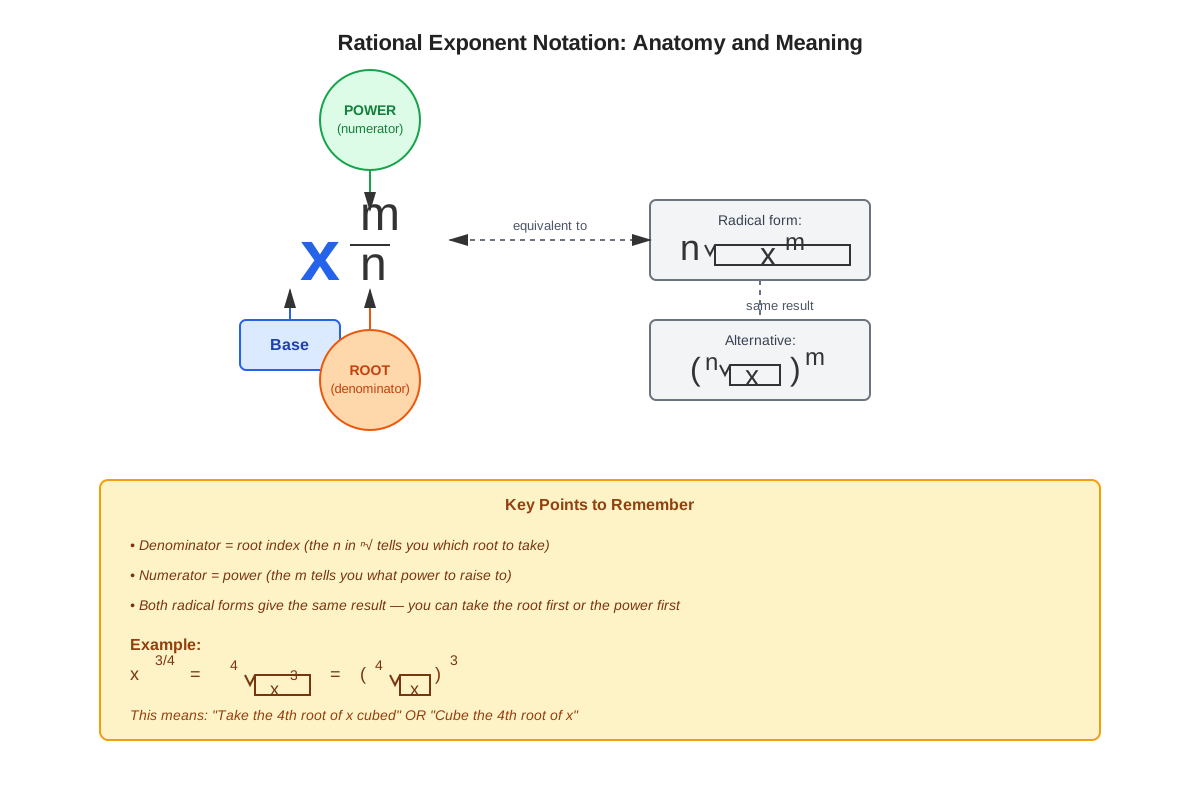
A rational exponent is an exponent expressed as a fraction m/n, where m and n are integers and n ≠ 0. The fundamental relationship connecting rational exponents to radicals is:
x^(m/n) = ⁿ√(x^m) = (ⁿ√x)^mThis notation provides two equivalent interpretations: either take the nth root of x raised to the mth power, or raise the nth root of x to the mth power. Both approaches yield identical results, though one may be computationally easier depending on the specific values involved.
The denominator of the rational exponent indicates the root (or index of the radical), while the numerator indicates the power. For instance, x^(2/3) means "the cube root of x squared" or equivalently "the cube root of x, then squared." When the numerator is 1, as in x^(1/n), the expression simply represents the nth root of x with no additional power applied.
Converting Between Radical and Exponential Forms
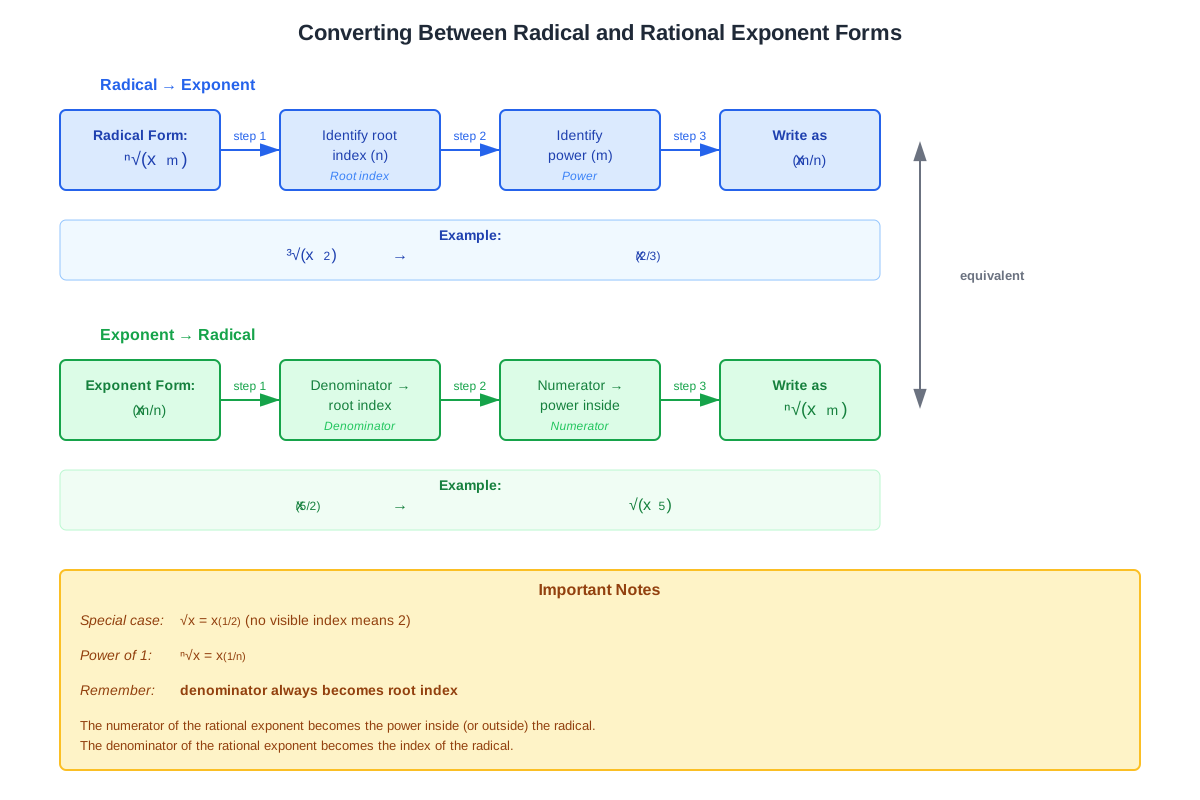
The ability to translate fluently between radical notation and rational exponent notation is crucial for SAT success. This conversion follows these patterns:
| Radical Form | Exponential Form | Description |
|---|---|---|
| √x | x^(1/2) | Square root |
| ³√x | x^(1/3) | Cube root |
| ⁿ√x | x^(1/n) | nth root |
| ⁿ√(x^m) | x^(m/n) | nth root of x to the mth power |
| (ⁿ√x)^m | x^(m/n) | nth root of x, then raised to m |
When converting from radical to exponential form, the index of the radical becomes the denominator of the rational exponent, and any power inside or outside the radical becomes the numerator. When converting from exponential to radical form, the denominator becomes the index and the numerator becomes a power that can be placed either inside or outside the radical.
Properties of Rational Exponents
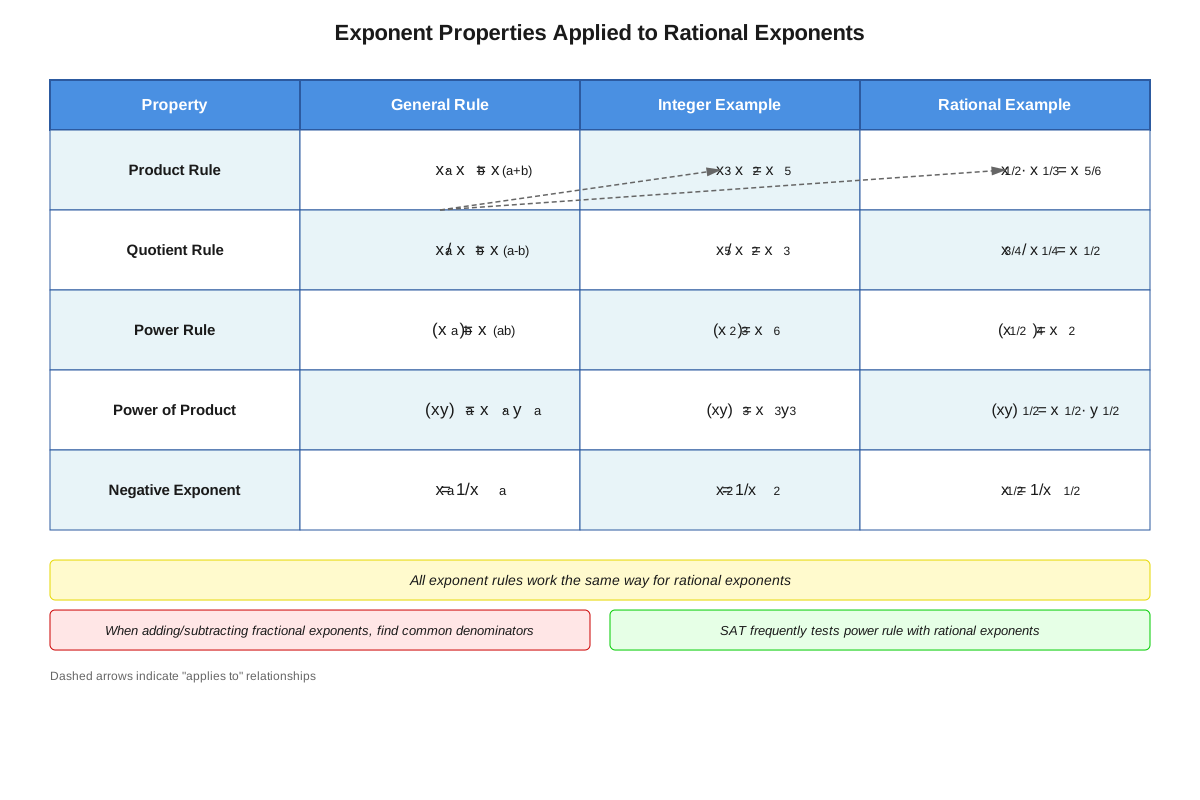
Rational exponents follow the same fundamental properties as integer exponents, making algebraic manipulation systematic and predictable:
- Product Rule: x^(a/b) · x^(c/d) = x^(a/b + c/d)
- When multiplying expressions with the same base, add the exponents
- Requires finding common denominators when adding fractions
- Quotient Rule: x^(a/b) ÷ x^(c/d) = x^(a/b - c/d)
- When dividing expressions with the same base, subtract the exponents
- The exponent in the denominator is subtracted from the numerator's exponent
- Power Rule: (x^(a/b))^(c/d) = x^(ac/bd)
- When raising a power to another power, multiply the exponents
- Simplify the resulting fraction if possible
- Power of a Product: (xy)^(a/b) = x^(a/b) · y^(a/b)
- A rational exponent distributes over multiplication
- Power of a Quotient: (x/y)^(a/b) = x^(a/b) / y^(a/b)
- A rational exponent distributes over division
- Negative Rational Exponents: x^(-a/b) = 1/x^(a/b)
- Negative exponents indicate reciprocals, regardless of whether the exponent is rational or integer
Simplifying Expressions with Rational Exponents
Simplification involves applying exponent properties strategically to reduce expressions to their most compact form. The process typically follows these steps:
- Convert all radicals to exponential form if mixed notation appears
- Apply exponent properties to combine like bases
- Simplify any fractional exponents by reducing fractions
- Convert back to radical form if requested or if it produces a cleaner appearance
- Ensure all exponents are positive unless negative exponents are specifically requested
For example, simplifying (x^(2/3) · x^(1/2)) / x^(1/6):
- Apply product rule to numerator: x^(2/3 + 1/2) = x^(4/6 + 3/6) = x^(7/6)
- Apply quotient rule: x^(7/6) / x^(1/6) = x^(7/6 - 1/6) = x^(6/6) = x^1 = x
Evaluating Numerical Expressions
The SAT frequently tests whether students can evaluate expressions with rational exponents without a calculator. Success requires recognizing perfect powers and applying the definition strategically:
For expressions like 16^(3/4):
- Method 1: Find the fourth root first, then cube: ⁴√16 = 2, then 2³ = 8
- Method 2: Cube first, then find the fourth root: 16³ = 4096, then ⁴√4096 = 8
Method 1 is typically more efficient because it keeps numbers smaller. Recognizing perfect squares (4, 9, 16, 25, 36, 49, 64, 81, 100, 121, 144), perfect cubes (8, 27, 64, 125), and perfect fourth powers (16, 81, 256) accelerates this process significantly.
Solving Equations with Rational Exponents
Equations involving rational exponents require isolating the variable by applying inverse operations. The key strategy involves raising both sides of the equation to the reciprocal of the rational exponent:
If x^(m/n) = k, then (x^(m/n))^(n/m) = k^(n/m), which simplifies to x = k^(n/m)
For example, solving x^(2/3) = 16:
- Raise both sides to the 3/2 power: (x^(2/3))^(3/2) = 16^(3/2)
- Simplify left side: x^1 = x
- Evaluate right side: 16^(3/2) = (√16)³ = 4³ = 64
- Solution: x = 64
Always verify solutions by substituting back into the original equation, as raising to even powers can introduce extraneous solutions.
Concept Relationships
The concepts within rational exponents form a hierarchical structure where understanding builds progressively. The definition and notation serves as the foundation, establishing the equivalence between fractional exponents and radical expressions. This fundamental relationship enables conversion between forms, which is not merely a mechanical skill but a conceptual tool that allows students to choose the most efficient representation for any given problem.
Properties of rational exponents extend directly from the properties of integer exponents, demonstrating that exponent rules are universal regardless of whether exponents are whole numbers, fractions, or even irrational numbers. These properties enable simplification of expressions, which combines multiple concepts: recognizing when to apply which property, managing fractional arithmetic, and determining when an expression has reached its simplest form.
Evaluating numerical expressions applies both the definition and the properties, requiring strategic thinking about which computational path minimizes calculation complexity. This skill connects directly to solving equations, where the goal shifts from simplification to isolation of variables using inverse operations.
The relationship map flows as follows:
Definition of Rational Exponents → Conversion Between Forms → Properties of Rational Exponents → Simplification of Expressions → Evaluation of Numerical Expressions → Solving Equations with Rational Exponents
These concepts connect to prerequisite knowledge of integer exponents by extending familiar rules to fractional values, and to radical expressions by providing an alternative notation system. They also connect forward to logarithms (which are inverse operations to exponentiation), polynomial functions (where rational exponents create non-polynomial power functions), and calculus (where derivatives of power functions use rational exponents extensively).
Quick check — test yourself on Rational exponents so far.
Try Flashcards →High-Yield Facts
⭐ The denominator of a rational exponent indicates the root (index), while the numerator indicates the power
⭐ x^(1/n) = ⁿ√x, making any root expressible as a rational exponent
⭐ All properties of integer exponents apply identically to rational exponents
⭐ When multiplying same bases with rational exponents, add the exponents (requires common denominators)
⭐ When dividing same bases with rational exponents, subtract the exponents
- When raising a power to a power with rational exponents, multiply the exponents
- Negative rational exponents indicate reciprocals: x^(-m/n) = 1/x^(m/n)
- To solve x^(m/n) = k, raise both sides to the n/m power
- Evaluating rational exponents is most efficient when you take the root first, then apply the power
- The expression x^(m/n) can be computed as either (ⁿ√x)^m or ⁿ√(x^m), both yielding identical results
- Perfect powers (squares, cubes, fourth powers) should be memorized for efficient no-calculator evaluation
- Rational exponents between 0 and 1 represent roots, while those greater than 1 represent roots combined with powers
- Converting to exponential form often simplifies complex radical expressions
- The base must be positive when dealing with even-indexed roots (even denominators in rational exponents)
Common Misconceptions
Misconception: The numerator of a rational exponent indicates the root and the denominator indicates the power.
Correction: This is reversed. The denominator indicates the root (index of the radical), while the numerator indicates the power. For x^(2/3), you take the cube root (denominator 3) and then square (numerator 2).
Misconception: x^(1/2) · x^(1/3) = x^(1/6) because you multiply the fractions.
Correction: When multiplying expressions with the same base, you add the exponents, not multiply them. The correct answer is x^(1/2 + 1/3) = x^(3/6 + 2/6) = x^(5/6).
Misconception: (x^2)^(1/3) = x^(2/3) is the same as x^2 · x^(1/3).
Correction: These are different operations. (x^2)^(1/3) uses the power rule (multiply exponents) giving x^(2/3), while x^2 · x^(1/3) uses the product rule (add exponents) giving x^(2 + 1/3) = x^(7/3).
Misconception: 16^(3/4) equals 16^3 divided by 4, which is 4096/4 = 1024.
Correction: The rational exponent 3/4 does not mean "cubed then divided by 4." It means "take the fourth root, then cube" or equivalently "cube, then take the fourth root." The correct answer is (⁴√16)³ = 2³ = 8.
Misconception: Negative rational exponents make the result negative.
Correction: Negative exponents indicate reciprocals, not negative values. x^(-2/3) = 1/x^(2/3), which is positive when x is positive. The negative sign affects the position (numerator vs. denominator), not the sign of the result.
Misconception: You cannot have a rational exponent with a numerator greater than the denominator.
Correction: Rational exponents can have any integer numerator and any non-zero integer denominator. x^(5/2) is perfectly valid and equals x² · √x or √(x⁵).
Misconception: When solving x^(2/3) = 4, you can simply take the square root of both sides.
Correction: Taking the square root would only address the numerator. To solve x^(2/3) = 4, raise both sides to the reciprocal power: (x^(2/3))^(3/2) = 4^(3/2), giving x = 8.
Worked Examples
Example 1: Simplifying Complex Expressions
Problem: Simplify the expression (8x^6)^(2/3) / (x^2)^(1/3)
Solution:
Step 1: Apply the power of a product rule to the numerator.
- (8x^6)^(2/3) = 8^(2/3) · (x^6)^(2/3)
Step 2: Evaluate 8^(2/3) using the definition of rational exponents.
- 8^(2/3) = (³√8)² = 2² = 4
Step 3: Apply the power rule to (x^6)^(2/3).
- (x^6)^(2/3) = x^(6 · 2/3) = x^(12/3) = x^4
Step 4: Apply the power rule to the denominator.
- (x^2)^(1/3) = x^(2 · 1/3) = x^(2/3)
Step 5: Combine the results.
- Numerator: 4x^4
- Denominator: x^(2/3)
- Expression: 4x^4 / x^(2/3)
Step 6: Apply the quotient rule.
- 4x^4 / x^(2/3) = 4x^(4 - 2/3) = 4x^(12/3 - 2/3) = 4x^(10/3)
Final Answer: 4x^(10/3) or equivalently 4x³ · ³√x
This problem demonstrates the application of multiple exponent properties in sequence and connects to Learning Objective 3 (applying rational exponents to SAT-style questions) by showing the systematic approach required for complex simplification problems.
Example 2: Solving Equations with Rational Exponents
Problem: Solve for x: (2x - 1)^(3/2) = 27
Solution:
Step 1: Identify the strategy—raise both sides to the reciprocal of 3/2, which is 2/3.
- This will eliminate the rational exponent on the left side.
Step 2: Apply the power to both sides.
- [(2x - 1)^(3/2)]^(2/3) = 27^(2/3)
Step 3: Simplify the left side using the power rule.
- (2x - 1)^(3/2 · 2/3) = (2x - 1)^1 = 2x - 1
Step 4: Evaluate the right side.
- 27^(2/3) = (³√27)² = 3² = 9
Step 5: Solve the resulting linear equation.
- 2x - 1 = 9
- 2x = 10
- x = 5
Step 6: Verify the solution by substituting back into the original equation.
- (2(5) - 1)^(3/2) = (10 - 1)^(3/2) = 9^(3/2)
- 9^(3/2) = (√9)³ = 3³ = 27 ✓
Final Answer: x = 5
This problem illustrates the equation-solving technique specific to rational exponents and connects to Learning Objective 3 by demonstrating a complete problem-solving process including verification, which is crucial for SAT success.
Exam Strategy
When approaching SAT questions involving rational exponents, begin by identifying whether the question requires conversion, simplification, evaluation, or equation-solving. Trigger words to watch for include "equivalent to," "simplified form," "value of," and "solve for," each indicating a different approach.
For conversion problems, immediately recognize that radical notation and exponential notation are interchangeable—choose whichever form makes the subsequent work easier. If you see multiple radicals with different indices, converting to exponential form almost always simplifies the problem because adding and subtracting fractions is more straightforward than manipulating nested radicals.
When simplifying expressions, work systematically through exponent properties rather than trying to see the answer immediately. Write out each step, particularly when combining exponents that require common denominators. The SAT rewards careful arithmetic with fractions, and rushing through this step causes more errors than any other aspect of rational exponent problems.
For evaluation problems without a calculator, recognize perfect powers immediately: 4, 8, 9, 16, 25, 27, 32, 36, 49, 64, 81, 100, 121, 125, 144, and 169 appear frequently. When evaluating expressions like 64^(2/3), always take the root first (³√64 = 4), then apply the power (4² = 16), rather than cubing first (64³ = 262,144), which creates unnecessarily large numbers.
Process-of-elimination strategies work particularly well with rational exponents. If a question asks for an equivalent expression, test the answer choices with a simple value like x = 1 or x = 8 (which has convenient roots). Eliminate any choices that don't produce the same numerical result. For "which of the following is NOT equivalent" questions, this strategy is especially powerful.
Time allocation for rational exponent questions should be approximately 60-90 seconds for straightforward simplification or conversion problems, and up to 2 minutes for complex equation-solving or multi-step simplification problems. If a problem requires more than three distinct exponent property applications, double-check each step rather than rushing to finish.
Memory Techniques
Mnemonic for the definition: "Denominator = Dig for the root" (the denominator tells you which root to take)
Mnemonic for exponent properties: "MADSPM"
- Multiply bases → Add exponents
- Divide bases → Subtract exponents
- Power to power → Multiply exponents
Visualization strategy: Picture rational exponents as a two-story building where the denominator is the foundation (root) and the numerator is the upper floor (power). You must build the foundation (take the root) before adding the upper floor (applying the power).
Acronym for perfect powers: "FENCE" for the most common perfect squares and cubes:
- Four (2²), Eight (2³), Nine (3²)
- Cube of 3 is 27, Eight squared is 64
Memory technique for reciprocal exponents: When solving equations, remember "FLIP to STRIP"—flip the exponent (take its reciprocal) to strip it away from the variable.
Pattern recognition: Rational exponents between 0 and 1 make numbers smaller (they're roots), while rational exponents greater than 1 can make numbers larger or smaller depending on whether the base is greater than or less than 1.
Summary
Rational exponents provide a powerful algebraic notation for expressing roots and fractional powers, with the denominator indicating the root and the numerator indicating the power. The fundamental equivalence x^(m/n) = ⁿ√(x^m) = (ⁿ√x)^m enables fluid conversion between exponential and radical forms, allowing students to choose the most efficient representation for any problem. All properties of integer exponents—product rule, quotient rule, power rule, and rules for negative exponents—apply identically to rational exponents, making simplification systematic and predictable. Success on SAT questions requires mastery of four core skills: converting between forms, simplifying expressions using exponent properties, evaluating numerical expressions by recognizing perfect powers, and solving equations by raising both sides to reciprocal powers. The topic appears consistently on the SAT across multiple question types and difficulty levels, making it a high-yield area for focused study and practice.
Key Takeaways
- Rational exponents express roots and powers simultaneously: x^(m/n) means the nth root of x raised to the mth power
- The denominator of a rational exponent always indicates the root (index), while the numerator indicates the power
- All exponent properties (product, quotient, power rules) apply to rational exponents exactly as they do to integer exponents
- Converting between radical and exponential notation is essential for simplifying complex expressions efficiently
- When evaluating rational exponents without a calculator, take the root first (using the denominator), then apply the power (using the numerator) to keep numbers manageable
- Solving equations with rational exponents requires raising both sides to the reciprocal of the given exponent
- Memorizing perfect squares, cubes, and fourth powers dramatically increases speed and accuracy on no-calculator questions
Related Topics
Properties of Integer Exponents: Mastering rational exponents builds directly on understanding integer exponent rules, extending these properties to fractional values and reinforcing why these rules work universally.
Radical Expressions and Equations: Rational exponents provide an alternative notation system for radicals, and fluency with both representations enables more sophisticated algebraic manipulation.
Polynomial and Rational Functions: While rational exponents create non-polynomial power functions, understanding them deepens comprehension of function behavior and transformations.
Exponential Growth and Decay: Many real-world applications involve rational exponents in formulas for compound interest, population models, and radioactive decay.
Logarithms: As the inverse operation to exponentiation, logarithms connect intimately with rational exponents, particularly when solving exponential equations.
Practice CTA
Now that you've mastered the core concepts of rational exponents, it's time to solidify your understanding through active practice. Attempt the practice questions to test your ability to convert between forms, simplify expressions, and solve equations under timed conditions. Use the flashcards to reinforce high-yield facts and perfect your recall of exponent properties. Remember, rational exponents appear on virtually every SAT, and the confidence you build through deliberate practice will translate directly into points on test day. Your investment in mastering this topic will pay dividends not only on the SAT but throughout your mathematical journey!
Sign up free to keep reading
Create a free AnvayaPrep account to finish this SAT guide on Rational exponents — plus flashcards and practice questions.