Overview
Initial value and growth factor are fundamental concepts in exponential functions that appear frequently on the SAT Math section. These concepts describe how quantities change over time through multiplication rather than addition, forming the backbone of exponential growth and decay problems. The initial value represents the starting amount before any growth or decay occurs, while the growth factor determines the rate at which the quantity multiplies over each time period.
Understanding these concepts is essential for SAT success because they appear in multiple question formats across both calculator and no-calculator sections. Students encounter these ideas in word problems involving population growth, compound interest, radioactive decay, and bacterial reproduction. The SAT tests not only the ability to identify these values in equations but also the skill to construct exponential models from real-world scenarios and interpret their meaning in context.
These concepts connect directly to broader math topics including function notation, coordinate geometry, and algebraic manipulation. Mastery of sat initial value and growth factor problems provides a foundation for understanding logarithms, sequences, and more advanced function transformations. The ability to recognize and work with exponential patterns is a high-yield skill that appears in approximately 3-5 questions per SAT administration, making it one of the most important topics in the Exponents and Radicals unit.
Learning Objectives
- [ ] Identify key features of initial value and growth factor in exponential expressions and equations
- [ ] Explain how initial value and growth factor appears on the SAT in various question formats
- [ ] Apply initial value and growth factor to answer SAT-style questions accurately and efficiently
- [ ] Distinguish between growth factors greater than 1 (growth) and between 0 and 1 (decay)
- [ ] Convert between percentage change and growth factor representations
- [ ] Construct exponential models from word problems by identifying initial value and growth factor
- [ ] Interpret the meaning of initial value and growth factor in real-world contexts
Prerequisites
- Basic exponent rules: Understanding how to evaluate expressions like 2³ and (1.5)⁴ is necessary for computing exponential function values
- Percentage calculations: Converting between percentages and decimals enables translation of growth rates into growth factors
- Function notation: Familiarity with f(x) notation helps interpret exponential functions and evaluate them at specific inputs
- Linear vs. exponential patterns: Recognizing that exponential functions involve repeated multiplication rather than repeated addition distinguishes them from linear relationships
- Order of operations: Correctly evaluating expressions with exponents and multiplication ensures accurate calculations
Why This Topic Matters
Exponential functions model countless real-world phenomena where change occurs proportionally to the current amount. Population dynamics, financial investments, medication concentration in the bloodstream, and viral spread all follow exponential patterns. Understanding initial value and growth factor provides the mathematical tools to analyze these situations quantitatively and make predictions.
On the SAT, initial value and growth factor questions appear with high frequency—typically 3-5 questions per test administration. These questions span multiple formats: some ask students to identify values from given equations, others require constructing equations from word problems, and still others involve interpreting graphs or tables of exponential data. The College Board considers this a "Passport to Advanced Math" topic, meaning it's essential for demonstrating college readiness in mathematics.
Common SAT question types include: identifying which parameter represents initial value in an equation; determining the growth factor from a percentage increase or decrease; writing an exponential function to model a described situation; calculating future values using exponential models; and comparing multiple exponential scenarios. Questions often embed these concepts in real-world contexts like investment accounts, population studies, or scientific experiments, requiring students to translate between mathematical and contextual representations.
Core Concepts
The Standard Form of Exponential Functions
The general form of an exponential function is:
f(x) = a · b^xor equivalently:
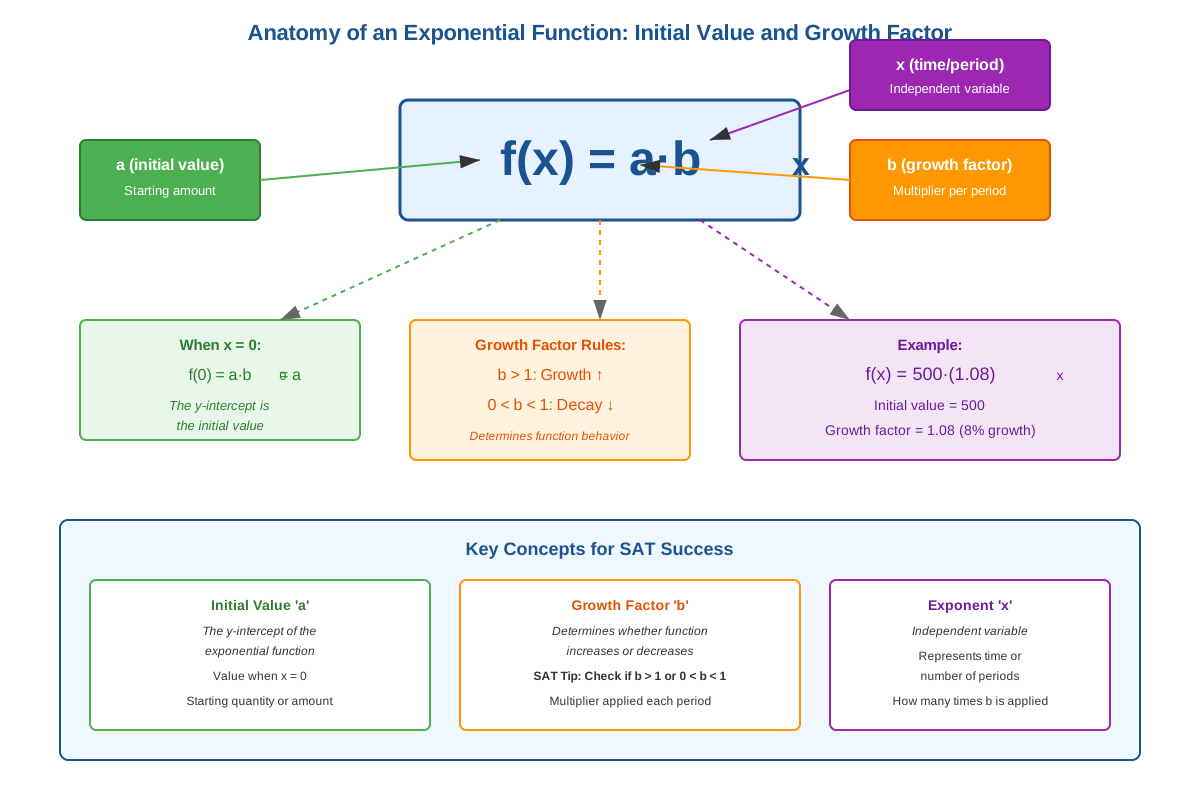
y = a · b^xIn this equation, a represents the initial value (also called the y-intercept or starting value), and b represents the growth factor (also called the base or multiplier). The variable x typically represents time or the number of periods elapsed.
The initial value (a) is the output when x = 0, since any non-zero number raised to the power of 0 equals 1, making f(0) = a · b⁰ = a · 1 = a. This represents the starting quantity before any growth or decay has occurred.
The growth factor (b) determines how the quantity changes with each unit increase in x. When b > 1, the function represents exponential growth (the quantity increases). When 0 < b < 1, the function represents exponential decay (the quantity decreases). The value of b should always be positive in standard exponential functions.
Identifying Initial Value
To identify the initial value in an exponential equation, look for the coefficient that multiplies the exponential expression. Consider these examples:
- In y = 500(1.08)^x, the initial value is 500
- In P(t) = 1200(0.95)^t, the initial value is 1200
- In f(x) = 3^x, the initial value is 1 (implied coefficient)
- In A = 2500(1.03)^n, the initial value is 2500
The initial value always represents the quantity at time zero or at the starting point. In word problems, look for phrases like "starts with," "initially," "at the beginning," or "when t = 0."
Identifying Growth Factor
The growth factor is the base of the exponential expression—the number being raised to the variable power. To identify it:
- In y = 500(1.08)^x, the growth factor is 1.08
- In P(t) = 1200(0.95)^t, the growth factor is 0.95
- In f(x) = 3^x, the growth factor is 3
- In A = 2500(1.03)^n, the growth factor is 1.03
Converting Between Percentage Change and Growth Factor
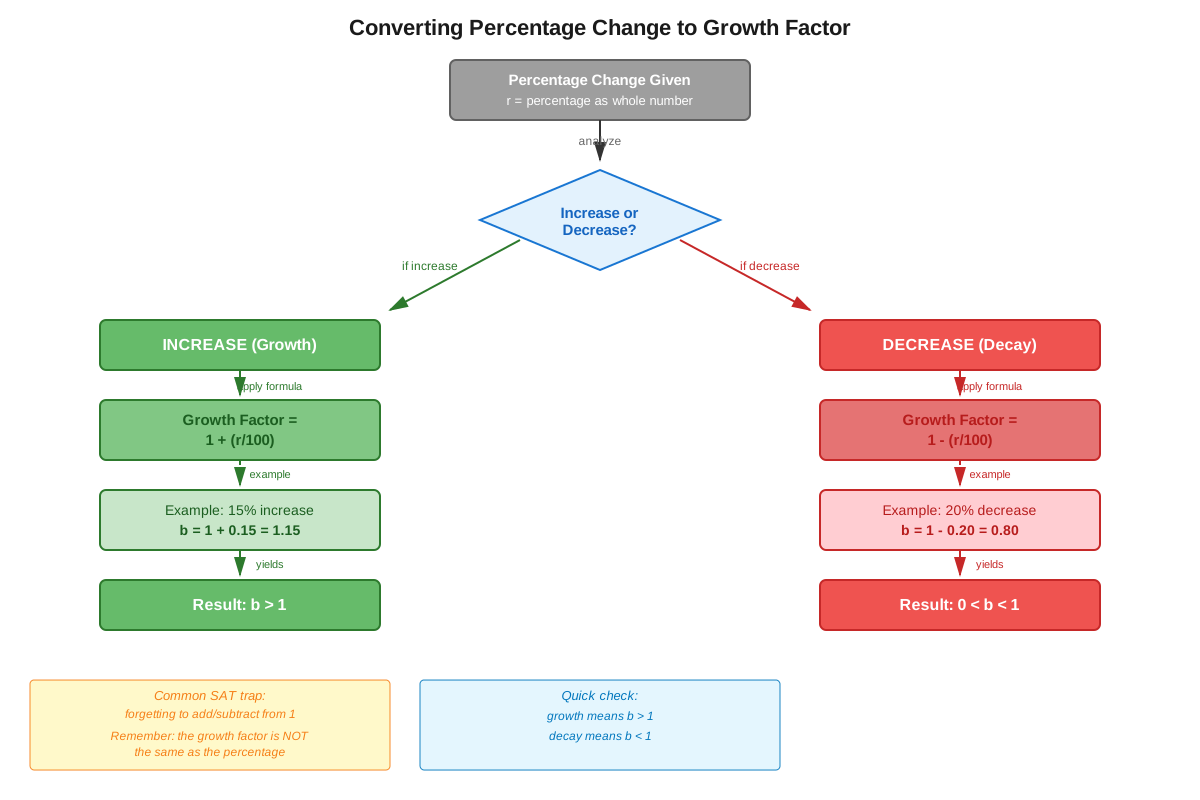
One of the most tested skills involves converting between percentage descriptions and growth factor values. The relationship follows these patterns:
| Situation | Percentage Change | Growth Factor (b) | Formula |
|---|---|---|---|
| Increase by r% | +r% | 1 + (r/100) | b = 1 + r/100 |
| Decrease by r% | -r% | 1 - (r/100) | b = 1 - r/100 |
| Doubles | +100% | 2 | b = 2 |
| Triples | +200% | 3 | b = 3 |
| Halves | -50% | 0.5 | b = 0.5 |
Key conversion examples:
- "Increases by 15% each year" → growth factor = 1 + 0.15 = 1.15
- "Decreases by 8% per hour" → growth factor = 1 - 0.08 = 0.92
- "Grows at a rate of 3.5% annually" → growth factor = 1 + 0.035 = 1.035
- "Decays by 12% per day" → growth factor = 1 - 0.12 = 0.88
Exponential Growth vs. Exponential Decay
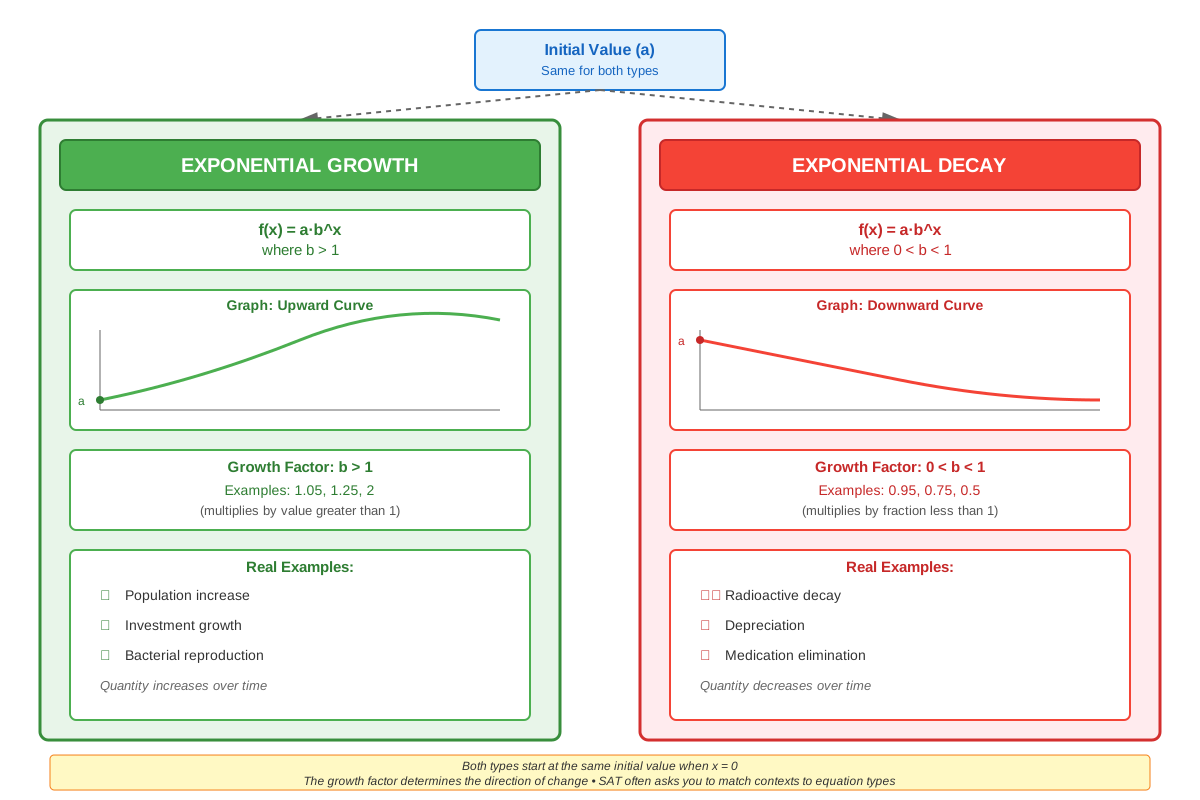
The value of the growth factor determines whether a function represents growth or decay:
Exponential Growth (b > 1):
- The quantity increases over time
- Each successive value is larger than the previous
- Graph curves upward
- Examples: population growth, compound interest, viral spread
Exponential Decay (0 < b < 1):
- The quantity decreases over time
- Each successive value is smaller than the previous
- Graph curves downward toward zero
- Examples: radioactive decay, depreciation, medication elimination
Critical boundary: When b = 1, the function is constant (no growth or decay), resulting in a horizontal line y = a.
Constructing Exponential Models
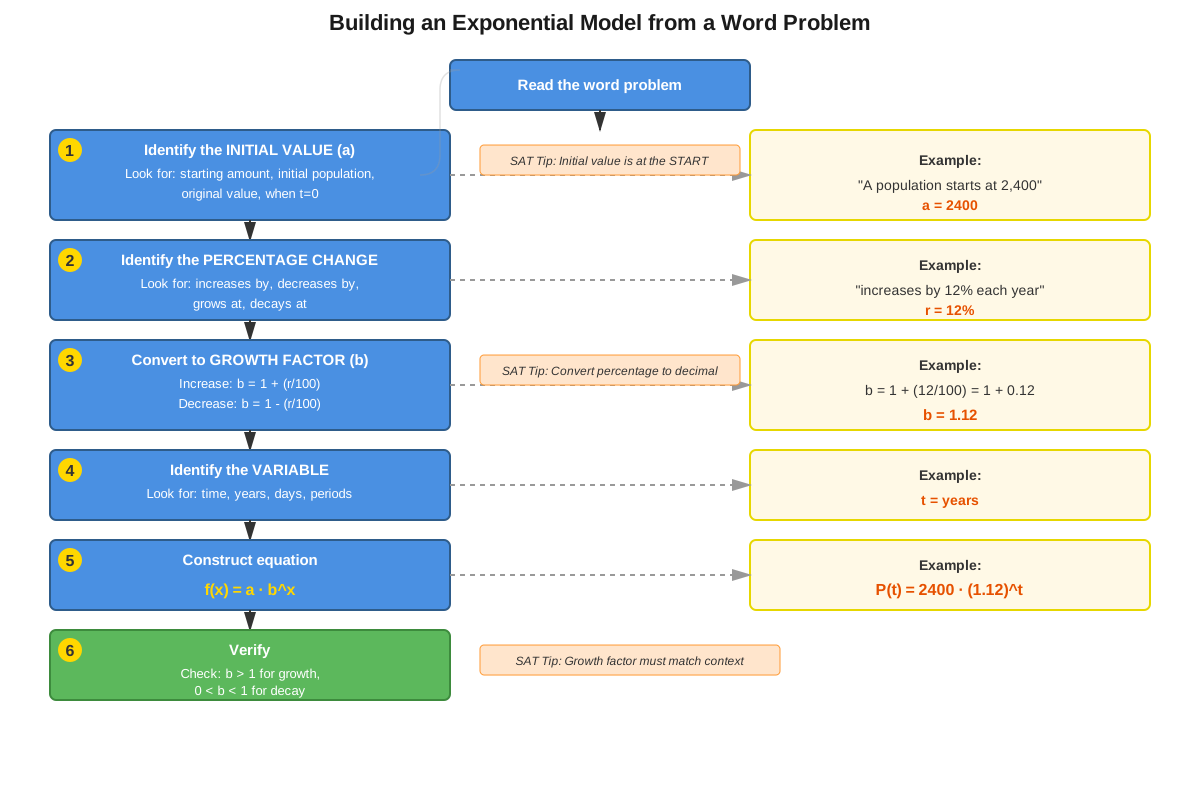
To build an exponential function from a word problem, follow these steps:
- Identify the initial value: Find the starting amount, quantity at time zero, or initial condition
- Determine the growth factor: Convert any percentage change to a growth factor using the formulas above
- Define the variable: Clarify what x or t represents (usually time or number of periods)
- Write the equation: Use the form y = a · b^x with your identified values
Example: A population of 8,000 bacteria increases by 25% each hour.
- Initial value: a = 8,000
- Growth factor: b = 1 + 0.25 = 1.25
- Variable: Let t = number of hours
- Model: P(t) = 8000(1.25)^t
Interpreting Exponential Models in Context
SAT questions frequently ask students to interpret what specific values mean in real-world contexts. When analyzing an exponential model:
- The initial value represents the starting quantity with appropriate units
- The growth factor indicates the multiplier per time period
- The growth rate (r) can be found from the growth factor: r = b - 1 for growth, or r = 1 - b for decay
- The exponent variable represents the number of time periods elapsed
For example, in the model A(t) = 15000(1.06)^t representing an investment:
- 15000 represents the initial investment amount in dollars
- 1.06 means the investment multiplies by 1.06 each period
- The growth rate is 0.06 or 6% per period
- t represents the number of time periods (years, months, etc.)
Concept Relationships
The concepts within this topic form a logical progression: Initial value and growth factor are the two essential parameters that completely define an exponential function. The initial value sets the starting point, while the growth factor determines the trajectory. Together, they enable prediction of future values through the exponential model.
The relationship flows as follows: Real-world scenario → Identify initial value and percentage change → Convert percentage to growth factor → Construct exponential model → Use model to make predictions or answer questions.
These concepts connect to prerequisite knowledge of exponents because the growth factor is repeatedly multiplied through exponentiation. Understanding that b^x means "b multiplied by itself x times" explains why exponential functions grow or decay so rapidly compared to linear functions.
Looking forward, mastery of initial value and growth factor enables understanding of more advanced topics including logarithms (the inverse of exponential functions), compound interest formulas, continuous growth models using e, and exponential regression from data sets. These concepts also connect to geometric sequences, where the growth factor becomes the common ratio.
The distinction between growth (b > 1) and decay (0 < b < 1) connects to the broader mathematical concept of function behavior and transformations. This understanding extends to analyzing graphs, determining domain and range, and identifying asymptotic behavior.
Quick check — test yourself on Initial value and growth factor so far.
Try Flashcards →High-Yield Facts
⭐ The initial value is the coefficient that multiplies the exponential expression and equals the function value when x = 0
⭐ The growth factor is the base of the exponential expression (the number raised to the variable power)
⭐ To convert a percentage increase of r% to a growth factor: b = 1 + (r/100)
⭐ To convert a percentage decrease of r% to a growth factor: b = 1 - (r/100)
⭐ Growth factors greater than 1 indicate exponential growth; growth factors between 0 and 1 indicate exponential decay
- The standard form of an exponential function is y = a · b^x where a is initial value and b is growth factor
- When b = 1, the function is constant (neither growth nor decay)
- The growth rate (as a decimal) equals the growth factor minus 1: r = b - 1
- Doubling corresponds to a growth factor of 2; tripling corresponds to a growth factor of 3
- Halving corresponds to a growth factor of 0.5 (or 1/2)
- The initial value can be found by evaluating the function at x = 0
- In compound interest problems, the growth factor is (1 + r) where r is the interest rate per period
- The units of the initial value match the units of the output (y-value)
- The exponent variable typically represents time or number of periods
- Exponential functions never reach zero (they have a horizontal asymptote at y = 0 for decay)
Common Misconceptions
Misconception: The growth factor for a 20% increase is 0.20 → Correction: The growth factor is 1.20 because the quantity retains 100% of its original value plus gains 20%, totaling 120% or 1.20 times the original
Misconception: The initial value is always the first number in the equation → Correction: The initial value is specifically the coefficient multiplying the exponential expression; in y = 5 + 3(2)^x, the initial value is NOT 5—this equation isn't in standard form
Misconception: A growth factor of 0.85 means 85% growth → Correction: A growth factor of 0.85 represents 15% decay (the quantity retains 85% of its value, losing 15% each period)
Misconception: The growth factor and growth rate are the same thing → Correction: The growth rate is the percentage change (like 0.08 for 8%), while the growth factor is 1 plus the growth rate (1.08 for 8% growth)
Misconception: Exponential decay means the quantity eventually becomes negative → Correction: Exponential decay approaches zero asymptotically but never reaches or crosses zero; the quantity remains positive
Misconception: In y = 100(1.5)^x, the function increases by 1.5 each time → Correction: The function multiplies by 1.5 each time (increases by 50%), not adds 1.5; exponential functions involve repeated multiplication, not addition
Misconception: The initial value must always be positive → Correction: While most real-world applications involve positive initial values, mathematically the initial value can be negative, though this is rare on the SAT
Worked Examples
Example 1: Constructing an Exponential Model
Problem: A car purchased for $28,000 depreciates by 18% each year. Write an exponential function that models the car's value after t years, then find its value after 5 years.
Solution:
Step 1: Identify the initial value
- The car starts at $28,000, so a = 28,000
Step 2: Determine the growth factor
- The car depreciates by 18%, meaning it loses 18% of its value each year
- It retains 100% - 18% = 82% of its value
- Growth factor: b = 1 - 0.18 = 0.82
Step 3: Define the variable
- Let t = number of years after purchase
Step 4: Write the exponential model
- V(t) = 28,000(0.82)^t
Step 5: Calculate the value after 5 years
- V(5) = 28,000(0.82)^5
- V(5) = 28,000(0.3707)
- V(5) ≈ $10,380
Connection to learning objectives: This problem demonstrates identifying initial value ($28,000), converting a percentage decrease (18%) to a growth factor (0.82), and applying the exponential model to answer a practical question—all key SAT skills.
Example 2: Interpreting an Exponential Function
Problem: The function P(t) = 450(1.12)^t models a population of insects, where t is measured in weeks.
a) What is the initial population?
b) What is the weekly growth rate as a percentage?
c) Is the population increasing or decreasing?
d) What does P(3) represent in context?
Solution:
a) Initial population:
- The initial value is the coefficient: a = 450
- The initial population is 450 insects
b) Weekly growth rate:
- The growth factor is b = 1.12
- Growth rate: r = b - 1 = 1.12 - 1 = 0.12
- As a percentage: 0.12 × 100% = 12% per week
c) Increasing or decreasing:
- Since b = 1.12 > 1, this represents exponential growth
- The population is increasing
d) Meaning of P(3):
- P(3) = 450(1.12)^3 = 450(1.405) ≈ 632
- P(3) represents the population of insects after 3 weeks, which is approximately 632 insects
Connection to learning objectives: This problem requires identifying key features (initial value and growth factor), explaining how these concepts appear in SAT questions (interpretation in context), and applying understanding to extract meaningful information from an exponential model.
Exam Strategy
When approaching sat initial value and growth factor questions on the SAT, use this systematic approach:
Step 1: Identify the question type
- Are you asked to identify values from a given equation?
- Must you construct an equation from a word problem?
- Do you need to interpret what values mean in context?
Step 2: Look for trigger words and phrases
- "Initially," "starts with," "at time zero" → signals initial value
- "Increases by," "grows at a rate of," "gains" → signals percentage increase
- "Decreases by," "decays at," "loses," "depreciates" → signals percentage decrease
- "Each year," "per hour," "every month" → indicates the time period for the growth factor
Step 3: Convert percentages carefully
- For increases: add the percentage (as a decimal) to 1
- For decreases: subtract the percentage (as a decimal) from 1
- Double-check that growth factors for decay are between 0 and 1
Step 4: Verify your answer makes sense
- Does the initial value match the starting condition in the problem?
- Does the growth factor align with whether the quantity should increase or decrease?
- Are the units consistent throughout?
Exam Tip: If a question asks about "the value of a" or "the value of b" in an exponential equation, immediately identify which parameter is which—a is always the initial value (coefficient), and b is always the growth factor (base).
Process of elimination strategies:
- Eliminate answer choices with growth factors that indicate the wrong direction (growth vs. decay)
- Eliminate choices where the initial value doesn't match the stated starting condition
- For percentage conversion questions, eliminate answers that forgot to add or subtract from 1
Time allocation: These questions typically require 45-90 seconds. Spend more time on word problems that require constructing models (up to 2 minutes) and less time on straightforward identification questions (30-45 seconds).
Memory Techniques
Mnemonic for growth factor conversion: "Plus for Plus, Minus for Minus"
- Plus (increase) → 1 plus the rate
- Minus (decrease) → 1 minus the rate
Acronym for exponential function components: "AIR"
- A = Initial value (where you start)
- I = Identifies the base
- R = Rate determines if b > 1 or b < 1
Visualization strategy: Picture a graph
- Initial value = where the curve crosses the y-axis (height at the start)
- Growth factor > 1 = curve swoops upward (growth)
- Growth factor < 1 = curve swoops downward (decay)
Memory anchor for percentage conversion: Think of 100% as "keeping everything you had"
- Growing by 15% means keeping 100% + gaining 15% = 115% = 1.15
- Shrinking by 15% means keeping only 85% = 0.85
Rhyme for identification: "Coefficient's the start, base is the heart"
- The coefficient (initial value) is where you start
- The base (growth factor) is the heart of how it changes
Summary
Initial value and growth factor are the two fundamental parameters that define exponential functions, appearing frequently on the SAT Math section in various contexts. The initial value (a) represents the starting quantity when time equals zero and appears as the coefficient multiplying the exponential expression in the standard form y = a · b^x. The growth factor (b) is the base of the exponential expression and determines whether the function represents growth (b > 1) or decay (0 < b < 1). Converting between percentage changes and growth factors is a critical skill: for an r% increase, the growth factor is 1 + (r/100), while for an r% decrease, it's 1 - (r/100). SAT questions test these concepts through identification tasks, model construction from word problems, and contextual interpretation. Success requires recognizing trigger words, converting percentages accurately, and understanding the real-world meaning of these mathematical parameters in scenarios involving population dynamics, financial investments, and scientific phenomena.
Key Takeaways
- The standard exponential function form is y = a · b^x, where a is the initial value and b is the growth factor
- Initial value equals the function output when x = 0 and represents the starting quantity
- Growth factors greater than 1 indicate growth; growth factors between 0 and 1 indicate decay
- Convert percentage increases to growth factors by adding the decimal rate to 1: b = 1 + r
- Convert percentage decreases to growth factors by subtracting the decimal rate from 1: b = 1 - r
- The growth rate (as a decimal) equals the growth factor minus 1: r = b - 1
- SAT questions require identifying these values, constructing models, and interpreting them in real-world contexts
Related Topics
Exponential Function Graphs: Understanding how initial value and growth factor affect the shape and position of exponential curves enables visual analysis of these functions and connects algebraic and graphical representations.
Compound Interest: This financial application uses exponential functions where the initial value is the principal investment and the growth factor incorporates the interest rate, demonstrating practical uses of these concepts.
Logarithms: As the inverse operations of exponentials, logarithms allow solving for the exponent when the initial value, growth factor, and final value are known, extending problem-solving capabilities.
Geometric Sequences: These discrete sequences follow the same pattern as exponential functions, with the first term corresponding to initial value and the common ratio corresponding to growth factor.
Exponential Regression: This statistical technique finds the best-fit exponential model for data sets, requiring understanding of how initial value and growth factor parameters affect curve fitting.
Practice CTA
Now that you've mastered the concepts of initial value and growth factor, it's time to solidify your understanding through practice! Attempt the practice questions to test your ability to identify these parameters, convert between percentages and growth factors, and construct exponential models from word problems. Use the flashcards to reinforce key definitions and conversion formulas. Remember, these concepts appear on nearly every SAT administration—your investment in practice now will pay exponential dividends on test day!
Sign up free to keep reading
Create a free AnvayaPrep account to finish this SAT guide on Initial value and growth factor — plus flashcards and practice questions.