Overview
Interest is a fundamental financial concept that appears regularly on the SAT math section, testing students' ability to work with percentages, exponential growth, and algebraic modeling. At its core, interest represents the cost of borrowing money or the earnings from lending or investing money over time. Understanding interest calculations is essential not only for achieving a high SAT score but also for making informed financial decisions throughout life.
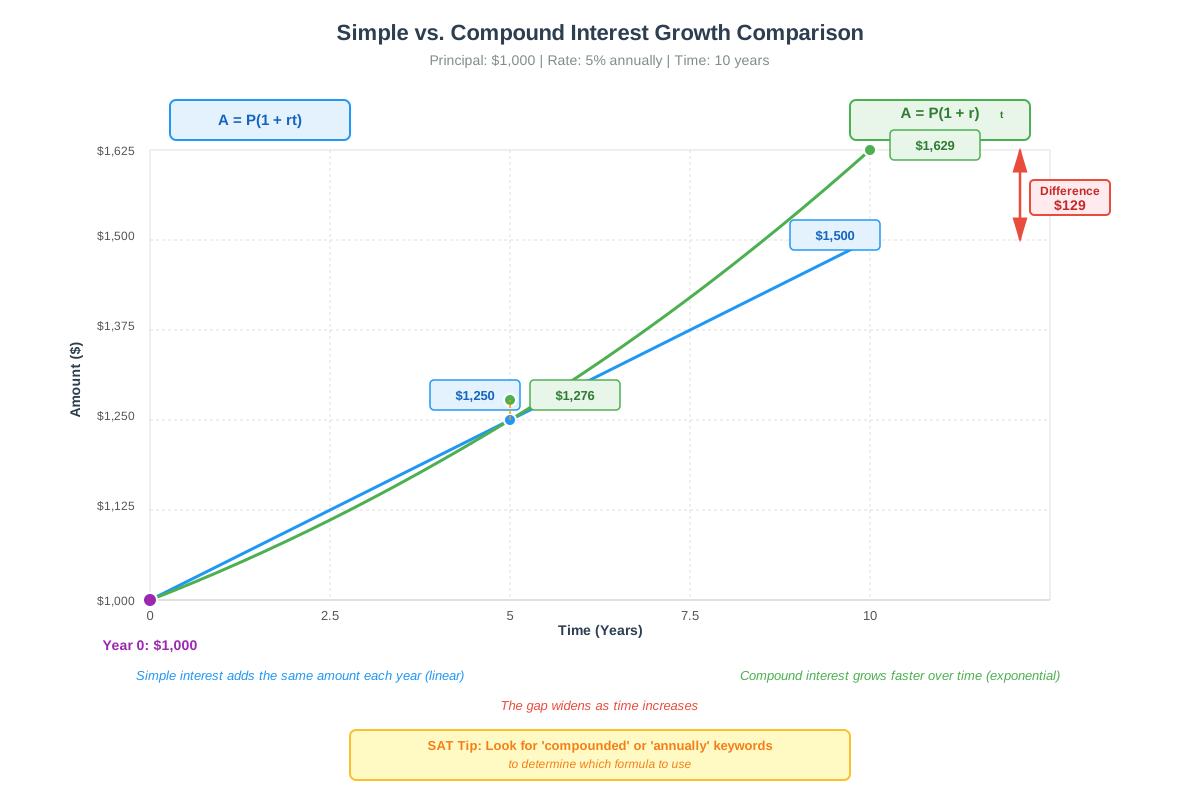
The SAT tests interest through two primary frameworks: simple interest and compound interest. Simple interest calculations involve linear growth where the interest amount remains constant over each time period, while compound interest involves exponential growth where interest is calculated on both the principal and previously accumulated interest. These concepts connect directly to the broader mathematical topics of linear and exponential functions, percentage calculations, and algebraic equation solving. Students must be comfortable manipulating formulas, identifying which type of interest applies to a given scenario, and solving for various unknowns including principal, rate, time, and final amount.
Mastering sat interest problems requires both conceptual understanding and computational fluency. Questions may appear as straightforward calculation problems, word problems requiring formula application, or more complex scenarios involving comparison between different interest scenarios. The ability to quickly identify the appropriate formula, substitute values correctly, and solve efficiently is crucial for maximizing points on test day. This topic typically accounts for 1-3 questions per SAT administration, making it a high-yield area for focused study.
Learning Objectives
- [ ] Identify key features of Interest
- [ ] Explain how Interest appears on the SAT
- [ ] Apply Interest to answer SAT-style questions
- [ ] Distinguish between simple interest and compound interest scenarios
- [ ] Solve for any variable in interest formulas (principal, rate, time, or amount)
- [ ] Compare different investment or loan scenarios using interest calculations
- [ ] Interpret real-world contexts to determine appropriate interest models
Prerequisites
- Percentage calculations: Converting between percentages, decimals, and fractions is essential for working with interest rates
- Basic algebra: Solving linear and exponential equations is required to manipulate interest formulas and isolate variables
- Exponent rules: Understanding how to work with powers is necessary for compound interest calculations
- Order of operations: Correctly evaluating complex expressions ensures accurate interest computations
- Word problem interpretation: Translating real-world scenarios into mathematical expressions is fundamental to all interest problems
Why This Topic Matters
Interest calculations are among the most practical mathematical skills tested on the SAT, with direct applications to personal finance, business decisions, and economic understanding. Every time someone takes out a student loan, opens a savings account, uses a credit card, or invests in retirement accounts, interest calculations determine the actual cost or benefit of that financial decision. Understanding how interest works empowers students to make informed choices about borrowing, saving, and investing throughout their lives.
On the SAT, interest problems appear with moderate frequency—typically 1-3 questions per test administration—making them a high-yield study area. These questions often appear in both the calculator and no-calculator sections, testing computational skills alongside conceptual understanding. The College Board favors interest problems because they assess multiple skills simultaneously: percentage fluency, algebraic manipulation, exponential reasoning, and real-world application. Questions may be presented as straightforward calculations, comparative scenarios requiring analysis, or multi-step problems embedded within larger contexts.
Interest problems commonly appear in several formats on the SAT: direct calculation questions asking for the final amount after a specified time period, inverse problems requiring students to find the interest rate or time period given other information, and comparison problems asking which of several investment or loan options yields better results. The SAT particularly favors compound interest scenarios because they test exponential thinking, a key mathematical reasoning skill. Students who master interest calculations gain confidence not only for test day but also for the financial decisions they'll face throughout college and beyond.
Core Concepts
Simple Interest
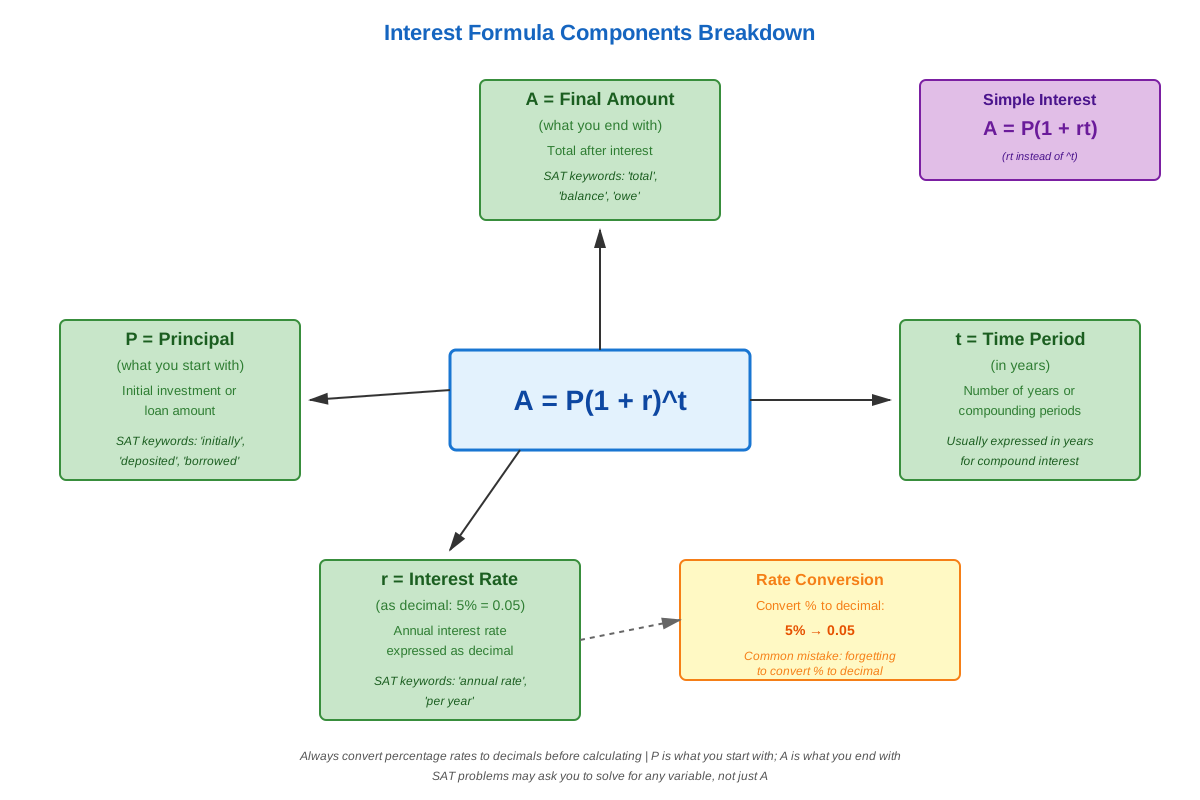
Simple interest is calculated only on the original principal amount throughout the entire time period. The interest earned or owed remains constant for each time period, resulting in linear growth. The formula for simple interest is:
I = PrtWhere:
- I = interest earned or owed
- P = principal (initial amount)
- r = annual interest rate (expressed as a decimal)
- t = time (in years)
The total amount (A) after time t is calculated as:
A = P + I = P + Prt = P(1 + rt)Simple interest is commonly used for short-term loans, certain bonds, and some basic savings scenarios. For example, if you invest $1,000 at 5% simple interest for 3 years, the interest earned each year is $50 (5% of $1,000), totaling $150 in interest over the three years, for a final amount of $1,150.
Compound Interest
Compound interest is calculated on both the principal and any previously accumulated interest, resulting in exponential growth. This "interest on interest" effect means the amount grows faster than with simple interest, especially over longer time periods. The compound interest formula is:
A = P(1 + r/n)^(nt)Where:
- A = final amount
- P = principal (initial amount)
- r = annual interest rate (as a decimal)
- n = number of times interest is compounded per year
- t = time in years
Common compounding frequencies include:
- Annually: n = 1
- Semi-annually: n = 2
- Quarterly: n = 4
- Monthly: n = 12
- Daily: n = 365
Continuous Compounding
For theoretical or advanced scenarios, interest can be compounded continuously, using the formula:
A = Pe^(rt)Where e is Euler's number (approximately 2.71828). While less common on the SAT, understanding that more frequent compounding leads to greater returns helps with conceptual questions.
Interest Rate Conversion
Interest rates must be expressed as decimals in formulas. To convert:
- From percentage to decimal: divide by 100 (5% becomes 0.05)
- From decimal to percentage: multiply by 100 (0.03 becomes 3%)
The annual percentage rate (APR) represents the yearly interest rate, while the effective rate accounts for compounding effects. When comparing different interest scenarios, always ensure rates are expressed in comparable terms.
Time Period Adjustments
Interest formulas typically use time in years. When problems provide time in months or days, conversion is necessary:
- Months to years: divide by 12
- Days to years: divide by 365
For example, 6 months = 6/12 = 0.5 years, and 90 days = 90/365 ≈ 0.247 years.
Solving for Different Variables
SAT questions may ask students to solve for any variable in the interest formulas:
Finding Principal (P): Rearrange the formula to isolate P
- Simple interest: P = A/(1 + rt)
- Compound interest: P = A/(1 + r/n)^(nt)
Finding Rate (r): Isolate r through algebraic manipulation
- Simple interest: r = (A - P)/(Pt)
- Compound interest: r = n[(A/P)^(1/nt) - 1]
Finding Time (t): Solve for t using logarithms for compound interest
- Simple interest: t = (A - P)/(Pr)
- Compound interest: t = ln(A/P)/(n·ln(1 + r/n))
Comparison Table
| Feature | Simple Interest | Compound Interest |
|---|---|---|
| Growth Pattern | Linear | Exponential |
| Calculation Base | Principal only | Principal + accumulated interest |
| Formula Complexity | Simpler | More complex |
| Long-term Growth | Slower | Faster |
| Common Uses | Short-term loans, basic savings | Long-term investments, most loans |
| SAT Frequency | Moderate | High |
Concept Relationships
The interest concepts form a hierarchical relationship where understanding simple interest provides the foundation for grasping compound interest. Simple interest → serves as the baseline model → compound interest extends this by adding the compounding mechanism → continuous compounding represents the theoretical limit of infinite compounding frequency.
Both interest types connect directly to prerequisite knowledge: percentage calculations enable rate conversions, algebraic manipulation allows solving for unknown variables, and exponent rules are essential for compound interest calculations. The distinction between linear (simple) and exponential (compound) growth connects interest to broader mathematical concepts of function types and growth models.
Interest calculations also relate to other SAT math topics: exponential functions share the same mathematical structure as compound interest, sequences and series can model interest accumulation, and data analysis skills help compare different financial scenarios. Understanding that compound interest grows faster than simple interest over time connects to the general principle that exponential functions eventually exceed linear functions, a key insight tested across multiple SAT math domains.
The relationship between compounding frequency and final amount demonstrates the concept of limits: as n increases (more frequent compounding), the final amount approaches but never exceeds the continuous compounding result. This connects to calculus concepts while remaining accessible through numerical exploration on the SAT.
High-Yield Facts
⭐ Simple interest formula: I = Prt, where interest is calculated only on the principal
⭐ Compound interest formula: A = P(1 + r/n)^(nt), where interest is calculated on principal plus accumulated interest
⭐ Interest rates must be converted to decimals before using in formulas (divide percentage by 100)
⭐ Time must be expressed in years in standard interest formulas; convert months by dividing by 12
⭐ Compound interest always yields more than simple interest over the same time period with the same rate (except at t = 0)
- More frequent compounding (higher n) results in greater final amounts for compound interest
- The principal (P) represents the initial amount before any interest is applied
- The final amount (A) equals principal plus all accumulated interest
- When solving for rate or time in compound interest problems, logarithms may be required
- Doubling time decreases as interest rate increases and as compounding frequency increases
- For small interest rates and short time periods, simple and compound interest yield similar results
- The expression (1 + r/n)^(nt) represents the growth factor in compound interest
- Interest problems often require multi-step solutions: identify the formula, substitute values, then solve
Quick check — test yourself on Interest so far.
Try Flashcards →Common Misconceptions
Misconception: Interest rate percentages can be used directly in formulas without conversion.
Correction: Interest rates must always be converted to decimal form by dividing by 100. A 5% rate becomes 0.05 in the formula, not 5.
Misconception: Simple interest and compound interest formulas can be used interchangeably.
Correction: These formulas model fundamentally different processes. Simple interest produces linear growth (I = Prt), while compound interest produces exponential growth (A = P(1 + r/n)^(nt)). Using the wrong formula yields incorrect results.
Misconception: The variable "A" in compound interest represents only the interest earned.
Correction: The variable A represents the total final amount, which includes both the original principal and all accumulated interest. To find just the interest earned, calculate A - P.
Misconception: Time can be used in any unit (months, days, years) without adjustment.
Correction: Standard interest formulas require time in years. When given months, divide by 12; when given days, divide by 365. Failing to convert leads to dramatically incorrect answers.
Misconception: Doubling the interest rate doubles the final amount.
Correction: In simple interest, doubling the rate doubles only the interest portion, not the total amount. In compound interest, the relationship is even more complex due to the exponential nature of growth.
Misconception: Compound interest compounded annually is the same as simple interest.
Correction: Even with annual compounding (n = 1), compound interest differs from simple interest after the first year because subsequent years calculate interest on the growing balance, not just the original principal.
Misconception: The "n" in compound interest represents the number of years.
Correction: The variable n represents the number of compounding periods per year (frequency), while t represents the number of years. The product nt gives the total number of compounding periods.
Worked Examples
Example 1: Simple Interest Calculation
Problem: Maria invests $2,500 in a certificate of deposit that pays 4% simple interest per year. How much total money will she have after 3 years?
Solution:
Step 1: Identify the given information and what we're solving for.
- Principal (P) = $2,500
- Rate (r) = 4% = 0.04 (converted to decimal)
- Time (t) = 3 years
- Find: Total amount (A)
Step 2: Choose the appropriate formula.
Since this is simple interest, we use: A = P(1 + rt)
Step 3: Substitute the values.
A = 2,500(1 + 0.04 × 3)
A = 2,500(1 + 0.12)
A = 2,500(1.12)
A = 2,800
Step 4: Interpret the result.
Maria will have $2,800 after 3 years. This consists of her original $2,500 principal plus $300 in interest ($100 per year for 3 years).
Connection to Learning Objectives: This example demonstrates identifying key features of interest (principal, rate, time) and applying the simple interest formula to answer an SAT-style question.
Example 2: Compound Interest with Quarterly Compounding
Problem: James deposits $5,000 into a savings account that pays 6% annual interest compounded quarterly. What will be the account balance after 2 years? Round to the nearest cent.
Solution:
Step 1: Identify the given information.
- Principal (P) = $5,000
- Annual rate (r) = 6% = 0.06
- Compounding frequency (n) = 4 (quarterly means 4 times per year)
- Time (t) = 2 years
- Find: Final amount (A)
Step 2: Choose the appropriate formula.
Since this is compound interest: A = P(1 + r/n)^(nt)
Step 3: Substitute the values.
A = 5,000(1 + 0.06/4)^(4×2)
A = 5,000(1 + 0.015)^8
A = 5,000(1.015)^8
Step 4: Calculate the exponent.
(1.015)^8 ≈ 1.126493
A = 5,000 × 1.126493
A ≈ 5,632.47
Step 5: Interpret the result.
After 2 years, James will have approximately $5,632.47 in his account. The interest earned is $5,632.47 - $5,000 = $632.47.
Note: If this had been simple interest instead, the amount would have been only $5,600 (A = 5,000(1 + 0.06×2) = 5,600), demonstrating that compound interest yields $32.47 more over this period.
Connection to Learning Objectives: This example shows how to distinguish between interest types, apply the compound interest formula, and compare different scenarios—all key SAT skills.
Example 3: Solving for Time
Problem: How long will it take for an investment of $8,000 to grow to $10,000 at 5% simple interest per year?
Solution:
Step 1: Identify the given information and unknown.
- Principal (P) = $8,000
- Final amount (A) = $10,000
- Rate (r) = 5% = 0.05
- Find: Time (t)
Step 2: Choose and rearrange the formula.
Starting with A = P(1 + rt), solve for t:
A = P(1 + rt)
A/P = 1 + rt
A/P - 1 = rt
t = (A/P - 1)/r
Step 3: Substitute and solve.
t = (10,000/8,000 - 1)/0.05
t = (1.25 - 1)/0.05
t = 0.25/0.05
t = 5
Step 4: Interpret the result.
It will take 5 years for the investment to grow from $8,000 to $10,000 at 5% simple interest.
Connection to Learning Objectives: This demonstrates solving for different variables in interest formulas, a common SAT challenge that tests algebraic manipulation skills.
Exam Strategy
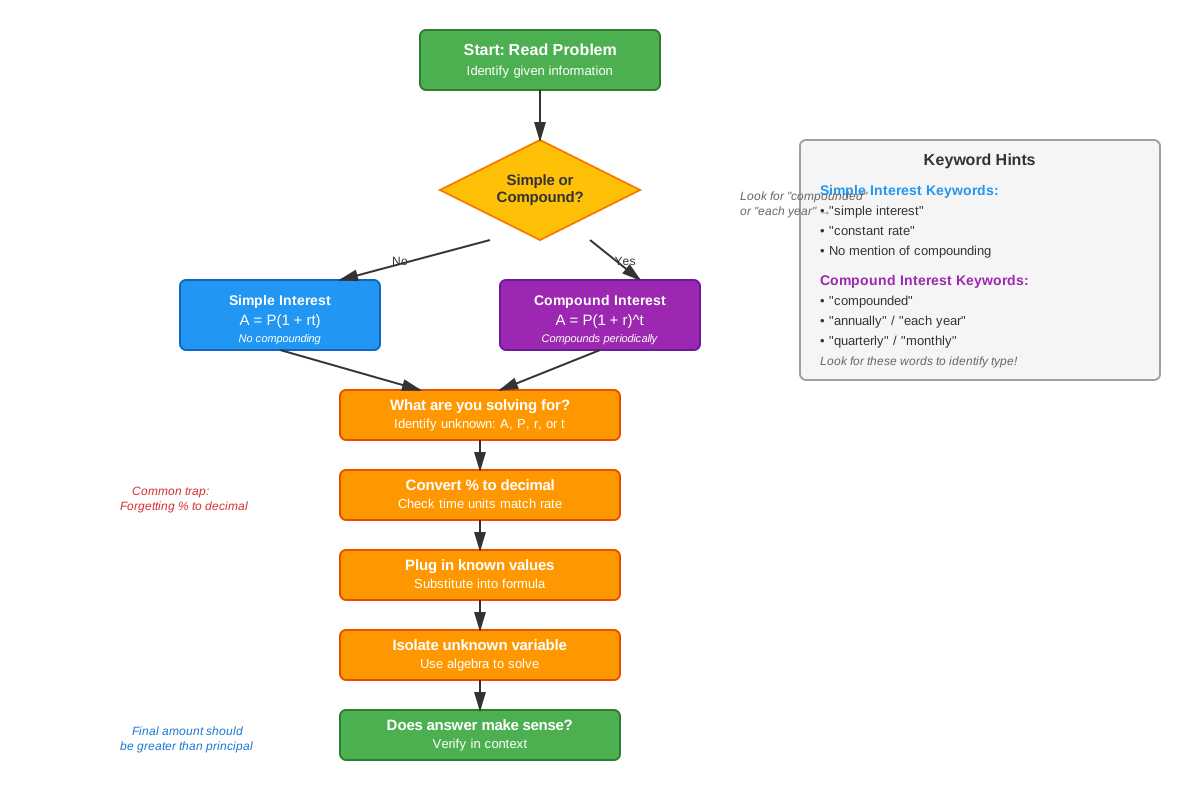
When approaching sat interest problems, begin by carefully reading the problem to identify whether it involves simple or compound interest. Key trigger words include "simple interest" (explicit), "compounded" (indicates compound interest), and phrases like "quarterly," "monthly," or "annually" that specify compounding frequency. If the problem doesn't specify, compound interest is more common in real-world scenarios, but the SAT will typically make this clear.
Exam Tip: Always write down the formula before substituting values. This prevents errors and helps organize your work, which is valuable if you need to check your answer or if partial credit is available on grid-in questions.
Create a systematic approach for every interest problem:
- Identify and label all given values (P, r, n, t, A)
- Determine which variable you're solving for
- Write the appropriate formula
- Convert percentages to decimals and time to years if needed
- Substitute values carefully
- Solve using proper order of operations
- Check if your answer makes logical sense
For process-of-elimination on multiple-choice questions, use these strategies:
- Eliminate answers that are less than the principal (unless the question asks for interest only)
- For compound interest, eliminate answers equal to or less than what simple interest would yield
- Check if answers are reasonable given the time period (very long times should show significant growth)
- Verify that your answer matches the units requested (total amount vs. interest earned)
Time allocation: Simple interest problems should take 1-2 minutes, while compound interest problems may require 2-3 minutes due to more complex calculations. If a problem requires logarithms to solve for time or rate in compound interest, it will typically be in the calculator section—use your calculator's logarithm function efficiently.
Watch for these common SAT variations:
- Comparison questions: Which investment yields more? Calculate both and compare.
- Inverse problems: Given the final amount, find the rate or time.
- Multi-step problems: Calculate interest for one period, then use that result in another calculation.
- Real-world contexts: Loans, investments, savings accounts—all follow the same mathematical principles.
Memory Techniques
For Simple Interest Formula (I = Prt): Remember "I Promise Right Time" where I Promise connects to I = P, and Right Time connects to r and t being multiplied.
For Compound Interest Formula: Think "A Pple Rises Naturally Tall" to remember A = P(1 + r/n)^(nt). The "rises" reminds you of the exponent representing growth.
To distinguish Simple vs. Compound:
- Simple = Straight line (linear growth)
- Compound = Curve (exponential growth)
For converting percentages to decimals: "Percentage Divides by 100" (PD100)
For time conversions:
- Months: Make it 12 (divide by 12)
- Days: Divide by 365
Compounding frequency memory aid: "Annually, Semi-annually, Quarterly, Monthly" = ASQM = 1, 2, 4, 12
Visual memory technique: Picture compound interest as a snowball rolling downhill, getting bigger as it picks up more snow (interest on interest), while simple interest is like stacking identical blocks (same amount each period).
Summary
Interest calculations represent a critical intersection of percentage skills, algebraic reasoning, and real-world financial literacy on the SAT. The two primary models—simple interest (I = Prt) and compound interest (A = P(1 + r/n)^(nt))—differ fundamentally in their growth patterns, with simple interest producing linear growth and compound interest producing exponential growth. Success on SAT interest problems requires fluency in identifying which model applies, converting percentages to decimals and time to years, substituting values correctly into formulas, and solving for any variable through algebraic manipulation. Students must recognize that compound interest always exceeds simple interest over time (except at t = 0) and that more frequent compounding yields greater returns. The ability to interpret real-world contexts, compare different financial scenarios, and work efficiently with both calculator and non-calculator problems makes interest a high-yield topic for focused preparation. Mastering these concepts provides not only test-day confidence but also practical skills for lifelong financial decision-making.
Key Takeaways
- Simple interest (I = Prt) calculates interest only on the principal, producing linear growth, while compound interest (A = P(1 + r/n)^(nt)) calculates interest on principal plus accumulated interest, producing exponential growth
- Always convert percentage rates to decimals by dividing by 100, and express time in years before using standard interest formulas
- Compound interest always yields more than simple interest over the same period with the same rate, and more frequent compounding increases returns
- SAT interest problems may ask you to solve for any variable—principal, rate, time, or final amount—requiring strong algebraic manipulation skills
- The final amount (A) includes both principal and interest; to find interest alone, calculate A - P
- Identify problem type by looking for trigger words: "simple interest," "compounded," or frequency terms like "quarterly" or "monthly"
- Interest problems connect to broader math concepts including linear vs. exponential functions, percentage calculations, and real-world modeling
Related Topics
Exponential Functions: Compound interest is a specific application of exponential growth, where the base (1 + r/n) and exponent (nt) determine the growth rate. Mastering interest provides concrete context for understanding abstract exponential relationships.
Sequences and Series: Interest accumulation can be modeled as geometric sequences (compound interest) or arithmetic sequences (simple interest), connecting to series summation and pattern recognition.
Logarithms: Solving for time or rate in compound interest problems often requires logarithmic functions, making interest an applied context for logarithm skills.
Percentage Applications: Interest builds on fundamental percentage concepts, extending them to multi-step, time-dependent scenarios that appear throughout the SAT math section.
Financial Literacy: Understanding interest enables analysis of loans, mortgages, credit cards, and investments—practical skills that extend far beyond the SAT into college and career decision-making.
Practice CTA
Now that you've mastered the core concepts of interest calculations, it's time to solidify your understanding through practice! Work through the practice questions to test your ability to identify problem types, apply the correct formulas, and solve efficiently under test-like conditions. Use the flashcards to reinforce key formulas, conversions, and strategies until they become automatic. Remember, confidence with interest problems comes from repeated application—each practice problem you solve strengthens your skills and prepares you for test day success. You've built a strong foundation; now put it to work and watch your accuracy and speed improve!
Sign up free to keep reading
Create a free AnvayaPrep account to finish this SAT guide on Interest — plus flashcards and practice questions.