Overview
Radical equations are equations in which the variable appears under a radical symbol (most commonly a square root, but also cube roots and higher-order roots). Solving these equations requires isolating the radical expression and then eliminating it through inverse operations—typically by raising both sides of the equation to an appropriate power. This topic represents a critical intersection of algebraic manipulation skills and conceptual understanding of inverse operations, making it a frequent testing ground on the SAT.
On the SAT, radical equations appear regularly in both the calculator and no-calculator sections, often embedded within word problems, function notation questions, or multi-step algebraic challenges. The College Board uses these problems to assess whether students can systematically apply algebraic procedures while remaining vigilant about extraneous solutions—false answers that emerge from the solving process but don't satisfy the original equation. Mastery of radical equations demonstrates mathematical maturity and procedural fluency that extends beyond memorization.
Understanding radical equations connects directly to broader math concepts including exponent rules, function composition, and domain restrictions. Since radicals are intimately related to fractional exponents (√x = x^(1/2)), proficiency with radical equations reinforces understanding of exponential relationships. Additionally, the domain considerations inherent in radical expressions (even-indexed radicals require non-negative radicands) prepare students for more advanced function analysis and graphing questions that frequently appear on the SAT.
Learning Objectives
- [ ] Identify key features of radical equations, including the presence of variables under radical symbols
- [ ] Explain how radical equations appears on the SAT, including common question formats and difficulty patterns
- [ ] Apply radical equations to answer SAT-style questions with accuracy and efficiency
- [ ] Determine when extraneous solutions arise and verify all solutions in the original equation
- [ ] Isolate radical expressions systematically before applying inverse operations
- [ ] Recognize domain restrictions imposed by even-indexed radicals and apply them to solution verification
Prerequisites
- Basic algebraic manipulation: Solving linear and quadratic equations provides the foundation for isolating variables and applying inverse operations
- Exponent rules: Understanding that radicals are fractional exponents (√x = x^(1/2)) enables flexible problem-solving approaches
- Order of operations: Correctly sequencing mathematical operations ensures accurate isolation of radical terms
- Squaring binomials: Recognizing patterns like (a + b)² = a² + 2ab + b² prevents common algebraic errors when eliminating radicals
- Domain and range concepts: Understanding when expressions are defined helps identify valid solutions and recognize restrictions
Why This Topic Matters
Radical equations appear in approximately 2-4 questions per SAT administration, making them a high-yield topic for focused study. These questions typically fall in the medium-to-hard difficulty range and often serve as discriminators between good and excellent scores. The College Board favors radical equations because they efficiently test multiple competencies: algebraic manipulation, attention to detail, solution verification, and conceptual understanding of inverse operations.
In real-world applications, radical equations model numerous phenomena including projectile motion (time calculations), electrical engineering (impedance calculations), and physics (kinetic energy relationships). The Pythagorean theorem, which students encounter in geometry, frequently generates radical equations when solving for unknown side lengths. Understanding how to manipulate and solve these equations provides practical problem-solving tools beyond standardized testing.
On the SAT, radical equations commonly appear in several formats: direct algebraic solving problems, word problems requiring equation setup, questions involving function notation where f(x) contains radicals, and systems of equations where one equation contains a radical. The test may also embed radical equations within data interpretation questions or present them as part of multi-step reasoning chains. Recognizing these patterns enables efficient question identification and appropriate strategy deployment.
Core Concepts
Definition and Structure of Radical Equations
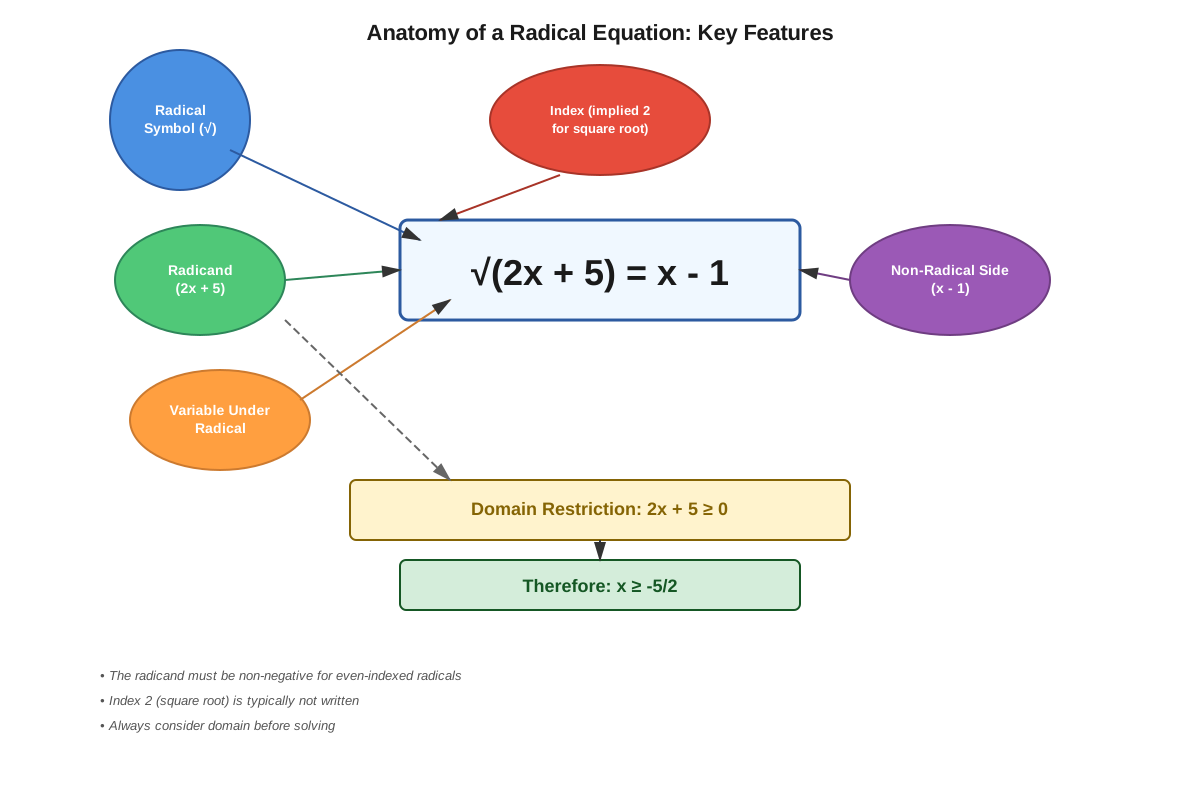
A radical equation is any equation containing a variable within a radical expression. The most common form involves square roots: √(expression with variable) = some value. However, SAT questions may also feature cube roots (∛x), fourth roots (⁴√x), or general nth roots. The defining characteristic is that the variable appears under the radical symbol, distinguishing these from equations where radicals appear only as coefficients or constants.
The index of the radical (the small number indicating which root) determines the solving strategy. Square roots (index 2, usually unwritten) require squaring both sides, cube roots require cubing both sides, and so forth. Even-indexed radicals (square roots, fourth roots, etc.) impose domain restrictions because the radicand (the expression under the radical) must be non-negative in the real number system.
Standard Solution Procedure
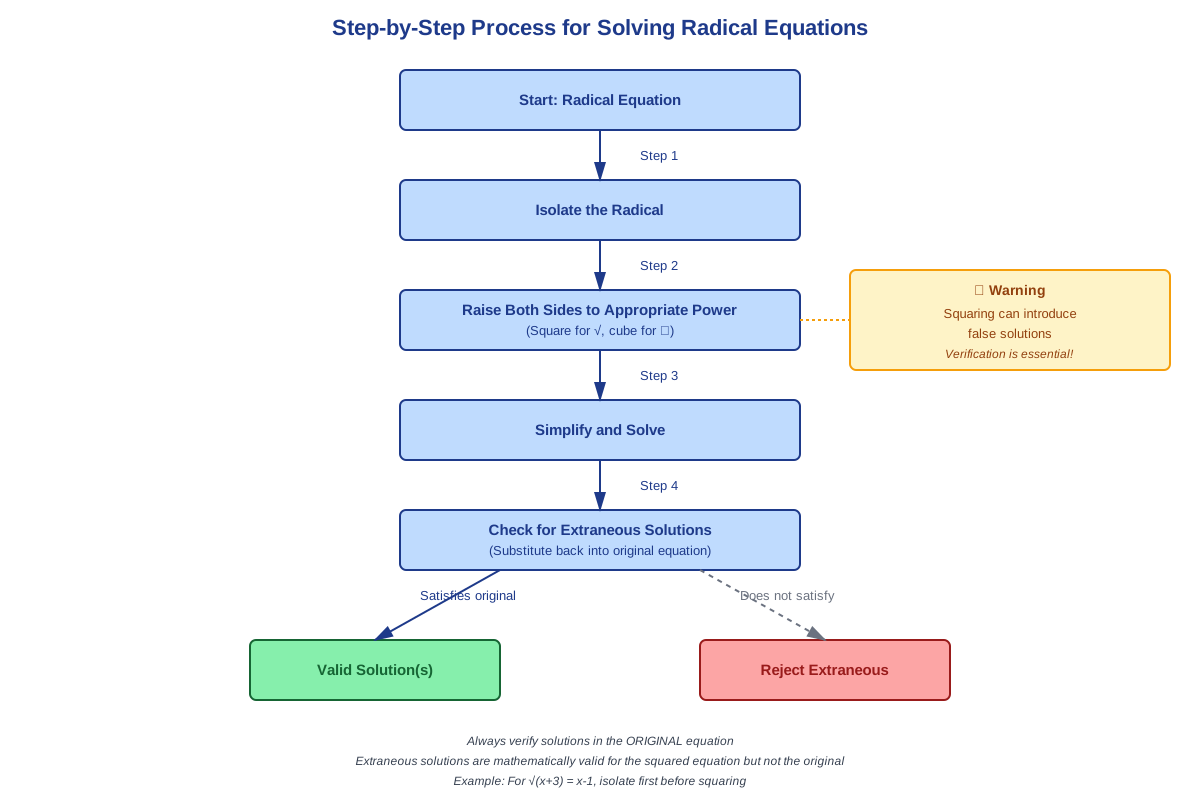
The systematic approach to solving radical equations follows these steps:
- Isolate the radical expression on one side of the equation
- Raise both sides to the power matching the radical's index
- Solve the resulting equation using standard algebraic techniques
- Check all solutions in the original equation to identify extraneous solutions
This procedure is critical because raising both sides to a power is not a reversible operation—it can introduce solutions that don't satisfy the original equation. For example, if x = 3, then x² = 9, but if x² = 9, then x could be 3 or -3. This asymmetry necessitates verification.
Extraneous Solutions
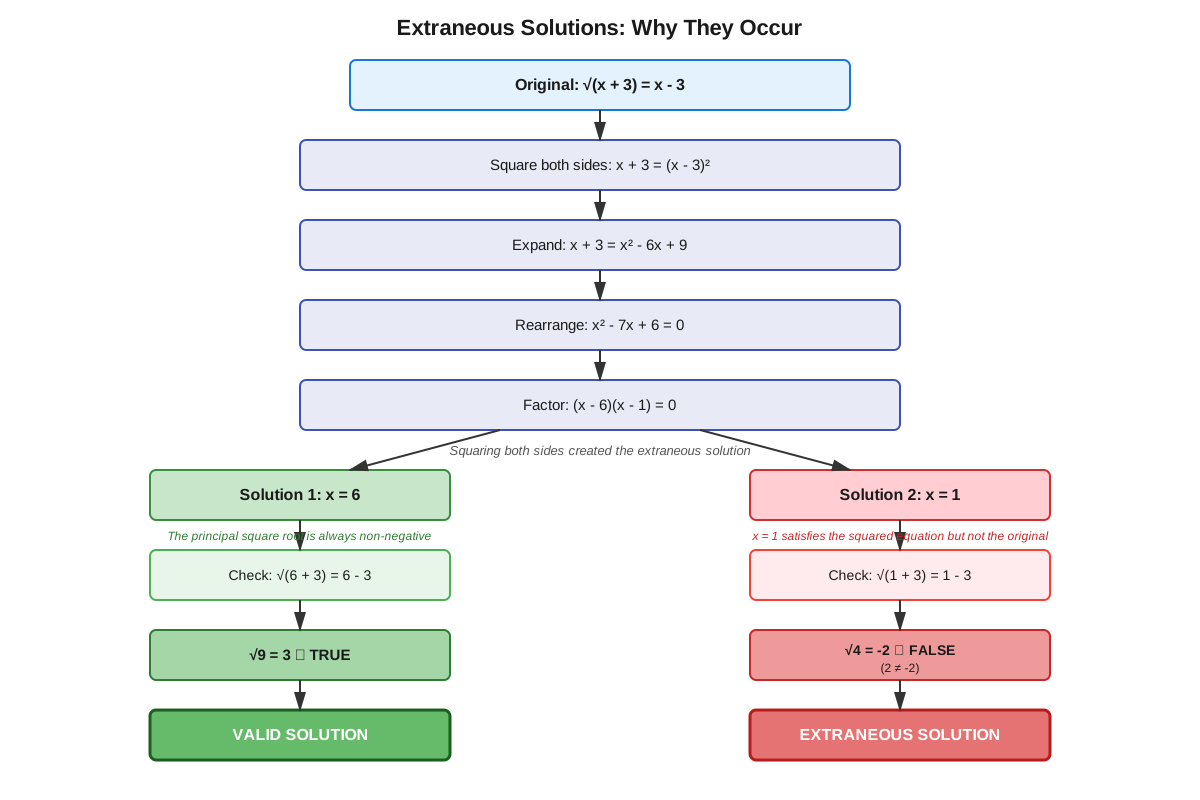
Extraneous solutions are values that emerge from the solving process but fail to satisfy the original equation. They arise specifically when both sides of an equation are raised to an even power. Consider √x = -2: squaring both sides yields x = 4, but substituting back gives √4 = 2 ≠ -2, so x = 4 is extraneous. The original equation actually has no solution because square roots of real numbers are always non-negative.
The verification step is non-negotiable on the SAT. Questions frequently include extraneous solutions among answer choices to penalize students who skip verification. Always substitute potential solutions back into the original equation, not the transformed equation, because the transformation may have altered the solution set.
Equations with Multiple Radicals
When an equation contains two or more radical terms, the strategy requires careful sequencing:
- Isolate one radical on one side of the equation
- Raise both sides to the appropriate power
- If radicals remain, repeat the isolation and elimination process
- Solve the resulting polynomial equation
- Verify all solutions
For example, √(x + 5) = √(2x - 3) can be solved by squaring both sides immediately: x + 5 = 2x - 3, yielding x = 8. However, √(x + 5) + √(2x - 3) = 4 requires isolating one radical first, then squaring, which produces another radical term requiring a second squaring operation.
Domain Considerations
Even-indexed radicals impose domain restrictions: the radicand must be non-negative. For √(x - 3), the domain is x ≥ 3. These restrictions can eliminate potential solutions before solving begins. If a question asks for solutions to √(x - 3) = -1, recognizing that square roots cannot be negative immediately reveals "no solution" without algebraic manipulation.
Odd-indexed radicals (cube roots, fifth roots, etc.) have no domain restrictions in the real numbers because negative numbers have real odd roots: ∛(-8) = -2. This distinction affects both solving strategies and solution verification.
Radical Equations in Context
SAT questions often embed radical equations within word problems or geometric contexts. A classic example involves the Pythagorean theorem: if a right triangle has legs of length x and x + 2, and hypotenuse 10, the equation becomes x² + (x + 2)² = 100. While this isn't initially a radical equation, solving for x and then finding the hypotenuse of a different triangle might require √(a² + b²), creating a radical equation.
Function notation problems might present f(x) = √(2x + 3) and ask for the value of x where f(x) = 5, requiring solution of √(2x + 3) = 5. Recognizing the underlying radical equation structure within various contexts is essential for SAT success.
Concept Relationships
The core concepts within radical equations form a logical progression: understanding the definition and structure enables recognition of these equations in various formats → mastering the standard solution procedure provides the algorithmic framework → recognizing extraneous solutions ensures accuracy → handling multiple radicals extends the basic procedure → applying domain considerations prevents wasted effort on impossible solutions → recognizing contextual applications enables transfer to diverse question types.
Radical equations connect backward to prerequisite topics: exponent rules provide the theoretical foundation (since √x = x^(1/2)), algebraic manipulation supplies the procedural tools, and quadratic equations often emerge after eliminating radicals. They connect forward to more advanced topics including function composition (where radical functions combine with other functions), complex numbers (which extend solutions beyond real-number restrictions), and graphing (where radical equations define curves and intersection points).
The relationship map: Exponent Rules → Radical Notation → Radical Equations → Solution Procedures → Extraneous Solutions → Verification → Application in Context. Each step builds on previous understanding while adding complexity and nuance.
Quick check — test yourself on Radical equations so far.
Try Flashcards →High-Yield Facts
⭐ Always verify solutions in the original equation; extraneous solutions frequently appear in answer choices
⭐ Square roots of real numbers are non-negative; √x = -5 has no real solution regardless of algebraic manipulation
⭐ Isolate the radical before raising both sides to a power; failing to isolate first creates unnecessarily complex equations
⭐ Squaring both sides can introduce extraneous solutions; this is the primary source of false answers
⭐ Even-indexed radicals require non-negative radicands; x must satisfy the domain restriction before being a valid solution
- Odd-indexed radicals (cube roots, etc.) have no domain restrictions in real numbers
- When two radicals are equal (√A = √B), their radicands are equal (A = B) without squaring
- Equations with multiple radicals may require squaring twice or more
- The equation √x = a has solution x = a² only if a ≥ 0
- Radical equations can be rewritten using fractional exponents: √x = 5 becomes x^(1/2) = 5
Common Misconceptions
Misconception: After squaring both sides, all resulting solutions are valid → Correction: Squaring both sides is not a reversible operation and can introduce extraneous solutions. Every solution must be verified in the original equation, not the squared equation.
Misconception: √(x²) always equals x → Correction: √(x²) = |x|, the absolute value of x. For example, if x = -3, then √((-3)²) = √9 = 3 = |-3|, not -3. This distinction matters when simplifying radical expressions during solving.
Misconception: If √x = -4, then x = 16 → Correction: While squaring gives x = 16, the original equation has no solution because square roots of real numbers cannot be negative. The value x = 16 is extraneous.
Misconception: You can square individual terms on each side separately → Correction: (a + b)² ≠ a² + b². If the equation is √x + 3 = 5, you cannot write x + 9 = 25. You must first isolate the radical: √x = 2, then square: x = 4.
Misconception: Domain restrictions only matter for graphing, not solving → Correction: Domain restrictions eliminate potential solutions. If solving √(x - 5) = 3 yields x = 14, checking the domain (x ≥ 5) confirms validity. If a solution violates the domain, it's invalid regardless of algebraic correctness.
Misconception: All radical equations have exactly one solution → Correction: Radical equations may have zero, one, or multiple solutions. √x = -1 has no solution, √x = 4 has one solution (x = 16), and equations involving multiple radicals or higher-degree polynomials after elimination may have multiple valid solutions.
Worked Examples
Example 1: Basic Radical Equation with Extraneous Solution
Problem: Solve √(2x + 5) = x - 1
Solution:
Step 1: The radical is already isolated, so square both sides:
(√(2x + 5))² = (x - 1)²
2x + 5 = x² - 2x + 1
Step 2: Rearrange into standard quadratic form:
0 = x² - 4x - 4Step 3: Use the quadratic formula with a = 1, b = -4, c = -4:
x = (4 ± √(16 + 16))/2 = (4 ± √32)/2 = (4 ± 4√2)/2 = 2 ± 2√2This gives x ≈ 4.83 or x ≈ -0.83
Step 4: Verify both solutions in the original equation:
For x = 2 + 2√2 ≈ 4.83:
√(2(4.83) + 5) ≈ √14.66 ≈ 3.83
4.83 - 1 = 3.83 ✓
For x = 2 - 2√2 ≈ -0.83:
√(2(-0.83) + 5) ≈ √3.34 ≈ 1.83
-0.83 - 1 = -1.83 ✗Answer: x = 2 + 2√2 only. The solution x = 2 - 2√2 is extraneous because it produces a negative value on the right side while the left side (a square root) must be non-negative.
This example demonstrates the critical importance of verification and shows how the squaring process introduces an extraneous solution.
Example 2: Equation with Two Radicals
Problem: Solve √(x + 7) - √(x - 5) = 2
Solution:
Step 1: Isolate one radical:
√(x + 7) = 2 + √(x - 5)Step 2: Square both sides:
x + 7 = (2 + √(x - 5))²
x + 7 = 4 + 4√(x - 5) + (x - 5)
x + 7 = x - 1 + 4√(x - 5)
Step 3: Simplify and isolate the remaining radical:
8 = 4√(x - 5)
2 = √(x - 5)
Step 4: Square again:
4 = x - 5
x = 9
Step 5: Verify in the original equation:
√(9 + 7) - √(9 - 5) = √16 - √4 = 4 - 2 = 2 ✓Step 6: Check domain restrictions:
- For √(x + 7): x ≥ -7 ✓ (9 ≥ -7)
- For √(x - 5): x ≥ 5 ✓ (9 ≥ 5)
Answer: x = 9
This example shows the systematic approach for equations with multiple radicals: isolate, square, simplify, repeat if necessary, then verify both algebraically and against domain restrictions.
Exam Strategy
When approaching SAT radical equations, begin by quickly scanning for the number of radical terms and their indices. Single square root equations typically require one squaring operation and take 1-2 minutes; multiple radicals or higher-order roots may require 2-3 minutes. Budget time accordingly.
Trigger words and phrases that signal radical equations include: "square root," "cube root," "radical," "√ symbol," and contextual phrases like "the positive solution" (indicating potential extraneous solutions exist) or "what value of x satisfies" (direct solving). Geometric contexts mentioning "distance," "Pythagorean theorem," or "hypotenuse" often generate radical equations.
Process-of-elimination strategies:
- Immediately eliminate negative answer choices for equations like √x = [answer], since square roots are non-negative
- If the equation is √(x - a) = b where b < 0, "no solution" is correct without calculation
- Plug answer choices back into the original equation when solving algebraically seems complex; this is often faster for multiple-choice questions
- Eliminate answers that violate domain restrictions (e.g., if √(x - 5) appears, x must be ≥ 5)
Time allocation: For straightforward single-radical equations, aim for 60-90 seconds. For equations with multiple radicals or embedded in word problems, allocate 2-3 minutes. If verification reveals an extraneous solution and you must reconsider, don't panic—this is expected and built into the question design.
Strategic approach sequence:
- Identify all radical terms and domain restrictions (10 seconds)
- Isolate and eliminate radicals systematically (45-90 seconds)
- Solve the resulting equation (30-45 seconds)
- Verify solutions (20-30 seconds)
- Select answer and move forward (5 seconds)
Memory Techniques
RISE for the solution procedure:
- Radical isolation first
- Inverse operation (raise to power)
- Solve the resulting equation
- Examine solutions (verify)
"Square Roots Stay Positive" - Remember that √x ≥ 0 always for real numbers. Visualize a square root symbol with a smiley face to reinforce that outputs are never negative.
"Extraneous = Extra Neous = Extra No" - Extraneous solutions are "extra no's"—they don't work. This silly connection helps remember to check and reject false solutions.
Domain Restriction Visualization: Picture even-indexed radicals as requiring "even ground" (non-negative values) to stand on, while odd-indexed radicals can stand on any terrain (all real numbers).
The Squaring Danger Zone: Visualize a caution sign whenever you square both sides. This mental image triggers the reminder to verify solutions afterward.
Summary
Radical equations, where variables appear under radical symbols, are high-yield SAT topics requiring systematic algebraic manipulation and careful verification. The standard solution procedure—isolate the radical, raise both sides to the appropriate power, solve the resulting equation, and verify all solutions—must become automatic. The critical insight is that squaring both sides (or raising to any even power) can introduce extraneous solutions that satisfy the transformed equation but not the original. Domain restrictions from even-indexed radicals provide an additional filter for valid solutions. SAT questions test not just mechanical solving ability but also conceptual understanding of why verification matters and how domain restrictions operate. Success requires balancing procedural fluency with vigilant attention to mathematical validity, making radical equations an excellent discriminator of mathematical maturity on the exam.
Key Takeaways
- Radical equations require isolating the radical before applying inverse operations (raising to a power)
- Always verify solutions in the original equation; squaring both sides introduces extraneous solutions
- Square roots of real numbers are non-negative; equations like √x = -3 have no real solution
- Even-indexed radicals impose domain restrictions (non-negative radicands); odd-indexed radicals do not
- Multiple-radical equations may require repeated isolation and squaring operations
- Plugging answer choices into the original equation is often faster than algebraic solving on multiple-choice questions
- Extraneous solutions frequently appear as wrong answer choices to penalize students who skip verification
Related Topics
Rational Exponents: Since radicals can be expressed as fractional exponents (√x = x^(1/2)), mastering radical equations provides foundation for solving exponential equations with rational exponents.
Function Composition: Radical functions often compose with other functions (f(g(x)) where g(x) involves radicals), requiring solution of radical equations to find specific input values.
Systems of Equations: Radical equations appear within systems, requiring integration of substitution or elimination methods with radical-solving procedures.
Quadratic Equations: Eliminating radicals frequently produces quadratic equations, making quadratic-solving techniques essential for completing radical equation problems.
Complex Numbers: When even-indexed radicals have negative radicands, solutions extend into complex numbers, a topic that builds directly on radical equation foundations.
Practice CTA
Now that you've mastered the core concepts, solution procedures, and exam strategies for radical equations, it's time to cement your understanding through active practice. Attempt the practice questions to apply these techniques under test-like conditions, and use the flashcards to reinforce high-yield facts and common pitfalls. Remember: the difference between knowing the procedure and executing it flawlessly under time pressure comes from deliberate practice. Each problem you solve strengthens your pattern recognition and builds the confidence you need to tackle any radical equation the SAT presents. You've got this!
Sign up free to keep reading
Create a free AnvayaPrep account to finish this SAT guide on Radical equations — plus flashcards and practice questions.